Learning Aim D:
Evaluation
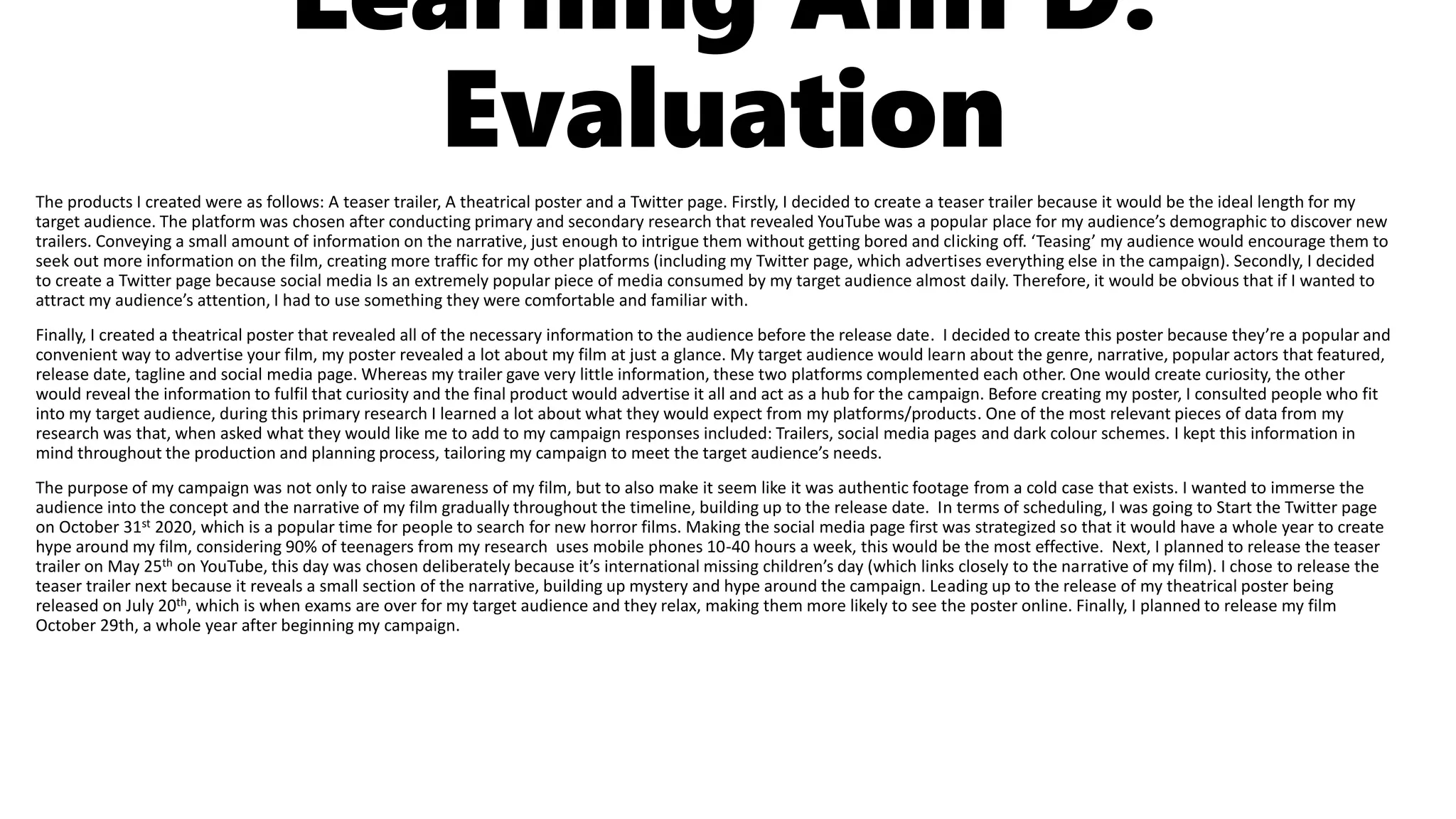
The products I created were as follows: A teaser trailer, A theatrical poster and a Twitter page. Firstly, I decided to create a teaser trailer because it would be the ideal length for my
target audience. The platform was chosen after conducting primary and secondary research that revealed YouTube was a popular place for my audience’s demographic to discover new
trailers. Conveying a small amount of information on the narrative, just enough to intrigue them without getting bored and clicking off. ‘Teasing’ my audience would encourage them to
seek out more information on the film, creating more traffic for my other platforms (including my Twitter page, which advertises everything else in the campaign). Secondly, I decided
to create a Twitter page because social media Is an extremely popular piece of media consumed by my target audience almost daily. Therefore, it would be obvious that if I wanted to
attract my audience’s attention, I had to use something they were comfortable and familiar with.
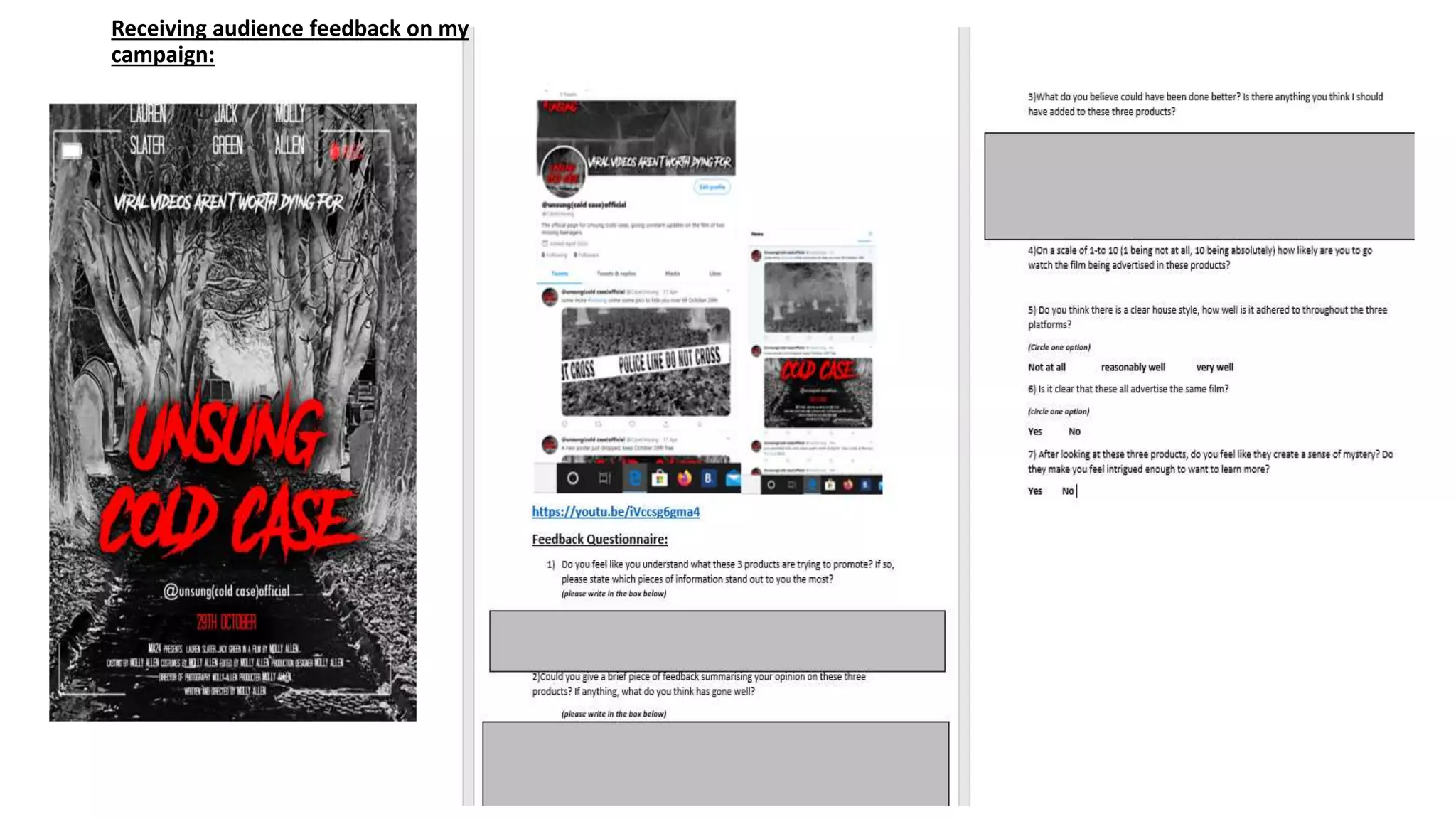
Finally, I created a theatrical poster that revealed all of the necessary information to the audience before the release date. I decided to create this poster because they’re a popular and
convenient way to advertise your film, my poster revealed a lot about my film at just a glance. My target audience would learn about the genre, narrative, popular actors that featured,
release date, tagline and social media page. Whereas my trailer gave very little information, these two platforms complemented each other. One would create curiosity, the other
would reveal the information to fulfil that curiosity and the final product would advertise it all and act as a hub for the campaign. Before creating my poster, I consulted people who fit
into my target audience, during this primary research I learned a lot about what they would expect from my platforms/products. One of the most relevant pieces of data from my
research was that, when asked what they would like me to add to my campaign responses included: Trailers, social media pages and dark colour schemes. I kept this information in
mind throughout the production and planning process, tailoring my campaign to meet the target audience’s needs.
The purpose of my campaign was not only to raise awareness of my film, but to also make it seem like it was authentic footage from a cold case that exists. I wanted to immerse the
audience into the concept and the narrative of my film gradually throughout the timeline, building up to the release date. In terms of scheduling, I was going to Start the Twitter page
on October 31st 2020, which is a popular time for people to search for new horror films. Making the social media page first was strategized so that it would have a whole year to create
hype around my film, considering 90% of teenagers from my research uses mobile phones 10-40 hours a week, this would be the most effective. Next, I planned to release the teaser
trailer on May 25th on YouTube, this day was chosen deliberately because it’s international missing children’s day (which links closely to the narrative of my film). I chose to release the
teaser trailer next because it reveals a small section of the narrative, building up mystery and hype around the campaign. Leading up to the release of my theatrical poster being
released on July 20th, which is when exams are over for my target audience and they relax, making them more likely to see the poster online. Finally, I planned to release my film
October 29th, a whole year after beginning my campaign.
Receiving audience feedback on my
campaign:
Due to current circumstances, I am unable to hand out physical questionnaires or interview them on
video. Therefore, I created the questionnaire on word and emailed it to numerous people who can give
me feedback online. This will help me evaluate the success of the strategies I applied throughout my
campaign. For the written section, I will take quotes from a selection of answers which give me the most
helpful feedback.
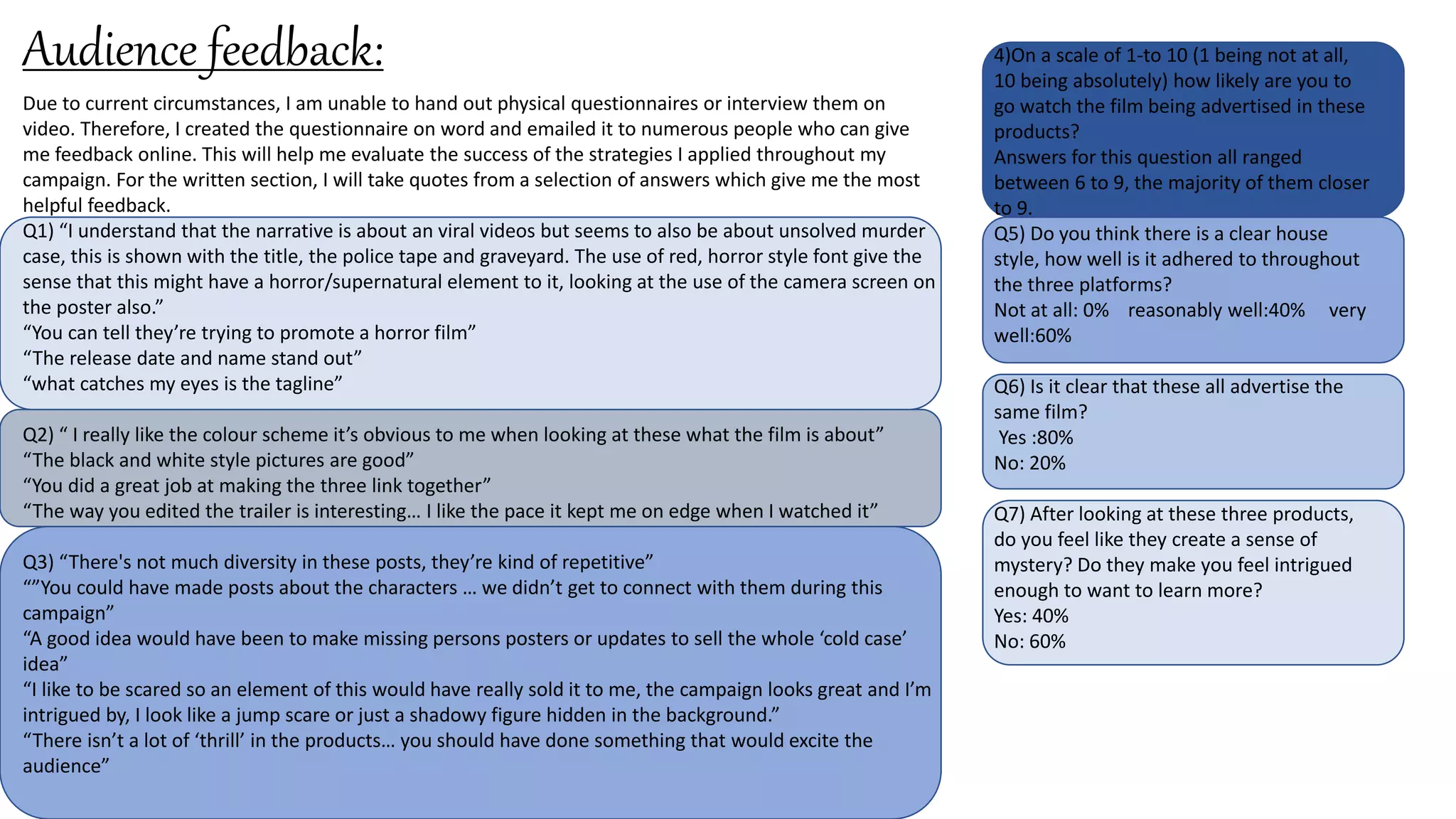
Q1) “I understand that the narrative is about an viral videos but seems to also be about unsolved murder
case, this is shown with the title, the police tape and graveyard. The use of red, horror style font give the
sense that this might have a horror/supernatural element to it, looking at the use of the camera screen on
the poster also.”
“You can tell they’re trying to promote a horror film”
“The release date and name stand out”
“what catches my eyes is the tagline”
Q2) “ I really like the colour scheme it’s obvious to me when looking at these what the film is about”
“The black and white style pictures are good”
“You did a great job at making the three link together”
“The way you edited the trailer is interesting… I like the pace it kept me on edge when I watched it”
Q3) “There's not much diversity in these posts, they’re kind of repetitive”
“”You could have made posts about the characters … we didn’t get to connect with them during this
campaign”
“A good idea would have been to make missing persons posters or updates to sell the whole ‘cold case’
idea”
“I like to be scared so an element of this would have really sold it to me, the campaign looks great and I’m
intrigued by, I look like a jump scare or just a shadowy figure hidden in the background.”
“There isn’t a lot of ‘thrill’ in the products… you should have done something that would excite the
audience”
Audience feedback: 4)On a scale of 1-to 10 (1 being not at all,
10 being absolutely) how likely are you to
go watch the film being advertised in these
products?
Answers for this question all ranged
between 6 to 9, the majority of them closer
to 9.
Q5) Do you think there is a clear house
style, how well is it adhered to throughout
the three platforms?
Not at all: 0% reasonably well:40% very
well:60%
Q6) Is it clear that these all advertise the
same film?
Yes :80%
No: 20%
Q7) After looking at these three products,
do you feel like they create a sense of
mystery? Do they make you feel intrigued
enough to want to learn more?
Yes: 40%
No: 60%
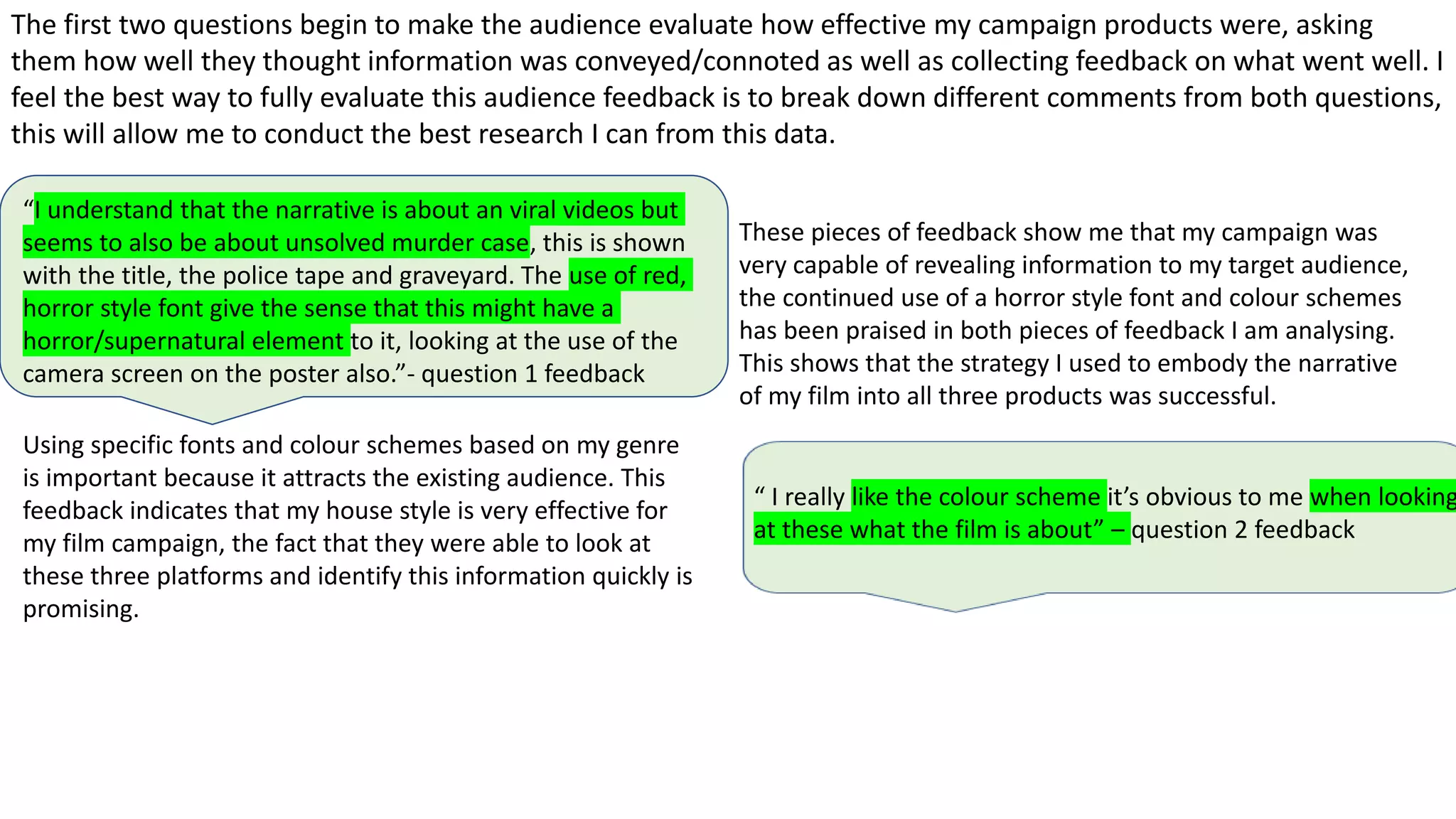
The first two questions begin to make the audience evaluate how effective my campaign products were, asking
them how well they thought information was conveyed/connoted as well as collecting feedback on what went well. I
feel the best way to fully evaluate this audience feedback is to break down different comments from both questions,
this will allow me to conduct the best research I can from this data.
“I understand that the narrative is about an viral videos but
seems to also be about unsolved murder case, this is shown
with the title, the police tape and graveyard. The use of red,
horror style font give the sense that this might have a
horror/supernatural element to it, looking at the use of the
camera screen on the poster also.”- question 1 feedback
“ I really like the colour scheme it’s obvious to me when looking
at these what the film is about” – question 2 feedback
These pieces of feedback show me that my campaign was
very capable of revealing information to my target audience,
the continued use of a horror style font and colour schemes
has been praised in both pieces of feedback I am analysing.
This shows that the strategy I used to embody the narrative
of my film into all three products was successful.
Using specific fonts and colour schemes based on my genre
is important because it attracts the existing audience. This
feedback indicates that my house style is very effective for
my film campaign, the fact that they were able to look at
these three platforms and identify this information quickly is
promising.
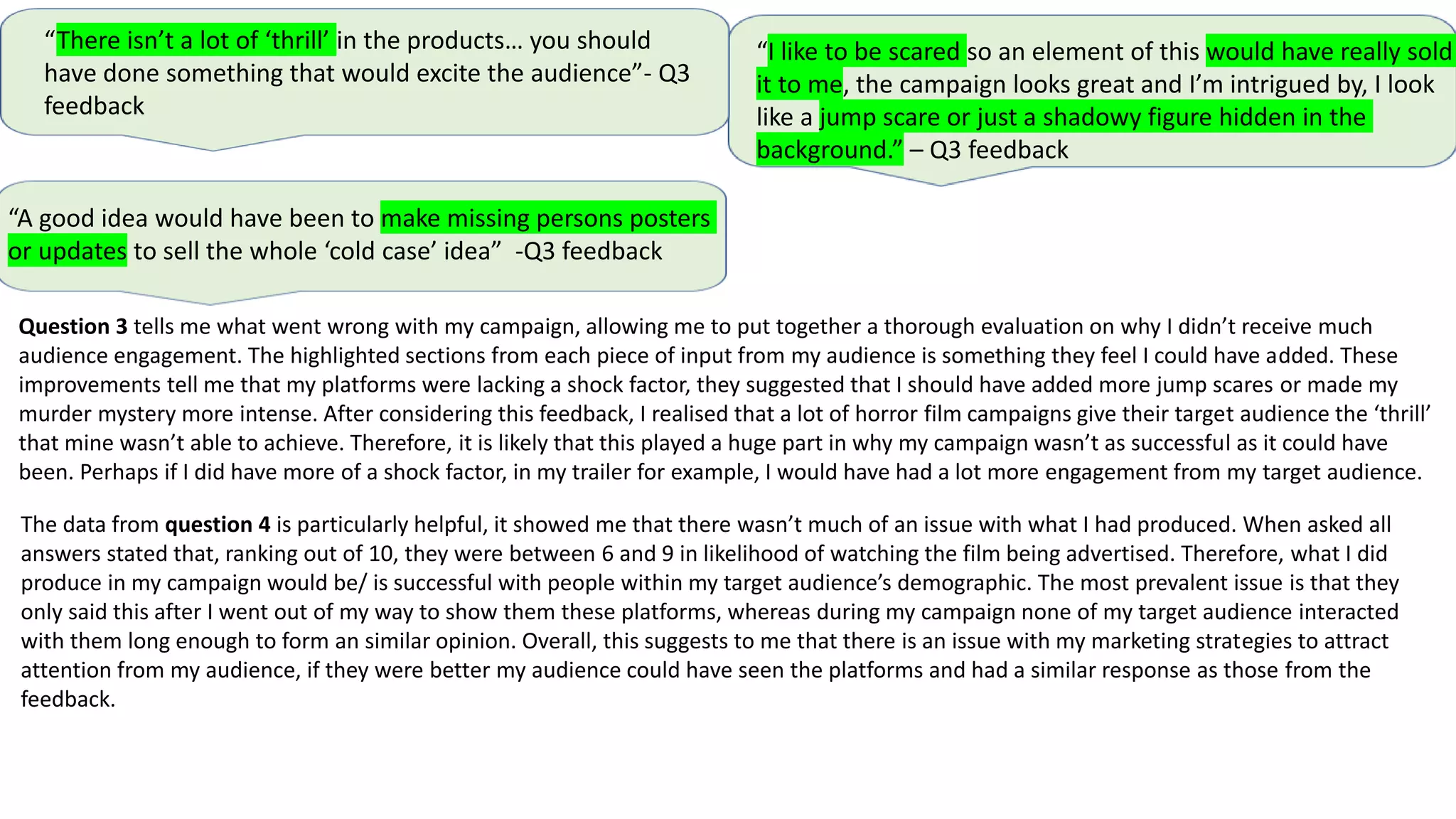
“A good idea would have been to make missing persons posters
or updates to sell the whole ‘cold case’ idea” -Q3 feedback
“I like to be scared so an element of this would have really sold
it to me, the campaign looks great and I’m intrigued by, I look
like a jump scare or just a shadowy figure hidden in the
background.” – Q3 feedback
“There isn’t a lot of ‘thrill’ in the products… you should
have done something that would excite the audience”- Q3
feedback
Question 3 tells me what went wrong with my campaign, allowing me to put together a thorough evaluation on why I didn’t receive much
audience engagement. The highlighted sections from each piece of input from my audience is something they feel I could have added. These
improvements tell me that my platforms were lacking a shock factor, they suggested that I should have added more jump scares or made my
murder mystery more intense. After considering this feedback, I realised that a lot of horror film campaigns give their target audience the ‘thrill’
that mine wasn’t able to achieve. Therefore, it is likely that this played a huge part in why my campaign wasn’t as successful as it could have
been. Perhaps if I did have more of a shock factor, in my trailer for example, I would have had a lot more engagement from my target audience.
The data from question 4 is particularly helpful, it showed me that there wasn’t much of an issue with what I had produced. When asked all
answers stated that, ranking out of 10, they were between 6 and 9 in likelihood of watching the film being advertised. Therefore, what I did
produce in my campaign would be/ is successful with people within my target audience’s demographic. The most prevalent issue is that they
only said this after I went out of my way to show them these platforms, whereas during my campaign none of my target audience interacted
with them long enough to form an similar opinion. Overall, this suggests to me that there is an issue with my marketing strategies to attract
attention from my audience, if they were better my audience could have seen the platforms and had a similar response as those from the
feedback.
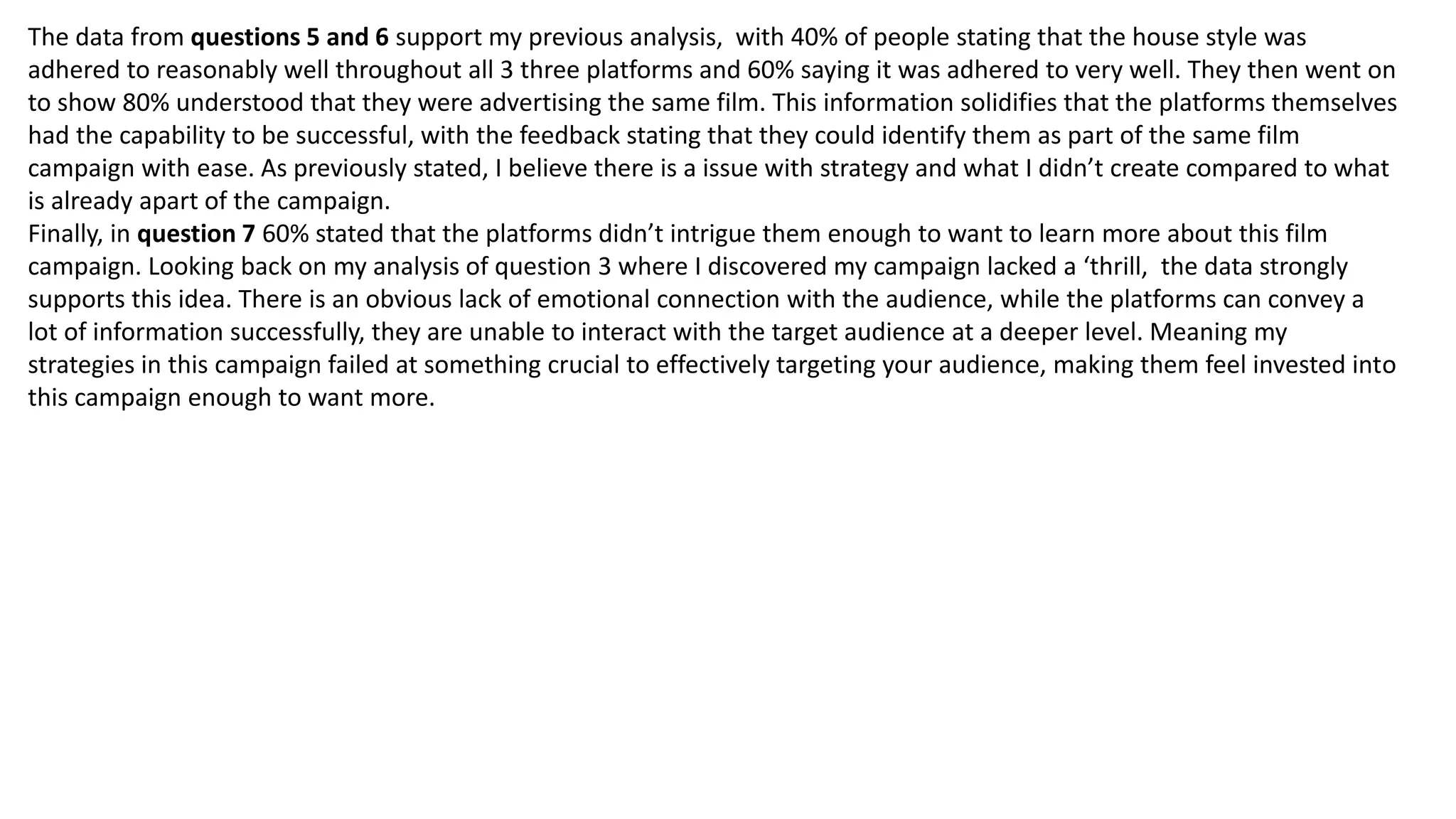
The data from questions 5 and 6 support my previous analysis, with 40% of people stating that the house style was
adhered to reasonably well throughout all 3 three platforms and 60% saying it was adhered to very well. They then went on
to show 80% understood that they were advertising the same film. This information solidifies that the platforms themselves
had the capability to be successful, with the feedback stating that they could identify them as part of the same film
campaign with ease. As previously stated, I believe there is a issue with strategy and what I didn’t create compared to what
is already apart of the campaign.
Finally, in question 7 60% stated that the platforms didn’t intrigue them enough to want to learn more about this film
campaign. Looking back on my analysis of question 3 where I discovered my campaign lacked a ‘thrill, the data strongly
supports this idea. There is an obvious lack of emotional connection with the audience, while the platforms can convey a
lot of information successfully, they are unable to interact with the target audience at a deeper level. Meaning my
strategies in this campaign failed at something crucial to effectively targeting your audience, making them feel invested into
this campaign enough to want more.
Unfortunately, my Twitter page received no shares/likes/follows, similar with my teaser trailer on YouTube. This means that my platforms
received no interaction from my target audience, therefore the strategies I applied to the campaign were extremely unsuccessful. This lack of
audience response was detrimental to the success of my campaign and by extension, my film. Not having any interaction with your audience
in this way has such a negative impact because it means that I have failed to appeal towards them, if the audience haven’t discovered my
trailer, poster and Twitter page then my campaign hasn’t fulfilled it’s purpose (to raise awareness of my film and immerse then into the
narrative, creating an emotional connection to the campaign building up to the release date).
If I were to do this again, there would be multiple things I would do differently (based on my research on social media performance and
feedback). The first change being the amount of social media content, I believe I could have provided my target audience with a wider range
of content. This was something mentioned specifically in my feedback; “There's not much diversity in these posts, they’re kind of repetitive”.
Furthermore, I believe I would have benefitted from using more that one social media platform to attract the attention of my target
audience. Despite my original strategy utilising the high usage of social media from young people, it has became clear that it could have took
this a lot further. A second account on another platforms, for example Instagram almost doubles the potential of the target audience seeing
this campaign. With both platforms being extremely popular with my audience, this kind of strategy would have definitely improved the
number of likes/shares/follows I would have achieved from the campaign.
Another change I would make to my campaign strategy would be to implement viral marketing or ARG, both of these techniques are an
extremely effective way of adding the ‘thrill’ my feedback mentioned. Using these as part of my strategy alongside my platforms would have
massively increased the emotional investment my target audience would put into the campaign, improving the performance overall. If they
feel more connected to the campaign, they will feel compelled to learn more about it (increasing the traffic I would get on social media). This
change was heavily influenced by the feedback given to me by others, which helped me realize what went wrong in my campaign.
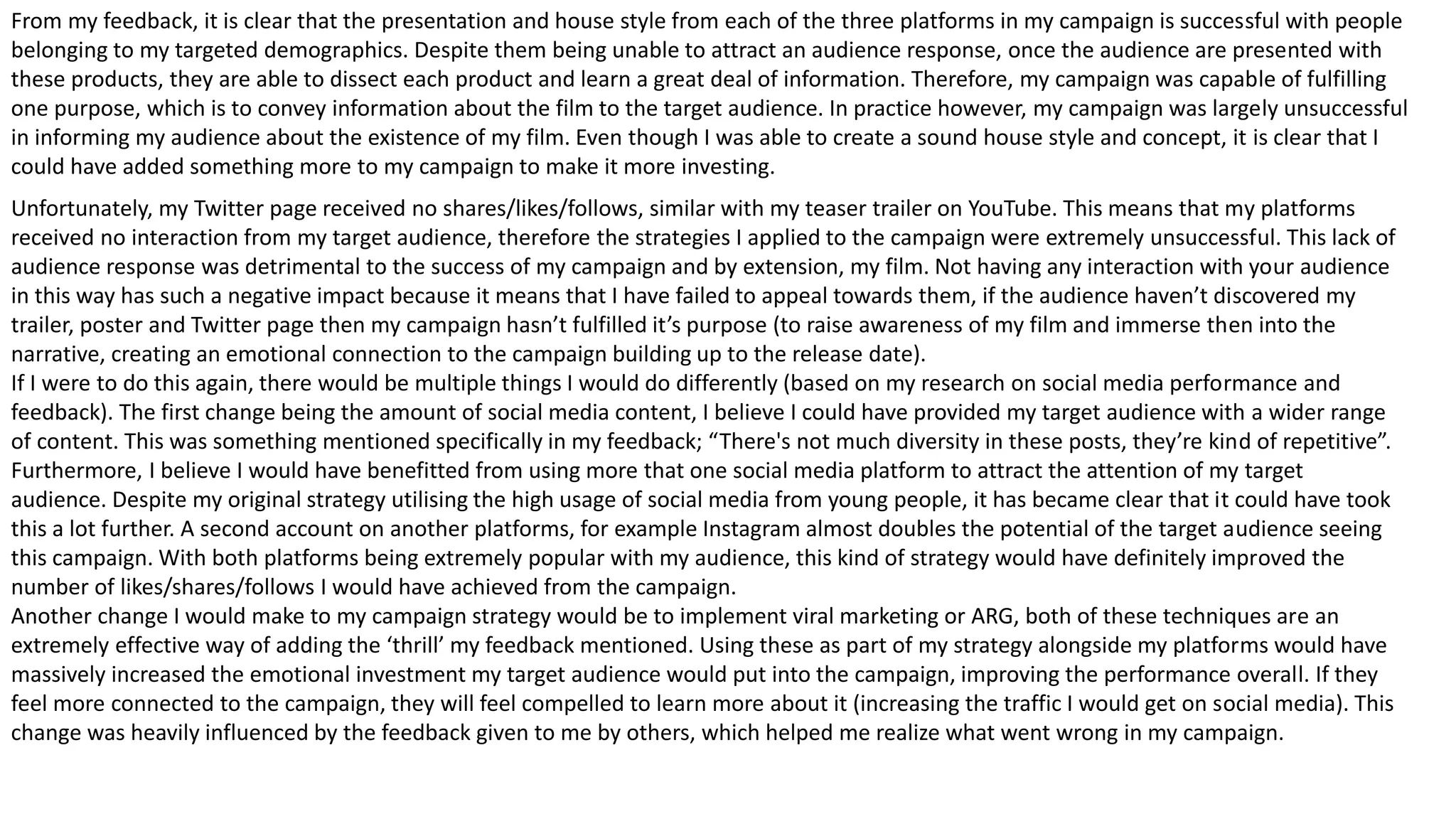
From my feedback, it is clear that the presentation and house style from each of the three platforms in my campaign is successful with people
belonging to my targeted demographics. Despite them being unable to attract an audience response, once the audience are presented with
these products, they are able to dissect each product and learn a great deal of information. Therefore, my campaign was capable of fulfilling
one purpose, which is to convey information about the film to the target audience. In practice however, my campaign was largely unsuccessful
in informing my audience about the existence of my film. Even though I was able to create a sound house style and concept, it is clear that I
could have added something more to my campaign to make it more investing.

Learning aim d

  • 1.
    Learning Aim D: Evaluation Theproducts I created were as follows: A teaser trailer, A theatrical poster and a Twitter page. Firstly, I decided to create a teaser trailer because it would be the ideal length for my target audience. The platform was chosen after conducting primary and secondary research that revealed YouTube was a popular place for my audience’s demographic to discover new trailers. Conveying a small amount of information on the narrative, just enough to intrigue them without getting bored and clicking off. ‘Teasing’ my audience would encourage them to seek out more information on the film, creating more traffic for my other platforms (including my Twitter page, which advertises everything else in the campaign). Secondly, I decided to create a Twitter page because social media Is an extremely popular piece of media consumed by my target audience almost daily. Therefore, it would be obvious that if I wanted to attract my audience’s attention, I had to use something they were comfortable and familiar with. Finally, I created a theatrical poster that revealed all of the necessary information to the audience before the release date. I decided to create this poster because they’re a popular and convenient way to advertise your film, my poster revealed a lot about my film at just a glance. My target audience would learn about the genre, narrative, popular actors that featured, release date, tagline and social media page. Whereas my trailer gave very little information, these two platforms complemented each other. One would create curiosity, the other would reveal the information to fulfil that curiosity and the final product would advertise it all and act as a hub for the campaign. Before creating my poster, I consulted people who fit into my target audience, during this primary research I learned a lot about what they would expect from my platforms/products. One of the most relevant pieces of data from my research was that, when asked what they would like me to add to my campaign responses included: Trailers, social media pages and dark colour schemes. I kept this information in mind throughout the production and planning process, tailoring my campaign to meet the target audience’s needs. The purpose of my campaign was not only to raise awareness of my film, but to also make it seem like it was authentic footage from a cold case that exists. I wanted to immerse the audience into the concept and the narrative of my film gradually throughout the timeline, building up to the release date. In terms of scheduling, I was going to Start the Twitter page on October 31st 2020, which is a popular time for people to search for new horror films. Making the social media page first was strategized so that it would have a whole year to create hype around my film, considering 90% of teenagers from my research uses mobile phones 10-40 hours a week, this would be the most effective. Next, I planned to release the teaser trailer on May 25th on YouTube, this day was chosen deliberately because it’s international missing children’s day (which links closely to the narrative of my film). I chose to release the teaser trailer next because it reveals a small section of the narrative, building up mystery and hype around the campaign. Leading up to the release of my theatrical poster being released on July 20th, which is when exams are over for my target audience and they relax, making them more likely to see the poster online. Finally, I planned to release my film October 29th, a whole year after beginning my campaign.
  • 2.
  • 3.
    Due to currentcircumstances, I am unable to hand out physical questionnaires or interview them on video. Therefore, I created the questionnaire on word and emailed it to numerous people who can give me feedback online. This will help me evaluate the success of the strategies I applied throughout my campaign. For the written section, I will take quotes from a selection of answers which give me the most helpful feedback. Q1) “I understand that the narrative is about an viral videos but seems to also be about unsolved murder case, this is shown with the title, the police tape and graveyard. The use of red, horror style font give the sense that this might have a horror/supernatural element to it, looking at the use of the camera screen on the poster also.” “You can tell they’re trying to promote a horror film” “The release date and name stand out” “what catches my eyes is the tagline” Q2) “ I really like the colour scheme it’s obvious to me when looking at these what the film is about” “The black and white style pictures are good” “You did a great job at making the three link together” “The way you edited the trailer is interesting… I like the pace it kept me on edge when I watched it” Q3) “There's not much diversity in these posts, they’re kind of repetitive” “”You could have made posts about the characters … we didn’t get to connect with them during this campaign” “A good idea would have been to make missing persons posters or updates to sell the whole ‘cold case’ idea” “I like to be scared so an element of this would have really sold it to me, the campaign looks great and I’m intrigued by, I look like a jump scare or just a shadowy figure hidden in the background.” “There isn’t a lot of ‘thrill’ in the products… you should have done something that would excite the audience” Audience feedback: 4)On a scale of 1-to 10 (1 being not at all, 10 being absolutely) how likely are you to go watch the film being advertised in these products? Answers for this question all ranged between 6 to 9, the majority of them closer to 9. Q5) Do you think there is a clear house style, how well is it adhered to throughout the three platforms? Not at all: 0% reasonably well:40% very well:60% Q6) Is it clear that these all advertise the same film? Yes :80% No: 20% Q7) After looking at these three products, do you feel like they create a sense of mystery? Do they make you feel intrigued enough to want to learn more? Yes: 40% No: 60%
  • 4.
    The first twoquestions begin to make the audience evaluate how effective my campaign products were, asking them how well they thought information was conveyed/connoted as well as collecting feedback on what went well. I feel the best way to fully evaluate this audience feedback is to break down different comments from both questions, this will allow me to conduct the best research I can from this data. “I understand that the narrative is about an viral videos but seems to also be about unsolved murder case, this is shown with the title, the police tape and graveyard. The use of red, horror style font give the sense that this might have a horror/supernatural element to it, looking at the use of the camera screen on the poster also.”- question 1 feedback “ I really like the colour scheme it’s obvious to me when looking at these what the film is about” – question 2 feedback These pieces of feedback show me that my campaign was very capable of revealing information to my target audience, the continued use of a horror style font and colour schemes has been praised in both pieces of feedback I am analysing. This shows that the strategy I used to embody the narrative of my film into all three products was successful. Using specific fonts and colour schemes based on my genre is important because it attracts the existing audience. This feedback indicates that my house style is very effective for my film campaign, the fact that they were able to look at these three platforms and identify this information quickly is promising.
  • 5.
    “A good ideawould have been to make missing persons posters or updates to sell the whole ‘cold case’ idea” -Q3 feedback “I like to be scared so an element of this would have really sold it to me, the campaign looks great and I’m intrigued by, I look like a jump scare or just a shadowy figure hidden in the background.” – Q3 feedback “There isn’t a lot of ‘thrill’ in the products… you should have done something that would excite the audience”- Q3 feedback Question 3 tells me what went wrong with my campaign, allowing me to put together a thorough evaluation on why I didn’t receive much audience engagement. The highlighted sections from each piece of input from my audience is something they feel I could have added. These improvements tell me that my platforms were lacking a shock factor, they suggested that I should have added more jump scares or made my murder mystery more intense. After considering this feedback, I realised that a lot of horror film campaigns give their target audience the ‘thrill’ that mine wasn’t able to achieve. Therefore, it is likely that this played a huge part in why my campaign wasn’t as successful as it could have been. Perhaps if I did have more of a shock factor, in my trailer for example, I would have had a lot more engagement from my target audience. The data from question 4 is particularly helpful, it showed me that there wasn’t much of an issue with what I had produced. When asked all answers stated that, ranking out of 10, they were between 6 and 9 in likelihood of watching the film being advertised. Therefore, what I did produce in my campaign would be/ is successful with people within my target audience’s demographic. The most prevalent issue is that they only said this after I went out of my way to show them these platforms, whereas during my campaign none of my target audience interacted with them long enough to form an similar opinion. Overall, this suggests to me that there is an issue with my marketing strategies to attract attention from my audience, if they were better my audience could have seen the platforms and had a similar response as those from the feedback.
  • 6.
    The data fromquestions 5 and 6 support my previous analysis, with 40% of people stating that the house style was adhered to reasonably well throughout all 3 three platforms and 60% saying it was adhered to very well. They then went on to show 80% understood that they were advertising the same film. This information solidifies that the platforms themselves had the capability to be successful, with the feedback stating that they could identify them as part of the same film campaign with ease. As previously stated, I believe there is a issue with strategy and what I didn’t create compared to what is already apart of the campaign. Finally, in question 7 60% stated that the platforms didn’t intrigue them enough to want to learn more about this film campaign. Looking back on my analysis of question 3 where I discovered my campaign lacked a ‘thrill, the data strongly supports this idea. There is an obvious lack of emotional connection with the audience, while the platforms can convey a lot of information successfully, they are unable to interact with the target audience at a deeper level. Meaning my strategies in this campaign failed at something crucial to effectively targeting your audience, making them feel invested into this campaign enough to want more.
  • 7.
    Unfortunately, my Twitterpage received no shares/likes/follows, similar with my teaser trailer on YouTube. This means that my platforms received no interaction from my target audience, therefore the strategies I applied to the campaign were extremely unsuccessful. This lack of audience response was detrimental to the success of my campaign and by extension, my film. Not having any interaction with your audience in this way has such a negative impact because it means that I have failed to appeal towards them, if the audience haven’t discovered my trailer, poster and Twitter page then my campaign hasn’t fulfilled it’s purpose (to raise awareness of my film and immerse then into the narrative, creating an emotional connection to the campaign building up to the release date). If I were to do this again, there would be multiple things I would do differently (based on my research on social media performance and feedback). The first change being the amount of social media content, I believe I could have provided my target audience with a wider range of content. This was something mentioned specifically in my feedback; “There's not much diversity in these posts, they’re kind of repetitive”. Furthermore, I believe I would have benefitted from using more that one social media platform to attract the attention of my target audience. Despite my original strategy utilising the high usage of social media from young people, it has became clear that it could have took this a lot further. A second account on another platforms, for example Instagram almost doubles the potential of the target audience seeing this campaign. With both platforms being extremely popular with my audience, this kind of strategy would have definitely improved the number of likes/shares/follows I would have achieved from the campaign. Another change I would make to my campaign strategy would be to implement viral marketing or ARG, both of these techniques are an extremely effective way of adding the ‘thrill’ my feedback mentioned. Using these as part of my strategy alongside my platforms would have massively increased the emotional investment my target audience would put into the campaign, improving the performance overall. If they feel more connected to the campaign, they will feel compelled to learn more about it (increasing the traffic I would get on social media). This change was heavily influenced by the feedback given to me by others, which helped me realize what went wrong in my campaign. From my feedback, it is clear that the presentation and house style from each of the three platforms in my campaign is successful with people belonging to my targeted demographics. Despite them being unable to attract an audience response, once the audience are presented with these products, they are able to dissect each product and learn a great deal of information. Therefore, my campaign was capable of fulfilling one purpose, which is to convey information about the film to the target audience. In practice however, my campaign was largely unsuccessful in informing my audience about the existence of my film. Even though I was able to create a sound house style and concept, it is clear that I could have added something more to my campaign to make it more investing.