


nef (the new economics foundation)
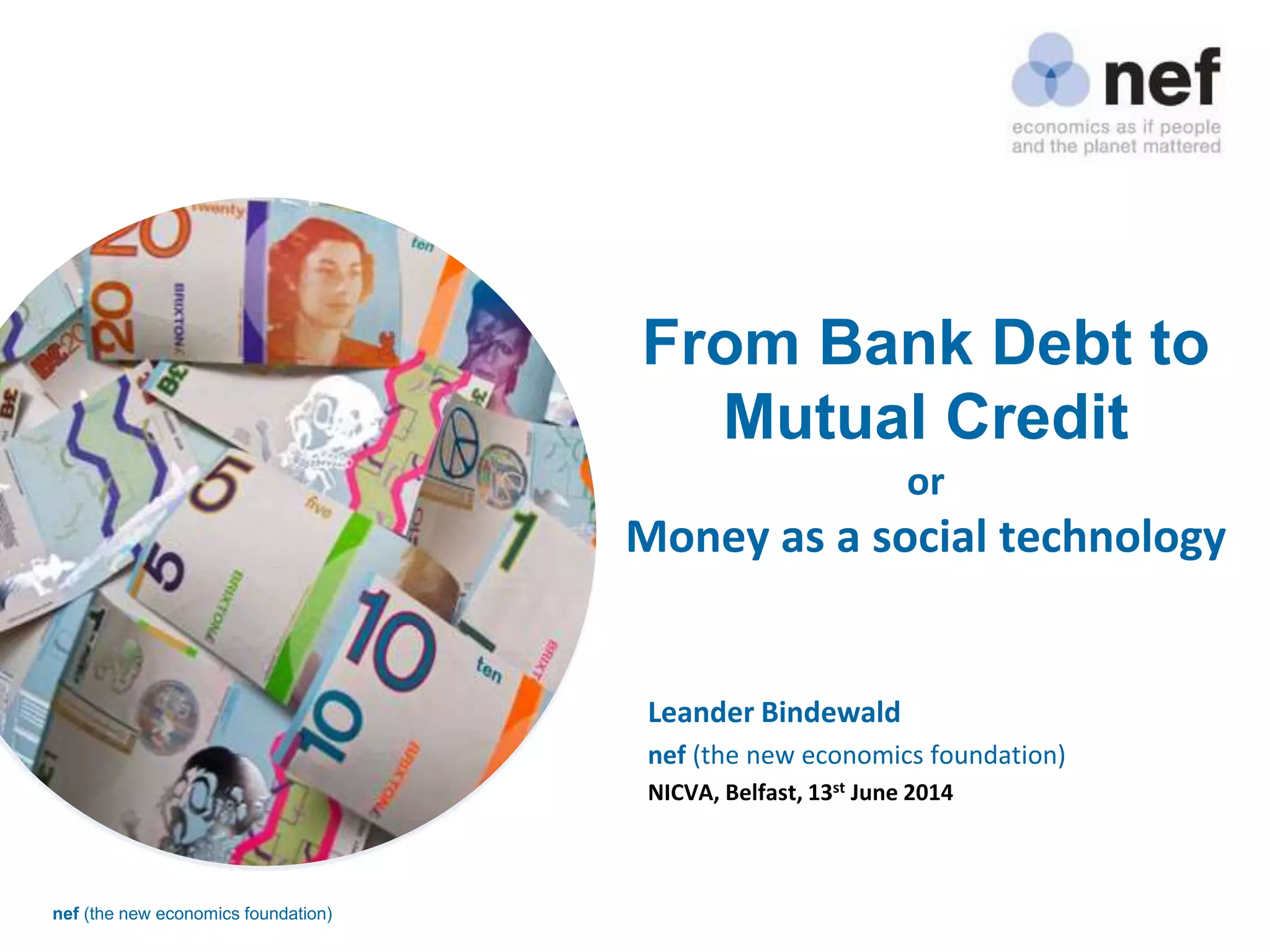
From Bank Debt to
Mutual Credit
or
Money as a social technology
Leander Bindewald
nef (the new economics foundation)
NICVA, Belfast, 13st June 2014
nef (the new economics foundation) 2
This presentation has been produced by the New Economics Foundation
as part of the Community Currencies in Action (CCIA) collaboration project.
CCIA is a transnational partnership working to develop and deliver community currency demonstrations in several
member states across the North West of Europe. CCIA will lead the way in sharing knowledge and best practice to enable
communities throughout Europe to grow stronger in their ability to achieve vibrant and prosperous networks that are
efficient in delivering social, economic and environmental outcomes.
CCIA will design, develop and implement community currencies across NW Europe; providing a rigorously tested
package of support structures to facilitate the development of CCs across NWE and promote CCs as a credible (policy)
vehicle for achieving positive outcomes.
CCIA is part funded through the INTERREG IVB North West Europe (NWE) Programme, which is a financial instrument
of the European Union’s Cohesion Policy - Investing in Opportunities.
Find out more about CCIA on our website: www.communitycurrenciesinaction.eu
nef (the new economics foundation)
From Bank Debt to Mutual Credit
1. What is money?
2. What is the role of Banks
3. Where does money come from
4. Problems with bank-debt money
5. What are Community Currencies?
6. What are the different concepts
7. What are the advantages
8. Typical examples
nef (the new economics foundation)
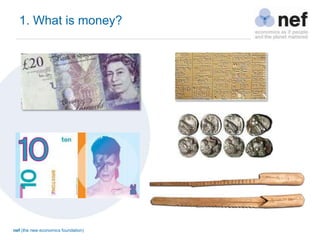
1. What is money?
nef (the new economics foundation)
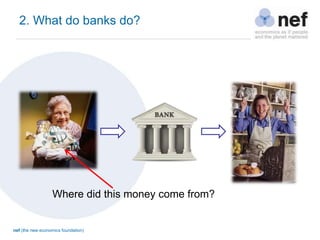
2. What do banks do?
Where did this money come from?
nef (the new economics foundation)
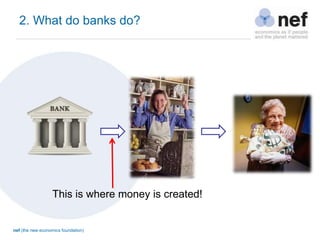
2. What do banks do?
This is where money is created!
nef (the new economics foundation)
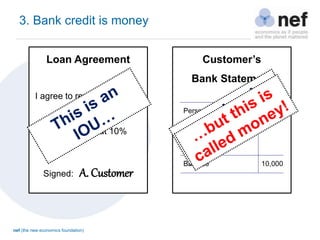
Loan Agreement
I agree to repay the sum of
£ 10,000
with interest at 10%
Signed: A. Customer
Customer’s
Bank Statement
Personal loan 10,000
Balance 10,000
DR CR
3. Bank credit is money
nef (the new economics foundation)
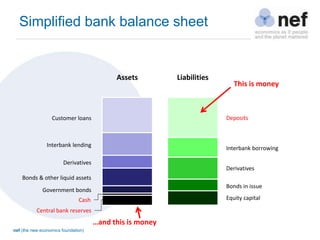
Simplified bank balance sheet
Assets Liabilities
Central bank reserves
Bonds & other liquid assets
Derivatives
Customer loans
Government bonds
Equity capital
Bonds in issue
Derivatives
Interbank borrowing
Deposits
Interbank lending
This is money
…and this is money
Cash
nef (the new economics foundation)
Government bonds
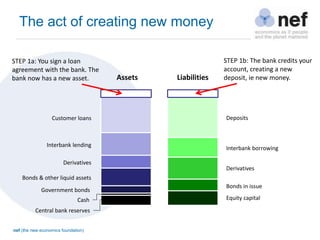
The act of creating new money
Assets Liabilities
Bonds & other liquid assets
Derivatives
Customer loans
Equity capital
Bonds in issue
Derivatives
Interbank borrowing
Deposits
Interbank lending
STEP 1a: You sign a loan
agreement with the bank. The
bank now has a new asset.
STEP 1b: The bank credits your
account, creating a new
deposit, ie new money.
Central bank reserves
Cash
nef (the new economics foundation)
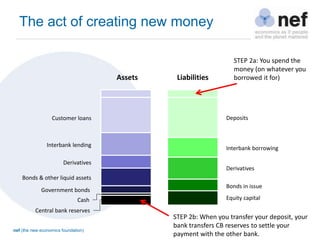
The act of creating new money
Assets Liabilities
Bonds & other liquid assets
Derivatives
Customer loans
Equity capital
Bonds in issue
Derivatives
Interbank borrowing
Deposits
Interbank lending
STEP 2a: You spend the
money (on whatever you
borrowed it for)
STEP 2b: When you transfer your deposit, your
bank transfers CB reserves to settle your
payment with the other bank.
Central bank reserves
Cash
Government bonds
nef (the new economics foundation)
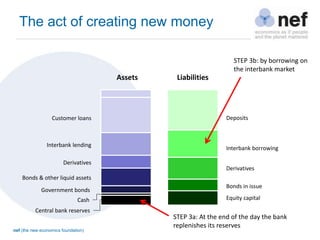
The act of creating new money
Assets Liabilities
Bonds & other liquid assets
Derivatives
Customer loans
Equity capital
Bonds in issue
Derivatives
Interbank borrowing
Deposits
Interbank lending
STEP 3b: by borrowing on
the interbank market
STEP 3a: At the end of the day the bank
replenishes its reserves
Central bank reserves
Cash
Government bonds
nef (the new economics foundation)
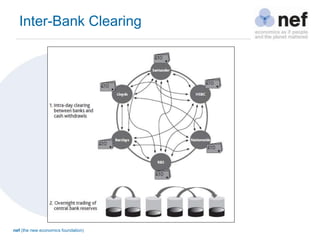
Inter-Bank Clearing
nef (the new economics foundation)
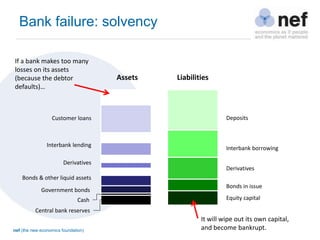
Bank failure: solvency
Assets Liabilities
Bonds & other liquid assets
Derivatives
Customer loans
Equity capital
Bonds in issue
Derivatives
Interbank borrowing
Deposits
Interbank lending
If a bank makes too many
losses on its assets
(because the debtor
defaults)…
It will wipe out its own capital,
and become bankrupt.
Central bank reserves
Cash
Government bonds
nef (the new economics foundation)
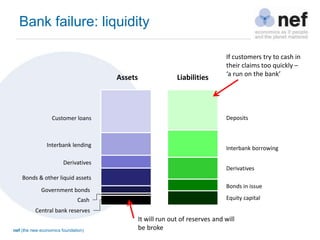
Bank failure: liquidity
Assets Liabilities
Bonds & other liquid assets
Derivatives
Customer loans
Equity capital
Bonds in issue
Derivatives
Interbank borrowing
Deposits
Interbank lending
If customers try to cash in
their claims too quickly –
‘a run on the bank’
It will run out of reserves and will
be broke
Central bank reserves
Cash
Government bonds
nef (the new economics foundation)
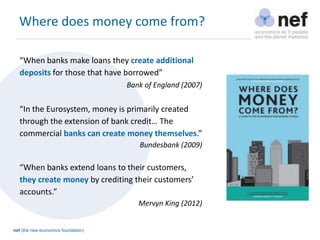
Where does money come from?
“When banks make loans they create additional
deposits for those that have borrowed”
Bank of England (2007)
“In the Eurosystem, money is primarily created
through the extension of bank credit… The
commercial banks can create money themselves.”
Bundesbank (2009)
“When banks extend loans to their customers,
they create money by crediting their customers’
accounts.”
Mervyn King (2012)
nef (the new economics foundation)
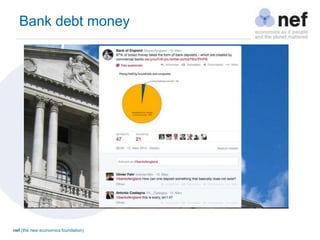
Bank debt money
nef (the new economics foundation)
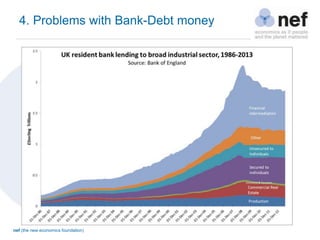
4. Problems with Bank-Debt money
nef (the new economics foundation)
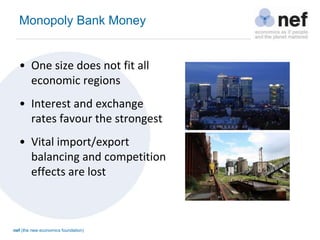
Monopoly Bank Money
• One size does not fit all
economic regions
• Interest and exchange
rates favour the strongest
• Vital import/export
balancing and competition
effects are lost
nef (the new economics foundation)
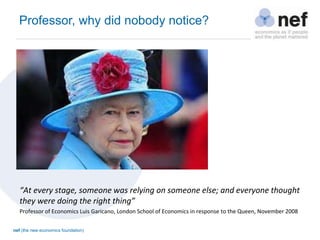
Professor, why did nobody notice?
“At every stage, someone was relying on someone else; and everyone thought
they were doing the right thing”
Professor of Economics Luis Garicano, London School of Economics in response to the Queen, November 2008
nef (the new economics foundation)
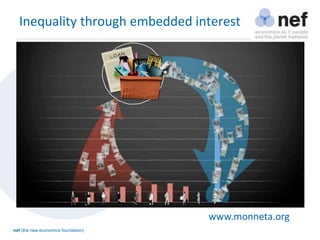
Inequality through embedded interest
www.monneta.org
nef (the new economics foundation)
www.egs.mmu.ac.uk
nef (the new economics foundation)
www.PositiveMoney.org
Monetary Reform
nef (the new economics foundation)
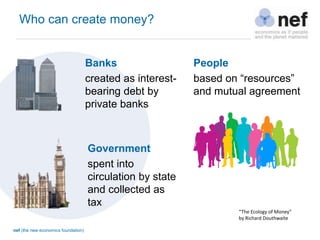
Who can create money?
Banks
created as interest-
bearing debt by
private banks
“The Ecology of Money”
by Richard Douthwaite
People
based on “resources”
and mutual agreement
Government
spent into
circulation by state
and collected as
tax
nef (the new economics foundation)
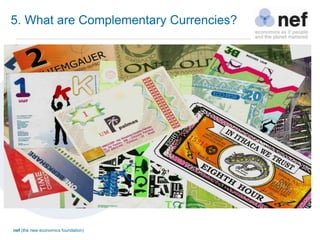
5. What are Complementary Currencies?
nef (the new economics foundation)
“An agreement within a community to use something as a
medium of exchange”
Bernard Lietaer
“Currency is any unit system,
that facilitates collaboration
in a community”
Currency = Social Technology
nef (the new economics foundation)
Local exchange – backed by fiat currencies
Social exchange – time credits/hours
Economic exchange – Business Barter, Loyalty points
Environmental exchange – Reward Points, Carbon quotas
Community Currencies concepts
Learning/Awareness, “participate and feel empowered”
nef (the new economics foundation)
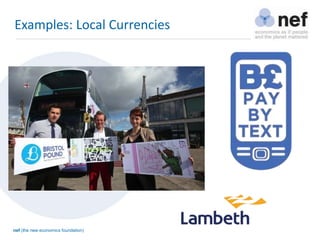
Examples: Local Currencies
nef (the new economics foundation)
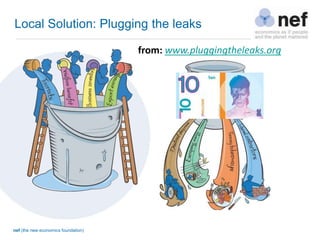
Local Solution: Plugging the leaks
from: www.pluggingtheleaks.org
nef (the new economics foundation)
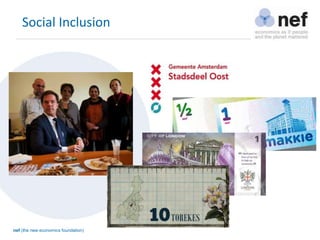
Social Inclusion
nef (the new economics foundation)
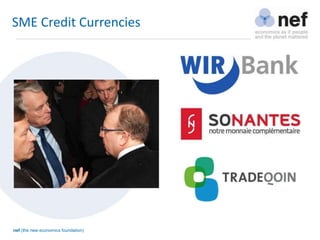
SME Credit Currencies
nef (the new economics foundation)
Ecological Reward Points
www.e-portemonnee.be
nef (the new economics foundation)
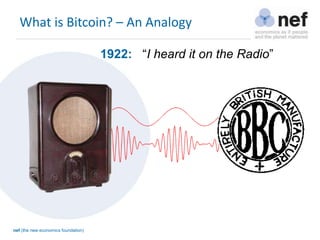
What is Bitcoin? – An Analogy
1922: “I heard it on the Radio”
nef (the new economics foundation)
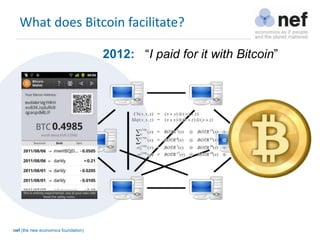
2012: “I paid for it with Bitcoin”
What does Bitcoin facilitate?
nef (the new economics foundation)
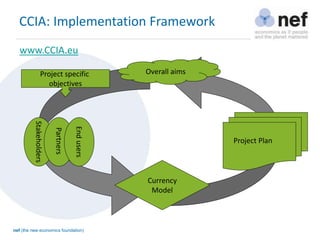
CCIA: Implementation Framework
Overall aims
Project Plan
Stakeholders
Project specific
objectives
Partners
Endusers
Currency
Model
www.CCIA.eu
nef (the new economics foundation)
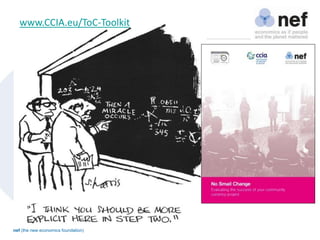
www.CCIA.eu/ToC-Toolkit
nef (the new economics foundation)
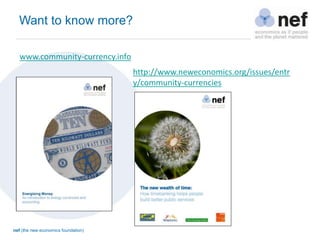
Want to know more?
http://www.neweconomics.org/issues/entr
y/community-currencies
www.community-currency.info
nef (the new economics foundation)
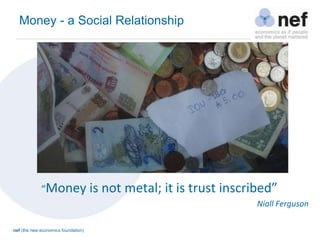
“Money is not metal; it is trust inscribed”
Niall Ferguson
Money - a Social Relationship

Money as a Social Technology - Leander Bindewald (nef)

  • 1.
    nef (the neweconomics foundation) From Bank Debt to Mutual Credit or Money as a social technology Leander Bindewald nef (the new economics foundation) NICVA, Belfast, 13st June 2014
  • 2.
    nef (the neweconomics foundation) 2 This presentation has been produced by the New Economics Foundation as part of the Community Currencies in Action (CCIA) collaboration project. CCIA is a transnational partnership working to develop and deliver community currency demonstrations in several member states across the North West of Europe. CCIA will lead the way in sharing knowledge and best practice to enable communities throughout Europe to grow stronger in their ability to achieve vibrant and prosperous networks that are efficient in delivering social, economic and environmental outcomes. CCIA will design, develop and implement community currencies across NW Europe; providing a rigorously tested package of support structures to facilitate the development of CCs across NWE and promote CCs as a credible (policy) vehicle for achieving positive outcomes. CCIA is part funded through the INTERREG IVB North West Europe (NWE) Programme, which is a financial instrument of the European Union’s Cohesion Policy - Investing in Opportunities. Find out more about CCIA on our website: www.communitycurrenciesinaction.eu
  • 3.
    nef (the neweconomics foundation) From Bank Debt to Mutual Credit 1. What is money? 2. What is the role of Banks 3. Where does money come from 4. Problems with bank-debt money 5. What are Community Currencies? 6. What are the different concepts 7. What are the advantages 8. Typical examples
  • 4.
    nef (the neweconomics foundation) 1. What is money?
  • 5.
    nef (the neweconomics foundation) 2. What do banks do? Where did this money come from?
  • 6.
    nef (the neweconomics foundation) 2. What do banks do? This is where money is created!
  • 7.
    nef (the neweconomics foundation) Loan Agreement I agree to repay the sum of £ 10,000 with interest at 10% Signed: A. Customer Customer’s Bank Statement Personal loan 10,000 Balance 10,000 DR CR 3. Bank credit is money
  • 8.
    nef (the neweconomics foundation) Simplified bank balance sheet Assets Liabilities Central bank reserves Bonds & other liquid assets Derivatives Customer loans Government bonds Equity capital Bonds in issue Derivatives Interbank borrowing Deposits Interbank lending This is money …and this is money Cash
  • 9.
    nef (the neweconomics foundation) Government bonds The act of creating new money Assets Liabilities Bonds & other liquid assets Derivatives Customer loans Equity capital Bonds in issue Derivatives Interbank borrowing Deposits Interbank lending STEP 1a: You sign a loan agreement with the bank. The bank now has a new asset. STEP 1b: The bank credits your account, creating a new deposit, ie new money. Central bank reserves Cash
  • 10.
    nef (the neweconomics foundation) The act of creating new money Assets Liabilities Bonds & other liquid assets Derivatives Customer loans Equity capital Bonds in issue Derivatives Interbank borrowing Deposits Interbank lending STEP 2a: You spend the money (on whatever you borrowed it for) STEP 2b: When you transfer your deposit, your bank transfers CB reserves to settle your payment with the other bank. Central bank reserves Cash Government bonds
  • 11.
    nef (the neweconomics foundation) The act of creating new money Assets Liabilities Bonds & other liquid assets Derivatives Customer loans Equity capital Bonds in issue Derivatives Interbank borrowing Deposits Interbank lending STEP 3b: by borrowing on the interbank market STEP 3a: At the end of the day the bank replenishes its reserves Central bank reserves Cash Government bonds
  • 12.
    nef (the neweconomics foundation) Inter-Bank Clearing
  • 13.
    nef (the neweconomics foundation) Bank failure: solvency Assets Liabilities Bonds & other liquid assets Derivatives Customer loans Equity capital Bonds in issue Derivatives Interbank borrowing Deposits Interbank lending If a bank makes too many losses on its assets (because the debtor defaults)… It will wipe out its own capital, and become bankrupt. Central bank reserves Cash Government bonds
  • 14.
    nef (the neweconomics foundation) Bank failure: liquidity Assets Liabilities Bonds & other liquid assets Derivatives Customer loans Equity capital Bonds in issue Derivatives Interbank borrowing Deposits Interbank lending If customers try to cash in their claims too quickly – ‘a run on the bank’ It will run out of reserves and will be broke Central bank reserves Cash Government bonds
  • 15.
    nef (the neweconomics foundation) Where does money come from? “When banks make loans they create additional deposits for those that have borrowed” Bank of England (2007) “In the Eurosystem, money is primarily created through the extension of bank credit… The commercial banks can create money themselves.” Bundesbank (2009) “When banks extend loans to their customers, they create money by crediting their customers’ accounts.” Mervyn King (2012)
  • 16.
    nef (the neweconomics foundation) Bank debt money
  • 17.
    nef (the neweconomics foundation) 4. Problems with Bank-Debt money
  • 18.
    nef (the neweconomics foundation) Monopoly Bank Money • One size does not fit all economic regions • Interest and exchange rates favour the strongest • Vital import/export balancing and competition effects are lost
  • 19.
    nef (the neweconomics foundation) Professor, why did nobody notice? “At every stage, someone was relying on someone else; and everyone thought they were doing the right thing” Professor of Economics Luis Garicano, London School of Economics in response to the Queen, November 2008
  • 20.
    nef (the neweconomics foundation) Inequality through embedded interest www.monneta.org
  • 21.
    nef (the neweconomics foundation) www.egs.mmu.ac.uk
  • 22.
    nef (the neweconomics foundation) www.PositiveMoney.org Monetary Reform
  • 23.
    nef (the neweconomics foundation) Who can create money? Banks created as interest- bearing debt by private banks “The Ecology of Money” by Richard Douthwaite People based on “resources” and mutual agreement Government spent into circulation by state and collected as tax
  • 24.
    nef (the neweconomics foundation) 5. What are Complementary Currencies?
  • 25.
    nef (the neweconomics foundation)
  • 26.
    nef (the neweconomics foundation) “An agreement within a community to use something as a medium of exchange” Bernard Lietaer “Currency is any unit system, that facilitates collaboration in a community” Currency = Social Technology
  • 27.
    nef (the neweconomics foundation) Local exchange – backed by fiat currencies Social exchange – time credits/hours Economic exchange – Business Barter, Loyalty points Environmental exchange – Reward Points, Carbon quotas Community Currencies concepts Learning/Awareness, “participate and feel empowered”
  • 28.
    nef (the neweconomics foundation) Examples: Local Currencies
  • 29.
    nef (the neweconomics foundation) Local Solution: Plugging the leaks from: www.pluggingtheleaks.org
  • 30.
    nef (the neweconomics foundation) Social Inclusion
  • 31.
    nef (the neweconomics foundation) SME Credit Currencies
  • 32.
    nef (the neweconomics foundation) Ecological Reward Points www.e-portemonnee.be
  • 33.
    nef (the neweconomics foundation) What is Bitcoin? – An Analogy 1922: “I heard it on the Radio”
  • 34.
    nef (the neweconomics foundation) 2012: “I paid for it with Bitcoin” What does Bitcoin facilitate?
  • 35.
    nef (the neweconomics foundation) CCIA: Implementation Framework Overall aims Project Plan Stakeholders Project specific objectives Partners Endusers Currency Model www.CCIA.eu
  • 36.
    nef (the neweconomics foundation) www.CCIA.eu/ToC-Toolkit
  • 37.
    nef (the neweconomics foundation) Want to know more? http://www.neweconomics.org/issues/entr y/community-currencies www.community-currency.info
  • 38.
    nef (the neweconomics foundation) “Money is not metal; it is trust inscribed” Niall Ferguson Money - a Social Relationship