2 DAY PROGRAMME ON

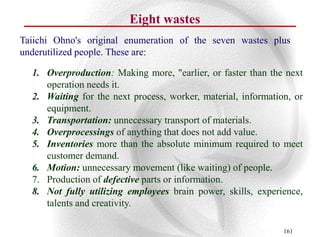
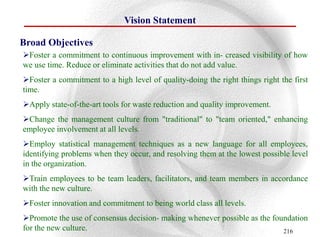
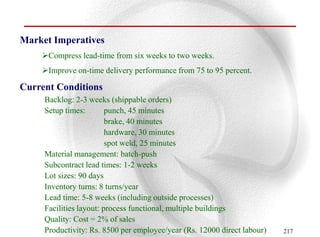
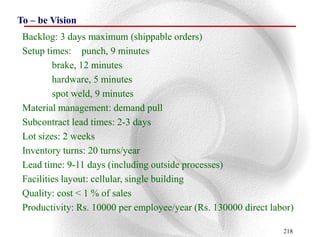
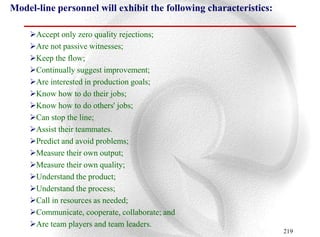
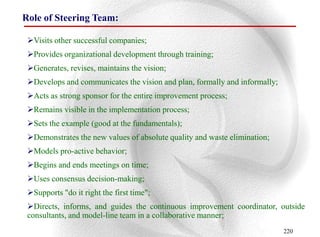
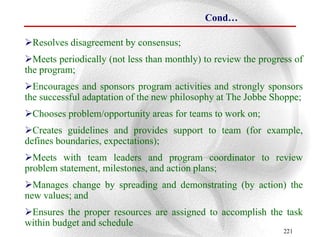
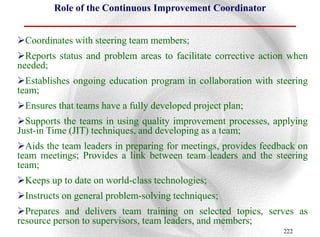
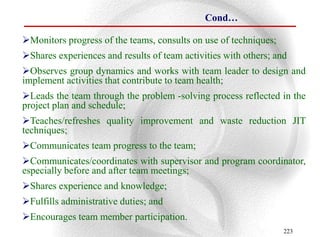
                          LEAN
                            &
                       SIX SIGMA
                     MANUFACTURING
                       PRACTICES


Faculty:    Prof. A. Rajagopal,
            HEAD, SQC&OR UNIT
            INDIAN STATISTICAL INSTITUTE
            Ph: 0422-2441192
mobile no +91 98442245219 mail id
abramaya@hathway.com


                                           1
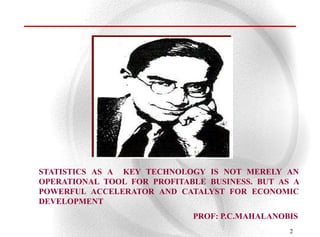
STATISTICS AS A KEY TECHNOLOGY IS NOT MERELY AN
OPERATIONAL TOOL FOR PROFITABLE BUSINESS. BUT AS A
POWERFUL ACCELERATOR AND CATALYST FOR ECONOMIC
DEVELOPMENT
                             PROF: P.C.MAHALANOBIS
                                                2
ABOUT THE INSTITUTE
      PIONEERING QUALITY MOVEMENT IN INDIA BY
                 SQC & OR DIVISION OF ISI
70 years of existence as a centre of excellence promoting
statistics as a key technology.
 One of the world‟s leading organization recognized as an
Institute of National Importance.
 At         the       Initiation    of     founder       Prof.
P.C.Mahalanobis, Dr.Walter Shewart visited the institute in
1947 to introduce SQC in the industries particularly in the
textile sector in a significant way.
 Successfully demonstrated SQC / SPC not only as operational
tool for profitable business but also as a powerful accelerator
and catalyst for economic development.
                                                           3
Every year about 100 organizations are benefited in
following this approach in different sector, Private – Public –
Government, around the country. Over 10,000 projects has
been carried out so far.
 Now Coimbatore Unit is introducing this approach to small
scale sector also based on the widespread experience in the
application of Textile sector.
Objective:
 Improve Quality
 Reduce Waste / Rework / Rejection
 Increase Productivity
 Best utilization of resources including time.
                                                           4
The value of
     time


               5
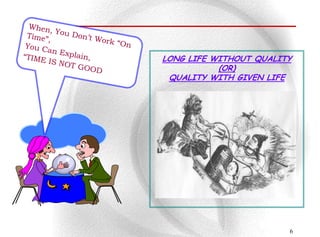
LONG LIFE WITHOUT QUALITY
           (OR)
 QUALITY WITH GIVEN LIFE


                        6
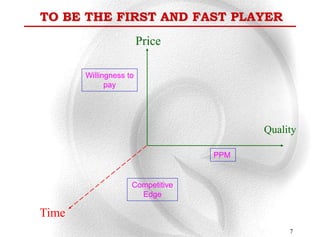
TO BE THE FIRST AND FAST PLAYER
                        Price

       Willingness to
             pay


                                        Quality

                                  PPM


                    Competitive
                      Edge

Time
                                             7
TODAY’S BUSINESS ISSUES:
        Quality and price are two axis of business so long. The Third axis
emerged as -"THE TIME"- the factor taking leading position in business.
“SPEED" is the need of hour. “To be FAST and to be FIRST has become the
challenge".

         Conventional Business approach is moving towards higher production
(Quantity), which some time affects the Quality and may force to sell in
discounts or as seconds, and to carry out "High Inventories“

         “Quality in time" at the "least cost" is the mission statement, moving
ahead in this changing environment.

         "Statistical Methodologies" -that study the uncertainties, Analytical
approach that economies the cost and which minimizes the waiting time/ idle
time through such “No investment”- “No cost tools” enabled to maximize the
return on valued resources.

                                                                            8
TAKING OF THE BLINDERS…

“In strategy it is important to see distant things as if
they were close and to take a distanced view of close
                       things”

                Miyamoto Musashi
               The Book of Five Rings


                                                       9
COMPETITIVE REQUIRES INNOVATION

No existing market share is safe today, no product life is
indefinite. Not only is this true for high technology, but it
is also true for all consumer products. Competition will
tear away market niches and technology advantages from
the    established   business   through   the   weapon        of
innovation. Companies will become merely a shadow of
their „glory days‟ or will vanish if they do not find a way
to re-create their market success through a steady stream
of innovative products and customer – oriented solutions.

                                                         10
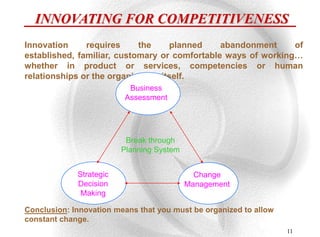
INNOVATING FOR COMPETITIVENESS
Innovation     requires     the     planned    abandonment     of
established, familiar, customary or comfortable ways of working…
whether in product or services, competencies or human
relationships or the organisation itself.
                          Business
                         Assessment


                          Break through
                         Planning System


             Strategic                       Change
             Decision                      Management
              Making

Conclusion: Innovation means that you must be organized to allow
constant change.
                                                                   11
MANAGEMENT
    OF
   TIME

             12
TIME CRESIS MANAGEMENT:
         Crisis involves two aspects. The cresis created by factors within one‟s
control and such crisis can be avoided. Then those crisis created by factor‟s
beyond one‟s control and have to be faced.
          Major cresis can be avoid, if we act upon a situation at the right time.
More often than not, there are two tendencies that present us from acting at the
right time.
               Postponement of the unpleasant
              Non recognition of the problem

PROCRASTINATION CREATES CRESIS:
The tendency to do what ii easy, trouble free, and pleasant and leave for the
future the issues that are difficult, Thus the difficult issues keeps piling up. They
become irritants. We do not want this because it remind us of our inefficiency
and incapacity to face unpleasant issues. A thing undone always remain with us.


                                                                                13
DO THE UNPLEASANT FIRST:
         We can not expect every thing in life to be pleasant. Like the two
sides of the coin, the unpleasant always goes with the pleasant.

         The one who does not postpone making a decision, right or
wrong, to fulfill a responsibility, that person alone can be successful.

         Postponing something because it is unpleasant is wrong. It has the
potential to create a crisis and when it occurs, we will be inadequately
equipped to face it.

RECOGNIZE THE PROBLEM AND ACT:
We get used to the problem so much so chronically, that we don‟t recognize
it as a problem. When there is a problem, we tend to say, “There is no
problem, Everything will be alright”. But it will not be all right.


                                                                           14
MURPHY’S LAW:
         What can go wrong, will go wrong. The possibility of something
going wrong is much greater than its going right. One can act upon a
problem, however small it is, only when the problem is first accepted. Action
presupposes a decision, a will, and the will can exists, only when there is
recognition.


KARMA:
         “Everything will be all right if my karma is good”. Karma does not
work that way, the theory of karma is not fatalism. It does not justify passing
the buck. It pins down the responsibility upon us.

         so accept problem as it occurs.


                                                                              15
DEALING WITH THE ISSUES:
          For any business man, interference from competitor will be a problem.
This is not created by him. This has to be faced. This requires inner strength. It is
like learning to drive a car. The instruction cannot reproduce all possible traffic
situations. The learner has to deal with particular situation as they occur.

EVERY EFFECT IS A CALCULATED RISK:
          When you make a business projection for the following year, factors
like potential demand, availability of raw material, changes in tax structure,
shrikes are taken in to account.
          Since every intelligent effort involves a calculated risk, only two results
can be expected from every effort – Success to different degree – Failure to
different degree.
          With every failure, a person seems to become more and more frightened
and a time comes when are is not able to act at all. So it is important that we are
prepared for failure in our effort, because success may not always come. Our
power are limited, and there are factors beyond our control.

                                                                                16
ACCEPT LIMITATIONS:
         To be for failure, it is necessary to recognize one‟s limitations. Our
knowledge is limited and so we can not avoid many situations from occurring-
otherwise we could avoid all accidents.

          sometime we have the knowledge but our power is limited and we
feel helpless . If you permit yourself to be depressed for reasons you seem to
have no control over, you become helpless and the outside factors will make
you more and more inefficient and ineffective.

         Depression is a reaction. In action, you have freedom to exercise your
will.

          Acceptance of facts is a precondition to an action, Non –acceptance is
an ideal condition for reaction – in fact Non- acceptance itself is a reaction. Non
–acceptance does not alter the facts- the reaction creates a chain of reactions.
SO ACCEPT THE FACTS AND KEEP ACTION.

                                                                              17
TIME PRIORITIZATION:
          Water, Tumbler, pebbles, sand, stones, grane . All can be accommodated, if it is
planned in priority while filling the tumbler without pilferage. We can find time for
anything, provided we have passion for it.
GOALS MUST BE CLEAR:
          Nobody works for failure. You do not have to make an effort to achieve a failure.
Sometimes people invest in failing business for tax purposes. It is not a real failure. It is a
calculated achievement.
CORPORATE MANAGER:
          BE CLEAR ABOUT GOAL.
           What is to be accomplished. What is expected out of me. I must also know, what I
expect of those who works for me.
PRIORITIZING GOALS:
          With out conflict
          Based on resources (Time, Manpower, resources)
          Be concern with immediate plan without getting bogged down by the scale of
          the project.
                                                                                        18
“What ever a leader does, other people do. The very thing.
What ever the upholds as authority, an ordinary person
follows that”.

                                      - BHAGAVATGITA.

KRISHNA TO ARUGUNA:

       If you runaway from this battle field, all others will also
follow you. If you fail to do what is to be done, others will also do
exactly that, because you are leader, whether you like it or not.

                                              - Set our Example.

                                                                19
Understanding
     lean


                20
Understanding lean


   Lean:
        A systematic approach to identifying and eliminating waste
{non- value-added activities) through continuous improvement in
pursuit of perfection by flowing the product at the pull of the customer.
   Lean champion:
        Subject matter expert in the tools of lean typically chosen to
lead lean training, lean projects, and lean transformation.
   Lean enterprise:
       Any organization that continually strives to eliminate waste,
reduce costs, and improve quality, on-time delivery, and service levels.


                                                                      21
Lean production:
      The opposite of mass production.
Muda:

        A Japanese word, usually translated as “waste”, that refers to
those elements of production that do not add value to the product.
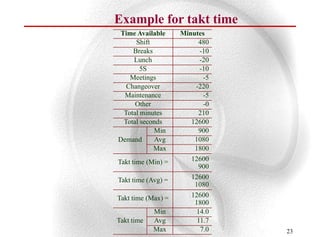
Takt Time:

      The available production time divided by the rate of customer
demand. Takt time sets the pace of production to math the rate of
customer demand and becomes the heartbeat of any lean system.


                                                                  22
Example for takt time
Time Available      Minutes
     Shift               480
    Breaks               -10
    Lunch                -20
       5S                -10
   Meetings               -5
  Changeover            -220
  Maintenance             -5
     Other                -0
 Total minutes           210
 Total seconds         12600
           Min           900
Demand     Avg          1080
           Max          1800
Takt time (Min) =      12600
                         900
Takt time (Avg) =      12600
                        1080
Takt time (Max) =      12600
                        1800
            Min         14.0
Takt time   Avg          11.7
            Max           7.0   23
Business
  Process
Improvement
  system
              24
Ground Rules

• Everyone participates
• Anything is open to question
• Look at issues from larger perspective
• Ideas from anyone is respected
• Talk to the ideas generated ; not the person
• No complaining – unless accompanied with
  solution and action plan
• No blaming


                                                 25
Leadership Vision

• “Quality . . . is the next opportunity for our Company to
  set itself apart from its competitors . . .
 ... Dramatically improved Quality will increase employee
 and customer satisfaction, will improve share and
 profitability, and will enhance our reputation.
 ... “[Six Sigma] is the most important training
 thing we have ever had. It’s better than going
 to Harvard Business School.”
                                           J.F. Welch


                                                          26
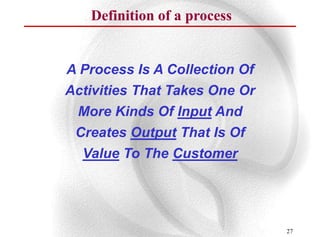
Definition of a process


A Process Is A Collection Of
Activities That Takes One Or
 More Kinds Of Input And
 Creates Output That Is Of
  Value To The Customer


                               27
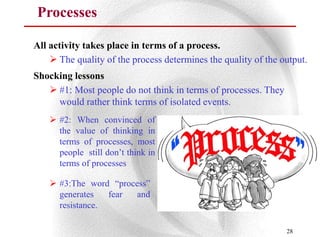
Processes

    All activity takes place in terms of a process.
         The quality of the process determines the quality of the output.
    Shocking lessons
        #1: Most people do not think in terms of processes. They
         would rather think terms of isolated events.
         #2: When convinced of
          the value of thinking in
          terms of processes, most
          people still don‟t think in
          terms of processes

         #3:The word “process”
          generates   fear and
          resistance.

6                                                                   28
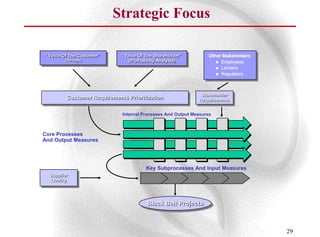
Strategic Focus

 “Voice Of The Customer”     “Voice Of The Shareholder”          Other Stakeholders
        (Surveys)              (Profitability Analysis)              Employees
                                                                     Lenders
                                                                     Regulators


                                                              Stakeholder
         Customer Requirements Prioritization                Requirements


                             Internal Processes And Output Measures


Core Processes
And Output Measures


                                       Key Subprocesses And Input Measures
  Supplier
  Quality


                                        Black Belt Projects


                                                                                      29
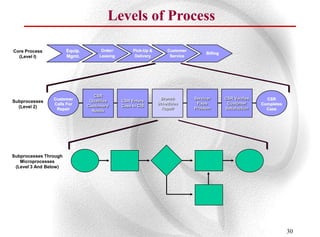
Levels of Process

Core Process           Equip.         Order/        Pick-Up &       Customer
                                                                                    Billing
  (Level I)            Mgmt.         Leasing         Delivery        Service


                                   CSR
                Customer                                         Branch        Servicer       CSR Verifies     CSR
Subprocesses                     Qualifies     CSR Enters
                Calls For                                       Schedules       Fixes          Customer      Completes
  (Level 2)                     Customers’     Case In CIS
                 Repair                                           Repair       Problem        Satisfaction     Case
                                  Needs


Subprocesses Through
   Microprocesses
 (Level 3 And Below)


                                                                                                                         30
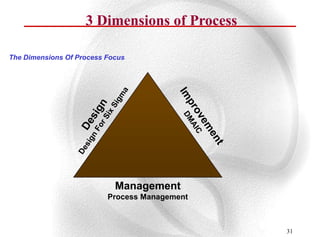
3 Dimensions of Process

The Dimensions Of Process Focus


                            Management
                          Process Management


                                               31
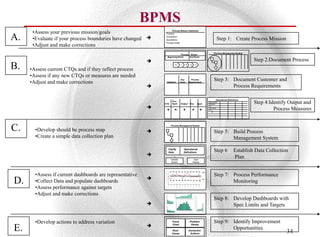
BPMS

  What is BPMS?


A nine step methodology designed to create
ongoing accountability for managing entire
cross-functional processes to satisfy process
goals


                                          32
BPMS
 Why BPMS ?

• Proven methodology to optimize process
  performance


• Establishes value-added metrics to assess
  process performance – takes the guesswork out
  of how a process is performing


                                           33
BPMS
      •Assess your previous mission/goals                                     Process Mission Statement
                                                                         Purpose:

A.    •Evaluate if your process boundaries have changed 
                                                                         Importance:
                                                                         Boundaries:                                                                                                                                                                                                                                                                                     Step 1: Create Process Mission
      •Adjust and make corrections
                                                                         Process Goals:


                                                                                                                                                                                                                                                                                                                                                                      Process Management System
                                                                                                                   Process Owner
                                                                                                       Beginning Point    End Point

                                                                                                                                                                                                                                                                                                                                                                                                  Step 2:Document Process
B.   •Assess current CTQs and if they reflect process
                                                                                                                                                        S                                                I                              P                         O                                       C


     •Assess if any new CTQs or measures are needed
     •Adjust and make corrections                                                                  Verbatim
                                                                                                                                                                                                   Key
                                                                                                                                                                                                  Issue
                                                                                                                                                                                                                                                           Process
                                                                                                                                                                                                                                                         Requirement
                                                                                                                                                                                                                                                                                                                                                                      Step 3: Document Customer and
                                                                                                                                                                                                                                                                                                                                                                             Process Requirements

                                                                                                                                                                                                                                                                                                                                                                        Operational Definitions
                                                              CTQ
                                                                                                                                    Proc.
                                                                                                                                    Rqmt                                                            Output Proc                                                                                                           Input
                                                                                                                                                                                                                                                                                                                                                                Data Owner
                                                                                                                                                                                                                                                                                                                                                                Definition
                                                                                                                                                                                                                                                                                                                                                                                                   Step 4:Identify Output and
                                                                                                                                                                                                                                                                                                                                 
                                                                                                                                                                                                                                                                                                                                                                Unit
                                                                                                                                                                                                                                                                                                                                                                How Many
                                                                                                                                                                                                                                                                                                                                                                DPU                                         Process Measures
                                                                                                                                                                                                                                                                                                                                                                     


C.     •Develop should be process map                     
                                                                                                                         Process Management System


                                                                                                                                                                                                                                                                                                                                                                      Step 5: Build Process
       •Create a simple data collection plan                                                                                                                                                                                                                                                                                                                                  Management System
                                                                                                         Clarify
                                                                                                         Data
                                                                                                                                                                                                                         Operational
                                                                                                                                                                                                                         Definitions                                                                                                                                  Step 6              Establish Data Collection
                                                          
                                                                                                                         Validate                                                                                                                                                       Data
                                                                                                                                                                                                                                                                                                                                                                                          Plan
                                                                                                                         System                                                                                                                                                        Display


                                                              80


       •Assess if current dashboards are representative
                                                                                                                                                                                                                                                                                                                                                    UCL

                                                                                                                                                                                                                                                                                                                                                                      Step 7: Process Performance
                                                              70

                                                              60


                                                          
                                                              50


D.     •Collect Data and populate dashboards
                                                              40

                                                                                                                                                                                                                                                                                                                                                    LCL
                                                                                                                                                                                                                                                                                                                                                                              Monitoring
                                                              30

                                                              20

                                                              10


                                                                                                                                                                                                                                                                                                                                  18- S ep
                                                                                                                                                                                                                                                                                            21- A ug
                                                                                                                         17- A pr


                                                                                                                                                                                                                                                                                                                4- S ep
                                                                                                                                                             15- M ay


                                                                                                                                                                                       29- M ay


       •Assess performance against targets
                                                                                                       3- A pr


                                                                                                   0
                                                                                                                                          1- M ay


                                                                                                                                                                                                                                               10- Jul


                                                                                                                                                                                                                                                                   24- Jul
                                                                                                                                                                                                              12- Jun


                                                                                                                                                                                                                              26- Jun


       •Adjust and make corrections                                                                                                             25
                                                                                                                                                20
                                                                                                                                                15
                                                               Nov


                                                                                                                                                10                                                                                                                                                     $1,600


                                                                                                                                                                                                                                                                                                                                                                      Step 8: Develop Dashboards with
                                                               Sep


                                                                                                                                                    5
                                                                                                                                                    0                                                                                                                                                  $1,400
                                                               Jul


                                                                                                                                                                                     M ar


                                                                                                                                                                                                             M ay


                                                                                                                                                                                                                              Jul
                                                                                                                                                         Jan


                                                                                                                                                                                                                        Jun
                                                                                                                                                                         Feb


                                                                                                                                                                                                                                                Sep

                                                                                                                                                                                                                                                            Oct

                                                                                                                                                                                                                                                                         Nov

                                                                                                                                                                                                                                                                                      Dec
                                                                                                                                                                                                   Apr


                                                                                                                                                                                                                                        Aug


                                                                                                                                                                                                                                                                                                       $1,200
                                                               May


                                                                                                                                                        10


                                                          
                                                                                                                                                                                                                                                                                                       $1,000
                                                                ar


                                                                                                                                                         9
                                                               M


                                                                                                                                                         8


                                                                                                                                                                                                                                                                                                                                                                              Spec Limits and Targets
                                                               Jan


                                                                                                                                                                                                                                                                                                        $800
                                                                                                                                                         7
                                                                                                   0             5              10         15            6
                                                                                                                                                                                                                                                                                                        $600
                                                                                                                                                         5
                                                               J a n M a r M a y J u l Se p No v


                                                                                                                                                         4
                                                                                                                                                                                                                                                                                                        $400
                                                                                                                                                         3
                                                                                                                                                         2
                                                                                                                                                                                                                                                                                                        $200
                                                                                                                                                         1
                                                                                                                                                         0
                                                                                                                                                                                                                              Jul
                                                                                                                                                                   Jan


                                                                                                                                                                                                                        Jun
                                                                                                                                                                               Feb


                                                                                                                                                                                                                                               Se p

                                                                                                                                                                                                                                                         Oc t

                                                                                                                                                                                                                                                                  No v

                                                                                                                                                                                                                                                                               De c
                                                                                                                                                                                            Ma r

                                                                                                                                                                                                     Ap r


                                                                                                                                                                                                                                        Au g
                                                                                                                                                                                                                Ma y


                                                                                                                                                                                                                                                                                                          $0
                                                                                                                                                                                                                                                                                                                                             J ul
                                                                                                                                                                                                                                                                                                                     J an


                                                                                                                                                                                                                                                                                                                                                    Sep

                                                                                                                                                                                                                                                                                                                                                          Nov
                                                                                                                                                                                                                                                                                                                            Mar

                                                                                                                                                                                                                                                                                                                                      May


                                                                                                   0                 5               10                 15


       •Develop actions to address variation                                                                                        Trend                                                                                                                       Problem                                                                                               Step 9: Identify Improvement
                                                                                                                                   Chart                                                                                                                        Pareto

E.                                                                                                                                  Root
                                                                                                                                    Cause
                                                                                                                                                                                                                                                         Corrective
                                                                                                                                                                                                                                                          Actions
                                                                                                                                                                                                                                                                                                                                                                              Opportunities
                                                                                                                                                                                                                                                                                                                                                                                                                  34
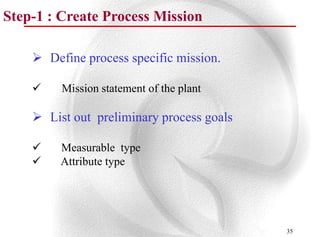
Step-1 : Create Process Mission

     Define process specific mission.

        Mission statement of the plant

     List out preliminary process goals

        Measurable type
        Attribute type


                                           35
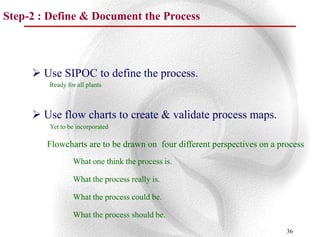
Step-2 : Define & Document the Process


      Use SIPOC to define the process.
        Ready for all plants


      Use flow charts to create & validate process maps.
         Yet to be incorporated

        Flowcharts are to be drawn on four different perspectives on a process
                 What one think the process is.

                 What the process really is.

                 What the process could be.

                 What the process should be.
                                                                         36
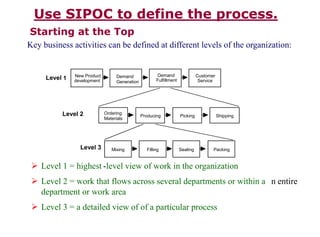
Use SIPOC to define the process.
     Starting at the Top
     Key business activities can be defined at different levels of the organization:


                    New Product         Demand              Demand                  Customer
          Level 1   development                             Fulfillment              Service
                                        Generation


               Level 2            Ordering
                                                     Producing            Picking              Shipping
                                  Materials


                      Level 3        Mixing            Filling            Sealing          Packing


       Level 1 = highest -level view of work in the organization
       Level 2 = work that flows across several departments or within a n entire
        department or work area
       Level 3 = a detailed view of of a particular process

30                                                                                                        37
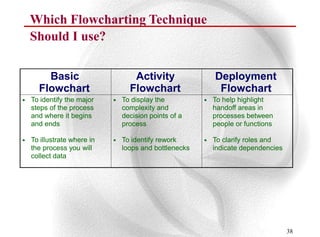
Which Flowcharting Technique
     Should I use?

         Basic                   Activity             Deployment
       Flowchart                Flowchart              Flowchart
     To identify the major    To display the          To help highlight
     steps of the process     complexity and          handoff areas in
     and where it begins      decision points of a    processes between
     and ends                 process                 people or functions

     To illustrate where in   To identify rework      To clarify roles and
     the process you will     loops and bottlenecks   indicate dependencies
     collect data


35                                                                            38
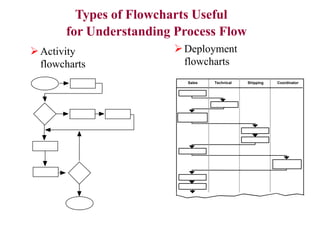
Types of Flowcharts Useful
            for Understanding Process Flow
      Activity               Deployment
       flowcharts              flowcharts
                                Sales   Technical   Shipping   Coordinator


31                                                                 39
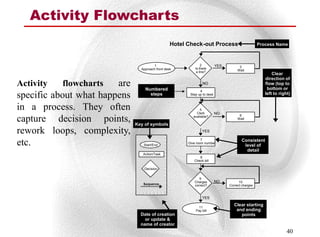
Activity Flowcharts
                                                  Hotel Check-out Process                          Process Name


                                       1                        2          YES
                                                            Is there                   3
                                Approach front desk                                   Wait
                                                             a line?
                                                                                                          Clear
                                                                                                      direction of
Activity   flowcharts   are       Numbered
                                                                 NO                                   flow (top to
                                                                                                       bottom or
                                                               4
specific about what happens         steps                Step up to desk                              left to right)


in a process. They often                                       5
                                                             Clerk         NO
                                                                                       6
capture decision points,      Key of symbols
                                                           available?
                                                                                      Wait


rework loops, complexity,                                        YES

                                                                7                       Consistent
etc.                             Start/End
                                                        Give room number
                                                                                         level of
                                                                                          detail
                                 Action/Task
                                                              8
                                                           Check bill

                                  Decision

                                                              9
                                                           Charges         NO          10
                                 Sequence                  correct?              Correct charges


                                                                 YES

                                                              11
                                                                                    Clear starting
                                                            Pay bill                 and ending
                                Date of creation                                       points
                                  or update &
                                name of creator
                                                                                                                  40
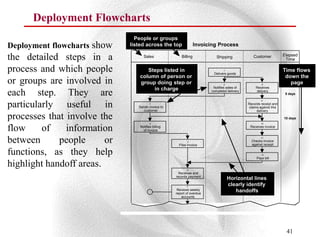
Deployment Flowcharts
                                People or groups
Deployment flowcharts show    listed across the top                Invoicing Process

the detailed steps in a             Sales                Billing            Shipping             Customer           Elapsed
                                                                                                                     Time

process and which people             Steps listed in                             1
                                                                           Delivers goods
                                                                                                                    Time flows
                                  column of person or                                                                down the
or groups are involved in         group doing step or                            2                    8                page
                                                                          Notifies sales of        Receives
                                       in charge
each step. They are                                                      completed delivery         delivery
                                                                                                                     5 days
                                                                                                      9

particularly useful in                   3
                                 Sends invoice to
                                    customer
                                                                                              Records receipt and
                                                                                              claims against this
                                                                                                   delivery

processes that involve the                                                                                          10 days
                                         4                                                            10


flow     of    information        Notifies billing
                                    of invoice
                                                                                               Receives invoice


between      people      or                                 5
                                                       Files invoice
                                                                                                      11
                                                                                                Checks invoice
                                                                                                against receipt

functions, as they help                                                                               12
                                                                                                   Pays bill

highlight handoff areas.                                    6
                                                       Receives and
                                                     records payment
                                                                                     Horizontal lines
                                                            7
                                                                                     clearly identify
                                                      Reviews weekly
                                                     report of overdue
                                                                                        handoffs
                                                        accounts


                                                                                                                     41
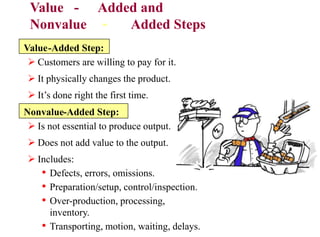
Value - Added and
      Nonvalue -  Added Steps
     Value-Added Step:
       Customers are willing to pay for it.
       It physically changes the product.
       It‟s done right the first time.
     Nonvalue-Added Step:
       Is not essential to produce output.
       Does not add value to the output.
       Includes:
         • Defects, errors, omissions.
         • Preparation/setup, control/inspection.
         • Over-production, processing,
           inventory.
43
         • Transporting, motion, waiting, delays.   42
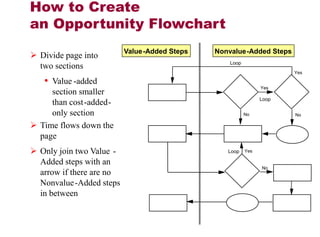
How to Create
     an Opportunity Flowchart
                               Value-Added Steps   Nonvalue-Added Steps
      Divide page into
                                                      Loop
       two sections
                                                                               Yes

        • Value -added
                                                                   Yes
          section smaller
                                                                   Loop
          than cost-added-
          only section                                       No                No

      Time flows down the
       page
      Only join two Value -                          Loop   Yes

       Added steps with an
                                                                   No
       arrow if there are no
       Nonvalue -Added steps
       in between


47                                                                        43
Step-3 : Document Customer & Process Requirements


 Types of customers.


 Translating VOC into specific requirements.
  this is the place for defining the QFD


                                                      44
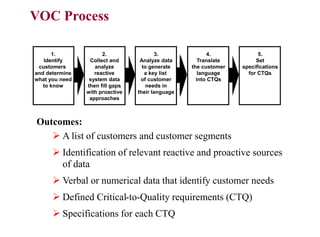
VOC Process

          1.              2.                 3.              4.            5.
       Identify      Collect and      Analyze data       Translate        Set
     customers         analyze         to generate    the customer   specifications
    and determine      reactive         a key list       language      for CTQs
    what you need    system data      of customer       into CTQs
       to know      then fill gaps       needs in
                    with proactive   their language
                     approaches


    Outcomes:
        A list of customers and customer segments
           Identification of relevant reactive and proactive sources
            of data
           Verbal or numerical data that identify customer needs
           Defined Critical-to-Quality requirements (CTQ)
           Specifications for each CTQ
7                                                                                     45
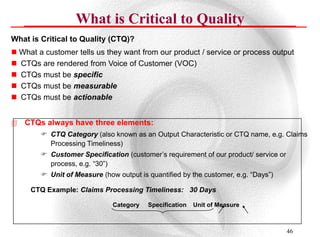
What is Critical to Quality
What is Critical to Quality (CTQ)?
 What a customer tells us they want from our product / service or process output
 CTQs are rendered from Voice of Customer (VOC)
 CTQs must be specific
 CTQs must be measurable
 CTQs must be actionable


   CTQs always have three elements:
         CTQ Category (also known as an Output Characteristic or CTQ name, e.g. Claims
          Processing Timeliness)
         Customer Specification (customer’s requirement of our product/ service or
          process, e.g. “30”)
         Unit of Measure (how output is quantified by the customer, e.g. “Days”)

     CTQ Example: Claims Processing Timeliness: 30 Days

                              Category   Specification   Unit of Measure


                                                                                      46
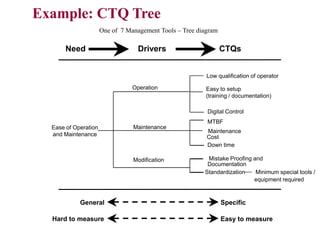
Example: CTQ Tree
                           One of 7 Management Tools – Tree diagram

            Need                        Drivers                       CTQs


                                                               Low qualification of operator

                                      Operation                Easy to setup
                                                               (training / documentation)

                                                               Digital Control
                                                               MTBF
       Ease of Operation              Maintenance
                                                               Maintenance
       and Maintenance                                         Cost
                                                               Down time

                                      Modification             Mistake Proofing and
                                                               Documentation
                                                              Standardization    Minimum special tools /
                                                                                equipment required


                 General                                              Specific

       Hard to measure                                                Easy to measure
23                                                                                             47
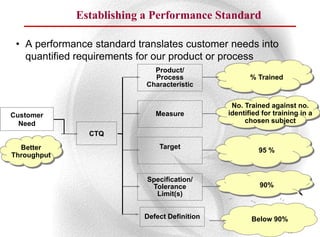
Establishing a Performance Standard

 • A performance standard translates customer needs into
   quantified requirements for our product or process
                              Product/
                              Process                 % Trained
                            Characteristic


                                                No. Trained against no.
Customer                      Measure          identified for training in a
  Need                                              chosen subject
                CTQ
  Better                       Target
                                                         95 %
Throughput


                            Specification/
                             Tolerance                   90%
                              Limit(s)


                           Defect Definition          Below 90%
                                                                  48
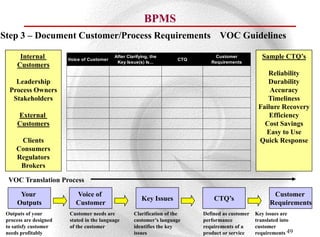
BPMS
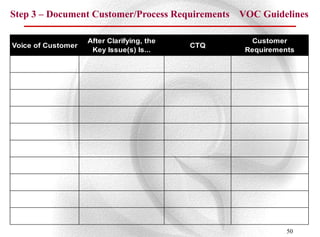
Step 3 – Document Customer/Process Requirements VOC Guidelines

      Internal          Voice of Customer
                                            After Clarifying, the
                                                                       CTQ
                                                                                 Customer            Sample CTQ’s
                                             Key Issue(s) Is...                 Requirements
     Customers
                                                                                                       Reliability
    Leadership                                                                                         Durability
  Process Owners                                                                                        Accuracy
   Stakeholders                                                                                        Timeliness
                                                                                                    Failure Recovery
     External                                                                                          Efficiency
     Customers                                                                                        Cost Savings
                                                                                                      Easy to Use
      Clients                                                                                       Quick Response
     Consumers
     Regulators
      Brokers

  VOC Translation Process

      Your                 Voice of                                                                      Customer
                                                         Key Issues              CTQ’s
     Outputs               Customer                                                                     Requirements
 Outputs of your        Customer needs are           Clarification of the    Defined as customer   Key issues are
 process are designed   stated in the language       customer’s language     performance           translated into
 to satisfy customer    of the customer              identifies the key      requirements of a     customer
 needs profitably                                    issues                  product or service    requirements 49
Step 3 – Document Customer/Process Requirements VOC Guidelines

                    After Clarifying, the          Customer
Voice of Customer                           CTQ
                     Key Issue(s) Is...           Requirements


                                                            50
BPMS
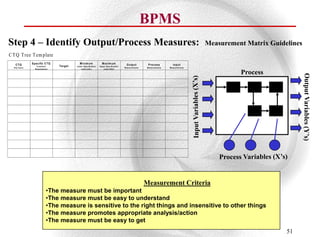
Step 4 – Identify Output/Process Measures:                                                                                                                           Measurement Matrix Guidelines
C T Q T ree T em plate
   CTQ          S p e c ific C T Q                    M in im u m                 M a x im u m               O u tp u t         P ro c e ss          In p u t
  K ey Issu e
                     C u sto m er     T a rg e t   L o w er S p ecificatio n   U p p er S p ecificatio n
                                                                                                           M easu rem en ts    M easu rem en ts   M easu rem en ts
                   R eq u irem en t                      L im it (L S L )            L im it (U S L )

                                                                                                                                                                               Process


                                                                                                                              Measurement Criteria
                                •The measure must be important
                                •The measure must be easy to understand
                                •The measure is sensitive to the right things and insensitive to other things
                                •The measure promotes appropriate analysis/action
                                •The measure must be easy to get
                                                                                                                                                                                             51
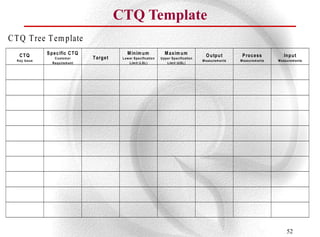
CTQ Template
C T Q T ree T em plate
   CTQ          S p e c ific C T Q                     M in im u m                 M a x im u m               O u tp u t        P ro c e ss          In p u t
  K ey Issu e
                     C u sto m er     T a rg e t    L o w er S p ecificatio n   U p p er S p ecificatio n
                                                                                                            M easu rem en ts   M easu rem en ts   M easu rem en ts
                   R eq u irem en t                       L im it (L S L )            L im it (U S L )


                                                                                                                                                       52
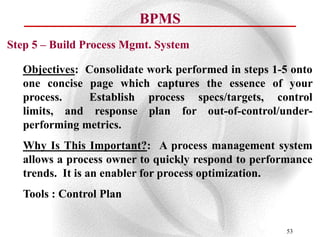
BPMS
Step 5 – Build Process Mgmt. System

   Objectives: Consolidate work performed in steps 1-5 onto
   one concise page which captures the essence of your
   process.    Establish process specs/targets, control
   limits, and response plan for out-of-control/under-
   performing metrics.
   Why Is This Important?: A process management system
   allows a process owner to quickly respond to performance
   trends. It is an enabler for process optimization.
   Tools : Control Plan


                                                      53
Step-5 : Build Process Management System


 Measures & Targets.

 Monitoring System.

 Contingency Plan.


                                       54
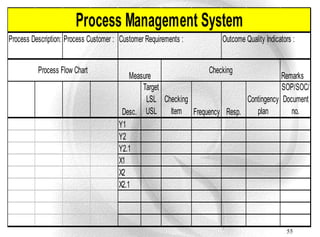
Process Management System
Process Description: Process Customer : Customer Requirements :      Outcome Quality Indicators :


          Process Flow Chart                                    Checking
                                           Measure                                     Remarks
                                               Target                                  SOP/SOC/
                                                LSL Checking               Contingency Document
                                        Desc. USL     Item Frequency Resp.    plan        no.
                                       Y1
                                       Y2
                                       Y2.1
                                       X1
                                       X2
                                       X2.1


                                                                                             55
BPMS
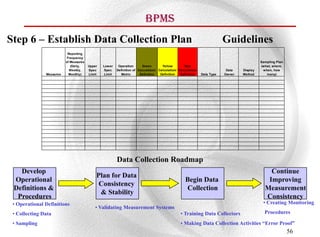
Step 6 – Establish Data Collection Plan                                                                                     Guidelines
                           Reporting
                           Frequency
                          of Measures                                                                                                         Sampling Plan
                             (Daily,    Upper   Lower     Operation       Green       Yellow         Red                                      (what, where,
                            Weekly,     Spec     Spec    Definition of Calculation/ Calculation/ Calculation/                Data   Display    when, how
               Measures     Monthly)    Limit    Limit      Metric      Definition   Definition   Definition    Data Type   Owner   Method       many)


                                                         Data Collection Roadmap
   Develop                                                                                                                                        Continue
                                            Plan for Data
 Operational                                                                                         Begin Data                                  Improving
                                             Consistency
 Definitions &                                                                                       Collection                                 Measurement
                                             & Stability
  Procedures                                                                                                                                    Consistency
 • Operational Definitions                                                                                                                     • Creating Monitoring
                                            • Validating Measurement Systems
 • Collecting Data                                                                                • Training Data Collectors                    Procedures

 • Sampling                                                                                       • Making Data Collection Activities “Error Proof”
                                                                                                                                                              56
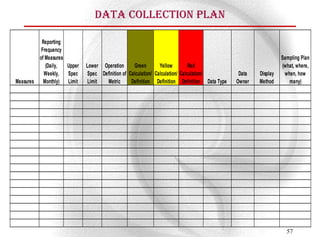
Data Collection Plan

          Reporting
          Frequency
         of Measures                                                                                            Sampling Plan
            (Daily,  Upper   Lower Operation      Green        Yellow         Red                               (what, where,
           Weekly,   Spec    Spec Definition of Calculation/ Calculation/ Calculation/         Data   Display    when, how
Measures   Monthly) Limit    Limit  Metric       Definition Definition Definition Data Type   Owner   Method       many)


                                                                                                                  57
BPMS
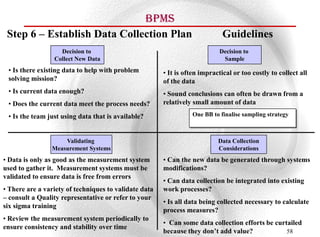
 Step 6 – Establish Data Collection Plan                                     Guidelines
                   Decision to                                              Decision to
                 Collect New Data                                            Sample
 • Is there existing data to help with problem         • It is often impractical or too costly to collect all
 solving mission?                                      of the data
 • Is current data enough?                             • Sound conclusions can often be drawn from a
 • Does the current data meet the process needs?       relatively small amount of data

 • Is the team just using data that is available?                One BB to finalise sampling strategy


                    Validating                                             Data Collection
                Measurement Systems                                        Considerations
• Data is only as good as the measurement system       • Can the new data be generated through systems
used to gather it. Measurement systems must be         modifications?
validated to ensure data is free from errors
                                                       • Can data collection be integrated into existing
• There are a variety of techniques to validate data   work processes?
– consult a Quality representative or refer to your
                                                       • Is all data being collected necessary to calculate
six sigma training
                                                       process measures?
• Review the measurement system periodically to
                                                       • Can some data collection efforts be curtailed
ensure consistency and stability over time
                                                       because they don’t add value?             58
BPMS

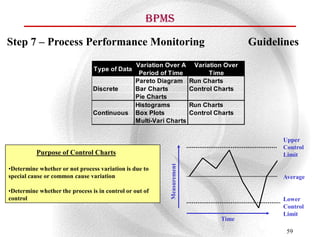
Step 7 – Process Performance Monitoring                                               Guidelines
                                                Variation Over A     Variation Over
                                Type of Data
                                                 Period of Time           Time
                                                Pareto Diagram      Run Charts
                                Discrete        Bar Charts          Control Charts
                                                Pie Charts
                                                Histograms          Run Charts
                                Continuous      Box Plots           Control Charts
                                                Multi-Vari Charts


                                                                                            Upper
                                                                                            Control
          Purpose of Control Charts                                                         Limit

•Determine whether or not process variation is due to
special cause or common cause variation                                                     Average

•Determine whether the process is in control or out of
control                                                                                     Lower
                                                                                            Control
                                                                                            Limit
                                                                              Time

                                                                                             59
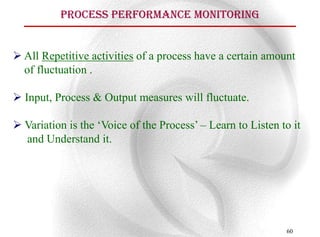
Process Performance Monitoring


 All Repetitive activities of a process have a certain amount
  of fluctuation .

 Input, Process & Output measures will fluctuate.

 Variation is the „Voice of the Process‟ – Learn to Listen to it
  and Understand it.


                                                             60
BPMS
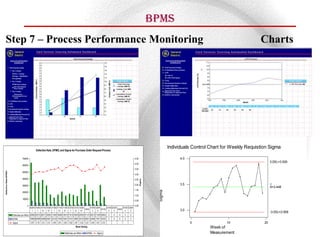
Step 7 – Process Performance Monitoring                                                                                                                                                                                                             Charts


                                                                                                                                                                                                         Individuals Control Chart for Weekly Requistion Sigma
                                                 Defective Rate, DPMO, and Sigma for Purchase Order Request Process

                                700000                                                                                                                                           4.50                          4.0
                                                                                                                                                                                                                                                           3.0SL=3.939
                                                                                                                                                                                 4.00
                                600000
                                                                                                                                                                                 3.50
Defective Rate/DPMO


                                500000
                                                                                                                                                                                 3.00
                                400000
                                                                                                                                                                                        Sigma


                                                                                                                                                                                 2.50

                                300000                                                                                                                                           2.00                          3.5
                                                                                                                                                                                                                                                           X=3.448
                                                                                                                                                                                 1.50
                                                                                                                                                                                                 Sigma


                                200000
                                                                                                                                                                                 1.00
                                100000
                                                                                                                                                                                 0.50

                                      0                                                                                                                                          0.00
                                          9/28/0 10/5/0 10/19/ 10/26/ 11/9/0 11/16/ 11/30/ 12/7/0 12/14/ 12/28/        1/18/0 1/25/0        2/15/0 2/22/0        3/15/0 3/29/0
                                                                                                                1/4/02               2/1/02               3/8/02
                                             1     1     01     01      1     01     01      1     01     01              2      2             2      2             2      2                                   3.0
                                                                                                                                                                                                                                                           -3.0SL=2.958
                      Defectives per Million 63809 34574 38271 30000 11842 16666 14814 17613 16000 25000 31147 22413 71429 30833              0      0      0      0      0
                      DPMO                70899 46099 43896 34921 24123 17490 16461 10101 8889 34722 38251 23946 7937 33333                   0      0      0      0      0
                      Sigma                2.97 3.18     3.21 3.31     3.48 3.61     3.63 3.82 3.87       3.32 3.27     3.48 3.91 3.33                                                                               0              10                20
                                                                                                    Week Ending                                                                                                              Week of
                                                                                      Defectives per Million      DPMO          Sigma                                                                                        Measurement                             61
BPMS

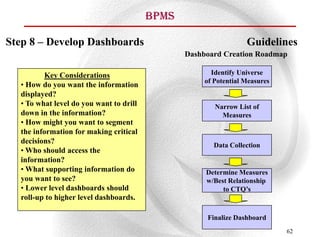
Step 8 – Develop Dashboards                                       Guidelines
                                                Dashboard Creation Roadmap

         Key Considerations                            Identify Universe
                                                     of Potential Measures
  • How do you want the information
  displayed?
  • To what level do you want to drill                  Narrow List of
  down in the information?                                Measures
  • How might you want to segment
  the information for making critical
  decisions?
                                                       Data Collection
  • Who should access the
  information?
  • What supporting information do                   Determine Measures
  you want to see?                                   w/Best Relationship
  • Lower level dashboards should                         to CTQ’s
  roll-up to higher level dashboards.

                                                     Finalize Dashboard
                                                                             62
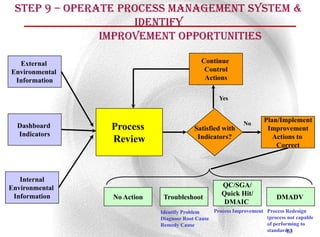
Step 9 – Operate Process Management System &
                    Identify
               Improvement Opportunities

  External                                  Continue
Environmental                                Control
 Information                                 Actions

                                                   Yes


                                                            No
                                                                    Plan/Implement
  Dashboard     Process                  Satisfied with              Improvement
  Indicators                              Indicators?                  Actions to
                Review
                                                                        Correct


   Internal
Environmental                                      QC/SGA/
 Information                                       Quick Hit/
                No Action    Troubleshoot                                DMADV
                                                   DMAIC
                            Identify Problem    Process Improvement Process Redesign
                            Diagnose Root Cause                     (process not capable
                            Remedy Cause                            of performing to
                                                                    standards)
                                                                             63
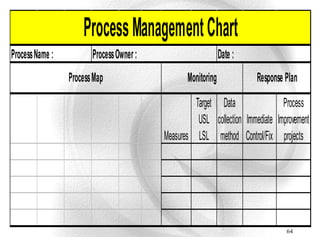
Process Management Chart
Process Name :          Process Owner :                       Date :
                 Process Map                     Monitoring            Response Plan

                                                   Target Data                 Process
                                                    USL collection Immediate Improvement
                                          Measures LSL method Control/Fix projects


                                                                                64
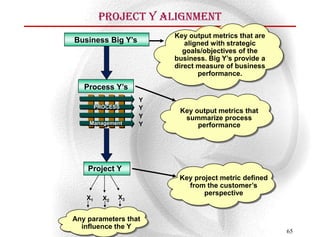
Project Y Alignment
                        Key output metrics that are
Business Big Y’s           aligned with strategic
                           goals/objectives of the
                        business. Big Y’s provide a
                        direct measure of business
                               performance.
   Process Y’s
                    Y
        PROCESS     Y
                         Key output metrics that
                    Y     summarize process
    Management      Y         performance


    Project Y
                         Key project metric defined
                           from the customer’s
                                perspective
   X1     X2   X3


Any parameters that
  influence the Y
                                                      65
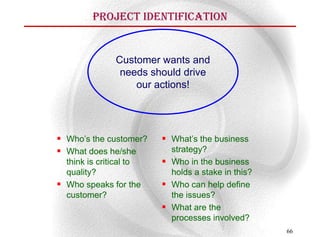
Project Identification


               Customer wants and
                needs should drive
                   our actions!


 Who’s the customer?     What’s the business
 What does he/she         strategy?
  think is critical to    Who in the business
  quality?                 holds a stake in this?
 Who speaks for the      Who can help define
  customer?                the issues?
                          What are the
                           processes involved?
                                                    66
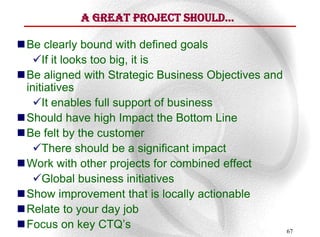
A GreAt Project Should…

 Be clearly bound with defined goals
    If it looks too big, it is
 Be aligned with Strategic Business Objectives and
  initiatives
    It enables full support of business
 Should have high Impact the Bottom Line
 Be felt by the customer
    There should be a significant impact
 Work with other projects for combined effect
    Global business initiatives
 Show improvement that is locally actionable
 Relate to your day job
 Focus on key CTQ’s                                  67
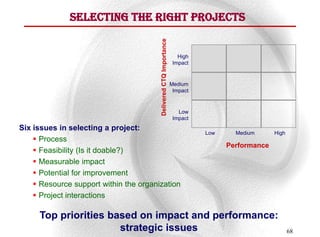
Selecting the Right Projects


                                        Delivered CTQ Importance
                                                                      High
                                                                    Impact


                                                                   Medium
                                                                    Impact


                                                                      Low
                                                                    Impact
Six issues in selecting a project:
                                                                             Low     Medium      High
     Process
                                                                                   Performance
     Feasibility (Is it doable?)
     Measurable impact
     Potential for improvement
     Resource support within the organization
     Project interactions

     Top priorities based on impact and performance:
                      strategic issues                                                                  68
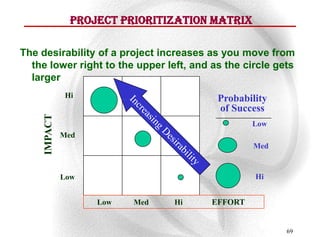
Project Prioritization Matrix

The desirability of a project increases as you move from
  the lower right to the upper left, and as the circle gets
  larger
              Hi                          Probability
                                          of Success
     IMPACT


                                                  Low
              Med
                                                  Med


              Low                                 Hi


                    Low   Med    Hi      EFFORT


                                                         69
Project Selection
• Success Factors
   – Project scope is manageable
   – Project has identifiable defect
   – Project has identifiable impact
   – Adequate buy-in from key stakeholders
• To Be Successful…
   – Set up project charter and have it reviewed
   – Measure where defects occur in the process
   – Assess and quantify potential impact up front
   – Perform stakeholder analysis
• Common Pitfalls
   – Inadequately resourcing the project
   – Duplicating another project
   – Losing project momentum
   – Picking the easy Y, not the critical Y
• Avoiding Pitfalls
   – Identify and get committed resources up front
   – Research the project database and translate from other projects where
     possible
   – Set up milestones and a communications plan                             70
A Good Project

A good project:
  – Problem and Goal Statements are clearly stated
  – Defect and opportunity definition is clearly understood
  – Does not presuppose a solution
  – Clearly relates to customers and their requirements
  – Aligns to the business strategy
  – Uses the tools effectively
  – Is data driven


                                                          71
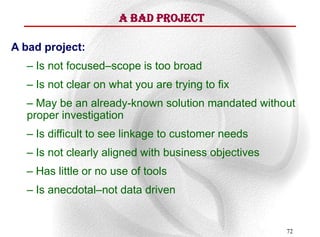
A Bad Project

A bad project:
  – Is not focused–scope is too broad
  – Is not clear on what you are trying to fix
  – May be an already-known solution mandated without
  proper investigation
  – Is difficult to see linkage to customer needs
  – Is not clearly aligned with business objectives
  – Has little or no use of tools
  – Is anecdotal–not data driven


                                                      72
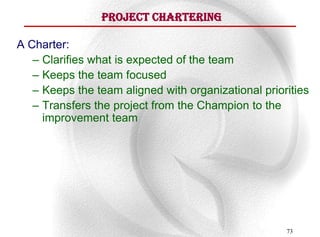
Project Chartering

A Charter:
   – Clarifies what is expected of the team
   – Keeps the team focused
   – Keeps the team aligned with organizational priorities
   – Transfers the project from the Champion to the
     improvement team


                                                     73
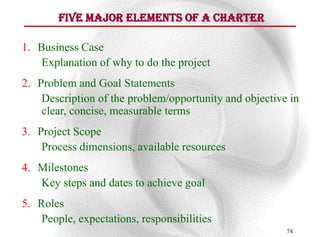
Five Major Elements Of A Charter

1. Business Case
    Explanation of why to do the project
2. Problem and Goal Statements
    Description of the problem/opportunity and objective in
    clear, concise, measurable terms
3. Project Scope
    Process dimensions, available resources
4. Milestones
   Key steps and dates to achieve goal
5. Roles
    People, expectations, responsibilities
                                                        74
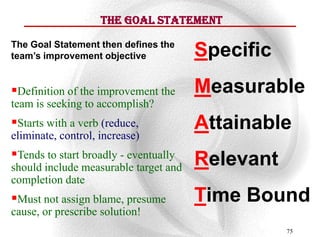
The Goal Statement

The Goal Statement then defines the
team’s improvement objective           Specific
Definition of the improvement the     Measurable
team is seeking to accomplish?
Starts with a verb (reduce,           Attainable
eliminate, control, increase)
Tends to start broadly - eventually   Relevant
should include measurable target and
completion date
Must not assign blame, presume        Time Bound
cause, or prescribe solution!
                                                  75
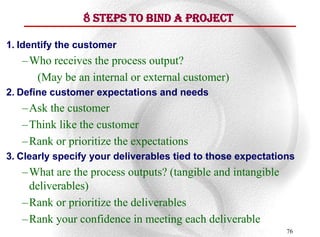
8 Steps To Bind A Project

1. Identify the customer
   – Who receives the process output?
      (May be an internal or external customer)
2. Define customer expectations and needs
   – Ask the customer
   – Think like the customer
   – Rank or prioritize the expectations
3. Clearly specify your deliverables tied to those expectations
   – What are the process outputs? (tangible and intangible
     deliverables)
   – Rank or prioritize the deliverables
   – Rank your confidence in meeting each deliverable
                                                              76
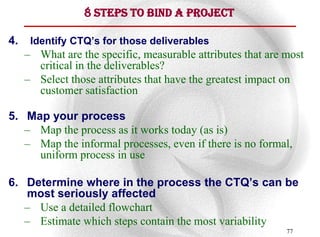
8 Steps To Bind A Project

4.    Identify CTQ’s for those deliverables
     – What are the specific, measurable attributes that are most
       critical in the deliverables?
     – Select those attributes that have the greatest impact on
       customer satisfaction

5. Map your process
   – Map the process as it works today (as is)
   – Map the informal processes, even if there is no formal,
     uniform process in use

6. Determine where in the process the CTQ’s can be
   most seriously affected
   – Use a detailed flowchart
   – Estimate which steps contain the most variability
                                                             77
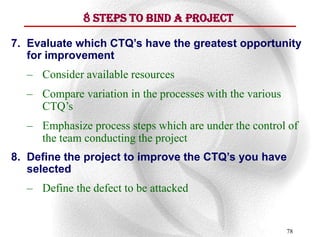
8 Steps To Bind A Project

7. Evaluate which CTQ’s have the greatest opportunity
   for improvement
  – Consider available resources
  – Compare variation in the processes with the various
    CTQ‟s
  – Emphasize process steps which are under the control of
    the team conducting the project
8. Define the project to improve the CTQ’s you have
   selected
  – Define the defect to be attacked


                                                          78
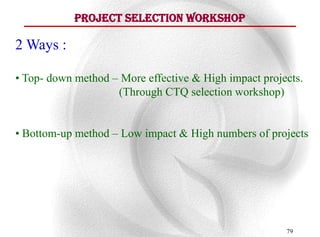
Project Selection Workshop

2 Ways :

• Top- down method – More effective & High impact projects.
                    (Through CTQ selection workshop)


• Bottom-up method – Low impact & High numbers of projects


                                                       79
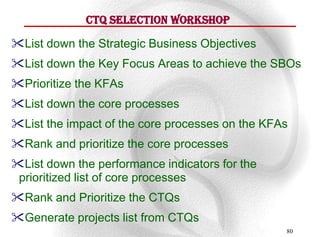
CTQ Selection Workshop

List down the Strategic Business Objectives
List down the Key Focus Areas to achieve the SBOs
Prioritize the KFAs
List down the core processes
List the impact of the core processes on the KFAs
Rank and prioritize the core processes
List down the performance indicators for the
 prioritized list of core processes
Rank and Prioritize the CTQs
Generate projects list from CTQs
                                                 80
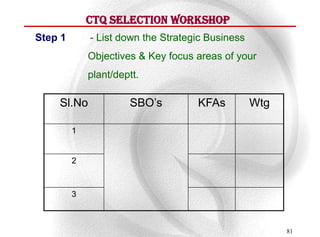
CTQ Selection Workshop
Step 1       - List down the Strategic Business
             Objectives & Key focus areas of your
             plant/deptt.

    Sl.No             SBO’s         KFAs          Wtg

         1


         2


         3


                                                        81
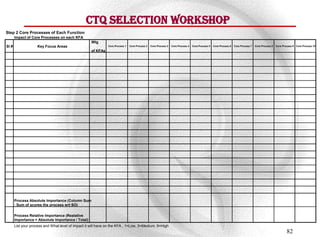
CTQ Selection Workshop
Step 2 Core Processes of Each Function
       Impact of Core Processes on each KFA
                                                    Wtg
Sl #                Key Focus Areas                            Core Process 1   Core Process 2   Core Process 3   Core Process 4   Core Process 5   Core Process 6   Core Process 7   Core Process 8   Core Process 9 Core Process 10

                                                    of KFAs


       Process Absolute Importance (Column Sum
       : Sum of scores the process wrt SO)

       Process Relative Importance (Realative
       Importance = Absolute Importance / Total)
       List your process and What level of impact it will have on the KFA , 1=Low, 3=Medium, 9=High
                                                                                                                                                                                                               82
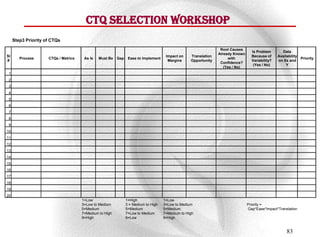
CTQ Selection Workshop
     Step3 Priority of CTQs
                                                                                                                 Root Causes
                                                                                                                                  Is Problem       Data
                                                                                                                Already Known
Sl                                                                                   Impact on    Translation                     Because of     Availability
        Process      CTQs / Metrics    As Is   Must Be   Gap    Ease to Implement                                    with                                     Priority
#                                                                                     Margins     Opportunity                     Variability?   on Xs and
                                                                                                                 Confidence?
                                                                                                                                   (Yes / No)         Y
                                                                                                                   (Yes / No)
 1
 2
 3
 4
 5
 6
 7
 8
 9
10
11
12
13
14
15
16
17
18
19
20
                                      1=Low                    1=High               1=Low
                                      3=Low to Medium          3 = Medium to High   3=Low to Medium                             Priority =
                                      5=Medium                 5=Medium             5=Medium                                    Gap*Ease*Impact*Translation
                                      7=Medium to High         7=Low to Medium      7=Medium to High
                                      9=High                   9=Low                9=High


                                                                                                                                                      83
CTQ Selection Workshop
Step-4 :


               List of projects


                                    84
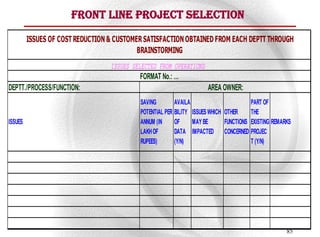
Front line Project Selection

         ISSUES OF COST REDUCTION & CUSTOMER SATISFACTION OBTAINED FROM EACH DEPTT THROUGH
                                           BRAINSTORMING
                                  ISSUES SELECTED FROM OPERATIONS
                                            FORMAT No.: …
DEPTT./PROCESS/FUNCTION:                                             AREA OWNER:
                                           SAVING        AVAILA                        PART OF
                                           POTENTIAL PER BILITY ISSUES WHICH OTHER     THE
ISSUES                                     ANNUM (IN     OF     MAY BE       FUNCTIONS EXISTING REMARKS
                                           LAKH OF       DATA IMPACTED CONCERNED PROJEC
                                           RUPEES)       (Y/N)                         T (Y/N)


                                                                                                     85
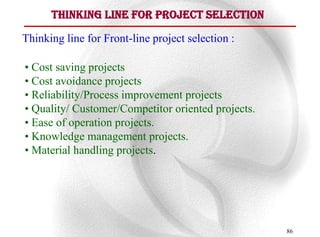
Thinking line for Project Selection

Thinking line for Front-line project selection :

• Cost saving projects
• Cost avoidance projects
• Reliability/Process improvement projects
• Quality/ Customer/Competitor oriented projects.
• Ease of operation projects.
• Knowledge management projects.
• Material handling projects.


                                                    86
Production
 cycle time


              87
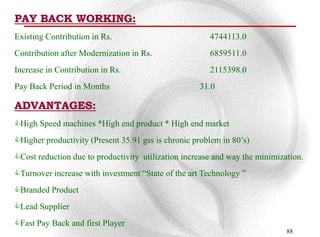
PAY BACK WORKING:
Existing Contribution in Rs.                           4744113.0
Contribution after Modernization in Rs.                6859511.0
Increase in Contribution in Rs.                        2115398.0
Pay Back Period in Months                           31.0

ADVANTAGES:
High Speed machines *High end product * High end market
Higher productivity (Present 35.91 gss is chronic problem in 80‟s)
Cost reduction due to productivity utilization increase and way the minimization.
Turnover increase with investment “State of the art Technology ”
Branded Product
Lead Supplier
Fast Pay Back and first Player
                                                                             88
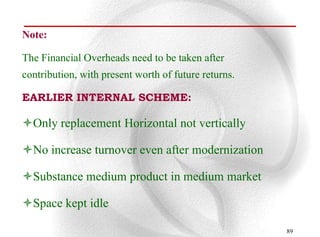
Note:

The Financial Overheads need to be taken after
contribution, with present worth of future returns.

EARLIER INTERNAL SCHEME:

Only replacement Horizontal not vertically

No increase turnover even after modernization

Substance medium product in medium market

Space kept idle

                                                      89
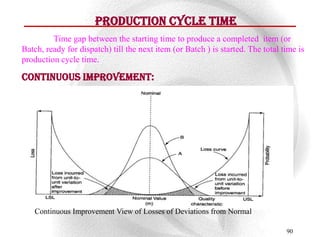
PRODUCTION CYCLE TIME
         Time gap between the starting time to produce a completed item (or
Batch, ready for dispatch) till the next item (or Batch ) is started. The total time is
production cycle time.

CONTINUOUS IMPROVEMENT:


   Continuous Improvement View of Losses of Deviations from Normal

                                                                                 90
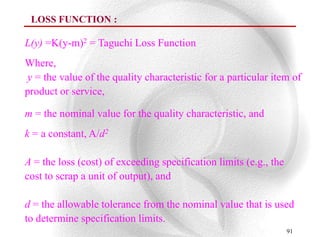
LOSS FUNCTION :

L(y) =K(y-m)2 = Taguchi Loss Function
Where,
y = the value of the quality characteristic for a particular item of
product or service,

m = the nominal value for the quality characteristic, and
k = a constant, A/d2

A = the loss (cost) of exceeding specification limits (e.g., the
cost to scrap a unit of output), and

d = the allowable tolerance from the nominal value that is used
to determine specification limits.
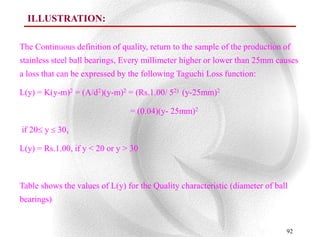
                                                                   91
ILLUSTRATION:

The Continuous definition of quality, return to the sample of the production of
stainless steel ball bearings, Every millimeter higher or lower than 25mm causes
a loss that can be expressed by the following Taguchi Loss function:

L(y) = K(y-m)2 = (A/d2)(y-m)2 = (Rs.1.00/ 52) (y-25mm)2

                                = (0.04)(y- 25mm)2

if 20 y 30,

L(y) = Rs.1.00, if y < 20 or y > 30


Table shows the values of L(y) for the Quality characteristic (diameter of ball
bearings)


                                                                              92
ORDERING TIME, SETUP
   TIME, OPTIMUM
    PRODUCTION
     QUANTITY
                  93
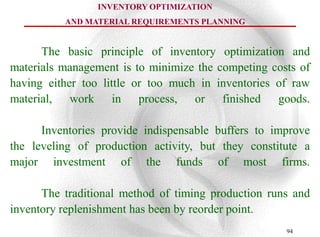
INVENTORY OPTIMIZATION
          AND MATERIAL REQUIREMENTS PLANNING


      The basic principle of inventory optimization and
materials management is to minimize the competing costs of
having either too little or too much in inventories of raw
material, work in process, or finished goods.

      Inventories provide indispensable buffers to improve
the leveling of production activity, but they constitute a
major investment of the funds of most firms.

      The traditional method of timing production runs and
inventory replenishment has been by reorder point.
                                                     94
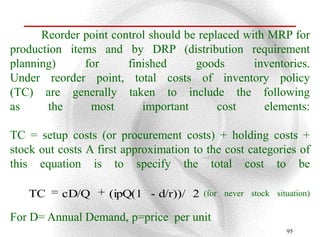
Reorder point control should be replaced with MRP for
production items and by DRP (distribution requirement
planning)     for      finished      goods       inventories.
Under reorder point, total costs of inventory policy
(TC) are generally taken to include the following
as      the    most       important       cost     elements:

TC = setup costs (or procurement costs) + holding costs +
stock out costs A first approximation to the cost categories of
this equation is to specify the total cost to be

   TC     cD/Q      (ipQ(1 - d/r))/ 2   (for never stock situation)

For D= Annual Demand, p=price per unit
                                                             95
The procurement or setup cost is “c” dollars per order,
and   the    order   or   production    run    amount    is    “Q”
units per batch. If the item is produced, it is at a daily rate of
“r”    and     depleted    at    a     daily   rate     of     “d”.


      The value for the effective rate of interest, i, is often
taken to be about 30 percent, to include the opportunity cost of
capital. insurance, obsolescence, and other costs of holding.

                                                              96
Economical Production Quantity (EPQ):


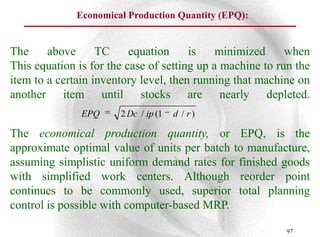
The     above      TC     equation     is    minimized     when
This equation is for the case of setting up a machine to run the
item to a certain inventory level, then running that machine on
another item until stocks are nearly depleted.
               EPQ     2 Dc / ip (1   d / r)

The economical production quantity, or EPQ, is the
approximate optimal value of units per batch to manufacture,
assuming simplistic uniform demand rates for finished goods
with simplified work centers. Although reorder point
continues to be commonly used, superior total planning
control is possible with computer-based MRP.

                                                           97
INVENTORY THEORY AND MODELING:
          Proper control of inventory requires a delicate balance and careful, detailed
planning. To the controller who sees funds tied up in material in the warehouse, work-
in- process inventory, and finished goods not shipped, the natural reaction is that
inventories are too high. To the production superintendent faced with the prospect of
interrupted deliveries or silent production lines due to inadequate raw, in-process, or
finished materials, the response must be that inventories are too low. Therefore, a
balance is needed between holding large quantities to satisfy the latter and frequent
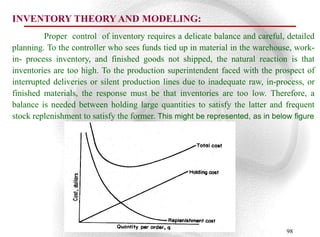
stock replenishment to satisfy the former. This might be represented, as in below figure


                                                                               98
If the replenishment quantity q is represented on one axis and the total

inventory cost in dollars is represented on the other.

         Many reasons exist for keeping inventory. They include: to improve

customer service; to hedge against demand surges and variation of production

level; to take advantage of favorable prices; to ensure against error and loss; and

to avoid production stoppage.

         Overproduction for any of these reasons can, on the other hand, increase

costs   through    high    investment    and    low      capital   turnover,   material

obsolescence, spoilage an deterioration, storage and handling excesses,            and

inefficient use of space due to overcrowding.


                                                                                   99
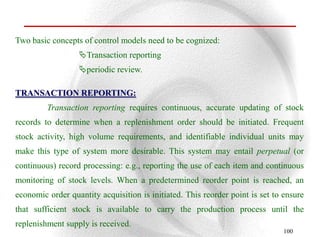
Two basic concepts of control models need to be cognized:
                  Transaction reporting
                  periodic review.

TRANSACTION REPORTING:
         Transaction reporting requires continuous, accurate updating of stock
records to determine when a replenishment order should be initiated. Frequent
stock activity, high volume requirements, and identifiable individual units may
make this type of system more desirable. This system may entail perpetual (or
continuous) record processing: e.g., reporting the use of each item and continuous
monitoring of stock levels. When a predetermined reorder point is reached, an
economic order quantity acquisition is initiated. This reorder point is set to ensure
that sufficient stock is available to carry the production process until the
replenishment supply is received.
                                                                               100
PERIODIC REVIEW:

         A second concept is that records will be reviewed periodically
(weekly, monthly, quarterly, etc.) and if the level of inventory for that ; item has
fallen below a certain target level, anew ) order will be placed. If it has not, the
record will be , returned to the file for review again at the end of the next period.
Target levels, period lengths, and e replenishment quantities are dependent on
frequency of use, replenishment lead time, and criticality of item. This system is
usually more difficult to establish but results in lower clerical cost to maintain stock
control. Both transaction reporting and periodic review systems can be maintained
manually or by computer, if the inventory system is of sufficient size to warrant
computer control.

EXAMPLE:
         A manufacturer uses wooden pallets for unit load shipping of the product.
These pallets are used regularly at rate of 100 per month and purchased from a
vendor Rs. 3.50 per pallet. They are stored in an unheated but covered shed until
needed, 19 and it is estimated that it costs 20 percent of the unit value to pay for the
investment and storage costs.
                                                                                101
A fixed cost of 150 in clerical time and processing is incurred every time a
replenishment order is processed. If pallets are available when needed, re -handling
of the unit load of final product is necessary at a cost of Rs10 per unit. Delivery
normally takes from 6 to 10 days from the time of order, and 6, 7, 8, 9, or 10 days are
equally likely. To determine the EOQ, the following is considered:


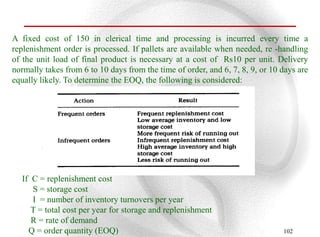
  If C = replenishment cost
     S = storage cost
     I = number of inventory turnovers per year
     T = total cost per year for storage and replenishment
     R = rate of demand
    Q = order quantity (EOQ)                                                   102
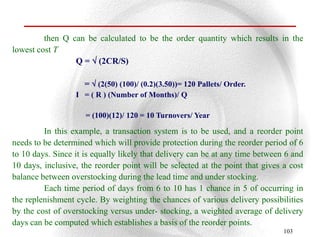
then Q can be calculated to be the order quantity which results in the
lowest cost T
                 Q = (2CR/S)

                     = (2(50) (100)/ (0.2)(3.50))= 120 Pallets/ Order.
                  I = ( R ) (Number of Months)/ Q

                     = (100)(12)/ 120 = 10 Turnovers/ Year

         In this example, a transaction system is to be used, and a reorder point
needs to be determined which will provide protection during the reorder period of 6
to 10 days. Since it is equally likely that delivery can be at any time between 6 and
10 days, inclusive, the reorder point will be selected at the point that gives a cost
balance between overstocking during the lead time and under stocking.
         Each time period of days from 6 to 10 has 1 chance in 5 of occurring in
the replenishment cycle. By weighting the chances of various delivery possibilities
by the cost of overstocking versus under- stocking, a weighted average of delivery
days can be computed which establishes a basis of the reorder points.
                                                                               103
In this example it may be computed as follows:
Number of items demanded per day = 100/20* = 5 .
*20 days assumes a 5-day workweek
Average cost of overstocking = (5)( 3.50)(1/5)(x- 5)

where x = delivery period between 6 to 10 days
Average cost of under stocking =(10 X 1/5)[10-(x -5)]

Solving for x as the point where the weighted-average overstocking
cost equals the weighted-average under stocking cost:
        (5)(3.50)(1/5)(x- 5) = (10)(1/5)(10 -x)
                3.5x- 17.5 = 20 -2x
                       5.5x = 37.5
                          x= 6.8
                                                               104
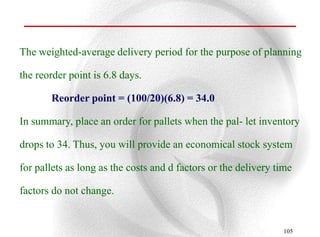
The weighted-average delivery period for the purpose of planning

the reorder point is 6.8 days.

       Reorder point = (100/20)(6.8) = 34.0

In summary, place an order for pallets when the pal- let inventory

drops to 34. Thus, you will provide an economical stock system

for pallets as long as the costs and d factors or the delivery time

factors do not change.


                                                                105
Pay back time


                106
PAYBACK TIME
Payback Time is a rough – and – ready model that is looked upon disdain by
many academic theorists . Payback sometimes called payout or payoff. Yet pay
back is most widely used decision model, and it certainly is an improvement over
the criterion of urgency or postponability.

Further more, it is a handy device

    a. Where precision in estimates of profitability is not crucial and
        preliminary screening of a rash of proposals is necessary

    b. Where a weak cash and –credit position has a heavy bearing on the
        selection of investment possibilities and

    c. Where the contemplated project is extremely risky.

                                                                         107
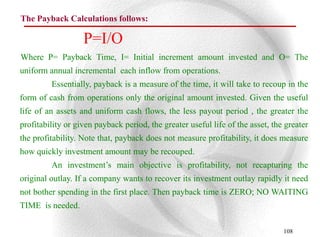
The Payback Calculations follows:

                   P=I/O
Where P= Payback Time, I= Initial increment amount invested and O= The
uniform annual incremental each inflow from operations.
         Essentially, payback is a measure of the time, it will take to recoup in the
form of cash from operations only the original amount invested. Given the useful
life of an assets and uniform cash flows, the less payout period , the greater the
profitability or given payback period, the greater useful life of the asset, the greater
the profitability. Note that, payback does not measure profitability, it does measure
how quickly investment amount may be recouped.
         An investment‟s main objective is profitability, not recapturing the
original outlay. If a company wants to recover its investment outlay rapidly it need
not bother spending in the first place. Then payback time is ZERO; NO WAITING
TIME is needed.

                                                                                108
The Major weakness of the payback model is its neglect the
profitability.
    Continuous Technological up gradation is required to be in
    the competition.
    The profit earned is ploughed back, with additional
    investment in order to enhance the growth of the organization
    Such options involves various alternatives and working for
    return on investment.
    Firstly the technical feasibility is examined reliably
    predication is a valuable activity to design reliable systems.
    Failure have to be identified and proacted
    System need to be designed that is robust
                                                                109
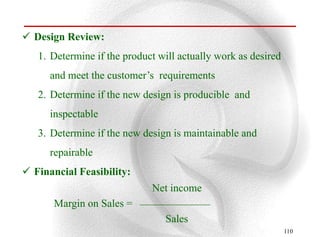
 Design Review:
   1. Determine if the product will actually work as desired
      and meet the customer‟s requirements
   2. Determine if the new design is producible and
      inspectable
   3. Determine if the new design is maintainable and
      repairable
 Financial Feasibility:
                             Net income
       Margin on Sales =
                                Sales
                                                               110
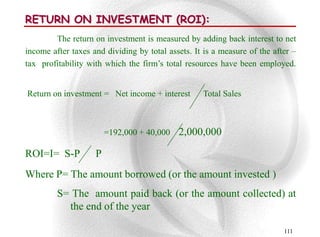
RETURN ON INVESTMENT (ROI):
        The return on investment is measured by adding back interest to net
income after taxes and dividing by total assets. It is a measure of the after –
tax profitability with which the firm‟s total resources have been employed.


Return on investment = Net income + interest       Total Sales


                        =192,000 + 40,000   2,000,000

ROI=I= S-P          P
Where P= The amount borrowed (or the amount invested )
         S= The amount paid back (or the amount collected) at
           the end of the year

                                                                           111
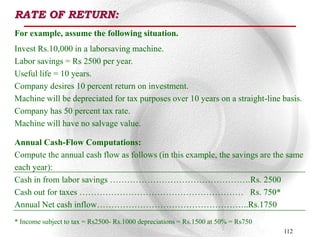
RATE OF RETURN:
For example, assume the following situation.
Invest Rs.10,000 in a laborsaving machine.
Labor savings = Rs 2500 per year.
Useful life = 10 years.
Company desires 10 percent return on investment.
Machine will be depreciated for tax purposes over 10 years on a straight-line basis.
Company has 50 percent tax rate.
Machine will have no salvage value.

Annual Cash-Flow Computations:
Compute the annual cash flow as follows (in this example, the savings are the same
each year):
Cash in from labor savings ………………………………………….Rs. 2500
Cash out for taxes ………………………………………………… Rs. 750*
Annual Net cash inflow……………………………………………..Rs.1750
* Income subject to tax = Rs2500- Rs.1000 depreciations = Rs.1500 at 50% = Rs750
                                                                                   112
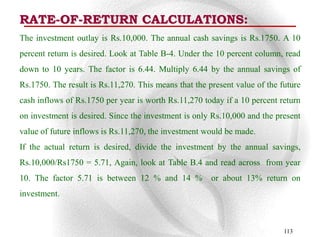
RATE-OF-RETURN CALCULATIONS:
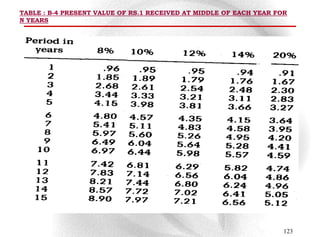
The investment outlay is Rs.10,000. The annual cash savings is Rs.1750. A 10
percent return is desired. Look at Table B-4. Under the 10 percent column, read
down to 10 years. The factor is 6.44. Multiply 6.44 by the annual savings of
Rs.1750. The result is Rs.11,270. This means that the present value of the future
cash inflows of Rs.1750 per year is worth Rs.11,270 today if a 10 percent return
on investment is desired. Since the investment is only Rs.10,000 and the present
value of future inflows is Rs.11,270, the investment would be made.
If the actual return is desired, divide the investment by the annual savings,
Rs.10,000/Rs1750 = 5.71, Again, look at Table B.4 and read across from year
10. The factor 5.71 is between 12 % and 14 %           or about 13% return on
investment.


                                                                            113
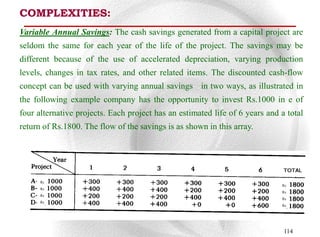
COMPLEXITIES:
Variable Annual Savings: The cash savings generated from a capital project are
seldom the same for each year of the life of the project. The savings may be
different because of the use of accelerated depreciation, varying production
levels, changes in tax rates, and other related items. The discounted cash-flow
concept can be used with varying annual savings in two ways, as illustrated in
the following example company has the opportunity to invest Rs.1000 in e of
four alternative projects. Each project has an estimated life of 6 years and a total
return of Rs.1800. The flow of the savings is as shown in this array.


      Rs
                                                                             Rs
      Rs
                                                                             Rs
      Rs
                                                                             Rs
      Rs
                                                                             Rs


                                                                              114
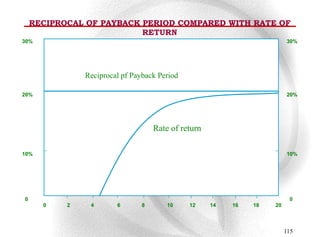
RECIPROCAL OF PAYBACK PERIOD COMPARED WITH RATE OF
                          RETURN
30%                                                                      30%


               Reciprocal pf Payback Period

20%                                                                      20%


                                    Rate of return

10%                                                                      10%


0                                                                         0
      0    2    4       6       8       10    12     14   16   18   20


                                                                         115
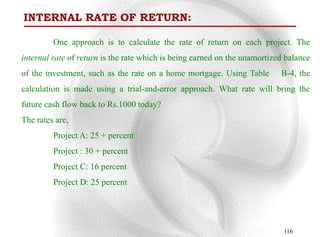
INTERNAL RATE OF RETURN:

         One approach is to calculate the rate of return on each project. The
internal rate of return is the rate which is being earned on the unamortized balance
of the investment, such as the rate on a home mortgage. Using Table        B-4, the
calculation is made using a trial-and-error approach. What rate will bring the
future cash flow back to Rs.1000 today?
The rates are,
         Project A: 25 + percent
         Project : 30 + percent
         Project C: 16 percent
         Project D: 25 percent


                                                                            116
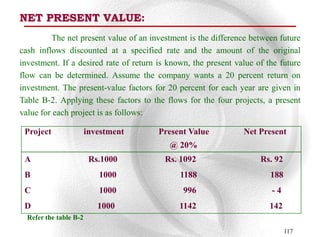
NET PRESENT VALUE:
         The net present value of an investment is the difference between future
cash inflows discounted at a specified rate and the amount of the original
investment. If a desired rate of return is known, the present value of the future
flow can be determined. Assume the company wants a 20 percent return on
investment. The present-value factors for 20 percent for each year are given in
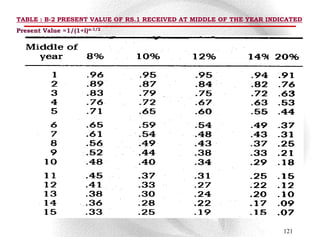
Table B-2. Applying these factors to the flows for the four projects, a present
value for each project is as follows:

 Project                investment      Present Value           Net Present
                                           @ 20%
 A                       Rs.1000         Rs. 1092                    Rs. 92
 B                         1000               1188                      188
 C                         1000                996                      -4
 D                         1000               1142                      142
  Refer the table B-2
                                                                              117
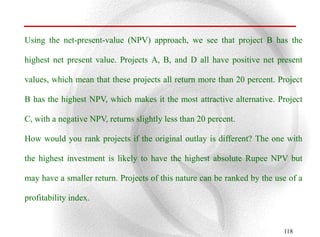
Using the net-present-value (NPV) approach, we see that project B has the

highest net present value. Projects A, B, and D all have positive net present

values, which mean that these projects all return more than 20 percent. Project

B has the highest NPV, which makes it the most attractive alternative. Project

C, with a negative NPV, returns slightly less than 20 percent.

How would you rank projects if the original outlay is different? The one with

the highest investment is likely to have the highest absolute Rupee NPV but

may have a smaller return. Projects of this nature can be ranked by the use of a

profitability index.


                                                                          118
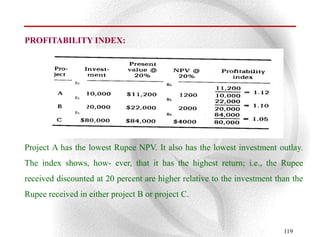
PROFITABILITY INDEX:


              Rs.                        Rs.


              Rs.                        Rs.


              Rs.                        Rs.


Project A has the lowest Rupee NPV. It also has the lowest investment outlay.
The index shows, how- ever, that it has the highest return; i.e., the Rupee
received discounted at 20 percent are higher relative to the investment than the
Rupee received in either project B or project C.


                                                                          119
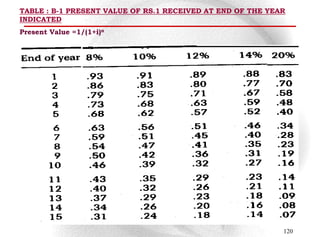
TABLE : B-1 PRESENT VALUE OF RS.1 RECEIVED AT END OF THE YEAR
INDICATED
Present Value =1/(1+i)n


                                                            120
TABLE : B-2 PRESENT VALUE OF RS.1 RECEIVED AT MIDDLE OF THE YEAR INDICATED
Present Value =1/(1+i)n-1/2


                                                                     121
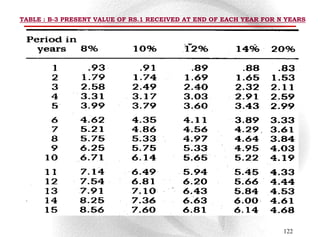
TABLE : B-3 PRESENT VALUE OF RS.1 RECEIVED AT END OF EACH YEAR FOR N YEARS


                                                                    122
TABLE : B-4 PRESENT VALUE OF RS.1 RECEIVED AT MIDDLE OF EACH YEAR FOR
N YEARS


                                                                    123
Emulating

  the bench mark of

Koba Yashi – Mitsubishi

    Success Model


                          124
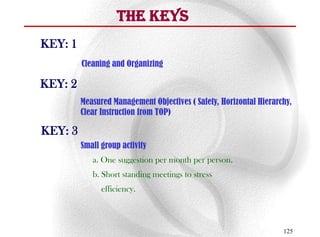
The Keys
KEY: 1
         Cleaning and Organizing

KEY: 2
         Measured Management Objectives ( Safety, Horizontal Hierarchy,
         Clear Instruction from TOP)

KEY: 3
         Small group activity
            a. One suggestion per month per person.
            b. Short standing meetings to stress
               efficiency.


                                                                    125
126
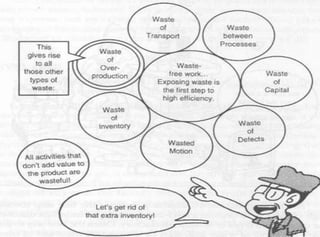
KEY: 4

Reducing Inventory. (Work - in - Progress)

   a. All activity that don’t add value to product are
   wasteful.


                                                         127
128
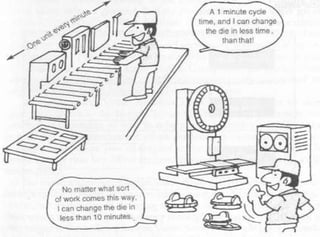
KEY: 5

  QUICK CHANGEOVER TECHNOLOGY
         a. Any one should be able to perform a quick
           changeover ever in new environments.

         b. Accept the change to shorten all changeovers
           to less than one cycle time.


                                                           129
130
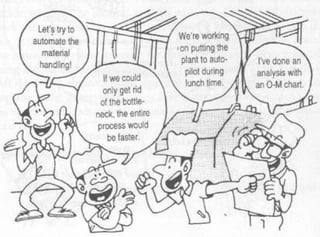
KEY: 6

 Value Analysis of Manufacturing Methods (Improvement in Methods)

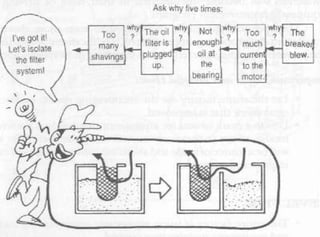
         a. Ask “WHY” five times for every motion of
            activity.
         b. Modular a management of predetermined
            Time standards
               (i) Material Handling Method


                                                           131
132
KEY: 7

    Zero Monitor Production


            a. Monitoring is a form of Waste
            b. Watching the running machine?


                                               133
134
KEY: 8

    Integrating Functions


            a. Reduce the inventory at the joining points.
            b. Reduce the “Joints” and make seamless.
            c. Planned Maintenance activity.


                                                             135
136
KEY: 9

   Maintaining Machines and Equipment


           a. Prepare Preventive maintenance group
           b. Full employee involvement in study groups


                                                          137
138
139
KEY: 10

   WORK FLOOR TIME POLICES


           Encourage the workers to do the next day’s
            preparation before they go home at night.


                                                 140
141
KEY: 11

   QUALITY ASSURANCE SYSTEM


           Next process is customer.
           No bad product to the next process.
           Workers perform inspection on their own
            product.


                                                  142
I’ll inspect what I make


      We must build quality
        in the processes
          themselves!


                              143
POKA YOKA


            144
KEY: 12

   DEVELOPING YOUR SUPPLIERS


           Treat external as internal division.
           Technical Support.


                                                   145
KEY: 13

  ELIMINATING WASTE WITH A “ TREASURE MOUNTAIN MAP”


           Only do those actions customer will pay.


                                                       146
147
KEY: 14

     EMPOWER WORKER TO MAKE IMPROVEMENTS


     Expand processing capability in the improvement corner.
     Building through Low-cost Automation Devices.


                                                        148
149
KEY: 15

SKILL VERSATALITY AND CROSS TRAINING


                                       150
151
KEY: 16


    PRODUCTION SCHEDULING


                            152
153
KEY: 17

               EFFICIENCY CONTROL

     Decide on standard times for each process.
     Compare the standard times to actual times.


                                                    154
155
KEY: 18

   USING MICROPROCESSORS

     Mechatronics.
     Learnt about sensors and how they are used.


                                                    156
157
KEY: 19

   CONSERVING ENERGY AND MATERIALS

     Quantify the importance of conservation by showing
      energy and material costs as a percentage of total costs.


                                                         158
159
KEY: 20

   LEADING TECHNOLOGY - SITE TECHNOLOGY

     There is no interest in the progress of the other players in
      the industry.
     People in the factory are content with the current site
      technology.
     The factory is about on par with the rest of the industry.


                                                             160
Eight wastes
Taiichi Ohno's original enumeration of the seven wastes plus
underutilized people. These are:

  1. Overproduction: Making more, "earlier, or faster than the next
     operation needs it.
  2. Waiting for the next process, worker, material, information, or
     equipment.
  3. Transportation: unnecessary transport of materials.
  4. Overprocessings of anything that does not add value.
  5. Inventories more than the absolute minimum required to meet
     customer demand.
  6. Motion: unnecessary movement (like waiting) of people.
  7. Production of defective parts or information.
  8. Not fully utilizing employees brain power, skills, experience,
     talents and creativity.

                                                               161
Value stream
   mapping


               162
Value stream mapping – from rfq to delivery


       1. Determine the process family.

       2. Draw the current state map

       3. Create a future state map

       4. Develop the action plan to get to the
          improved future state.


                                                  163
Four steps to Value stream mapping

Step 1: product development

          Identify customer requirements,
          Define method of delivery, and
          Define typical quantity requirements.

 This value stream can serve more than one customer, but
 be sure to use similar primary processes. Use a pencil
 rather than a computer.


                                                     164
Step 2: process design
Perform an upstream walk-through for each process step, observing
and documenting as much of the following as possible.

        Cycle time (Operator and Machine cycle time)
        Changeover times,
        Average inventory queue,
        Average production batch size,
        Number of operations at each process,
        Package or container size,
        Available time (take out break and lunch times),
        Scrap rate,
        Machine up-time (availability), and
        Number of product variations.
                                                              165
Step 3: preparation
Record as much information as is pertinent in the process
description box.

Step 4: planning

      Develop a future state map,
      Dream about perfection (Imagineering),
      Think outside the box,
      Develop alternatives to the current state map that are
      muda free, and
      Focus on velocity.


                                                                166
1% error
Adds Directly
   to The
 Bottom Line

                167
1 % error Adds Directly to The Bottom Line

This business was very focused on its core processing activity, but less
focused on the support functions. One of these support functions was the
off-line handling and managing of its molds, which were quite fragile and
breakable.

This was considered to be a less important activity than production and, as
long as the molds were ready for production as required, Plant
Management largely ignored this activity.

Also, the budget for this section was relatively small; in anyone year they
would spend about $200,000 on the replacement of molds that were broken
off line. As this was only about 1% of costs, the activity was never
previously targeted in typical cost reduction programs.

                                                                    168
Contd…

As part of an operational review, this organization investigated its 1
%errors and this previously ignored cost.

A comparison with similar plants showed that it was possible to operate
with almost zero breakages and that the current expense could be
eliminated with better handling and management. The procedures from
the other plants were adopted to address the issue.

This resulted in breakages being almost eliminated. Focusing on this
previously ignored 1 % error and adopting simple procedural changes
added $200,000 to the bottom line.


                                                                 169
Process capability


                     170
PROCESS CAPABILITY RATIO


The concept of Process Capability Ratio (PCR), was defined as

                           PCR = USL – LSL / 6σ (two – sided)

For one – sided upper specifications only, the PCR is defined as

                           PCRU = USL -µ / 3σ (upper)

And for one – sided lower specifications only, the PCR id defined as

                           PCRL = µ - LSL / 3σ (Lower)

The PCR aids in the evaluation of processes with respect to their specification
limits.


                                                                          171
Recommended Minimum values of the Process Capability Ratio

                                Two – sided   One – Sided
                                Specification Specification

   Existing processes           1.33          1.25

   New processes                1.50          1.45

   Safety, strength, or critical 1.50         1.45
   parameter, existing
   process

   Safety, strength, or critical 1.67         1.60
   parameter, new process


                                                              172
173
Process follow out for a normally distributed characteristics (One-
sided specifications). For Two sided Double the value of Y- axis

                                                                        174
INDICES OF PROCESS CAPABILITY


 SHORT TERM CAPABILITY


                                175
LONG TERM CAPABILITY


                       176
Example: PCRs AS FRACTION NONCONFORMING

         PCRs      may     be     translated   into     an     expected   fraction
nonconforming, assuming a normal distribution for the characteristic of interest.
For instance , a PCR = 1.25 for a two –sided specification indicates that

                           PCR = USL – LSL / 6σ = 1.25

So that USL – LSL = 7.5σ and

                           Z = 3.75σ / σ = 3.75

More extensive tabulation from Normal Distribution Table, show that,

                           1 – Φ (3.75) = 0.000088

Since we are considering a two – sided specification, the expected fraction non
conforming is 2 (0.000088) = 0.00018. Currently, quality controllers are
concerned with parts per million (ppm) defective. For PCR = 1.25, we expect
180 ppm non conforming.
                                                                            177
THE SIGMA CONVERSION GUIDELINES

                                   FROM

                    Short - Term          Long - Term


     Short - Term
                      No Action               + 1.5
To


     Long - Term
                        - 1.5               No Action


                                                        178
Product quality


                  179
180
181
WHEN TO USE DPO AND WHEN DPU?

• e-dpo denotes the probability that an opportunity will not have a
defect.

• e-dpu denotes the probability that a unit will be defect free.

•In most practical situations, we have more than one CTQ (critical-
to-quality) characteristics associated with a product and hence
more than one opportunity of defect. Hence it is more rational to
use       e-dpo as a measure of yield.

• However, if the possible number of opportunities is infinitely
large, then e-dpu should be used as a measure of yield.
                                                                   182
PERFORMANCE MEASURES AT A GLANCE


    d:      Number of defects
    dpu:    Defects per unit
    dpo:    Defects per opportunities
    Dpmo: Defects per million opportunities
    Zst:    Short term sigma rating
    Zlt:    Long term sigma rating = Zst + 1.5
    Y tp:   Through put yield
    Y rt:   Rolled through put yield
    Cp:     Process capability (Potential) index
    Cpk:    Process capability (performance) index
    PPM:    Parts per million defects

                                                     183
Yes

      184
NO

     185
186
187
YIELD: THE CLASSICAL PERSPECTIVE
Y final == S / U
where Y final == Final yield
U == Number of units tested
S == Number of units that pass
Is the classical calculation of yield con-elated to other- major business metrics?


-Yield has always been considered a very important metric for guiding the
business; however, no correlation is observed between yield and profit
margin. How can this be explained?

                                                                           188
IDEA OF ROLLED THROUGHPUT YIELD

 Suppose we say that there are 5 key tasks which must be executed (
  without error) in order to successfully prepare a report, viz writing,
  typing, Xeroxing, collating and binding .

 Suppose that each of these tasks are operated at 3σ level. The
  probability of not getting a defect at any of these stages is 0.9973.

 Then the probability of preparing an error free report is given by 0.9973 x
  0.9973 x 0.9973 x 0.9973 x 0.9973 = 0.9866.

 If there are 18 such reports prepared, then the total number of
  opportunities for non-conformance would be 5xI8=90.

 The probability of 100% conformance to all requirements would be
  0.986618 = 0.7840.

 Thus the rolled throughput yield is given by   ytp = 78.40%.
                                                                      189
190
191
192
193
194
195
196
EXERCISES
1. In an organization the rate for winding, machine,
   laminating   and     processing    Departments     are
   80%,98%,68%, & 99%. What is the YRT, YNA, PPM.

2. In the process of producing 7500 units 50 defects were
   observed. The total type id defects that could have
   occurred were 10. Find DPU, TOP, DPO & YFT. The
   yield of 96%. What is the PPM Level?

3. What is the PPM level for DPU of 2.5?

                                                      197
The 10 steps
        And
     Minimizing
inventory investment

                       198
Step #1: Get Organized

Arrange warehouse/ store in a logical and orderly manner.

            Appropriate shelving/ racking
            High- frequency items closest to entry / exit
            Group like products
            Clearly identified names and code numbers

 Ensure a high standard of housekeeping at all times.
 Use visual management techniques.
           Location indicators
           Reorder indicators
           Line marking

        Ensure consistent sign in and sign out of goods.
        Identify rush periods and level load activity accordingly.
                                                                      199
Step #2: Apply the Fundamentals with Rigor

      Use the fundamentals of supply chain management and stock
      calculation to set and review holding requirements.

Step #3: Focus on Function, not Cost

     Recognize that the function of inventory is to maintain a
     supply promise to customers and manage the inventory to fulf1l
     this need.

            Inventory that does not move does not fulfi1 this
            need
            Base stocking policy on movement and service
            and not cost of product .

                                                                 200
Step #4: Identify and Focus on Leverage Points

 The key steps of cost in inventory are the ownership of the item and
the length of time of ownership.
 To minimize cost, activities should focus on eliminating ownership
(as opposed to access) and/or minimizing the time between gaining
ownership and shipping/using the item.

Step #5: Limit and Prioritize Resources

Limiting the funds available for investment in inventory will drive the
need to prioritize inventory and extract greater value from the
investment.


                                                                 201
Step #6: Work on the 1% errors
A key 1% error in inventory management is the tracking of
receipts and delivery. By ensuring that the systems are followed and
records kept, the data will be available to make sound stocking
decisions.
Step #7: Eliminate Duplication
This includes duplication of items, but also duplication of locations
and duplication of safety stock.
Step #8: Question Everything
The assumptions made when inventory levels were first set may no
longer be valid. Have supply dynamics changed? Have customer
needs/usage changed? Has our appetite for risk changed?

Review inventory assumptions on a regular basis.
                                                                 202
Step #9: Take Some Chances

      Seek to use innovations that do not have an obvious direct
     payback. For example, apply visual management techniques-
      Arrange for consignment stocks if this has not been your
     policy. Remember to understand and manage the risks.

Step #10: Ignore Tradition

    Review what is preventing further improvement and change it!
    Review       e-business   changes   that   might   provide   further
   opportunity.


                                                                   203
Quality tools
    with
   jidoka
    and
 poka yoke
                204
Andon:
        A Japanese word meaning light or lantern. It is triggered by an
abnormal condition or machine breakdown. It is a form of
communication indicating that human intervention is required. Many
times these are presented like a stoplight (red = stop, yellow = caution,
green = go).
Poke – yoke (error Proofing):
        low – cost, highly reliable devices or innovations that can
either detect abnormal situations before they occur in a production
process, or, if they occur, will stop the machines or equipment and
prevent the production of defective products, those that prevent errors
by an operator, and those that detect errors by an operator and give a
warning, and those that defects in products and prevent further
processing of them.

                                                                   205
Heijunka:
        A method of leveling production for mix and volume.

jidoka:
         This defect detection system automatically or manually stops
 production and/or equipment whenever an abnormal or defective
 condition arises. Any necessary improvements can then be made by
 directing attention to the stopped equipment and the worker who
 stopped the operation. The jidoka system posits faith in the worker as a
 thinker and allows all workers the right to stop the line on which they
 are working. It is now called autonomation in English.
Continuous flow production:
          A production system where products flow continuously
  rather than being separated into lots. No work in process is built up.

                                                                    206
Material requirements planning (MRP):
  A computerized system typically used to determine the quantity and
  timing requirements for production and delivery of items (both
  customers and suppliers). Using MRP to schedule production at
  various processes will result in push production, since any
  predetermined schedule is only an estimate of what the next process
  will actually need.
Manufacturing resource planning (MRP II):
   MRP as just defined, plus capacity planning and a finance interface to
   translate operations planning into financial terms, and a simulation
   tool to assess alternate production plans. ERP is enterprise wide
   resource planning waste.
Overall equipment effectiveness (oee):
           A machine‟s overall equipment effectiveness is the product of
  its availability. Performance efficiency, and first – pass yield.
                                                                   207
First- pass yield (fpy):

           The quality rate, is the percentage of units that complete a
   process and meet quality guidelines with out being scrapped, rerun,
   retested, reworked, returned, or diverted into an off-line repair area.
   FPY is calculated by dividing the units entering the process minus the
   defective units by the total number of units entering the process.

Cycle time

          The time required to complete one cycle of an operation. The
  time elapsing between a particular point in one cycle and the same
  point in the next cycle. If cycle time for every operation in a complete
  process can be reduced to equal takt time, products can be made in
  single-piece flow.

                                                                     208
MISTAKE - PROOFING (OR POKA – YOKE)


Mistake - Proofing emphasizes the detection and correction of mistakes before

they become defects delivered to customers. It puts special attention on the one

constant threat to any process: human error. Mistake – Proofing is simply to pay

careful attention to every activity in the process and to place checks and problem

prevention at each step. It‟s a matter of constant, instantaneous feedback, rather

like the balance and direction data transmitted from a cyclist‟s ears to brain,

keeping his or her bike upright and on the path.


                                                                            209
USES OF MISTAKE – PROOFING
Mistake – Proofing can be used to:
 Fine – tune improvements and process designs from DMAIC projects.
 Gather data from processes approaching Six Sigma performance.
 Eliminate the kinds of process issues and defects needed to take a
  process from 4.5 to 6 Sigma.
BASIC STEPS IN MISTAKE – PROOFING
Mistake – Proofing is best applied after completion of a through FMEA
prediction and prevention review. Then we can
 Identify possible errors that might occur despite preventive actions.
 Determine a way to detect that an error or malfunction is taking place or
  about to occur.
 Identify and select the type of action to be taken when an error is detected.


                                                                             210
DIFFERENT KIND OF ERRORS
• Forgetfulness – Rail gate closing
• Errors due to misunderstanding – Steps on break car with auto transmission
• Errors in identification – Bill amount
• Errors made by Amateurs
• Wilfull errors – No cars at sight crossing in red.
• In advertent errors – Crossing without noticing
• Errors due to slowness – Delays, step on break
• Errors due to lack of standards – To discretion
• Surprise errors – Malfunction without warning
• Intentional errors – Crimes
Mistake happen for many reasons, but almost all can be prevented if we take the
Time to identify when and why they happen.


                                                                                  211
The basic types of “Mistake – Proofing Device” are:

Control:

  An action that self – corrects the process, like an automatic spell –checker /
  corrector.

Shutdown:

  A procedure or device that blocks or shuts down the process when an error
  occurs. Example. The automatic shutoff feature of a home iron.

Warning:

  This alerts the person involved in the work that something is going wrong.

Example. A seat – belt buzzer. So is a control chart that shows that a process may

be “out of control”.

                                                                               212
Some common types of Mistake –Proofing measures include:


• Color-and shape-coding of materials and documents


• Distinctive shapes of such key items as legal documents


• Symbols and icons to identify easily confused items


• Computerized checklists, clear forms, best-in-class, up-to-date procedures and

  simple workflows will help to prevent errors from becoming defects in the

  hands of customers.


                                                                          213
MISTAKE – PROOFING “DOS AND DON’TS”

DO’s:

    Try to imagine all conceivable errors that can be made.

    Use of all your creative powers to brainstorming clever ways to detect

        and correct errors as part of the work process itself.

DON’TS:

    Fall into the “ to error is human” mindset.

    Rely on people to catch their own errors all the time.


                                                                          214
IMPLEMENTING
    THE
LEAN KAIZEN

               215
Vision Statement

Broad Objectives
Foster a commitment to continuous improvement with in- creased visibility of how
we use time. Reduce or eliminate activities that do not add value.
Foster a commitment to a high level of quality-doing the right things right the first
time.
Apply state-of-the-art tools for waste reduction and quality improvement.
Change the management culture from "traditional" to "team oriented," enhancing
employee involvement at all levels.
Employ statistical management techniques as a new language for all employees,
identifying problems when they occur, and resolving them at the lowest possible level
in the organization.
Train employees to be team leaders, facilitators, and team members in accordance
with the new culture.
Foster innovation and commitment to being world class all levels.
Promote the use of consensus decision- making whenever possible as the foundation
for the new culture.                                                       216
Market Imperatives
    Compress lead-time from six weeks to two weeks.
    Improve on-time delivery performance from 75 to 95 percent.

Current Conditions
     Backlog: 2-3 weeks (shippable orders)
     Setup times:        punch, 45 minutes
                         brake, 40 minutes
                         hardware, 30 minutes
                         spot weld, 25 minutes
     Material management: batch-push
     Subcontract lead times: 1-2 weeks
     Lot sizes: 90 days
     Inventory turns: 8 turns/year
     Lead time: 5-8 weeks (including outside processes)
     Facilities layout: process functional, multiple buildings
     Quality: Cost = 2% of sales
     Productivity: Rs. 8500 per employee/year (Rs. 12000 direct labour)   217
To – be Vision
 Backlog: 3 days maximum (shippable orders)
 Setup times: punch, 9 minutes
         brake, 12 minutes
         hardware, 5 minutes
         spot weld, 9 minutes
 Material management: demand pull
 Subcontract lead times: 2-3 days
 Lot sizes: 2 weeks
 Inventory turns: 20 turns/year
 Lead time: 9-11 days (including outside processes)
 Facilities layout: cellular, single building
 Quality: cost < 1 % of sales
 Productivity: Rs. 10000 per employee/year (Rs. 130000 direct labor)

                                                                 218
Model-line personnel will exhibit the following characteristics:

    Accept only zero quality rejections;
    Are not passive witnesses;
    Keep the flow;
    Continually suggest improvement;
    Are interested in production goals;
    Know how to do their jobs;
    Know how to do others' jobs;
    Can stop the line;
    Assist their teammates.
    Predict and avoid problems;
    Measure their own output;
    Measure their own quality;
    Understand the product;
    Understand the process;
    Call in resources as needed;
    Communicate, cooperate, collaborate; and
    Are team players and team leaders.
                                                                   219
Role of Steering Team:

 Visits other successful companies;
 Provides organizational development through training;
 Generates, revises, maintains the vision;
 Develops and communicates the vision and plan, formally and informally;
 Acts as strong sponsor for the entire improvement process;
 Remains visible in the implementation process;
 Sets the example (good at the fundamentals);
 Demonstrates the new values of absolute quality and waste elimination;
 Models pro-active behavior;
 Begins and ends meetings on time;
 Uses consensus decision-making;
 Supports "do it right the first time";
 Directs, informs, and guides the continuous improvement coordinator, outside
 consultants, and model-line team in a collaborative manner;
                                                                            220
Cond…

Resolves disagreement by consensus;
Meets periodically (not less than monthly) to review the progress of
the program;
Encourages and sponsors program activities and strongly sponsors
the successful adaptation of the new philosophy at The Jobbe Shoppe;
Chooses problem/opportunity areas for teams to work on;
Creates guidelines and provides support to team (for example,
defines boundaries, expectations);
Meets with team leaders and program coordinator to review
problem statement, milestones, and action plans;
Manages change by spreading and demonstrating (by action) the
new values; and
Ensures the proper resources are assigned to accomplish the task
within budget and schedule
                                                                221
Role of the Continuous Improvement Coordinator


Coordinates with steering team members;
Reports status and problem areas to facilitate corrective action when
needed;
Establishes ongoing education program in collaboration with steering
team;
Ensures that teams have a fully developed project plan;
Supports the teams in using quality improvement processes, applying
Just-in Time (JIT) techniques, and developing as a team;
Aids the team leaders in preparing for meetings, provides feedback on
team meetings; Provides a link between team leaders and the steering
team;
Keeps up to date on world-class technologies;
Instructs on general problem-solving techniques;
Prepares and delivers team training on selected topics, serves as
resource person to supervisors, team leaders, and members;
                                                                222
Cond…

Monitors progress of the teams, consults on use of techniques;
Shares experiences and results of team activities with others; and
Observes group dynamics and works with team leader to design and
implement activities that contribute to team health;
Leads the team through the problem -solving process reflected in the
project plan and schedule;
Teaches/refreshes quality improvement and waste reduction JIT
techniques;
Communicates team progress to the team;
Communicates/coordinates with supervisor and program coordinator,
especially before and after team meetings;
Shares experience and knowledge;
Fulfills administrative duties; and
Encourages team member participation.
                                                                  223
224

Lean Manufacturing And Six Sigma

  • 1.
    2 DAY PROGRAMMEON LEAN & SIX SIGMA MANUFACTURING PRACTICES Faculty: Prof. A. Rajagopal, HEAD, SQC&OR UNIT INDIAN STATISTICAL INSTITUTE Ph: 0422-2441192 mobile no +91 98442245219 mail id abramaya@hathway.com 1
  • 2.
    STATISTICS AS AKEY TECHNOLOGY IS NOT MERELY AN OPERATIONAL TOOL FOR PROFITABLE BUSINESS. BUT AS A POWERFUL ACCELERATOR AND CATALYST FOR ECONOMIC DEVELOPMENT PROF: P.C.MAHALANOBIS 2
  • 3.
    ABOUT THE INSTITUTE PIONEERING QUALITY MOVEMENT IN INDIA BY SQC & OR DIVISION OF ISI 70 years of existence as a centre of excellence promoting statistics as a key technology.  One of the world‟s leading organization recognized as an Institute of National Importance.  At the Initiation of founder Prof. P.C.Mahalanobis, Dr.Walter Shewart visited the institute in 1947 to introduce SQC in the industries particularly in the textile sector in a significant way. Successfully demonstrated SQC / SPC not only as operational tool for profitable business but also as a powerful accelerator and catalyst for economic development. 3
  • 4.
    Every year about100 organizations are benefited in following this approach in different sector, Private – Public – Government, around the country. Over 10,000 projects has been carried out so far.  Now Coimbatore Unit is introducing this approach to small scale sector also based on the widespread experience in the application of Textile sector. Objective:  Improve Quality  Reduce Waste / Rework / Rejection  Increase Productivity  Best utilization of resources including time. 4
  • 5.
  • 6.
    LONG LIFE WITHOUTQUALITY (OR) QUALITY WITH GIVEN LIFE 6
  • 7.
    TO BE THEFIRST AND FAST PLAYER Price Willingness to pay Quality PPM Competitive Edge Time 7
  • 8.
    TODAY’S BUSINESS ISSUES: Quality and price are two axis of business so long. The Third axis emerged as -"THE TIME"- the factor taking leading position in business. “SPEED" is the need of hour. “To be FAST and to be FIRST has become the challenge". Conventional Business approach is moving towards higher production (Quantity), which some time affects the Quality and may force to sell in discounts or as seconds, and to carry out "High Inventories“ “Quality in time" at the "least cost" is the mission statement, moving ahead in this changing environment. "Statistical Methodologies" -that study the uncertainties, Analytical approach that economies the cost and which minimizes the waiting time/ idle time through such “No investment”- “No cost tools” enabled to maximize the return on valued resources. 8
  • 9.
    TAKING OF THEBLINDERS… “In strategy it is important to see distant things as if they were close and to take a distanced view of close things” Miyamoto Musashi The Book of Five Rings 9
  • 10.
    COMPETITIVE REQUIRES INNOVATION Noexisting market share is safe today, no product life is indefinite. Not only is this true for high technology, but it is also true for all consumer products. Competition will tear away market niches and technology advantages from the established business through the weapon of innovation. Companies will become merely a shadow of their „glory days‟ or will vanish if they do not find a way to re-create their market success through a steady stream of innovative products and customer – oriented solutions. 10
  • 11.
    INNOVATING FOR COMPETITIVENESS Innovation requires the planned abandonment of established, familiar, customary or comfortable ways of working… whether in product or services, competencies or human relationships or the organisation itself. Business Assessment Break through Planning System Strategic Change Decision Management Making Conclusion: Innovation means that you must be organized to allow constant change. 11
  • 12.
    MANAGEMENT OF TIME 12
  • 13.
    TIME CRESIS MANAGEMENT: Crisis involves two aspects. The cresis created by factors within one‟s control and such crisis can be avoided. Then those crisis created by factor‟s beyond one‟s control and have to be faced. Major cresis can be avoid, if we act upon a situation at the right time. More often than not, there are two tendencies that present us from acting at the right time.  Postponement of the unpleasant Non recognition of the problem PROCRASTINATION CREATES CRESIS: The tendency to do what ii easy, trouble free, and pleasant and leave for the future the issues that are difficult, Thus the difficult issues keeps piling up. They become irritants. We do not want this because it remind us of our inefficiency and incapacity to face unpleasant issues. A thing undone always remain with us. 13
  • 14.
    DO THE UNPLEASANTFIRST: We can not expect every thing in life to be pleasant. Like the two sides of the coin, the unpleasant always goes with the pleasant. The one who does not postpone making a decision, right or wrong, to fulfill a responsibility, that person alone can be successful. Postponing something because it is unpleasant is wrong. It has the potential to create a crisis and when it occurs, we will be inadequately equipped to face it. RECOGNIZE THE PROBLEM AND ACT: We get used to the problem so much so chronically, that we don‟t recognize it as a problem. When there is a problem, we tend to say, “There is no problem, Everything will be alright”. But it will not be all right. 14
  • 15.
    MURPHY’S LAW: What can go wrong, will go wrong. The possibility of something going wrong is much greater than its going right. One can act upon a problem, however small it is, only when the problem is first accepted. Action presupposes a decision, a will, and the will can exists, only when there is recognition. KARMA: “Everything will be all right if my karma is good”. Karma does not work that way, the theory of karma is not fatalism. It does not justify passing the buck. It pins down the responsibility upon us. so accept problem as it occurs. 15
  • 16.
    DEALING WITH THEISSUES: For any business man, interference from competitor will be a problem. This is not created by him. This has to be faced. This requires inner strength. It is like learning to drive a car. The instruction cannot reproduce all possible traffic situations. The learner has to deal with particular situation as they occur. EVERY EFFECT IS A CALCULATED RISK: When you make a business projection for the following year, factors like potential demand, availability of raw material, changes in tax structure, shrikes are taken in to account. Since every intelligent effort involves a calculated risk, only two results can be expected from every effort – Success to different degree – Failure to different degree. With every failure, a person seems to become more and more frightened and a time comes when are is not able to act at all. So it is important that we are prepared for failure in our effort, because success may not always come. Our power are limited, and there are factors beyond our control. 16
  • 17.
    ACCEPT LIMITATIONS: To be for failure, it is necessary to recognize one‟s limitations. Our knowledge is limited and so we can not avoid many situations from occurring- otherwise we could avoid all accidents. sometime we have the knowledge but our power is limited and we feel helpless . If you permit yourself to be depressed for reasons you seem to have no control over, you become helpless and the outside factors will make you more and more inefficient and ineffective. Depression is a reaction. In action, you have freedom to exercise your will. Acceptance of facts is a precondition to an action, Non –acceptance is an ideal condition for reaction – in fact Non- acceptance itself is a reaction. Non –acceptance does not alter the facts- the reaction creates a chain of reactions. SO ACCEPT THE FACTS AND KEEP ACTION. 17
  • 18.
    TIME PRIORITIZATION: Water, Tumbler, pebbles, sand, stones, grane . All can be accommodated, if it is planned in priority while filling the tumbler without pilferage. We can find time for anything, provided we have passion for it. GOALS MUST BE CLEAR: Nobody works for failure. You do not have to make an effort to achieve a failure. Sometimes people invest in failing business for tax purposes. It is not a real failure. It is a calculated achievement. CORPORATE MANAGER: BE CLEAR ABOUT GOAL. What is to be accomplished. What is expected out of me. I must also know, what I expect of those who works for me. PRIORITIZING GOALS: With out conflict Based on resources (Time, Manpower, resources) Be concern with immediate plan without getting bogged down by the scale of the project. 18
  • 19.
    “What ever aleader does, other people do. The very thing. What ever the upholds as authority, an ordinary person follows that”. - BHAGAVATGITA. KRISHNA TO ARUGUNA: If you runaway from this battle field, all others will also follow you. If you fail to do what is to be done, others will also do exactly that, because you are leader, whether you like it or not. - Set our Example. 19
  • 20.
  • 21.
    Understanding lean Lean: A systematic approach to identifying and eliminating waste {non- value-added activities) through continuous improvement in pursuit of perfection by flowing the product at the pull of the customer. Lean champion: Subject matter expert in the tools of lean typically chosen to lead lean training, lean projects, and lean transformation. Lean enterprise: Any organization that continually strives to eliminate waste, reduce costs, and improve quality, on-time delivery, and service levels. 21
  • 22.
    Lean production: The opposite of mass production. Muda: A Japanese word, usually translated as “waste”, that refers to those elements of production that do not add value to the product. Takt Time: The available production time divided by the rate of customer demand. Takt time sets the pace of production to math the rate of customer demand and becomes the heartbeat of any lean system. 22
  • 23.
    Example for takttime Time Available Minutes Shift 480 Breaks -10 Lunch -20 5S -10 Meetings -5 Changeover -220 Maintenance -5 Other -0 Total minutes 210 Total seconds 12600 Min 900 Demand Avg 1080 Max 1800 Takt time (Min) = 12600 900 Takt time (Avg) = 12600 1080 Takt time (Max) = 12600 1800 Min 14.0 Takt time Avg 11.7 Max 7.0 23
  • 24.
  • 25.
    Ground Rules • Everyoneparticipates • Anything is open to question • Look at issues from larger perspective • Ideas from anyone is respected • Talk to the ideas generated ; not the person • No complaining – unless accompanied with solution and action plan • No blaming 25
  • 26.
    Leadership Vision • “Quality. . . is the next opportunity for our Company to set itself apart from its competitors . . . ... Dramatically improved Quality will increase employee and customer satisfaction, will improve share and profitability, and will enhance our reputation. ... “[Six Sigma] is the most important training thing we have ever had. It’s better than going to Harvard Business School.” J.F. Welch 26
  • 27.
    Definition of aprocess A Process Is A Collection Of Activities That Takes One Or More Kinds Of Input And Creates Output That Is Of Value To The Customer 27
  • 28.
    Processes All activity takes place in terms of a process.  The quality of the process determines the quality of the output. Shocking lessons  #1: Most people do not think in terms of processes. They would rather think terms of isolated events.  #2: When convinced of the value of thinking in terms of processes, most people still don‟t think in terms of processes  #3:The word “process” generates fear and resistance. 6 28
  • 29.
    Strategic Focus “VoiceOf The Customer” “Voice Of The Shareholder” Other Stakeholders (Surveys) (Profitability Analysis)  Employees  Lenders  Regulators Stakeholder Customer Requirements Prioritization Requirements Internal Processes And Output Measures Core Processes And Output Measures Key Subprocesses And Input Measures Supplier Quality Black Belt Projects 29
  • 30.
    Levels of Process CoreProcess Equip. Order/ Pick-Up & Customer Billing (Level I) Mgmt. Leasing Delivery Service CSR Customer Branch Servicer CSR Verifies CSR Subprocesses Qualifies CSR Enters Calls For Schedules Fixes Customer Completes (Level 2) Customers’ Case In CIS Repair Repair Problem Satisfaction Case Needs Subprocesses Through Microprocesses (Level 3 And Below) 30
  • 31.
    3 Dimensions ofProcess The Dimensions Of Process Focus Management Process Management 31
  • 32.
    BPMS Whatis BPMS? A nine step methodology designed to create ongoing accountability for managing entire cross-functional processes to satisfy process goals 32
  • 33.
    BPMS Why BPMS? • Proven methodology to optimize process performance • Establishes value-added metrics to assess process performance – takes the guesswork out of how a process is performing 33
  • 34.
    BPMS •Assess your previous mission/goals Process Mission Statement Purpose: A. •Evaluate if your process boundaries have changed  Importance: Boundaries: Step 1: Create Process Mission •Adjust and make corrections Process Goals: Process Management System Process Owner Beginning Point End Point  Step 2:Document Process B. •Assess current CTQs and if they reflect process S I P O C •Assess if any new CTQs or measures are needed •Adjust and make corrections Verbatim Key Issue Process Requirement Step 3: Document Customer and  Process Requirements Operational Definitions CTQ Proc. Rqmt Output Proc Input Data Owner Definition Step 4:Identify Output and       Unit How Many DPU Process Measures  C. •Develop should be process map  Process Management System Step 5: Build Process •Create a simple data collection plan Management System Clarify Data Operational Definitions Step 6 Establish Data Collection  Validate Data Plan System Display 80 •Assess if current dashboards are representative UCL Step 7: Process Performance 70 60  50 D. •Collect Data and populate dashboards 40 LCL Monitoring 30 20 10 18- S ep 21- A ug 17- A pr 4- S ep 15- M ay 29- M ay •Assess performance against targets 3- A pr 0 1- M ay 10- Jul 24- Jul 12- Jun 26- Jun •Adjust and make corrections 25 20 15 Nov 10 $1,600 Step 8: Develop Dashboards with Sep 5 0 $1,400 Jul M ar M ay Jul Jan Jun Feb Sep Oct Nov Dec Apr Aug $1,200 May 10  $1,000 ar 9 M 8 Spec Limits and Targets Jan $800 7 0 5 10 15 6 $600 5 J a n M a r M a y J u l Se p No v 4 $400 3 2 $200 1 0 Jul Jan Jun Feb Se p Oc t No v De c Ma r Ap r Au g Ma y $0 J ul J an Sep Nov Mar May 0 5 10 15 •Develop actions to address variation Trend Problem Step 9: Identify Improvement  Chart Pareto E. Root Cause Corrective Actions Opportunities 34
  • 35.
    Step-1 : CreateProcess Mission  Define process specific mission.  Mission statement of the plant  List out preliminary process goals  Measurable type  Attribute type 35
  • 36.
    Step-2 : Define& Document the Process  Use SIPOC to define the process. Ready for all plants  Use flow charts to create & validate process maps. Yet to be incorporated Flowcharts are to be drawn on four different perspectives on a process What one think the process is. What the process really is. What the process could be. What the process should be. 36
  • 37.
    Use SIPOC todefine the process. Starting at the Top Key business activities can be defined at different levels of the organization: New Product Demand Demand Customer Level 1 development Fulfillment Service Generation Level 2 Ordering Producing Picking Shipping Materials Level 3 Mixing Filling Sealing Packing  Level 1 = highest -level view of work in the organization  Level 2 = work that flows across several departments or within a n entire department or work area  Level 3 = a detailed view of of a particular process 30 37
  • 38.
    Which Flowcharting Technique Should I use? Basic Activity Deployment Flowchart Flowchart Flowchart To identify the major To display the To help highlight steps of the process complexity and handoff areas in and where it begins decision points of a processes between and ends process people or functions To illustrate where in To identify rework To clarify roles and the process you will loops and bottlenecks indicate dependencies collect data 35 38
  • 39.
    Types of FlowchartsUseful for Understanding Process Flow  Activity  Deployment flowcharts flowcharts Sales Technical Shipping Coordinator 31 39
  • 40.
    Activity Flowcharts Hotel Check-out Process Process Name 1 2 YES Is there 3 Approach front desk Wait a line? Clear direction of Activity flowcharts are Numbered NO flow (top to bottom or 4 specific about what happens steps Step up to desk left to right) in a process. They often 5 Clerk NO 6 capture decision points, Key of symbols available? Wait rework loops, complexity, YES 7 Consistent etc. Start/End Give room number level of detail Action/Task 8 Check bill Decision 9 Charges NO 10 Sequence correct? Correct charges YES 11 Clear starting Pay bill and ending Date of creation points or update & name of creator 40
  • 41.
    Deployment Flowcharts People or groups Deployment flowcharts show listed across the top Invoicing Process the detailed steps in a Sales Billing Shipping Customer Elapsed Time process and which people Steps listed in 1 Delivers goods Time flows column of person or down the or groups are involved in group doing step or 2 8 page Notifies sales of Receives in charge each step. They are completed delivery delivery 5 days 9 particularly useful in 3 Sends invoice to customer Records receipt and claims against this delivery processes that involve the 10 days 4 10 flow of information Notifies billing of invoice Receives invoice between people or 5 Files invoice 11 Checks invoice against receipt functions, as they help 12 Pays bill highlight handoff areas. 6 Receives and records payment Horizontal lines 7 clearly identify Reviews weekly report of overdue handoffs accounts 41
  • 42.
    Value - Addedand Nonvalue - Added Steps Value-Added Step:  Customers are willing to pay for it.  It physically changes the product.  It‟s done right the first time. Nonvalue-Added Step:  Is not essential to produce output.  Does not add value to the output.  Includes: • Defects, errors, omissions. • Preparation/setup, control/inspection. • Over-production, processing, inventory. 43 • Transporting, motion, waiting, delays. 42
  • 43.
    How to Create an Opportunity Flowchart Value-Added Steps Nonvalue-Added Steps  Divide page into Loop two sections Yes • Value -added Yes section smaller Loop than cost-added- only section No No  Time flows down the page  Only join two Value - Loop Yes Added steps with an No arrow if there are no Nonvalue -Added steps in between 47 43
  • 44.
    Step-3 : DocumentCustomer & Process Requirements  Types of customers.  Translating VOC into specific requirements. this is the place for defining the QFD 44
  • 45.
    VOC Process 1. 2. 3. 4. 5. Identify Collect and Analyze data Translate Set customers analyze to generate the customer specifications and determine reactive a key list language for CTQs what you need system data of customer into CTQs to know then fill gaps needs in with proactive their language approaches Outcomes:  A list of customers and customer segments  Identification of relevant reactive and proactive sources of data  Verbal or numerical data that identify customer needs  Defined Critical-to-Quality requirements (CTQ)  Specifications for each CTQ 7 45
  • 46.
    What is Criticalto Quality What is Critical to Quality (CTQ)?  What a customer tells us they want from our product / service or process output  CTQs are rendered from Voice of Customer (VOC)  CTQs must be specific  CTQs must be measurable  CTQs must be actionable  CTQs always have three elements:  CTQ Category (also known as an Output Characteristic or CTQ name, e.g. Claims Processing Timeliness)  Customer Specification (customer’s requirement of our product/ service or process, e.g. “30”)  Unit of Measure (how output is quantified by the customer, e.g. “Days”) CTQ Example: Claims Processing Timeliness: 30 Days Category Specification Unit of Measure 46
  • 47.
    Example: CTQ Tree One of 7 Management Tools – Tree diagram Need Drivers CTQs Low qualification of operator Operation Easy to setup (training / documentation) Digital Control MTBF Ease of Operation Maintenance Maintenance and Maintenance Cost Down time Modification Mistake Proofing and Documentation Standardization Minimum special tools / equipment required General Specific Hard to measure Easy to measure 23 47
  • 48.
    Establishing a PerformanceStandard • A performance standard translates customer needs into quantified requirements for our product or process Product/ Process % Trained Characteristic No. Trained against no. Customer Measure identified for training in a Need chosen subject CTQ Better Target 95 % Throughput Specification/ Tolerance 90% Limit(s) Defect Definition Below 90% 48
  • 49.
    BPMS Step 3 –Document Customer/Process Requirements VOC Guidelines Internal Voice of Customer After Clarifying, the CTQ Customer Sample CTQ’s Key Issue(s) Is... Requirements Customers Reliability Leadership Durability Process Owners Accuracy Stakeholders Timeliness Failure Recovery External Efficiency Customers Cost Savings Easy to Use Clients Quick Response Consumers Regulators Brokers VOC Translation Process Your Voice of Customer Key Issues CTQ’s Outputs Customer Requirements Outputs of your Customer needs are Clarification of the Defined as customer Key issues are process are designed stated in the language customer’s language performance translated into to satisfy customer of the customer identifies the key requirements of a customer needs profitably issues product or service requirements 49
  • 50.
    Step 3 –Document Customer/Process Requirements VOC Guidelines After Clarifying, the Customer Voice of Customer CTQ Key Issue(s) Is... Requirements 50
  • 51.
    BPMS Step 4 –Identify Output/Process Measures: Measurement Matrix Guidelines C T Q T ree T em plate CTQ S p e c ific C T Q M in im u m M a x im u m O u tp u t P ro c e ss In p u t K ey Issu e C u sto m er T a rg e t L o w er S p ecificatio n U p p er S p ecificatio n M easu rem en ts M easu rem en ts M easu rem en ts R eq u irem en t L im it (L S L ) L im it (U S L ) Process Measurement Criteria •The measure must be important •The measure must be easy to understand •The measure is sensitive to the right things and insensitive to other things •The measure promotes appropriate analysis/action •The measure must be easy to get 51
  • 52.
    CTQ Template C TQ T ree T em plate CTQ S p e c ific C T Q M in im u m M a x im u m O u tp u t P ro c e ss In p u t K ey Issu e C u sto m er T a rg e t L o w er S p ecificatio n U p p er S p ecificatio n M easu rem en ts M easu rem en ts M easu rem en ts R eq u irem en t L im it (L S L ) L im it (U S L ) 52
  • 53.
    BPMS Step 5 –Build Process Mgmt. System Objectives: Consolidate work performed in steps 1-5 onto one concise page which captures the essence of your process. Establish process specs/targets, control limits, and response plan for out-of-control/under- performing metrics. Why Is This Important?: A process management system allows a process owner to quickly respond to performance trends. It is an enabler for process optimization. Tools : Control Plan 53
  • 54.
    Step-5 : BuildProcess Management System  Measures & Targets.  Monitoring System.  Contingency Plan. 54
  • 55.
    Process Management System ProcessDescription: Process Customer : Customer Requirements : Outcome Quality Indicators : Process Flow Chart Checking Measure Remarks Target SOP/SOC/ LSL Checking Contingency Document Desc. USL Item Frequency Resp. plan no. Y1 Y2 Y2.1 X1 X2 X2.1 55
  • 56.
    BPMS Step 6 –Establish Data Collection Plan Guidelines Reporting Frequency of Measures Sampling Plan (Daily, Upper Lower Operation Green Yellow Red (what, where, Weekly, Spec Spec Definition of Calculation/ Calculation/ Calculation/ Data Display when, how Measures Monthly) Limit Limit Metric Definition Definition Definition Data Type Owner Method many) Data Collection Roadmap Develop Continue Plan for Data Operational Begin Data Improving Consistency Definitions & Collection Measurement & Stability Procedures Consistency • Operational Definitions • Creating Monitoring • Validating Measurement Systems • Collecting Data • Training Data Collectors Procedures • Sampling • Making Data Collection Activities “Error Proof” 56
  • 57.
    Data Collection Plan Reporting Frequency of Measures Sampling Plan (Daily, Upper Lower Operation Green Yellow Red (what, where, Weekly, Spec Spec Definition of Calculation/ Calculation/ Calculation/ Data Display when, how Measures Monthly) Limit Limit Metric Definition Definition Definition Data Type Owner Method many) 57
  • 58.
    BPMS Step 6– Establish Data Collection Plan Guidelines Decision to Decision to Collect New Data Sample • Is there existing data to help with problem • It is often impractical or too costly to collect all solving mission? of the data • Is current data enough? • Sound conclusions can often be drawn from a • Does the current data meet the process needs? relatively small amount of data • Is the team just using data that is available? One BB to finalise sampling strategy Validating Data Collection Measurement Systems Considerations • Data is only as good as the measurement system • Can the new data be generated through systems used to gather it. Measurement systems must be modifications? validated to ensure data is free from errors • Can data collection be integrated into existing • There are a variety of techniques to validate data work processes? – consult a Quality representative or refer to your • Is all data being collected necessary to calculate six sigma training process measures? • Review the measurement system periodically to • Can some data collection efforts be curtailed ensure consistency and stability over time because they don’t add value? 58
  • 59.
    BPMS Step 7 –Process Performance Monitoring Guidelines Variation Over A Variation Over Type of Data Period of Time Time Pareto Diagram Run Charts Discrete Bar Charts Control Charts Pie Charts Histograms Run Charts Continuous Box Plots Control Charts Multi-Vari Charts Upper Control Purpose of Control Charts Limit •Determine whether or not process variation is due to special cause or common cause variation Average •Determine whether the process is in control or out of control Lower Control Limit Time 59
  • 60.
    Process Performance Monitoring All Repetitive activities of a process have a certain amount of fluctuation .  Input, Process & Output measures will fluctuate.  Variation is the „Voice of the Process‟ – Learn to Listen to it and Understand it. 60
  • 61.
    BPMS Step 7 –Process Performance Monitoring Charts Individuals Control Chart for Weekly Requistion Sigma Defective Rate, DPMO, and Sigma for Purchase Order Request Process 700000 4.50 4.0 3.0SL=3.939 4.00 600000 3.50 Defective Rate/DPMO 500000 3.00 400000 Sigma 2.50 300000 2.00 3.5 X=3.448 1.50 Sigma 200000 1.00 100000 0.50 0 0.00 9/28/0 10/5/0 10/19/ 10/26/ 11/9/0 11/16/ 11/30/ 12/7/0 12/14/ 12/28/ 1/18/0 1/25/0 2/15/0 2/22/0 3/15/0 3/29/0 1/4/02 2/1/02 3/8/02 1 1 01 01 1 01 01 1 01 01 2 2 2 2 2 2 3.0 -3.0SL=2.958 Defectives per Million 63809 34574 38271 30000 11842 16666 14814 17613 16000 25000 31147 22413 71429 30833 0 0 0 0 0 DPMO 70899 46099 43896 34921 24123 17490 16461 10101 8889 34722 38251 23946 7937 33333 0 0 0 0 0 Sigma 2.97 3.18 3.21 3.31 3.48 3.61 3.63 3.82 3.87 3.32 3.27 3.48 3.91 3.33 0 10 20 Week Ending Week of Defectives per Million DPMO Sigma Measurement 61
  • 62.
    BPMS Step 8 –Develop Dashboards Guidelines Dashboard Creation Roadmap Key Considerations Identify Universe of Potential Measures • How do you want the information displayed? • To what level do you want to drill Narrow List of down in the information? Measures • How might you want to segment the information for making critical decisions? Data Collection • Who should access the information? • What supporting information do Determine Measures you want to see? w/Best Relationship • Lower level dashboards should to CTQ’s roll-up to higher level dashboards. Finalize Dashboard 62
  • 63.
    Step 9 –Operate Process Management System & Identify Improvement Opportunities External Continue Environmental Control Information Actions Yes No Plan/Implement Dashboard Process Satisfied with Improvement Indicators Indicators? Actions to Review Correct Internal Environmental QC/SGA/ Information Quick Hit/ No Action Troubleshoot DMADV DMAIC Identify Problem Process Improvement Process Redesign Diagnose Root Cause (process not capable Remedy Cause of performing to standards) 63
  • 64.
    Process Management Chart ProcessName : Process Owner : Date : Process Map Monitoring Response Plan Target Data Process USL collection Immediate Improvement Measures LSL method Control/Fix projects 64
  • 65.
    Project Y Alignment Key output metrics that are Business Big Y’s aligned with strategic goals/objectives of the business. Big Y’s provide a direct measure of business performance. Process Y’s Y PROCESS Y Key output metrics that Y summarize process Management Y performance Project Y Key project metric defined from the customer’s perspective X1 X2 X3 Any parameters that influence the Y 65
  • 66.
    Project Identification Customer wants and needs should drive our actions!  Who’s the customer?  What’s the business  What does he/she strategy? think is critical to  Who in the business quality? holds a stake in this?  Who speaks for the  Who can help define customer? the issues?  What are the processes involved? 66
  • 67.
    A GreAt ProjectShould…  Be clearly bound with defined goals If it looks too big, it is  Be aligned with Strategic Business Objectives and initiatives It enables full support of business  Should have high Impact the Bottom Line  Be felt by the customer There should be a significant impact  Work with other projects for combined effect Global business initiatives  Show improvement that is locally actionable  Relate to your day job  Focus on key CTQ’s 67
  • 68.
    Selecting the RightProjects Delivered CTQ Importance High Impact Medium Impact Low Impact Six issues in selecting a project: Low Medium High  Process Performance  Feasibility (Is it doable?)  Measurable impact  Potential for improvement  Resource support within the organization  Project interactions Top priorities based on impact and performance: strategic issues 68
  • 69.
    Project Prioritization Matrix Thedesirability of a project increases as you move from the lower right to the upper left, and as the circle gets larger Hi Probability of Success IMPACT Low Med Med Low Hi Low Med Hi EFFORT 69
  • 70.
    Project Selection • SuccessFactors – Project scope is manageable – Project has identifiable defect – Project has identifiable impact – Adequate buy-in from key stakeholders • To Be Successful… – Set up project charter and have it reviewed – Measure where defects occur in the process – Assess and quantify potential impact up front – Perform stakeholder analysis • Common Pitfalls – Inadequately resourcing the project – Duplicating another project – Losing project momentum – Picking the easy Y, not the critical Y • Avoiding Pitfalls – Identify and get committed resources up front – Research the project database and translate from other projects where possible – Set up milestones and a communications plan 70
  • 71.
    A Good Project Agood project: – Problem and Goal Statements are clearly stated – Defect and opportunity definition is clearly understood – Does not presuppose a solution – Clearly relates to customers and their requirements – Aligns to the business strategy – Uses the tools effectively – Is data driven 71
  • 72.
    A Bad Project Abad project: – Is not focused–scope is too broad – Is not clear on what you are trying to fix – May be an already-known solution mandated without proper investigation – Is difficult to see linkage to customer needs – Is not clearly aligned with business objectives – Has little or no use of tools – Is anecdotal–not data driven 72
  • 73.
    Project Chartering A Charter: – Clarifies what is expected of the team – Keeps the team focused – Keeps the team aligned with organizational priorities – Transfers the project from the Champion to the improvement team 73
  • 74.
    Five Major ElementsOf A Charter 1. Business Case Explanation of why to do the project 2. Problem and Goal Statements Description of the problem/opportunity and objective in clear, concise, measurable terms 3. Project Scope Process dimensions, available resources 4. Milestones Key steps and dates to achieve goal 5. Roles People, expectations, responsibilities 74
  • 75.
    The Goal Statement TheGoal Statement then defines the team’s improvement objective Specific Definition of the improvement the Measurable team is seeking to accomplish? Starts with a verb (reduce, Attainable eliminate, control, increase) Tends to start broadly - eventually Relevant should include measurable target and completion date Must not assign blame, presume Time Bound cause, or prescribe solution! 75
  • 76.
    8 Steps ToBind A Project 1. Identify the customer – Who receives the process output? (May be an internal or external customer) 2. Define customer expectations and needs – Ask the customer – Think like the customer – Rank or prioritize the expectations 3. Clearly specify your deliverables tied to those expectations – What are the process outputs? (tangible and intangible deliverables) – Rank or prioritize the deliverables – Rank your confidence in meeting each deliverable 76
  • 77.
    8 Steps ToBind A Project 4. Identify CTQ’s for those deliverables – What are the specific, measurable attributes that are most critical in the deliverables? – Select those attributes that have the greatest impact on customer satisfaction 5. Map your process – Map the process as it works today (as is) – Map the informal processes, even if there is no formal, uniform process in use 6. Determine where in the process the CTQ’s can be most seriously affected – Use a detailed flowchart – Estimate which steps contain the most variability 77
  • 78.
    8 Steps ToBind A Project 7. Evaluate which CTQ’s have the greatest opportunity for improvement – Consider available resources – Compare variation in the processes with the various CTQ‟s – Emphasize process steps which are under the control of the team conducting the project 8. Define the project to improve the CTQ’s you have selected – Define the defect to be attacked 78
  • 79.
    Project Selection Workshop 2Ways : • Top- down method – More effective & High impact projects. (Through CTQ selection workshop) • Bottom-up method – Low impact & High numbers of projects 79
  • 80.
    CTQ Selection Workshop Listdown the Strategic Business Objectives List down the Key Focus Areas to achieve the SBOs Prioritize the KFAs List down the core processes List the impact of the core processes on the KFAs Rank and prioritize the core processes List down the performance indicators for the prioritized list of core processes Rank and Prioritize the CTQs Generate projects list from CTQs 80
  • 81.
    CTQ Selection Workshop Step1 - List down the Strategic Business Objectives & Key focus areas of your plant/deptt. Sl.No SBO’s KFAs Wtg 1 2 3 81
  • 82.
    CTQ Selection Workshop Step2 Core Processes of Each Function Impact of Core Processes on each KFA Wtg Sl # Key Focus Areas Core Process 1 Core Process 2 Core Process 3 Core Process 4 Core Process 5 Core Process 6 Core Process 7 Core Process 8 Core Process 9 Core Process 10 of KFAs Process Absolute Importance (Column Sum : Sum of scores the process wrt SO) Process Relative Importance (Realative Importance = Absolute Importance / Total) List your process and What level of impact it will have on the KFA , 1=Low, 3=Medium, 9=High 82
  • 83.
    CTQ Selection Workshop Step3 Priority of CTQs Root Causes Is Problem Data Already Known Sl Impact on Translation Because of Availability Process CTQs / Metrics As Is Must Be Gap Ease to Implement with Priority # Margins Opportunity Variability? on Xs and Confidence? (Yes / No) Y (Yes / No) 1 2 3 4 5 6 7 8 9 10 11 12 13 14 15 16 17 18 19 20 1=Low 1=High 1=Low 3=Low to Medium 3 = Medium to High 3=Low to Medium Priority = 5=Medium 5=Medium 5=Medium Gap*Ease*Impact*Translation 7=Medium to High 7=Low to Medium 7=Medium to High 9=High 9=Low 9=High 83
  • 84.
    CTQ Selection Workshop Step-4: List of projects 84
  • 85.
    Front line ProjectSelection ISSUES OF COST REDUCTION & CUSTOMER SATISFACTION OBTAINED FROM EACH DEPTT THROUGH BRAINSTORMING ISSUES SELECTED FROM OPERATIONS FORMAT No.: … DEPTT./PROCESS/FUNCTION: AREA OWNER: SAVING AVAILA PART OF POTENTIAL PER BILITY ISSUES WHICH OTHER THE ISSUES ANNUM (IN OF MAY BE FUNCTIONS EXISTING REMARKS LAKH OF DATA IMPACTED CONCERNED PROJEC RUPEES) (Y/N) T (Y/N) 85
  • 86.
    Thinking line forProject Selection Thinking line for Front-line project selection : • Cost saving projects • Cost avoidance projects • Reliability/Process improvement projects • Quality/ Customer/Competitor oriented projects. • Ease of operation projects. • Knowledge management projects. • Material handling projects. 86
  • 87.
  • 88.
    PAY BACK WORKING: ExistingContribution in Rs. 4744113.0 Contribution after Modernization in Rs. 6859511.0 Increase in Contribution in Rs. 2115398.0 Pay Back Period in Months 31.0 ADVANTAGES: High Speed machines *High end product * High end market Higher productivity (Present 35.91 gss is chronic problem in 80‟s) Cost reduction due to productivity utilization increase and way the minimization. Turnover increase with investment “State of the art Technology ” Branded Product Lead Supplier Fast Pay Back and first Player 88
  • 89.
    Note: The Financial Overheadsneed to be taken after contribution, with present worth of future returns. EARLIER INTERNAL SCHEME: Only replacement Horizontal not vertically No increase turnover even after modernization Substance medium product in medium market Space kept idle 89
  • 90.
    PRODUCTION CYCLE TIME Time gap between the starting time to produce a completed item (or Batch, ready for dispatch) till the next item (or Batch ) is started. The total time is production cycle time. CONTINUOUS IMPROVEMENT: Continuous Improvement View of Losses of Deviations from Normal 90
  • 91.
    LOSS FUNCTION : L(y)=K(y-m)2 = Taguchi Loss Function Where, y = the value of the quality characteristic for a particular item of product or service, m = the nominal value for the quality characteristic, and k = a constant, A/d2 A = the loss (cost) of exceeding specification limits (e.g., the cost to scrap a unit of output), and d = the allowable tolerance from the nominal value that is used to determine specification limits. 91
  • 92.
    ILLUSTRATION: The Continuous definitionof quality, return to the sample of the production of stainless steel ball bearings, Every millimeter higher or lower than 25mm causes a loss that can be expressed by the following Taguchi Loss function: L(y) = K(y-m)2 = (A/d2)(y-m)2 = (Rs.1.00/ 52) (y-25mm)2 = (0.04)(y- 25mm)2 if 20 y 30, L(y) = Rs.1.00, if y < 20 or y > 30 Table shows the values of L(y) for the Quality characteristic (diameter of ball bearings) 92
  • 93.
    ORDERING TIME, SETUP TIME, OPTIMUM PRODUCTION QUANTITY 93
  • 94.
    INVENTORY OPTIMIZATION AND MATERIAL REQUIREMENTS PLANNING The basic principle of inventory optimization and materials management is to minimize the competing costs of having either too little or too much in inventories of raw material, work in process, or finished goods. Inventories provide indispensable buffers to improve the leveling of production activity, but they constitute a major investment of the funds of most firms. The traditional method of timing production runs and inventory replenishment has been by reorder point. 94
  • 95.
    Reorder point controlshould be replaced with MRP for production items and by DRP (distribution requirement planning) for finished goods inventories. Under reorder point, total costs of inventory policy (TC) are generally taken to include the following as the most important cost elements: TC = setup costs (or procurement costs) + holding costs + stock out costs A first approximation to the cost categories of this equation is to specify the total cost to be TC cD/Q (ipQ(1 - d/r))/ 2 (for never stock situation) For D= Annual Demand, p=price per unit 95
  • 96.
    The procurement orsetup cost is “c” dollars per order, and the order or production run amount is “Q” units per batch. If the item is produced, it is at a daily rate of “r” and depleted at a daily rate of “d”. The value for the effective rate of interest, i, is often taken to be about 30 percent, to include the opportunity cost of capital. insurance, obsolescence, and other costs of holding. 96
  • 97.
    Economical Production Quantity(EPQ): The above TC equation is minimized when This equation is for the case of setting up a machine to run the item to a certain inventory level, then running that machine on another item until stocks are nearly depleted. EPQ 2 Dc / ip (1 d / r) The economical production quantity, or EPQ, is the approximate optimal value of units per batch to manufacture, assuming simplistic uniform demand rates for finished goods with simplified work centers. Although reorder point continues to be commonly used, superior total planning control is possible with computer-based MRP. 97
  • 98.
    INVENTORY THEORY ANDMODELING: Proper control of inventory requires a delicate balance and careful, detailed planning. To the controller who sees funds tied up in material in the warehouse, work- in- process inventory, and finished goods not shipped, the natural reaction is that inventories are too high. To the production superintendent faced with the prospect of interrupted deliveries or silent production lines due to inadequate raw, in-process, or finished materials, the response must be that inventories are too low. Therefore, a balance is needed between holding large quantities to satisfy the latter and frequent stock replenishment to satisfy the former. This might be represented, as in below figure 98
  • 99.
    If the replenishmentquantity q is represented on one axis and the total inventory cost in dollars is represented on the other. Many reasons exist for keeping inventory. They include: to improve customer service; to hedge against demand surges and variation of production level; to take advantage of favorable prices; to ensure against error and loss; and to avoid production stoppage. Overproduction for any of these reasons can, on the other hand, increase costs through high investment and low capital turnover, material obsolescence, spoilage an deterioration, storage and handling excesses, and inefficient use of space due to overcrowding. 99
  • 100.
    Two basic conceptsof control models need to be cognized: Transaction reporting periodic review. TRANSACTION REPORTING: Transaction reporting requires continuous, accurate updating of stock records to determine when a replenishment order should be initiated. Frequent stock activity, high volume requirements, and identifiable individual units may make this type of system more desirable. This system may entail perpetual (or continuous) record processing: e.g., reporting the use of each item and continuous monitoring of stock levels. When a predetermined reorder point is reached, an economic order quantity acquisition is initiated. This reorder point is set to ensure that sufficient stock is available to carry the production process until the replenishment supply is received. 100
  • 101.
    PERIODIC REVIEW: A second concept is that records will be reviewed periodically (weekly, monthly, quarterly, etc.) and if the level of inventory for that ; item has fallen below a certain target level, anew ) order will be placed. If it has not, the record will be , returned to the file for review again at the end of the next period. Target levels, period lengths, and e replenishment quantities are dependent on frequency of use, replenishment lead time, and criticality of item. This system is usually more difficult to establish but results in lower clerical cost to maintain stock control. Both transaction reporting and periodic review systems can be maintained manually or by computer, if the inventory system is of sufficient size to warrant computer control. EXAMPLE: A manufacturer uses wooden pallets for unit load shipping of the product. These pallets are used regularly at rate of 100 per month and purchased from a vendor Rs. 3.50 per pallet. They are stored in an unheated but covered shed until needed, 19 and it is estimated that it costs 20 percent of the unit value to pay for the investment and storage costs. 101
  • 102.
    A fixed costof 150 in clerical time and processing is incurred every time a replenishment order is processed. If pallets are available when needed, re -handling of the unit load of final product is necessary at a cost of Rs10 per unit. Delivery normally takes from 6 to 10 days from the time of order, and 6, 7, 8, 9, or 10 days are equally likely. To determine the EOQ, the following is considered: If C = replenishment cost S = storage cost I = number of inventory turnovers per year T = total cost per year for storage and replenishment R = rate of demand Q = order quantity (EOQ) 102
  • 103.
    then Q canbe calculated to be the order quantity which results in the lowest cost T Q = (2CR/S) = (2(50) (100)/ (0.2)(3.50))= 120 Pallets/ Order. I = ( R ) (Number of Months)/ Q = (100)(12)/ 120 = 10 Turnovers/ Year In this example, a transaction system is to be used, and a reorder point needs to be determined which will provide protection during the reorder period of 6 to 10 days. Since it is equally likely that delivery can be at any time between 6 and 10 days, inclusive, the reorder point will be selected at the point that gives a cost balance between overstocking during the lead time and under stocking. Each time period of days from 6 to 10 has 1 chance in 5 of occurring in the replenishment cycle. By weighting the chances of various delivery possibilities by the cost of overstocking versus under- stocking, a weighted average of delivery days can be computed which establishes a basis of the reorder points. 103
  • 104.
    In this exampleit may be computed as follows: Number of items demanded per day = 100/20* = 5 . *20 days assumes a 5-day workweek Average cost of overstocking = (5)( 3.50)(1/5)(x- 5) where x = delivery period between 6 to 10 days Average cost of under stocking =(10 X 1/5)[10-(x -5)] Solving for x as the point where the weighted-average overstocking cost equals the weighted-average under stocking cost: (5)(3.50)(1/5)(x- 5) = (10)(1/5)(10 -x) 3.5x- 17.5 = 20 -2x 5.5x = 37.5 x= 6.8 104
  • 105.
    The weighted-average deliveryperiod for the purpose of planning the reorder point is 6.8 days. Reorder point = (100/20)(6.8) = 34.0 In summary, place an order for pallets when the pal- let inventory drops to 34. Thus, you will provide an economical stock system for pallets as long as the costs and d factors or the delivery time factors do not change. 105
  • 106.
  • 107.
    PAYBACK TIME Payback Timeis a rough – and – ready model that is looked upon disdain by many academic theorists . Payback sometimes called payout or payoff. Yet pay back is most widely used decision model, and it certainly is an improvement over the criterion of urgency or postponability. Further more, it is a handy device a. Where precision in estimates of profitability is not crucial and preliminary screening of a rash of proposals is necessary b. Where a weak cash and –credit position has a heavy bearing on the selection of investment possibilities and c. Where the contemplated project is extremely risky. 107
  • 108.
    The Payback Calculationsfollows: P=I/O Where P= Payback Time, I= Initial increment amount invested and O= The uniform annual incremental each inflow from operations. Essentially, payback is a measure of the time, it will take to recoup in the form of cash from operations only the original amount invested. Given the useful life of an assets and uniform cash flows, the less payout period , the greater the profitability or given payback period, the greater useful life of the asset, the greater the profitability. Note that, payback does not measure profitability, it does measure how quickly investment amount may be recouped. An investment‟s main objective is profitability, not recapturing the original outlay. If a company wants to recover its investment outlay rapidly it need not bother spending in the first place. Then payback time is ZERO; NO WAITING TIME is needed. 108
  • 109.
    The Major weaknessof the payback model is its neglect the profitability. Continuous Technological up gradation is required to be in the competition. The profit earned is ploughed back, with additional investment in order to enhance the growth of the organization Such options involves various alternatives and working for return on investment. Firstly the technical feasibility is examined reliably predication is a valuable activity to design reliable systems. Failure have to be identified and proacted System need to be designed that is robust 109
  • 110.
     Design Review: 1. Determine if the product will actually work as desired and meet the customer‟s requirements 2. Determine if the new design is producible and inspectable 3. Determine if the new design is maintainable and repairable  Financial Feasibility: Net income Margin on Sales = Sales 110
  • 111.
    RETURN ON INVESTMENT(ROI): The return on investment is measured by adding back interest to net income after taxes and dividing by total assets. It is a measure of the after – tax profitability with which the firm‟s total resources have been employed. Return on investment = Net income + interest Total Sales =192,000 + 40,000 2,000,000 ROI=I= S-P P Where P= The amount borrowed (or the amount invested ) S= The amount paid back (or the amount collected) at the end of the year 111
  • 112.
    RATE OF RETURN: Forexample, assume the following situation. Invest Rs.10,000 in a laborsaving machine. Labor savings = Rs 2500 per year. Useful life = 10 years. Company desires 10 percent return on investment. Machine will be depreciated for tax purposes over 10 years on a straight-line basis. Company has 50 percent tax rate. Machine will have no salvage value. Annual Cash-Flow Computations: Compute the annual cash flow as follows (in this example, the savings are the same each year): Cash in from labor savings ………………………………………….Rs. 2500 Cash out for taxes ………………………………………………… Rs. 750* Annual Net cash inflow……………………………………………..Rs.1750 * Income subject to tax = Rs2500- Rs.1000 depreciations = Rs.1500 at 50% = Rs750 112
  • 113.
    RATE-OF-RETURN CALCULATIONS: The investmentoutlay is Rs.10,000. The annual cash savings is Rs.1750. A 10 percent return is desired. Look at Table B-4. Under the 10 percent column, read down to 10 years. The factor is 6.44. Multiply 6.44 by the annual savings of Rs.1750. The result is Rs.11,270. This means that the present value of the future cash inflows of Rs.1750 per year is worth Rs.11,270 today if a 10 percent return on investment is desired. Since the investment is only Rs.10,000 and the present value of future inflows is Rs.11,270, the investment would be made. If the actual return is desired, divide the investment by the annual savings, Rs.10,000/Rs1750 = 5.71, Again, look at Table B.4 and read across from year 10. The factor 5.71 is between 12 % and 14 % or about 13% return on investment. 113
  • 114.
    COMPLEXITIES: Variable Annual Savings:The cash savings generated from a capital project are seldom the same for each year of the life of the project. The savings may be different because of the use of accelerated depreciation, varying production levels, changes in tax rates, and other related items. The discounted cash-flow concept can be used with varying annual savings in two ways, as illustrated in the following example company has the opportunity to invest Rs.1000 in e of four alternative projects. Each project has an estimated life of 6 years and a total return of Rs.1800. The flow of the savings is as shown in this array. Rs Rs Rs Rs Rs Rs Rs Rs 114
  • 115.
    RECIPROCAL OF PAYBACKPERIOD COMPARED WITH RATE OF RETURN 30% 30% Reciprocal pf Payback Period 20% 20% Rate of return 10% 10% 0 0 0 2 4 6 8 10 12 14 16 18 20 115
  • 116.
    INTERNAL RATE OFRETURN: One approach is to calculate the rate of return on each project. The internal rate of return is the rate which is being earned on the unamortized balance of the investment, such as the rate on a home mortgage. Using Table B-4, the calculation is made using a trial-and-error approach. What rate will bring the future cash flow back to Rs.1000 today? The rates are, Project A: 25 + percent Project : 30 + percent Project C: 16 percent Project D: 25 percent 116
  • 117.
    NET PRESENT VALUE: The net present value of an investment is the difference between future cash inflows discounted at a specified rate and the amount of the original investment. If a desired rate of return is known, the present value of the future flow can be determined. Assume the company wants a 20 percent return on investment. The present-value factors for 20 percent for each year are given in Table B-2. Applying these factors to the flows for the four projects, a present value for each project is as follows: Project investment Present Value Net Present @ 20% A Rs.1000 Rs. 1092 Rs. 92 B 1000 1188 188 C 1000 996 -4 D 1000 1142 142 Refer the table B-2 117
  • 118.
    Using the net-present-value(NPV) approach, we see that project B has the highest net present value. Projects A, B, and D all have positive net present values, which mean that these projects all return more than 20 percent. Project B has the highest NPV, which makes it the most attractive alternative. Project C, with a negative NPV, returns slightly less than 20 percent. How would you rank projects if the original outlay is different? The one with the highest investment is likely to have the highest absolute Rupee NPV but may have a smaller return. Projects of this nature can be ranked by the use of a profitability index. 118
  • 119.
    PROFITABILITY INDEX: Rs. Rs. Rs. Rs. Rs. Rs. Project A has the lowest Rupee NPV. It also has the lowest investment outlay. The index shows, how- ever, that it has the highest return; i.e., the Rupee received discounted at 20 percent are higher relative to the investment than the Rupee received in either project B or project C. 119
  • 120.
    TABLE : B-1PRESENT VALUE OF RS.1 RECEIVED AT END OF THE YEAR INDICATED Present Value =1/(1+i)n 120
  • 121.
    TABLE : B-2PRESENT VALUE OF RS.1 RECEIVED AT MIDDLE OF THE YEAR INDICATED Present Value =1/(1+i)n-1/2 121
  • 122.
    TABLE : B-3PRESENT VALUE OF RS.1 RECEIVED AT END OF EACH YEAR FOR N YEARS 122
  • 123.
    TABLE : B-4PRESENT VALUE OF RS.1 RECEIVED AT MIDDLE OF EACH YEAR FOR N YEARS 123
  • 124.
    Emulating thebench mark of Koba Yashi – Mitsubishi Success Model 124
  • 125.
    The Keys KEY: 1 Cleaning and Organizing KEY: 2 Measured Management Objectives ( Safety, Horizontal Hierarchy, Clear Instruction from TOP) KEY: 3 Small group activity a. One suggestion per month per person. b. Short standing meetings to stress efficiency. 125
  • 126.
  • 127.
    KEY: 4 Reducing Inventory.(Work - in - Progress) a. All activity that don’t add value to product are wasteful. 127
  • 128.
  • 129.
    KEY: 5 QUICK CHANGEOVER TECHNOLOGY a. Any one should be able to perform a quick changeover ever in new environments. b. Accept the change to shorten all changeovers to less than one cycle time. 129
  • 130.
  • 131.
    KEY: 6 ValueAnalysis of Manufacturing Methods (Improvement in Methods) a. Ask “WHY” five times for every motion of activity. b. Modular a management of predetermined Time standards (i) Material Handling Method 131
  • 132.
  • 133.
    KEY: 7 Zero Monitor Production a. Monitoring is a form of Waste b. Watching the running machine? 133
  • 134.
  • 135.
    KEY: 8 Integrating Functions a. Reduce the inventory at the joining points. b. Reduce the “Joints” and make seamless. c. Planned Maintenance activity. 135
  • 136.
  • 137.
    KEY: 9 Maintaining Machines and Equipment a. Prepare Preventive maintenance group b. Full employee involvement in study groups 137
  • 138.
  • 139.
  • 140.
    KEY: 10 WORK FLOOR TIME POLICES  Encourage the workers to do the next day’s preparation before they go home at night. 140
  • 141.
  • 142.
    KEY: 11 QUALITY ASSURANCE SYSTEM  Next process is customer.  No bad product to the next process.  Workers perform inspection on their own product. 142
  • 143.
    I’ll inspect whatI make We must build quality in the processes themselves! 143
  • 144.
  • 145.
    KEY: 12 DEVELOPING YOUR SUPPLIERS  Treat external as internal division.  Technical Support. 145
  • 146.
    KEY: 13 ELIMINATING WASTE WITH A “ TREASURE MOUNTAIN MAP”  Only do those actions customer will pay. 146
  • 147.
  • 148.
    KEY: 14 EMPOWER WORKER TO MAKE IMPROVEMENTS  Expand processing capability in the improvement corner.  Building through Low-cost Automation Devices. 148
  • 149.
  • 150.
    KEY: 15 SKILL VERSATALITYAND CROSS TRAINING 150
  • 151.
  • 152.
    KEY: 16 PRODUCTION SCHEDULING 152
  • 153.
  • 154.
    KEY: 17 EFFICIENCY CONTROL  Decide on standard times for each process.  Compare the standard times to actual times. 154
  • 155.
  • 156.
    KEY: 18 USING MICROPROCESSORS  Mechatronics.  Learnt about sensors and how they are used. 156
  • 157.
  • 158.
    KEY: 19 CONSERVING ENERGY AND MATERIALS  Quantify the importance of conservation by showing energy and material costs as a percentage of total costs. 158
  • 159.
  • 160.
    KEY: 20 LEADING TECHNOLOGY - SITE TECHNOLOGY  There is no interest in the progress of the other players in the industry.  People in the factory are content with the current site technology.  The factory is about on par with the rest of the industry. 160
  • 161.
    Eight wastes Taiichi Ohno'soriginal enumeration of the seven wastes plus underutilized people. These are: 1. Overproduction: Making more, "earlier, or faster than the next operation needs it. 2. Waiting for the next process, worker, material, information, or equipment. 3. Transportation: unnecessary transport of materials. 4. Overprocessings of anything that does not add value. 5. Inventories more than the absolute minimum required to meet customer demand. 6. Motion: unnecessary movement (like waiting) of people. 7. Production of defective parts or information. 8. Not fully utilizing employees brain power, skills, experience, talents and creativity. 161
  • 162.
    Value stream mapping 162
  • 163.
    Value stream mapping– from rfq to delivery 1. Determine the process family. 2. Draw the current state map 3. Create a future state map 4. Develop the action plan to get to the improved future state. 163
  • 164.
    Four steps toValue stream mapping Step 1: product development  Identify customer requirements,  Define method of delivery, and  Define typical quantity requirements. This value stream can serve more than one customer, but be sure to use similar primary processes. Use a pencil rather than a computer. 164
  • 165.
    Step 2: processdesign Perform an upstream walk-through for each process step, observing and documenting as much of the following as possible. Cycle time (Operator and Machine cycle time) Changeover times, Average inventory queue, Average production batch size, Number of operations at each process, Package or container size, Available time (take out break and lunch times), Scrap rate, Machine up-time (availability), and Number of product variations. 165
  • 166.
    Step 3: preparation Recordas much information as is pertinent in the process description box. Step 4: planning Develop a future state map, Dream about perfection (Imagineering), Think outside the box, Develop alternatives to the current state map that are muda free, and Focus on velocity. 166
  • 167.
    1% error Adds Directly to The Bottom Line 167
  • 168.
    1 % errorAdds Directly to The Bottom Line This business was very focused on its core processing activity, but less focused on the support functions. One of these support functions was the off-line handling and managing of its molds, which were quite fragile and breakable. This was considered to be a less important activity than production and, as long as the molds were ready for production as required, Plant Management largely ignored this activity. Also, the budget for this section was relatively small; in anyone year they would spend about $200,000 on the replacement of molds that were broken off line. As this was only about 1% of costs, the activity was never previously targeted in typical cost reduction programs. 168
  • 169.
    Contd… As part ofan operational review, this organization investigated its 1 %errors and this previously ignored cost. A comparison with similar plants showed that it was possible to operate with almost zero breakages and that the current expense could be eliminated with better handling and management. The procedures from the other plants were adopted to address the issue. This resulted in breakages being almost eliminated. Focusing on this previously ignored 1 % error and adopting simple procedural changes added $200,000 to the bottom line. 169
  • 170.
  • 171.
    PROCESS CAPABILITY RATIO Theconcept of Process Capability Ratio (PCR), was defined as PCR = USL – LSL / 6σ (two – sided) For one – sided upper specifications only, the PCR is defined as PCRU = USL -µ / 3σ (upper) And for one – sided lower specifications only, the PCR id defined as PCRL = µ - LSL / 3σ (Lower) The PCR aids in the evaluation of processes with respect to their specification limits. 171
  • 172.
    Recommended Minimum valuesof the Process Capability Ratio Two – sided One – Sided Specification Specification Existing processes 1.33 1.25 New processes 1.50 1.45 Safety, strength, or critical 1.50 1.45 parameter, existing process Safety, strength, or critical 1.67 1.60 parameter, new process 172
  • 173.
  • 174.
    Process follow outfor a normally distributed characteristics (One- sided specifications). For Two sided Double the value of Y- axis 174
  • 175.
    INDICES OF PROCESSCAPABILITY SHORT TERM CAPABILITY 175
  • 176.
  • 177.
    Example: PCRs ASFRACTION NONCONFORMING PCRs may be translated into an expected fraction nonconforming, assuming a normal distribution for the characteristic of interest. For instance , a PCR = 1.25 for a two –sided specification indicates that PCR = USL – LSL / 6σ = 1.25 So that USL – LSL = 7.5σ and Z = 3.75σ / σ = 3.75 More extensive tabulation from Normal Distribution Table, show that, 1 – Φ (3.75) = 0.000088 Since we are considering a two – sided specification, the expected fraction non conforming is 2 (0.000088) = 0.00018. Currently, quality controllers are concerned with parts per million (ppm) defective. For PCR = 1.25, we expect 180 ppm non conforming. 177
  • 178.
    THE SIGMA CONVERSIONGUIDELINES FROM Short - Term Long - Term Short - Term No Action + 1.5 To Long - Term - 1.5 No Action 178
  • 179.
  • 180.
  • 181.
  • 182.
    WHEN TO USEDPO AND WHEN DPU? • e-dpo denotes the probability that an opportunity will not have a defect. • e-dpu denotes the probability that a unit will be defect free. •In most practical situations, we have more than one CTQ (critical- to-quality) characteristics associated with a product and hence more than one opportunity of defect. Hence it is more rational to use e-dpo as a measure of yield. • However, if the possible number of opportunities is infinitely large, then e-dpu should be used as a measure of yield. 182
  • 183.
    PERFORMANCE MEASURES ATA GLANCE d: Number of defects dpu: Defects per unit dpo: Defects per opportunities Dpmo: Defects per million opportunities Zst: Short term sigma rating Zlt: Long term sigma rating = Zst + 1.5 Y tp: Through put yield Y rt: Rolled through put yield Cp: Process capability (Potential) index Cpk: Process capability (performance) index PPM: Parts per million defects 183
  • 184.
    Yes 184
  • 185.
    NO 185
  • 186.
  • 187.
  • 188.
    YIELD: THE CLASSICALPERSPECTIVE Y final == S / U where Y final == Final yield U == Number of units tested S == Number of units that pass Is the classical calculation of yield con-elated to other- major business metrics? -Yield has always been considered a very important metric for guiding the business; however, no correlation is observed between yield and profit margin. How can this be explained? 188
  • 189.
    IDEA OF ROLLEDTHROUGHPUT YIELD  Suppose we say that there are 5 key tasks which must be executed ( without error) in order to successfully prepare a report, viz writing, typing, Xeroxing, collating and binding .  Suppose that each of these tasks are operated at 3σ level. The probability of not getting a defect at any of these stages is 0.9973.  Then the probability of preparing an error free report is given by 0.9973 x 0.9973 x 0.9973 x 0.9973 x 0.9973 = 0.9866.  If there are 18 such reports prepared, then the total number of opportunities for non-conformance would be 5xI8=90.  The probability of 100% conformance to all requirements would be 0.986618 = 0.7840.  Thus the rolled throughput yield is given by ytp = 78.40%. 189
  • 190.
  • 191.
  • 192.
  • 193.
  • 194.
  • 195.
  • 196.
  • 197.
    EXERCISES 1. In anorganization the rate for winding, machine, laminating and processing Departments are 80%,98%,68%, & 99%. What is the YRT, YNA, PPM. 2. In the process of producing 7500 units 50 defects were observed. The total type id defects that could have occurred were 10. Find DPU, TOP, DPO & YFT. The yield of 96%. What is the PPM Level? 3. What is the PPM level for DPU of 2.5? 197
  • 198.
    The 10 steps And Minimizing inventory investment 198
  • 199.
    Step #1: GetOrganized Arrange warehouse/ store in a logical and orderly manner. Appropriate shelving/ racking High- frequency items closest to entry / exit Group like products Clearly identified names and code numbers Ensure a high standard of housekeeping at all times. Use visual management techniques. Location indicators Reorder indicators Line marking Ensure consistent sign in and sign out of goods. Identify rush periods and level load activity accordingly. 199
  • 200.
    Step #2: Applythe Fundamentals with Rigor Use the fundamentals of supply chain management and stock calculation to set and review holding requirements. Step #3: Focus on Function, not Cost Recognize that the function of inventory is to maintain a supply promise to customers and manage the inventory to fulf1l this need. Inventory that does not move does not fulfi1 this need Base stocking policy on movement and service and not cost of product . 200
  • 201.
    Step #4: Identifyand Focus on Leverage Points  The key steps of cost in inventory are the ownership of the item and the length of time of ownership.  To minimize cost, activities should focus on eliminating ownership (as opposed to access) and/or minimizing the time between gaining ownership and shipping/using the item. Step #5: Limit and Prioritize Resources Limiting the funds available for investment in inventory will drive the need to prioritize inventory and extract greater value from the investment. 201
  • 202.
    Step #6: Workon the 1% errors A key 1% error in inventory management is the tracking of receipts and delivery. By ensuring that the systems are followed and records kept, the data will be available to make sound stocking decisions. Step #7: Eliminate Duplication This includes duplication of items, but also duplication of locations and duplication of safety stock. Step #8: Question Everything The assumptions made when inventory levels were first set may no longer be valid. Have supply dynamics changed? Have customer needs/usage changed? Has our appetite for risk changed? Review inventory assumptions on a regular basis. 202
  • 203.
    Step #9: TakeSome Chances  Seek to use innovations that do not have an obvious direct payback. For example, apply visual management techniques-  Arrange for consignment stocks if this has not been your policy. Remember to understand and manage the risks. Step #10: Ignore Tradition  Review what is preventing further improvement and change it!  Review e-business changes that might provide further opportunity. 203
  • 204.
    Quality tools with jidoka and poka yoke 204
  • 205.
    Andon: A Japanese word meaning light or lantern. It is triggered by an abnormal condition or machine breakdown. It is a form of communication indicating that human intervention is required. Many times these are presented like a stoplight (red = stop, yellow = caution, green = go). Poke – yoke (error Proofing): low – cost, highly reliable devices or innovations that can either detect abnormal situations before they occur in a production process, or, if they occur, will stop the machines or equipment and prevent the production of defective products, those that prevent errors by an operator, and those that detect errors by an operator and give a warning, and those that defects in products and prevent further processing of them. 205
  • 206.
    Heijunka: A method of leveling production for mix and volume. jidoka: This defect detection system automatically or manually stops production and/or equipment whenever an abnormal or defective condition arises. Any necessary improvements can then be made by directing attention to the stopped equipment and the worker who stopped the operation. The jidoka system posits faith in the worker as a thinker and allows all workers the right to stop the line on which they are working. It is now called autonomation in English. Continuous flow production: A production system where products flow continuously rather than being separated into lots. No work in process is built up. 206
  • 207.
    Material requirements planning(MRP): A computerized system typically used to determine the quantity and timing requirements for production and delivery of items (both customers and suppliers). Using MRP to schedule production at various processes will result in push production, since any predetermined schedule is only an estimate of what the next process will actually need. Manufacturing resource planning (MRP II): MRP as just defined, plus capacity planning and a finance interface to translate operations planning into financial terms, and a simulation tool to assess alternate production plans. ERP is enterprise wide resource planning waste. Overall equipment effectiveness (oee): A machine‟s overall equipment effectiveness is the product of its availability. Performance efficiency, and first – pass yield. 207
  • 208.
    First- pass yield(fpy): The quality rate, is the percentage of units that complete a process and meet quality guidelines with out being scrapped, rerun, retested, reworked, returned, or diverted into an off-line repair area. FPY is calculated by dividing the units entering the process minus the defective units by the total number of units entering the process. Cycle time The time required to complete one cycle of an operation. The time elapsing between a particular point in one cycle and the same point in the next cycle. If cycle time for every operation in a complete process can be reduced to equal takt time, products can be made in single-piece flow. 208
  • 209.
    MISTAKE - PROOFING(OR POKA – YOKE) Mistake - Proofing emphasizes the detection and correction of mistakes before they become defects delivered to customers. It puts special attention on the one constant threat to any process: human error. Mistake – Proofing is simply to pay careful attention to every activity in the process and to place checks and problem prevention at each step. It‟s a matter of constant, instantaneous feedback, rather like the balance and direction data transmitted from a cyclist‟s ears to brain, keeping his or her bike upright and on the path. 209
  • 210.
    USES OF MISTAKE– PROOFING Mistake – Proofing can be used to:  Fine – tune improvements and process designs from DMAIC projects.  Gather data from processes approaching Six Sigma performance.  Eliminate the kinds of process issues and defects needed to take a process from 4.5 to 6 Sigma. BASIC STEPS IN MISTAKE – PROOFING Mistake – Proofing is best applied after completion of a through FMEA prediction and prevention review. Then we can  Identify possible errors that might occur despite preventive actions.  Determine a way to detect that an error or malfunction is taking place or about to occur.  Identify and select the type of action to be taken when an error is detected. 210
  • 211.
    DIFFERENT KIND OFERRORS • Forgetfulness – Rail gate closing • Errors due to misunderstanding – Steps on break car with auto transmission • Errors in identification – Bill amount • Errors made by Amateurs • Wilfull errors – No cars at sight crossing in red. • In advertent errors – Crossing without noticing • Errors due to slowness – Delays, step on break • Errors due to lack of standards – To discretion • Surprise errors – Malfunction without warning • Intentional errors – Crimes Mistake happen for many reasons, but almost all can be prevented if we take the Time to identify when and why they happen. 211
  • 212.
    The basic typesof “Mistake – Proofing Device” are: Control: An action that self – corrects the process, like an automatic spell –checker / corrector. Shutdown: A procedure or device that blocks or shuts down the process when an error occurs. Example. The automatic shutoff feature of a home iron. Warning: This alerts the person involved in the work that something is going wrong. Example. A seat – belt buzzer. So is a control chart that shows that a process may be “out of control”. 212
  • 213.
    Some common typesof Mistake –Proofing measures include: • Color-and shape-coding of materials and documents • Distinctive shapes of such key items as legal documents • Symbols and icons to identify easily confused items • Computerized checklists, clear forms, best-in-class, up-to-date procedures and simple workflows will help to prevent errors from becoming defects in the hands of customers. 213
  • 214.
    MISTAKE – PROOFING“DOS AND DON’TS” DO’s:  Try to imagine all conceivable errors that can be made.  Use of all your creative powers to brainstorming clever ways to detect and correct errors as part of the work process itself. DON’TS:  Fall into the “ to error is human” mindset.  Rely on people to catch their own errors all the time. 214
  • 215.
    IMPLEMENTING THE LEAN KAIZEN 215
  • 216.
    Vision Statement Broad Objectives Fostera commitment to continuous improvement with in- creased visibility of how we use time. Reduce or eliminate activities that do not add value. Foster a commitment to a high level of quality-doing the right things right the first time. Apply state-of-the-art tools for waste reduction and quality improvement. Change the management culture from "traditional" to "team oriented," enhancing employee involvement at all levels. Employ statistical management techniques as a new language for all employees, identifying problems when they occur, and resolving them at the lowest possible level in the organization. Train employees to be team leaders, facilitators, and team members in accordance with the new culture. Foster innovation and commitment to being world class all levels. Promote the use of consensus decision- making whenever possible as the foundation for the new culture. 216
  • 217.
    Market Imperatives Compress lead-time from six weeks to two weeks. Improve on-time delivery performance from 75 to 95 percent. Current Conditions Backlog: 2-3 weeks (shippable orders) Setup times: punch, 45 minutes brake, 40 minutes hardware, 30 minutes spot weld, 25 minutes Material management: batch-push Subcontract lead times: 1-2 weeks Lot sizes: 90 days Inventory turns: 8 turns/year Lead time: 5-8 weeks (including outside processes) Facilities layout: process functional, multiple buildings Quality: Cost = 2% of sales Productivity: Rs. 8500 per employee/year (Rs. 12000 direct labour) 217
  • 218.
    To – beVision Backlog: 3 days maximum (shippable orders) Setup times: punch, 9 minutes brake, 12 minutes hardware, 5 minutes spot weld, 9 minutes Material management: demand pull Subcontract lead times: 2-3 days Lot sizes: 2 weeks Inventory turns: 20 turns/year Lead time: 9-11 days (including outside processes) Facilities layout: cellular, single building Quality: cost < 1 % of sales Productivity: Rs. 10000 per employee/year (Rs. 130000 direct labor) 218
  • 219.
    Model-line personnel willexhibit the following characteristics: Accept only zero quality rejections; Are not passive witnesses; Keep the flow; Continually suggest improvement; Are interested in production goals; Know how to do their jobs; Know how to do others' jobs; Can stop the line; Assist their teammates. Predict and avoid problems; Measure their own output; Measure their own quality; Understand the product; Understand the process; Call in resources as needed; Communicate, cooperate, collaborate; and Are team players and team leaders. 219
  • 220.
    Role of SteeringTeam: Visits other successful companies; Provides organizational development through training; Generates, revises, maintains the vision; Develops and communicates the vision and plan, formally and informally; Acts as strong sponsor for the entire improvement process; Remains visible in the implementation process; Sets the example (good at the fundamentals); Demonstrates the new values of absolute quality and waste elimination; Models pro-active behavior; Begins and ends meetings on time; Uses consensus decision-making; Supports "do it right the first time"; Directs, informs, and guides the continuous improvement coordinator, outside consultants, and model-line team in a collaborative manner; 220
  • 221.
    Cond… Resolves disagreement byconsensus; Meets periodically (not less than monthly) to review the progress of the program; Encourages and sponsors program activities and strongly sponsors the successful adaptation of the new philosophy at The Jobbe Shoppe; Chooses problem/opportunity areas for teams to work on; Creates guidelines and provides support to team (for example, defines boundaries, expectations); Meets with team leaders and program coordinator to review problem statement, milestones, and action plans; Manages change by spreading and demonstrating (by action) the new values; and Ensures the proper resources are assigned to accomplish the task within budget and schedule 221
  • 222.
    Role of theContinuous Improvement Coordinator Coordinates with steering team members; Reports status and problem areas to facilitate corrective action when needed; Establishes ongoing education program in collaboration with steering team; Ensures that teams have a fully developed project plan; Supports the teams in using quality improvement processes, applying Just-in Time (JIT) techniques, and developing as a team; Aids the team leaders in preparing for meetings, provides feedback on team meetings; Provides a link between team leaders and the steering team; Keeps up to date on world-class technologies; Instructs on general problem-solving techniques; Prepares and delivers team training on selected topics, serves as resource person to supervisors, team leaders, and members; 222
  • 223.
    Cond… Monitors progress ofthe teams, consults on use of techniques; Shares experiences and results of team activities with others; and Observes group dynamics and works with team leader to design and implement activities that contribute to team health; Leads the team through the problem -solving process reflected in the project plan and schedule; Teaches/refreshes quality improvement and waste reduction JIT techniques; Communicates team progress to the team; Communicates/coordinates with supervisor and program coordinator, especially before and after team meetings; Shares experience and knowledge; Fulfills administrative duties; and Encourages team member participation. 223
  • 224.