Lean Planning: Resilient Plans for
Complex Environments
Matt Barcomb, odbox
with Matt Barcomb
@mattbarcomb
matt@odbox.co
Lean Planning:
Resilient Plans for
Complex Environments
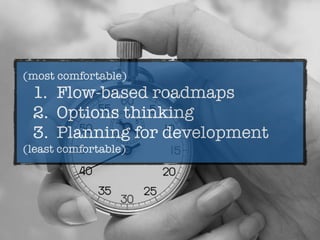
(most comfortable)
1. Flow-based roadmaps
2. Options thinking
3. Planning for development
(least comfortable)
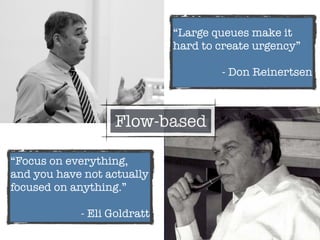
“Focus on everything,
and you have not actually
focused on anything.”
- Eli Goldratt
“Large queues make it
hard to create urgency”
- Don Reinertsen
Flow-based
Flow-based
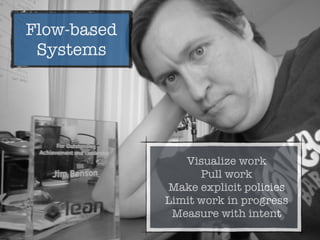
Systems
Visualize work
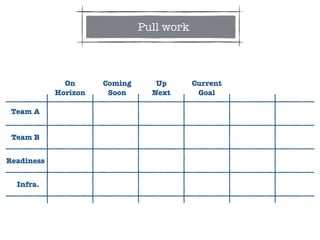
Pull work
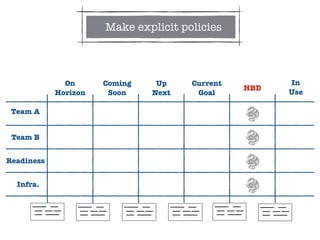
Make explicit policies
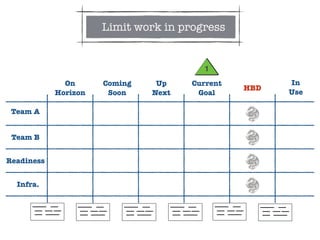
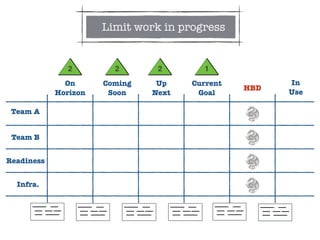
Limit work in progress
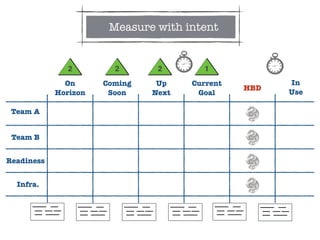
Measure with intent
Team A
Team B
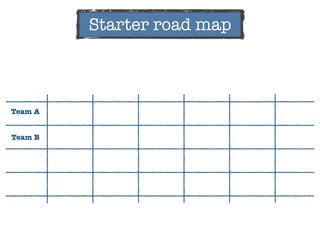
Starter road map
Team A
Team B
Readiness
Infra.
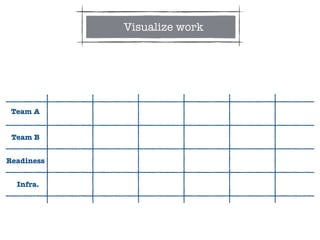
Visualize work
Team A
Team B
Readiness
Infra.
Current
Goal
Up
Next
Coming
Soon
On
Horizon
Pull work
Team A
Team B
Readiness
Infra.
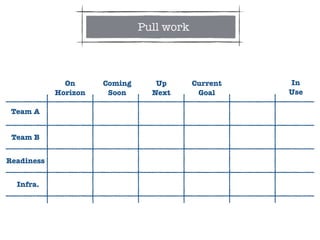
Current
Goal
Up
Next
Coming
Soon
On
Horizon
In
Use
Pull work
Team A
Team B
Readiness
Infra.
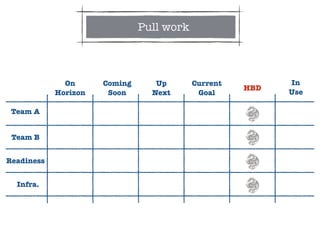
Current
Goal
Up
Next
Coming
Soon
On
Horizon
In
Use
HBD
Pull work
Team A
Team B
Readiness
Infra.
Current
Goal
Up
Next
Coming
Soon
On
Horizon
In
Use
HBD
Make explicit policies
Team A
Team B
Readiness
Infra.
Current
Goal
Up
Next
Coming
Soon
On
Horizon
In
Use
HBD
1
Limit work in progress
Team A
Team B
Readiness
Infra.
Current
Goal
Up
Next
Coming
Soon
On
Horizon
In
Use
HBD
1222
Limit work in progress
Team A
Team B
Readiness
Infra.
Current
Goal
Up
Next
Coming
Soon
On
Horizon
In
Use
HBD
1222
Measure with intent
“Long-range planning
does not deal with the
future decisions, but
with the future of
present decisions.”
- Peter Drucker
Options-thinking
Real Options
Execute intentionally
Options are valuable
Options expire
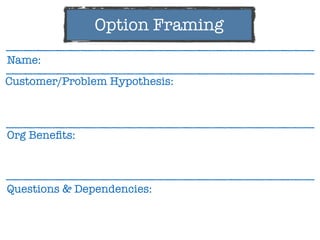
Customer/Problem Hypothesis:
Questions & Dependencies:
Name:
Org Benefits:
Option Framing
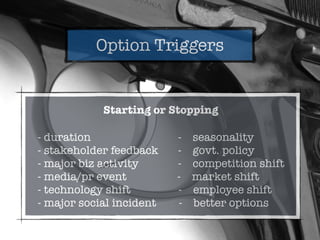
Option Triggers
Starting or Stopping
- duration - seasonality
- stakeholder feedback - govt. policy
- major biz activity - competition shift
- media/pr event - market shift
- technology shift - employee shift
- major social incident - better options
“Essentially, all models
are wrong, but some
are useful.”
- George Box
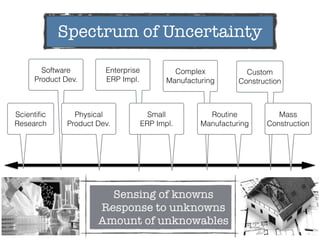
Development Planning Models
Construction
Research
Scientific
Research
Custom
Construction
Complex
Manufacturing
Mass
Construction
Routine
Manufacturing
Enterprise
ERP Impl.
Software
Product Dev.
Physical
Product Dev.
Small
ERP Impl.
Spectrum of Uncertainty
Sensing of knowns
Response to unknowns
Amount of unknowables
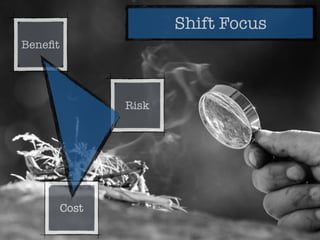
Benefit
Risk
Cost
Shift Focus
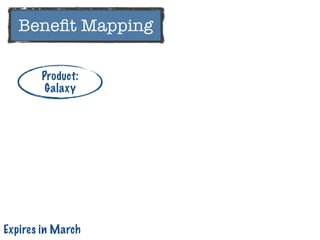
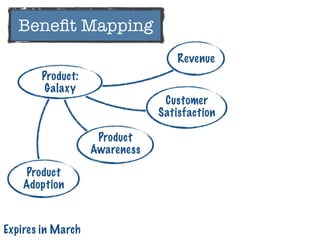
Product:
Galaxy
Expires in March
Benefit Mapping
Product:
Galaxy
Revenue
Customer
Satisfaction
Product
Adoption
Product
Awareness
Expires in March
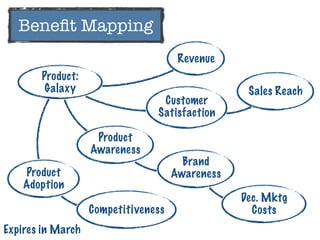
Benefit Mapping
Product:
Galaxy
Revenue
Customer
Satisfaction
Product
Adoption
Product
Awareness
Competitiveness
Dec. Mktg
Costs
Sales Reach
Brand
Awareness
Expires in March
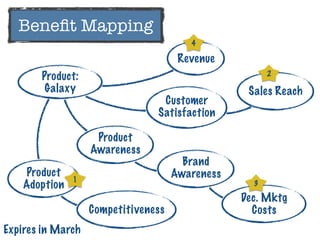
Benefit Mapping
Product:
Galaxy
Revenue
Customer
Satisfaction
Product
Adoption
Product
Awareness
Competitiveness
Dec. Mktg
Costs
Sales Reach
Brand
Awareness1
Expires in March
2
3
4
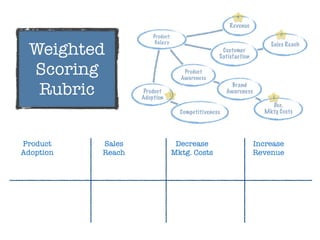
Benefit Mapping
Sales
Reach
Increase
Revenue
Decrease
Mktg. Costs
Product
Adoption
Product:
Galaxy
Revenue
Customer
Satisfaction
Product
Adoption
Product
Awareness
Competitiveness
Dec.
Mktg Costs
Sales Reach
Brand
Awareness
1
2
3
4
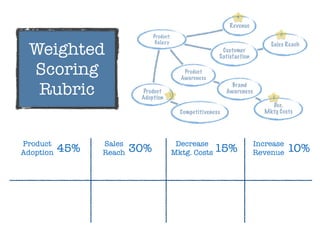
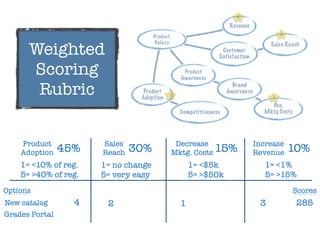
Weighted
Scoring
Rubric
Sales
Reach 30%
Increase
Revenue 10%
Decrease
Mktg. Costs 15%
Product
Adoption 45%
Product:
Galaxy
Revenue
Customer
Satisfaction
Product
Adoption
Product
Awareness
Competitiveness
Dec.
Mktg Costs
Sales Reach
Brand
Awareness
1
2
3
4
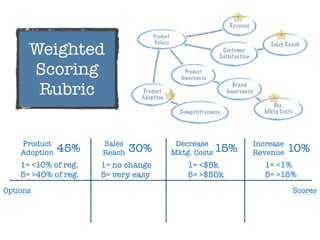
Weighted
Scoring
Rubric
Sales
Reach 30%
Increase
Revenue 10%
Decrease
Mktg. Costs 15%
Product
Adoption 45%
1= <1%
5= >15%
1= <$5k
5= >$50k
1= no change
5= very easy
1= <10% of reg.
5= >40% of reg.
Options Scores
Product:
Galaxy
Revenue
Customer
Satisfaction
Product
Adoption
Product
Awareness
Competitiveness
Dec.
Mktg Costs
Sales Reach
Brand
Awareness
1
2
3
4
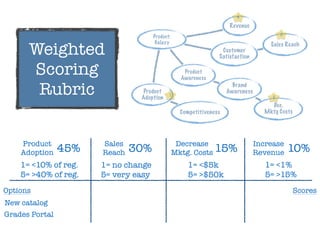
Weighted
Scoring
Rubric
Sales
Reach 30%
Increase
Revenue 10%
Decrease
Mktg. Costs 15%
Product
Adoption 45%
1= <1%
5= >15%
1= <$5k
5= >$50k
1= no change
5= very easy
1= <10% of reg.
5= >40% of reg.
Options Scores
New catalog
Grades Portal
Product:
Galaxy
Revenue
Customer
Satisfaction
Product
Adoption
Product
Awareness
Competitiveness
Dec.
Mktg Costs
Sales Reach
Brand
Awareness
1
2
3
4
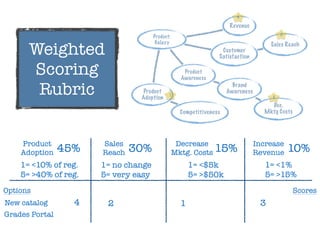
Weighted
Scoring
Rubric
Sales
Reach 30%
Increase
Revenue 10%
Decrease
Mktg. Costs 15%
Product
Adoption 45%
1= <1%
5= >15%
1= <$5k
5= >$50k
1= no change
5= very easy
1= <10% of reg.
5= >40% of reg.
Options Scores
New catalog
Grades Portal
4 2 1 3
Product:
Galaxy
Revenue
Customer
Satisfaction
Product
Adoption
Product
Awareness
Competitiveness
Dec.
Mktg Costs
Sales Reach
Brand
Awareness
1
2
3
4
Weighted
Scoring
Rubric
Sales
Reach 30%
Increase
Revenue 10%
Decrease
Mktg. Costs 15%
Product
Adoption 45%
1= <1%
5= >15%
1= <$5k
5= >$50k
1= no change
5= very easy
1= <10% of reg.
5= >40% of reg.
Options Scores
New catalog
Grades Portal
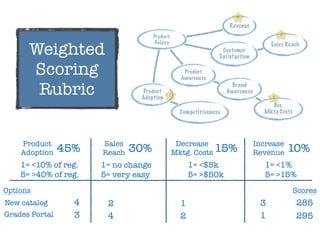
4 2 1 3 285
Product:
Galaxy
Revenue
Customer
Satisfaction
Product
Adoption
Product
Awareness
Competitiveness
Dec.
Mktg Costs
Sales Reach
Brand
Awareness
1
2
3
4
Weighted
Scoring
Rubric
Sales
Reach 30%
Increase
Revenue 10%
Decrease
Mktg. Costs 15%
Product
Adoption 45%
1= <1%
5= >15%
1= <$5k
5= >$50k
1= no change
5= very easy
1= <10% of reg.
5= >40% of reg.
Options Scores
New catalog
Grades Portal
4
3
2
4
1
2
3
1
285
295
Product:
Galaxy
Revenue
Customer
Satisfaction
Product
Adoption
Product
Awareness
Competitiveness
Dec.
Mktg Costs
Sales Reach
Brand
Awareness
1
2
3
4
Weighted
Scoring
Rubric
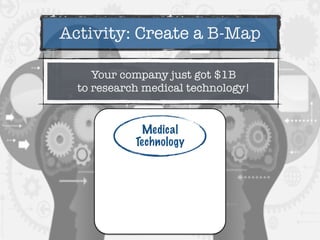
Activity: Create a B-Map
Your company just got $1B
to research medical technology!
Medical
Technology
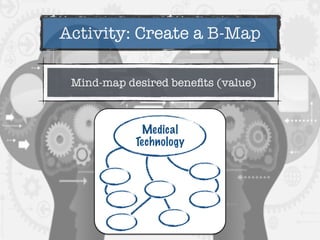
Activity: Create a B-Map
Mind-map desired benefits (value)
Medical
Technology
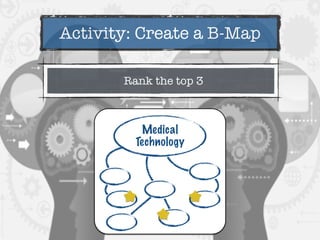
Activity: Create a B-Map
Rank the top 3
Medical
Technology
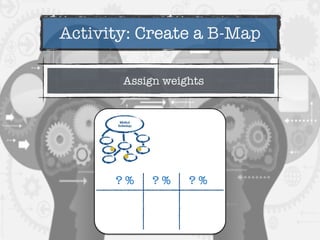
Activity: Create a B-Map
Assign weights
Medical
Technology
? % ? % ? %
Activity: Create a B-Map
Come up with 2 research options
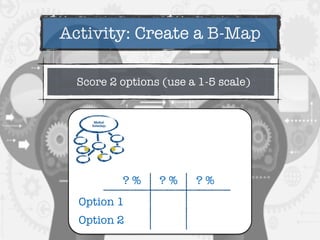
Activity: Create a B-Map
Score 2 options (use a 1-5 scale)
Medical
Technology
? % ? % ? %
Option 1
Option 2
Activity: Create a B-Map
What did you discuss?
How did you decide?
Coherence vs. Artifacts
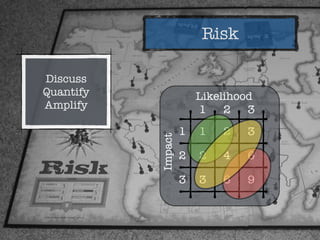
Risk
Discuss
Quantify
Amplify 1 2 3
1
2
3
1 2 3
2 4 6
3 6 9
Likelihood
Impact
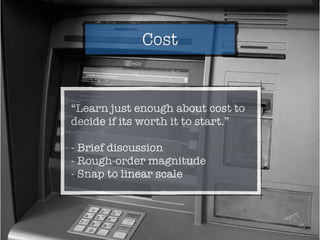
Cost
“Learn just enough about cost to
decide if its worth it to start.”
- Brief discussion
- Rough-order magnitude
- Snap to linear scale
“More effective development planning is
achieved through using a flow-based road map
laid out with real options from which we can
choose based primarily on the benefits they
provide while considering risks and understanding
just enough about cost to get started.”
Questions?
Matt Barcomb @mattbarcomb matt@odbox.co

Lean development planning using options thinking