The League of Nations
 What you will learn:


 The FOUR aims of the League of Nations [SIDE].
 How many members the League had in 1919 and in the 1930s.
 The names of THREE countries who weren’t members of the League (and
 why).
 The FOUR main members of the League.
 FOUR strengths of the League.
 THREE weaknesses of the League.
 FOUR powers of the League.
 EIGHT parts of the League’s organisation.
 NINE successes of the League in the 1920s.
 FOUR failures of the League in the 1920s.
 TWO failures of the League in the 1930s – and their effect on the League.
 SEVEN reasons why the League failed in the 1930s [WAS DUMB].


You must do the following written work:

A spider diagram showing the main aims of the League.
Written notes on the League’s powers.
Written notes on the League’s organisation.
An essay: ‘How strong was the League of Nations?’
Written notes on the work done by the League.
Written notes on Manchuria, 1931
Written notes on Abyssinia, 1935
A 35-word ‘last word’ comment on the League.
Pass the End of Unit Test!
Source A                        The League of Nations
It is not enough
just to win the war.            The League of Nations was set up because President Wilson
We must win it in               wanted this more than anything else.
such a way as to                      He wanted the League to be a kind of ‘world
keep the future                 parliament’, where nations would sort out their arguments.
peace of the world.             He hoped this would stop wars. But Wilson wanted to do
President Wilson,               more than just stop war; he wanted to make the world a
talking in 1918.                better place. He wanted the League to do things to
                                improve people’s lives and jobs. He wanted to improve
                                public health, and to end slavery.
                                      Wilson also hoped that the League would persuade
Tasks                           the nations to agree to disarmament – to put down their
1. Work in threes.
                                weapons. That would make war impossible.
Imagine that you are
Woodrow Wilson,                       Finally, Wilson thought that the League of Nations
talking to Clemenceau           could enforce the Treaty of Versailles, and persuade
and Lloyd George.               countries to keep the promises they had made.
Tell them about your
idea for the League of
Nations, what it                Task
would do, and how it            Draw a spider diagram of the FOUR aims of the League of Nations.
would work. Write a             Were the League’s aims impossible, do you think?.
short speech and
deliver this to the
class – one r tow
points from each                America Pulls Out
person.                         But when Wilson got back home to the United States, the
2. Study Source B               American Senate refused to join the League.
What effect did the                  Americans did not want to get dragged into other
artists think America’s         countries’ problems. This damaged the League a great deal.
refusal to join the
League have?


Source B
‘The Gap in the Bridge’ – a British cartoon of 1919 – shows America refusing to join the League.

   2
Strengths &                                   Source A – Powers
                                              1. Covenant (in the League’s Covenant,
Weaknesses                                    especially Article 10, all members had promised to
                                              keep the peace).
 Forty-two countries joined the League        2. Condemnation (the League could tell a
                                              country it was doing wrong).
at the start. In the 1930sabout 60            3. Arbitration (the League could offer to decide
countries were members. This made             between two countries).
the League seem strong.                       4. Sanctions (stopping trade).
     However, the most powerful
countries in the world were not
members. The USAdid not want to
join. The Russians refused to join – they     Source B – Organisation
were Communists and distrusted                1.   Assembly (the main meeting o the League –
Britain and France. Germanywas not               all members met once a year). Its main
                                                 problem was that decisions had to be
allowed to join. Without these three
                                                 unanimous, which was very difficult to
big powers, the League was weak.                 achieve.
 Britain and France were the main             2. Council (a small group of the more
 members, helped by Italy and Japan;             important nations – Britain, France, Italy and
 they were quite powerful countries.             Japan plus some other countries – met 4–5
                                                 times a year).
 Also, the League had four powers it
                                              3. Agencies (committees of the League):
 could use to make countries do as it           Court of International Justice (for small
 wanted (see Source A). Theoretically,           disputes).
 the League was allowed to use military         Health (to improve world health).
 force, but the League did not have             International Labour Organisation (to try to
                                                 get fair wages).
 an army of its own – so if a country
                                                Slavery (to end slavery)
 ignored it, in the end, there was              Refugees.
 nothing the League could do.                 4. Secretariat (was supposed to organise the
 The main strength of the League was             League, but failed).
 that it had been set up by the Treaty
 of Versailles, and agreed by
 everybody at the conference.
     The biggest weakness was that
the League’s organisation was a
muddle (see Source B). The different
parts of the League were supposed to
act together; but in a crisis, no-one
could agree.


Tasks
1. Using the seven sentences in bold in the
passage above, create side-by-side lists of
the League’s ‘strengths’ and ‘weaknesses’.
2 People at the time used all these phrases
to explain how they thought the League
would influence countries:
    Collective Security

                                                                                                   3
Community of Power
    Moral Persuasion.
For each, discuss and write down what you
think people meant.
3. Do you think the League had any chance
of keeping world peace?


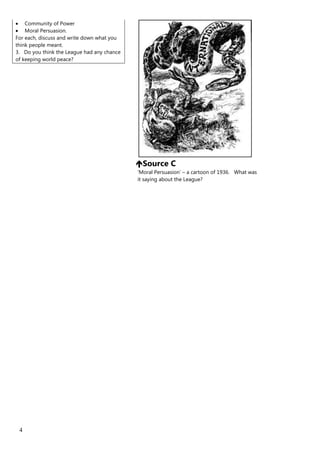
                                            Source C
                                            ‘Moral Persuasion’ – a cartoon of 1936. What was
                                            it saying about the League?


 4
Did the League stop wars in the 1920s?
The main aim of the League of Nations was to stop wars. In the 1920s, there were
many small disputes between countries, which the League tried to solve. This spread
looks at just two disputes (you will need to research other incidents). Did the League
manage to stop wars in the 1920s? Decide if you think the League was a success or
a failure.


Corfu, 1923                                     Bulgaria, 1925

The Dispute:                                    The Dispute:
An Italian general was killed while he          Some Greek soldiers were killed in a small
was doing some work for the League in           fight on the border between Greece and
Greece. The Italian leader Mussolini was        Bulgaria. The Greeks were angry. They
angry with the Greeks. He invaded the           invaded Bulgaria.
Greek island of Corfu.
                                                Bulgaria asked the League to help.
The Greeks asked the League to help.
                                                What the League did:
What the League did:                            The Council of the League met. It
The Council of the League met. It               condemned the Geeks, and told them to
condemned Mussolini, and told him to            leave Bulgaria.
leave Corfu.
   It told the Greeks to give some              What happened:
money to the League.                            The Bulgarian government sent orders to
                                                its army not to fight back.
What happened:                                       The Greeks did as the League said.
Mussolini refused to accept its decision.       They left Bulgaria.
He refused to leave Corfu.
   The League changed its decision. It
told Greece to apologise to Mussolini,
and to pay the money to Italy.
   The Greeks did as the League said.
Then Mussolini gave Corfu back to
Greece.


Tasks
1. Discuss as a whole class:
a. Was the League successful in Corfu?
b. Was the League successful in Bulgaria?
2. In 1925, Greece complained that there        Source A
seemed to be one set of rules for small         A British cartoon of 1925 shows Greece and
countries such as Greece, and a different       Bulgaria fighting – like Tweedle-dum and
set of rules for big countries such as Italy.   Tweedle-dee in the story Alice in Wonderland.
                                                                                                5
Do you agree?                                 The League, like the dove of peace, stops the
3. Did the League’s actions add to its        fight.
standing, or detract from it, do you think?


  6
Was the League successful in the
     1920s?
     This spread looks at the League’s
     work: boxes a–m on this page
                                                   Tasks
                                                   1 Divide boxes a–m up into ‘successes’ and
     describe some of the work done                   ‘failure’s. Overall, was the League a
     by the League in the 1920s.                      success or a failure in the 1920s?
                                                   2 Divide up the boxes again, this time into
     The League of Nations had four                   the four kinds of work done by the
                                                      League.
     aims:
                                                      Stopping wars,
1.   Stop wars,                                       Improving lives and jobs,
2.   Improve people’s lives and jobs,                 Disarmament,
3.   Disarmament,                                     Enforcing the Treaty of Versailles.
4.   Enforce the Treaty of Versailles.             Share your answers as a whole class. Copy
                                                   up notes on ‘The Work of the League in the
        In the last spread, you looked at
                                                   1920s’, under the four sub-headings. Colour
     the League’s work to stop wars..              the titles: one colour for the League’s
        You will be able to decide if you          ‘successes’, another colour for its ‘failures’.
     think the League was a success or
     a failure.


                                                   h. Jobs
                                                   The International Labour Organisation failed
     a. Bulgaria (1925)
                                                   to persuade countries to adopt a 48-hour
     Greece obeyed the League’s orders to
                                                   week.
     pull out of Bulgaria in 1925.

                                                   i.   Economic problems
     b. Poland (1920)
                                                   The League sent economics experts to help
     Poland took land from Russia, breaking
                                                   Austria and Hungary.
     the Treaty of Versailles. The Poles ignored
     the League’s order to stop
                                                   j.   Kellogg-Briand Pact (1928)
                                                   Sixty-five countries signed the treaty to end
     c. Slaves
                                                   war – but just ignored it.
     The League attacked slave traders in
     Africa and Burma and freed 200,000
     slaves.                                       k. Refugees (1922)
                                                   The League set up camps and fed Turkish
                                                   refugees.
     d. Disease
     The League worked to prevent malaria
     and leprosy.                                  l. Corfu (1923)
                                                   Mussolini ignored the League’s orders to
                                                   pull out of Corfu in 1923, and made Greece
     e. Disarmament (1932)
                                                   pay money to Italy.
     Disarmament talks failed, because
     Germany demanded as many weapons as
     everyone else.                                m. Drugs
                                                   The League closed down four big companies
                                                   which were selling drugs.
     f. Prisoners of War
     The League took home half a million
     World War One prisoners of war.

                                                                                                     7
g. Reparations (1921)
When the Germans refused to pay,
France and Britain invaded Germany and
made them pay.


8
The League’s Failures                   Manchuria, 1931
in the 1930s
In the 1920s, the League of
Nations had been quite
successful. In the 1930s, it failed
terribly.
      This spread looks at the
League’s two main failures in the
1930s – in Manchuria and
Abyssinia.

By 1935, most countries did not
                                        The Dispute:                             (p
think that the League could keep
                                        In the 1930s there was a world-
the peace.                              wide economic depression. Japan
      When Hitler began to break        tried tp overcome the depression
the Treaty of Versailles in the         by building up an empire.
1930s, the League was powerless              In 1932, the Japanese army
to stop him (this is the next topic     invaded Manchuria, threw out the
you will study).                        Chinese, and set up their own
      The league failed, and the        government there.
only way to stop Hitler was a
                                        China asked the League to help.
Second World War.


                                        What the League did:
                                        The League sent officials to study
                                        the problem (this took a year).

                                        In February 1933 it ordered Japan
                                        to leave Manchuria.


Source A                               What happened:
A British cartoon of 1933 shows Japan   Japan refused to leave Manchuria.
trampling all over the League, whilst   Instead, Japan left the League.
Britain powders her nose. Other              Many countries had important
cartoons made the same point.
                                        trading links with Japan. The
                                        League could not agree on
                                        sanctions or even a ban on
                                        weapons sales. Britain and France
                                        did not want a war, so nothing was
                                        done.

                                        The Japanese stayed in Manchuria.
                                        The League had failed.
Tasks
1. Read the stories about Manchuria
and Abyssinia. From the stories, can
                                                                             9
you work out WHY the League failed
there?
2. Read Sources B–D. Did the
Abyssinian crisis ‘kill’ the League?
3. Who gained most from the
Manchurian and Abyssinian crises?


10
Abyssinia, 1935                         Source B
                                        The crisis was fatal to the
                                        League. Nobody took it
                                        seriously again. They got ready
                                        for the Second World War.
                                        Written by the historian JR Western
                                        (1971).


                                        Source C
                                        After Manchuria and Abyssinia,
                                        people decided that it was no
                                        longer any use putting their
                                        hopes in the League.
                                        Written by the historian J Joll (1976).


The Dispute:                                                                  (pages 205-207)
Mussolini got ready to invade
Abyssinia (Ethiopia). He wanted war     Source D
and glory.                              The League died in 1935. One
                                        day it was a powerful body
Abyssinia asked the League to help.
                                        imposing sanctions, the next
                                        day it was a useless fraud,
                                        everybody running away from it
What the League did:
                                        as quickly as possible. Hitler
The League talked to Mussolini – but
he used the time to send an army to     watched.
                                        Written by the historian AJP Taylor
Africa.
                                        (1966).
     The League suggested a plan to
give part of Abyssinia to Italy.


What happened:
Mussolini ignored the League, and
invaded Abyssinia.
       The League banned weapons
sales, and put sanctions on rubber
and metal.

It did nothing else – in fact Britain
and France secretly agreed to give
Abyssinia to Italy.

Italy conquered Abyssinia
                                        Source E
                                        A British cartoon of 1935 shows
The League had failed.                  international politics like a stage
                                        musical. Britain and France sing:
                                            ‘We don’t want you to fight,
                                              but by jingo if you do,
                                                                                                11
We will probably issue a joint
     memorandum
           Suggesting a mild disapproval of
     you.’


12
13
14