Data and the City 
Jop Esmeijer 
Anne Fleur van Veenstra 
Bas Kotterink 
Tom Bakker 
Silvain de Munck
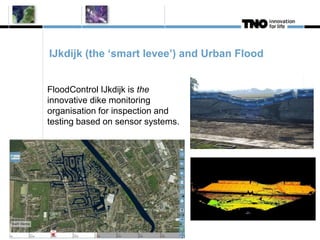
IJkdijk (the ‘smart levee’) and Urban Flood 
FloodControl IJkdijk is the 
innovative dike monitoring 
organisation for inspection and 
testing based on sensor systems.
Data and the City 
From large scale crisis management to complex societal challenges on a 
local level: “Liveability” 
Liveability (“quality of life”) comprises various aspects, i.e.: 
Safety, public space, social cohesion 
Both public and private actors (companies, citizens) 
An explorative study on the data landscape of “liveability” in Rotterdam 
Part of the OECD “KBC2 : Data” project
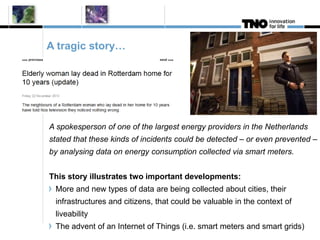
A tragic story… 
A spokesperson of one of the largest energy providers in the Netherlands 
stated that these kinds of incidents could be detected – or even prevented – 
by analysing data on energy consumption collected via smart meters. 
This story illustrates two important developments: 
More and new types of data are being collected about cities, their 
infrastructures and citizens, that could be valuable in the context of 
liveability 
The advent of an Internet of Things (i.e. smart meters and smart grids)
Data-driven innovation and liveability 
What is happening? 
Urban population in OECD member countries approaches 1 billion 
Ongoing digitisation of soft and hard city infrastructures 
Becoming “smart” is a widely shared ambition of bigger cities 
EC Work Programme: “Inclusive digital societies” 
Risks: discrimination (profiling), autonomy, consumer protection 
The objective of the study was to explore and map: 
Data-driven innovation in the context of liveability in the city of Rotterdam 
The emergence of a new data ecosystem of liveability 
The impacts of data-driven innovation on (the organisation of) liveability
The emerging data ecosystem 
A shift in control of (and access to) “city data”: 
Traditionally: governmental services and semi-public organisations 
Now: many city- and citizen-oriented services and citizens, i.e.: 
Google: interests (search) and movements (maps) 
Facebook and Twitter: social interactions and sentiment 
Iens: restaurants and bars 
Funda: housing 
Marktplaats (eBay): shopping 
Global players battle for city platforms and IoT-infrastructures 
While “liveability” is very local… 
Horizontally oriented services (GIS-tools, analytics, authentication) 
New interfaces (cars, wearables, smart meters, smart grids, TVs, …)
Impacts on (the organisation) of liveability 
Government retains control, impact of DDI is limited – for now 
Little use of advanced analytics and no automated decision-making 
Only limited data spill-over from commercial players 
Via ‘traditional’ information brokers (i.e. GfK) 
The safety-domain is an exception 
Social media data, internet data, citizen data (special apps) 
Pilots: prediction and profiling of neighbourhoods to allocate resources 
The impact of DDI via commercial actors is limited – for now 
Current business models determine focus – no mechanisms for sharing 
Business models do not directly touch elements of liveability, but… 
Start-ups and VCs enter a trillion dollar “Smart City” market 
“When you scale, you automatically become a data company”
Policy implications 
Restructuring effects: ‘datafication’ is not a neutral, “natural” phenomenon. 
The balance between “public” and “private” may shift when business 
models collide with elements of liveability (Uber and AirBnB as signs of 
things to come). 
When data integration (public/private) becomes increasingly important to 
gain actionable insights, it remains to be seen whether liveability will retain 
its largely public character or that new commercial services will take over 
(parts of) interfaces, platforms, public tasks and functions.

Jop Esmeijer gfke 2014

  • 1.
    Data and theCity Jop Esmeijer Anne Fleur van Veenstra Bas Kotterink Tom Bakker Silvain de Munck
  • 2.
    IJkdijk (the ‘smartlevee’) and Urban Flood FloodControl IJkdijk is the innovative dike monitoring organisation for inspection and testing based on sensor systems.
  • 3.
    Data and theCity From large scale crisis management to complex societal challenges on a local level: “Liveability” Liveability (“quality of life”) comprises various aspects, i.e.: Safety, public space, social cohesion Both public and private actors (companies, citizens) An explorative study on the data landscape of “liveability” in Rotterdam Part of the OECD “KBC2 : Data” project
  • 4.
    A tragic story… A spokesperson of one of the largest energy providers in the Netherlands stated that these kinds of incidents could be detected – or even prevented – by analysing data on energy consumption collected via smart meters. This story illustrates two important developments: More and new types of data are being collected about cities, their infrastructures and citizens, that could be valuable in the context of liveability The advent of an Internet of Things (i.e. smart meters and smart grids)
  • 5.
    Data-driven innovation andliveability What is happening? Urban population in OECD member countries approaches 1 billion Ongoing digitisation of soft and hard city infrastructures Becoming “smart” is a widely shared ambition of bigger cities EC Work Programme: “Inclusive digital societies” Risks: discrimination (profiling), autonomy, consumer protection The objective of the study was to explore and map: Data-driven innovation in the context of liveability in the city of Rotterdam The emergence of a new data ecosystem of liveability The impacts of data-driven innovation on (the organisation of) liveability
  • 6.
    The emerging dataecosystem A shift in control of (and access to) “city data”: Traditionally: governmental services and semi-public organisations Now: many city- and citizen-oriented services and citizens, i.e.: Google: interests (search) and movements (maps) Facebook and Twitter: social interactions and sentiment Iens: restaurants and bars Funda: housing Marktplaats (eBay): shopping Global players battle for city platforms and IoT-infrastructures While “liveability” is very local… Horizontally oriented services (GIS-tools, analytics, authentication) New interfaces (cars, wearables, smart meters, smart grids, TVs, …)
  • 7.
    Impacts on (theorganisation) of liveability Government retains control, impact of DDI is limited – for now Little use of advanced analytics and no automated decision-making Only limited data spill-over from commercial players Via ‘traditional’ information brokers (i.e. GfK) The safety-domain is an exception Social media data, internet data, citizen data (special apps) Pilots: prediction and profiling of neighbourhoods to allocate resources The impact of DDI via commercial actors is limited – for now Current business models determine focus – no mechanisms for sharing Business models do not directly touch elements of liveability, but… Start-ups and VCs enter a trillion dollar “Smart City” market “When you scale, you automatically become a data company”
  • 8.
    Policy implications Restructuringeffects: ‘datafication’ is not a neutral, “natural” phenomenon. The balance between “public” and “private” may shift when business models collide with elements of liveability (Uber and AirBnB as signs of things to come). When data integration (public/private) becomes increasingly important to gain actionable insights, it remains to be seen whether liveability will retain its largely public character or that new commercial services will take over (parts of) interfaces, platforms, public tasks and functions.

Editor's Notes

  • #2 One of the largest RTOs in Europe Stimulate smart and inclusive data-driven innovation in NL and Europe DDI: a multi-disciplinary field Data-mining Sensor-technology Visualisation techniques Interoperability Policies and strategies for a data-driven society Domain-specific knowledge (i.e. mobility, energy)
  • #5 Change in the data landscape of cities: all kinds of players collect more and new types of data about cities, its infrastructures and its citizens and their interactions, that could potentially be valuable in the context of liveability (Though not directly) The advent of the Internet of Things (smart grids) http://www.nrcreader.nl/artikel/3316/de-mensen-hebben-geen-contact-meer-met-elkaar
  • #6 In its Work Programme, the European Commission emphasized the importance of inclusive and trustworthy digital societies. If (big) data analytics becomes an increasingly important factor in decision-making, it is important to gain a better understanding of the data landscape in which this occurs, both in terms of the data that is being used, but also how it is being used and, for instance, how this affects fundamental civil liberties such as privacy and autonomy, and other public values. Furthermore, as the influence of data and data analytics increases, it should be transparent what assumptions are encoded into algorithms that will guide the actions of city planners, public officials or other types of players that have (or could have) a big impact on city life.
  • #7 more and more data about cities and its citizens and their interactions are collected by private companies and citizens
  • #8 The impact of data analytics on liveability via commercial services appears to be limited as well. There are services that have a direct link to liveability, by collecting data (such as the Beter Buiten app), deploying data where the analytics supports business operations (Achmea) or that are related to liveability via their services (such as the Bomenspotter app and Peerby). These services do not (yet) deploy data analytics for contextualisation. There are many more services that collect data about citizens and the city. But as long as the core of these services and their underlying businesses models are not directly linked to elements of liveability it is not likely that exploitation of all these data has an impact in this field.
  • #9 When business models from existing players or start-ups collide with elements of liveability, the current balance between public and private may change, including the impact of their deployment of data and data analytics. It remains to be seen what may happen to the domain of liveability and how government may or may not adapt its policies. In other sectors and markets, the emergence of ‘killer apps’ has had great impact, such as AirBnB in the hotel branch and Uber in the taxi branch which rely heavily on data analytics. In these markets the ‘interface’ to the market has led to a network of competitors (with very low thresholds for entry), threatening the existence of traditional service providers and possibly changing these sectors forever. The question is whether governments are willing to let that happen in the domain of liveability.