Dr Pietro Micheli
Associate Professor of Organizational Performance
Warwick Business School
Why this research?

>

Evidence of impact of design on business performance, but not
conclusive

>

Quantitative studies don’t say much about how design impacts
performance

>

If design and (radical) innovation are connected, we’d better pay
attention!
What did we do?
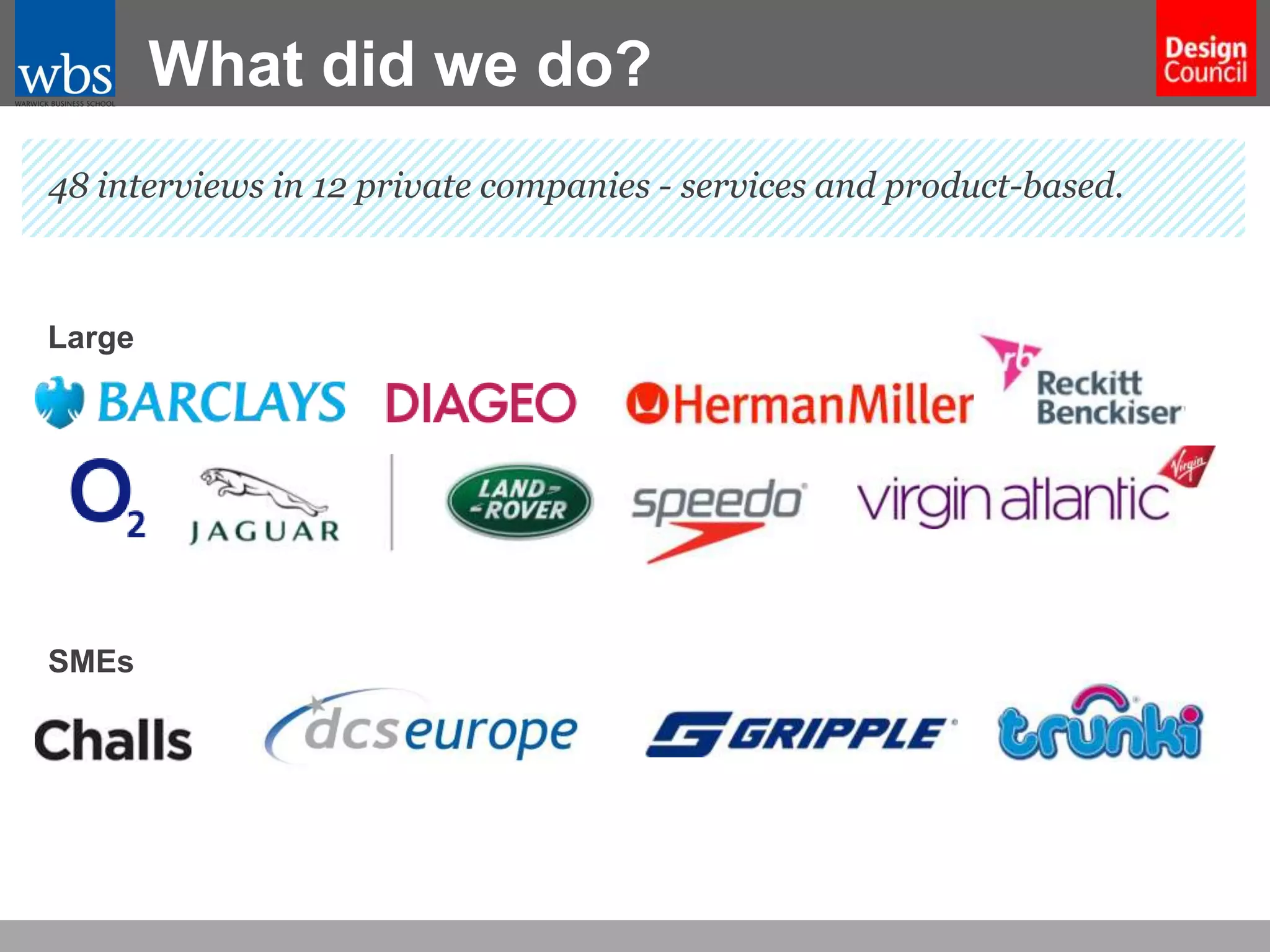
48 interviews in 12 private companies - services and product-based.

Large

SMEs
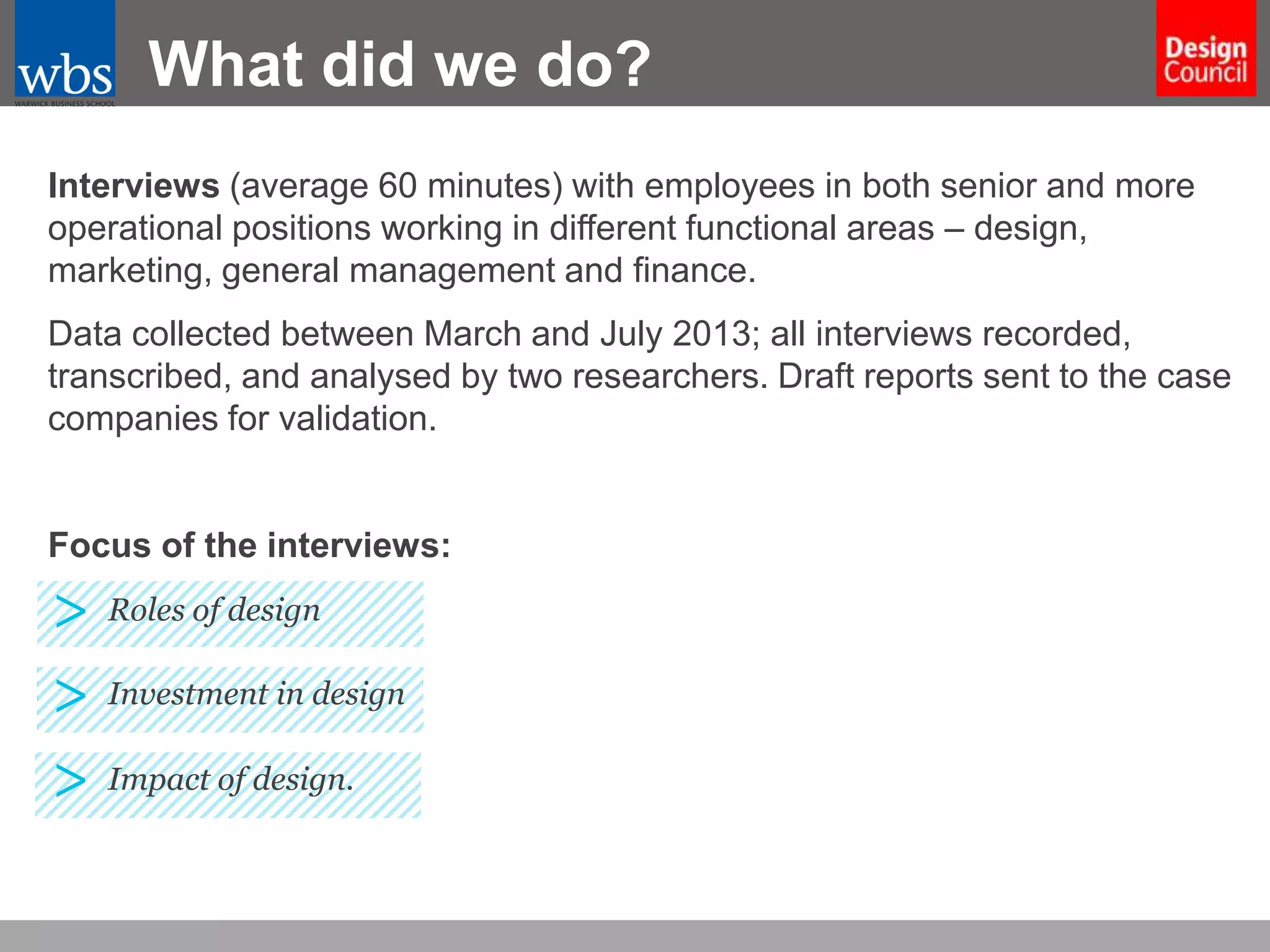
What did we do?
Interviews (average 60 minutes) with employees in both senior and more
operational positions working in different functional areas – design,
marketing, general management and finance.
Data collected between March and July 2013; all interviews recorded,
transcribed, and analysed by two researchers. Draft reports sent to the case
companies for validation.

Focus of the interviews:

> Roles of design
> Investment in design
> Impact of design.
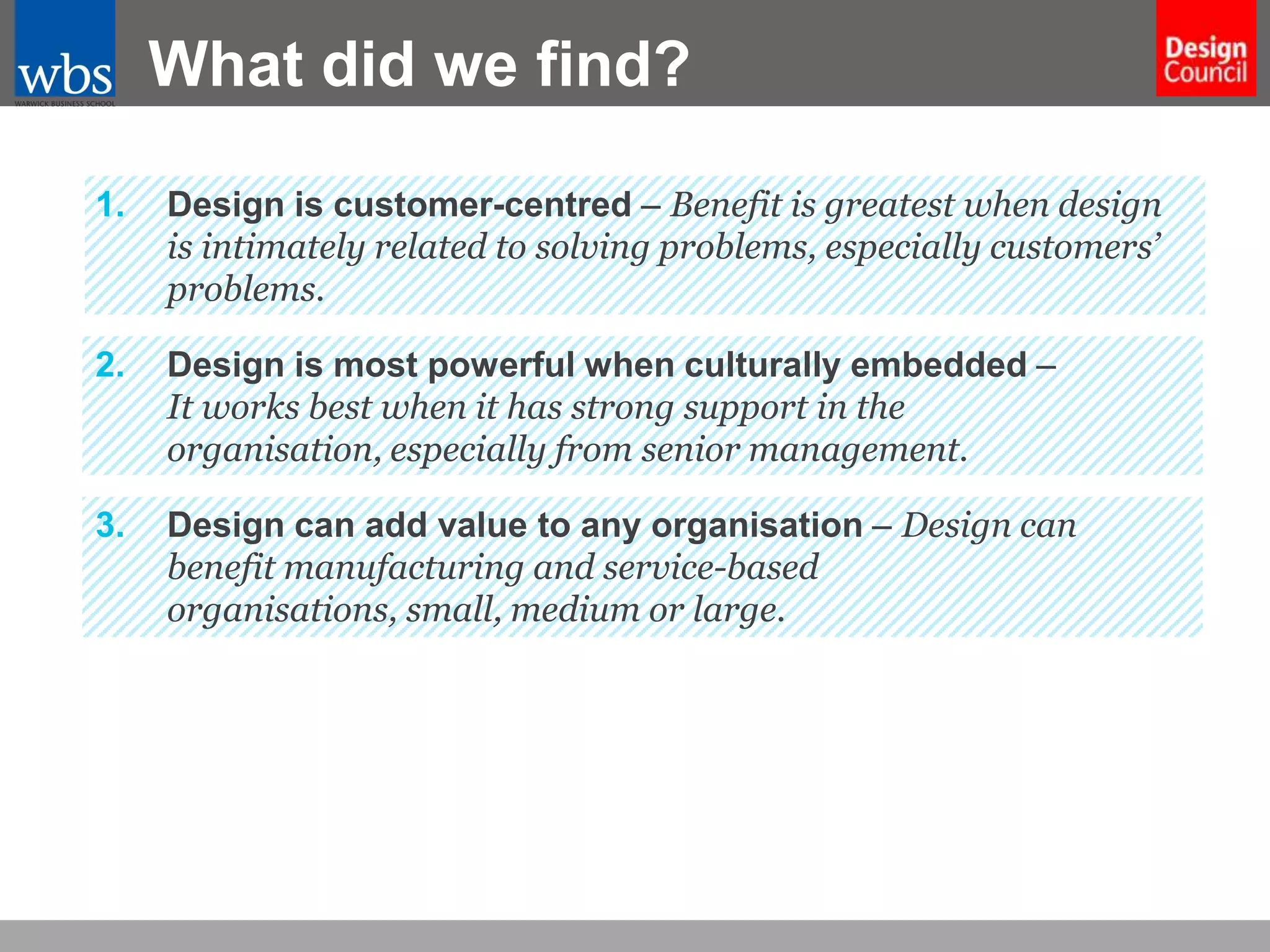
What did we find?
1.

Design is customer-centred – Benefit is greatest when design
is intimately related to solving problems, especially customers’
problems.

2.

Design is most powerful when culturally embedded –
It works best when it has strong support in the
organisation, especially from senior management.

3.

Design can add value to any organisation – Design can
benefit manufacturing and service-based
organisations, small, medium or large.
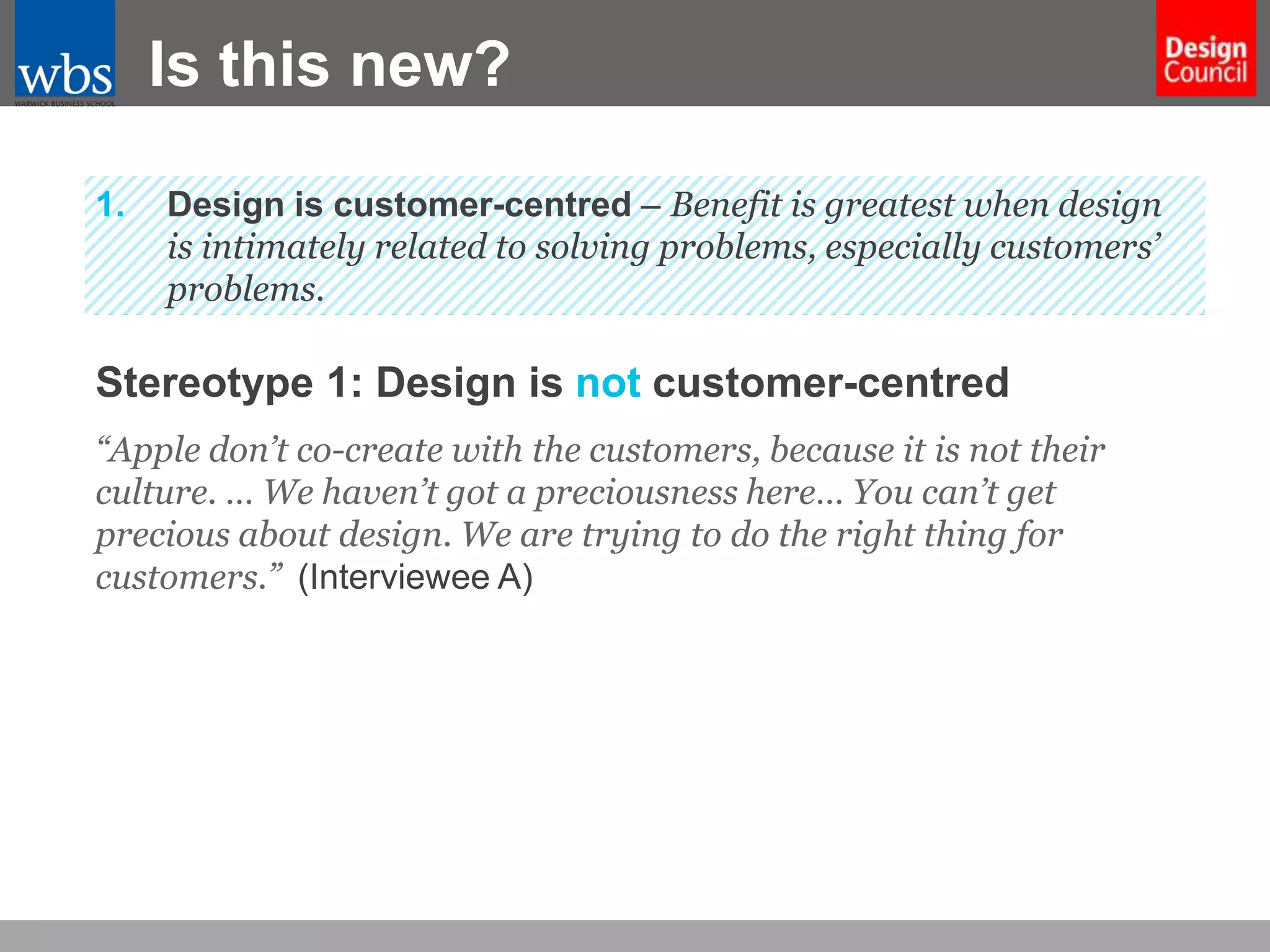
Is this new?
1.

Design is customer-centred – Benefit is greatest when design
is intimately related to solving problems, especially customers’
problems.

Stereotype 1: Design is not customer-centred
“Apple don’t co-create with the customers, because it is not their
culture. … We haven’t got a preciousness here… You can’t get
precious about design. We are trying to do the right thing for
customers.” (Interviewee A)
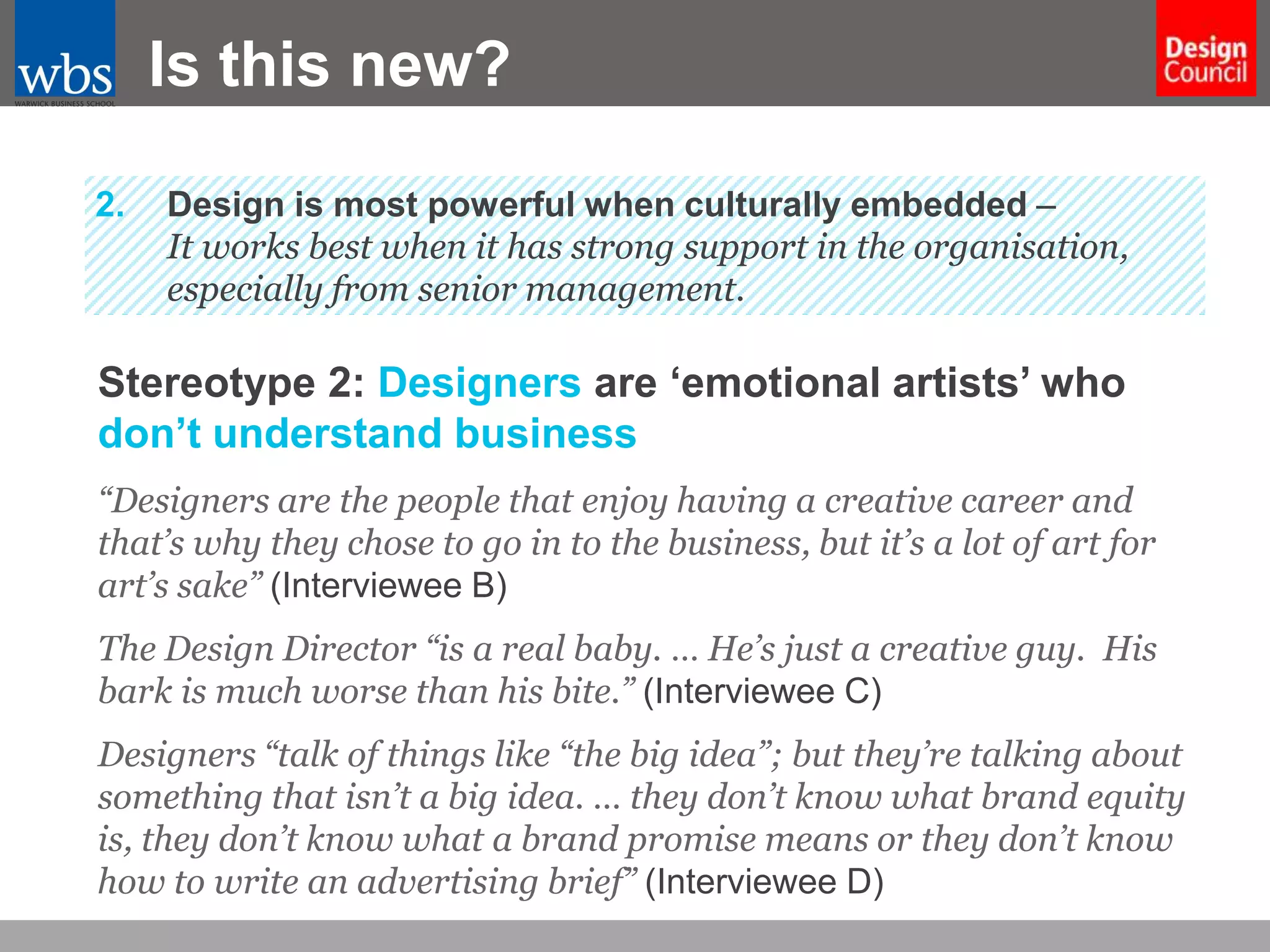
Is this new?
2.

Design is most powerful when culturally embedded –
It works best when it has strong support in the organisation,
especially from senior management.

Stereotype 2: Designers are ‘emotional artists’ who
don’t understand business
“Designers are the people that enjoy having a creative career and
that’s why they chose to go in to the business, but it’s a lot of art for
art’s sake” (Interviewee B)
The Design Director “is a real baby. … He’s just a creative guy. His
bark is much worse than his bite.” (Interviewee C)
Designers “talk of things like “the big idea”; but they’re talking about
something that isn’t a big idea. … they don’t know what brand equity
is, they don’t know what a brand promise means or they don’t know
how to write an advertising brief” (Interviewee D)
What did we find?
Impact of design
1.as a ‘service’

2.as a key perspective in the development process

3.as a strategic perspective.
What did we find?
Strategic role of design?

>

Presence of a sponsor among senior management (CEO / founder in
the case of an SME)

>

Design Director / Manager crucial, especially when leadership
support is lacking

>

Rigorous documentation and review of successes.
Benefits
Design can add value by:

>

Driving innovation and opening up uncontested market spaces

>

Differentiating products and services to attract customers

>

Strengthening branding, embodying a company’s values and
improving recognition.
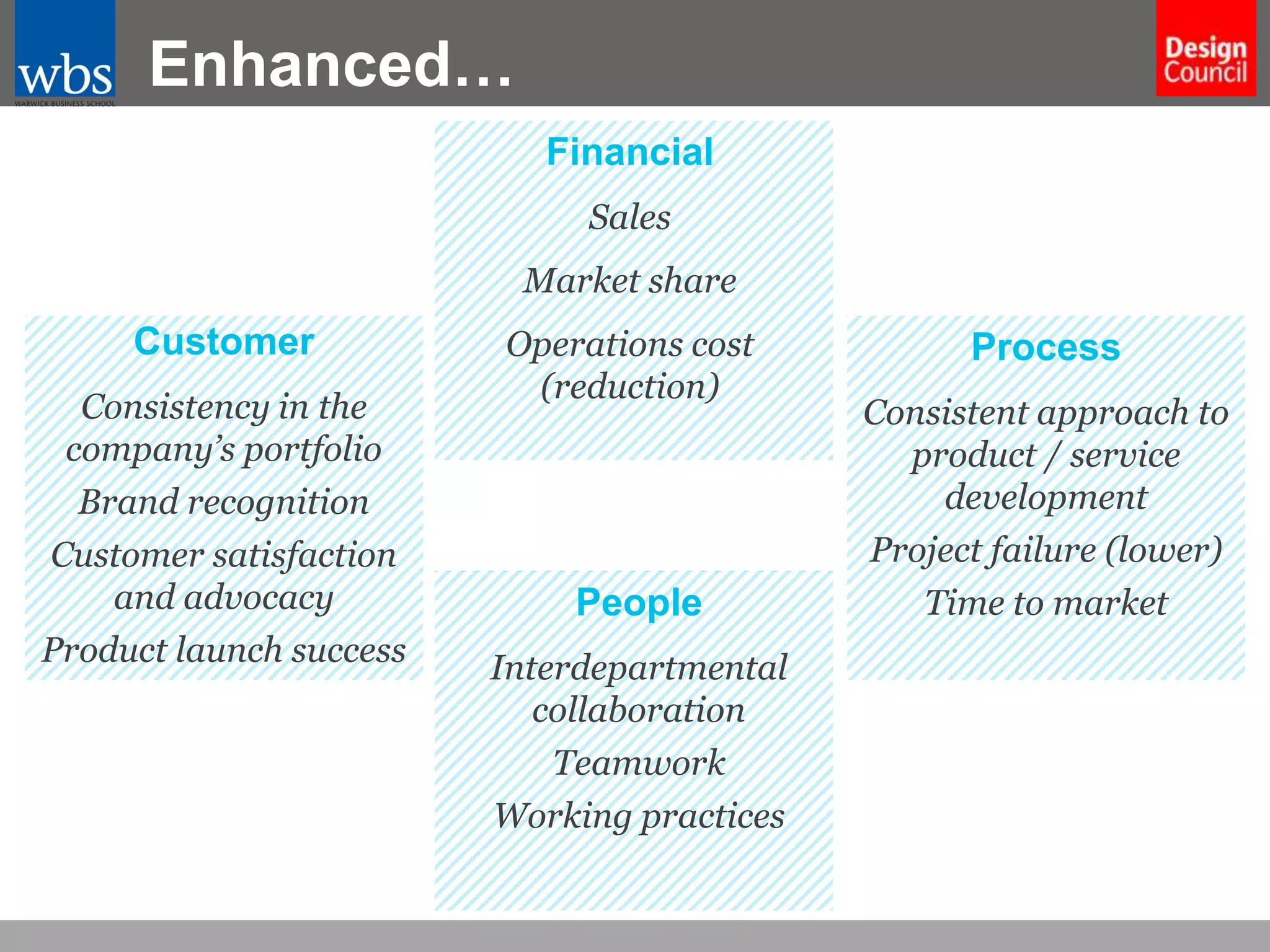
Enhanced…
Financial
Sales
Market share

Customer
Consistency in the
company’s portfolio
Brand recognition
Customer satisfaction
and advocacy
Product launch success

Operations cost
(reduction)

People
Interdepartmental
collaboration
Teamwork
Working practices

Process
Consistent approach to
product / service
development
Project failure (lower)
Time to market
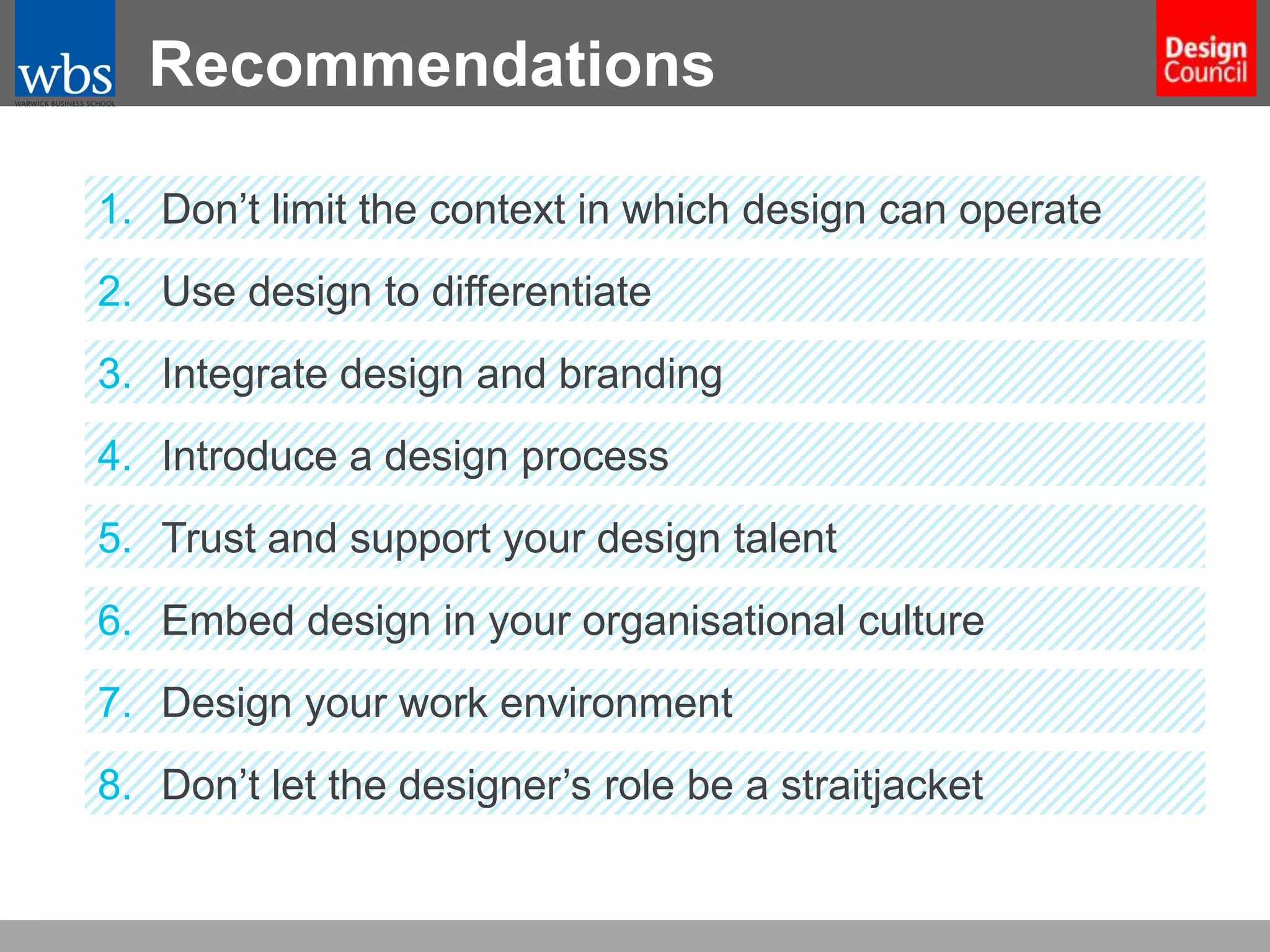
Recommendations
1. Don’t limit the context in which design can operate
2. Use design to differentiate
3. Integrate design and branding

4. Introduce a design process
5. Trust and support your design talent
6. Embed design in your organisational culture
7. Design your work environment
8. Don’t let the designer’s role be a straitjacket
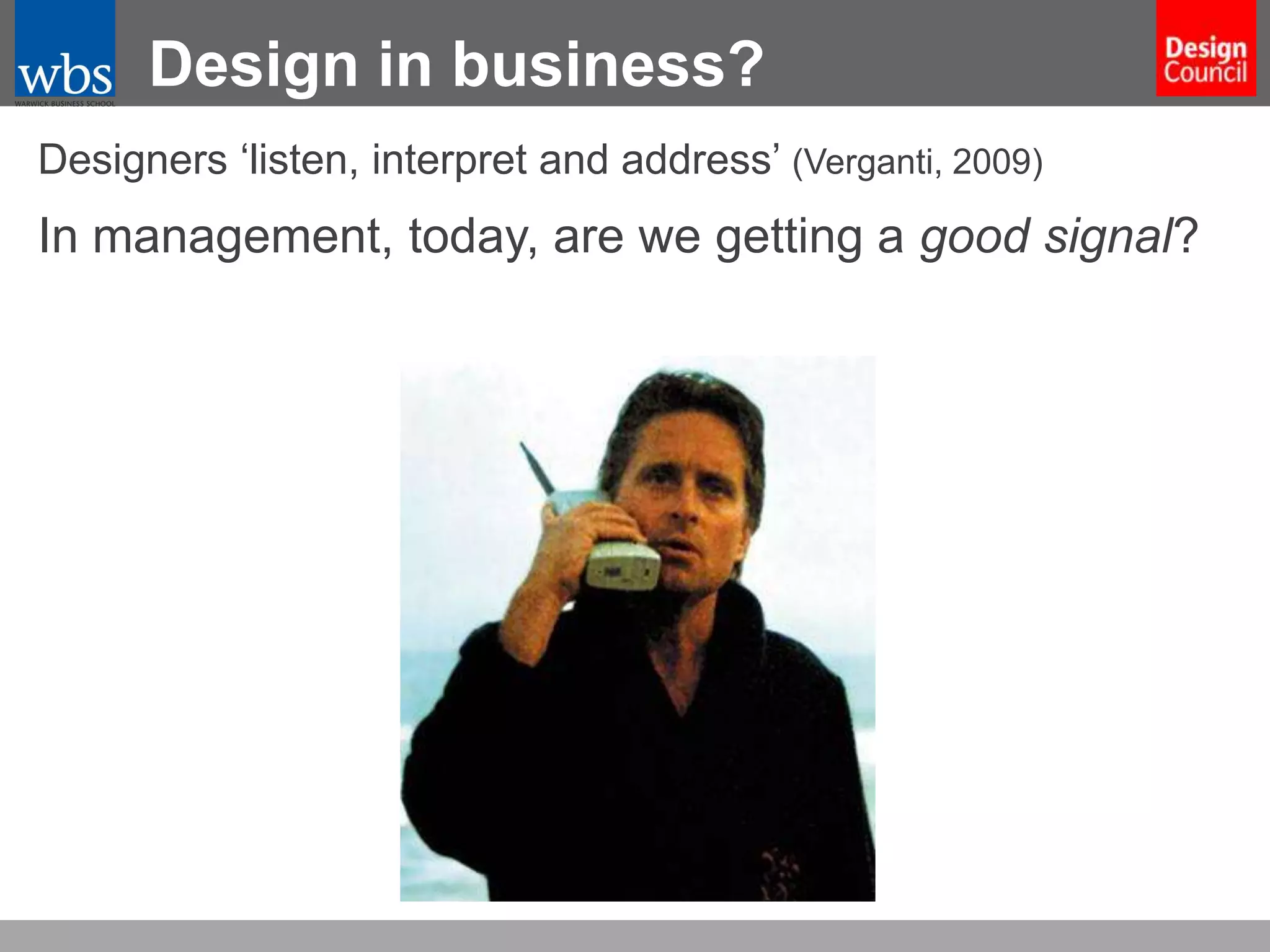
Design in business?
Designers ‘listen, interpret and address’ (Verganti, 2009)

In management, today, are we getting a good signal?
Contact Information

Dr Pietro Micheli
Associate Professor of Organizational Performance
Warwick Business School
University of Warwick
Coventry CV4 7AL
United Kingdom
Tel: +44 (0)24 7615 0882
E-mail: pietro.micheli@wbs.ac.uk
Agree with the research
findings

Focus : What holds Design
back?
Leading Business by Design

Leading Business by Design

  • 2.
    Dr Pietro Micheli AssociateProfessor of Organizational Performance Warwick Business School
  • 3.
    Why this research? > Evidenceof impact of design on business performance, but not conclusive > Quantitative studies don’t say much about how design impacts performance > If design and (radical) innovation are connected, we’d better pay attention!
  • 4.
    What did wedo? 48 interviews in 12 private companies - services and product-based. Large SMEs
  • 5.
    What did wedo? Interviews (average 60 minutes) with employees in both senior and more operational positions working in different functional areas – design, marketing, general management and finance. Data collected between March and July 2013; all interviews recorded, transcribed, and analysed by two researchers. Draft reports sent to the case companies for validation. Focus of the interviews: > Roles of design > Investment in design > Impact of design.
  • 6.
    What did wefind? 1. Design is customer-centred – Benefit is greatest when design is intimately related to solving problems, especially customers’ problems. 2. Design is most powerful when culturally embedded – It works best when it has strong support in the organisation, especially from senior management. 3. Design can add value to any organisation – Design can benefit manufacturing and service-based organisations, small, medium or large.
  • 7.
    Is this new? 1. Designis customer-centred – Benefit is greatest when design is intimately related to solving problems, especially customers’ problems. Stereotype 1: Design is not customer-centred “Apple don’t co-create with the customers, because it is not their culture. … We haven’t got a preciousness here… You can’t get precious about design. We are trying to do the right thing for customers.” (Interviewee A)
  • 8.
    Is this new? 2. Designis most powerful when culturally embedded – It works best when it has strong support in the organisation, especially from senior management. Stereotype 2: Designers are ‘emotional artists’ who don’t understand business “Designers are the people that enjoy having a creative career and that’s why they chose to go in to the business, but it’s a lot of art for art’s sake” (Interviewee B) The Design Director “is a real baby. … He’s just a creative guy. His bark is much worse than his bite.” (Interviewee C) Designers “talk of things like “the big idea”; but they’re talking about something that isn’t a big idea. … they don’t know what brand equity is, they don’t know what a brand promise means or they don’t know how to write an advertising brief” (Interviewee D)
  • 10.
    What did wefind? Impact of design 1.as a ‘service’ 2.as a key perspective in the development process 3.as a strategic perspective.
  • 11.
    What did wefind? Strategic role of design? > Presence of a sponsor among senior management (CEO / founder in the case of an SME) > Design Director / Manager crucial, especially when leadership support is lacking > Rigorous documentation and review of successes.
  • 12.
    Benefits Design can addvalue by: > Driving innovation and opening up uncontested market spaces > Differentiating products and services to attract customers > Strengthening branding, embodying a company’s values and improving recognition.
  • 13.
    Enhanced… Financial Sales Market share Customer Consistency inthe company’s portfolio Brand recognition Customer satisfaction and advocacy Product launch success Operations cost (reduction) People Interdepartmental collaboration Teamwork Working practices Process Consistent approach to product / service development Project failure (lower) Time to market
  • 14.
    Recommendations 1. Don’t limitthe context in which design can operate 2. Use design to differentiate 3. Integrate design and branding 4. Introduce a design process 5. Trust and support your design talent 6. Embed design in your organisational culture 7. Design your work environment 8. Don’t let the designer’s role be a straitjacket
  • 15.
    Design in business? Designers‘listen, interpret and address’ (Verganti, 2009) In management, today, are we getting a good signal?
  • 16.
    Contact Information Dr PietroMicheli Associate Professor of Organizational Performance Warwick Business School University of Warwick Coventry CV4 7AL United Kingdom Tel: +44 (0)24 7615 0882 E-mail: pietro.micheli@wbs.ac.uk
  • 21.
    Agree with theresearch findings Focus : What holds Design back?