PRESENTED BY
DILMANPREET SINGH OJAS DHINGRA
PRESENTED BY
IN
TRODUCTION
0
Leadership is the ability to develop a vision that motivates
others to move with a passion toward a common goal. So
leadership is a process by which a person influences others to
accomplish an objective and directs the organization in
a way that makes it more cohesive and coherent.
Definition
• leadership is the "process of social
influence in which one person can
enlist the aid and support of others in
the accomplishment of a common task‘’.
M Chemers.
• "Leadership is ultimately about creating a
way for people to contribute to making
something extraordinary happen.''
Alan Keith.
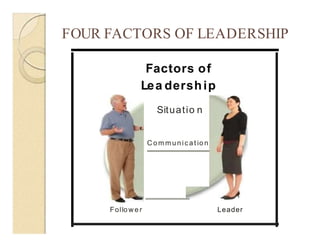
FOUR FACTORS OF LEADERSHIP
Factors of
Lea dership
Situatio n
Com municat io n
Follower Leader
• Leader - You must have an honest
understanding of who you are, what you know
and what you can do. To be successful you have to
convince your followers not your superiors, that
you are worthy of being followed.
• Follower -You must know your people. The
fundamental starting point is having a good
understanding of human nature, such as
needs, emotions and motivation.
• Communication-The nonverba l
communication is leading. E.g.- when you set
example that communicates to your people that
you would not ask them to perform anything
that you would not be willing to do. Bad
communication harm the relation between
leader and employee.
•Situation-We must use our judgm ent to decide
the best course of action and the leadership
style needed for each situation. What we do in
one situation will not always work in another.
0
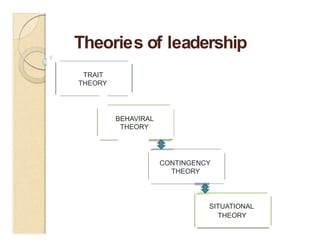
Theories of leadership
TRAIT
THEORY
BEHAVIRAL
THEORY
CONTINGENCY
THEORY
SITUATIONAL
THEORY
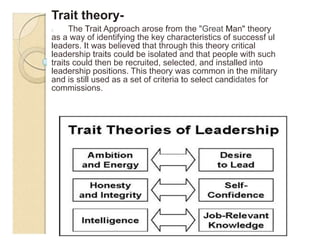
Trait theory-
0 The Trait Approach arose from the "Great Man" theory
as a way of identifying the key characteristics of successf ul
leaders. It was believed that through this theory critical
leadership traits could be isolated and that people with such
traits could then be recruited, selected, and installed into
leadership positions. This theory was common in the military
and is still used as a set of criteria to select candidates for
commissions.
-- --.
Advantages of Trait Theory -
• It is naturally pleasing theory.
• It serves as a yardstick against which the
leadership traits of an individual can be
assessed.
• It gives a detailed knowledge and understanding
of the leader element in the leadership process.
Limitations of The Trait Theory -
• There is bound to be some subjective judgment in
determining who is regarded as a 'good' or
'successful' leader.
• There is also a disagreement over which traits are the
most important for an effec tive leader
Behavioral Theory-
J;.>. These theories of leadership are based upon the
belief that great leaders are made, not born.
J;.>. Rooted in behaviorism, this leadership theory
focuses on the actions of leaders not on
mental qualities or internal states.
:;.. According to this theory, people can LEARN to
become leaders through teaching and
observation.
>- The behavior approach says that anyone
who adopts the appropriate behavior can be a
good leader.
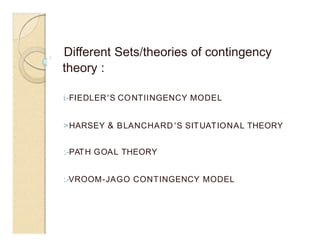
Different Sets/theories of contingency
theory :
0
i.-FIEDLER'S CONTllNGENCY MODEL
>HARSEY & BLANCHARD 'S SITUATIONAL THEORY
:.-PATH GOAL THEORY
:.-VROOM-JAGO CONTINGENCY MODEL
LEADERSHIP.ppt
LEADERSHIP.ppt

LEADERSHIP.ppt

  • 1.
    PRESENTED BY DILMANPREET SINGHOJAS DHINGRA PRESENTED BY
  • 2.
    IN TRODUCTION 0 Leadership is theability to develop a vision that motivates others to move with a passion toward a common goal. So leadership is a process by which a person influences others to accomplish an objective and directs the organization in a way that makes it more cohesive and coherent.
  • 3.
    Definition • leadership isthe "process of social influence in which one person can enlist the aid and support of others in the accomplishment of a common task‘’. M Chemers. • "Leadership is ultimately about creating a way for people to contribute to making something extraordinary happen.'' Alan Keith.
  • 4.
    FOUR FACTORS OFLEADERSHIP Factors of Lea dership Situatio n Com municat io n Follower Leader
  • 5.
    • Leader -You must have an honest understanding of who you are, what you know and what you can do. To be successful you have to convince your followers not your superiors, that you are worthy of being followed. • Follower -You must know your people. The fundamental starting point is having a good understanding of human nature, such as needs, emotions and motivation.
  • 6.
    • Communication-The nonverbal communication is leading. E.g.- when you set example that communicates to your people that you would not ask them to perform anything that you would not be willing to do. Bad communication harm the relation between leader and employee. •Situation-We must use our judgm ent to decide the best course of action and the leadership style needed for each situation. What we do in one situation will not always work in another.
  • 7.
  • 8.
    Trait theory- 0 TheTrait Approach arose from the "Great Man" theory as a way of identifying the key characteristics of successf ul leaders. It was believed that through this theory critical leadership traits could be isolated and that people with such traits could then be recruited, selected, and installed into leadership positions. This theory was common in the military and is still used as a set of criteria to select candidates for commissions. -- --.
  • 9.
    Advantages of TraitTheory - • It is naturally pleasing theory. • It serves as a yardstick against which the leadership traits of an individual can be assessed. • It gives a detailed knowledge and understanding of the leader element in the leadership process.
  • 10.
    Limitations of TheTrait Theory - • There is bound to be some subjective judgment in determining who is regarded as a 'good' or 'successful' leader. • There is also a disagreement over which traits are the most important for an effec tive leader
  • 11.
    Behavioral Theory- J;.>. Thesetheories of leadership are based upon the belief that great leaders are made, not born. J;.>. Rooted in behaviorism, this leadership theory focuses on the actions of leaders not on mental qualities or internal states. :;.. According to this theory, people can LEARN to become leaders through teaching and observation. >- The behavior approach says that anyone who adopts the appropriate behavior can be a good leader.
  • 13.
    Different Sets/theories ofcontingency theory : 0 i.-FIEDLER'S CONTllNGENCY MODEL >HARSEY & BLANCHARD 'S SITUATIONAL THEORY :.-PATH GOAL THEORY :.-VROOM-JAGO CONTINGENCY MODEL