BUSM139 Assessment 1:
Enhanced CDM for Tropicana
Team 4 Friday’s Batch:
1. Alicia Schandy - ID 220197597
2. Annkit Sharma - ID 220885591
3. Arpitha Thollapalli Gopinath - ID 220471578
4. Khushboo Bakhtiani - ID 220376181
5. Kui Zhao - ID 220474432
Client Organization: Tropicana
● Tropicana is a beverage company that sells fruit juices.
● It was founded in 1947.
● Between 1998 and 2021 it was a subsidiary of PepsiCo, but in August 2021, 61% of Tropicana was sold
to PAI Partners (private equity firm).
● Tropicana has a global footprint of more than 2,000 associates that spans North America and Europe.
● Tropicana highlights innovation and R&D as an essential part of their mission on their LinkedIn profile,
which makes their business particularly suitable to implement the CDM.
1
Client Organization: Tropicana
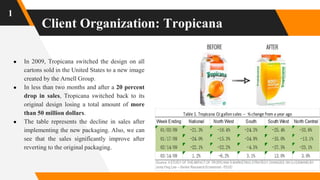
● In 2009, Tropicana switched the design on all
cartons sold in the United States to a new image
created by the Arnell Group.
● In less than two months and after a 20 percent
drop in sales, Tropicana switched back to its
original design losing a total amount of more
than 50 million dollars.
● The table represents the decline in sales after
implementing the new packaging. Also, we can
see that the sales significantly improve after
reverting to the original packaging.
1
The Company Democracy Model (CDM)
2
The Company Democracy Model (CDM)
2
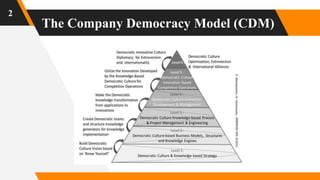
The CDM is a practical methodology that organizations can adopt to achieve effective knowledge-based management
and leadership.The model is based on the utilization of the knowledge produced by the company itself as its own core
innovation engine.
Sustainability strategy:
● Level 1: Build a knowledge-based democratic culture.
-Employers feel free and secure to share knowledge, ideas, and insights in any format.
-The employers keeps the intellectual property of his contribution.
● Level 2: Build teams to validate and mature the idea presented in Level 1.
-Adjust human resources to support the employee in transforming the initial idea into practical project
requirements.
-Anyone with a good idea can receive this support.
● Level 3: Development efforts to produce actual and tangible results.
-The company invests in implementing the idea.
The Company Democracy Model (CDM)
2
Extroversion strategy:
● Level 4: Identify and manage innovation.
-Invest heavily in the product developed in level 3 and turn it into an innovation.
-Costly and time-consuming process; not all ideas reach this point.
● Level 5: Utilize competitiveness and promote international strategy and operations.
-Marketing and communication to exploit the power of the new products or services.
-Redesign organizational strategy to utilize innovation.
● Level 6: Reach the apex of the strategy
-Company can enjoy the benefits of being in a blue ocean, extroversion.
Organization challenges that the CDM cannot fulfill
3
● Sometimes products that look great on paper fail to deliver to customers.
● With the existing Company Democracy model, if an idea reaches level 3, and the product doesn’t perform well, it
could lead to huge losses for the company.
Reasons :
1. Fault in the product
2. Customer Dissatisfaction
3. Existing Competition in the market
4. Bad Design or Packaging
5. Incompatible with the existing system
● All the above can be identified at an earlier stage with thorough testing of the product, and can save time, effort
and money.
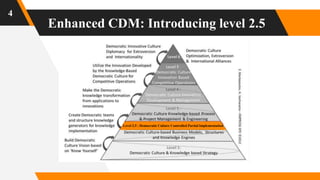
Enhanced CDM: Introducing level 2.5
4
Level 2.5 : Democratic Culture Controlled Partial Implementation
Enhanced CDM: Introducing level 2.5
4
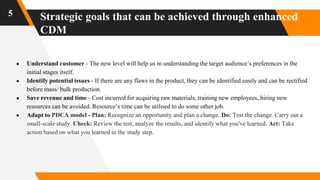
Level 2.5: Democratic Culture Controlled Partial Implementation.
● Between Level 2 and Level 3.
● The company makes small investment to launch the product/idea in a segment of the target market and evaluate
the result.
● Evaluation should be in-depth and aim to identify flaws and areas of improvement for the product/idea including
Customer feedback and Market Analysis.
● If it works well, advance to Level 3 to fully implement it.
● If it doesn't, drop to Level 2 to adjust/reassess.
Enhanced CDM: Introducing level 2.5
4
Level 2.5: Democratic Culture Controlled Partial
Implementation.
For Tropicana:
● Company can change the package design in a
few trial cities and evaluate the results.
● If there is no impact on the sales or if the sales
reduce, then it makes no sense for the company
to move to Level 3.
● The company needs to move back to Level 2 to
modify or drop the idea.
Strategic goals that can be achieved through enhanced
CDM
5
● Understand customer - The new level will help us in understanding the target audience’s preferences in the
initial stages itself.
● Identify potential issues - If there are any flaws in the product, they can be identified easily and can be rectified
before mass/ bulk production.
● Save revenue and time - Cost incurred for acquiring raw materials, training new employees, hiring new
resources can be avoided. Resource’s time can be utilised to do some other job.
● Adapt to PDCA model - Plan: Recognize an opportunity and plan a change. Do: Test the change. Carry out a
small-scale study. Check: Review the test, analyze the results, and identify what you've learned. Act: Take
action based on what you learned in the study step.
Leadership styles needed to adopt Level 2.5
6
● Participative leadership:
Definition: The leader listens to the followers and involves them in the decision-making process
-Employees are involved in the decision-making process
-QA teams provide feedback on the product performance and quality
-Suggestions are taken from employees for the improvement of product
● Transactional leadership:
Definition: The leaders set clear objective and reward the followers accordingly for accomplishing said
objective in an organized fashion
-Focus on tasks and results during partial implementation
-Clarifying role and tasks to guide employees towards established goals
-Practicality, Performance-Oriented, Conventional Decision Making
Leadership activities needed to execute level 2.5
7
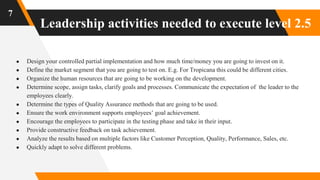
● Design your controlled partial implementation and how much time/money you are going to invest on it.
● Define the market segment that you are going to test on. E.g. For Tropicana this could be different cities.
● Organize the human resources that are going to be working on the development.
● Determine scope, assign tasks, clarify goals and processes. Communicate the expectation of the leader to the
employees clearly.
● Determine the types of Quality Assurance methods that are going to be used.
● Ensure the work environment supports employees’ goal achievement.
● Encourage the employees to participate in the testing phase and take in their input.
● Provide constructive feedback on task achievement.
● Analyze the results based on multiple factors like Customer Perception, Quality, Performance, Sales, etc.
● Quickly adapt to solve different problems.
Impacts of level 2.5 on other levels
8
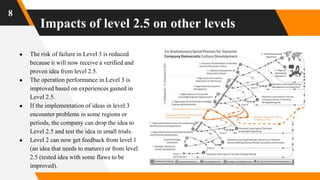
● The risk of failure in Level 3 is reduced
because it will now receive a verified and
proven idea from level 2.5.
● The operation performance in Level 3 is
improved based on experiences gained in
Level 2.5.
● If the implementation of ideas in level 3
encounter problems in some regions or
periods, the company can drop the idea to
Level 2.5 and test the idea in small trials.
● Level 2 can now get feedback from level 1
(an idea that needs to mature) or from level
2.5 (tested idea with some flaws to be
improved).
Conclusions
9
By including level 2.5 :
● Chances of failure are reduced - Since the changes are thoroughly tested in Level 2.5, the chances of
failure after implementing new idea is very less.
● Company image and reputation is unharmed - Both corporate image and reputation can impact a
company’s revenue and success
● Company can avoid product launch being cancelled or delayed - this is important because it can hurt
relationships with company business partners
● Win customer’s trust - Companies will have good reputation in the market, this will increase their
customer base.
● This level can benefit companies of all sizes in every sector like technology, automobile, FMCG, etc.
Thank You

Leadership-Assignment1-ppt.pptx

  • 1.
    BUSM139 Assessment 1: EnhancedCDM for Tropicana Team 4 Friday’s Batch: 1. Alicia Schandy - ID 220197597 2. Annkit Sharma - ID 220885591 3. Arpitha Thollapalli Gopinath - ID 220471578 4. Khushboo Bakhtiani - ID 220376181 5. Kui Zhao - ID 220474432
  • 2.
    Client Organization: Tropicana ●Tropicana is a beverage company that sells fruit juices. ● It was founded in 1947. ● Between 1998 and 2021 it was a subsidiary of PepsiCo, but in August 2021, 61% of Tropicana was sold to PAI Partners (private equity firm). ● Tropicana has a global footprint of more than 2,000 associates that spans North America and Europe. ● Tropicana highlights innovation and R&D as an essential part of their mission on their LinkedIn profile, which makes their business particularly suitable to implement the CDM. 1
  • 3.
    Client Organization: Tropicana ●In 2009, Tropicana switched the design on all cartons sold in the United States to a new image created by the Arnell Group. ● In less than two months and after a 20 percent drop in sales, Tropicana switched back to its original design losing a total amount of more than 50 million dollars. ● The table represents the decline in sales after implementing the new packaging. Also, we can see that the sales significantly improve after reverting to the original packaging. 1
  • 4.
    The Company DemocracyModel (CDM) 2
  • 5.
    The Company DemocracyModel (CDM) 2 The CDM is a practical methodology that organizations can adopt to achieve effective knowledge-based management and leadership.The model is based on the utilization of the knowledge produced by the company itself as its own core innovation engine. Sustainability strategy: ● Level 1: Build a knowledge-based democratic culture. -Employers feel free and secure to share knowledge, ideas, and insights in any format. -The employers keeps the intellectual property of his contribution. ● Level 2: Build teams to validate and mature the idea presented in Level 1. -Adjust human resources to support the employee in transforming the initial idea into practical project requirements. -Anyone with a good idea can receive this support. ● Level 3: Development efforts to produce actual and tangible results. -The company invests in implementing the idea.
  • 6.
    The Company DemocracyModel (CDM) 2 Extroversion strategy: ● Level 4: Identify and manage innovation. -Invest heavily in the product developed in level 3 and turn it into an innovation. -Costly and time-consuming process; not all ideas reach this point. ● Level 5: Utilize competitiveness and promote international strategy and operations. -Marketing and communication to exploit the power of the new products or services. -Redesign organizational strategy to utilize innovation. ● Level 6: Reach the apex of the strategy -Company can enjoy the benefits of being in a blue ocean, extroversion.
  • 7.
    Organization challenges thatthe CDM cannot fulfill 3 ● Sometimes products that look great on paper fail to deliver to customers. ● With the existing Company Democracy model, if an idea reaches level 3, and the product doesn’t perform well, it could lead to huge losses for the company. Reasons : 1. Fault in the product 2. Customer Dissatisfaction 3. Existing Competition in the market 4. Bad Design or Packaging 5. Incompatible with the existing system ● All the above can be identified at an earlier stage with thorough testing of the product, and can save time, effort and money.
  • 8.
    Enhanced CDM: Introducinglevel 2.5 4 Level 2.5 : Democratic Culture Controlled Partial Implementation
  • 9.
    Enhanced CDM: Introducinglevel 2.5 4 Level 2.5: Democratic Culture Controlled Partial Implementation. ● Between Level 2 and Level 3. ● The company makes small investment to launch the product/idea in a segment of the target market and evaluate the result. ● Evaluation should be in-depth and aim to identify flaws and areas of improvement for the product/idea including Customer feedback and Market Analysis. ● If it works well, advance to Level 3 to fully implement it. ● If it doesn't, drop to Level 2 to adjust/reassess.
  • 10.
    Enhanced CDM: Introducinglevel 2.5 4 Level 2.5: Democratic Culture Controlled Partial Implementation. For Tropicana: ● Company can change the package design in a few trial cities and evaluate the results. ● If there is no impact on the sales or if the sales reduce, then it makes no sense for the company to move to Level 3. ● The company needs to move back to Level 2 to modify or drop the idea.
  • 11.
    Strategic goals thatcan be achieved through enhanced CDM 5 ● Understand customer - The new level will help us in understanding the target audience’s preferences in the initial stages itself. ● Identify potential issues - If there are any flaws in the product, they can be identified easily and can be rectified before mass/ bulk production. ● Save revenue and time - Cost incurred for acquiring raw materials, training new employees, hiring new resources can be avoided. Resource’s time can be utilised to do some other job. ● Adapt to PDCA model - Plan: Recognize an opportunity and plan a change. Do: Test the change. Carry out a small-scale study. Check: Review the test, analyze the results, and identify what you've learned. Act: Take action based on what you learned in the study step.
  • 12.
    Leadership styles neededto adopt Level 2.5 6 ● Participative leadership: Definition: The leader listens to the followers and involves them in the decision-making process -Employees are involved in the decision-making process -QA teams provide feedback on the product performance and quality -Suggestions are taken from employees for the improvement of product ● Transactional leadership: Definition: The leaders set clear objective and reward the followers accordingly for accomplishing said objective in an organized fashion -Focus on tasks and results during partial implementation -Clarifying role and tasks to guide employees towards established goals -Practicality, Performance-Oriented, Conventional Decision Making
  • 13.
    Leadership activities neededto execute level 2.5 7 ● Design your controlled partial implementation and how much time/money you are going to invest on it. ● Define the market segment that you are going to test on. E.g. For Tropicana this could be different cities. ● Organize the human resources that are going to be working on the development. ● Determine scope, assign tasks, clarify goals and processes. Communicate the expectation of the leader to the employees clearly. ● Determine the types of Quality Assurance methods that are going to be used. ● Ensure the work environment supports employees’ goal achievement. ● Encourage the employees to participate in the testing phase and take in their input. ● Provide constructive feedback on task achievement. ● Analyze the results based on multiple factors like Customer Perception, Quality, Performance, Sales, etc. ● Quickly adapt to solve different problems.
  • 14.
    Impacts of level2.5 on other levels 8 ● The risk of failure in Level 3 is reduced because it will now receive a verified and proven idea from level 2.5. ● The operation performance in Level 3 is improved based on experiences gained in Level 2.5. ● If the implementation of ideas in level 3 encounter problems in some regions or periods, the company can drop the idea to Level 2.5 and test the idea in small trials. ● Level 2 can now get feedback from level 1 (an idea that needs to mature) or from level 2.5 (tested idea with some flaws to be improved).
  • 15.
    Conclusions 9 By including level2.5 : ● Chances of failure are reduced - Since the changes are thoroughly tested in Level 2.5, the chances of failure after implementing new idea is very less. ● Company image and reputation is unharmed - Both corporate image and reputation can impact a company’s revenue and success ● Company can avoid product launch being cancelled or delayed - this is important because it can hurt relationships with company business partners ● Win customer’s trust - Companies will have good reputation in the market, this will increase their customer base. ● This level can benefit companies of all sizes in every sector like technology, automobile, FMCG, etc.
  • 16.