Leadership in Islamic Context
Gaphs Panimbang
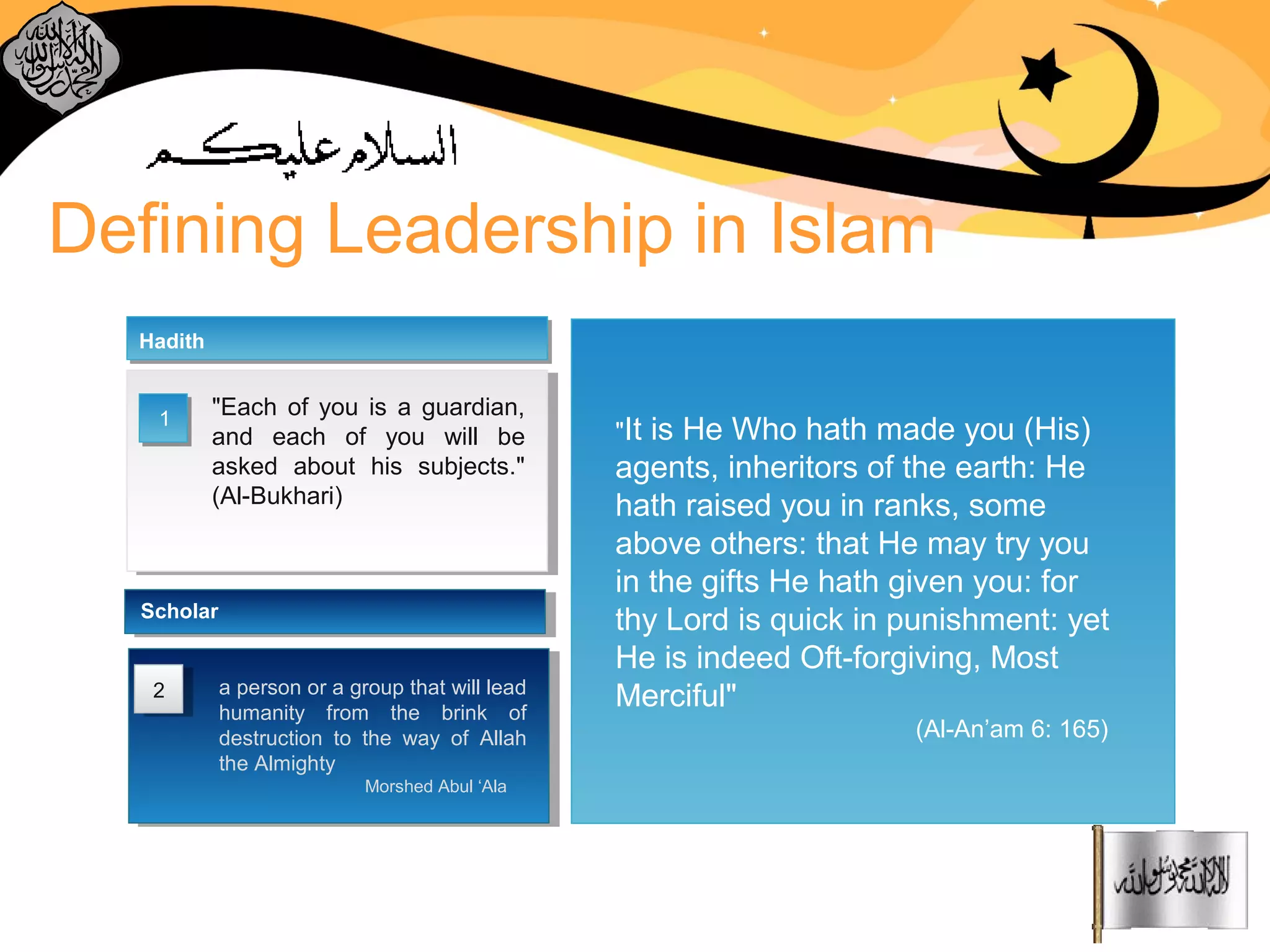
Defining Leadership in Islam
"Each of you is a guardian,
and each of you will be
asked about his subjects."
(Al-Bukhari)
Hadith
2 a person or a group that will lead
humanity from the brink of
destruction to the way of Allah
the Almighty
Morshed Abul ‘Ala
Scholar
"It is He Who hath made you (His)
agents, inheritors of the earth: He
hath raised you in ranks, some
above others: that He may try you
in the gifts He hath given you: for
thy Lord is quick in punishment: yet
He is indeed Oft-forgiving, Most
Merciful"
(Al-An’am 6: 165)
1
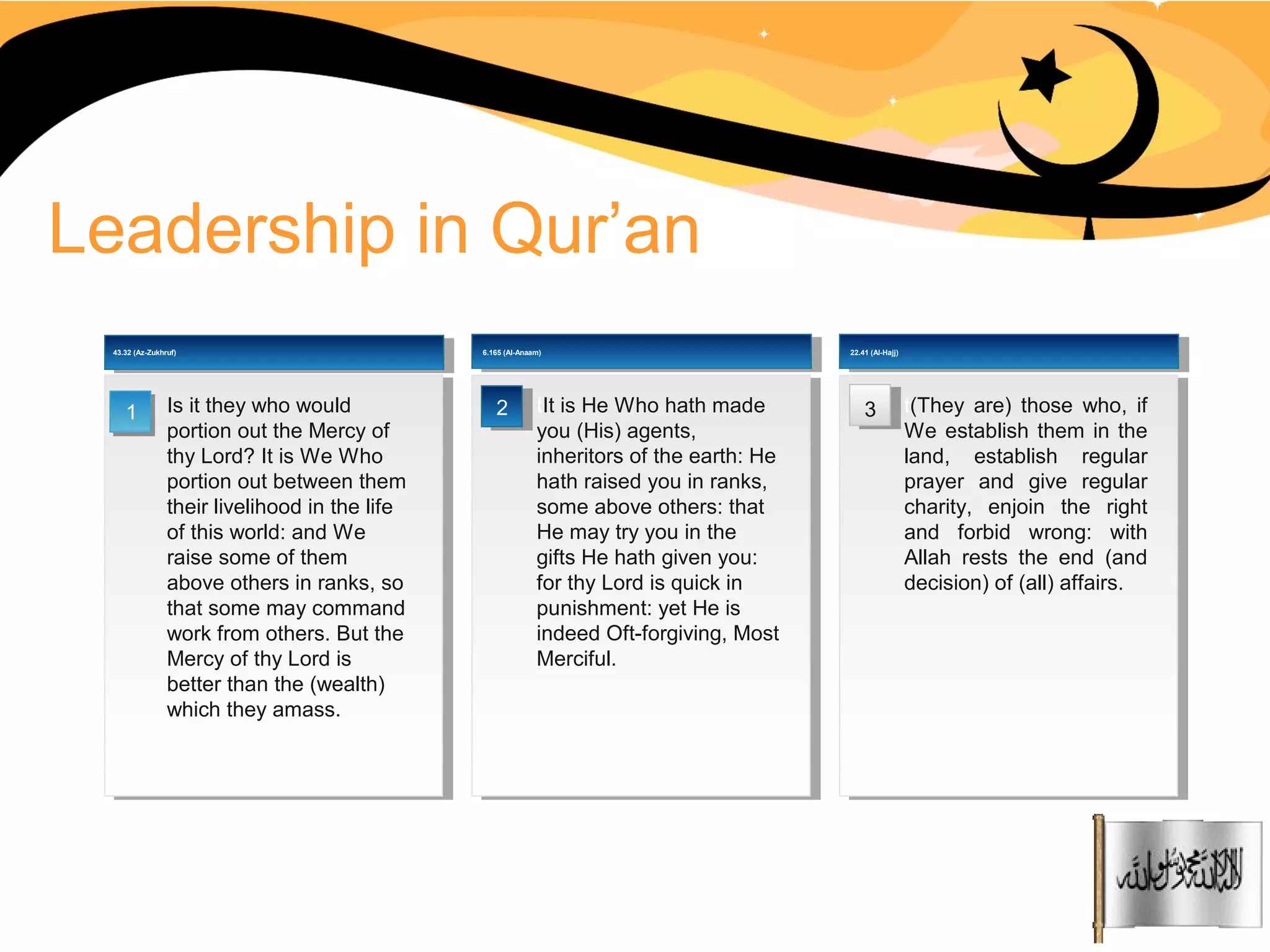
Leadership in Qur’an
tIt is He Who hath made
you (His) agents,
inheritors of the earth: He
hath raised you in ranks,
some above others: that
He may try you in the
gifts He hath given you:
for thy Lord is quick in
punishment: yet He is
indeed Oft-forgiving, Most
Merciful.
6.165 (Al-Anaam)43.32 (Az-Zukhruf)
t(They are) those who, if
We establish them in the
land, establish regular
prayer and give regular
charity, enjoin the right
and forbid wrong: with
Allah rests the end (and
decision) of (all) affairs.
22.41 (Al-Hajj)
Is it they who would
portion out the Mercy of
thy Lord? It is We Who
portion out between them
their livelihood in the life
of this world: and We
raise some of them
above others in ranks, so
that some may command
work from others. But the
Mercy of thy Lord is
better than the (wealth)
which they amass.
321
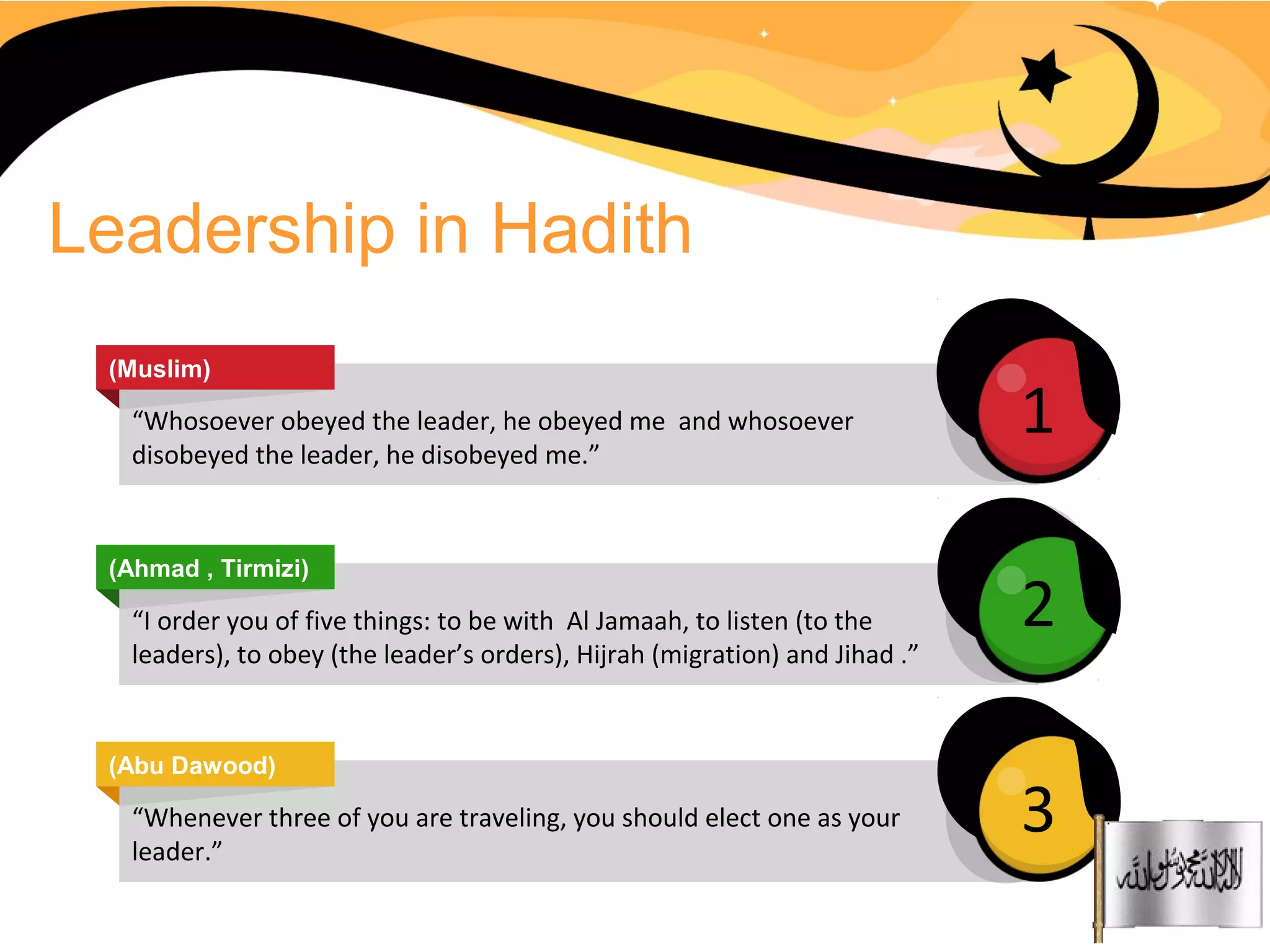
Leadership in Hadith
“I order you of five things: to be with Al Jamaah, to listen (to the
leaders), to obey (the leader’s orders), Hijrah (migration) and Jihad .”
(Ahmad , Tirmizi)
“Whenever three of you are traveling, you should elect one as your
leader.”
(Abu Dawood)
“Whosoever obeyed the leader, he obeyed me and whosoever
disobeyed the leader, he disobeyed me.”
(Muslim)
2
3
1
Importance of
Islamic Leadership
Every movement has a need for leadership
Importance of leadership is like the engine of
a train
Only Islamic leadership can solve the
problems of humanity . . . .
Difference between
Secular & Sacred Leadership
• Secular
leadership's
target is self-
establishment.
• Secular
leaderships work
for the respect
of people
• Islamic
Leadership's target
is Jannatul Firdaws
(Highest position in
Paradise)
• Islamic
Leaderships work
for the pleasure of
Allah
SacredSecular
Guiding Principles
of Islamic Leadership
1
Trust
(Amanah)
2
Responsibility
(Taklif)
3
Accountability
(Mas’uliyyah)
Moral Basis of
Islamic Leadership
4 Stages
of
Spiritual
Development
Ihsan Iman
IslamTaqwa
Leadership and the
Bases of Power
Bases of Power
Legitimate
Power
Reward
Power
Coercive
Power
Expert
Power
Charismatic
Power
The Concept of
Leadership in Islam
Trust
Righteousness
The struggle towards self-development
Justice
Promise-keeping
5 Key5 Key
ParametersParameters
of Islamicof Islamic
BehaviorBehavior
The Source of
Islamic Leadership Principles
Pious Followers
Wise Caliphs
The Holy Qur’an
"There has come to you from Allah Light and a Plain
Book." (5.15)
The Holy Prophet
"For you the life of the Prophet is a good model of behaviour"
(33:21).
The 4 Caliphs: Abu Bakr, Umar, Uthman, and Ali (RA)
Leaders and people of great wisdom who followed the Qur’an & Sunnah
Characteristics
of a Leader
ConsultationConsultationConsultationConsultation
HonestyHonestyHonestyHonesty
CompetenceCompetenceCompetenceCompetence
InspirationInspirationInspirationInspiration
HumilityHumilityHumilityHumility PatiencePatiencePatiencePatience
http://facebook.com/gaphorpanimbang
gpanimbang
Gaphor M. Panimbang
@gpanimbang
gpanimbang
Jazakallahu
Khairan!

Leadership in Islam

  • 1.
    Leadership in IslamicContext Gaphs Panimbang
  • 2.
    Defining Leadership inIslam "Each of you is a guardian, and each of you will be asked about his subjects." (Al-Bukhari) Hadith 2 a person or a group that will lead humanity from the brink of destruction to the way of Allah the Almighty Morshed Abul ‘Ala Scholar "It is He Who hath made you (His) agents, inheritors of the earth: He hath raised you in ranks, some above others: that He may try you in the gifts He hath given you: for thy Lord is quick in punishment: yet He is indeed Oft-forgiving, Most Merciful" (Al-An’am 6: 165) 1
  • 3.
    Leadership in Qur’an tItis He Who hath made you (His) agents, inheritors of the earth: He hath raised you in ranks, some above others: that He may try you in the gifts He hath given you: for thy Lord is quick in punishment: yet He is indeed Oft-forgiving, Most Merciful. 6.165 (Al-Anaam)43.32 (Az-Zukhruf) t(They are) those who, if We establish them in the land, establish regular prayer and give regular charity, enjoin the right and forbid wrong: with Allah rests the end (and decision) of (all) affairs. 22.41 (Al-Hajj) Is it they who would portion out the Mercy of thy Lord? It is We Who portion out between them their livelihood in the life of this world: and We raise some of them above others in ranks, so that some may command work from others. But the Mercy of thy Lord is better than the (wealth) which they amass. 321
  • 4.
    Leadership in Hadith “Iorder you of five things: to be with Al Jamaah, to listen (to the leaders), to obey (the leader’s orders), Hijrah (migration) and Jihad .” (Ahmad , Tirmizi) “Whenever three of you are traveling, you should elect one as your leader.” (Abu Dawood) “Whosoever obeyed the leader, he obeyed me and whosoever disobeyed the leader, he disobeyed me.” (Muslim) 2 3 1
  • 5.
    Importance of Islamic Leadership Everymovement has a need for leadership Importance of leadership is like the engine of a train Only Islamic leadership can solve the problems of humanity . . . .
  • 6.
    Difference between Secular &Sacred Leadership • Secular leadership's target is self- establishment. • Secular leaderships work for the respect of people • Islamic Leadership's target is Jannatul Firdaws (Highest position in Paradise) • Islamic Leaderships work for the pleasure of Allah SacredSecular
  • 7.
    Guiding Principles of IslamicLeadership 1 Trust (Amanah) 2 Responsibility (Taklif) 3 Accountability (Mas’uliyyah)
  • 8.
    Moral Basis of IslamicLeadership 4 Stages of Spiritual Development Ihsan Iman IslamTaqwa
  • 9.
    Leadership and the Basesof Power Bases of Power Legitimate Power Reward Power Coercive Power Expert Power Charismatic Power
  • 10.
    The Concept of Leadershipin Islam Trust Righteousness The struggle towards self-development Justice Promise-keeping 5 Key5 Key ParametersParameters of Islamicof Islamic BehaviorBehavior
  • 11.
    The Source of IslamicLeadership Principles Pious Followers Wise Caliphs The Holy Qur’an "There has come to you from Allah Light and a Plain Book." (5.15) The Holy Prophet "For you the life of the Prophet is a good model of behaviour" (33:21). The 4 Caliphs: Abu Bakr, Umar, Uthman, and Ali (RA) Leaders and people of great wisdom who followed the Qur’an & Sunnah
  • 12.
  • 13.