Rural Leadership
Dr. Rajinder Kaur Kalra
Professor & Head (Retired )
Deptt.of Ext. Edu.
Leadership Quote
Before you are a leader success is all
about growing yourself.
When you become a leader, success is all
about growing others (Jack Welch)
Concept of Leadership
Leadership is the ability to persuade
others to seek defined objectives
enthusiastically
It is a human factor that finds a group
together and motivates it towards goals
Haiman (1951) Leadership refers to that process
where by an individual directs, guides, influences
or controls the thoughts, feelings or behavior of
the human beings.
Definitions of Leadership
According to Cartwright and Zender (1960)
leadership as the performance of acts that help the
group to achieve its preferred outcomes
According to Niderfrank (1966) Leadership in
essence is simply influencing the attitudes and
actions of one or more persons leading towards
the achievement of some purpose
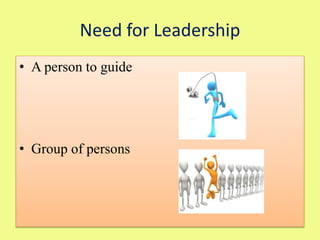
• A person to guide
• Group of persons
Need for Leadership
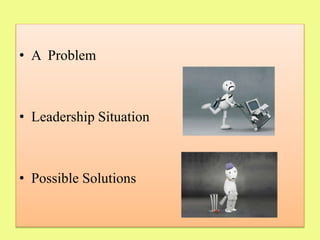
• A Problem
• Leadership Situation
• Possible Solutions
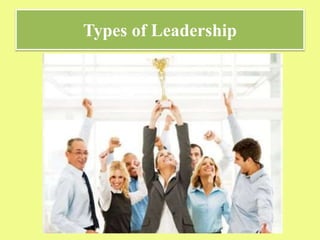
Types of Leadership
Autocratic Leadership
Democratic Leadership
Free Rein Leadership
Determines all policies ,activities and goals of the
organizations
Stifles the creativity and innovative ability of his
subordinates
Take no part in work except when conducting meetings,
telling others what to do or demonstrating
Members are uncertain about what to do and usually take
actions they are told to take
Leader is personal in both praise and criticism of the
work
Autocratic leadership
Produces a shared leadership that permits a
feeling of satisfaction and achievements
Leader helps the members to understands the
steps required in working
 Leader takes responsibility for group
maintenance and task performance
Shows concerns for his followers and thereby
gains their respect
Places emphasis on results rather than on
action
Democratic leadership
Leader gives minimum guidance
Leader remains in the background and
seldom express his opinion or works with
organization
 Members have almost complete freedom
operates with a minimum of rules
Members often act as leaders in making
decisions that guide the organization
Insecurity and frequent frustrations
Free Rein leadership
1. They coordinate the efforts of a group to
achieve its goals
2. They establish proper social climate in the
group
3. Leaders assist the group to organize themselves
4. They promote the spread of message of
extension agencies
5. They help in planning and execution of
development programmes
Roles of a leader
6 They act as demonstrators for the innovations
7 They create inter and intra group coordination
8 They act as spokesman of group
9 They encourage others for action
10 They develop self confidence among members
Roles of a leader
11 They take active part in organizing and
functioning of rural institutions
12 They create favorable climate for introducing
development programmes
13 They support and motivate others to make
efforts for realizing their needs
14 They help in making effective decisions and
develop scientific decision making process
15 They act as a model for members
Roles of a leader
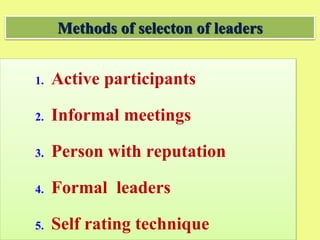
1. Active participants
2. Informal meetings
3. Person with reputation
4. Formal leaders
5. Self rating technique
Methods of selecton of leaders
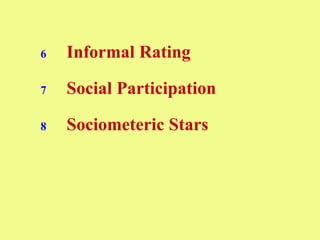
6 Informal Rating
7 Social Participation
8 Sociometeric Stars
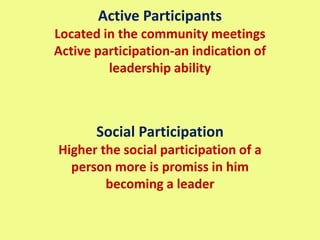
Active Participants
Located in the community meetings
Active participation-an indication of
leadership ability
Social Participation
Higher the social participation of a
person more is promiss in him
becoming a leader
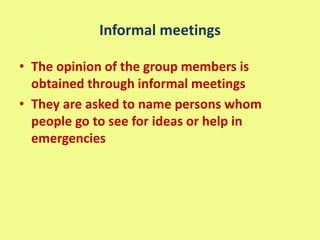
Informal meetings
• The opinion of the group members is
obtained through informal meetings
• They are asked to name persons whom
people go to see for ideas or help in
emergencies
Persons with Reputation
• Persons having reputation of being
• honest,
• intelligent and
• helping hand are selected
Formal Leaders
Persons who hold offices in formal
organzations
Self Rating technique
Each person is asked to evaluate his
own abilities to act as a leader
Informal Rating
• 3-4 Judges are appointed to nominate the
persons suitable to act as leader for a
particular activity
• The names obtained in this way are sorted
out by frequency mentioned and those of
high frequency are accepted as possible
selectees
• The judges are the persons of repute in the
area
Sociometeric Stars
• All members of a group are asked to name
three persons in order of preference as their
leaders from the same group
• The name obtaining the maximum choices is
accepted as the possible leader
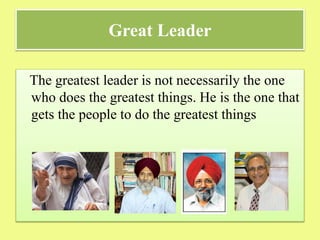
Great Leader
The greatest leader is not necessarily the one
who does the greatest things. He is the one that
gets the people to do the greatest things
Thank you

Leadership

  • 1.
    Rural Leadership Dr. RajinderKaur Kalra Professor & Head (Retired ) Deptt.of Ext. Edu.
  • 2.
    Leadership Quote Before youare a leader success is all about growing yourself. When you become a leader, success is all about growing others (Jack Welch)
  • 3.
    Concept of Leadership Leadershipis the ability to persuade others to seek defined objectives enthusiastically It is a human factor that finds a group together and motivates it towards goals
  • 4.
    Haiman (1951) Leadershiprefers to that process where by an individual directs, guides, influences or controls the thoughts, feelings or behavior of the human beings. Definitions of Leadership
  • 5.
    According to Cartwrightand Zender (1960) leadership as the performance of acts that help the group to achieve its preferred outcomes
  • 6.
    According to Niderfrank(1966) Leadership in essence is simply influencing the attitudes and actions of one or more persons leading towards the achievement of some purpose
  • 7.
    • A personto guide • Group of persons Need for Leadership
  • 8.
    • A Problem •Leadership Situation • Possible Solutions
  • 9.
  • 10.
  • 11.
    Determines all policies,activities and goals of the organizations Stifles the creativity and innovative ability of his subordinates Take no part in work except when conducting meetings, telling others what to do or demonstrating Members are uncertain about what to do and usually take actions they are told to take Leader is personal in both praise and criticism of the work Autocratic leadership
  • 12.
    Produces a sharedleadership that permits a feeling of satisfaction and achievements Leader helps the members to understands the steps required in working  Leader takes responsibility for group maintenance and task performance Shows concerns for his followers and thereby gains their respect Places emphasis on results rather than on action Democratic leadership
  • 13.
    Leader gives minimumguidance Leader remains in the background and seldom express his opinion or works with organization  Members have almost complete freedom operates with a minimum of rules Members often act as leaders in making decisions that guide the organization Insecurity and frequent frustrations Free Rein leadership
  • 14.
    1. They coordinatethe efforts of a group to achieve its goals 2. They establish proper social climate in the group 3. Leaders assist the group to organize themselves 4. They promote the spread of message of extension agencies 5. They help in planning and execution of development programmes Roles of a leader
  • 15.
    6 They actas demonstrators for the innovations 7 They create inter and intra group coordination 8 They act as spokesman of group 9 They encourage others for action 10 They develop self confidence among members Roles of a leader
  • 16.
    11 They takeactive part in organizing and functioning of rural institutions 12 They create favorable climate for introducing development programmes 13 They support and motivate others to make efforts for realizing their needs 14 They help in making effective decisions and develop scientific decision making process 15 They act as a model for members Roles of a leader
  • 17.
    1. Active participants 2.Informal meetings 3. Person with reputation 4. Formal leaders 5. Self rating technique Methods of selecton of leaders
  • 18.
    6 Informal Rating 7Social Participation 8 Sociometeric Stars
  • 19.
    Active Participants Located inthe community meetings Active participation-an indication of leadership ability Social Participation Higher the social participation of a person more is promiss in him becoming a leader
  • 20.
    Informal meetings • Theopinion of the group members is obtained through informal meetings • They are asked to name persons whom people go to see for ideas or help in emergencies
  • 21.
    Persons with Reputation •Persons having reputation of being • honest, • intelligent and • helping hand are selected
  • 22.
    Formal Leaders Persons whohold offices in formal organzations Self Rating technique Each person is asked to evaluate his own abilities to act as a leader
  • 23.
    Informal Rating • 3-4Judges are appointed to nominate the persons suitable to act as leader for a particular activity • The names obtained in this way are sorted out by frequency mentioned and those of high frequency are accepted as possible selectees • The judges are the persons of repute in the area
  • 24.
    Sociometeric Stars • Allmembers of a group are asked to name three persons in order of preference as their leaders from the same group • The name obtaining the maximum choices is accepted as the possible leader
  • 25.
    Great Leader The greatestleader is not necessarily the one who does the greatest things. He is the one that gets the people to do the greatest things
  • 26.