Lead Time vs Lag Time in Project Management (2025 Guide)
1.
Project Management, WorkforceManagement
Lead Time vs Lag Time in Project Management: A
Complete Guide
Alma Reed Updated on May 2, 2025 Read Time: 4min
TABLE OF CONTENTS
Introduction: Time is Everything in Project
Log In
2.
Management
In project scheduling,timing isn’t merely a matter of meeting deadlines—it’s about how one task flows into
another. Two frequently confused but mission-critical scheduling terms are lead time and lag time. The
difference in these timing factors can be between a smooth flow of work and an expensive delay.
Whether it is overseeing a building development, launching software or a marketing promotion, a clear
understanding of lead time vs. lag time enables you to make informed scheduling decisions, align teams more
efficiently, and keep stakeholders engaged.
In this guide, we will demystify everything you need to know about lead time vs lag time through real-world
examples, formulas, and practical tips to apply these concepts to contemporary planning. And yes—we will
also demonstrate how a free project management tool can automate and visualize these timings to make it
easy to execute.
What is Lead Time in Project Management?
Lead time is the duration between when a process begins and when it ends. When it comes to task
dependencies, it is the degree of overlap between two tasks.
Example: If Task B can start 2 days prior to Task A finishing, then that time of 2 days is lead time.
Formula:
Lead Time = Successor Task Start Date – Predecessor Task Finish Date (wherever it overlaps)
Lead time has the effect of moving a task forward so it can be performed concurrently. It can greatly minimize
a project duration when utilized judiciously.
What is Lag Time in Project Management?
Lag time is specifically used to denote a planned delay between two successive dependent activities. It is time
that has to elapse between when one activity completes and when another activity commences.
Example: If Task B does not begin until Task A is finished, then this 3-day wait is considered lag
time.
Formula:
Lag Time = Successor Task Start Date – Predecessor Task Finish Date (if gap exists)
Lag time is frequently employed to measure processing time in construction, approval time in administrative
3.
work, or supplylead times in logistics.
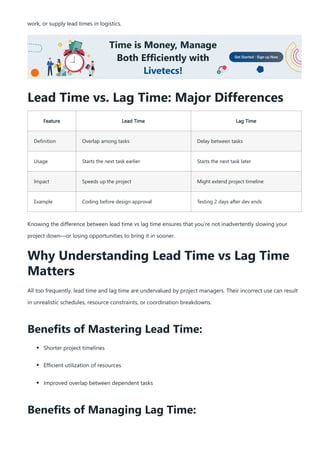
Lead Time vs. Lag Time: Major Differences
Feature Lead Time Lag Time
Definition Overlap among tasks Delay between tasks
Usage Starts the next task earlier Starts the next task later
Impact Speeds up the project Might extend project timeline
Example Coding before design approval Testing 2 days after dev ends
Knowing the difference between lead time vs lag time ensures that you’re not inadvertently slowing your
project down—or losing opportunities to bring it in sooner.
Why Understanding Lead Time vs Lag Time
Matters
All too frequently, lead time and lag time are undervalued by project managers. Their incorrect use can result
in unrealistic schedules, resource constraints, or coordination breakdowns.
Benefits of Mastering Lead Time:
Shorter project timelines
Efficient utilization of resources
Improved overlap between dependent tasks
Benefits of Managing Lag Time:
4.
Lowered risk fromrushed processes
More realistic scheduling buffers
Improved quality assurance and compliance
When integrated with a free project management software, it becomes easy to visualize and realign such
timings.
Real-World Examples of Lead and Lag Time
1. Construction Industry
Lead Time: Wiring begins before wall construction is finished.
Lag Time: Wait 3 days after pouring concrete before flooring begins.
2. Software Development
Lead Time: Testing starts once a module is done, not the full system.
Lag Time: Release code after a mandatory 2-day QA review.
3. Event Management
Lead Time: Marketing begins while event logistics are still being finalized.
Lag Time: Wait a week post-registration to finalize catering.
These examples show how essential lead vs lag time is for cross-functional teams and regulatory compliance.
Where Lead and Lag Time Fit in Project Scheduling
These timings are typically built into task dependencies in project schedules, especially within Gantt charts or
CPM (Critical Path Method) analysis.
Key Dependency Types:
Finish-to-Start (FS) – Task B begins after Task A finishes (default)
Finish-to-Finish (FF) – Task B finishes after Task A
Start-to-Start (SS) – Task B starts after Task A
5.
Start-to-Finish (SF) –Rare; Task B ends when Task A starts
In all of these, lead time brings a successor task forward, while lag time pushes it back.
How to Calculate and Implement Lead Time vs Lag
Time
Step-by-Step Approach:
1. Identify task dependencies (usually FS)
2. Evaluate overlap feasibility (Lead): Can Task B start early?
3. Determine necessary delays (Lag): Is waiting justified?
4. Apply time offsets using positive (lag) or negative (lead) values
5. Visualize using Gantt charts or timeline views
Most free project tools allow this through visual interfaces or logic-based settings.
Best Practices in Lead and Lag Time Management
1. Document Task Dependencies Fully
Define relationship type (FS, SS, etc.) and any lead/lag involved.
2. Communicate Across Teams
Only add lead time when both teams are aligned.
3. Employ Buffers Strategically
Use lag time for logical buffers, not arbitrary delays.
4. Automate with Tools
Choose software that supports drag-and-drop dependencies and visual timelines.
5. Continuously Monitor
Reassess lead/lag during every status meeting—projects evolve.
Tools That Assist in Managing Lag Time vs Lead
6.
Time
Without naming vendors,modern tools support:
Drag-and-drop task dependencies
Lead/lag values within settings
Visual adjustments on timelines
Slack or email alerts for overlaps/gaps
Even free tools often offer these scheduling features.
Common Pitfalls to Avoid
❌ Assuming all tasks must wait
❌ Overlapping without resource checks
❌ Hard-coding lead/lag from past projects
❌ Ignoring risk vs. speed trade-offs
When to Use Lead Time vs Lag Time
Situation Use Lead Time Use Lag Time
Tight Deadlines ✅ ❌
Compliance Checks ❌ ✅
Agile Development ✅ ✅ (for reviews)
Waterfall Projects ✅ (if possible) ✅
Conclusion: Lead Time vs Lag Time – Finding a
Harmony
Mastering lead and lag time is a critical skill in project management. It helps you:
7.
Identify opportunities foracceleration
Insert intentional pauses for quality and risk control
Build reliable, flexible schedules
In fast-paced work, speed is key—but only when balanced with control. That’s what lead and lag time offer.
Want to apply this? Use a free project management tool to map your current project and add
lead and lag adjustments to see immediate benefits.
See Also: Best Project Management Memes (2025)
Final Thought
Every project has its rhythm. The skill lies in managing that rhythm—sometimes through smart overlaps,
sometimes through strategic delays. That’s the essence of lead vs lag time.
Author: Alma Reed
8.
Alma Reed isan author and researcher dedicated to enhancing productivity. She is deeply interested in
areas such as time management, increasing productivity, and fostering healthy routines. Through her
writing, she aims to assist people in boosting their job performance and attaining an ideal balance
between work and life.
Speak with our Expert.
Get a free demo of our Best Time and Expense Tracking Software.
GET A FREE DEMO
Start using TimeLive today
Track time and expenses effortlessly
Simplify project management and invoicing
Collaborate seamlessly with your team
Get Started - It’s Free
Related Articles
Best Project Management Memes (2025)
Alma Reed April 30, 2025
How to Calculate Hours in Excel (A Complete Tutorial and Helpful Formulas)
9.
Alma Reed April28, 2025
How to Strike Through Text in Google Docs: A Complete 2025 Guide
Alma Reed April 25, 2025
How To Create A Dashboard In Excel? (Steps & Templates) 2025
Alma Reed April 24, 2025
LIVETECS
About
Blogs
Contact
10.
Our Client
Become APartner
Customization Service
PRODUCTS
Features
Feature Tour Video
Quick Start Video
Release Notes
Integrations
Download
On Premises
LEGAL & POLICIES
Privacy Policy
Terms Of Use
CONTACT US
111 NE 1st Street, 8th Floor #303 MIAMI, FL 33132, US
+1-888-666-8154
sales@livetecs.com
FOLLOW US
JOIN OUR NEWSLETTER
Enter your work email




![20260201 [FOSDEM] gomodjail - library sandboxing for Go modules.pdf](https://cdn.slidesharecdn.com/ss_thumbnails/20260201fosdemgomodjail-librarysandboxingforgomodules-260201225659-76609ec4-thumbnail.jpg?width=640&height=640&fit=bounds)


