Le Chatelier’s Principle
Effect of Pressure Change
Theory Le Chatelier’s Principle
 If you walking up an
escalator at the same speed
as it is moving down, there
is no overall change in your
position because the two
opposing motions are
balanced.
Start the Escalator
Theory Le Chatelier’s Principle
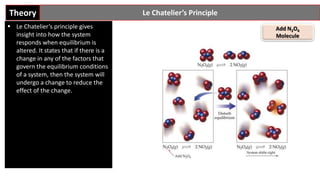
 Le Chatelier’s principle gives
insight into how the system
responds when equilibrium is
altered. It states that if there is a
change in any of the factors that
govern the equilibrium conditions
of a system, then the system will
undergo a change to reduce the
effect of the change.
Add N2O4
Molecule
Theory Le Chatelier’s Principle-Effect of Pressure
 Let us consider the synthesis
of ammonia from nitrogen
and hydrogen. Let the
system be allowed to attain
equilibrium in a cylinder
with a piston.
N2(g) + 3H2(g) ⇌ 2NH3(g)
Theory Le Chatelier’s Principle-Effect of Pressure
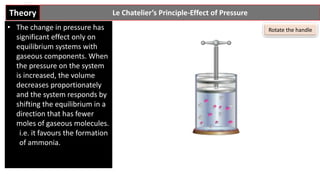
• The change in pressure has
significant effect only on
equilibrium systems with
gaseous components. When
the pressure on the system
is increased, the volume
decreases proportionately
and the system responds by
shifting the equilibrium in a
direction that has fewer
moles of gaseous molecules.
i.e. it favours the formation
of ammonia.
Rotate the handle
Theory Le Chatelier’s Principle-Effect of Pressure
• The change in pressure has
significant effect only on
equilibrium systems with
gaseous components. When
the pressure on the system
is increased, the volume
decreases proportionately
and the system responds by
shifting the equilibrium in a
direction that has fewer
moles of gaseous molecules.
i.e. it favours the formation
of ammonia.
Rotate increase
pressure
Rotate decrease
pressure
Theory Le Chatelier’s Principle-Effect of Pressure
 If we pull the piston upwards to
reduce the pressure, the volume
increases. It favours the
decomposition of ammonia
Rotate increase
pressure
Rotate decrease
pressure
Theory Le Chatelier’s Principle-Effect of Pressure
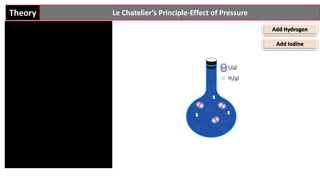
Add Hydrogen
Add Iodine
Theory Le Chatelier’s Principle-Effect of Pressure
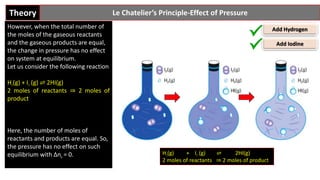
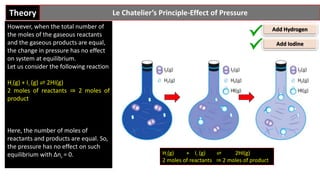
However, when the total number of
the moles of the gaseous reactants
and the gaseous products are equal,
the change in pressure has no effect
on system at equilibrium.
Let us consider the following reaction
H2(g) + I2 (g) ⇌ 2HI(g)
2 moles of reactants ⇒ 2 moles of
product
Here, the number of moles of
reactants and products are equal. So,
the pressure has no effect on such
equilibrium with Δng = 0.
Add Hydrogen
Add Iodine
H2(g) + I2 (g) ⇌ 2HI(g)
2 moles of reactants ⇒ 2 moles of product
Theory Le Chatelier’s Principle-Effect of Pressure
However, when the total number of
the moles of the gaseous reactants
and the gaseous products are equal,
the change in pressure has no effect
on system at equilibrium.
Let us consider the following reaction
H2(g) + I2 (g) ⇌ 2HI(g)
2 moles of reactants ⇒ 2 moles of
product
Here, the number of moles of
reactants and products are equal. So,
the pressure has no effect on such
equilibrium with Δng = 0.
Add Hydrogen
Add Iodine
H2(g) + I2 (g) ⇌ 2HI(g)
2 moles of reactants ⇒ 2 moles of product
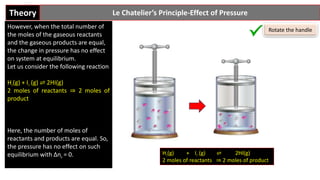
Theory Le Chatelier’s Principle-Effect of Pressure
However, when the total number of
the moles of the gaseous reactants
and the gaseous products are equal,
the change in pressure has no effect
on system at equilibrium.
Let us consider the following reaction
H2(g) + I2 (g) ⇌ 2HI(g)
2 moles of reactants ⇒ 2 moles of
product
Here, the number of moles of
reactants and products are equal. So,
the pressure has no effect on such
equilibrium with Δng = 0. H2(g) + I2 (g) ⇌ 2HI(g)
2 moles of reactants ⇒ 2 moles of product
Rotate the handle
Le Chatelier’s Principle.pptx

Le Chatelier’s Principle.pptx

  • 1.
  • 2.
    Theory Le Chatelier’sPrinciple  If you walking up an escalator at the same speed as it is moving down, there is no overall change in your position because the two opposing motions are balanced. Start the Escalator
  • 3.
    Theory Le Chatelier’sPrinciple  Le Chatelier’s principle gives insight into how the system responds when equilibrium is altered. It states that if there is a change in any of the factors that govern the equilibrium conditions of a system, then the system will undergo a change to reduce the effect of the change. Add N2O4 Molecule
  • 4.
    Theory Le Chatelier’sPrinciple-Effect of Pressure  Let us consider the synthesis of ammonia from nitrogen and hydrogen. Let the system be allowed to attain equilibrium in a cylinder with a piston. N2(g) + 3H2(g) ⇌ 2NH3(g)
  • 5.
    Theory Le Chatelier’sPrinciple-Effect of Pressure • The change in pressure has significant effect only on equilibrium systems with gaseous components. When the pressure on the system is increased, the volume decreases proportionately and the system responds by shifting the equilibrium in a direction that has fewer moles of gaseous molecules. i.e. it favours the formation of ammonia. Rotate the handle
  • 6.
    Theory Le Chatelier’sPrinciple-Effect of Pressure • The change in pressure has significant effect only on equilibrium systems with gaseous components. When the pressure on the system is increased, the volume decreases proportionately and the system responds by shifting the equilibrium in a direction that has fewer moles of gaseous molecules. i.e. it favours the formation of ammonia. Rotate increase pressure Rotate decrease pressure
  • 7.
    Theory Le Chatelier’sPrinciple-Effect of Pressure  If we pull the piston upwards to reduce the pressure, the volume increases. It favours the decomposition of ammonia Rotate increase pressure Rotate decrease pressure
  • 8.
    Theory Le Chatelier’sPrinciple-Effect of Pressure Add Hydrogen Add Iodine
  • 9.
    Theory Le Chatelier’sPrinciple-Effect of Pressure However, when the total number of the moles of the gaseous reactants and the gaseous products are equal, the change in pressure has no effect on system at equilibrium. Let us consider the following reaction H2(g) + I2 (g) ⇌ 2HI(g) 2 moles of reactants ⇒ 2 moles of product Here, the number of moles of reactants and products are equal. So, the pressure has no effect on such equilibrium with Δng = 0. Add Hydrogen Add Iodine H2(g) + I2 (g) ⇌ 2HI(g) 2 moles of reactants ⇒ 2 moles of product
  • 10.
    Theory Le Chatelier’sPrinciple-Effect of Pressure However, when the total number of the moles of the gaseous reactants and the gaseous products are equal, the change in pressure has no effect on system at equilibrium. Let us consider the following reaction H2(g) + I2 (g) ⇌ 2HI(g) 2 moles of reactants ⇒ 2 moles of product Here, the number of moles of reactants and products are equal. So, the pressure has no effect on such equilibrium with Δng = 0. Add Hydrogen Add Iodine H2(g) + I2 (g) ⇌ 2HI(g) 2 moles of reactants ⇒ 2 moles of product
  • 11.
    Theory Le Chatelier’sPrinciple-Effect of Pressure However, when the total number of the moles of the gaseous reactants and the gaseous products are equal, the change in pressure has no effect on system at equilibrium. Let us consider the following reaction H2(g) + I2 (g) ⇌ 2HI(g) 2 moles of reactants ⇒ 2 moles of product Here, the number of moles of reactants and products are equal. So, the pressure has no effect on such equilibrium with Δng = 0. H2(g) + I2 (g) ⇌ 2HI(g) 2 moles of reactants ⇒ 2 moles of product Rotate the handle