LE CHATELIER'S PRINCIPLE
UNDERSTANDING HOW EQUILIBRIA RESPOND TO
CHANGES
CONTENT
• Introduction to Le Chatelier's Principle
• Effect of Temperature
• Effect of Pressure
• Effect of Concentration (No. of Molecules)
• Effect of Catalyst
• Summary
INTRODUCTION TO LE CHATELIER'S PRINCIPLE
Definition:
When a system at equilibrium is disturbed by a change in temperature,
pressure, or concentration, the system shifts its equilibrium position to
counteract the disturbance.
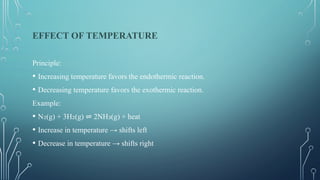
EFFECT OF TEMPERATURE
Principle:
• Increasing temperature favors the endothermic reaction.
• Decreasing temperature favors the exothermic reaction.
Example:
• N (g) + 3H (g) 2NH (g) + heat
₂ ₂ ⇌ ₃
• Increase in temperature → shifts left
• Decrease in temperature → shifts right
EFFECT OF PRESSURE
Principle:
• Increase in pressure → side with fewer gas molecules
• Decrease in pressure → side with more gas molecules
Example:
• N (g) + 3H (g) 2NH (g)
₂ ₂ ⇌ ₃
• 4 moles → 2 moles
• Increase in pressure → shifts right
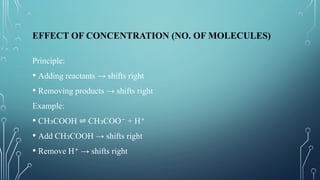
EFFECT OF CONCENTRATION (NO. OF MOLECULES)
Principle:
• Adding reactants → shifts right
• Removing products → shifts right
Example:
• CH COOH CH COO + H
₃ ⇌ ₃ ⁻ ⁺
• Add CH COOH → shifts right
₃
• Remove H → shifts right
⁺
EFFECT OF CATALYST
Principle:
• Catalyst does not affect equilibrium position
• It only speeds up the rate of reaching equilibrium
Example:
• Haber process (Fe catalyst):
• N + 3H 2NH
₂ ₂ ⇌ ₃
• Catalyst speeds up NH production but yield remains same
₃
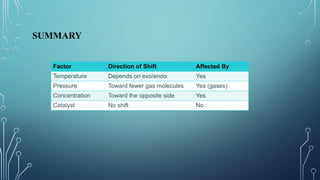
SUMMARY
Factor Direction of Shift Affected By
Temperature Depends on exo/endo Yes
Pressure Toward fewer gas molecules Yes (gases)
Concentration Toward the opposite side Yes
Catalyst No shift No

Any Question?
Thank You

LE CHATELIER PRINCIPLE: Understanding how equilibrium responds to changes

  • 1.
    LE CHATELIER'S PRINCIPLE UNDERSTANDINGHOW EQUILIBRIA RESPOND TO CHANGES
  • 2.
    CONTENT • Introduction toLe Chatelier's Principle • Effect of Temperature • Effect of Pressure • Effect of Concentration (No. of Molecules) • Effect of Catalyst • Summary
  • 3.
    INTRODUCTION TO LECHATELIER'S PRINCIPLE Definition: When a system at equilibrium is disturbed by a change in temperature, pressure, or concentration, the system shifts its equilibrium position to counteract the disturbance.
  • 4.
    EFFECT OF TEMPERATURE Principle: •Increasing temperature favors the endothermic reaction. • Decreasing temperature favors the exothermic reaction. Example: • N (g) + 3H (g) 2NH (g) + heat ₂ ₂ ⇌ ₃ • Increase in temperature → shifts left • Decrease in temperature → shifts right
  • 5.
    EFFECT OF PRESSURE Principle: •Increase in pressure → side with fewer gas molecules • Decrease in pressure → side with more gas molecules Example: • N (g) + 3H (g) 2NH (g) ₂ ₂ ⇌ ₃ • 4 moles → 2 moles • Increase in pressure → shifts right
  • 6.
    EFFECT OF CONCENTRATION(NO. OF MOLECULES) Principle: • Adding reactants → shifts right • Removing products → shifts right Example: • CH COOH CH COO + H ₃ ⇌ ₃ ⁻ ⁺ • Add CH COOH → shifts right ₃ • Remove H → shifts right ⁺
  • 7.
    EFFECT OF CATALYST Principle: •Catalyst does not affect equilibrium position • It only speeds up the rate of reaching equilibrium Example: • Haber process (Fe catalyst): • N + 3H 2NH ₂ ₂ ⇌ ₃ • Catalyst speeds up NH production but yield remains same ₃
  • 8.
    SUMMARY Factor Direction ofShift Affected By Temperature Depends on exo/endo Yes Pressure Toward fewer gas molecules Yes (gases) Concentration Toward the opposite side Yes Catalyst No shift No
  • 9.
  • 10.