PLANT PROPAGATION BYLAYERING
Layering It is an attached method of propagation. In this method,
roots are allowed to develop on the covered portion of the stem
while still being attached to the mother plant. After the emergence
and development of the roots, this portion is separated from the
mother plant and allowed to grow as a new plant on its own root
stem. Such root stem is known as ‘layer’.
Types of layering
Tip layering
Simple layering
Compound or serpentine layering
Trench layering
Mound layering or stooling
Air layering
2.
Simple layering
Insimple layering, a partial
tongue-like cut is given on a
branch. The branch is then
bent to the ground and the
treated portion is covered
with soil, keeping the top or
terminal portion exposed.
The layered branches
produce roots in weeks and
are ready for transplanting in
a nursery after detaching
them carefully.
Examples are jasmine, ixora,
clerodendron, pyrostegia,
etc.
3.
Compound or serpentinelayering
Compound layering is similar to simple layering, except the branches are
alternately covered and exposed along their length. The branches must be
longer so that they can be layered at several places. This method is
followed in plants like bougainvillea, jasmine, clematis, muscadine grape
and wisteria.
4.
Trench layering
Trenchlayering is primarily used in fruit plants. Covering the shoots with soil
results in etiolation, so it is also known as ‘etiolation layering’. New shoots
arise from the length of the burried branches. After rooting, individual shoots
are separated from the mother plant. This method is followed in apple,
cherry, pear, jasmine and rhododendron
5.
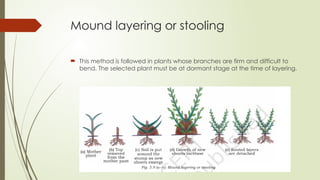
Mound layering orstooling
This method is followed in plants whose branches are firm and difficult to
bend. The selected plant must be at dormant stage at the time of layering.
6.
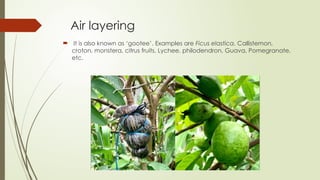
Air layering
Itis also known as ‘gootee’. Examples are Ficus elastica, Callistemon,
croton, monstera, citrus fruits, Lychee, philodendron, Guava, Pomegranate,
etc.
Bulb
Bulb isa specialised underground structure having a flat basal stem and
surrounded by fleshy scales, e.g., onion, tuberose, amaryllis.
Structurally, bulbs are tunicated and non-tunicated. In tunicated bulbs, the
outer layer of scales is converted into dry membranous covering, which
gives protection, e.g., onion, tuberose, amaryllus, tulip, etc.
Non-tunicated bulbs do not possess the enveloping dry covering and are
represented by lilium.
9.
Corm
Corm is anunderground modified solid or compressed stem oriented
vertically in the side having nodes and buds, e.g., gladiolus, crocus, etc.
Tuber
It is an underground storage organ having special swollen
modified stem or roots, e.g., root tuber like Dahlia, Caladium, Dioscorea,
Jerusalem artichoke, etc; and stem tuber like Begonia, Potato, etc.
Rhizome
A modified stem of some plant growing horizontally just below
the ground surface, e.g., Canna, Ferns, Ginger, Iris, etc.
Runner
It is a modified stalk, which is creeping in nature, produced in the leaf
axil and grows out from the parent plant. It grows horizontally along the
ground, where roots are produced at the nodes, which can be used to
produce new plants, e.g., Doob grass, Strawberry, Chlorophytum, etc.
10.
Sucker
Itis a special shoot arising from the root or stem portion of a plant below
the ground level, e.g., chrysanthemum (stem), Clerodendron splendens
(root suckers), anthurium, etc.
Tuberous root
It refers to a swollen tuberous growth that functions as a storage organ.
Examples are satavar, dahlia, chlorophytum, etc
Editor's Notes
#2 Select one-year old healthy, flexible,
long un-branched shoot near the ground
level. Remove leaves of the selected
shoot, retaining some at the top. The
retained leaves prepare food through
photosynthesis. Bend down the shoot so
that some part of it touches the ground.
At that portion, generally, 15−30 cm away
from the terminal end, a sharp slanting
inward cut of 2−3 cm is given. A small
matchstick is inserted in the cut to keep
the slit open. Bend down the branch and
cover the cut part with soil. Keep some
weight or stone over the buried part so
that it is not pulled upward, and remains
GARDENER – CLASS XI
in the same position. A stake is fixed near the layered
branch and the branch operated upon is tied with it.
Water the layered portion regularly. After 3−4 weeks,
rooting starts at the operated portion and this can be
indicated by sprouting buds on the shoot. After this, the
layer is separated from the mother plant and planted in a
new place
#3 One-year old healthy and flexible long shoot
near the ground is selected for compound
layering. The selected stem is placed in
soil in a way that the nodes at certain
distance are covered under the soil and
the intermediate internodes are exposed.
Remove leaves from the selected branch
but retain few leaves at the top. Give two
circular cut around the bark about 2.5−4
cm wide. Remove the bark of the operated
portion (girdling). Apply rooting hormone
to the girdled portion and cover it with soil. The same
branch is operated at 3−4 places at certain distance in
the same way. The growing shoots, which emerge from
the covered portion of the branch, are separated from the
mother plant for planting in a nursery.
#7 Specialised organs are modified stems or roots, developing above the ground surface or underground, which may be used for multiplication of plants. In horticulture, bulbous ornamentals include bulbs, corms, tubers, tuberous roots and rhizomes




![Layering[1]](https://cdn.slidesharecdn.com/ss_thumbnails/layering1-200414104809-thumbnail.jpg?width=640&height=640&fit=bounds)


![grafting and budding [Autosaved]....pptx](https://cdn.slidesharecdn.com/ss_thumbnails/graftingandbuddingautosaved-250508034509-fb3fab88-thumbnail.jpg?width=640&height=640&fit=bounds)


![Lec 9 principles of fruit and vegetaqble preservation [Autosaved].ppt](https://cdn.slidesharecdn.com/ss_thumbnails/lec9principlesoffruitandvegetaqblepreservationautosaved-250104062150-3cfff76f-thumbnail.jpg?width=640&height=640&fit=bounds)


