Post-harvest
management and
value addition of fruits
and vegetables
Post harvest technology
It is a branch of agriculture that deals with all the
operations right from harvesting or even the preharvest
stages till the commodity reaches the consumer, either in
fresh (grains, apple, mango, tomato fruits) or processed
form (flour, juice, nectar, ketchup) and utilization of the
wastes (pomace, peel, seed, skin etc.) in a profitable
manner (manufacture of fermented beverages, colour
extraction, pectin extraction etc.)
Horticulture plays a significant role in Indian Agriculture.
It contributes 30% GDP from 11.73 % of its arable land
area.
India is the second largest producer of both fruits and
vegetables in the world (107.10 Mt and 204.61 Mt
respectively) after China.
The systematic nutritional value of the some fruits &
vegetables was recognized in the early 17th century in
England.
Fresh fruits and vegetables (F&V) have been part of
human diet since the dawn of the history.
Importance of Post harvest
technology
• fruits and vegetables utilized for processing (< 1%).
• exported (Fruits – 0.5% and Vegetables – 1.7%).
• Post harvest losses in fruits and vegetables (20-40%).
• fruits and vegetables shrivel and decay (10-15%).
• Minimizing these losses can increase their supply
without bringing additional land under cultivation.
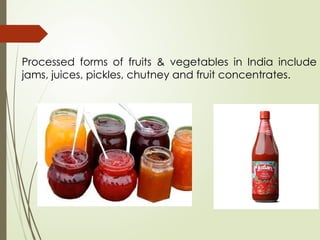
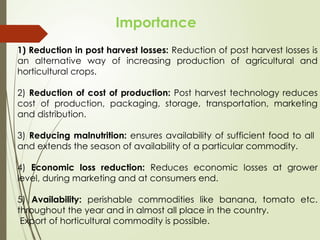
Processed forms of fruits & vegetables in India include
jams, juices, pickles, chutney and fruit concentrates.
1) Reduction in post harvest losses: Reduction of post harvest losses is
an alternative way of increasing production of agricultural and
horticultural crops.
2) Reduction of cost of production: Post harvest technology reduces
cost of production, packaging, storage, transportation, marketing
and distribution.
3) Reducing malnutrition: ensures availability of sufficient food to all
and extends the season of availability of a particular commodity.
4) Economic loss reduction: Reduces economic losses at grower
level, during marketing and at consumers end.
5) Availability: perishable commodities like banana, tomato etc.
throughout the year and in almost all place in the country.
Export of horticultural commodity is possible.
Importance
6)Employment generation: The food processing industry
ranks first in terms of employment generation.
7)Export earnings: Export of fresh and processed
horticultural commodities also attracts valuable foreign
exchange.
8)Defense and astronaut’s requirements: Defense and
astronauts have special requirements of ready to eat
and high energy low volume food.
9)Infant and sports drinks preparations: special infant
and sports drinks to meet the specific nutritional
requirements of their body.
Nature and causes of post harvest losses
(a)Extend of post-harvest loss: Swaminathan Committee (1980)
reported the post-harvest handling accounts for 20-30% of the
losses.
India loses about 35-45% of the harvested fruits and vegetables
during handling, storage, transportation etc. leading to the loss of
Rs. 40,000 crores per year.
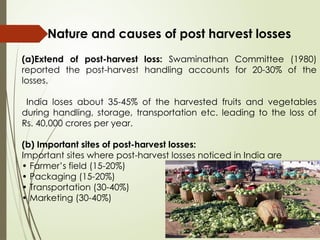
(b) Important sites of post-harvest losses:
Important sites where post-harvest losses noticed in India are
• Farmer’s field (15-20%)
• Packaging (15-20%)
• Transportation (30-40%)
• Marketing (30-40%)
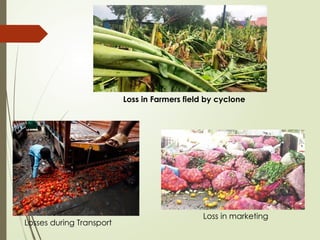
Loss in Farmers field by cyclone
Loss in marketing
Losses during Transport
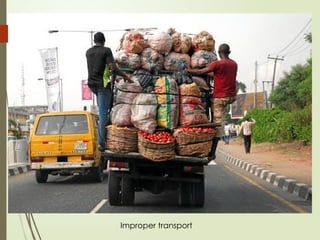
Improper transport
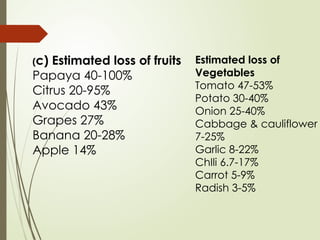
(c) Estimated loss of fruits
Papaya 40-100%
Citrus 20-95%
Avocado 43%
Grapes 27%
Banana 20-28%
Apple 14%
Estimated loss of
Vegetables
Tomato 47-53%
Potato 30-40%
Onion 25-40%
Cabbage & cauliflower
7-25%
Garlic 8-22%
ChIli 6.7-17%
Carrot 5-9%
Radish 3-5%
(d) Causes of post-harvest losses
Horticultural crops typically have high moisture content,
tender texture and high perishability.
The causes of postharvest losses can be divided into different
categories:
1. Metabolic
All fresh horticultural crops are live organs. The natural process
of respiration involves the breakdown of food reserves and
the ageing of these organs.
2. Mechanical
Owing to their tender texture and high moisture content, fresh
fruits and vegetables are very susceptible to mechanical
injury.
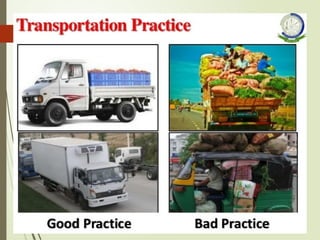
Poor handling, unsuitable containers, improper packaging
and transportation can easily cause bruising, cutting,
breaking, impact wounding and other forms of injury.
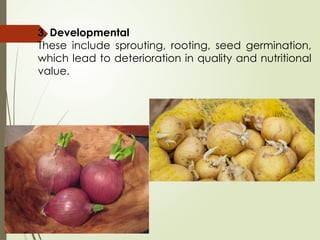
3. Developmental
These include sprouting, rooting, seed germination,
which lead to deterioration in quality and nutritional
value.
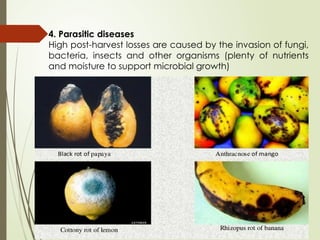
4. Parasitic diseases
High post-harvest losses are caused by the invasion of fungi,
bacteria, insects and other organisms (plenty of nutrients
and moisture to support microbial growth)
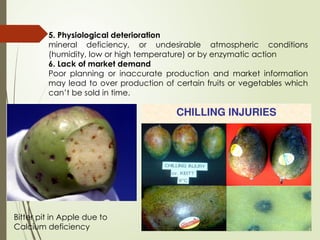
5. Physiological deterioration
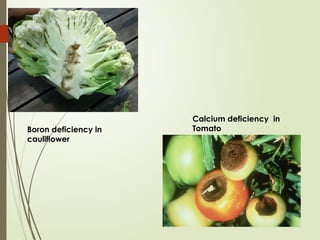
mineral deficiency, or undesirable atmospheric conditions
(humidity, low or high temperature) or by enzymatic action
6. Lack of market demand
Poor planning or inaccurate production and market information
may lead to over production of certain fruits or vegetables which
can’t be sold in time.
Bitter pit in Apple due to
Calcium deficiency
Boron deficiency in
cauliflower
Calcium deficiency in
Tomato
7. Consumption
These losses can be due to inadequate preservation
methods at home, methods of cooking and preparation
such as peeling, cutting etc.
8. Miscellaneous
— Lack of clear concept of packing house operations.
— Lack of awareness among the growers, contractors and
even the policy makers.
— Late realization of its importance,
— Inadequate technical support.
— Unorganized marketing.
—Inadequate market facilities, market intelligence and
market information service (MIS)
Pre-harvest factors
affecting the quality of
fruits and vegetables
1 Temperature
1. Environmental factors
Maturity, colour, sugar, acidity etc. High temperature reduces the
quality, e.g., citrus, radish, spinach, cauliflower, etc., and increased the
quality in grapes, melons tomato, etc. Low temperature cause chilling
and freezing injury.
LIGHT:
Essential for anthocyanin formation. Exposed fruit to
sun light develop the lighter weight, thinner peel,
lower juice and acids and higher TSS than shaded
fruits, e.g., citrus, mango, etc. Exposure of potato to
light causes Greening (solanine formation) which
has toxic properties. High sun light intensity causes
Sunscald in citrus and tomatoes and reduces the
pure white colour of cauliflower.
3 Rains Causes cracking in grapes, dates, litchi, limes,
lemon, tomato, sweet potato, etc. It reduces
appearance and sweetness.
4 Wind Causes bruising, scratching and corky scar (citrus
fruits) on the fruit and damage leafy vegetables.
5 Humidity High humidity reduces the colour and TSS and
increases acidity in citrus, grapes, tomato, etc., but
on other hand it is needed for better quality of
banana, litchi and pineapple.
High nitrogen reduces the ascorbic acid
content, TSS/ acid ratio and keeping
quality but increases thiamine, riboflavin,
carotene, e.g., Citrus and Spinach.
Its deficiency reduces size of fruits.
Nitrogen
High phosphorous decreases size, weight,
vitamin C e.g., Citrus. Its deficiency causes
poor appearance of fruit.
Phosphorous
Increases size, weight and vitamin C, e.g.,
Citrus fruits
Potassium
Increases firmness of many fruits, e.g.,
Apple, Mango, Guava, Tomato, etc.
Calcium
Magnesium Increases size, weight and vitamin C,
e.g., Citrus.
Deficiency causes straggled cluster in
Grape.
Zinc
Deficiency causes flesh browning in fruits,
e.g., Anola and gummy discolouration of
albedo in citrus. Fruits and vegetables
become hard and misshapen. Cabbage, Turnip
and cauliflower are sensitive to boron
Boron
Cytokinin Maintain green colour of leafy vegetables and
causes parthenocarpic fruits in fig.
Ethephon increases anthocyanin (coloured grape,
plum, apple, chillies, brinjal), carotenoides (mango,
guava, papaya, citrus, tomato etc), ascorbic acid
and TSS reduces tannin (grapes, dates, etc) and
acidity (grape, mango, tomato, etc.)
Ethylene
Alar (B9) increases colour in fruits, e.g., apple,
cherry, apricot, etc. Maleic hydrazide (MH) inhibits
sprouting in onion bulbs.
Growth retardant
In citrus Troyer and Carizzo (Citranges) rootstock
produce the fruit of excellent quality of oranges,
mandarins and lemons. In guava P.pumilum root
stock increases sugar and P.cujavillis increases
ascorbic acid content of fruits.
Root stock
Excess irrigation causes high acidity and
deficiency of moisture reduces fruit size, juice
content and increases thickness of peel.
Irrigation
It affects the size, colour, acidity and sugar
content of grape, phalsa, ber, peach,
apple etc.
Thinning in grapes, dates, peaches, plum,
etc., increases size, colour, acidity and
sugar content of fruits.
Pruning
Thinning
In grapes, it increases size, colour and
sugar content of the berries.
Girdling
Varieties differ in size, shape, colour and
chemical composition. High yield, bright
appearance and good shipping qualities
are most important characters of the
varieties.
Variety
Diseases and
pests
Both are harmful to fruits and vegetables
Pesticide spray residues may give rise to
flavour taints in the processed product.
Excessive use of pesticides may even
produce harmful metabolites and
toxicity not necessarily destroyed during
processing.
Pesticide
In general vegetables with exception of
potato and onion are of higher quality
when less mature because they are more
tender, succulent, less fibrous or starchy.
On the other hand fruits when ripe are of
higher quality on account of full size,
bright colour, sweetness and less acidic.
Maturity
Fruits and vegetables should be in no
case injured or damaged other wise
injury, such as skin abrasion and tissue
bruising will reduce appearance and may
be source of infection
Mechanical
injury
importanceofpostharvesttechnologyinfruitsandvegetables-230529070339-0ae41395 - Copy.pptx