Growing Media
Substrate orthe medium which is used to grow plants is commonly
called the growing medium. Media is a source of mineral nutrients,
moisture and support for the plant.
• Mineral source: Media supplies the necessary nutrients for plant
growth.
• Moisture source: Media also supplies the necessary water for the plant.
• Plant support: The third major function of the media is to afford
mechanical support for the plant and its roots, while also ensuring
optimum moisture and aeration for roots.
2.
Different Types ofGrowing Media
• In most cases, two types of growing media are used in protected cultivation viz.
soil and soilless media.
• Soil as a Growing Medium
• Soil is the basic natural medium for growing plants and is indeed the cheapest
source. Loamy and porous soil, rich in organic matter with neutral pH (around 7)
is good for the growth of plants. Soil is mixed with sand and farmyard manure
(2:1:1) for better aeration, water-holding capacity and nutrient supply to the
plants.
• Problems of soil as a medium
• (i) It is difficult to maintain the nutritive status, pH and water-holding capacity of
soil as per the requirements of a particular crop for long duration.
• (ii) The soil-borne pathogens pose a serious threat to the plants, resulting in lower
production.
• (iii) Some types of soil such as saline or ill-drained soil create problems in soil
aeration, porosity.
3.
• Soilless Substratesas Growing Media - the media other than soil (solid
or liquid) are used as a base to grow plants under protected
conditions. This is called ‘soilless culture’.
• Advantages of Soilless Culture
• (i) Soilless culture media, whether liquid or solid, facilitates precise
nutritional requirement of the plant.
• (ii) It helps pathogen-free cultivation.
• (iii) More economical use of fertiliser is possible.
• (iv) Labour saving in weeding and fertiliser applications.
• (v) Saving basal doses of manure.
• (vi) Crop cultivation under problematic soil conditions is possible.
4.
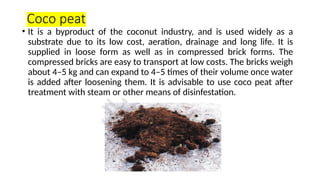
Coco peat
• Itis a byproduct of the coconut industry, and is used widely as a
substrate due to its low cost, aeration, drainage and long life. It is
supplied in loose form as well as in compressed brick forms. The
compressed bricks are easy to transport at low costs. The bricks weigh
about 4–5 kg and can expand to 4–5 times of their volume once water
is added after loosening them. It is advisable to use coco peat after
treatment with steam or other means of disinfestation.
5.
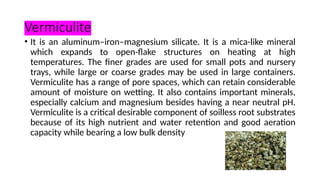
Vermiculite
• It isan aluminum–iron–magnesium silicate. It is a mica-like mineral
which expands to open-flake structures on heating at high
temperatures. The finer grades are used for small pots and nursery
trays, while large or coarse grades may be used in large containers.
Vermiculite has a range of pore spaces, which can retain considerable
amount of moisture on wetting. It also contains important minerals,
especially calcium and magnesium besides having a near neutral pH.
Vermiculite is a critical desirable component of soilless root substrates
because of its high nutrient and water retention and good aeration
capacity while bearing a low bulk density
6.
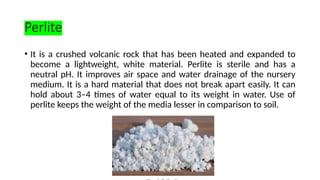
Perlite
• It isa crushed volcanic rock that has been heated and expanded to
become a lightweight, white material. Perlite is sterile and has a
neutral pH. It improves air space and water drainage of the nursery
medium. It is a hard material that does not break apart easily. It can
hold about 3–4 times of water equal to its weight in water. Use of
perlite keeps the weight of the media lesser in comparison to soil.
7.
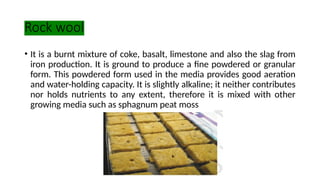
Rock wool
• Itis a burnt mixture of coke, basalt, limestone and also the slag from
iron production. It is ground to produce a fine powdered or granular
form. This powdered form used in the media provides good aeration
and water-holding capacity. It is slightly alkaline; it neither contributes
nor holds nutrients to any extent, therefore it is mixed with other
growing media such as sphagnum peat moss
8.
• Sand: Itis the basic component of soil. Its particle size ranges from
0.05 mm–2.0 mm in diameter. It improves aeration and drainage and
needs minimum cost incurrence. While sand is vulnerable to diseases
and pests, however once sterilised, it can prove to be a good medium
for both potting and propagation media.
• Rice Husk: It is a byproduct of the rice milling industry. It is extremely
light in weight and is very effective for improving drainage.
9.
• Bark:
• Itis a byproduct of saw mills, which is used as a media for pot
cultures as well as in greenhouses. It provides aeration at low cost. It
is either used alone in containers or mixed with one-fourth part of
peat moss for improving water-holding capacity. Bark particles of less
than 3/8 inch (9.5 mm) in size are used as growing media in general.
For improving the pH of the bark medium, dolomite lime may be
added to bring it above a pH of 6 at the least.
• Saw dust: It is similar to peat moss in many ways and its quality
depends on the type of trees. It may contain toxic substances such as
resins, tannins or turpentine. It is acidic in nature and requires
limestone to neutralise it.
10.
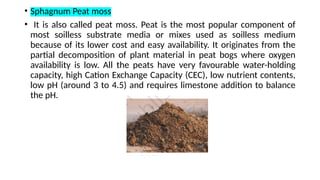
• Sphagnum Peatmoss
• It is also called peat moss. Peat is the most popular component of
most soilless substrate media or mixes used as soilless medium
because of its lower cost and easy availability. It originates from the
partial decomposition of plant material in peat bogs where oxygen
availability is low. All the peats have very favourable water-holding
capacity, high Cation Exchange Capacity (CEC), low nutrient contents,
low pH (around 3 to 4.5) and requires limestone addition to balance
the pH.
11.
Plant Growing Containersfor Greenhouse Production
• The duration of a crop in the greenhouse is the key to make the
greenhouse technology profitable. Therefore, the use of containers in
greenhouse production carries significance.
(i) Raising of seedlings in the nursery.
(ii) Growing plants in greenhouses for hybrid seed production of
flowers.
(iii) Growing cut flowers in greenhouses.
(iv) Growing potted ornamental plants in greenhouses.
12.
• Advantages ofContainers in Greenhouse Production
(i) Increase in production capacity by reducing crop duration.
(ii) Quality production of nursery or crop.
(iii) Uniformity of plant growth, and better vigour and survival rates.
(iv) Provide quick take-off with little or no transplanting shock.
(v) Easy maintenance of sanitation in greenhouse.
(vi) Easy to handle, grade and shift for transportation.
(vii) Better water drainage and aeration in pot media.
(viii) Easy to monitor chemical characteristics and plant nutrition with
advanced irrigation system like drip irrigation.
(ix) Protection from soil-borne pathogens.
13.
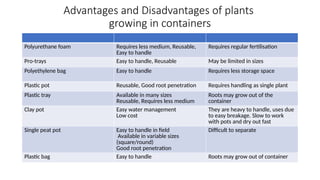
Advantages and Disadvantagesof plants
growing in containers
Polyurethane foam Requires less medium, Reusable,
Easy to handle
Requires regular fertilisation
Pro-trays Easy to handle, Reusable May be limited in sizes
Polyethylene bag Easy to handle Requires less storage space
Plastic pot Reusable, Good root penetration Requires handling as single plant
Plastic tray Available in many sizes
Reusable, Requires less medium
Roots may grow out of the
container
Clay pot Easy water management
Low cost
They are heavy to handle, uses due
to easy breakage. Slow to work
with pots and dry out fast
Single peat pot Easy to handle in field
Available in variable sizes
(square/round)
Good root penetration
Difficult to separate
Plastic bag Easy to handle Roots may grow out of container
14.
TRAINING
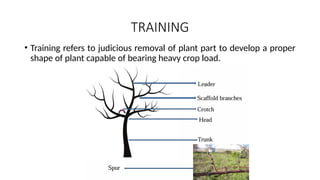
• Training refersto judicious removal of plant part to develop a proper
shape of plant capable of bearing heavy crop load.
16.
Objectives of training
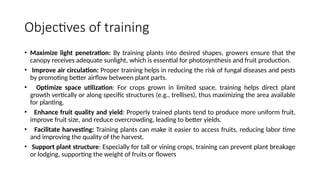
•Maximize light penetration: By training plants into desired shapes, growers ensure that the
canopy receives adequate sunlight, which is essential for photosynthesis and fruit production.
• Improve air circulation: Proper training helps in reducing the risk of fungal diseases and pests
by promoting better airflow between plant parts.
• Optimize space utilization: For crops grown in limited space, training helps direct plant
growth vertically or along specific structures (e.g., trellises), thus maximizing the area available
for planting.
• Enhance fruit quality and yield: Properly trained plants tend to produce more uniform fruit,
improve fruit size, and reduce overcrowding, leading to better yields.
• Facilitate harvesting: Training plants can make it easier to access fruits, reducing labor time
and improving the quality of the harvest.
• Support plant structure: Especially for tall or vining crops, training can prevent plant breakage
or lodging, supporting the weight of fruits or flowers
17.
Principles of training
•Start from very beginning age of tree
• Shoots having narrower crotch angle are discarded
• Water sprout should be removed
• Drooping branches needs to be removed
• Terminal buds should be removed to facilitate emergence of side
shoots.
#13 Selection of suitable containers depends on the crop to be produced in the greenhouse, plant characteristics like crop stage, duration, vigour, growth habit, root system, etc. Generally, small containers are suitable for nursery and small plants or short plants with less growth of roots, while large containers are used for plants with profuse root system.
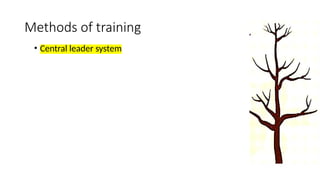
#18 The central leader system of tree training involves shaping a tree with a dominant central trunk or "leader" that extends upward, with branches (scaffolds) developing from this leader in a tiered or layered manner. This system is often used for fruit trees like apples and pears, and is designed to promote a strong, upright structure with good light penetration.
Key aspects of the central leader system:
Central Leader:
The primary, upright stem that serves as the main axis of the tree.
Tiered Branches (Scaffolds):
Lateral branches, also known as scaffolds, grow from the central leader in layers, usually 3-4 tiers.
Spacing and Angle:
Branches are typically spaced at intervals along the central leader and positioned at angles that promote structural strength, such as 45 to 60 degrees from the trunk.
Pruning:
Regular pruning is essential to maintain the desired shape, remove weak or competing branches, and promote fruit production.
Advantages:
This system can lead to a taller, more upright tree with good light penetration, potentially increasing fruit production in areas with high sunlight availability.
How it works:
1. Initial Training:
The first year after planting, a strong central leader is established, and the first tier of scaffolds is selected and pruned to promote outward growth.
2. Developing Scaffolds:
Subsequent tiers are developed in following years, ensuring proper spacing and branch angles.
3. Maintaining the Shape:
Regular pruning throughout the tree's life is crucial to maintain the central leader, remove weak branches, and encourage fruit production.
Examples of use:
Apples and Pears:
The central leader system is well-suited for these fruit trees, as it promotes a strong, upright structure that can support heavy loads of fruit.
Other Trees:
While primarily used for fruit trees, the principles of the central leader system can be adapted for other tree species.
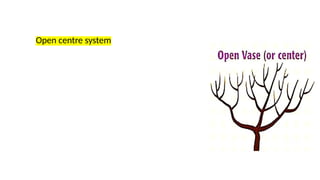
#19 The open-center system, also known as the vase system, is a training method in horticulture where the main stem of a tree is terminated, and growth is encouraged from lateral branches near the top, creating a vase-shaped tree with open center. This system allows for good sunlight penetration to all branches, facilitates harvesting and plant protection operations, and promotes fruit production closer to the ground.
Key features of the open-center system:
Termination of the main stem:
The main stem is cut back to a certain height, encouraging the development of lateral branches.
Selection of scaffold branches:
4-5 well-distributed lateral branches are selected to form the main framework of the tree.
Vase-shaped structure:
The resulting tree has a vase shape with a wide, open center.
Benefits:
Good light penetration, easier access for harvesting, and potentially higher fruit production.
When is it used?
This system is commonly used for training fruit trees like peaches, apricots, and berries.
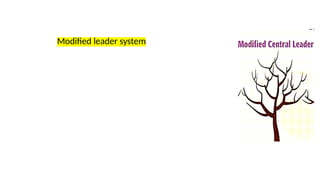
#20 The modified open center system of training is a variation of the traditional open center system, aiming to improve fruit tree structure and yield by selectively pruning and training lower branches. This system involves cutting back the main stem (deheading) at a certain height and selecting well-arranged, lower branches as scaffolds, promoting a more bowl-shaped tree.
Key Features and Benefits:
Lower Height:
The modified open center system results in trees with a shorter overall height compared to traditional open center or central leader systems.
Enhanced Light Penetration:
By focusing on lower branches, the system ensures better light exposure to the tree's interior, potentially increasing fruit production and quality.
Stronger Crotch Angles:
Lower branches are known to have wider crotch angles, making them more structurally sound and less prone to breakage compared to the crotches in traditional open center systems.
Improved Fruit Yield:
While some studies suggest lower initial yields, the improved tree structure and light penetration in modified open center systems can lead to increased yields over time.
How it's done:
1. Deheading:
When the plant reaches a specific height (e.g., 40-50 cm), the main stem is cut off at the top.
2. Selecting Scaffolds:
Four to five well-arranged and distributed lower branches are selected and encouraged to grow as the main scaffold branches.
3. Pruning and Shaping:
Ongoing pruning and shaping are necessary to maintain the desired tree shape and ensure optimal light penetration.
When it's used:
This system is commonly used for fruit trees like plums, peaches, and apricots.
It can also be used for other fruit crops where a shorter, bowl-shaped tree structure is desired.
Advantages:
Improved fruit yield:
The modified open center system can lead to increased fruit yields over time, especially when compared to traditional open center systems.
Stronger tree structure:
The lower scaffold branches provide a more stable and durable framework for the tree.
Better light penetration:
The open structure of the tree allows more sunlight to reach the interior, potentially leading to better fruit development and color.
Disadvantages:
Potential for lower initial yields:
Some studies have suggested that modified open center systems can produce lower yields initially compared to traditional open center or central leader systems.
Requires careful training and pruning:
Maintaining the desired tree shape and structure requires ongoing pruning and training efforts.


![grafting and budding [Autosaved]....pptx](https://cdn.slidesharecdn.com/ss_thumbnails/graftingandbuddingautosaved-250508034509-fb3fab88-thumbnail.jpg?width=640&height=640&fit=bounds)


![Lec 9 principles of fruit and vegetaqble preservation [Autosaved].ppt](https://cdn.slidesharecdn.com/ss_thumbnails/lec9principlesoffruitandvegetaqblepreservationautosaved-250104062150-3cfff76f-thumbnail.jpg?width=640&height=640&fit=bounds)


