NYSEMO Version 1.0 Sept. 2003
Community
Emergency
Response Team
CERT
Launching a CERT
NYSEMO Version 1.0 Sept. 2003
Launching a CERT –
5 Components
1. Define Program Goals
2. Identify Resources
3. Market the Program
4. Deliver the Training
5. Plan for Program Maintenance
NYSEMO Version 1.0 Sept. 2003
1. Define Program Goals
Effective Disaster Response Teams?
Better Community Preparedness?
Support for Other Public Safety Efforts?
Enhanced Public Relations?
NYSEMO Version 1.0 Sept. 2003
Effective Disaster Response
Teams
Individual disaster responder skills
Team organization
Linkage with professional responders
NYSEMO Version 1.0 Sept. 2003
Linkage with Professional
Responders
When deployed, CERTs must be able
to function on their own
CERT operations also need to be linked
with other responders
Means and degree of linkage between
CERTs and other responders depend
on nature of the event
NYSEMO Version 1.0 Sept. 2003
Better Community
Preparedness
CERT participants maintain high level of
home and workplace preparedness
Participants are more informed about
risks and vulnerabilities
Participants are already committed to
safety and well-being of their neighbors
NYSEMO Version 1.0 Sept. 2003
Support Other Public Safety Efforts
Installing smoke detectors, providing safety
standby at community events, etc.
Benefits the community-at-large
Benefits the CERTs
Benefits the program (“value-added
volunteers”)
NYSEMO Version 1.0 Sept. 2003
2. Identify Resources
What will we need?
Where will we get it?
NYSEMO Version 1.0 Sept. 2003
What Do We Need to Get
Started?
Course material and training
props
Support for the concept
Program Coordinator
Trainers
Program forms and flyer
Info management tool
NYSEMO Version 1.0 Sept. 2003
Course Material and
Props
NYS CERT CD with IG, PM, PPT, etc. for
printing manuals and presentations
Internet sites (NYSEMO, FEMA, other
CERT programs)
Local emergency management offices
American Red Cross (video, pamphlets,
specialty training)
Local utilities (info pamphlets, props)
NYSEMO Version 1.0 Sept. 2003
Support for the
Concept
“It’s a real resource!” vs. “It’s a new
program!”
Whenever possible, “Let your citizens do
the talking”
Always keep elected officials in the loop
NYSEMO Version 1.0 Sept. 2003
Program Coordinator
Program development
– Link between CERTs and professional
responders
– Expanding role and responsibilities of CERTs
– Continuing education for program participants
Funding and budgeting
Educating the department and jurisdiction
Publicity and networking
NYSEMO Version 1.0 Sept. 2003
Program Coordinator
Also responsible for program
administration
– Handle public inquiries about program
– Process registrations
– Maintain records (financial, inventory,
database of CERT members, etc.)
– Schedule basic training courses, follow-up
training, special events, etc.
– Coordinate newsletter and other mailings
NYSEMO Version 1.0 Sept. 2003
Program Coordinator
Also responsible for course
management
– Regular contact with current students
– Recruit, train and schedule instructors
– Maintain consistent and up-to-date content
– Set up classrooms
– Provide orientation at beginning of new
course
NYSEMO Version 1.0 Sept. 2003
Program Forms and Info
Material
Recruitment flyer or brochure (w/
mailer)
Registration form
Course confirmation letter
Liability waiver form
Class sign-in roster
Certificate of Completion
Course evaluation form
NYSEMO Version 1.0 Sept. 2003
Info Management Tool
Collect and organize info on each
program participant as soon as you
start the training
– Contact information
– Team
– Classes completed / year of completion
– Continuing ed training completed
– Other, e.g., ham operator, CERT leader?
Consider building a database to
facilitate mailings, contact lists, etc.
NYSEMO Version 1.0 Sept. 2003
First Responders as CERT
Trainers
ADVANTAGES
 1st response
experience
 Training experience
 Quality control
 Reliability
 Set schedules
CHALLENGES
 Uncertainty about
CERTs
 Training experience
 Cost
NYSEMO Version 1.0 Sept. 2003
Bottom Line on
Resources
Staffing (coordinator and trainers) will
drive the cost per student
NYSEMO Version 1.0 Sept. 2003
3. Market the Program
Reaching the Community
Maintaining the Political Support
Pitching to the Media
Pitching to Your Organization
Getting Corporate Support
NYSEMO Version 1.0 Sept. 2003
Reaching the
Community
Defining “The Community”
Defining Citizen Roles
Working with Ready-Made
Partners
Effective Community Outreach
NYSEMO Version 1.0 Sept. 2003
“The Community” Sees
Itself
Geographic Communities
Ethnic Communities
Businesses
Schools
Communities of Faith
Communities of Interest
NYSEMO Version 1.0 Sept. 2003
“The Community” Seen by
Govt.
Taxpayers
Voters
Advocates
Victims
Customers
Partners
NYSEMO Version 1.0 Sept. 2003
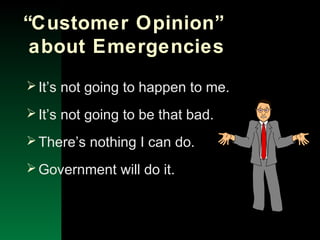
“Customer Opinion”
about Emergencies
It’s not going to happen to me.
It’s not going to be that bad.
There’s nothing I can do.
Government will do it.
NYSEMO Version 1.0 Sept. 2003
The Partner
n. A person associated
with another or others in
some activity of common
interest. Synonyms:
partner, colleague, ally,
confederate, accomplice.
These all denote one
who cooperates in a
venture, occupation, or
challenge.
NYSEMO Version 1.0 Sept. 2003
Examples of Ready-Made
Partners
Homeowner Associations
Neighborhood Associations
Church Groups
Business District Associations
Grange Associations
Schools/PTAs
Scouting Organizations
RACES/Amateur Radio
NYSEMO Version 1.0 Sept. 2003
Basic Outreach to
Citizens
Regular meetings of established
groups
Mailers to membership lists
Articles in community newsletters
Community events
Print media and TV
NYSEMO Version 1.0 Sept. 2003
Tips for Effective
Outreach
Explain the problem, then offer the
solution
Clarify processes and expectations up
front
Whenever possible, “Let your citizens
do the talking”
Identify special audiences that need to
know CERT training is available
NYSEMO Version 1.0 Sept. 2003
Maintaining Political
Support
Whenever possible, “Let your citizens do
the talking”
Demonstrate numbers of citizens visibly
Invite direct involvement of elected officials,
agency head, their executive staff
NYSEMO Version 1.0 Sept. 2003
Pitching to the Media
Give the media action involving citizens +
disasters
Publicize photo opportunities and “hands-
on” aspect of training
Whenever possible, “Let your citizens do
the talking”
Be prepared for the results of media
coverage
NYSEMO Version 1.0 Sept. 2003
Pitching to Your
Organization
Convince them of the problem, then offer
the solution
Clarify program goals and expectations up
front
Describe CERT training and protocols in
agency terms
NYSEMO Version 1.0 Sept. 2003
Getting Corporate
Support
Talk business to business
Emphasize potential employee
involvement
Feature enhanced community
preparedness
NYSEMO Version 1.0 Sept. 2003
Getting Corporate
Support
Spell out exactly what you want
Present a complete plan
– Goals and objectives
– Respective roles of all partners
– Measurable timeline
– Evaluation process
End result must be tangible
NYSEMO Version 1.0 Sept. 2003
4. Deliver the Training
Allow plenty of lead time –
Planning!!
Pilot course is most important
NYSEMO Version 1.0 Sept. 2003
The Program Pilot
Test the CERT curriculum
Test delivery of training
Collect feedback
Assess results
Make revisions if needed
NYSEMO Version 1.0 Sept. 2003
The Program Pilot
Select and target “test communities”
Conduct real-life version of the
training
Conduct a fearless debriefing
Seek an outsider to assess the
results
NYSEMO Version 1.0 Sept. 2003
The Program Pilot
Debriefing and assessing the results:
What prompted the participants to enroll?
How did they find out about the training?
Their satisfaction with program length?
Their satisfaction with program intensity?
NYSEMO Version 1.0 Sept. 2003
The Program Pilot
Debriefing and assessing the results (cont.):
Topics to be expanded, compressed,
added?
Effectiveness of instructional techniques?
Effectiveness of instructional materials?
Convenience of schedule and location(s)?
Ways to sustain their interest?
NYSEMO Version 1.0 Sept. 2003
5. Plan for Program
Maintenance
Comprehensive program
maintenance
Examples of maintenance
successes
NYSEMO Version 1.0 Sept. 2003
Volunteer Retention
Commitment to the community
Commitment to ongoing training
Commitment to building the team
A partnership in the program
NYSEMO Version 1.0 Sept. 2003
Rescuer Skills
Maintain a range of basic response skills
Enhance current skills
Learn new skills
NYSEMO Version 1.0 Sept. 2003
Program Administration
Manage information and data
Maintain and expand budget
Maintain and expand corps of
trainers
Evaluate program
NYSEMO Version 1.0 Sept. 2003
External Program Support
Professional responders
Community-based organizations
City Hall
Business community
Corporate donors
NYSEMO Version 1.0 Sept. 2003
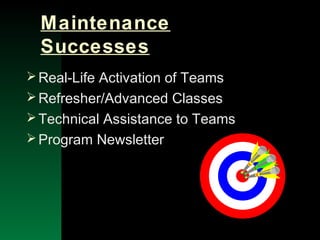
Maintenance
Successes
Real-Life Activation of Teams
Refresher/Advanced Classes
Technical Assistance to Teams
Program Newsletter
NYSEMO Version 1.0 Sept. 2003
More Maintenance
Successes
Citywide Exercises
Neighborhood Exercise Swaps
Acknowledgment Events
Expanded CERT Activities
NYSEMO Version 1.0 Sept. 2003
Sample Expanded
Activities
CERT “Smoke Detector Squad”
Coordination and staffing at safety fairs
Fundraising partnerships
Management of CERT program
First aid stations at neighborhood events
Disaster Preparedness Speakers’ Bureau
Simulators in Fire Department exercises
NYSEMO Version 1.0 Sept. 2003
Expanded CERT
Activities
Maintain individuals’ skills
Support individuals’ commitment
Maintain team cohesion
Build partnership with professionals
Build political support
Capitalize on initial investment
NYSEMO Version 1.0 Sept. 2003
Unit Summary
Five critical steps to launch a CERT
program
1. Define CERT Program Goals
2. Identify Resources
3. Market the Program
4. Deliver the Training
5. Develop a Maintenance Plan
Allow enough lead time
Be prepared for growth

Launching a-cert-program

  • 1.
    NYSEMO Version 1.0Sept. 2003 Community Emergency Response Team CERT Launching a CERT
  • 2.
    NYSEMO Version 1.0Sept. 2003 Launching a CERT – 5 Components 1. Define Program Goals 2. Identify Resources 3. Market the Program 4. Deliver the Training 5. Plan for Program Maintenance
  • 3.
    NYSEMO Version 1.0Sept. 2003 1. Define Program Goals Effective Disaster Response Teams? Better Community Preparedness? Support for Other Public Safety Efforts? Enhanced Public Relations?
  • 4.
    NYSEMO Version 1.0Sept. 2003 Effective Disaster Response Teams Individual disaster responder skills Team organization Linkage with professional responders
  • 5.
    NYSEMO Version 1.0Sept. 2003 Linkage with Professional Responders When deployed, CERTs must be able to function on their own CERT operations also need to be linked with other responders Means and degree of linkage between CERTs and other responders depend on nature of the event
  • 6.
    NYSEMO Version 1.0Sept. 2003 Better Community Preparedness CERT participants maintain high level of home and workplace preparedness Participants are more informed about risks and vulnerabilities Participants are already committed to safety and well-being of their neighbors
  • 7.
    NYSEMO Version 1.0Sept. 2003 Support Other Public Safety Efforts Installing smoke detectors, providing safety standby at community events, etc. Benefits the community-at-large Benefits the CERTs Benefits the program (“value-added volunteers”)
  • 8.
    NYSEMO Version 1.0Sept. 2003 2. Identify Resources What will we need? Where will we get it?
  • 9.
    NYSEMO Version 1.0Sept. 2003 What Do We Need to Get Started? Course material and training props Support for the concept Program Coordinator Trainers Program forms and flyer Info management tool
  • 10.
    NYSEMO Version 1.0Sept. 2003 Course Material and Props NYS CERT CD with IG, PM, PPT, etc. for printing manuals and presentations Internet sites (NYSEMO, FEMA, other CERT programs) Local emergency management offices American Red Cross (video, pamphlets, specialty training) Local utilities (info pamphlets, props)
  • 11.
    NYSEMO Version 1.0Sept. 2003 Support for the Concept “It’s a real resource!” vs. “It’s a new program!” Whenever possible, “Let your citizens do the talking” Always keep elected officials in the loop
  • 12.
    NYSEMO Version 1.0Sept. 2003 Program Coordinator Program development – Link between CERTs and professional responders – Expanding role and responsibilities of CERTs – Continuing education for program participants Funding and budgeting Educating the department and jurisdiction Publicity and networking
  • 13.
    NYSEMO Version 1.0Sept. 2003 Program Coordinator Also responsible for program administration – Handle public inquiries about program – Process registrations – Maintain records (financial, inventory, database of CERT members, etc.) – Schedule basic training courses, follow-up training, special events, etc. – Coordinate newsletter and other mailings
  • 14.
    NYSEMO Version 1.0Sept. 2003 Program Coordinator Also responsible for course management – Regular contact with current students – Recruit, train and schedule instructors – Maintain consistent and up-to-date content – Set up classrooms – Provide orientation at beginning of new course
  • 15.
    NYSEMO Version 1.0Sept. 2003 Program Forms and Info Material Recruitment flyer or brochure (w/ mailer) Registration form Course confirmation letter Liability waiver form Class sign-in roster Certificate of Completion Course evaluation form
  • 16.
    NYSEMO Version 1.0Sept. 2003 Info Management Tool Collect and organize info on each program participant as soon as you start the training – Contact information – Team – Classes completed / year of completion – Continuing ed training completed – Other, e.g., ham operator, CERT leader? Consider building a database to facilitate mailings, contact lists, etc.
  • 17.
    NYSEMO Version 1.0Sept. 2003 First Responders as CERT Trainers ADVANTAGES  1st response experience  Training experience  Quality control  Reliability  Set schedules CHALLENGES  Uncertainty about CERTs  Training experience  Cost
  • 18.
    NYSEMO Version 1.0Sept. 2003 Bottom Line on Resources Staffing (coordinator and trainers) will drive the cost per student
  • 19.
    NYSEMO Version 1.0Sept. 2003 3. Market the Program Reaching the Community Maintaining the Political Support Pitching to the Media Pitching to Your Organization Getting Corporate Support
  • 20.
    NYSEMO Version 1.0Sept. 2003 Reaching the Community Defining “The Community” Defining Citizen Roles Working with Ready-Made Partners Effective Community Outreach
  • 21.
    NYSEMO Version 1.0Sept. 2003 “The Community” Sees Itself Geographic Communities Ethnic Communities Businesses Schools Communities of Faith Communities of Interest
  • 22.
    NYSEMO Version 1.0Sept. 2003 “The Community” Seen by Govt. Taxpayers Voters Advocates Victims Customers Partners
  • 23.
    NYSEMO Version 1.0Sept. 2003 “Customer Opinion” about Emergencies It’s not going to happen to me. It’s not going to be that bad. There’s nothing I can do. Government will do it.
  • 24.
    NYSEMO Version 1.0Sept. 2003 The Partner n. A person associated with another or others in some activity of common interest. Synonyms: partner, colleague, ally, confederate, accomplice. These all denote one who cooperates in a venture, occupation, or challenge.
  • 25.
    NYSEMO Version 1.0Sept. 2003 Examples of Ready-Made Partners Homeowner Associations Neighborhood Associations Church Groups Business District Associations Grange Associations Schools/PTAs Scouting Organizations RACES/Amateur Radio
  • 26.
    NYSEMO Version 1.0Sept. 2003 Basic Outreach to Citizens Regular meetings of established groups Mailers to membership lists Articles in community newsletters Community events Print media and TV
  • 27.
    NYSEMO Version 1.0Sept. 2003 Tips for Effective Outreach Explain the problem, then offer the solution Clarify processes and expectations up front Whenever possible, “Let your citizens do the talking” Identify special audiences that need to know CERT training is available
  • 28.
    NYSEMO Version 1.0Sept. 2003 Maintaining Political Support Whenever possible, “Let your citizens do the talking” Demonstrate numbers of citizens visibly Invite direct involvement of elected officials, agency head, their executive staff
  • 29.
    NYSEMO Version 1.0Sept. 2003 Pitching to the Media Give the media action involving citizens + disasters Publicize photo opportunities and “hands- on” aspect of training Whenever possible, “Let your citizens do the talking” Be prepared for the results of media coverage
  • 30.
    NYSEMO Version 1.0Sept. 2003 Pitching to Your Organization Convince them of the problem, then offer the solution Clarify program goals and expectations up front Describe CERT training and protocols in agency terms
  • 31.
    NYSEMO Version 1.0Sept. 2003 Getting Corporate Support Talk business to business Emphasize potential employee involvement Feature enhanced community preparedness
  • 32.
    NYSEMO Version 1.0Sept. 2003 Getting Corporate Support Spell out exactly what you want Present a complete plan – Goals and objectives – Respective roles of all partners – Measurable timeline – Evaluation process End result must be tangible
  • 33.
    NYSEMO Version 1.0Sept. 2003 4. Deliver the Training Allow plenty of lead time – Planning!! Pilot course is most important
  • 34.
    NYSEMO Version 1.0Sept. 2003 The Program Pilot Test the CERT curriculum Test delivery of training Collect feedback Assess results Make revisions if needed
  • 35.
    NYSEMO Version 1.0Sept. 2003 The Program Pilot Select and target “test communities” Conduct real-life version of the training Conduct a fearless debriefing Seek an outsider to assess the results
  • 36.
    NYSEMO Version 1.0Sept. 2003 The Program Pilot Debriefing and assessing the results: What prompted the participants to enroll? How did they find out about the training? Their satisfaction with program length? Their satisfaction with program intensity?
  • 37.
    NYSEMO Version 1.0Sept. 2003 The Program Pilot Debriefing and assessing the results (cont.): Topics to be expanded, compressed, added? Effectiveness of instructional techniques? Effectiveness of instructional materials? Convenience of schedule and location(s)? Ways to sustain their interest?
  • 38.
    NYSEMO Version 1.0Sept. 2003 5. Plan for Program Maintenance Comprehensive program maintenance Examples of maintenance successes
  • 39.
    NYSEMO Version 1.0Sept. 2003 Volunteer Retention Commitment to the community Commitment to ongoing training Commitment to building the team A partnership in the program
  • 40.
    NYSEMO Version 1.0Sept. 2003 Rescuer Skills Maintain a range of basic response skills Enhance current skills Learn new skills
  • 41.
    NYSEMO Version 1.0Sept. 2003 Program Administration Manage information and data Maintain and expand budget Maintain and expand corps of trainers Evaluate program
  • 42.
    NYSEMO Version 1.0Sept. 2003 External Program Support Professional responders Community-based organizations City Hall Business community Corporate donors
  • 43.
    NYSEMO Version 1.0Sept. 2003 Maintenance Successes Real-Life Activation of Teams Refresher/Advanced Classes Technical Assistance to Teams Program Newsletter
  • 44.
    NYSEMO Version 1.0Sept. 2003 More Maintenance Successes Citywide Exercises Neighborhood Exercise Swaps Acknowledgment Events Expanded CERT Activities
  • 45.
    NYSEMO Version 1.0Sept. 2003 Sample Expanded Activities CERT “Smoke Detector Squad” Coordination and staffing at safety fairs Fundraising partnerships Management of CERT program First aid stations at neighborhood events Disaster Preparedness Speakers’ Bureau Simulators in Fire Department exercises
  • 46.
    NYSEMO Version 1.0Sept. 2003 Expanded CERT Activities Maintain individuals’ skills Support individuals’ commitment Maintain team cohesion Build partnership with professionals Build political support Capitalize on initial investment
  • 47.
    NYSEMO Version 1.0Sept. 2003 Unit Summary Five critical steps to launch a CERT program 1. Define CERT Program Goals 2. Identify Resources 3. Market the Program 4. Deliver the Training 5. Develop a Maintenance Plan Allow enough lead time Be prepared for growth

Editor's Notes

  • #4 <number>
  • #5 <number>
  • #6 <number>
  • #7 <number>
  • #8 <number>
  • #9 <number>
  • #10 <number>
  • #11 <number>
  • #12 <number>
  • #13 <number>
  • #14 <number>
  • #15 <number>
  • #16 <number>
  • #17 <number>
  • #18 <number>
  • #19 <number>
  • #20 <number>
  • #21 <number>
  • #22 <number>
  • #23 <number>
  • #24 <number>
  • #25 <number>
  • #26 <number>
  • #27 <number>
  • #28 <number>
  • #29 <number>
  • #30 <number>
  • #31 <number>
  • #32 <number>
  • #33 <number>
  • #34 <number>
  • #35 <number>
  • #36 <number>
  • #37 <number>
  • #38 <number>
  • #39 <number>
  • #40 <number>
  • #41 <number>
  • #42 <number>
  • #43 <number>
  • #44 <number>
  • #45 <number>
  • #46 <number>
  • #47 <number>
  • #48 <number>