PAN / PANDAPAN / PANDA
Damage AssessmentDamage Assessment
12/05/16 PAN / PANDA Damage
Assessment
2
Damage Assessment
• What is it?
– Report of injuries, structural damage, & hazards in
your area.
• Why is it needed?
– PANDA Incident Command provides local response
• PANDA first-responders are likely to be the only assistance
available for the first 1 to 3 days.
– Palo Alto EOC needs the “big picture”
• Coordinate overall response
• Deploy limited professional resources
• Request outside assistance & plan recovery
– Damage reports are rolled up to the County, State,
and FEMA
12/05/16 PAN / PANDA Damage
Assessment
3
PANDA Mission
3
Palo Alto Neighborhood Disaster Activities
(PANDA)
• Response
– Community Emergency Response Team (CERT)
– Official Fire Dept. volunteers
– 20+ hours of training in light medical, search &
rescue, fire suppression, etc..
– Report to PANDA Incident Command Post
– Dispatched to neighborhoods
12/05/16 PAN / PANDA Damage
Assessment
4
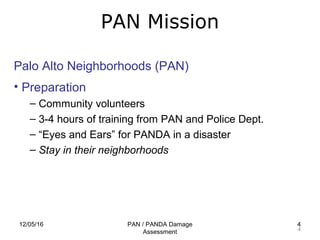
PAN Mission
4
Palo Alto Neighborhoods (PAN)
• Preparation
– Community volunteers
– 3-4 hours of training from PAN and Police Dept.
– “Eyes and Ears” for PANDA in a disaster
– Stay in their neighborhoods
12/05/16 PAN / PANDA Damage
Assessment
5
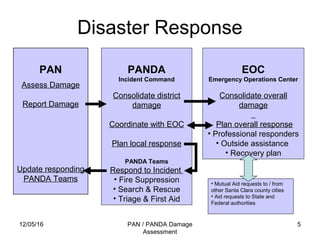
Disaster Response
PAN
Assess Damage
Report Damage
Update responding
PANDA Teams
PANDA
Incident Command
Consolidate district
damage
Coordinate with EOC
Plan local response
PANDA Teams
Respond to Incident
• Fire Suppression
• Search & Rescue
• Triage & First Aid
EOC
Emergency Operations Center
Consolidate overall
damage
Plan overall response
• Professional responders
• Outside assistance
• Recovery plan
• Mutual Aid requests to / from
other Santa Clara county cities
• Aid requests to State and
Federal authorities
12/05/16 PAN / PANDA Damage
Assessment
66
PAN Organization
• Neighborhood Preparedness Coordinator (NPC)
– Coordinates information to/from neighborhood
area.
– “down-link” = talk to neighborhood
– “up-link” = talk to Incident Command Post
– NPC collects and sorts (triages) messages (from
BPCs)
• Block Preparedness Coordinator (BPC)
– Responsible for 10-35 residences [and businesses]
– Collects information about the status of their block
– May use “low tech” comm, such as runners
12/05/16 PAN / PANDA Damage
Assessment
7
PANDA Field Teams
PAN Block Preparedness
Coordinators (BPC)
PAN Neighborhood
Preparedness Coordinators
(NPC)
PANDA Incident Command Post (ICP) at Fire Station
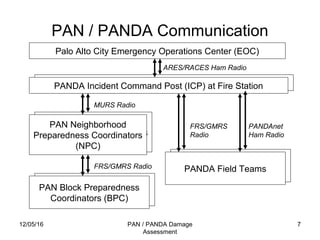
PAN / PANDA Communication
PANDA Incident Command Post (ICP) at Fire Station
PAN Neighborhood
Preparedness Coordinators
(NPC)
PAN Block Preparedness
Coordinators (BPC)
Palo Alto City Emergency Operations Center (EOC)
ARES/RACES Ham Radio
MURS Radio
FRS/GMRS Radio PANDA Field Teams
FRS/GMRS
Radio
PANDAnet
Ham Radio
12/05/16 PAN / PANDA Damage
Assessment
8
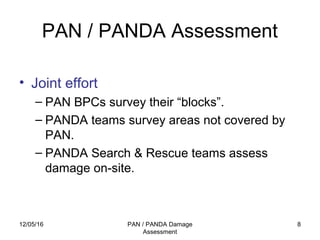
PAN / PANDA Assessment
• Joint effort
– PAN BPCs survey their “blocks”.
– PANDA teams survey areas not covered by
PAN.
– PANDA Search & Rescue teams assess
damage on-site.
12/05/16 PAN / PANDA Damage
Assessment
9
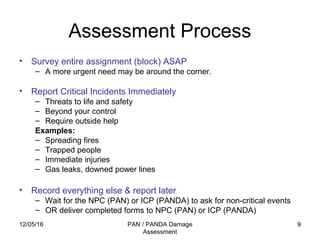
Assessment Process
• Survey entire assignment (block) ASAP
– A more urgent need may be around the corner.
• Report Critical Incidents Immediately
– Threats to life and safety
– Beyond your control
– Require outside help
Examples:
– Spreading fires
– Trapped people
– Immediate injuries
– Gas leaks, downed power lines
• Record everything else & report later
– Wait for the NPC (PAN) or ICP (PANDA) to ask for non-critical events
– OR deliver completed forms to NPC (PAN) or ICP (PANDA)
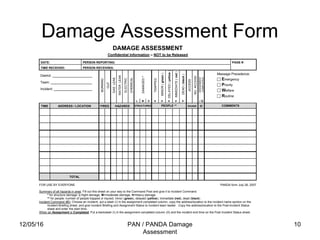
Damage Assessment Form
DAMAGE ASSESSMENT
Confidential Information – NOT to be Released
DATE: PERSON REPORTING:
TIME RECEIVED: PERSON RECEIVING:
PAGE #:
District:
Team:
Incident:
BURNING
OUT
GASLEAK
WATERLEAK
ELECTRIC
CHEMICAL
DAMAGED*
TRAPPED
MINOR(green)
DELAYED(yellow)
IMMEDIATE(red)
DEAD(black)
ACCESS
NOACCESS
ASSIGNMENT
COMPLETED
Message Precedence:
Emergency
Priority
Welfare
Routine
L M H # # # # # / X
TIME ADDRESS / LOCATION FIRES HAZARDS STRUCTURES PEOPLE ** ROADS IC COMMENTS
TOTAL
FOR USE BY EVERYONE PANDA form July 26, 2007
Summary of all hazards in area: Fill out this sheet on your way to the Command Post and give it to Incident Command.
* for structure damage: L=light damage, M=moderate damage, H=heavy damage
** for people: number of people trapped or injured; minor (green), delayed (yellow), immediate (red), dead (black)
Incident Command (IC): Choose an incident; put a slash (/) in the assignment completed column, copy the address/location to the incident name section on the
Incident Briefing sheet, and give Incident Briefing and Assignment Status to incident team leader. Copy the address/location to the Post-Incident Status
sheet and enter the start time.
When an Assignment is Completed: Put a backslash () in the assignment completed column (X) and the incident end time on the Post-Incident Status sheet.
12/05/16 10PAN / PANDA Damage
Assessment
12/05/16 PAN / PANDA Damage
Assessment
11
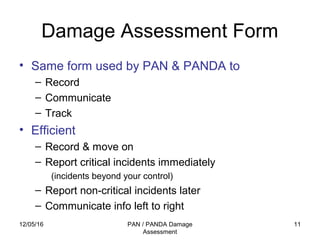
Damage Assessment Form
• Same form used by PAN & PANDA to
– Record
– Communicate
– Track
• Efficient
– Record & move on
– Report critical incidents immediately
(incidents beyond your control)
– Report non-critical incidents later
– Communicate info left to right
12/05/16 PAN / PANDA Damage
Assessment
12
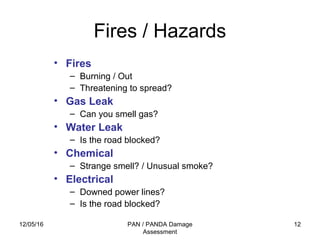
Fires / Hazards
• Fires
– Burning / Out
– Threatening to spread?
• Gas Leak
– Can you smell gas?
• Water Leak
– Is the road blocked?
• Chemical
– Strange smell? / Unusual smoke?
• Electrical
– Downed power lines?
– Is the road blocked?
12/05/16 PAN / PANDA Damage
Assessment
13
Structural Damage
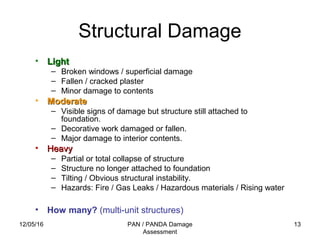
• LightLight
– Broken windows / superficial damage
– Fallen / cracked plaster
– Minor damage to contents
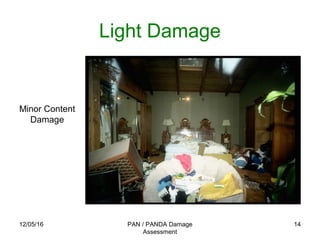
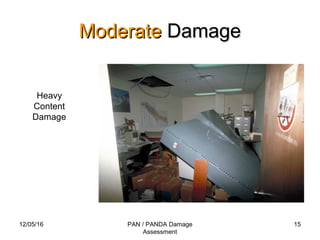
• ModerateModerate
– Visible signs of damage but structure still attached to
foundation.
– Decorative work damaged or fallen.
– Major damage to interior contents.
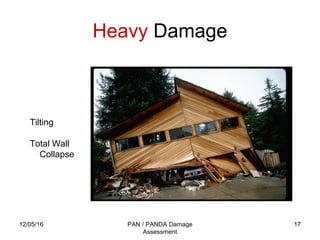
• HeavyHeavy
– Partial or total collapse of structure
– Structure no longer attached to foundation
– Tilting / Obvious structural instability.
– Hazards: Fire / Gas Leaks / Hazardous materials / Rising water
• How many? (multi-unit structures)
Light Damage
12/05/16 PAN / PANDA Damage
Assessment
14
Minor Content
Damage
ModerateModerate DamageDamage
12/05/16 PAN / PANDA Damage
Assessment
15
Heavy
Content
Damage
12/05/16 PAN / PANDA Damage
Assessment
16
ModerateModerate Damage
Non-Structural (decorative)
work has fallen
12/05/16 PAN / PANDA Damage
Assessment
17
Heavy Damage
Tilting
Total Wall
Collapse
12/05/16 PAN / PANDA Damage
Assessment
18
PAN - People
• How many?
– Trapped
– Minor Injuries
• Cuts, bruises, sprains
– Immediate Aid Needed
• Life threatening injuries
• Shock, severe blood loss, breathing problems
• Describe injuries in Comments column
– Dead
• Get the Big Picture
– Rough numbers are okay
12/05/16 PAN / PANDA Damage
Assessment
19
PANDA - People
• How many?
– Trapped
– Minor Injuries
• Cuts, bruises, sprains
– Delayed
• Injuries require treatment but not Immediate
– Immediate
• RPM Criteria
– Respiration – breathing faster than 30 breaths per minute.
– Pulse – severe bleeding or blanch test (capillary refill) slower than
2 seconds.
– Mental status – cannot respond to simple commands
• Examples: Shock, severe blood loss, breathing problems
• Describe injuries in Comments column
– Dead
• Get the Big Picture
– Rough numbers are okay
12/05/16 PAN / PANDA Damage
Assessment
20
Other Columns
• Roads
– Access for emergency equipment?
• Assignment Completed
– mark column “/” if you report immediately
• Comments
– Describe injuries and other information to help
PANDA plan response.
• Use multiple rows on form if necessary

panda system

  • 1.
    PAN / PANDAPAN/ PANDA Damage AssessmentDamage Assessment
  • 2.
    12/05/16 PAN /PANDA Damage Assessment 2 Damage Assessment • What is it? – Report of injuries, structural damage, & hazards in your area. • Why is it needed? – PANDA Incident Command provides local response • PANDA first-responders are likely to be the only assistance available for the first 1 to 3 days. – Palo Alto EOC needs the “big picture” • Coordinate overall response • Deploy limited professional resources • Request outside assistance & plan recovery – Damage reports are rolled up to the County, State, and FEMA
  • 3.
    12/05/16 PAN /PANDA Damage Assessment 3 PANDA Mission 3 Palo Alto Neighborhood Disaster Activities (PANDA) • Response – Community Emergency Response Team (CERT) – Official Fire Dept. volunteers – 20+ hours of training in light medical, search & rescue, fire suppression, etc.. – Report to PANDA Incident Command Post – Dispatched to neighborhoods
  • 4.
    12/05/16 PAN /PANDA Damage Assessment 4 PAN Mission 4 Palo Alto Neighborhoods (PAN) • Preparation – Community volunteers – 3-4 hours of training from PAN and Police Dept. – “Eyes and Ears” for PANDA in a disaster – Stay in their neighborhoods
  • 5.
    12/05/16 PAN /PANDA Damage Assessment 5 Disaster Response PAN Assess Damage Report Damage Update responding PANDA Teams PANDA Incident Command Consolidate district damage Coordinate with EOC Plan local response PANDA Teams Respond to Incident • Fire Suppression • Search & Rescue • Triage & First Aid EOC Emergency Operations Center Consolidate overall damage Plan overall response • Professional responders • Outside assistance • Recovery plan • Mutual Aid requests to / from other Santa Clara county cities • Aid requests to State and Federal authorities
  • 6.
    12/05/16 PAN /PANDA Damage Assessment 66 PAN Organization • Neighborhood Preparedness Coordinator (NPC) – Coordinates information to/from neighborhood area. – “down-link” = talk to neighborhood – “up-link” = talk to Incident Command Post – NPC collects and sorts (triages) messages (from BPCs) • Block Preparedness Coordinator (BPC) – Responsible for 10-35 residences [and businesses] – Collects information about the status of their block – May use “low tech” comm, such as runners
  • 7.
    12/05/16 PAN /PANDA Damage Assessment 7 PANDA Field Teams PAN Block Preparedness Coordinators (BPC) PAN Neighborhood Preparedness Coordinators (NPC) PANDA Incident Command Post (ICP) at Fire Station PAN / PANDA Communication PANDA Incident Command Post (ICP) at Fire Station PAN Neighborhood Preparedness Coordinators (NPC) PAN Block Preparedness Coordinators (BPC) Palo Alto City Emergency Operations Center (EOC) ARES/RACES Ham Radio MURS Radio FRS/GMRS Radio PANDA Field Teams FRS/GMRS Radio PANDAnet Ham Radio
  • 8.
    12/05/16 PAN /PANDA Damage Assessment 8 PAN / PANDA Assessment • Joint effort – PAN BPCs survey their “blocks”. – PANDA teams survey areas not covered by PAN. – PANDA Search & Rescue teams assess damage on-site.
  • 9.
    12/05/16 PAN /PANDA Damage Assessment 9 Assessment Process • Survey entire assignment (block) ASAP – A more urgent need may be around the corner. • Report Critical Incidents Immediately – Threats to life and safety – Beyond your control – Require outside help Examples: – Spreading fires – Trapped people – Immediate injuries – Gas leaks, downed power lines • Record everything else & report later – Wait for the NPC (PAN) or ICP (PANDA) to ask for non-critical events – OR deliver completed forms to NPC (PAN) or ICP (PANDA)
  • 10.
    Damage Assessment Form DAMAGEASSESSMENT Confidential Information – NOT to be Released DATE: PERSON REPORTING: TIME RECEIVED: PERSON RECEIVING: PAGE #: District: Team: Incident: BURNING OUT GASLEAK WATERLEAK ELECTRIC CHEMICAL DAMAGED* TRAPPED MINOR(green) DELAYED(yellow) IMMEDIATE(red) DEAD(black) ACCESS NOACCESS ASSIGNMENT COMPLETED Message Precedence: Emergency Priority Welfare Routine L M H # # # # # / X TIME ADDRESS / LOCATION FIRES HAZARDS STRUCTURES PEOPLE ** ROADS IC COMMENTS TOTAL FOR USE BY EVERYONE PANDA form July 26, 2007 Summary of all hazards in area: Fill out this sheet on your way to the Command Post and give it to Incident Command. * for structure damage: L=light damage, M=moderate damage, H=heavy damage ** for people: number of people trapped or injured; minor (green), delayed (yellow), immediate (red), dead (black) Incident Command (IC): Choose an incident; put a slash (/) in the assignment completed column, copy the address/location to the incident name section on the Incident Briefing sheet, and give Incident Briefing and Assignment Status to incident team leader. Copy the address/location to the Post-Incident Status sheet and enter the start time. When an Assignment is Completed: Put a backslash () in the assignment completed column (X) and the incident end time on the Post-Incident Status sheet. 12/05/16 10PAN / PANDA Damage Assessment
  • 11.
    12/05/16 PAN /PANDA Damage Assessment 11 Damage Assessment Form • Same form used by PAN & PANDA to – Record – Communicate – Track • Efficient – Record & move on – Report critical incidents immediately (incidents beyond your control) – Report non-critical incidents later – Communicate info left to right
  • 12.
    12/05/16 PAN /PANDA Damage Assessment 12 Fires / Hazards • Fires – Burning / Out – Threatening to spread? • Gas Leak – Can you smell gas? • Water Leak – Is the road blocked? • Chemical – Strange smell? / Unusual smoke? • Electrical – Downed power lines? – Is the road blocked?
  • 13.
    12/05/16 PAN /PANDA Damage Assessment 13 Structural Damage • LightLight – Broken windows / superficial damage – Fallen / cracked plaster – Minor damage to contents • ModerateModerate – Visible signs of damage but structure still attached to foundation. – Decorative work damaged or fallen. – Major damage to interior contents. • HeavyHeavy – Partial or total collapse of structure – Structure no longer attached to foundation – Tilting / Obvious structural instability. – Hazards: Fire / Gas Leaks / Hazardous materials / Rising water • How many? (multi-unit structures)
  • 14.
    Light Damage 12/05/16 PAN/ PANDA Damage Assessment 14 Minor Content Damage
  • 15.
    ModerateModerate DamageDamage 12/05/16 PAN/ PANDA Damage Assessment 15 Heavy Content Damage
  • 16.
    12/05/16 PAN /PANDA Damage Assessment 16 ModerateModerate Damage Non-Structural (decorative) work has fallen
  • 17.
    12/05/16 PAN /PANDA Damage Assessment 17 Heavy Damage Tilting Total Wall Collapse
  • 18.
    12/05/16 PAN /PANDA Damage Assessment 18 PAN - People • How many? – Trapped – Minor Injuries • Cuts, bruises, sprains – Immediate Aid Needed • Life threatening injuries • Shock, severe blood loss, breathing problems • Describe injuries in Comments column – Dead • Get the Big Picture – Rough numbers are okay
  • 19.
    12/05/16 PAN /PANDA Damage Assessment 19 PANDA - People • How many? – Trapped – Minor Injuries • Cuts, bruises, sprains – Delayed • Injuries require treatment but not Immediate – Immediate • RPM Criteria – Respiration – breathing faster than 30 breaths per minute. – Pulse – severe bleeding or blanch test (capillary refill) slower than 2 seconds. – Mental status – cannot respond to simple commands • Examples: Shock, severe blood loss, breathing problems • Describe injuries in Comments column – Dead • Get the Big Picture – Rough numbers are okay
  • 20.
    12/05/16 PAN /PANDA Damage Assessment 20 Other Columns • Roads – Access for emergency equipment? • Assignment Completed – mark column “/” if you report immediately • Comments – Describe injuries and other information to help PANDA plan response. • Use multiple rows on form if necessary