Lathe Operations :
Lathe tool, Facing, Turning, Knurling Grooving and Form turning
Prepared By: P.R.CHAUDHARI
Learning Objectives
 After completing this unit you will be able to:
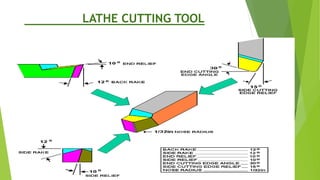
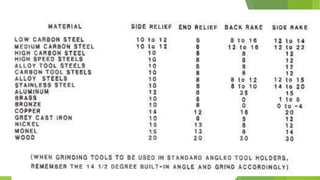
 Use the nomenclature of a cutting-tool point.
 Describe the cutting action of different types of machines.
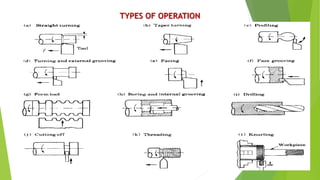
 Identify the applications of cutting tools in different operations such as Facing, turning,
Knurling, Grooving etc.
LATHE CUTTING TOOL
TYPES OF OPERATION
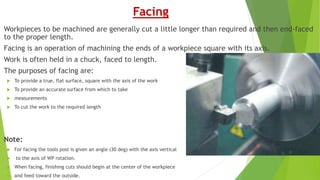
Facing
 Workpieces to be machined are generally cut a little longer than required and then end-faced
to the proper length.
 Facing is an operation of machining the ends of a workpiece square with its axis.
 Work is often held in a chuck, faced to length.
 The purposes of facing are:
 To provide a true, flat surface, square with the axis of the work
 To provide an accurate surface from which to take
 measurements
 To cut the work to the required length
 Note:
 For facing the tools post is given an angle (30 deg) with the axis vertical
 to the axis of WP rotation.
 When facing, finishing cuts should begin at the center of the workpiece
 and feed toward the outside.
Parallel Turning
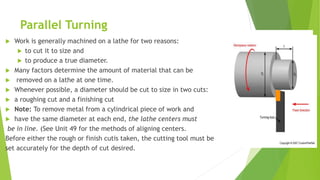
 Work is generally machined on a lathe for two reasons:
 to cut it to size and
 to produce a true diameter.
 Many factors determine the amount of material that can be
 removed on a lathe at one time.
 Whenever possible, a diameter should be cut to size in two cuts:
 a roughing cut and a finishing cut
 Note: To remove metal from a cylindrical piece of work and
 have the same diameter at each end, the lathe centers must
be in line. (See Unit 49 for the methods of aligning centers.
Before either the rough or finish cutis taken, the cutting tool must be
set accurately for the depth of cut desired.
Polishing in a Lathe
 After the work surface has been filed, the finish may be improved by polishing
with abrasive cloth.
Turning to a Shoulder
 When turning more than one diameter on a piece of work,
the change in diameters, or step, is known as a shoulder.
Three common types of shoulders are illustrated in Fig
above.
Grooving
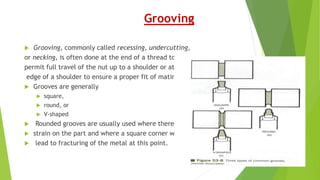
 Grooving, commonly called recessing, undercutting,
or necking, is often done at the end of a thread to
permit full travel of the nut up to a shoulder or at the
edge of a shoulder to ensure a proper fit of mating parts.
 Grooves are generally
 square,
 round, or
 V-shaped
 Rounded grooves are usually used where there is a
 strain on the part and where a square corner would
 lead to fracturing of the metal at this point.
Knurling
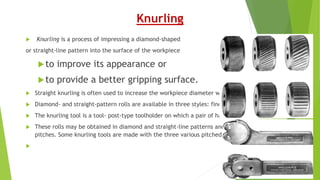
 Knurling is a process of impressing a diamond-shaped
or straight-line pattern into the surface of the workpiece
to improve its appearance or
to provide a better gripping surface.
 Straight knurling is often used to increase the workpiece diameter when a press fit is required.
 Diamond- and straight-pattern rolls are available in three styles: fine, medium, and coarse
 The knurling tool is a tool- post-type toolholder on which a pair of hardened-steel rolls are mounted.
 These rolls may be obtained in diamond and straight-line patterns and in coarse, medium, and fine
pitches. Some knurling tools are made with the three various pitched rollers on one holder

Drilling
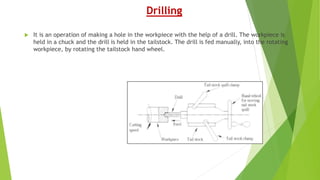
 It is an operation of making a hole in the workpiece with the help of a drill. The workpiece is
held in a chuck and the drill is held in the tailstock. The drill is fed manually, into the rotating
workpiece, by rotating the tailstock hand wheel.
THANK YOU

LATHE OPERATION.pptx

  • 1.
    Lathe Operations : Lathetool, Facing, Turning, Knurling Grooving and Form turning Prepared By: P.R.CHAUDHARI
  • 2.
    Learning Objectives  Aftercompleting this unit you will be able to:  Use the nomenclature of a cutting-tool point.  Describe the cutting action of different types of machines.  Identify the applications of cutting tools in different operations such as Facing, turning, Knurling, Grooving etc.
  • 3.
  • 5.
  • 6.
    Facing  Workpieces tobe machined are generally cut a little longer than required and then end-faced to the proper length.  Facing is an operation of machining the ends of a workpiece square with its axis.  Work is often held in a chuck, faced to length.  The purposes of facing are:  To provide a true, flat surface, square with the axis of the work  To provide an accurate surface from which to take  measurements  To cut the work to the required length  Note:  For facing the tools post is given an angle (30 deg) with the axis vertical  to the axis of WP rotation.  When facing, finishing cuts should begin at the center of the workpiece  and feed toward the outside.
  • 7.
    Parallel Turning  Workis generally machined on a lathe for two reasons:  to cut it to size and  to produce a true diameter.  Many factors determine the amount of material that can be  removed on a lathe at one time.  Whenever possible, a diameter should be cut to size in two cuts:  a roughing cut and a finishing cut  Note: To remove metal from a cylindrical piece of work and  have the same diameter at each end, the lathe centers must be in line. (See Unit 49 for the methods of aligning centers. Before either the rough or finish cutis taken, the cutting tool must be set accurately for the depth of cut desired.
  • 8.
    Polishing in aLathe  After the work surface has been filed, the finish may be improved by polishing with abrasive cloth.
  • 9.
    Turning to aShoulder  When turning more than one diameter on a piece of work, the change in diameters, or step, is known as a shoulder. Three common types of shoulders are illustrated in Fig above.
  • 10.
    Grooving  Grooving, commonlycalled recessing, undercutting, or necking, is often done at the end of a thread to permit full travel of the nut up to a shoulder or at the edge of a shoulder to ensure a proper fit of mating parts.  Grooves are generally  square,  round, or  V-shaped  Rounded grooves are usually used where there is a  strain on the part and where a square corner would  lead to fracturing of the metal at this point.
  • 11.
    Knurling  Knurling isa process of impressing a diamond-shaped or straight-line pattern into the surface of the workpiece to improve its appearance or to provide a better gripping surface.  Straight knurling is often used to increase the workpiece diameter when a press fit is required.  Diamond- and straight-pattern rolls are available in three styles: fine, medium, and coarse  The knurling tool is a tool- post-type toolholder on which a pair of hardened-steel rolls are mounted.  These rolls may be obtained in diamond and straight-line patterns and in coarse, medium, and fine pitches. Some knurling tools are made with the three various pitched rollers on one holder 
  • 12.
    Drilling  It isan operation of making a hole in the workpiece with the help of a drill. The workpiece is held in a chuck and the drill is held in the tailstock. The drill is fed manually, into the rotating workpiece, by rotating the tailstock hand wheel.
  • 13.