Latency VS
Everything
Meetup Optimisation &
performance PHP
chez CCM Benchmark
Juin 9 2016
Ori Pekelman
Je suis @OriPekelman partout (Twitter/Linked-
in/Github)
Désolé je vais faire les
slides en Anglais.
Tout ceci vient d’un
billet de blog que je
suis en train d’écrire.
Latency VS
Everything
You know the fallacies of distributed computing, right?
Allow me, if you please,to add something to the mix.
This is not troll bait, and I truly hope for a civilized
conversation, but I will posit from the get-go a
provocative statement:
Everything can be traded-off
against latency. Given infinite
latency you can achieve any
desired quality of a
distributed system. (duh)
Latency VS
Everything
Latency VS
Everything
In this talk we will discuss two forms of latencies, the first is the one
we usually think about: Run-Time Latency.
Mommy, Daddy, where do execution time latencies come from?
1. Badly implemented tight loops (you've been a bad boy)
2. Tight loops integrating slow IO (mommy told you about co-
locating data and processing)
3. The physical limitations on the rotation of magnetic platters
4. The speed of light and entropy
5. Anything you can't parallelize (you have multiple cores
dammnit)
As you can guess it is mostly about #6. And you can't do anything
about #5.
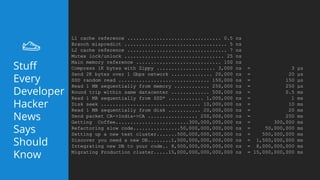
L1 cache reference ................................ 0.5 ns
Branch mispredict ................................... 5 ns
L2 cache reference .................................. 7 ns
Mutex lock/unlock .................................. 25 ns
Main memory reference ............................. 100 ns
Compress 1K bytes with Zippy .................... 3,000 ns = 3 µs
Send 2K bytes over 1 Gbps network .............. 20,000 ns = 20 µs
SSD random read ............................... 150,000 ns = 150 µs
Read 1 MB sequentially from memory ............ 250,000 ns = 250 µs
Round trip within same datacenter ............. 500,000 ns = 0.5 ms
Read 1 MB sequentially from SSD* ............ 1,000,000 ns = 1 ms
Disk seek .................................. 10,000,000 ns = 10 ms
Read 1 MB sequentially from disk ........... 20,000,000 ns = 20 ms
Send packet CA->India->CA ................. 250,000,000 ns = 250 ms
Getting Coffee.........................300,000,000,000 ns = 300,000 ms
Refactoring slow code................50,000,000,000,000 ns = 50,000,000 ms
Setting up a new test cluster.......500,000,000,000,000 ns = 500,000,000 ms
Discover you need a new DB........1,500,000,000,000,000 ns = 1,500,000,000 ms
Integrating new DB to your code.. 8,500,000,000,000,000 ns = 8,000,000,000 ms
Migrating Production cluster.....15,000,000,000,000,000 ns = 15,000,000,000 ms
Stuff
Every
Developer
Hacker
News
Says
Should
Know
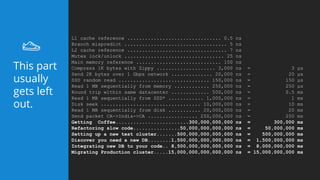
L1 cache reference ................................ 0.5 ns
Branch mispredict ................................... 5 ns
L2 cache reference .................................. 7 ns
Mutex lock/unlock .................................. 25 ns
Main memory reference ............................. 100 ns
Compress 1K bytes with Zippy .................... 3,000 ns = 3 µs
Send 2K bytes over 1 Gbps network .............. 20,000 ns = 20 µs
SSD random read ............................... 150,000 ns = 150 µs
Read 1 MB sequentially from memory ............ 250,000 ns = 250 µs
Round trip within same datacenter ............. 500,000 ns = 0.5 ms
Read 1 MB sequentially from SSD* ............ 1,000,000 ns = 1 ms
Disk seek .................................. 10,000,000 ns = 10 ms
Read 1 MB sequentially from disk ........... 20,000,000 ns = 20 ms
Send packet CA->India->CA ................. 250,000,000 ns = 250 ms
Getting Coffee.........................300,000,000,000 ns = 300,000 ms
Refactoring slow code................50,000,000,000,000 ns = 50,000,000 ms
Setting up a new test cluster.......500,000,000,000,000 ns = 500,000,000 ms
Discover you need a new DB........1,500,000,000,000,000 ns = 1,500,000,000 ms
Integrating new DB to your code.. 8,500,000,000,000,000 ns = 8,000,000,000 ms
Migrating Production cluster.....15,000,000,000,000,000 ns = 15,000,000,000 ms
This part
usually
gets left
out.
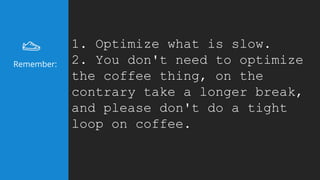
1. Optimize what is slow.
2. You don't need to optimize
the coffee thing, on the
contrary take a longer break,
and please don't do a tight
loop on coffee.
Remember:
In the real world, when thinking about distributed systems, we are
usually more interested in execution time. It's all about achieving a
desired state of world under some threshold, some time-out (People
are so anxious).
The thing is that in order to shorten latencies in the real-world, in
execution time, you are going to have to spend code-time (and coffee
time), which is so many factors greater.
And usually works at much higher granularity (human brains can only
be very poorly sharded, and sharding people may be illegal where
you live, check with a local legal expert for advice, IANAL). These are
hard problems.
Execution
time
vs
Code
time
You can create, quite easily, a system that has constant read-time as
long as you accept stale caches.
If you accept those stale caches you can also create a system where
writes are mostly constant-time (as long as there is no requirement
of writes to not having taken into consideration perfect consistency
and partition tolerance.).
Its enough to implement strict CQRS. Its enough to say "All writes
get logged, but may not succeed in the very improbable sense I have
promised you they would have").
Constant
response
time
systems
Resolving Code time latency is mostly about not solving solved
problems (there are so many unsolved ones to do yet).
It's hidden behind many layers, but, yes, you, Oh lowly developer of
something that should be simple, just a small web application. You
are tasked every day with resolving these hard theoretical questions;
Every time anyone says something is "Slow".
Solving them is all about Not Solving them. Not optimizing a tight
loop and use the L1 cache better.
It is about implementing patterns, using the frameworks and
leveraging infrastructure elements to do that.
Constant
response
time
systems
Solved
Problems:
This
specific
thing is
about
slow io in
a loop.
Because "slow" is always, just that, a desired state of the world,
having some guarantees of eventual consistency and acceptable
levels of latency: Between a MySQL database and the browser
rendering a page - between a payment gateway and a bank,
between two players frantically hitting their keyboard and an
imaginary beast, just eaten, or just having ate.
It’s always about the granularity of your cache, the staleness you can
accept on that side… and the minimal required time you can get an
async write to finish.
The latter usually being simply a function of how well you can
parallelize workers.
Constant
response
time
systems
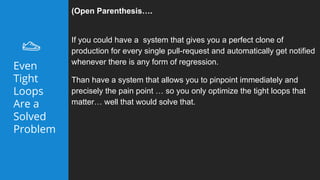
If you could have a system that gives you a perfect clone of
production for every single pull-request and automatically get notified
whenever there is any form of regression.
Than have a system that allows you to pinpoint immediately and
precisely the pain point … so you only optimize the tight loops that
matter… well that would solve that.
Even
Tight
Loops
Are a
Solved
Problem
(Open Parenthesis….
If you could have a system that gives you a perfect clone of
production for every single pull-request and automatically get notified
whenever there is any form of regression.
Than have a system that allows you to pinpoint immediately and
precisely the pain point … so you only optimize the tight loops that
matter… well that would solve that.
Platform.sh
+
blackfire.io
propose
that
capability :)
...close Parenthesis)
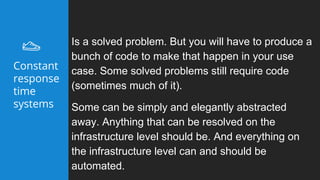
Is a solved problem. But you will have to produce a
bunch of code to make that happen in your use
case. Some solved problems still require code
(sometimes much of it).
Some can be simply and elegantly abstracted
away. Anything that can be resolved on the
infrastructure level should be. And everything on
the infrastructure level can and should be
automated.
Constant
response
time
systems
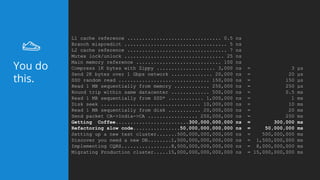
L1 cache reference ................................ 0.5 ns
Branch mispredict ................................... 5 ns
L2 cache reference .................................. 7 ns
Mutex lock/unlock .................................. 25 ns
Main memory reference ............................. 100 ns
Compress 1K bytes with Zippy .................... 3,000 ns = 3 µs
Send 2K bytes over 1 Gbps network .............. 20,000 ns = 20 µs
SSD random read ............................... 150,000 ns = 150 µs
Read 1 MB sequentially from memory ............ 250,000 ns = 250 µs
Round trip within same datacenter ............. 500,000 ns = 0.5 ms
Read 1 MB sequentially from SSD* ............ 1,000,000 ns = 1 ms
Disk seek .................................. 10,000,000 ns = 10 ms
Read 1 MB sequentially from disk ........... 20,000,000 ns = 20 ms
Send packet CA->India->CA ................. 250,000,000 ns = 250 ms
Getting Coffee.........................300,000,000,000 ns = 300,000 ms
Refactoring slow code................50,000,000,000,000 ns = 50,000,000 ms
Setting up a new test cluster.......500,000,000,000,000 ns = 500,000,000 ms
Discover you need a new DB........1,500,000,000,000,000 ns = 1,500,000,000 ms
Implementing CQRS.................8,500,000,000,000,000 ns = 8,000,000,000 ms
Migrating Production cluster.....15,000,000,000,000,000 ns = 15,000,000,000 ms
You do
this.
L1 cache reference ................................ 0.5 ns
Branch mispredict ................................... 5 ns
L2 cache reference .................................. 7 ns
Mutex lock/unlock .................................. 25 ns
Main memory reference ............................. 100 ns
Compress 1K bytes with Zippy .................... 3,000 ns = 3 µs
Send 2K bytes over 1 Gbps network .............. 20,000 ns = 20 µs
SSD random read ............................... 150,000 ns = 150 µs
Read 1 MB sequentially from memory ............ 250,000 ns = 250 µs
Round trip within same datacenter ............. 500,000 ns = 0.5 ms
Read 1 MB sequentially from SSD* ............ 1,000,000 ns = 1 ms
Disk seek .................................. 10,000,000 ns = 10 ms
Read 1 MB sequentially from disk ........... 20,000,000 ns = 20 ms
Send packet CA->India->CA ................. 250,000,000 ns = 250 ms
Getting Coffee.........................300,000,000,000 ns = 300,000 ms
Refactoring slow code................50,000,000,000,000 ns = 50,000,000 ms
Setting up a new test cluster.......500,000,000,000,000 ns = 500,000,000 ms
Discover you need a new DB........1,500,000,000,000,000 ns = 1,500,000,000 ms
Implementing CQRS.................8,500,000,000,000,000 ns = 8,000,000,000 ms
Migrating Production cluster.....15,000,000,000,000,000 ns = 15,000,000,000 ms
Because
platform.sh
can take
this.
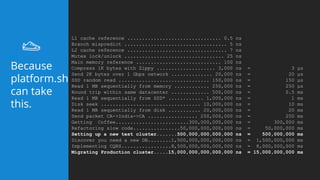
L1 cache reference ................................ 0.5 ns
Branch mispredict ................................... 5 ns
L2 cache reference .................................. 7 ns
Mutex lock/unlock .................................. 25 ns
Main memory reference ............................. 100 ns
Compress 1K bytes with Zippy .................... 3,000 ns = 3 µs
Send 2K bytes over 1 Gbps network .............. 20,000 ns = 20 µs
SSD random read ............................... 150,000 ns = 150 µs
Read 1 MB sequentially from memory ............ 250,000 ns = 250 µs
Round trip within same datacenter ............. 500,000 ns = 0.5 ms
Read 1 MB sequentially from SSD* ............ 1,000,000 ns = 1 ms
Disk seek .................................. 10,000,000 ns = 10 ms
Read 1 MB sequentially from disk ........... 20,000,000 ns = 20 ms
Send packet CA->India->CA ................. 250,000,000 ns = 250 ms
Getting Coffee.........................300,000,000,000 ns = 300,000 ms
Refactoring slow code................50,000,000,000,000 ns = 50,000,000 ms
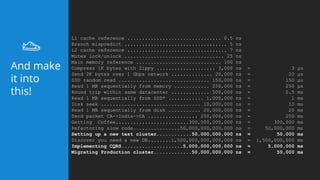
Setting up a new test cluster............50,000,000,000 ns = 50,000 ms
Discover you need a new DB........1,500,000,000,000,000 ns = 1,500,000,000 ms
Implementing CQRS.....................5,000,000,000,000 ns = 5,000,000 ms
Migrating Production cluster.............50,000,000,000 ns = 50,000 ms
And make
it into
this!
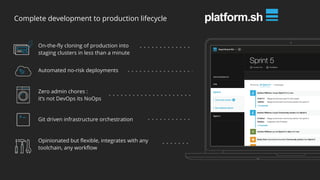
Complete development to production lifecycle
Opinionated but flexible, integrates with any
toolchain, any workflow
Git driven infrastructure orchestration
Automated no-risk deployments
On-the-fly cloning of production into
staging clusters in less than a minute
Zero admin chores :
it’s not DevOps its NoOps
Dynamic infrastructures, High-Availability, Elastic
Scaling, Managed integrated caches are solved
problems so is automated performance testing.
Don’t solve solved problems.
Go implement CQRS.
Because
we can do
this.
Enterprise grade
production
Best PHP PaaS out there. Powers Magento
Cloud. Default Symfony deployment option.
Multi-Cloud, highly available multi-datacenter
PaaS with zero-downtime scaling and 99.99%
SLAs
Entire infrastructure management - web servers,
databases, search-engines, caches, message
queues…
Secure, stable, scalable horizontally and
vertically
Fine-grain access controls for each environment
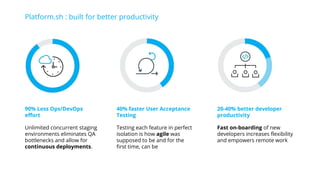
Platform.sh : built for better productivity
Unlimited concurrent staging
environments eliminates QA
bottlenecks and allow for
continuous deployments.
Testing each feature in perfect
isolation is how agile was
supposed to be and for the
first time, can be
Fast on-boarding of new
developers increases flexibility
and empowers remote work
20-40% better developer
productivity
90% Less Ops/DevOps
effort
40% faster User Acceptance
Testing
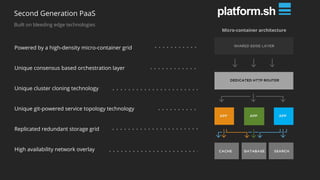
Second Generation PaaS
Built on bleeding edge technologies
Powered by a high-density micro-container grid
Unique consensus based orchestration layer
Unique cluster cloning technology
Unique git-powered service topology technology
Replicated redundant storage grid
High availability network overlay
Micro-container architecture
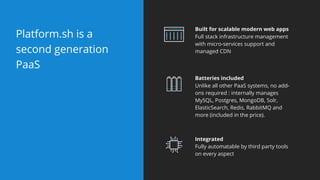
Platform.sh is a
second generation
PaaS
Batteries included
Unlike all other PaaS systems, no add-
ons required : internally manages
MySQL, Postgres, MongoDB, Solr,
ElasticSearch, Redis, RabbitMQ and
more (included in the price).
Built for scalable modern web apps
Full stack infrastructure management
with micro-services support and
managed CDN
Integrated
Fully automatable by third party tools
on every aspect
Ori Pekelman
Product Marketing &
Evangelist
Fred Plais
CEO
Damien Tournoud
CTO
Sylvie Georgeault
CFO
Kieron Sambrook-Smith
Chief Commercial Officer
Doug Goldberg
VP Sales, NA
Rob Douglass
VP Customer Success
Management team
Headquartered in Paris, with staff in the East Coast, West Coast, Canada, France, Germany, UK and more.
Subscriptions from
$10 to $50k per month
Global 24/7/365 support
Customers in 104+ countries
2,000+ customers, strong
acceleration in Q4 2015
Comprehensive Offering Since Q3 2014
Key growth metrics
Commercially successful
Many global brands with multi-year contracts, thousands of self-service clients
Testimonials “Platform.sh has reduced our hosting costs by over
60% but with a faster customer experience through
a cutting edge hosting stack. It has become the
cornerstone of our product development
lifecycle, saving time and money at every step. I
just can’t imagine working without it.”
Peter Ward, Reiss, a leading UK fashion brand
Strategic Symfony
partnership
Horizon 2020 Winner
Top EU Innovation Grant: €2m
Best Horizontal Cloud
Platform EuroCloud 2015
“European cloud leadership is
being born before our very own
eyes”, JDN
“Britain’s next $ Billion company”,
Silicon Valley Comes to UK
Strategic Atlassian
partnership
Awards & Recognition
VC backed award winning startup with a global reach
Our Product Offering
Self-service Hosting :
10$ to 300$ / month
Web Agency Plan, Partners (Symfony, Atlassian)
Enterprise Grade hosting:
800$ to 15k$ / month
Multi-Cloud: Amazon EC2, UpCloud, Orange
Business Services, On Premise (VMWare or
OpenStack)
Managed Private Cloud Region > 15k$ /
month
White-Label offering with automated single
tenant SaaS
All of the product offerings are based on a
single technical stack
Focus On Mass market PHP: Drupal, Symfony,
Magento, WordPress
Soft launch on NodeJS
Roadmap
We have runtimes ready for Java, Ruby and
Python (.Net is in the works )
More clouds targets (Azure, Google in discussions)
Work on more on premise targets
THANKS.

Latency vs everything

  • 1.
    Latency VS Everything Meetup Optimisation& performance PHP chez CCM Benchmark Juin 9 2016
  • 2.
    Ori Pekelman Je suis@OriPekelman partout (Twitter/Linked- in/Github)
  • 3.
    Désolé je vaisfaire les slides en Anglais. Tout ceci vient d’un billet de blog que je suis en train d’écrire. Latency VS Everything
  • 4.
    You know thefallacies of distributed computing, right? Allow me, if you please,to add something to the mix. This is not troll bait, and I truly hope for a civilized conversation, but I will posit from the get-go a provocative statement: Everything can be traded-off against latency. Given infinite latency you can achieve any desired quality of a distributed system. (duh) Latency VS Everything
  • 5.
    Latency VS Everything In thistalk we will discuss two forms of latencies, the first is the one we usually think about: Run-Time Latency. Mommy, Daddy, where do execution time latencies come from? 1. Badly implemented tight loops (you've been a bad boy) 2. Tight loops integrating slow IO (mommy told you about co- locating data and processing) 3. The physical limitations on the rotation of magnetic platters 4. The speed of light and entropy 5. Anything you can't parallelize (you have multiple cores dammnit) As you can guess it is mostly about #6. And you can't do anything about #5.
  • 6.
    L1 cache reference................................ 0.5 ns Branch mispredict ................................... 5 ns L2 cache reference .................................. 7 ns Mutex lock/unlock .................................. 25 ns Main memory reference ............................. 100 ns Compress 1K bytes with Zippy .................... 3,000 ns = 3 µs Send 2K bytes over 1 Gbps network .............. 20,000 ns = 20 µs SSD random read ............................... 150,000 ns = 150 µs Read 1 MB sequentially from memory ............ 250,000 ns = 250 µs Round trip within same datacenter ............. 500,000 ns = 0.5 ms Read 1 MB sequentially from SSD* ............ 1,000,000 ns = 1 ms Disk seek .................................. 10,000,000 ns = 10 ms Read 1 MB sequentially from disk ........... 20,000,000 ns = 20 ms Send packet CA->India->CA ................. 250,000,000 ns = 250 ms Getting Coffee.........................300,000,000,000 ns = 300,000 ms Refactoring slow code................50,000,000,000,000 ns = 50,000,000 ms Setting up a new test cluster.......500,000,000,000,000 ns = 500,000,000 ms Discover you need a new DB........1,500,000,000,000,000 ns = 1,500,000,000 ms Integrating new DB to your code.. 8,500,000,000,000,000 ns = 8,000,000,000 ms Migrating Production cluster.....15,000,000,000,000,000 ns = 15,000,000,000 ms Stuff Every Developer Hacker News Says Should Know
  • 7.
    L1 cache reference................................ 0.5 ns Branch mispredict ................................... 5 ns L2 cache reference .................................. 7 ns Mutex lock/unlock .................................. 25 ns Main memory reference ............................. 100 ns Compress 1K bytes with Zippy .................... 3,000 ns = 3 µs Send 2K bytes over 1 Gbps network .............. 20,000 ns = 20 µs SSD random read ............................... 150,000 ns = 150 µs Read 1 MB sequentially from memory ............ 250,000 ns = 250 µs Round trip within same datacenter ............. 500,000 ns = 0.5 ms Read 1 MB sequentially from SSD* ............ 1,000,000 ns = 1 ms Disk seek .................................. 10,000,000 ns = 10 ms Read 1 MB sequentially from disk ........... 20,000,000 ns = 20 ms Send packet CA->India->CA ................. 250,000,000 ns = 250 ms Getting Coffee.........................300,000,000,000 ns = 300,000 ms Refactoring slow code................50,000,000,000,000 ns = 50,000,000 ms Setting up a new test cluster.......500,000,000,000,000 ns = 500,000,000 ms Discover you need a new DB........1,500,000,000,000,000 ns = 1,500,000,000 ms Integrating new DB to your code.. 8,500,000,000,000,000 ns = 8,000,000,000 ms Migrating Production cluster.....15,000,000,000,000,000 ns = 15,000,000,000 ms This part usually gets left out.
  • 8.
    1. Optimize whatis slow. 2. You don't need to optimize the coffee thing, on the contrary take a longer break, and please don't do a tight loop on coffee. Remember:
  • 9.
    In the realworld, when thinking about distributed systems, we are usually more interested in execution time. It's all about achieving a desired state of world under some threshold, some time-out (People are so anxious). The thing is that in order to shorten latencies in the real-world, in execution time, you are going to have to spend code-time (and coffee time), which is so many factors greater. And usually works at much higher granularity (human brains can only be very poorly sharded, and sharding people may be illegal where you live, check with a local legal expert for advice, IANAL). These are hard problems. Execution time vs Code time
  • 10.
    You can create,quite easily, a system that has constant read-time as long as you accept stale caches. If you accept those stale caches you can also create a system where writes are mostly constant-time (as long as there is no requirement of writes to not having taken into consideration perfect consistency and partition tolerance.). Its enough to implement strict CQRS. Its enough to say "All writes get logged, but may not succeed in the very improbable sense I have promised you they would have"). Constant response time systems
  • 11.
    Resolving Code timelatency is mostly about not solving solved problems (there are so many unsolved ones to do yet). It's hidden behind many layers, but, yes, you, Oh lowly developer of something that should be simple, just a small web application. You are tasked every day with resolving these hard theoretical questions; Every time anyone says something is "Slow". Solving them is all about Not Solving them. Not optimizing a tight loop and use the L1 cache better. It is about implementing patterns, using the frameworks and leveraging infrastructure elements to do that. Constant response time systems
  • 12.
  • 13.
    Because "slow" isalways, just that, a desired state of the world, having some guarantees of eventual consistency and acceptable levels of latency: Between a MySQL database and the browser rendering a page - between a payment gateway and a bank, between two players frantically hitting their keyboard and an imaginary beast, just eaten, or just having ate. It’s always about the granularity of your cache, the staleness you can accept on that side… and the minimal required time you can get an async write to finish. The latter usually being simply a function of how well you can parallelize workers. Constant response time systems
  • 14.
    If you couldhave a system that gives you a perfect clone of production for every single pull-request and automatically get notified whenever there is any form of regression. Than have a system that allows you to pinpoint immediately and precisely the pain point … so you only optimize the tight loops that matter… well that would solve that. Even Tight Loops Are a Solved Problem (Open Parenthesis….
  • 15.
    If you couldhave a system that gives you a perfect clone of production for every single pull-request and automatically get notified whenever there is any form of regression. Than have a system that allows you to pinpoint immediately and precisely the pain point … so you only optimize the tight loops that matter… well that would solve that. Platform.sh + blackfire.io propose that capability :) ...close Parenthesis)
  • 16.
    Is a solvedproblem. But you will have to produce a bunch of code to make that happen in your use case. Some solved problems still require code (sometimes much of it). Some can be simply and elegantly abstracted away. Anything that can be resolved on the infrastructure level should be. And everything on the infrastructure level can and should be automated. Constant response time systems
  • 17.
    L1 cache reference................................ 0.5 ns Branch mispredict ................................... 5 ns L2 cache reference .................................. 7 ns Mutex lock/unlock .................................. 25 ns Main memory reference ............................. 100 ns Compress 1K bytes with Zippy .................... 3,000 ns = 3 µs Send 2K bytes over 1 Gbps network .............. 20,000 ns = 20 µs SSD random read ............................... 150,000 ns = 150 µs Read 1 MB sequentially from memory ............ 250,000 ns = 250 µs Round trip within same datacenter ............. 500,000 ns = 0.5 ms Read 1 MB sequentially from SSD* ............ 1,000,000 ns = 1 ms Disk seek .................................. 10,000,000 ns = 10 ms Read 1 MB sequentially from disk ........... 20,000,000 ns = 20 ms Send packet CA->India->CA ................. 250,000,000 ns = 250 ms Getting Coffee.........................300,000,000,000 ns = 300,000 ms Refactoring slow code................50,000,000,000,000 ns = 50,000,000 ms Setting up a new test cluster.......500,000,000,000,000 ns = 500,000,000 ms Discover you need a new DB........1,500,000,000,000,000 ns = 1,500,000,000 ms Implementing CQRS.................8,500,000,000,000,000 ns = 8,000,000,000 ms Migrating Production cluster.....15,000,000,000,000,000 ns = 15,000,000,000 ms You do this.
  • 18.
    L1 cache reference................................ 0.5 ns Branch mispredict ................................... 5 ns L2 cache reference .................................. 7 ns Mutex lock/unlock .................................. 25 ns Main memory reference ............................. 100 ns Compress 1K bytes with Zippy .................... 3,000 ns = 3 µs Send 2K bytes over 1 Gbps network .............. 20,000 ns = 20 µs SSD random read ............................... 150,000 ns = 150 µs Read 1 MB sequentially from memory ............ 250,000 ns = 250 µs Round trip within same datacenter ............. 500,000 ns = 0.5 ms Read 1 MB sequentially from SSD* ............ 1,000,000 ns = 1 ms Disk seek .................................. 10,000,000 ns = 10 ms Read 1 MB sequentially from disk ........... 20,000,000 ns = 20 ms Send packet CA->India->CA ................. 250,000,000 ns = 250 ms Getting Coffee.........................300,000,000,000 ns = 300,000 ms Refactoring slow code................50,000,000,000,000 ns = 50,000,000 ms Setting up a new test cluster.......500,000,000,000,000 ns = 500,000,000 ms Discover you need a new DB........1,500,000,000,000,000 ns = 1,500,000,000 ms Implementing CQRS.................8,500,000,000,000,000 ns = 8,000,000,000 ms Migrating Production cluster.....15,000,000,000,000,000 ns = 15,000,000,000 ms Because platform.sh can take this.
  • 19.
    L1 cache reference................................ 0.5 ns Branch mispredict ................................... 5 ns L2 cache reference .................................. 7 ns Mutex lock/unlock .................................. 25 ns Main memory reference ............................. 100 ns Compress 1K bytes with Zippy .................... 3,000 ns = 3 µs Send 2K bytes over 1 Gbps network .............. 20,000 ns = 20 µs SSD random read ............................... 150,000 ns = 150 µs Read 1 MB sequentially from memory ............ 250,000 ns = 250 µs Round trip within same datacenter ............. 500,000 ns = 0.5 ms Read 1 MB sequentially from SSD* ............ 1,000,000 ns = 1 ms Disk seek .................................. 10,000,000 ns = 10 ms Read 1 MB sequentially from disk ........... 20,000,000 ns = 20 ms Send packet CA->India->CA ................. 250,000,000 ns = 250 ms Getting Coffee.........................300,000,000,000 ns = 300,000 ms Refactoring slow code................50,000,000,000,000 ns = 50,000,000 ms Setting up a new test cluster............50,000,000,000 ns = 50,000 ms Discover you need a new DB........1,500,000,000,000,000 ns = 1,500,000,000 ms Implementing CQRS.....................5,000,000,000,000 ns = 5,000,000 ms Migrating Production cluster.............50,000,000,000 ns = 50,000 ms And make it into this!
  • 20.
    Complete development toproduction lifecycle Opinionated but flexible, integrates with any toolchain, any workflow Git driven infrastructure orchestration Automated no-risk deployments On-the-fly cloning of production into staging clusters in less than a minute Zero admin chores : it’s not DevOps its NoOps
  • 21.
    Dynamic infrastructures, High-Availability,Elastic Scaling, Managed integrated caches are solved problems so is automated performance testing. Don’t solve solved problems. Go implement CQRS. Because we can do this.
  • 22.
    Enterprise grade production Best PHPPaaS out there. Powers Magento Cloud. Default Symfony deployment option. Multi-Cloud, highly available multi-datacenter PaaS with zero-downtime scaling and 99.99% SLAs Entire infrastructure management - web servers, databases, search-engines, caches, message queues… Secure, stable, scalable horizontally and vertically Fine-grain access controls for each environment
  • 23.
    Platform.sh : builtfor better productivity Unlimited concurrent staging environments eliminates QA bottlenecks and allow for continuous deployments. Testing each feature in perfect isolation is how agile was supposed to be and for the first time, can be Fast on-boarding of new developers increases flexibility and empowers remote work 20-40% better developer productivity 90% Less Ops/DevOps effort 40% faster User Acceptance Testing
  • 24.
    Second Generation PaaS Builton bleeding edge technologies Powered by a high-density micro-container grid Unique consensus based orchestration layer Unique cluster cloning technology Unique git-powered service topology technology Replicated redundant storage grid High availability network overlay Micro-container architecture
  • 25.
    Platform.sh is a secondgeneration PaaS Batteries included Unlike all other PaaS systems, no add- ons required : internally manages MySQL, Postgres, MongoDB, Solr, ElasticSearch, Redis, RabbitMQ and more (included in the price). Built for scalable modern web apps Full stack infrastructure management with micro-services support and managed CDN Integrated Fully automatable by third party tools on every aspect
  • 26.
    Ori Pekelman Product Marketing& Evangelist Fred Plais CEO Damien Tournoud CTO Sylvie Georgeault CFO Kieron Sambrook-Smith Chief Commercial Officer Doug Goldberg VP Sales, NA Rob Douglass VP Customer Success Management team Headquartered in Paris, with staff in the East Coast, West Coast, Canada, France, Germany, UK and more.
  • 27.
    Subscriptions from $10 to$50k per month Global 24/7/365 support Customers in 104+ countries 2,000+ customers, strong acceleration in Q4 2015 Comprehensive Offering Since Q3 2014 Key growth metrics
  • 28.
    Commercially successful Many globalbrands with multi-year contracts, thousands of self-service clients
  • 29.
    Testimonials “Platform.sh hasreduced our hosting costs by over 60% but with a faster customer experience through a cutting edge hosting stack. It has become the cornerstone of our product development lifecycle, saving time and money at every step. I just can’t imagine working without it.” Peter Ward, Reiss, a leading UK fashion brand
  • 30.
    Strategic Symfony partnership Horizon 2020Winner Top EU Innovation Grant: €2m Best Horizontal Cloud Platform EuroCloud 2015 “European cloud leadership is being born before our very own eyes”, JDN “Britain’s next $ Billion company”, Silicon Valley Comes to UK Strategic Atlassian partnership Awards & Recognition VC backed award winning startup with a global reach
  • 31.
    Our Product Offering Self-serviceHosting : 10$ to 300$ / month Web Agency Plan, Partners (Symfony, Atlassian) Enterprise Grade hosting: 800$ to 15k$ / month Multi-Cloud: Amazon EC2, UpCloud, Orange Business Services, On Premise (VMWare or OpenStack) Managed Private Cloud Region > 15k$ / month White-Label offering with automated single tenant SaaS All of the product offerings are based on a single technical stack Focus On Mass market PHP: Drupal, Symfony, Magento, WordPress Soft launch on NodeJS Roadmap We have runtimes ready for Java, Ruby and Python (.Net is in the works ) More clouds targets (Azure, Google in discussions) Work on more on premise targets
  • 32.