BAUCHI STATE UNIVERSITY GADAU
FACULTY OF BASIC MEDICAL SCIENCE
DEPARTMENT OF PUBLIC HEALTH
300 LEVEL
Group (16) Seminar Presentation
on Lassa Fever
PBH3206: - SEMINARS IN PUBLIC HEALTH 2
Monday, October 23, 2023
OUTLINES
• INTRODUCTION
• EPIDEMIOLOGY
• PREVENTION & CONTROL
• CONCLUSION
• SUMMARY
2
LASSA FEVER
INTRODUCTION
• Lassa fever is an acute viral hemorrhagic fever first described in 1969 in the
town of Lassa in Borno state, Nigeria but the virus was not identified until
1969, when two missionary nurses died from it in the town of Lassa in Nigeria
• It is endemic in West African countries, and causes 300,000 cases annually
with 5000 deaths
• The prevalence of antibodies to the virus is 8-22%9 in Sierra Leone, 4-55% in
Guinea,12 and 21% in Nigeria
• Clinical features are difficult to differentiate from that of other viral
hemorrhagic fevers and common febrile illness such as Malaria,
Typhoid fever and so on, Definitive diagnosis is by viral isolation, Antigen and
Antibody detection and Reverse Transcriptase PCR
3
LASSA FEVER
INTRODUCTION
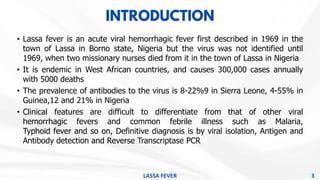
• Lassa virus, the agent of the disease is a member of the Arenaviridae
family
• Its primary animal host is the Natal Multimammate Mouse (Mastomys
Natalensis), an animal indigenous to most of Sub-Saharan African
• The virus is probably transmitted by the contact with the faces and
urine of animals accessing grain stores in residential areas
4
LASSA FEVER
Causative Agent
•EPIDEMIOLOGY
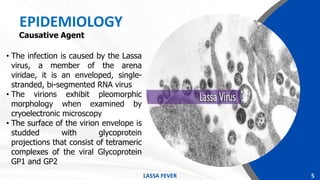
• The infection is caused by the Lassa
virus, a member of the arena
viridae, it is an enveloped, single-
stranded, bi-segmented RNA virus
• The virions exhibit pleomorphic
morphology when examined by
cryoelectronic microscopy
• The surface of the virion envelope is
studded with glycoprotein
projections that consist of tetrameric
complexes of the viral Glycoprotein
GP1 and GP2
5
LASSA FEVER
Vector
•EPIDEMIOLOGY
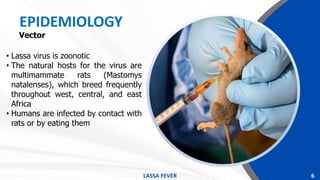
• Lassa virus is zoonotic
• The natural hosts for the virus are
multimammate rats (Mastomys
natalenses), which breed frequently
throughout west, central, and east
Africa
• Humans are infected by contact with
rats or by eating them
6
LASSA FEVER
Countries reporting endemic disease
and substantial outbreaks of Lassa
Fever are:- Guinea, Liberia, Nigeria,
Sierra Leone
Countries reporting few cases or
serological evidence of Lassa Fever
are:- Benin, Burkina Faso, Cote
d’Ivoire, Ghana, Mali, Togo
Distribution
•EPIDEMIOLOGY
7
LASSA FEVER
01
02
The incubation period of the disease
is 6-21 days
The primary source is exposure to food or
household items contaminated with urine or
faces of the infected Mastomys rats
Incubation Period
•EPIDEMIOLOGY
Mode Of Transmission
• Direct contact with fluid/faces of infected Rodent
• Contact with infected objects or surfaces
• Person –to-Person Contact through Body fluids
8
LASSA FEVER
 Fatigue
 Malaise
 Fever
 Headache
 Nausea
 Abdominal pain
 Sore throat
 Vomiting
 Diarrhea
 Face swelling
 Abnormal heart rate
 Low blood pressure
 Hearing deficit
 Conjunctivitis
 Seizures
 Nose & mouth
bleeding
Sign & Symptoms
•EPIDEMIOLOGY
1st
PHASE
3RD
PHASE
2ND
PHASE
9
LASSA FEVER
• Supportive Care
• Rehydration
• Electrolyte Balancing
• Oxygenation
• Blood Pressure Control
• Management Of
Complication
Management
•EPIDEMIOLOGY
10
LASSA FEVER
Affects all Age
Groups
People Living In
West Africa
Individuals Living In
Poorly Sanitized
Environment
Health Workers
Individuals At Risk
•EPIDEMIOLOGY
11
LASSA FEVER
PREVENTION &
CONTROL
• Practice standard precautions at all times
• Appropriate disposal of infected items
• Regular cleaning of the medical facility
• High index of suspicious
• Avoid using rodents as food source
• Setting rodents traps around our homes to
limit the number of rodents
• maintaining effective personal hygiene
• Isolating infected patient from contact
with unprotected persons until the
disease has run its course
12
LASSA FEVER
CONCLUSION
• Of all the Arenavirus diseases, Lassa fever has the greatest health impact
and prospect, for its prevention through rodent control is least
• Clinical laboratory provides little or no clue. RT-PCR tests which provide
definitive diagnosis are not readily available in West African countries and
even where it is available, it is too expensive and out of reach of the poor
people living in endemic areas
• Failure to effectively control the disease makes the attainment of the
millennium development goals of reducing maternal and infant mortality
rates impossible
• The disease also has the potential of being used as biological weapon, It
therefore constitutes a significant infectious menace that must be curbed
13
LASSA FEVER
SUMMARY
• Lassa fever is an acute viral haemorrhagic illness that occurs in West
Africa
• The disease is caused by the Lassa virus, which is transmitted to humans
via contact with food or household items contaminated with rodent urine
or faeces
• The primary transmission of the Lassa virus from its host to humans can
be prevented by avoiding contact with Mastomys rodents, especially in
the geographic regions where outbreaks occur
• Such precautions include wearing protective clothing, such as masks,
gloves, gowns, and goggles; using infection control measures, such as
complete equipment sterilization; and isolating infected patients from
contact with unprotected persons until the disease has run its course
14
LASSA FEVER
THANK YOU FOR LISTENING!!!

lassa fever.pptx

  • 1.
    BAUCHI STATE UNIVERSITYGADAU FACULTY OF BASIC MEDICAL SCIENCE DEPARTMENT OF PUBLIC HEALTH 300 LEVEL Group (16) Seminar Presentation on Lassa Fever PBH3206: - SEMINARS IN PUBLIC HEALTH 2 Monday, October 23, 2023
  • 2.
    OUTLINES • INTRODUCTION • EPIDEMIOLOGY •PREVENTION & CONTROL • CONCLUSION • SUMMARY 2 LASSA FEVER
  • 3.
    INTRODUCTION • Lassa feveris an acute viral hemorrhagic fever first described in 1969 in the town of Lassa in Borno state, Nigeria but the virus was not identified until 1969, when two missionary nurses died from it in the town of Lassa in Nigeria • It is endemic in West African countries, and causes 300,000 cases annually with 5000 deaths • The prevalence of antibodies to the virus is 8-22%9 in Sierra Leone, 4-55% in Guinea,12 and 21% in Nigeria • Clinical features are difficult to differentiate from that of other viral hemorrhagic fevers and common febrile illness such as Malaria, Typhoid fever and so on, Definitive diagnosis is by viral isolation, Antigen and Antibody detection and Reverse Transcriptase PCR 3 LASSA FEVER
  • 4.
    INTRODUCTION • Lassa virus,the agent of the disease is a member of the Arenaviridae family • Its primary animal host is the Natal Multimammate Mouse (Mastomys Natalensis), an animal indigenous to most of Sub-Saharan African • The virus is probably transmitted by the contact with the faces and urine of animals accessing grain stores in residential areas 4 LASSA FEVER
  • 5.
    Causative Agent •EPIDEMIOLOGY • Theinfection is caused by the Lassa virus, a member of the arena viridae, it is an enveloped, single- stranded, bi-segmented RNA virus • The virions exhibit pleomorphic morphology when examined by cryoelectronic microscopy • The surface of the virion envelope is studded with glycoprotein projections that consist of tetrameric complexes of the viral Glycoprotein GP1 and GP2 5 LASSA FEVER
  • 6.
    Vector •EPIDEMIOLOGY • Lassa virusis zoonotic • The natural hosts for the virus are multimammate rats (Mastomys natalenses), which breed frequently throughout west, central, and east Africa • Humans are infected by contact with rats or by eating them 6 LASSA FEVER
  • 7.
    Countries reporting endemicdisease and substantial outbreaks of Lassa Fever are:- Guinea, Liberia, Nigeria, Sierra Leone Countries reporting few cases or serological evidence of Lassa Fever are:- Benin, Burkina Faso, Cote d’Ivoire, Ghana, Mali, Togo Distribution •EPIDEMIOLOGY 7 LASSA FEVER
  • 8.
    01 02 The incubation periodof the disease is 6-21 days The primary source is exposure to food or household items contaminated with urine or faces of the infected Mastomys rats Incubation Period •EPIDEMIOLOGY Mode Of Transmission • Direct contact with fluid/faces of infected Rodent • Contact with infected objects or surfaces • Person –to-Person Contact through Body fluids 8 LASSA FEVER
  • 9.
     Fatigue  Malaise Fever  Headache  Nausea  Abdominal pain  Sore throat  Vomiting  Diarrhea  Face swelling  Abnormal heart rate  Low blood pressure  Hearing deficit  Conjunctivitis  Seizures  Nose & mouth bleeding Sign & Symptoms •EPIDEMIOLOGY 1st PHASE 3RD PHASE 2ND PHASE 9 LASSA FEVER
  • 10.
    • Supportive Care •Rehydration • Electrolyte Balancing • Oxygenation • Blood Pressure Control • Management Of Complication Management •EPIDEMIOLOGY 10 LASSA FEVER
  • 11.
    Affects all Age Groups PeopleLiving In West Africa Individuals Living In Poorly Sanitized Environment Health Workers Individuals At Risk •EPIDEMIOLOGY 11 LASSA FEVER
  • 12.
    PREVENTION & CONTROL • Practicestandard precautions at all times • Appropriate disposal of infected items • Regular cleaning of the medical facility • High index of suspicious • Avoid using rodents as food source • Setting rodents traps around our homes to limit the number of rodents • maintaining effective personal hygiene • Isolating infected patient from contact with unprotected persons until the disease has run its course 12 LASSA FEVER
  • 13.
    CONCLUSION • Of allthe Arenavirus diseases, Lassa fever has the greatest health impact and prospect, for its prevention through rodent control is least • Clinical laboratory provides little or no clue. RT-PCR tests which provide definitive diagnosis are not readily available in West African countries and even where it is available, it is too expensive and out of reach of the poor people living in endemic areas • Failure to effectively control the disease makes the attainment of the millennium development goals of reducing maternal and infant mortality rates impossible • The disease also has the potential of being used as biological weapon, It therefore constitutes a significant infectious menace that must be curbed 13 LASSA FEVER
  • 14.
    SUMMARY • Lassa feveris an acute viral haemorrhagic illness that occurs in West Africa • The disease is caused by the Lassa virus, which is transmitted to humans via contact with food or household items contaminated with rodent urine or faeces • The primary transmission of the Lassa virus from its host to humans can be prevented by avoiding contact with Mastomys rodents, especially in the geographic regions where outbreaks occur • Such precautions include wearing protective clothing, such as masks, gloves, gowns, and goggles; using infection control measures, such as complete equipment sterilization; and isolating infected patients from contact with unprotected persons until the disease has run its course 14 LASSA FEVER
  • 15.
    THANK YOU FORLISTENING!!!