Laser Light
Security System
Presented by:
Hadia Khursheed Kashish Khushi Sana Arshad
• Introduction
• Components used
• Circuit Diagram
• Practical Model
• Working
• Pros and Cons
• Applications
• Conclusion
TABLE OF CONTENTS
• Laser light: Light Amplification By Stimulated Emission of Radiation
• Laser light has a point-like beam having limited area, so when the
beam falls on the LDR and when there is any interruption, the whole
light is blocked and LDR receives very less amount of intensity. Hence,
the LED and Buzzer will work properly.
• But if we use any normal torch light, then in the case of interruption,
LDR is not fully blocked and there will be some reflected light in its
surroundings that’s why the LED and Buzzer will not work efficiently.
WHY LASER LIGHT?
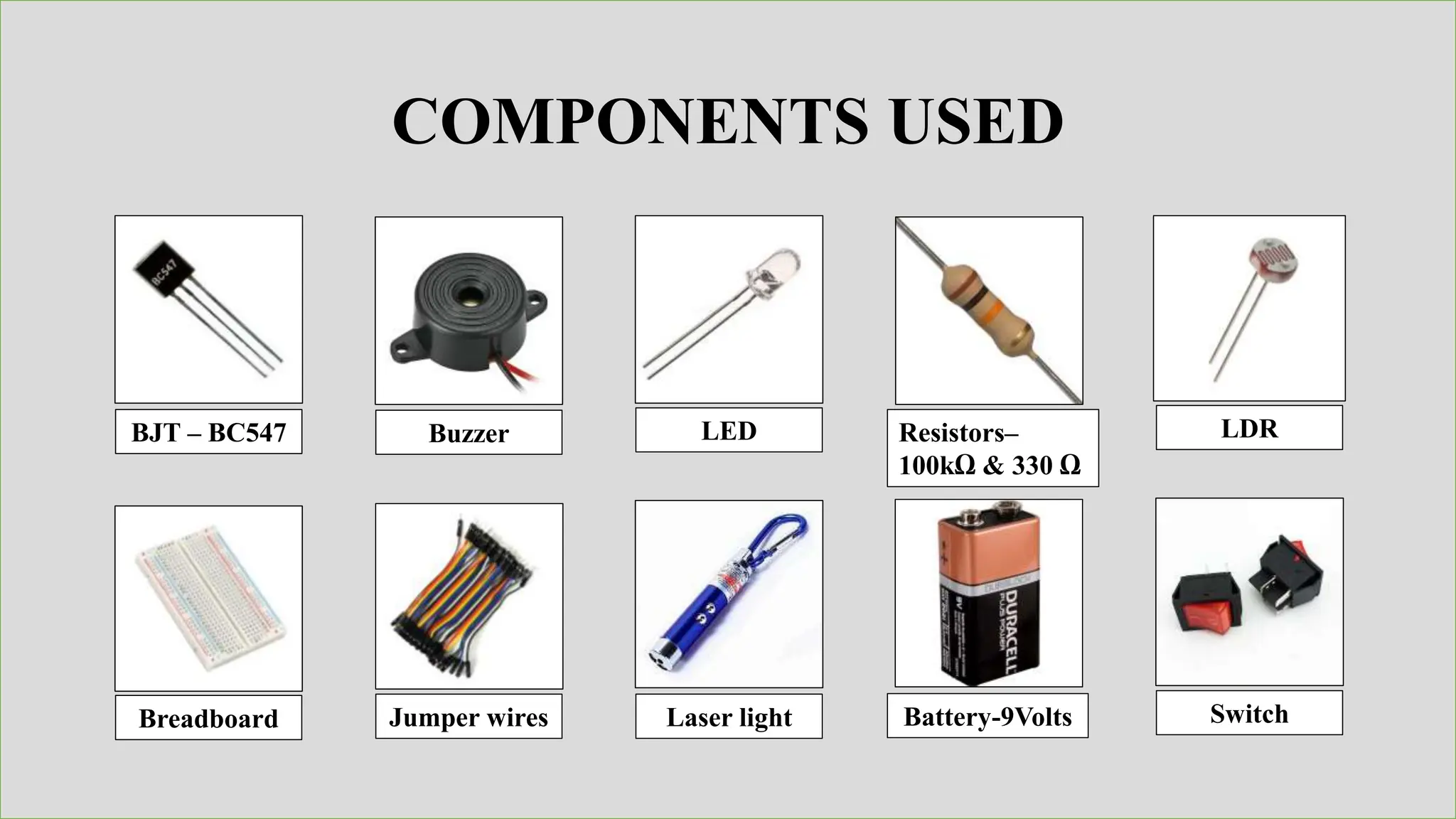
COMPONENTS USED
BJT – BC547 LED
Buzzer Resistors–
100kΩ & 330 Ω
Battery-9Volts
Breadboard Jumper wires Laser light
LDR
Switch
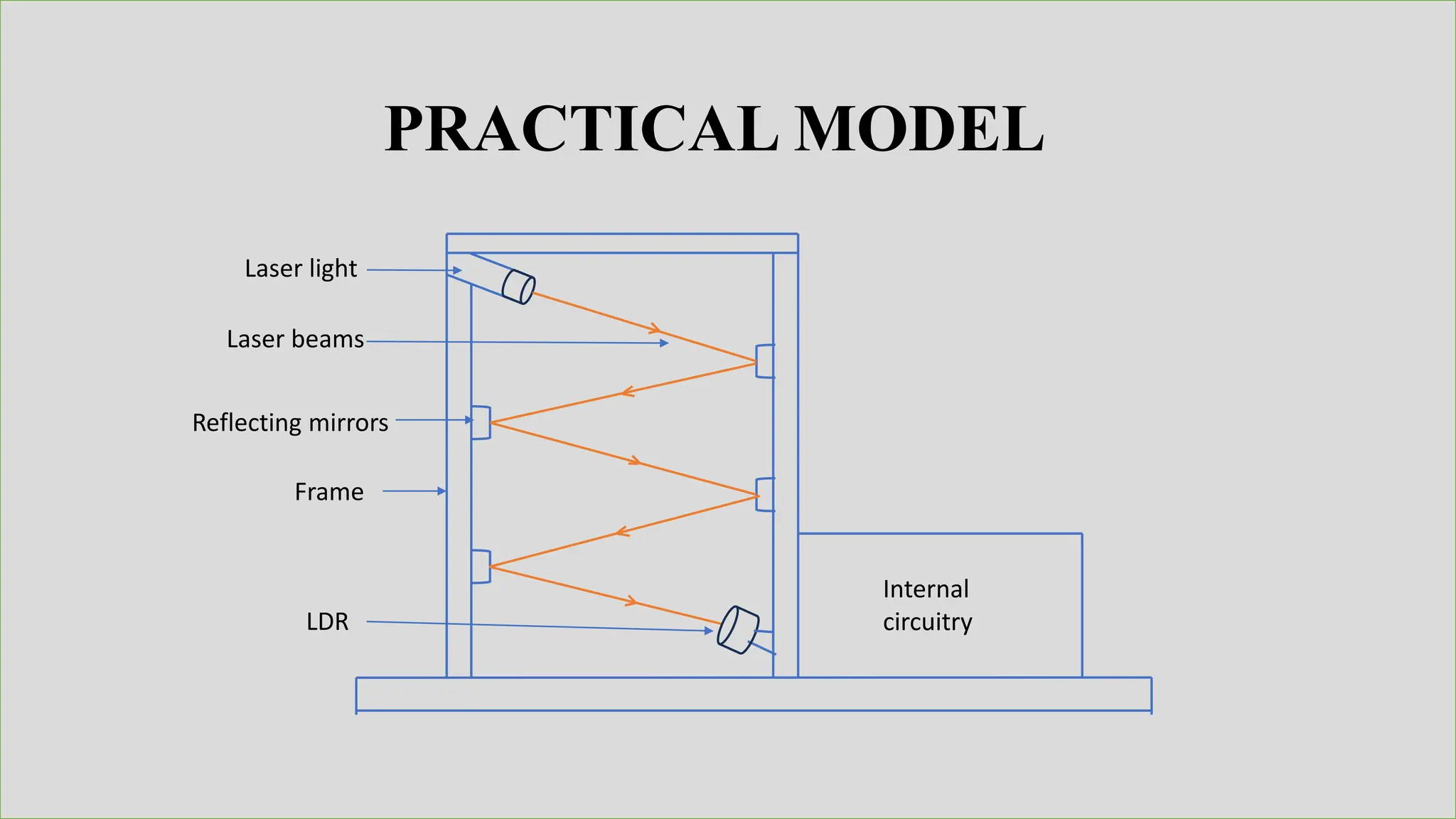
Laser light
Laser beams
Reflecting mirrors
Frame
PRACTICAL MODEL
LDR
Internal
circuitry
CIRCUIT DIAGRAM
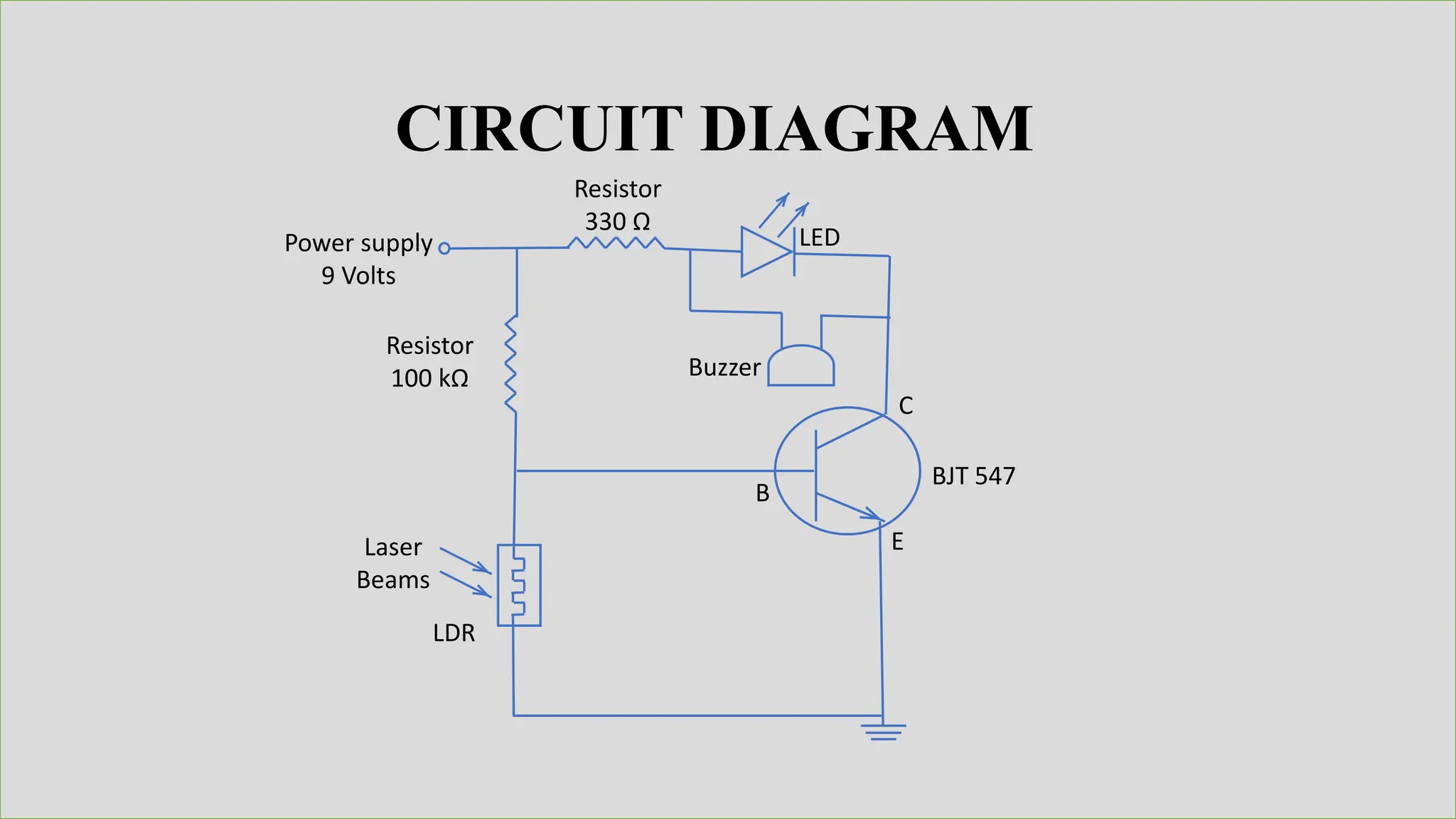
Power supply
9 Volts
Resistor
100 kΩ
LED
Buzzer
BJT 547
LDR
B
C
E
Laser
Beams
Resistor
330 Ω
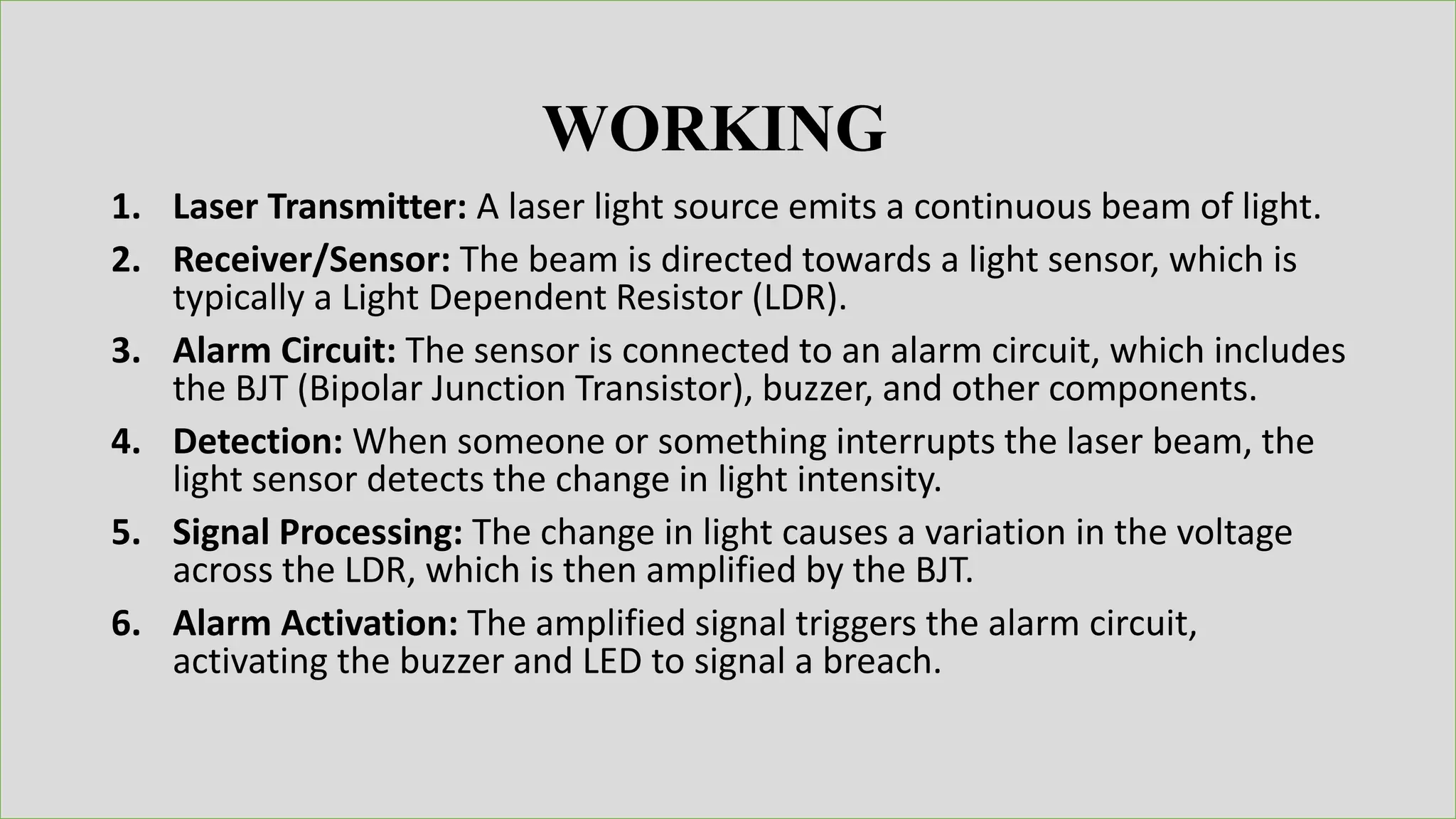
1. Laser Transmitter: A laser light source emits a continuous beam of light.
2. Receiver/Sensor: The beam is directed towards a light sensor, which is
typically a Light Dependent Resistor (LDR).
3. Alarm Circuit: The sensor is connected to an alarm circuit, which includes
the BJT (Bipolar Junction Transistor), buzzer, and other components.
4. Detection: When someone or something interrupts the laser beam, the
light sensor detects the change in light intensity.
5. Signal Processing: The change in light causes a variation in the voltage
across the LDR, which is then amplified by the BJT.
6. Alarm Activation: The amplified signal triggers the alarm circuit,
activating the buzzer and LED to signal a breach.
WORKING
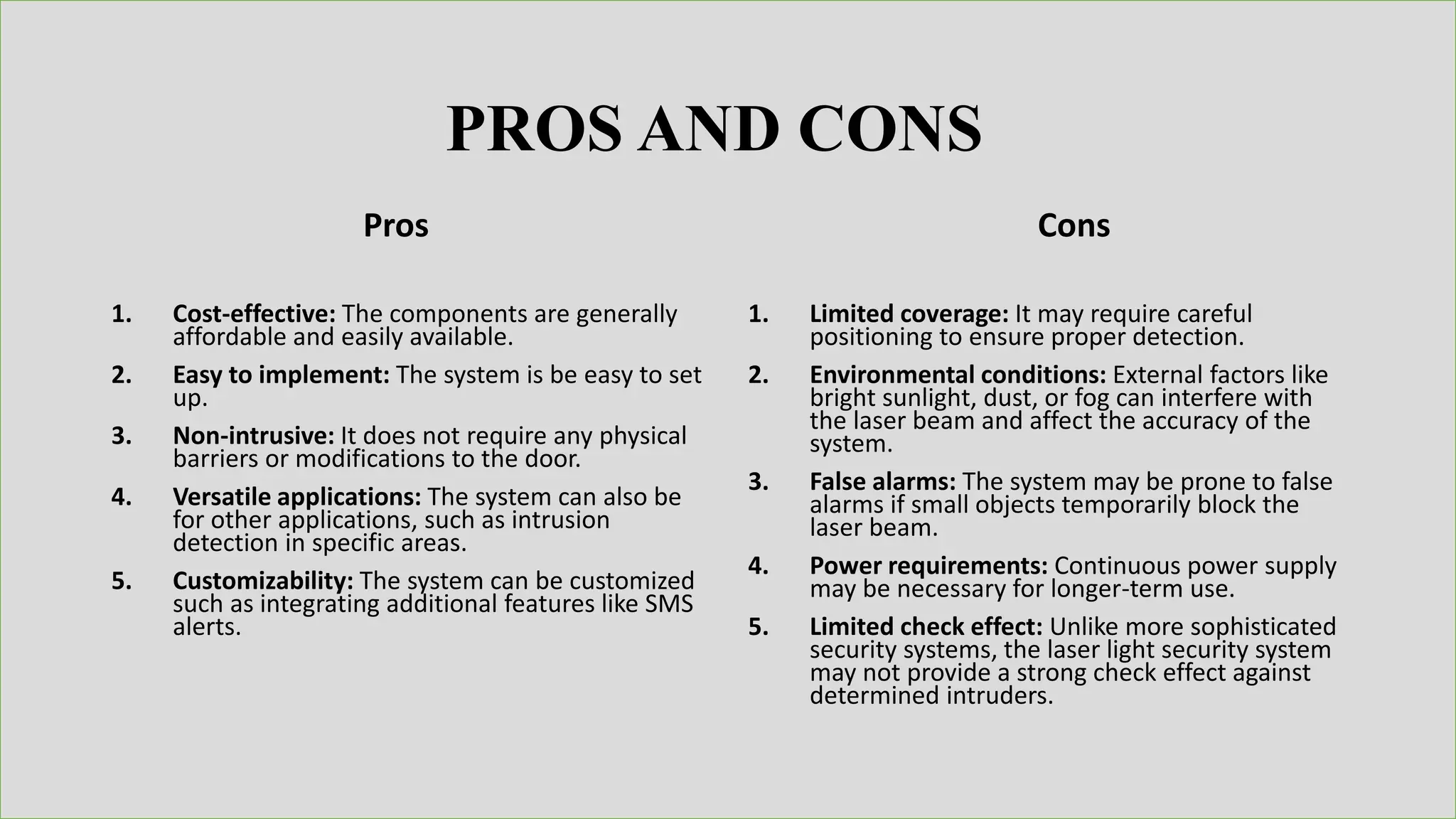
Pros
1. Cost-effective: The components are generally
affordable and easily available.
2. Easy to implement: The system is be easy to set
up.
3. Non-intrusive: It does not require any physical
barriers or modifications to the door.
4. Versatile applications: The system can also be
for other applications, such as intrusion
detection in specific areas.
5. Customizability: The system can be customized
such as integrating additional features like SMS
alerts.
1. Limited coverage: It may require careful
positioning to ensure proper detection.
2. Environmental conditions: External factors like
bright sunlight, dust, or fog can interfere with
the laser beam and affect the accuracy of the
system.
3. False alarms: The system may be prone to false
alarms if small objects temporarily block the
laser beam.
4. Power requirements: Continuous power supply
may be necessary for longer-term use.
5. Limited check effect: Unlike more sophisticated
security systems, the laser light security system
may not provide a strong check effect against
determined intruders.
Cons
PROS AND CONS
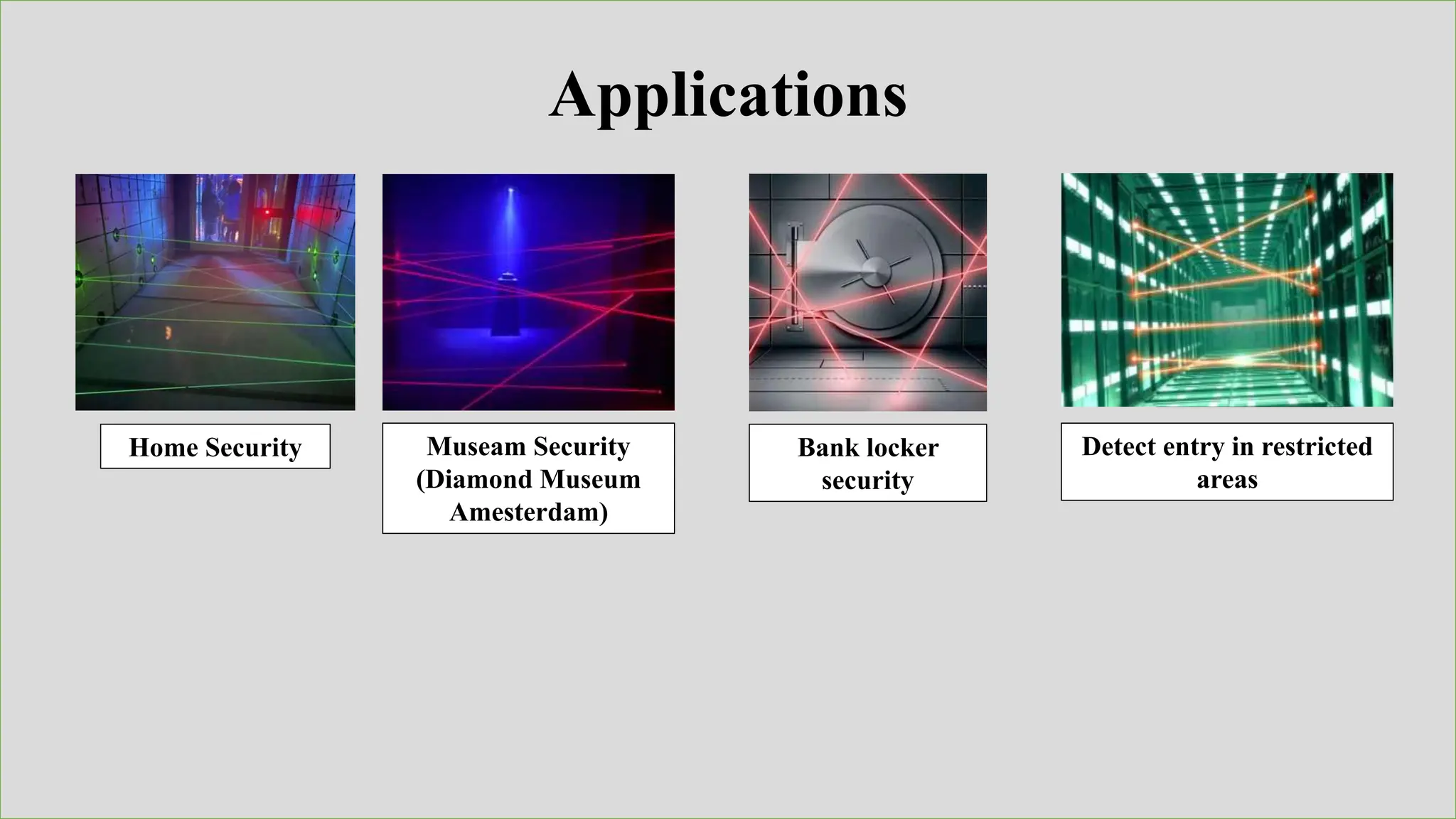
Applications
Home Security Bank locker
security
Museam Security
(Diamond Museum
Amesterdam)
Detect entry in restricted
areas
LDR
• In conclusion, the laser light security system is a cost-effective security
solution that can be easily implemented.
• This system can be used to secure entry points, detect intrusion, and
monitor access to restricted areas or objects.
• It offers several benefits such as flexibility in laser placement, adjustable
sensitivity, and customization options.
• Additionally, the laser light security system can be integrated with other
security systems to enhance overall security.
• Overall, the laser light security system provides a unique security solution
that can be adapted from residential and commercial security to
specialized installations in museums, galleries, and industrial environments.
• If we overcome the continuous power supply and high power consumption
problems, we can create a better model in future for security purpose.
CONCLUSION

Laser Light Security System (Home Security)

  • 1.
    Laser Light Security System Presentedby: Hadia Khursheed Kashish Khushi Sana Arshad
  • 2.
    • Introduction • Componentsused • Circuit Diagram • Practical Model • Working • Pros and Cons • Applications • Conclusion TABLE OF CONTENTS
  • 3.
    • Laser light:Light Amplification By Stimulated Emission of Radiation • Laser light has a point-like beam having limited area, so when the beam falls on the LDR and when there is any interruption, the whole light is blocked and LDR receives very less amount of intensity. Hence, the LED and Buzzer will work properly. • But if we use any normal torch light, then in the case of interruption, LDR is not fully blocked and there will be some reflected light in its surroundings that’s why the LED and Buzzer will not work efficiently. WHY LASER LIGHT?
  • 4.
    COMPONENTS USED BJT –BC547 LED Buzzer Resistors– 100kΩ & 330 Ω Battery-9Volts Breadboard Jumper wires Laser light LDR Switch
  • 5.
    Laser light Laser beams Reflectingmirrors Frame PRACTICAL MODEL LDR Internal circuitry
  • 6.
    CIRCUIT DIAGRAM Power supply 9Volts Resistor 100 kΩ LED Buzzer BJT 547 LDR B C E Laser Beams Resistor 330 Ω
  • 7.
    1. Laser Transmitter:A laser light source emits a continuous beam of light. 2. Receiver/Sensor: The beam is directed towards a light sensor, which is typically a Light Dependent Resistor (LDR). 3. Alarm Circuit: The sensor is connected to an alarm circuit, which includes the BJT (Bipolar Junction Transistor), buzzer, and other components. 4. Detection: When someone or something interrupts the laser beam, the light sensor detects the change in light intensity. 5. Signal Processing: The change in light causes a variation in the voltage across the LDR, which is then amplified by the BJT. 6. Alarm Activation: The amplified signal triggers the alarm circuit, activating the buzzer and LED to signal a breach. WORKING
  • 8.
    Pros 1. Cost-effective: Thecomponents are generally affordable and easily available. 2. Easy to implement: The system is be easy to set up. 3. Non-intrusive: It does not require any physical barriers or modifications to the door. 4. Versatile applications: The system can also be for other applications, such as intrusion detection in specific areas. 5. Customizability: The system can be customized such as integrating additional features like SMS alerts. 1. Limited coverage: It may require careful positioning to ensure proper detection. 2. Environmental conditions: External factors like bright sunlight, dust, or fog can interfere with the laser beam and affect the accuracy of the system. 3. False alarms: The system may be prone to false alarms if small objects temporarily block the laser beam. 4. Power requirements: Continuous power supply may be necessary for longer-term use. 5. Limited check effect: Unlike more sophisticated security systems, the laser light security system may not provide a strong check effect against determined intruders. Cons PROS AND CONS
  • 9.
    Applications Home Security Banklocker security Museam Security (Diamond Museum Amesterdam) Detect entry in restricted areas LDR
  • 10.
    • In conclusion,the laser light security system is a cost-effective security solution that can be easily implemented. • This system can be used to secure entry points, detect intrusion, and monitor access to restricted areas or objects. • It offers several benefits such as flexibility in laser placement, adjustable sensitivity, and customization options. • Additionally, the laser light security system can be integrated with other security systems to enhance overall security. • Overall, the laser light security system provides a unique security solution that can be adapted from residential and commercial security to specialized installations in museums, galleries, and industrial environments. • If we overcome the continuous power supply and high power consumption problems, we can create a better model in future for security purpose. CONCLUSION

Editor's Notes

  • #3 Table of content shows the subtopics going to be discussed though the presentation.
  • #4 Now here we added the contents of the presentation.
  • #5 This slide contains the images of the electronics components and their names
  • #6 This image was made using the shapes and lines from the powerpoint.
  • #7 This one too was made like that.
  • #8 Now further subtopics explained here.
  • #9 Now further subtopics explained here.
  • #10 These are the applications that can be explained verbally.
  • #11 At last, the conclusion slide. Thanks for watching, till then bye.