Kammavari Sangham (R) 1952, K.S.Group of Institutions
K. S SCHOOL OF ENGINEERING AND MANAGEMENT, BENGALURU-560109
(Affiliated to VTU, Belagavi & Approved by AICTE, New Delhi, Accredited by NAAC)
“Laser-Based Alarm System: Design and Fabrication ”
Batch No: B12
Group No: G2
Name USN
K NITHISH 1KG21CS051
RAKESH K S 1KG22CS409
DIBYA JOTI SAHU 1KG21CS035
DARSHAN R 1KG21CS026
Under the Guidance of
Dr. K. VENKATA RAO
Professor & HOD
Department of Computer Science and Engineering
1
DEPARTMENT OF COMPUTER SCIENCE AND ENGINEERING
Project Work Phase-1 (21CSP76) : Review-1
Outline
1. Introduction
2.Problem Identification, statement & scope
3.Literature Survey
4.Goals and Objectives
5.Methodology
6.Contribution to society
7.References
2
3
INTRODUCTION
 Security is essential in today's world to prevent theft and intrusion in homes, offices, and other important places.
 When an object interrupts the laser beam, the resistance of the LDR changes, triggering an alarm to alert the user.
 This project focuses on designing a simple, cost-effective, and efficient security system using laser and LDR technology.
 A laser alarm system works by continuously projecting a laser beam onto a Light Dependent Resistor (LDR).
PROBLEM IDENTIFICATION
 Security threats such as theft, unauthorized access, and intrusion are increasing, making it essential to have reliable security
systems in place.
 Traditional security systems, like CCTV cameras and motion detectors, can be expensive, require high maintenance, and may
not provide real-time intrusion alerts.
 Many alarm systems rely on motion sensors that can be triggered by false alarms due to environmental factors like wind, pets,
or lighting changes.
 There is a need for a simple, cost-effective, and efficient security system that provides instant alerts upon detecting
unauthorized entry.
5
PROBLEM STATEMENT
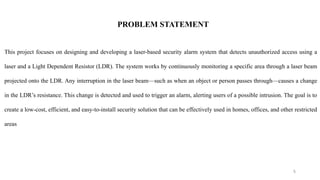
This project focuses on designing and developing a laser-based security alarm system that detects unauthorized access using a
laser and a Light Dependent Resistor (LDR). The system works by continuously monitoring a specific area through a laser beam
projected onto the LDR. Any interruption in the laser beam—such as when an object or person passes through—causes a change
in the LDR’s resistance. This change is detected and used to trigger an alarm, alerting users of a possible intrusion. The goal is to
create a low-cost, efficient, and easy-to-install security solution that can be effectively used in homes, offices, and other restricted
areas
6
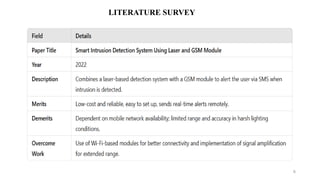
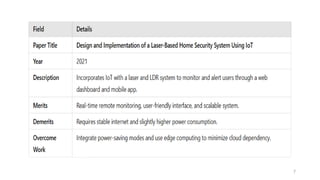
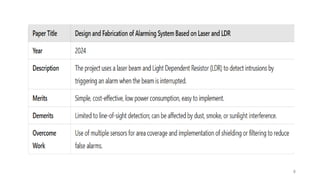
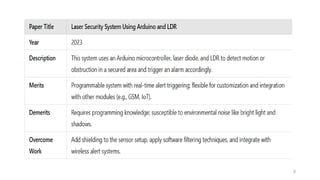
LITERATURE SURVEY
7
8
9
10
OBJECTIVES
 To select suitable and affordable components such as a laser, LDR, and buzzer to build a cost-effective and energy-efficient
security system.
 To design and construct a functional circuit that uses a laser and LDR to detect any interruption in the beam.
 To test the system to ensure real-time detection and immediate alarm activation when an intrusion occurs.
 To improve the system for better reliability and enable future integration with microcontrollers and IoT for remote
monitoring.
11
METHODOLOGY
•Select Affordable Components
Choose laser, LDR, buzzer, power supply, and other basic parts.
•Build the Circuit
Connect the laser to point at the LDR. Wire the buzzer to sound when the beam is blocked.
•Test the System
Break the laser beam and check if the buzzer activates correctly.
•Improve and Finalize
Adjust alignment, improve sensitivity, and make it more reliable. Add features if needed.
12
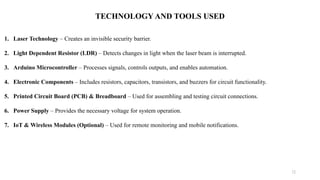
TECHNOLOGY AND TOOLS USED
1. Laser Technology – Creates an invisible security barrier.
2. Light Dependent Resistor (LDR) – Detects changes in light when the laser beam is interrupted.
3. Arduino Microcontroller – Processes signals, controls outputs, and enables automation.
4. Electronic Components – Includes resistors, capacitors, transistors, and buzzers for circuit functionality.
5. Printed Circuit Board (PCB) & Breadboard – Used for assembling and testing circuit connections.
6. Power Supply – Provides the necessary voltage for system operation.
7. IoT & Wireless Modules (Optional) – Used for remote monitoring and mobile notifications.
13
CONTRIBUTION TO THE SOCIETY
This laser-based alarm system contributes to society by providing a cost-effective and reliable security solution for homes,
offices, and other important areas. It helps prevent theft and unauthorized access by detecting intrusions instantly. The
system is easy to install and maintain, making it accessible to everyone, even without technical expertise. It is also energy-
efficient, consuming minimal power while offering continuous protection. With the option to integrate IoT and automation,
it can provide real-time alerts and remote monitoring for better security. Overall, this project promotes safety, awareness of
smart security systems, and technological innovation in daily life
14
The laser-based alarming system is a simple, cost-effective, and efficient security solution that helps protect
homes, offices, and other important areas from unauthorized access. By using a laser and Light Dependent
Resistor (LDR), the system detects interruptions and triggers an alarm, ensuring instant intrusion detection. It is
easy to install, energy-efficient, and requires minimal maintenance, making it accessible for widespread use.
Additionally, the system can be enhanced with Arduino and IoT integration for remote monitoring and smart
security features. Overall, this project provides a reliable and scalable solution to improve safety and prevent
security threats.
CONCLUSION
15
FUTURE ENHANCEMENTS
1. Wireless Connectivity – Using Wi-Fi or Bluetooth to communicate with security systems without physical wiring.
2. Camera Integration – Adding a camera module to capture images or videos when an intrusion is detected.
3. Battery Backup – Implementing a rechargeable battery to keep the system operational during power failures.
4. Voice or SMS Alerts – Sending automated voice calls or SMS alerts to users when an intrusion is detected.
5. Weatherproof Design – Making the system suitable for outdoor use by protecting it from rain, dust, and extreme
temperatures
16
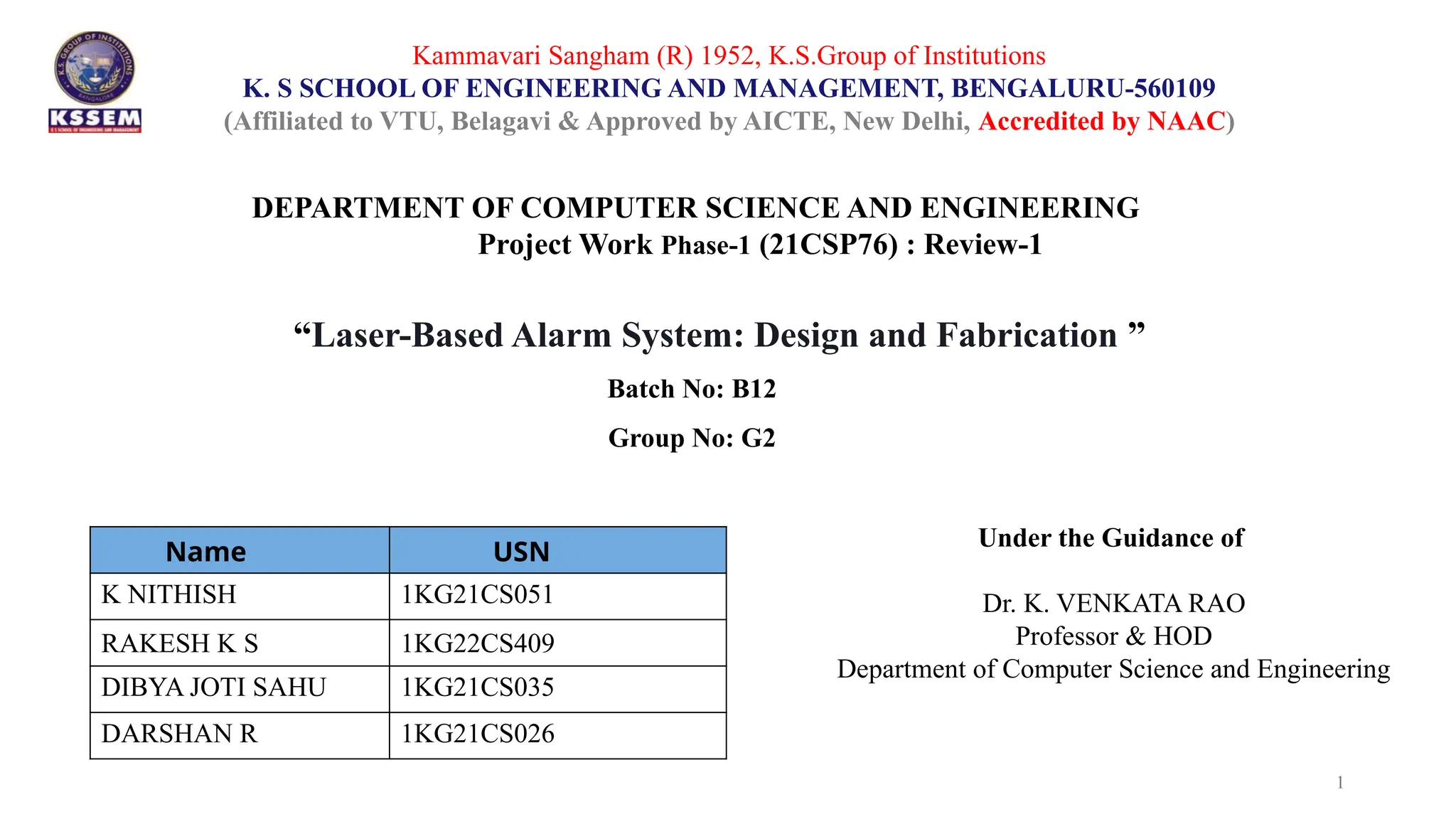
REFERENCES
1. Lusterio, V., Montecer, R. C., & Balba, N. (2020). Multiple Laser Alarm System using Arduino Uno. Lyceum of the
Philippines–Journal of Engineering and Computer Studies, 4(3), 1-1.
2. Singha, S., & Maji, D. (2016). Laser security system. International Journal of Scientific & Engineering Research, 7(4), 214-
218.
3. Syfullah, M. K., Peyal, H. I., Bipro, S. S., Shahriar, S. M., & Mondol, M. H. (2021). IoT Based Multi-layered Security &
Automated Monitoring System. IEEE International Conference on Computer, Communication, Chemical, Materials and
Electronic Engineering (IC4ME2).

Laser security based alarm system for be

  • 1.
    Kammavari Sangham (R)1952, K.S.Group of Institutions K. S SCHOOL OF ENGINEERING AND MANAGEMENT, BENGALURU-560109 (Affiliated to VTU, Belagavi & Approved by AICTE, New Delhi, Accredited by NAAC) “Laser-Based Alarm System: Design and Fabrication ” Batch No: B12 Group No: G2 Name USN K NITHISH 1KG21CS051 RAKESH K S 1KG22CS409 DIBYA JOTI SAHU 1KG21CS035 DARSHAN R 1KG21CS026 Under the Guidance of Dr. K. VENKATA RAO Professor & HOD Department of Computer Science and Engineering 1 DEPARTMENT OF COMPUTER SCIENCE AND ENGINEERING Project Work Phase-1 (21CSP76) : Review-1
  • 2.
    Outline 1. Introduction 2.Problem Identification,statement & scope 3.Literature Survey 4.Goals and Objectives 5.Methodology 6.Contribution to society 7.References 2
  • 3.
    3 INTRODUCTION  Security isessential in today's world to prevent theft and intrusion in homes, offices, and other important places.  When an object interrupts the laser beam, the resistance of the LDR changes, triggering an alarm to alert the user.  This project focuses on designing a simple, cost-effective, and efficient security system using laser and LDR technology.  A laser alarm system works by continuously projecting a laser beam onto a Light Dependent Resistor (LDR).
  • 4.
    PROBLEM IDENTIFICATION  Securitythreats such as theft, unauthorized access, and intrusion are increasing, making it essential to have reliable security systems in place.  Traditional security systems, like CCTV cameras and motion detectors, can be expensive, require high maintenance, and may not provide real-time intrusion alerts.  Many alarm systems rely on motion sensors that can be triggered by false alarms due to environmental factors like wind, pets, or lighting changes.  There is a need for a simple, cost-effective, and efficient security system that provides instant alerts upon detecting unauthorized entry.
  • 5.
    5 PROBLEM STATEMENT This projectfocuses on designing and developing a laser-based security alarm system that detects unauthorized access using a laser and a Light Dependent Resistor (LDR). The system works by continuously monitoring a specific area through a laser beam projected onto the LDR. Any interruption in the laser beam—such as when an object or person passes through—causes a change in the LDR’s resistance. This change is detected and used to trigger an alarm, alerting users of a possible intrusion. The goal is to create a low-cost, efficient, and easy-to-install security solution that can be effectively used in homes, offices, and other restricted areas
  • 6.
  • 7.
  • 8.
  • 9.
  • 10.
    10 OBJECTIVES  To selectsuitable and affordable components such as a laser, LDR, and buzzer to build a cost-effective and energy-efficient security system.  To design and construct a functional circuit that uses a laser and LDR to detect any interruption in the beam.  To test the system to ensure real-time detection and immediate alarm activation when an intrusion occurs.  To improve the system for better reliability and enable future integration with microcontrollers and IoT for remote monitoring.
  • 11.
    11 METHODOLOGY •Select Affordable Components Chooselaser, LDR, buzzer, power supply, and other basic parts. •Build the Circuit Connect the laser to point at the LDR. Wire the buzzer to sound when the beam is blocked. •Test the System Break the laser beam and check if the buzzer activates correctly. •Improve and Finalize Adjust alignment, improve sensitivity, and make it more reliable. Add features if needed.
  • 12.
    12 TECHNOLOGY AND TOOLSUSED 1. Laser Technology – Creates an invisible security barrier. 2. Light Dependent Resistor (LDR) – Detects changes in light when the laser beam is interrupted. 3. Arduino Microcontroller – Processes signals, controls outputs, and enables automation. 4. Electronic Components – Includes resistors, capacitors, transistors, and buzzers for circuit functionality. 5. Printed Circuit Board (PCB) & Breadboard – Used for assembling and testing circuit connections. 6. Power Supply – Provides the necessary voltage for system operation. 7. IoT & Wireless Modules (Optional) – Used for remote monitoring and mobile notifications.
  • 13.
    13 CONTRIBUTION TO THESOCIETY This laser-based alarm system contributes to society by providing a cost-effective and reliable security solution for homes, offices, and other important areas. It helps prevent theft and unauthorized access by detecting intrusions instantly. The system is easy to install and maintain, making it accessible to everyone, even without technical expertise. It is also energy- efficient, consuming minimal power while offering continuous protection. With the option to integrate IoT and automation, it can provide real-time alerts and remote monitoring for better security. Overall, this project promotes safety, awareness of smart security systems, and technological innovation in daily life
  • 14.
    14 The laser-based alarmingsystem is a simple, cost-effective, and efficient security solution that helps protect homes, offices, and other important areas from unauthorized access. By using a laser and Light Dependent Resistor (LDR), the system detects interruptions and triggers an alarm, ensuring instant intrusion detection. It is easy to install, energy-efficient, and requires minimal maintenance, making it accessible for widespread use. Additionally, the system can be enhanced with Arduino and IoT integration for remote monitoring and smart security features. Overall, this project provides a reliable and scalable solution to improve safety and prevent security threats. CONCLUSION
  • 15.
    15 FUTURE ENHANCEMENTS 1. WirelessConnectivity – Using Wi-Fi or Bluetooth to communicate with security systems without physical wiring. 2. Camera Integration – Adding a camera module to capture images or videos when an intrusion is detected. 3. Battery Backup – Implementing a rechargeable battery to keep the system operational during power failures. 4. Voice or SMS Alerts – Sending automated voice calls or SMS alerts to users when an intrusion is detected. 5. Weatherproof Design – Making the system suitable for outdoor use by protecting it from rain, dust, and extreme temperatures
  • 16.
    16 REFERENCES 1. Lusterio, V.,Montecer, R. C., & Balba, N. (2020). Multiple Laser Alarm System using Arduino Uno. Lyceum of the Philippines–Journal of Engineering and Computer Studies, 4(3), 1-1. 2. Singha, S., & Maji, D. (2016). Laser security system. International Journal of Scientific & Engineering Research, 7(4), 214- 218. 3. Syfullah, M. K., Peyal, H. I., Bipro, S. S., Shahriar, S. M., & Mondol, M. H. (2021). IoT Based Multi-layered Security & Automated Monitoring System. IEEE International Conference on Computer, Communication, Chemical, Materials and Electronic Engineering (IC4ME2).