Language
Translator
C
O
N
T
E
N
T
S
01 I n t r o d u c t i o n
02 B a c k g r o u n d o f
S t u d y
03 T o o l s a n d
t e c h n o l o g i e s
04 F u t u r e s c o p e
I n t r o d u c t i o n
Translation is the process of conveying a written source language text clearly, completely,
accurately, and appropriately in a target language. Translation allows information to be
transferred across languages, expanding accessibility of the information. The translation process
involves translation, editing, and proofreading. Training programs at NMHSs may be able to use
translation as a cost-effective means to expand their training program's offerings.
Translation is an activity, a product, and a process. As an activity, translation is a complex act that
requires close reading of a text in the source language, understanding its meaning, and creating
an equivalent text in the target language. The word “translation” also refers to the product of this
activity: the final target language text that will be published or distributed. Although this document
will touch on these aspects of translating, we will focus primarily on the process of creating a
translation, using this definition.resent the good effect of the release, please try to be concise and
concise; if necessary, add or subtract the text as needed, so that the viewer can accurately
understand the message you convey.
01
Here are some of the objectives
The goal of translation practice for non-specialists is to
found the language skills of the learner, to refine their
thematic and cultural knowledge and to encourage
them to think and to react.
1.Develop a system which able to do conversion
between the languages.
2.Provide an easy and simple for translation.
3.Endow good experience to the user.
4.Translate almost each language.
O b j e c t i v e s
When you livein other country you
faces a lot of difficulties mainly of
language,You needs them to br
translated for a better understanding
Better understanding
Music, literature, films, and various
other art forms transcend global
boundaries because of the way they
are effectively translated to reflect
local languages and sentiments
Cultural interchange
More often whenever a student
studies he/she found some difficult
words which are sopposed to be
translated to his/her native language.
Studies
While dealing with the people of
other countries we needs to talk to
them in their language
Business deals
W h y T r a n s l a t i o n i s n e c e s s a r y ?
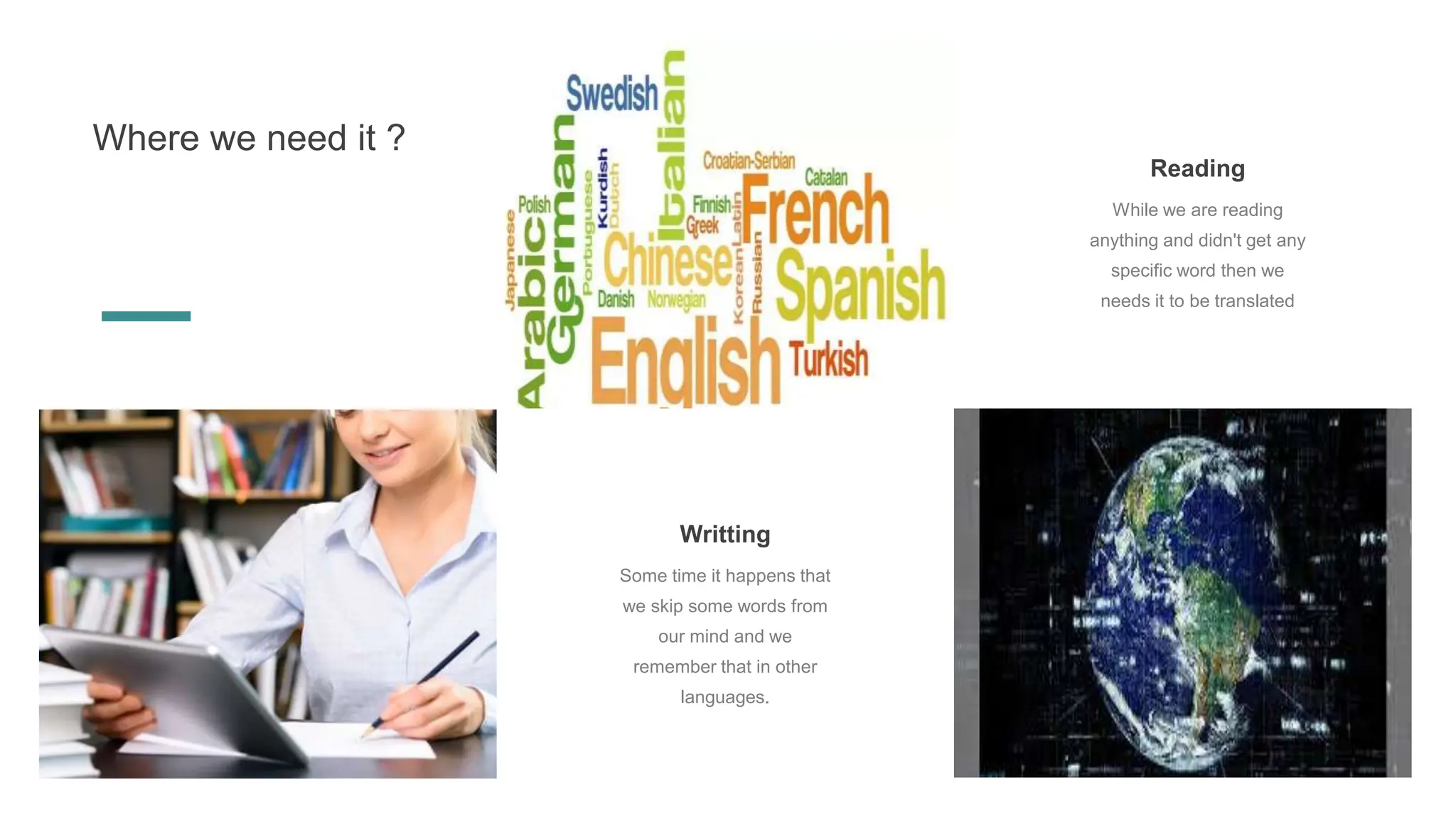
Where we need it ?
Some time it happens that
we skip some words from
our mind and we
remember that in other
languages.
Writting
While we are reading
anything and didn't get any
specific word then we
needs it to be translated
Reading
L a n g u a g e t r a n s l a t o r
Translation is one of simple and effective ways to understand another language easily. In
order to understand the message from another text accurately, a translator should have
knowledge both source and target language. Therefore, a deep understanding of translation
will help in doing a good translation text.
Many books that have been translated into Indonesian language spread everywhere, whether
in book shop or book market. For instance, the translator translates not only the scientific, the
technology books but also literary work. Those translation of technology, scientific and literary
books prove that translation in Indonesia is growing more and more, and hopefully that those
will be better. It is not easy to translate whether scientific or literary books. It deals with the
process of rendering the message and finding the accuracy and equivalent message of
Source Language (SL) into Target Language (TL). By enriching vocabulary, a translator
hopes he can produce a good translation
02
R e p o r t P r e s e n t a t i o n
Hardware configuration
1.Processor: Intel® Core™ i3-9750H CPU @ 2.6GHz or above
2.RAM: 2 GB RAM or above
3.Storage: 2 GB or above
4.Active Internet Connection
Software requirement
1.Python
2.Windows OS
03
Click here to add the text, the text
is the refinement of your thought
Title
Click here to add the text, the text
is the refinement of your thought
Title
Development Tools
Visual Studio Code
Visual Studio Code is a freeware source-code editor made by Microsoft for Windows, Linux and macOS. Features include support for debugging, syntax
highlighting, intelligent code completion, snippets, code refactoring, and embedded Git. Users can change the theme, keyboard shortcuts, preferences,
and install extensions that add additional functionality. Microsoft has released most of Visual Studio Code's source code on the microsoft/vscode (Code
- OSS) repository of GitHub, under the permissive MIT License, while the releases by Microsoft are proprietary freeware. In the Stack Overflow 2019
Developer Survey, Visual Studio Code was ranked the most popular developer environment tool, with 50.7% of 87,317 respondents reporting that they
use it. Visual Studio Code was first announced on April 29, 2015, by Microsoft at the 2015 Build conference. [9] A Preview build was released shortly
thereafter. On November
18, 2015, Visual Studio Code was released under the MIT License, having its source code available on GitHub. Extension support was also announced.
On April 14, 2016, Visual Studio Code graduated from the public preview stage and was released to the Web. Visual Studio Code is a source-code
editor that can be used with a variety of programming languages, including Java, JavaScript, Go, Node.js, Python and C++. It is based on the Electron
framework, which is used to develop Node.js Web applications that run on the Blink layout engine. Visual Studio Code employs the same editor
component (codenamed "Monaco") used in Azure DevOps (formerly called Visual Studio Online and Visual Studio Team Services). Instead of a project
system, it allows users to open one or more directories, which can then be saved in workspaces for future reuse. This allows it to operate as a
language-agnostic code editor for any language. It supports a number of programming languages and a set of features that differs per language.
Unwanted files and folders can be excluded from the project tree via the settings. Many Visual Studio Code features are not exposed through menus or
the user interface but can be accessed via the command palette. Visual Studio Code can be extended via extensions, available through a central
repository. This includes additions to the editor and language support. A notable feature is the ability to create extensions that add support for new
languages, themes, and debuggers, perform static code 19 | P a g e analysis, and add code linters using the Language Server Protocol. Visual Studio
Code includes multiple extensions for FTP, allowing the software to be used as a free alternative for web development. Code can be synced between
the editor and the server, without downloading any extra software. Visual Studio Code allows users to set the code page in which the active document is
saved, the newline character, and the programming language of the active document. This allows it to be used on any platform, in any locale, and for
any given programming language.
Programming Language
Python
Python is an interpreted high-level general-purpose programming language.
Its design philosophy emphasizes code readability with its use of significant
indentation. Its language constructs as well as its object-oriented approach
aim to help programmers write clear, logical code for small and large-scale
projects.
Python uses dynamic typing and a combination of reference counting and a
cycle-detecting garbage collector for memory management. It also features
dynamic name resolution (late binding), which binds method and variable
names during program execution.
Python strives for a simpler, less-cluttered syntax and grammar while giving
developers a choice in their coding methodology. In contrast to Perl's "there
is more than one way to do it" motto, Python embraces a "there should be
one— and preferably only one —obvious way to do it" design philosophy.
Alex Martelli, a Fellow at the Python Software Foundation and Python book
author, writes that "To describe something as 'clever' is not considered a
compliment in the Python culture.
Methodology
The methods we used in language translator
01
02
Googletrans is a free and unlimited python library
that implemented Google Translate API
Googletrans
To begin with, we can either input the language code or input
“ options” keyword to get the list of languages and their
respective code. After inputting the language code, translator
will ask you to enter the text that you want to translate.
Translator will automatically detect the language the user has
inputted. And, after that it will show you the translation and
pronounciation of the text into that language. In order to exit
the program, we have to input “close” in the terminal and we
will exit the program successfully.
Working
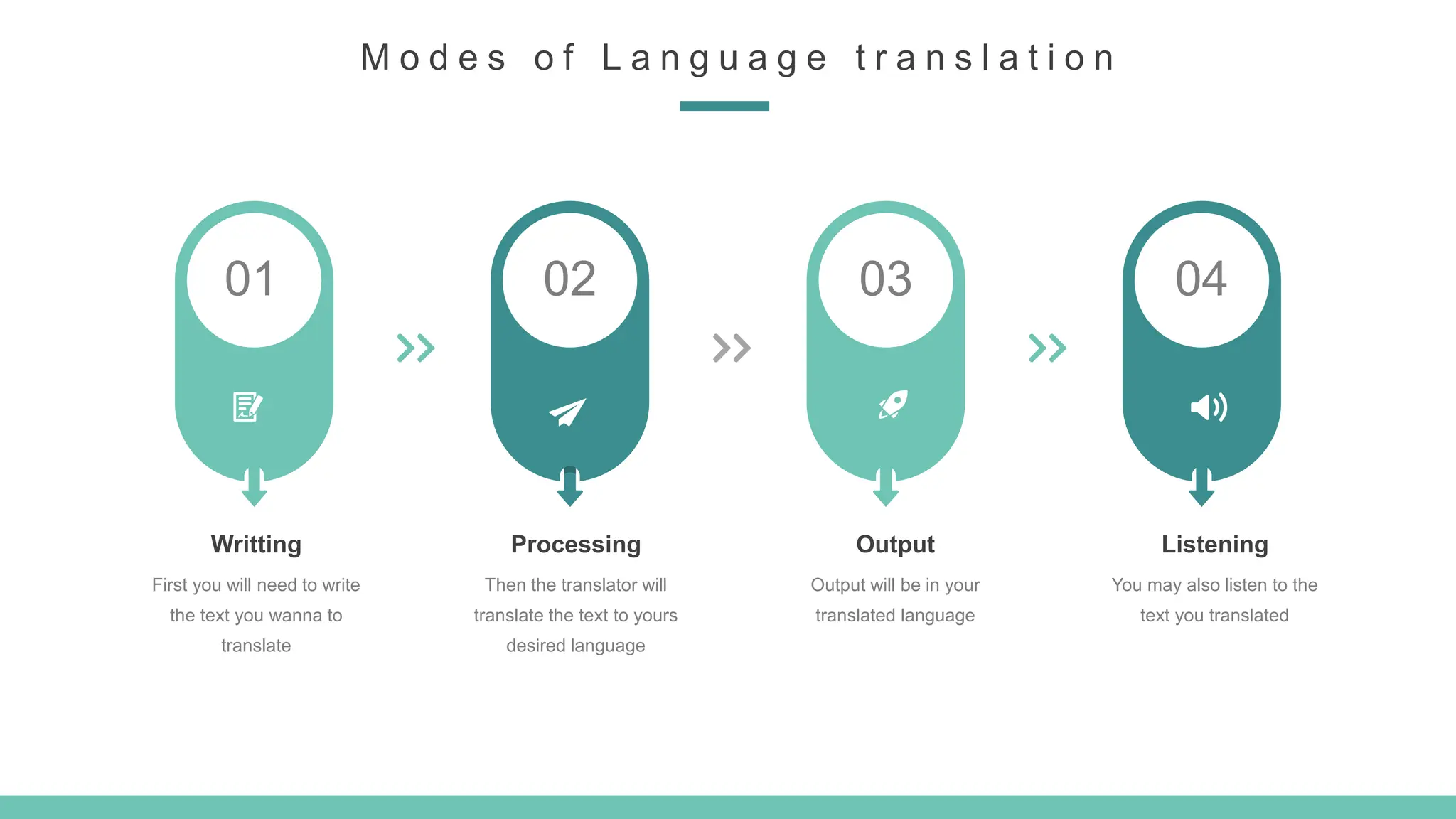
01 02 03 04
First you will need to write
the text you wanna to
translate
Writting
Then the translator will
translate the text to yours
desired language
Processing
Output will be in your
translated language
Output
You may also listen to the
text you translated
Listening
M o d e s o f L a n g u a g e t r a n s l a t i o n
L a n g u a g e t r a n s l a t i o r
The future of translation will cover more cultures, as the
internet continues to penetrate in emerging countries
worldwide. Besides the top languages for translation, the
software will have to provide accurate solutions to
communicate with audiences who speak less known dialects.
04
01 02 03 04
Faster, Cheaper,
Global
Automated
Translation Will Be
the New Standard
Translators Will
Use Artificial
Intelligence
We’ll Have More
Secured Cloud
Environments
N e w e r a o f l a n g u a g e t r a n s l a t o r
Improves
intraction
Saves time
Benefits of Language translator
Independent Working
Quick Career Progression.
Learning new things every time.
Acting as a network component.
THANKS

languagetranslator-211028085026.pptx

  • 1.
  • 2.
    C O N T E N T S 01 I nt r o d u c t i o n 02 B a c k g r o u n d o f S t u d y 03 T o o l s a n d t e c h n o l o g i e s 04 F u t u r e s c o p e
  • 3.
    I n tr o d u c t i o n Translation is the process of conveying a written source language text clearly, completely, accurately, and appropriately in a target language. Translation allows information to be transferred across languages, expanding accessibility of the information. The translation process involves translation, editing, and proofreading. Training programs at NMHSs may be able to use translation as a cost-effective means to expand their training program's offerings. Translation is an activity, a product, and a process. As an activity, translation is a complex act that requires close reading of a text in the source language, understanding its meaning, and creating an equivalent text in the target language. The word “translation” also refers to the product of this activity: the final target language text that will be published or distributed. Although this document will touch on these aspects of translating, we will focus primarily on the process of creating a translation, using this definition.resent the good effect of the release, please try to be concise and concise; if necessary, add or subtract the text as needed, so that the viewer can accurately understand the message you convey. 01
  • 4.
    Here are someof the objectives The goal of translation practice for non-specialists is to found the language skills of the learner, to refine their thematic and cultural knowledge and to encourage them to think and to react. 1.Develop a system which able to do conversion between the languages. 2.Provide an easy and simple for translation. 3.Endow good experience to the user. 4.Translate almost each language. O b j e c t i v e s
  • 5.
    When you liveinother country you faces a lot of difficulties mainly of language,You needs them to br translated for a better understanding Better understanding Music, literature, films, and various other art forms transcend global boundaries because of the way they are effectively translated to reflect local languages and sentiments Cultural interchange More often whenever a student studies he/she found some difficult words which are sopposed to be translated to his/her native language. Studies While dealing with the people of other countries we needs to talk to them in their language Business deals W h y T r a n s l a t i o n i s n e c e s s a r y ?
  • 6.
    Where we needit ? Some time it happens that we skip some words from our mind and we remember that in other languages. Writting While we are reading anything and didn't get any specific word then we needs it to be translated Reading
  • 7.
    L a ng u a g e t r a n s l a t o r Translation is one of simple and effective ways to understand another language easily. In order to understand the message from another text accurately, a translator should have knowledge both source and target language. Therefore, a deep understanding of translation will help in doing a good translation text. Many books that have been translated into Indonesian language spread everywhere, whether in book shop or book market. For instance, the translator translates not only the scientific, the technology books but also literary work. Those translation of technology, scientific and literary books prove that translation in Indonesia is growing more and more, and hopefully that those will be better. It is not easy to translate whether scientific or literary books. It deals with the process of rendering the message and finding the accuracy and equivalent message of Source Language (SL) into Target Language (TL). By enriching vocabulary, a translator hopes he can produce a good translation 02
  • 8.
    R e po r t P r e s e n t a t i o n Hardware configuration 1.Processor: Intel® Core™ i3-9750H CPU @ 2.6GHz or above 2.RAM: 2 GB RAM or above 3.Storage: 2 GB or above 4.Active Internet Connection Software requirement 1.Python 2.Windows OS 03
  • 9.
    Click here toadd the text, the text is the refinement of your thought Title Click here to add the text, the text is the refinement of your thought Title Development Tools Visual Studio Code Visual Studio Code is a freeware source-code editor made by Microsoft for Windows, Linux and macOS. Features include support for debugging, syntax highlighting, intelligent code completion, snippets, code refactoring, and embedded Git. Users can change the theme, keyboard shortcuts, preferences, and install extensions that add additional functionality. Microsoft has released most of Visual Studio Code's source code on the microsoft/vscode (Code - OSS) repository of GitHub, under the permissive MIT License, while the releases by Microsoft are proprietary freeware. In the Stack Overflow 2019 Developer Survey, Visual Studio Code was ranked the most popular developer environment tool, with 50.7% of 87,317 respondents reporting that they use it. Visual Studio Code was first announced on April 29, 2015, by Microsoft at the 2015 Build conference. [9] A Preview build was released shortly thereafter. On November 18, 2015, Visual Studio Code was released under the MIT License, having its source code available on GitHub. Extension support was also announced. On April 14, 2016, Visual Studio Code graduated from the public preview stage and was released to the Web. Visual Studio Code is a source-code editor that can be used with a variety of programming languages, including Java, JavaScript, Go, Node.js, Python and C++. It is based on the Electron framework, which is used to develop Node.js Web applications that run on the Blink layout engine. Visual Studio Code employs the same editor component (codenamed "Monaco") used in Azure DevOps (formerly called Visual Studio Online and Visual Studio Team Services). Instead of a project system, it allows users to open one or more directories, which can then be saved in workspaces for future reuse. This allows it to operate as a language-agnostic code editor for any language. It supports a number of programming languages and a set of features that differs per language. Unwanted files and folders can be excluded from the project tree via the settings. Many Visual Studio Code features are not exposed through menus or the user interface but can be accessed via the command palette. Visual Studio Code can be extended via extensions, available through a central repository. This includes additions to the editor and language support. A notable feature is the ability to create extensions that add support for new languages, themes, and debuggers, perform static code 19 | P a g e analysis, and add code linters using the Language Server Protocol. Visual Studio Code includes multiple extensions for FTP, allowing the software to be used as a free alternative for web development. Code can be synced between the editor and the server, without downloading any extra software. Visual Studio Code allows users to set the code page in which the active document is saved, the newline character, and the programming language of the active document. This allows it to be used on any platform, in any locale, and for any given programming language.
  • 10.
    Programming Language Python Python isan interpreted high-level general-purpose programming language. Its design philosophy emphasizes code readability with its use of significant indentation. Its language constructs as well as its object-oriented approach aim to help programmers write clear, logical code for small and large-scale projects. Python uses dynamic typing and a combination of reference counting and a cycle-detecting garbage collector for memory management. It also features dynamic name resolution (late binding), which binds method and variable names during program execution. Python strives for a simpler, less-cluttered syntax and grammar while giving developers a choice in their coding methodology. In contrast to Perl's "there is more than one way to do it" motto, Python embraces a "there should be one— and preferably only one —obvious way to do it" design philosophy. Alex Martelli, a Fellow at the Python Software Foundation and Python book author, writes that "To describe something as 'clever' is not considered a compliment in the Python culture.
  • 11.
    Methodology The methods weused in language translator 01 02 Googletrans is a free and unlimited python library that implemented Google Translate API Googletrans To begin with, we can either input the language code or input “ options” keyword to get the list of languages and their respective code. After inputting the language code, translator will ask you to enter the text that you want to translate. Translator will automatically detect the language the user has inputted. And, after that it will show you the translation and pronounciation of the text into that language. In order to exit the program, we have to input “close” in the terminal and we will exit the program successfully. Working
  • 12.
    01 02 0304 First you will need to write the text you wanna to translate Writting Then the translator will translate the text to yours desired language Processing Output will be in your translated language Output You may also listen to the text you translated Listening M o d e s o f L a n g u a g e t r a n s l a t i o n
  • 13.
    L a ng u a g e t r a n s l a t i o r The future of translation will cover more cultures, as the internet continues to penetrate in emerging countries worldwide. Besides the top languages for translation, the software will have to provide accurate solutions to communicate with audiences who speak less known dialects. 04
  • 14.
    01 02 0304 Faster, Cheaper, Global Automated Translation Will Be the New Standard Translators Will Use Artificial Intelligence We’ll Have More Secured Cloud Environments N e w e r a o f l a n g u a g e t r a n s l a t o r
  • 15.
    Improves intraction Saves time Benefits ofLanguage translator Independent Working Quick Career Progression. Learning new things every time. Acting as a network component.
  • 16.