Roll no.8
Sem. 4.
Paper 15 : Mass Communication and
Media Studies.
Unit 5 : “Advertisement”
Submitted to -
The Department of English,The Department of English,
MK Bhavnagar university.MK Bhavnagar university.
 Advertising is a form of communication used
to encourage or persuade an audience
(viewers, readers or listeners) to continue or
take some new action
 Most commonly, the desired result is to drive
consumer behavior with respect to a
commercial offering - get people to buy
things.
•The activity or profession of
producing advertisements
for commercial products or
services
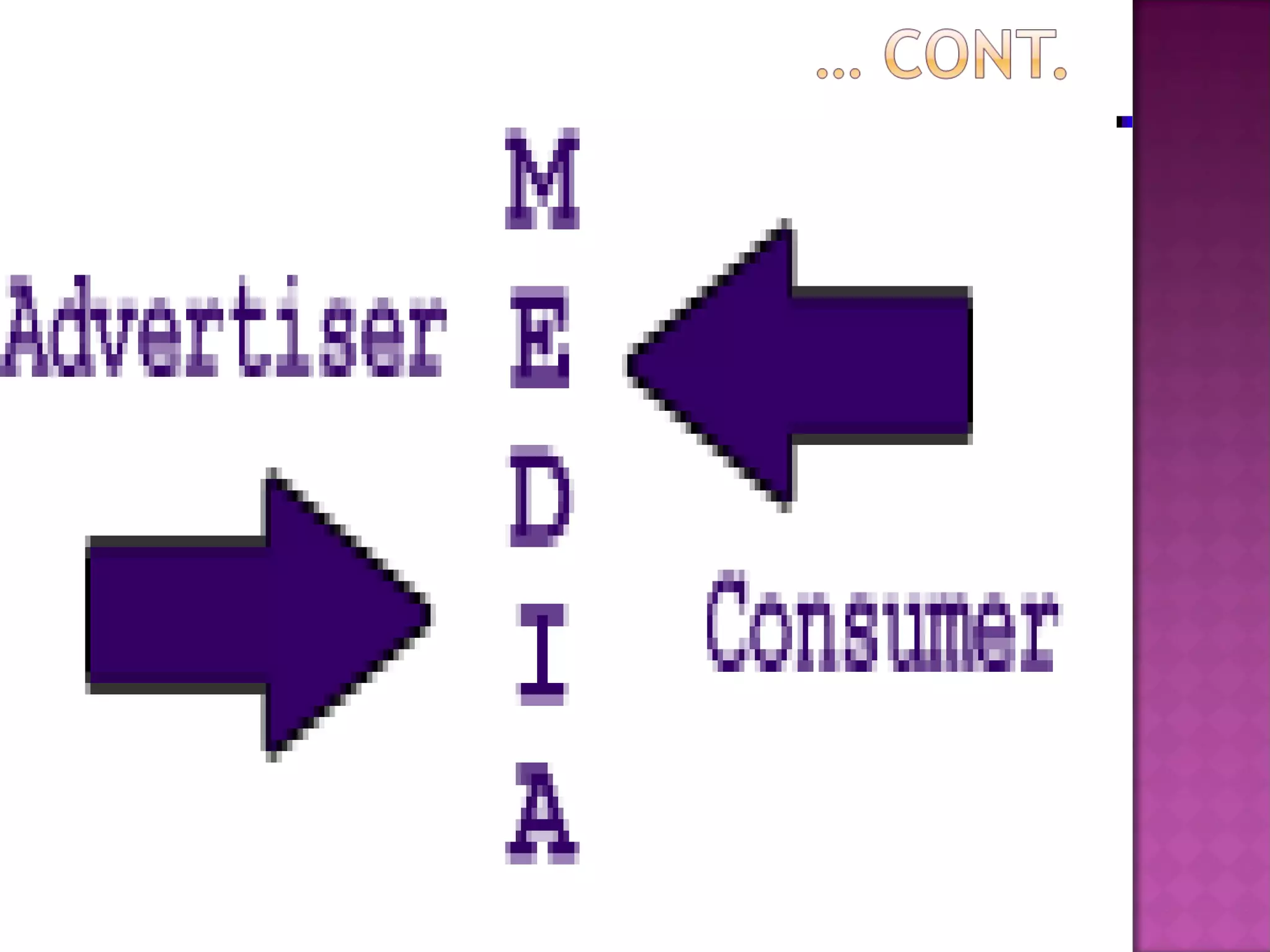
•Advertising, in its simplest
form, is the way in which
the vendor or manufacturer
of a product communicates
with consumers via a
medium, or many different
media.
•In simple words -
Advertising = messages.
 Language has a powerful influence over
people
 Language is key to effective advertising
 Language in advertising includes but is not
limited to:
1 Product names
2 Slogans
3 Language in relation to culture
 Certain words are often used in advertising
as they are words that often catch consumers
attention
(For Example- new, bigger, now, good, better,
best, special, extra, big, easy
Verbs: come, buy, need, love, use, feel, start,
go)
 Advertising is not only about the language
that is being used but also about where the
language is positioned.
 Careful planning goes into this process so
that the proper words stand out to you and
plant the seeds of ‘want or need’ in your
mind.
 This helps the consumer identify with the
product easily and therefore will be able to
pick up on the puns or the play on words
better if they are already familiar with the
base structure
 Pun :
 the humorous use of a word or
phrase so as to emphasize or suggest
its different meanings or
applications, or the use of words
that are alike or nearly alike in
sound but different in meaning; a
play on words.
““Run on Air”Run on Air”
•This is a play on
words that Nike is
using to promote their
Nike Air shoes.
•They are sending the
message that if you
wear these shoes it
will feel as though
you are running on air
- they are light, don’t
hurt your feel,
comfortable.
 a distinctive cry, phrase, or motto of any
party, group, manufacturer, or person;
catchword or catch phrase
 A slogan is a memorable motto or phrase
used in a political, commercial, religious,
and other context as a repetitive expression
of an idea or purpose
 Slogans are very important for businesses
because they help create a memorable image
 A slogan helps consumers remember your
product
 The more catchy your slogan is, the more
likely people are to remember it and
therefore, BUY!
 Slogans take careful planning as their life
span is usually very long
 Once a company chooses a slogan, that
slogan is likely to stick for a minimum of a
year however; there are slogans from very
popular companies that have been popular
and trendy for decades
 Spoof ads are also known as parody
advertisements
 Parody: A parody (  / pær di/; also calledˈ ə
pastiche, spoof, send-up or lampoon), in
current use, is an imitative work created to
mock, comment on, or trivialize an original
work, its subject, author, style, or some
other target, by means of humorous, or
ironic imitation
 A parody advertisement is a fictional
advertisement for a non-existent product,
either done within another advertisement for
an actual product, or done simply as parody
of advertisements—used either as a way of
ridiculing or drawing negative attention
towards a real advertisement or such an
advertisement's subject, or as a comedic
device, such as in a comedy skit or sketch.
 McDonald’s continues to be one of the
largest spoof targets because of its well
known unhealthy nature
 cigarette ads also madeup as spoof ad.
 You can find me here.
bhumidangi7405@gmail.com

Language used in advertisement.

  • 2.
    Roll no.8 Sem. 4. Paper15 : Mass Communication and Media Studies. Unit 5 : “Advertisement” Submitted to - The Department of English,The Department of English, MK Bhavnagar university.MK Bhavnagar university.
  • 3.
     Advertising isa form of communication used to encourage or persuade an audience (viewers, readers or listeners) to continue or take some new action  Most commonly, the desired result is to drive consumer behavior with respect to a commercial offering - get people to buy things.
  • 4.
    •The activity orprofession of producing advertisements for commercial products or services •Advertising, in its simplest form, is the way in which the vendor or manufacturer of a product communicates with consumers via a medium, or many different media. •In simple words - Advertising = messages.
  • 6.
     Language hasa powerful influence over people  Language is key to effective advertising  Language in advertising includes but is not limited to: 1 Product names 2 Slogans 3 Language in relation to culture
  • 7.
     Certain wordsare often used in advertising as they are words that often catch consumers attention (For Example- new, bigger, now, good, better, best, special, extra, big, easy Verbs: come, buy, need, love, use, feel, start, go)
  • 8.
     Advertising isnot only about the language that is being used but also about where the language is positioned.  Careful planning goes into this process so that the proper words stand out to you and plant the seeds of ‘want or need’ in your mind.  This helps the consumer identify with the product easily and therefore will be able to pick up on the puns or the play on words better if they are already familiar with the base structure
  • 10.
     Pun : the humorous use of a word or phrase so as to emphasize or suggest its different meanings or applications, or the use of words that are alike or nearly alike in sound but different in meaning; a play on words.
  • 11.
    ““Run on Air”Runon Air” •This is a play on words that Nike is using to promote their Nike Air shoes. •They are sending the message that if you wear these shoes it will feel as though you are running on air - they are light, don’t hurt your feel, comfortable.
  • 12.
     a distinctivecry, phrase, or motto of any party, group, manufacturer, or person; catchword or catch phrase  A slogan is a memorable motto or phrase used in a political, commercial, religious, and other context as a repetitive expression of an idea or purpose
  • 15.
     Slogans arevery important for businesses because they help create a memorable image  A slogan helps consumers remember your product  The more catchy your slogan is, the more likely people are to remember it and therefore, BUY!
  • 16.
     Slogans takecareful planning as their life span is usually very long  Once a company chooses a slogan, that slogan is likely to stick for a minimum of a year however; there are slogans from very popular companies that have been popular and trendy for decades
  • 17.
     Spoof adsare also known as parody advertisements  Parody: A parody (  / pær di/; also calledˈ ə pastiche, spoof, send-up or lampoon), in current use, is an imitative work created to mock, comment on, or trivialize an original work, its subject, author, style, or some other target, by means of humorous, or ironic imitation
  • 18.
     A parodyadvertisement is a fictional advertisement for a non-existent product, either done within another advertisement for an actual product, or done simply as parody of advertisements—used either as a way of ridiculing or drawing negative attention towards a real advertisement or such an advertisement's subject, or as a comedic device, such as in a comedy skit or sketch.
  • 19.
     McDonald’s continuesto be one of the largest spoof targets because of its well known unhealthy nature  cigarette ads also madeup as spoof ad.
  • 20.
     You canfind me here. bhumidangi7405@gmail.com

Editor's Notes

  • #7 http://www.kwintessential.co.uk/cultural-services/articles/cross-cultural-advertising.html
  • #19 Wikipedia