U.S. Residential Land Development
Processes, Prime Markets and Key Influences
1
Copyright ®2014 Real Deal Advisors, Inc.
Introduction
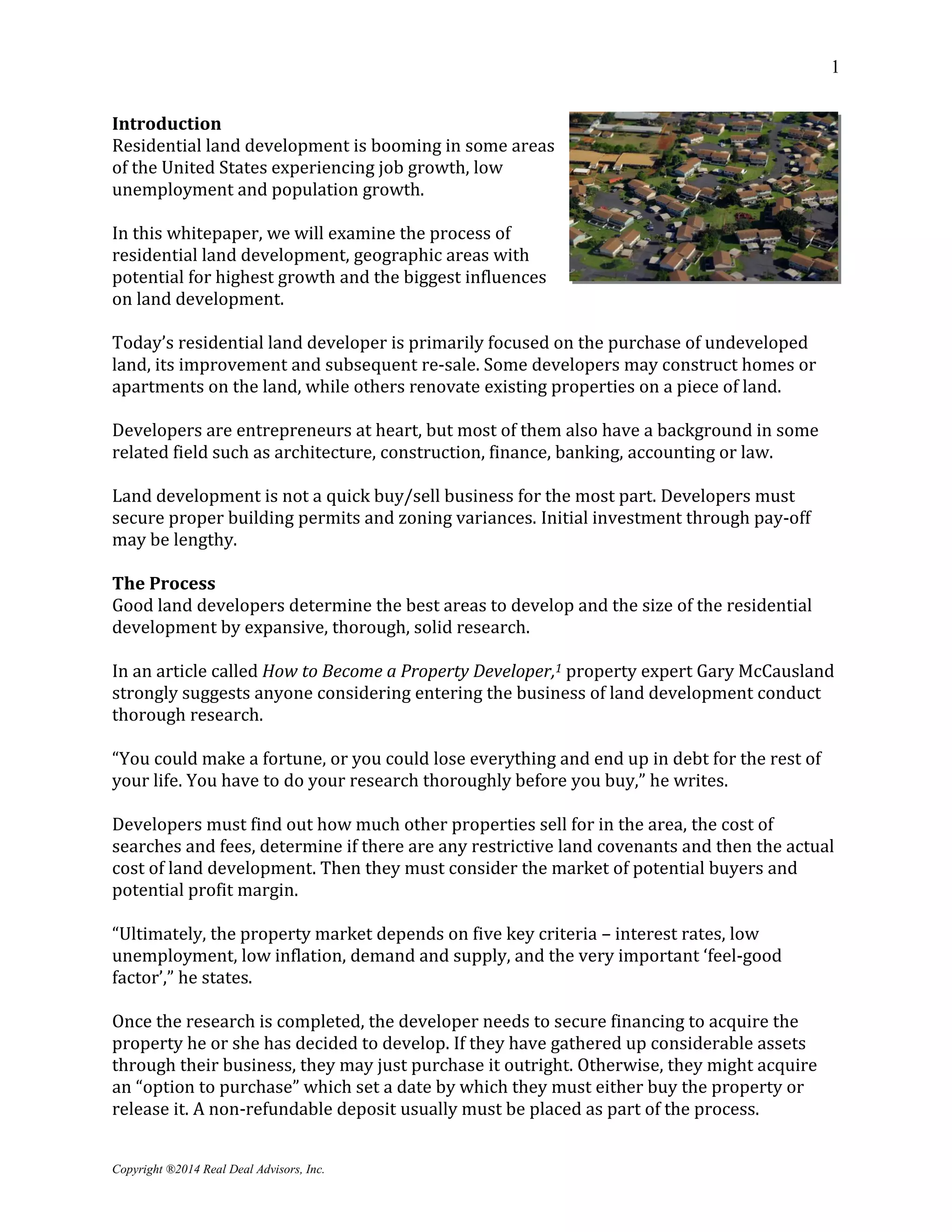
Residential land development is booming in some areas
of the United States experiencing job growth, low
unemployment and population growth.
In this whitepaper, we will examine the process of
residential land development, geographic areas with
potential for highest growth and the biggest influences
on land development.
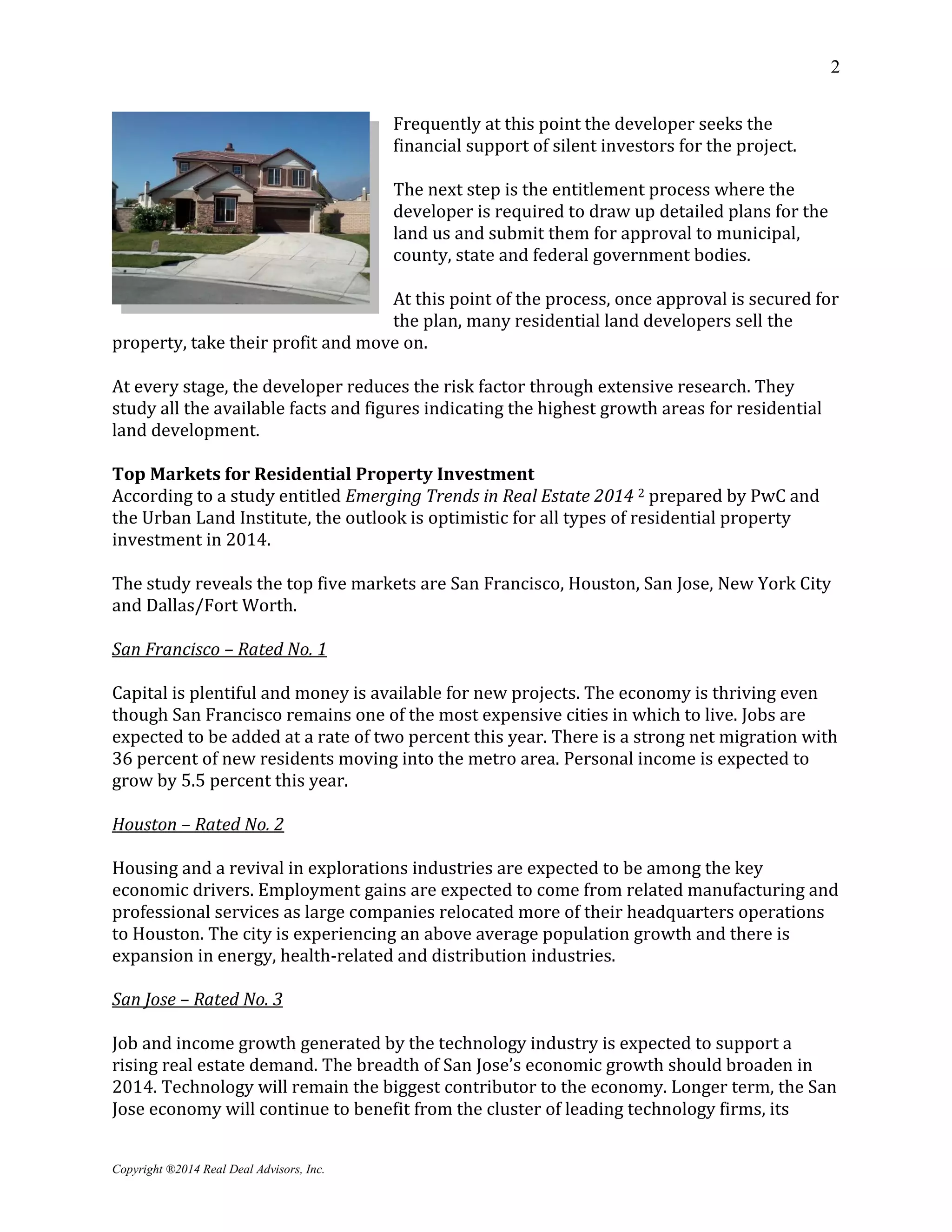
Today’s residential land developer is primarily focused on the purchase of undeveloped
land, its improvement and subsequent re-sale. Some developers may construct homes or
apartments on the land, while others renovate existing properties on a piece of land.
Developers are entrepreneurs at heart, but most of them also have a background in some
related field such as architecture, construction, finance, banking, accounting or law.
Land development is not a quick buy/sell business for the most part. Developers must
secure proper building permits and zoning variances. Initial investment through pay-off
may be lengthy.
The Process
Good land developers determine the best areas to develop and the size of the residential
development by expansive, thorough, solid research.
In an article called How to Become a Property Developer,1 property expert Gary McCausland
strongly suggests anyone considering entering the business of land development conduct
thorough research.
“You could make a fortune, or you could lose everything and end up in debt for the rest of
your life. You have to do your research thoroughly before you buy,” he writes.
Developers must find out how much other properties sell for in the area, the cost of
searches and fees, determine if there are any restrictive land covenants and then the actual
cost of land development. Then they must consider the market of potential buyers and
potential profit margin.
“Ultimately, the property market depends on five key criteria – interest rates, low
unemployment, low inflation, demand and supply, and the very important ‘feel-good
factor’,” he states.
Once the research is completed, the developer needs to secure financing to acquire the
property he or she has decided to develop. If they have gathered up considerable assets
through their business, they may just purchase it outright. Otherwise, they might acquire
an “option to purchase” which set a date by which they must either buy the property or
release it. A non-refundable deposit usually must be placed as part of the process.
2
Copyright ®2014 Real Deal Advisors, Inc.
Frequently at this point the developer seeks the
financial support of silent investors for the project.
The next step is the entitlement process where the
developer is required to draw up detailed plans for the
land us and submit them for approval to municipal,
county, state and federal government bodies.
At this point of the process, once approval is secured for
the plan, many residential land developers sell the
property, take their profit and move on.
At every stage, the developer reduces the risk factor through extensive research. They
study all the available facts and figures indicating the highest growth areas for residential
land development.
Top Markets for Residential Property Investment
According to a study entitled Emerging Trends in Real Estate 2014 2 prepared by PwC and
the Urban Land Institute, the outlook is optimistic for all types of residential property
investment in 2014.
The study reveals the top five markets are San Francisco, Houston, San Jose, New York City
and Dallas/Fort Worth.
San Francisco – Rated No. 1
Capital is plentiful and money is available for new projects. The economy is thriving even
though San Francisco remains one of the most expensive cities in which to live. Jobs are
expected to be added at a rate of two percent this year. There is a strong net migration with
36 percent of new residents moving into the metro area. Personal income is expected to
grow by 5.5 percent this year.
Houston – Rated No. 2
Housing and a revival in explorations industries are expected to be among the key
economic drivers. Employment gains are expected to come from related manufacturing and
professional services as large companies relocated more of their headquarters operations
to Houston. The city is experiencing an above average population growth and there is
expansion in energy, health-related and distribution industries.
San Jose – Rated No. 3
Job and income growth generated by the technology industry is expected to support a
rising real estate demand. The breadth of San Jose’s economic growth should broaden in
2014. Technology will remain the biggest contributor to the economy. Longer term, the San
Jose economy will continue to benefit from the cluster of leading technology firms, its
3
Copyright ®2014 Real Deal Advisors, Inc.
ability to cultivate and attract innovative companies and its highly educated population.
However, high costs will continue to be a concern.
New York City – Rated No. 4
Business and professional employment growth and the city’s exposure to technology
employment will help it grow in 2014, although there are some concerns about the prices
getting too high. Employment has surpassed its prior peak well ahead of other large metro
areas. In 2014, total employment will get more support from goods industries as
construction hiring ramps up. Job growth in New York City will approximate the national
rate but gross metro product (GMP) and income growth will be higher owner to the
region’s highly productive and well-educated work force.
Dallas / Fort Worth – Rated No. 5
The economy will continue to benefit from high concentrations of technology, corporate
headquarters operations, an excellent distribution infrastructure and above-average
population gains. The area also has a highly competitive cost of living and doing business.
Apartments, along with retail and office space, all have buy recommendations above the
comparative average.
However, the study authors noted that these top markets won’t be the only place investors
can look to protect the value of their assets in 2014.
Good potential markets can also be where land is affordable and buying habits are healthy.
For example, economist Jed Kolko recently wrote an article in the Huffington Post that the
“10 most affordable markets include eight in or near the Midwest, plus the southern
markets of Columbia, SC, and Little Rock, AR. Five of the top are in Ohio.3”
His recommended markets for housing for the middle class included Akron, OH; Toledo,
OH; Dayton, OH; Gary, IN; Columbia, SC; Columbus, OH; Detroit, MI; Cleveland, OH; Little
Rock, AR and; Rochester, NY.
Influences on Land Development Trends
Survey results make it clear that the biggest influences on residential land development
include a low unemployment rate coupled with growth of jobs in key industries. An overall
healthy economy is also vital, along with strong population growth.
New trends they identified for future investment in residential land development also
included the preference of the large generation of millennials (born between 1997-1992)
for city living and compact development where they can live and ride their bicycles or walk
to access community services and work places.
Other factors in selecting sites for investing include the availability of financing, housing
market development and ability to deal with uncertainty.
4
Copyright ®2014 Real Deal Advisors, Inc.
Craig Grella, author of The Bigger Pockets Blog, wrote a recent article which suggested that
land developers, like those in any other profession, need the right tools to succeed,
regardless of how the market swings for or against them. 4
He cited the most common reasons for failure as “insufficient finances, not planning for
contingencies, analysis paralysis and inability to seek advice.”
Grella recommended that each residential land developer start with a sound development
plan including the reason they want to develop, the types of development they plan to start
with, and at what point they consider the development a success. They also need a personal
financial statement and a strong team.
He offered a final piece of wisdom for residential land developers in the United States as
they prepare for the challenges ahead.
“You’ll meet a lot of people in the development game, and you need to be friends with all of
them. The idea is to shore up your list of resources by adding the strengths of others where
you are weak,” he wrote.
Sources
1. McCausland, Gary. How to become a property developer. Blog on Prime Location
Website. http://www.primelocation.com/guides/landlords-developers-and-
investors/how-to-become-a-property-developer/
2. PwC and the Urban Land Institute. (2013) Emerging Trends in Real Estate 2014.
Washington, DC http://www.uli.org/wp-content/uploads/ULI-
Documents/Emerging-Trends-in-Real-Estate-Americas-2014.pdf
3. Kolka, Jed. (May 19, 2014) Where Can the Middle Class Actually Afford to Buy Homes?
Huffington Post Financial Education http://www.huffingtonpost.com/jed-
kolko/where-can-the-middle-clas_b_5326891.html
4. Grella, Craig. (Oct. 9, 2009) Residential Land Development – Part 1. The Bigger
Pockets Blog
http://www.biggerpockets.com/renewsblog/2009/10/09/residential-land-
development-part-1/

LAND-DEVELOPMENT-WHITEPAPER-FINAL-FINAL-5-21-14

  • 1.
    U.S. Residential LandDevelopment Processes, Prime Markets and Key Influences
  • 2.
    1 Copyright ®2014 RealDeal Advisors, Inc. Introduction Residential land development is booming in some areas of the United States experiencing job growth, low unemployment and population growth. In this whitepaper, we will examine the process of residential land development, geographic areas with potential for highest growth and the biggest influences on land development. Today’s residential land developer is primarily focused on the purchase of undeveloped land, its improvement and subsequent re-sale. Some developers may construct homes or apartments on the land, while others renovate existing properties on a piece of land. Developers are entrepreneurs at heart, but most of them also have a background in some related field such as architecture, construction, finance, banking, accounting or law. Land development is not a quick buy/sell business for the most part. Developers must secure proper building permits and zoning variances. Initial investment through pay-off may be lengthy. The Process Good land developers determine the best areas to develop and the size of the residential development by expansive, thorough, solid research. In an article called How to Become a Property Developer,1 property expert Gary McCausland strongly suggests anyone considering entering the business of land development conduct thorough research. “You could make a fortune, or you could lose everything and end up in debt for the rest of your life. You have to do your research thoroughly before you buy,” he writes. Developers must find out how much other properties sell for in the area, the cost of searches and fees, determine if there are any restrictive land covenants and then the actual cost of land development. Then they must consider the market of potential buyers and potential profit margin. “Ultimately, the property market depends on five key criteria – interest rates, low unemployment, low inflation, demand and supply, and the very important ‘feel-good factor’,” he states. Once the research is completed, the developer needs to secure financing to acquire the property he or she has decided to develop. If they have gathered up considerable assets through their business, they may just purchase it outright. Otherwise, they might acquire an “option to purchase” which set a date by which they must either buy the property or release it. A non-refundable deposit usually must be placed as part of the process.
  • 3.
    2 Copyright ®2014 RealDeal Advisors, Inc. Frequently at this point the developer seeks the financial support of silent investors for the project. The next step is the entitlement process where the developer is required to draw up detailed plans for the land us and submit them for approval to municipal, county, state and federal government bodies. At this point of the process, once approval is secured for the plan, many residential land developers sell the property, take their profit and move on. At every stage, the developer reduces the risk factor through extensive research. They study all the available facts and figures indicating the highest growth areas for residential land development. Top Markets for Residential Property Investment According to a study entitled Emerging Trends in Real Estate 2014 2 prepared by PwC and the Urban Land Institute, the outlook is optimistic for all types of residential property investment in 2014. The study reveals the top five markets are San Francisco, Houston, San Jose, New York City and Dallas/Fort Worth. San Francisco – Rated No. 1 Capital is plentiful and money is available for new projects. The economy is thriving even though San Francisco remains one of the most expensive cities in which to live. Jobs are expected to be added at a rate of two percent this year. There is a strong net migration with 36 percent of new residents moving into the metro area. Personal income is expected to grow by 5.5 percent this year. Houston – Rated No. 2 Housing and a revival in explorations industries are expected to be among the key economic drivers. Employment gains are expected to come from related manufacturing and professional services as large companies relocated more of their headquarters operations to Houston. The city is experiencing an above average population growth and there is expansion in energy, health-related and distribution industries. San Jose – Rated No. 3 Job and income growth generated by the technology industry is expected to support a rising real estate demand. The breadth of San Jose’s economic growth should broaden in 2014. Technology will remain the biggest contributor to the economy. Longer term, the San Jose economy will continue to benefit from the cluster of leading technology firms, its
  • 4.
    3 Copyright ®2014 RealDeal Advisors, Inc. ability to cultivate and attract innovative companies and its highly educated population. However, high costs will continue to be a concern. New York City – Rated No. 4 Business and professional employment growth and the city’s exposure to technology employment will help it grow in 2014, although there are some concerns about the prices getting too high. Employment has surpassed its prior peak well ahead of other large metro areas. In 2014, total employment will get more support from goods industries as construction hiring ramps up. Job growth in New York City will approximate the national rate but gross metro product (GMP) and income growth will be higher owner to the region’s highly productive and well-educated work force. Dallas / Fort Worth – Rated No. 5 The economy will continue to benefit from high concentrations of technology, corporate headquarters operations, an excellent distribution infrastructure and above-average population gains. The area also has a highly competitive cost of living and doing business. Apartments, along with retail and office space, all have buy recommendations above the comparative average. However, the study authors noted that these top markets won’t be the only place investors can look to protect the value of their assets in 2014. Good potential markets can also be where land is affordable and buying habits are healthy. For example, economist Jed Kolko recently wrote an article in the Huffington Post that the “10 most affordable markets include eight in or near the Midwest, plus the southern markets of Columbia, SC, and Little Rock, AR. Five of the top are in Ohio.3” His recommended markets for housing for the middle class included Akron, OH; Toledo, OH; Dayton, OH; Gary, IN; Columbia, SC; Columbus, OH; Detroit, MI; Cleveland, OH; Little Rock, AR and; Rochester, NY. Influences on Land Development Trends Survey results make it clear that the biggest influences on residential land development include a low unemployment rate coupled with growth of jobs in key industries. An overall healthy economy is also vital, along with strong population growth. New trends they identified for future investment in residential land development also included the preference of the large generation of millennials (born between 1997-1992) for city living and compact development where they can live and ride their bicycles or walk to access community services and work places. Other factors in selecting sites for investing include the availability of financing, housing market development and ability to deal with uncertainty.
  • 5.
    4 Copyright ®2014 RealDeal Advisors, Inc. Craig Grella, author of The Bigger Pockets Blog, wrote a recent article which suggested that land developers, like those in any other profession, need the right tools to succeed, regardless of how the market swings for or against them. 4 He cited the most common reasons for failure as “insufficient finances, not planning for contingencies, analysis paralysis and inability to seek advice.” Grella recommended that each residential land developer start with a sound development plan including the reason they want to develop, the types of development they plan to start with, and at what point they consider the development a success. They also need a personal financial statement and a strong team. He offered a final piece of wisdom for residential land developers in the United States as they prepare for the challenges ahead. “You’ll meet a lot of people in the development game, and you need to be friends with all of them. The idea is to shore up your list of resources by adding the strengths of others where you are weak,” he wrote. Sources 1. McCausland, Gary. How to become a property developer. Blog on Prime Location Website. http://www.primelocation.com/guides/landlords-developers-and- investors/how-to-become-a-property-developer/ 2. PwC and the Urban Land Institute. (2013) Emerging Trends in Real Estate 2014. Washington, DC http://www.uli.org/wp-content/uploads/ULI- Documents/Emerging-Trends-in-Real-Estate-Americas-2014.pdf 3. Kolka, Jed. (May 19, 2014) Where Can the Middle Class Actually Afford to Buy Homes? Huffington Post Financial Education http://www.huffingtonpost.com/jed- kolko/where-can-the-middle-clas_b_5326891.html 4. Grella, Craig. (Oct. 9, 2009) Residential Land Development – Part 1. The Bigger Pockets Blog http://www.biggerpockets.com/renewsblog/2009/10/09/residential-land- development-part-1/