1
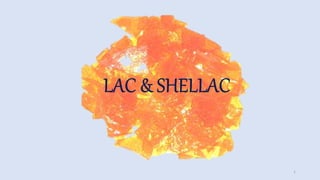
 One of the most important of minor forest products from point of view, is the resinous
substance known as lac from which shellac is obtained.
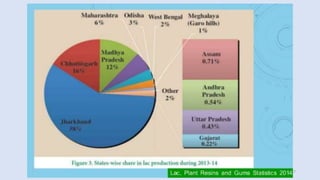
 India is the major producer of lac which accounts for nearly 70- 80% of total world
production.
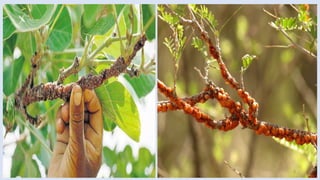
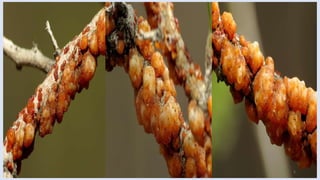
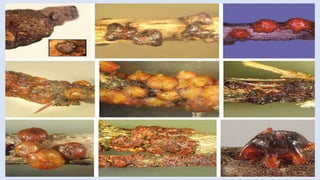
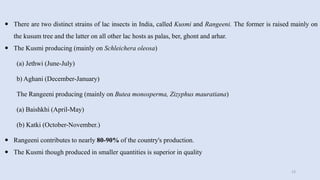
 Lac is a valuable resin secreted by the lac insect, Laccifer lacca.
 It is used in a very large number of industries, the chief among these are gramophone
records, furniture, floor polishes, paints, varnishes, electrical goods, sealing waxes and
printing inks.
2
3
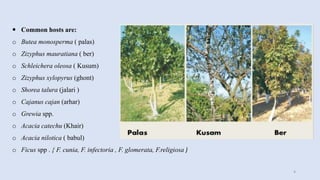
 Common hosts are:
o Butea monosperma ( palas)
o Zizyphus mauratiana ( ber)
o Schleichera oleosa ( Kusum)
o Zizyphus xylopyrus (ghont)
o Shorea talura (jalari )
o Cajanus cajan (arhar)
o Grewia spp.
o Acacia catechu (Khair)
o Acacia nilotica ( babul)
o Ficus spp . { F. cunia, F. infectoria , F. glomerata, F.religiosa )
4
5
6
7
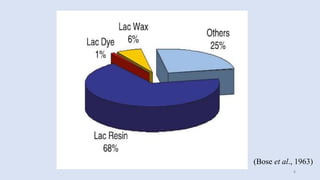
(Bose et al., 1963)
8
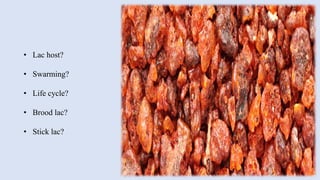
• Lac host?
• Swarming?
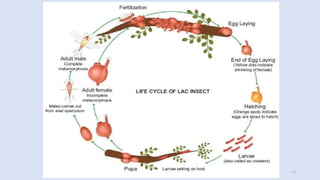
• Life cycle?
• Brood lac?
• Stick lac?
9
10
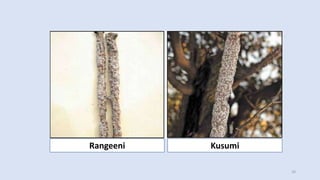
Rangeeni Kusumi
11
12
 There are two distinct strains of lac insects in India, called Kusmi and Rangeeni. The former is raised mainly on
the kusum tree and the latter on all other lac hosts as palas, ber, ghont and arhar.
 The Kusmi producing (mainly on Schleichera oleosa)
(a) Jethwi (June-July)
b) Aghani (December-January)
The Rangeeni producing (mainly on Butea monosperma, Zizyphus mauratiana)
(a) Baishkhi (April-May)
(b) Katki (October-November.)
 Rangeeni contributes to nearly 80-90% of the country's production.
 The Kusmi though produced in smaller quantities is superior in quality
13
14
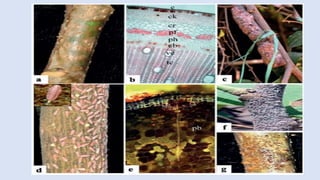
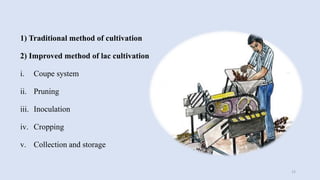
1) Traditional method of cultivation
2) Improved method of lac cultivation
i. Coupe system
ii. Pruning
iii. Inoculation
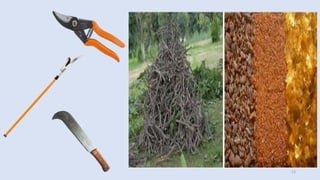
iv. Cropping
v. Collection and storage
15
16
17
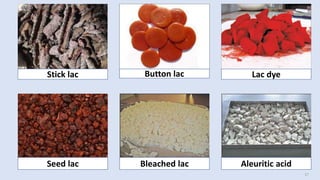
Seed lac
Stick lac
Bleached lac Aleuritic acid
Lac dye
Button lac
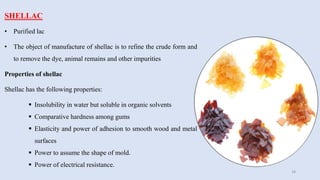
SHELLAC
• Purified lac
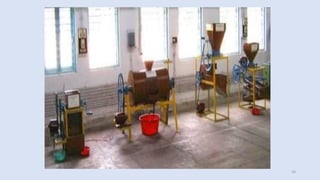
• The object of manufacture of shellac is to refine the crude form and
to remove the dye, animal remains and other impurities
Properties of shellac
Shellac has the following properties:
 Insolubility in water but soluble in organic solvents
 Comparative hardness among gums
 Elasticity and power of adhesion to smooth wood and metal
surfaces
 Power to assume the shape of mold.
 Power of electrical resistance.
18
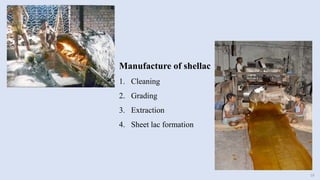
Manufacture of shellac
1. Cleaning
2. Grading
3. Extraction
4. Sheet lac formation
19
20
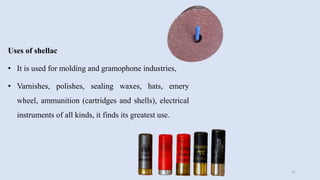
Uses of shellac
• It is used for molding and gramophone industries,
• Varnishes, polishes, sealing waxes, hats, emery
wheel, ammunition (cartridges and shells), electrical
instruments of all kinds, it finds its greatest use.
21
22
23
24
References:
Bose, P.K., Sankaranarayanan, Y., and Sen, S.C. 1963. Chemistry of lac. Indian
Institute of Natural Resins and Gums, Namkum, Ranchi. P. 225
Mehta, T. Handbook of Forest Utilization. International Book Distributors, Dehradun.
P. 290
Prasad, N. 2014. Final Report of NAIP sub-project on A Value Chain on Lac and Lac
based Products for Domestic and Export Markets. Indian Institute of Natural
Resins and Gums Nat. Resins Gums, Namkum, Ranchi.

LACANDSHELLAC.pptx

  • 1.
  • 2.
     One ofthe most important of minor forest products from point of view, is the resinous substance known as lac from which shellac is obtained.  India is the major producer of lac which accounts for nearly 70- 80% of total world production.  Lac is a valuable resin secreted by the lac insect, Laccifer lacca.  It is used in a very large number of industries, the chief among these are gramophone records, furniture, floor polishes, paints, varnishes, electrical goods, sealing waxes and printing inks. 2
  • 3.
  • 4.
     Common hostsare: o Butea monosperma ( palas) o Zizyphus mauratiana ( ber) o Schleichera oleosa ( Kusum) o Zizyphus xylopyrus (ghont) o Shorea talura (jalari ) o Cajanus cajan (arhar) o Grewia spp. o Acacia catechu (Khair) o Acacia nilotica ( babul) o Ficus spp . { F. cunia, F. infectoria , F. glomerata, F.religiosa ) 4
  • 5.
  • 6.
  • 7.
  • 8.
  • 9.
    • Lac host? •Swarming? • Life cycle? • Brood lac? • Stick lac? 9
  • 10.
  • 11.
  • 12.
  • 13.
     There aretwo distinct strains of lac insects in India, called Kusmi and Rangeeni. The former is raised mainly on the kusum tree and the latter on all other lac hosts as palas, ber, ghont and arhar.  The Kusmi producing (mainly on Schleichera oleosa) (a) Jethwi (June-July) b) Aghani (December-January) The Rangeeni producing (mainly on Butea monosperma, Zizyphus mauratiana) (a) Baishkhi (April-May) (b) Katki (October-November.)  Rangeeni contributes to nearly 80-90% of the country's production.  The Kusmi though produced in smaller quantities is superior in quality 13
  • 14.
  • 15.
    1) Traditional methodof cultivation 2) Improved method of lac cultivation i. Coupe system ii. Pruning iii. Inoculation iv. Cropping v. Collection and storage 15
  • 16.
  • 17.
    17 Seed lac Stick lac Bleachedlac Aleuritic acid Lac dye Button lac
  • 18.
    SHELLAC • Purified lac •The object of manufacture of shellac is to refine the crude form and to remove the dye, animal remains and other impurities Properties of shellac Shellac has the following properties:  Insolubility in water but soluble in organic solvents  Comparative hardness among gums  Elasticity and power of adhesion to smooth wood and metal surfaces  Power to assume the shape of mold.  Power of electrical resistance. 18
  • 19.
    Manufacture of shellac 1.Cleaning 2. Grading 3. Extraction 4. Sheet lac formation 19
  • 20.
  • 21.
    Uses of shellac •It is used for molding and gramophone industries, • Varnishes, polishes, sealing waxes, hats, emery wheel, ammunition (cartridges and shells), electrical instruments of all kinds, it finds its greatest use. 21
  • 22.
  • 23.
  • 24.
    24 References: Bose, P.K., Sankaranarayanan,Y., and Sen, S.C. 1963. Chemistry of lac. Indian Institute of Natural Resins and Gums, Namkum, Ranchi. P. 225 Mehta, T. Handbook of Forest Utilization. International Book Distributors, Dehradun. P. 290 Prasad, N. 2014. Final Report of NAIP sub-project on A Value Chain on Lac and Lac based Products for Domestic and Export Markets. Indian Institute of Natural Resins and Gums Nat. Resins Gums, Namkum, Ranchi.

Editor's Notes

  • #10 SWARMING-a large or dense group of flying insects MALE- 3 TO 4 DAYS YELLOW SPOT APPEARS ON THE LAC CELL OF FEMALE ADULT, INDICATIVE THAT BROOD IS MATURE AND IS READY TO BE CUT.
  • #14 KUSUMI STRAIN- SUPERIOR QUALITY LAC IN SMALL QUANTITY. GHONT- Sterculia urens, ARHAR- Cajanus cajan
  • #16 DIVIDED INTO NUMBER OF COUPES,ONE COUPE IS INOCULATED INITIALLY AND AFTER REAPING IT THE NEXT COUPE IS CONSIDERED. FACILITATES RENEWAL& FLESHING OF NEW SHOOTS IN HARVESTED COUPE PRUNING MAX. NO OF SHOOTS GEOGRAPHICAL, FUNCTIONAL, LEGAL, TERRITORIAL, ADMINISTRATIVE, MANAGEMENT CLASSIFICATION FEB-APRIL, ABOVE 2.5cm THICKNESS NOT ALLOWED TIEING OF STICK LAC, 15-20cm * MANAGEMENT CLASSIFICATION OF FORESTS- WC, FS, CS, COUPE, PB
  • #17 PROCESSING MACHINE FOR REFINING LAC
  • #18 Aleuritic acid, or α-aleuritic acid, is a major ingredient in shellac, constituting about 35% of it. It is used as a starting material in the perfume industry for the preparation of musk aroma.
  • #20 SIEVING AND WINNOWING CLASSIFIED AS LARGE, MEDIUM AND FINE COTTON BAG, STRETCHED & ROTATED IN FIRE, TWISTING THE BAG TO SQUEEZE OUT MELTED LAC EXUDATED LAC SPREAD OVER A PORCELIN CYINDER (25cm & 1m) FILLED WITH WARM WATER, LAC STRECTED TO FORM SHEET, ALLOWED TO DRY FOR HARDENING & THEN BROKEN INTO PIECES