What is a laboratory
apparatus ?
Equipment for scientific
research and experiments.
Laboratory Apparatus
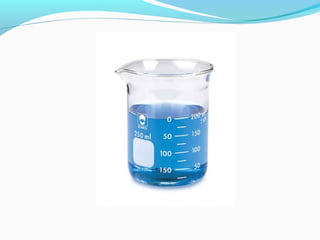
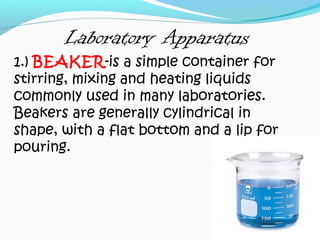
1.) BEAKER-is a simple container for
stirring, mixing and heating liquids
commonly used in many laboratories.
Beakers are generally cylindrical in
shape, with a flat bottom and a lip for
pouring.
Laboratory Apparatus
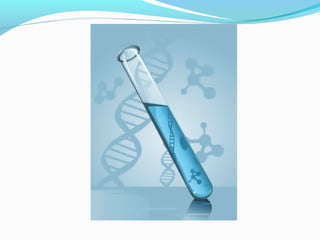
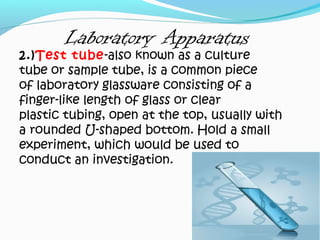
2.)Test tube-also known as a culture
tube or sample tube, is a common piece
of laboratory glassware consisting of a
finger-like length of glass or clear
plastic tubing, open at the top, usually with
a rounded U-shaped bottom. Hold a small
experiment, which would be used to
conduct an investigation.
Laboratory Apparatus
3.)Florence flask-has a round body with a
single long neck and with either a round or a
flat bottom. It can be used as a container to
hold solutions of chemicals. It is designed
for uniform heating and ease of swirling; it is
produced in a number of different glass
thicknesses to stand different types of use.
Laboratory Apparatus
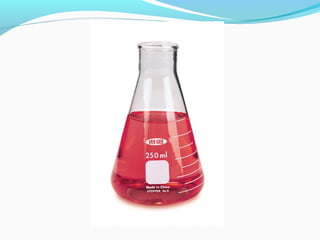
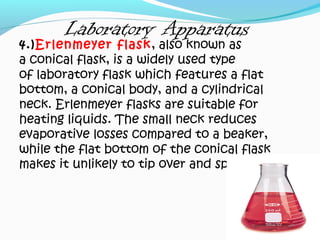
4.)Erlenmeyer flask, also known as
a conical flask, is a widely used type
of laboratory flask which features a flat
bottom, a conical body, and a cylindrical
neck. Erlenmeyer flasks are suitable for
heating liquids. The small neck reduces
evaporative losses compared to a beaker,
while the flat bottom of the conical flask
makes it unlikely to tip over and spill.
Laboratory Apparatus
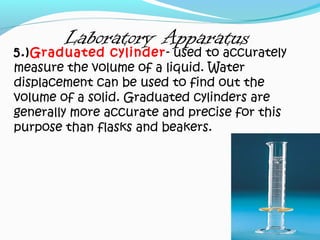
5.)Graduated cylinder- used to accurately
measure the volume of a liquid. Water
displacement can be used to find out the
volume of a solid. Graduated cylinders are
generally more accurate and precise for this
purpose than flasks and beakers.
Laboratory Apparatus
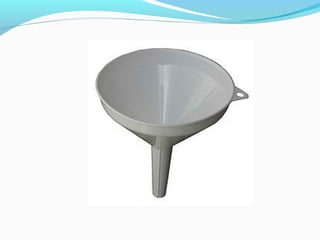
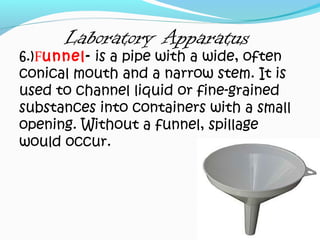
6.)Funnel- is a pipe with a wide, often
conical mouth and a narrow stem. It is
used to channel liquid or fine-grained
substances into containers with a small
opening. Without a funnel, spillage
would occur.
Laboratory Apparatus
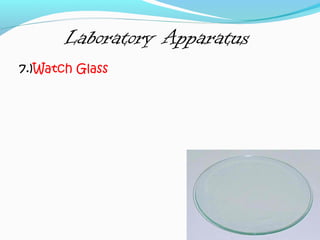
7.)Watch Glass
Laboratory Apparatus
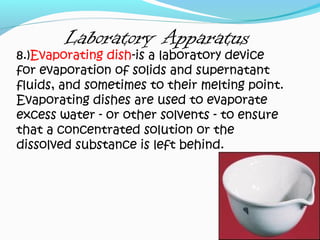
8.)Evaporating dish-is a laboratory device
for evaporation of solids and supernatant
fluids, and sometimes to their melting point.
Evaporating dishes are used to evaporate
excess water - or other solvents - to ensure
that a concentrated solution or the
dissolved substance is left behind.
Laboratory Apparatus
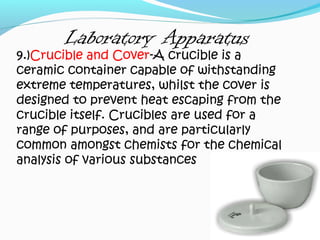
9.)Crucible and Cover-A crucible is a
ceramic container capable of withstanding
extreme temperatures, whilst the cover is
designed to prevent heat escaping from the
crucible itself. Crucibles are used for a
range of purposes, and are particularly
common amongst chemists for the chemical
analysis of various substances
Laboratory Apparatus
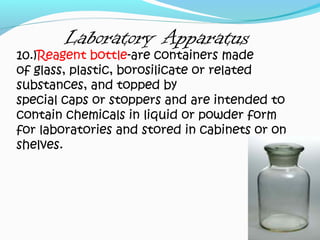
10.)Reagent bottle-are containers made
of glass, plastic, borosilicate or related
substances, and topped by
special caps or stoppers and are intended to
contain chemicals in liquid or powder form
for laboratories and stored in cabinets or on
shelves.
Laboratory Apparatus
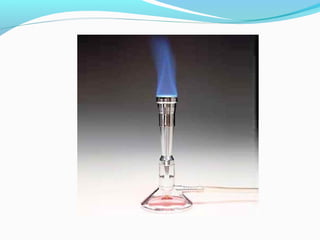
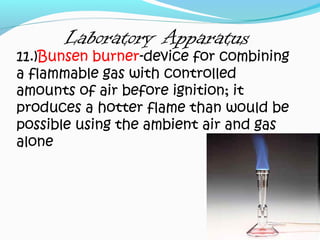
11.)Bunsen burner-device for combining
a flammable gas with controlled
amounts of air before ignition; it
produces a hotter flame than would be
possible using the ambient air and gas
alone
Laboratory Apparatus
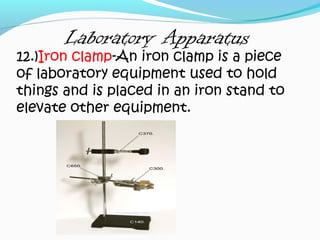
12.)Iron clamp-An iron clamp is a piece
of laboratory equipment used to hold
things and is placed in an iron stand to
elevate other equipment.
Laboratory Apparatus
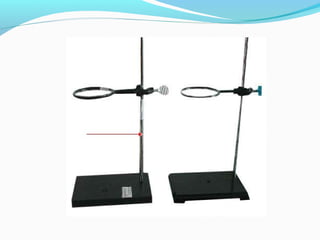
13.)Iron stand-A metal rod attached to a
heavy metal base. The heavy base keeps the
stand stable, and the vertical metal rod
allows for easy height adjustment of the iron
ring/clamp. (A tripod can sometimes be used
in place of an iron stand.)
Laboratory Apparatus
14.)Iron Ring-An iron ring that holds
glassware such as a funnels or other objects,
like the wire gauze or clay triangle for
heating with a Bunsen burner. Often, the
iron ring will be attached to an iron stand.
Laboratory Apparatus
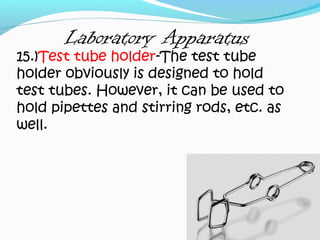
15.)Test tube holder-The test tube
holder obviously is designed to hold
test tubes. However, it can be used to
hold pipettes and stirring rods, etc. as
well.
Laboratory Apparatus
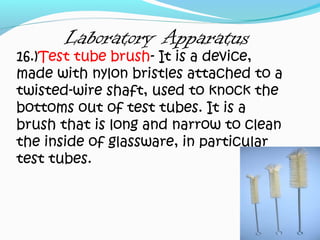
16.)Test tube brush- It is a device,
made with nylon bristles attached to a
twisted-wire shaft, used to knock the
bottoms out of test tubes. It is a
brush that is long and narrow to clean
the inside of glassware, in particular
test tubes.
Laboratory Apparatus
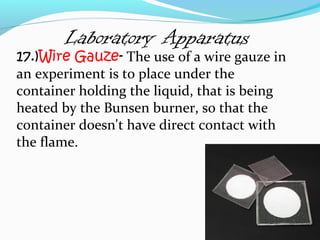
17.)Wire Gauze- The use of a wire gauze in
an experiment is to place under the
container holding the liquid, that is being
heated by the Bunsen burner, so that the
container doesn't have direct contact with
the flame.
Laboratory Apparatus
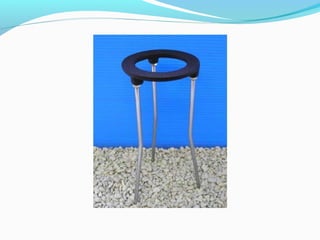
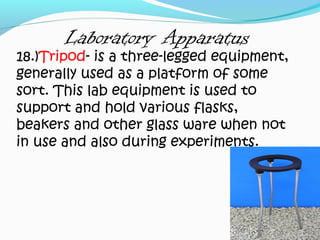
18.)Tripod- is a three-legged equipment,
generally used as a platform of some
sort. This lab equipment is used to
support and hold various flasks,
beakers and other glass ware when not
in use and also during experiments.
Laboratory Apparatus
19.)Spatula- is used to take and
handle small quantities of solid
chemicals. It is used like a spoon
or an instrument for scooping
material out of a container.
Laboratory Apparatus
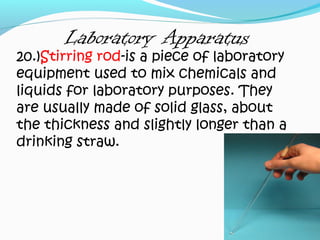
20.)Stirring rod-is a piece of laboratory
equipment used to mix chemicals and
liquids for laboratory purposes. They
are usually made of solid glass, about
the thickness and slightly longer than a
drinking straw.
Laboratory Apparatus
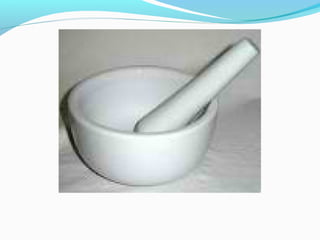
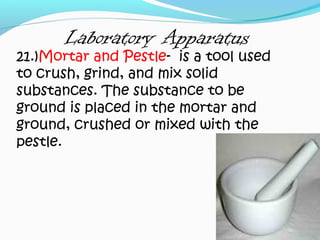
21.)Mortar and Pestle- is a tool used
to crush, grind, and mix solid
substances. The substance to be
ground is placed in the mortar and
ground, crushed or mixed with the
pestle.
Laboratory Apparatus
22.)Medicine dropper- is an
instrument used to measure small
amount of liquids, usually in
milligrams.
Laboratory Apparatus
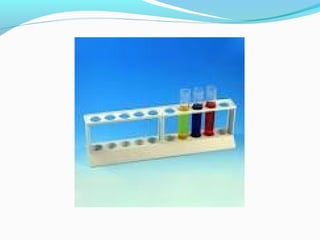
23.)Test tube racks- is a
convenient and necessary piece of
laboratory equipment for the
storage of test tubes.
Laboratory Apparatus
24.)Laboratory thermometer- is a device
that measures temperature or temperature
gradient using a variety of different
principles.
Laboratory Apparatus
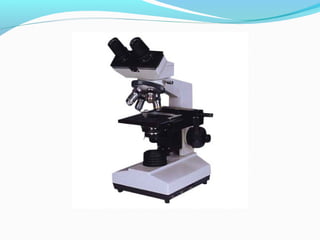
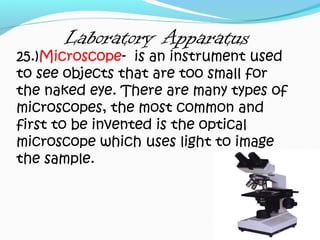
25.)Microscope- is an instrument used
to see objects that are too small for
the naked eye. There are many types of
microscopes, the most common and
first to be invented is the optical
microscope which uses light to image
the sample.
Laboratory Apparatus
26.)Triple beam balance- is a type of
balance commonly used in the
laboratory to determine the mass of
samples. To use the balance, you use
sliding weights called riders on three
beams, each with progressively small
incremental amounts.
Laboratory Apparatus
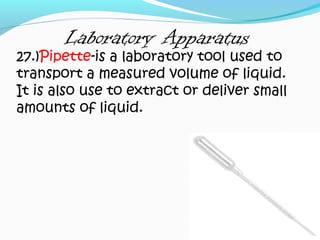
27.)Pipette-is a laboratory tool used to
transport a measured volume of liquid.
It is also use to extract or deliver small
amounts of liquid.
Laboratory Apparatus
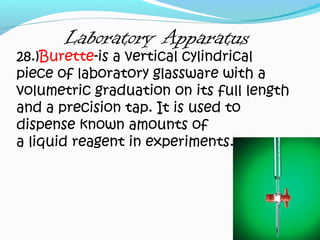
28.)Burette-is a vertical cylindrical
piece of laboratory glassware with a
volumetric graduation on its full length
and a precision tap. It is used to
dispense known amounts of
a liquid reagent in experiments.
Laboratory Apparatus
29.)Platform balance- The platform
balance is a form of equal-arm balance
in which two flat platforms are
attached to the top side of the beam,
one at each end.
Laboratory Apparatus
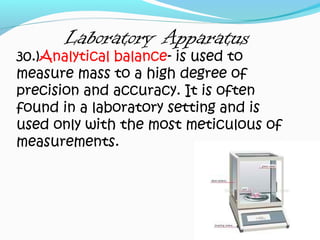
30.)Analytical balance- is used to
measure mass to a high degree of
precision and accuracy. It is often
found in a laboratory setting and is
used only with the most meticulous of
measurements.
Laboratory Apparatus
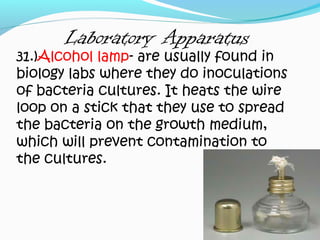
31.)Alcohol lamp- are usually found in
biology labs where they do inoculations
of bacteria cultures. It heats the wire
loop on a stick that they use to spread
the bacteria on the growth medium,
which will prevent contamination to
the cultures.
Laboratory Apparatus
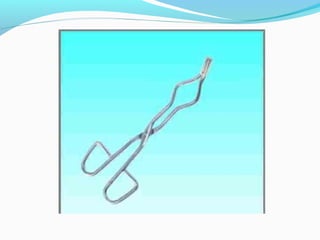
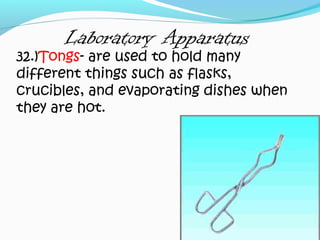
32.)Tongs- are used to hold many
different things such as flasks,
crucibles, and evaporating dishes when
they are hot.
Laboratory Apparatus
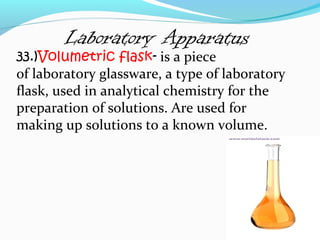
33.)Volumetric flask- is a piece
of laboratory glassware, a type of laboratory
flask, used in analytical chemistry for the
preparation of solutions. Are used for
making up solutions to a known volume.
Laboratory Apparatus
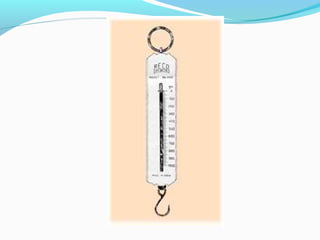
34.)Spring balance-is simply a spring fixed
at one end with a hook to attach an object
at the other. A spring balance measures the
weight of an object by opposing the force of
gravity with the force of an extended spring.
35. Hot Plates
can also be
used as
sources of
heat when an
open flame is
not desirable.
Safety Measures
Inside the Laboratory
Keep bags away from burners
Never eat, drink, or smoke while working in
the laboratory.
Tie back long hair
Read labels carefully.
Disposal - Students are responsible for the
proper disposal of used material if any in
appropriate containers.
Turn off gas when not in use
Wear gloves when using any hazardous or
toxic agent.
Wear safety glasses/goggles
 Store chemicals on shelves with labels
Clean up your work area before leaving.
O Do not engage in practical jokes or boisterous conduct in the laboratory.
O Never run in the laboratory.
O The use of personal audio or video equipment is prohibited in the
laboratory.
O The performance of unauthorized experiments is strictly forbidden.
O Never work in the laboratory without the supervision of an instructor.
O Always perform the experiments or work precisely as directed by your
instructor.
O Immediately report any spills, accidents, or injuries to your instructor.
O Never leave experiments while in progress.
O Make sure no flammable solvents are in the surrounding area when
lighting a flame.
O Do not leave lit Bunsen burners unattended.
O Turn off all heating apparatus, gas valves, and water faucets when not in
use.
Activity

labapparatus-181114071228.pdf

  • 2.
    What is alaboratory apparatus ? Equipment for scientific research and experiments.
  • 18.
    Laboratory Apparatus 1.) BEAKER-isa simple container for stirring, mixing and heating liquids commonly used in many laboratories. Beakers are generally cylindrical in shape, with a flat bottom and a lip for pouring.
  • 19.
    Laboratory Apparatus 2.)Test tube-alsoknown as a culture tube or sample tube, is a common piece of laboratory glassware consisting of a finger-like length of glass or clear plastic tubing, open at the top, usually with a rounded U-shaped bottom. Hold a small experiment, which would be used to conduct an investigation.
  • 20.
    Laboratory Apparatus 3.)Florence flask-hasa round body with a single long neck and with either a round or a flat bottom. It can be used as a container to hold solutions of chemicals. It is designed for uniform heating and ease of swirling; it is produced in a number of different glass thicknesses to stand different types of use.
  • 21.
    Laboratory Apparatus 4.)Erlenmeyer flask,also known as a conical flask, is a widely used type of laboratory flask which features a flat bottom, a conical body, and a cylindrical neck. Erlenmeyer flasks are suitable for heating liquids. The small neck reduces evaporative losses compared to a beaker, while the flat bottom of the conical flask makes it unlikely to tip over and spill.
  • 22.
    Laboratory Apparatus 5.)Graduated cylinder-used to accurately measure the volume of a liquid. Water displacement can be used to find out the volume of a solid. Graduated cylinders are generally more accurate and precise for this purpose than flasks and beakers.
  • 23.
    Laboratory Apparatus 6.)Funnel- isa pipe with a wide, often conical mouth and a narrow stem. It is used to channel liquid or fine-grained substances into containers with a small opening. Without a funnel, spillage would occur.
  • 24.
  • 25.
    Laboratory Apparatus 8.)Evaporating dish-isa laboratory device for evaporation of solids and supernatant fluids, and sometimes to their melting point. Evaporating dishes are used to evaporate excess water - or other solvents - to ensure that a concentrated solution or the dissolved substance is left behind.
  • 26.
    Laboratory Apparatus 9.)Crucible andCover-A crucible is a ceramic container capable of withstanding extreme temperatures, whilst the cover is designed to prevent heat escaping from the crucible itself. Crucibles are used for a range of purposes, and are particularly common amongst chemists for the chemical analysis of various substances
  • 27.
    Laboratory Apparatus 10.)Reagent bottle-arecontainers made of glass, plastic, borosilicate or related substances, and topped by special caps or stoppers and are intended to contain chemicals in liquid or powder form for laboratories and stored in cabinets or on shelves.
  • 28.
    Laboratory Apparatus 11.)Bunsen burner-devicefor combining a flammable gas with controlled amounts of air before ignition; it produces a hotter flame than would be possible using the ambient air and gas alone
  • 29.
    Laboratory Apparatus 12.)Iron clamp-Aniron clamp is a piece of laboratory equipment used to hold things and is placed in an iron stand to elevate other equipment.
  • 30.
    Laboratory Apparatus 13.)Iron stand-Ametal rod attached to a heavy metal base. The heavy base keeps the stand stable, and the vertical metal rod allows for easy height adjustment of the iron ring/clamp. (A tripod can sometimes be used in place of an iron stand.)
  • 31.
    Laboratory Apparatus 14.)Iron Ring-Aniron ring that holds glassware such as a funnels or other objects, like the wire gauze or clay triangle for heating with a Bunsen burner. Often, the iron ring will be attached to an iron stand.
  • 32.
    Laboratory Apparatus 15.)Test tubeholder-The test tube holder obviously is designed to hold test tubes. However, it can be used to hold pipettes and stirring rods, etc. as well.
  • 33.
    Laboratory Apparatus 16.)Test tubebrush- It is a device, made with nylon bristles attached to a twisted-wire shaft, used to knock the bottoms out of test tubes. It is a brush that is long and narrow to clean the inside of glassware, in particular test tubes.
  • 34.
    Laboratory Apparatus 17.)Wire Gauze-The use of a wire gauze in an experiment is to place under the container holding the liquid, that is being heated by the Bunsen burner, so that the container doesn't have direct contact with the flame.
  • 35.
    Laboratory Apparatus 18.)Tripod- isa three-legged equipment, generally used as a platform of some sort. This lab equipment is used to support and hold various flasks, beakers and other glass ware when not in use and also during experiments.
  • 36.
    Laboratory Apparatus 19.)Spatula- isused to take and handle small quantities of solid chemicals. It is used like a spoon or an instrument for scooping material out of a container.
  • 37.
    Laboratory Apparatus 20.)Stirring rod-isa piece of laboratory equipment used to mix chemicals and liquids for laboratory purposes. They are usually made of solid glass, about the thickness and slightly longer than a drinking straw.
  • 38.
    Laboratory Apparatus 21.)Mortar andPestle- is a tool used to crush, grind, and mix solid substances. The substance to be ground is placed in the mortar and ground, crushed or mixed with the pestle.
  • 39.
    Laboratory Apparatus 22.)Medicine dropper-is an instrument used to measure small amount of liquids, usually in milligrams.
  • 40.
    Laboratory Apparatus 23.)Test tuberacks- is a convenient and necessary piece of laboratory equipment for the storage of test tubes.
  • 41.
    Laboratory Apparatus 24.)Laboratory thermometer-is a device that measures temperature or temperature gradient using a variety of different principles.
  • 42.
    Laboratory Apparatus 25.)Microscope- isan instrument used to see objects that are too small for the naked eye. There are many types of microscopes, the most common and first to be invented is the optical microscope which uses light to image the sample.
  • 43.
    Laboratory Apparatus 26.)Triple beambalance- is a type of balance commonly used in the laboratory to determine the mass of samples. To use the balance, you use sliding weights called riders on three beams, each with progressively small incremental amounts.
  • 44.
    Laboratory Apparatus 27.)Pipette-is alaboratory tool used to transport a measured volume of liquid. It is also use to extract or deliver small amounts of liquid.
  • 45.
    Laboratory Apparatus 28.)Burette-is avertical cylindrical piece of laboratory glassware with a volumetric graduation on its full length and a precision tap. It is used to dispense known amounts of a liquid reagent in experiments.
  • 46.
    Laboratory Apparatus 29.)Platform balance-The platform balance is a form of equal-arm balance in which two flat platforms are attached to the top side of the beam, one at each end.
  • 47.
    Laboratory Apparatus 30.)Analytical balance-is used to measure mass to a high degree of precision and accuracy. It is often found in a laboratory setting and is used only with the most meticulous of measurements.
  • 48.
    Laboratory Apparatus 31.)Alcohol lamp-are usually found in biology labs where they do inoculations of bacteria cultures. It heats the wire loop on a stick that they use to spread the bacteria on the growth medium, which will prevent contamination to the cultures.
  • 49.
    Laboratory Apparatus 32.)Tongs- areused to hold many different things such as flasks, crucibles, and evaporating dishes when they are hot.
  • 50.
    Laboratory Apparatus 33.)Volumetric flask-is a piece of laboratory glassware, a type of laboratory flask, used in analytical chemistry for the preparation of solutions. Are used for making up solutions to a known volume.
  • 51.
    Laboratory Apparatus 34.)Spring balance-issimply a spring fixed at one end with a hook to attach an object at the other. A spring balance measures the weight of an object by opposing the force of gravity with the force of an extended spring.
  • 52.
    35. Hot Plates canalso be used as sources of heat when an open flame is not desirable.
  • 53.
  • 54.
    Keep bags awayfrom burners Never eat, drink, or smoke while working in the laboratory. Tie back long hair Read labels carefully. Disposal - Students are responsible for the proper disposal of used material if any in appropriate containers. Turn off gas when not in use Wear gloves when using any hazardous or toxic agent. Wear safety glasses/goggles  Store chemicals on shelves with labels Clean up your work area before leaving.
  • 55.
    O Do notengage in practical jokes or boisterous conduct in the laboratory. O Never run in the laboratory. O The use of personal audio or video equipment is prohibited in the laboratory. O The performance of unauthorized experiments is strictly forbidden. O Never work in the laboratory without the supervision of an instructor. O Always perform the experiments or work precisely as directed by your instructor. O Immediately report any spills, accidents, or injuries to your instructor. O Never leave experiments while in progress. O Make sure no flammable solvents are in the surrounding area when lighting a flame. O Do not leave lit Bunsen burners unattended. O Turn off all heating apparatus, gas valves, and water faucets when not in use.
  • 56.