CS425 - Web and Mobile Software Engineering
Dr. Lilia Sfaxi
27 avril 2017
Storage
Android Lab 04


STORAGE DR. LILIA SFAXI !1
MedTech
I. Storage in Android
There are several options to store persistent data in Android. The choice of the ideal solution
depends on the specific needs of the users:
• Is the data private or accessible to other applications?
• How much space is required?
• Must the data be structures, semi-structured or not structured?
The storage options we present in this lab are the following:
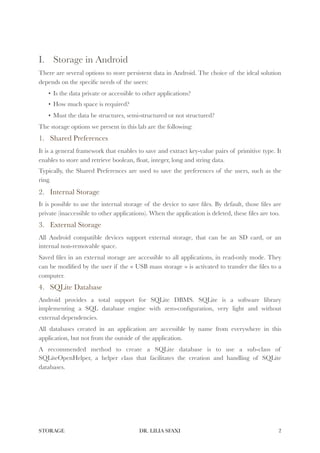
1. Shared Preferences
It is a general framework that enables to save and extract key-value pairs of primitive type. It
enables to store and retrieve boolean, float, integer, long and string data.
Typically, the Shared Preferences are used to save the preferences of the users, such as the
ring.
2. Internal Storage
It is possible to use the internal storage of the device to save files. By default, those files are
private (inaccessible to other applications). When the application is deleted, these files are too.
3. External Storage
All Android compatible devices support external storage, that can be an SD card, or an
internal non-removable space.
Saved files in an external storage are accessible to all applications, in read-only mode. They
can be modified by the user if the « USB mass storage » is activated to transfer the files to a
computer.
4. SQLite Database
Android provides a total support for SQLite DBMS. SQLite is a software library
implementing a SQL database engine with zero-configuration, very light and without
external dependencies.
All databases created in an application are accessible by name from everywhere in this
application, but not from the outside of the application.
A recommended method to create a SQLite database is to use a sub-class of
SQLiteOpenHelper, a helper class that facilitates the creation and handling of SQLite
databases.
STORAGE DR. LILIA SFAXI !2
II. Exercise 1: Shared Preferences
1. Objective
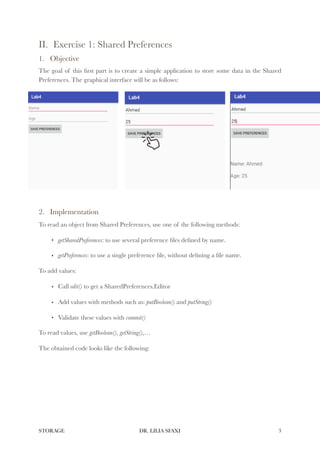
The goal of this first part is to create a simple application to store some data in the Shared
Preferences. The graphical interface will be as follows:
2. Implementation
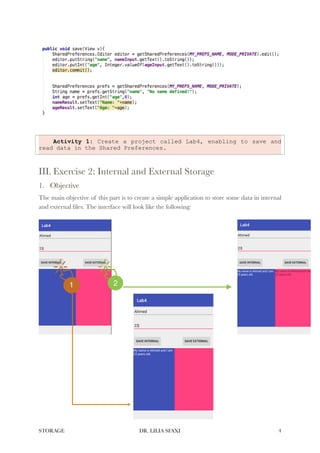
To read an object from Shared Preferences, use one of the following methods:
• getSharedPreferences: to use several preference files defined by name.
• getPreferences: to use a single preference file, without defining a file name.
To add values:
• Call edit() to get a SharedPreferences.Editor
• Add values with methods such as: putBoolean() and putString()
• Validate these values with commit()
To read values, use getBoolean(), getString(),…
The obtained code looks like the following:
STORAGE DR. LILIA SFAXI !3
Activity 1: Create a project called Lab4, enabling to save and
read data in the Shared Preferences.
III. Exercise 2: Internal and External Storage
1. Objective
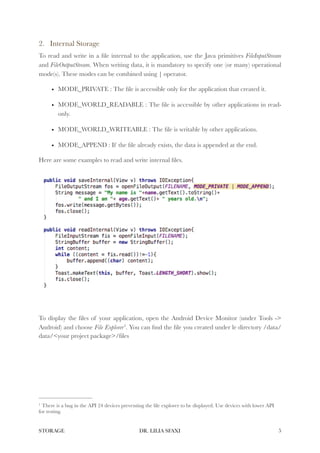
The main objective of this part is to create a simple application to store some data in internal
and external files. The interface will look like the following:
STORAGE DR. LILIA SFAXI !4
1 2
2. Internal Storage
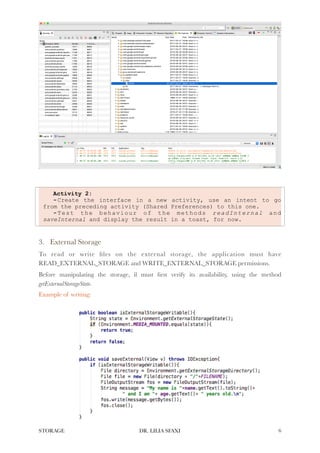
To read and write in a file internal to the application, use the Java primitives FileInputStream
and FileOutputStream. When writing data, it is mandatory to specify one (or many) operational
mode(s). These modes can be combined using | operator.
• MODE_PRIVATE : The file is accessible only for the application that created it.
• MODE_WORLD_READABLE : The file is accessible by other applications in read-
only.
• MODE_WORLD_WRITEABLE : The file is writable by other applications.
• MODE_APPEND : If the file already exists, the data is appended at the end.
Here are some examples to read and write internal files.
To display the files of your application, open the Android Device Monitor (under Tools ->
Android) and choose File Explorer . You can find the file you created under le directory /data/
1
data/<your project package>/files
There is a bug in the API 24 devices preventing the file explorer to be displayed. Use devices with lower API
1
for testing.
STORAGE DR. LILIA SFAXI !5
Activity 2:
-Create the interface in a new activity, use an intent to go
from the preceding activity (Shared Preferences) to this one.
-Test the behaviour of the methods readInternal and
saveInternal and display the result in a toast, for now.
3. External Storage
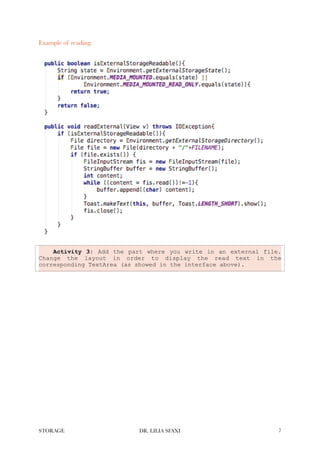
To read or write files on the external storage, the application must have
READ_EXTERNAL_STORAGE and WRITE_EXTERNAL_STORAGE permissions.
Before manipulating the storage, il must first verify its availability, using the method
getExternalStorageState.
Example of writing:
STORAGE DR. LILIA SFAXI !6
Example of reading:
Activity 3: Add the part where you write in an external file.
Change the layout in order to display the read text in the
corresponding TextArea (as showed in the interface above).
STORAGE DR. LILIA SFAXI !7

Lab4 - android

  • 1.
    CS425 - Weband Mobile Software Engineering Dr. Lilia Sfaxi 27 avril 2017 Storage Android Lab 04 
 STORAGE DR. LILIA SFAXI !1 MedTech
  • 2.
    I. Storage inAndroid There are several options to store persistent data in Android. The choice of the ideal solution depends on the specific needs of the users: • Is the data private or accessible to other applications? • How much space is required? • Must the data be structures, semi-structured or not structured? The storage options we present in this lab are the following: 1. Shared Preferences It is a general framework that enables to save and extract key-value pairs of primitive type. It enables to store and retrieve boolean, float, integer, long and string data. Typically, the Shared Preferences are used to save the preferences of the users, such as the ring. 2. Internal Storage It is possible to use the internal storage of the device to save files. By default, those files are private (inaccessible to other applications). When the application is deleted, these files are too. 3. External Storage All Android compatible devices support external storage, that can be an SD card, or an internal non-removable space. Saved files in an external storage are accessible to all applications, in read-only mode. They can be modified by the user if the « USB mass storage » is activated to transfer the files to a computer. 4. SQLite Database Android provides a total support for SQLite DBMS. SQLite is a software library implementing a SQL database engine with zero-configuration, very light and without external dependencies. All databases created in an application are accessible by name from everywhere in this application, but not from the outside of the application. A recommended method to create a SQLite database is to use a sub-class of SQLiteOpenHelper, a helper class that facilitates the creation and handling of SQLite databases. STORAGE DR. LILIA SFAXI !2
  • 3.
    II. Exercise 1:Shared Preferences 1. Objective The goal of this first part is to create a simple application to store some data in the Shared Preferences. The graphical interface will be as follows: 2. Implementation To read an object from Shared Preferences, use one of the following methods: • getSharedPreferences: to use several preference files defined by name. • getPreferences: to use a single preference file, without defining a file name. To add values: • Call edit() to get a SharedPreferences.Editor • Add values with methods such as: putBoolean() and putString() • Validate these values with commit() To read values, use getBoolean(), getString(),… The obtained code looks like the following: STORAGE DR. LILIA SFAXI !3
  • 4.
    Activity 1: Createa project called Lab4, enabling to save and read data in the Shared Preferences. III. Exercise 2: Internal and External Storage 1. Objective The main objective of this part is to create a simple application to store some data in internal and external files. The interface will look like the following: STORAGE DR. LILIA SFAXI !4 1 2
  • 5.
    2. Internal Storage Toread and write in a file internal to the application, use the Java primitives FileInputStream and FileOutputStream. When writing data, it is mandatory to specify one (or many) operational mode(s). These modes can be combined using | operator. • MODE_PRIVATE : The file is accessible only for the application that created it. • MODE_WORLD_READABLE : The file is accessible by other applications in read- only. • MODE_WORLD_WRITEABLE : The file is writable by other applications. • MODE_APPEND : If the file already exists, the data is appended at the end. Here are some examples to read and write internal files. To display the files of your application, open the Android Device Monitor (under Tools -> Android) and choose File Explorer . You can find the file you created under le directory /data/ 1 data/<your project package>/files There is a bug in the API 24 devices preventing the file explorer to be displayed. Use devices with lower API 1 for testing. STORAGE DR. LILIA SFAXI !5
  • 6.
    Activity 2: -Create theinterface in a new activity, use an intent to go from the preceding activity (Shared Preferences) to this one. -Test the behaviour of the methods readInternal and saveInternal and display the result in a toast, for now. 3. External Storage To read or write files on the external storage, the application must have READ_EXTERNAL_STORAGE and WRITE_EXTERNAL_STORAGE permissions. Before manipulating the storage, il must first verify its availability, using the method getExternalStorageState. Example of writing: STORAGE DR. LILIA SFAXI !6
  • 7.
    Example of reading: Activity3: Add the part where you write in an external file. Change the layout in order to display the read text in the corresponding TextArea (as showed in the interface above). STORAGE DR. LILIA SFAXI !7