MedTech
Chp3- Client-Side JavaScript
DOM, Forms and HTML Manipulation
Dr. Lilia SFAXI
www.liliasfaxi.wix.com/liliasfaxi
Slide 1
MedTech – Mediterranean Institute of Technology
CS-Web and Mobile Development
MedTech
MedTech
Window object
• Main entry point to all client-side JS features and APIs
• Represents a web browser window or frame
• Referred to with the identifier window
• It is the global object, and can be omitted
• Defines properties like:
• location (URL currently displayed)
• Ex: window.location = ”http://medtech.tn/”
navigates to the website of the institute
• alert() : displays a message in a dialog box
• setTimeout(): registers a function to be invoked after a specific amount of
time
• document: represents the content displayed in the window
Dr. Lilia SFAXI
www.liliasfaxi.wix.com/liliasfaxi
Slide 2
Client-Side JavaScript
MedTech
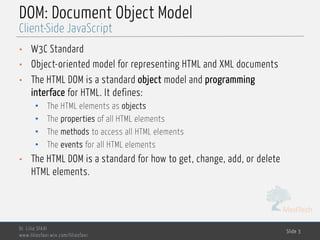
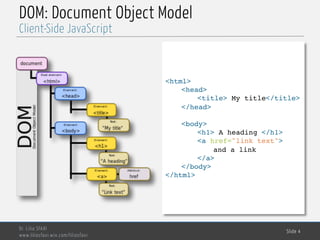
DOM: Document Object Model
• W3C Standard
• Object-oriented model for representing HTML and XML documents
• The HTML DOM is a standard object model and programming
interface for HTML. It defines:
• The HTML elements as objects
• The properties of all HTML elements
• The methods to access all HTML elements
• The events for all HTML elements
• The HTML DOM is a standard for how to get, change, add, or delete
HTML elements.
Dr. Lilia SFAXI
www.liliasfaxi.wix.com/liliasfaxi
Slide 3
Client-Side JavaScript
DOM: Document Object Model
Dr. Lilia SFAXI
www.liliasfaxi.wix.com/liliasfaxi
Slide 4
Client-Side JavaScript
<html>
<head>
<title> My title</title>
</head>
<body>
<h1> A heading </h1>
<a href="link text">
and a link
</a>
</body>
</html>
MedTech
GOING THROUGH THE DOM ELEMENTS
Client-Side JavaScript
Dr. Lilia SFAXI
www.liliasfaxi.wix.com/liliasfaxi
Slide 5
MedTech
DOM Programming Interface
• The HTML DOM can be accessed with JavaScript (and with other
programming languages).
• In the DOM, all HTML elements are defined as objects.
• The DOM Programming Interface is the set of properties and methods
of each object
• A property is a value that you can get or set (like changing the content of
an HTML element).
• A method is an action you can do (like add or deleting an HTML element).
• The top of the DOM tree is the object window
• The object document is a child element of window
• It represents the web page and enables to access the HTML element
Dr. Lilia SFAXI
www.liliasfaxi.wix.com/liliasfaxi
Slide 6
Client-Side JavaScript
MedTech
DOM Types
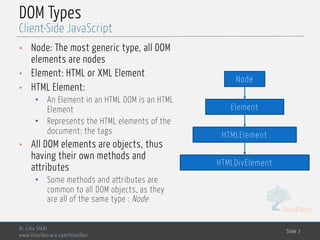
• Node: The most generic type, all DOM
elements are nodes
• Element: HTML or XML Element
• HTML Element:
• An Element in an HTML DOM is an HTML
Element
• Represents the HTML elements of the
document: the tags
• All DOM elements are objects, thus
having their own methods and
attributes
• Some methods and attributes are
common to all DOM objects, as they
are all of the same type : Node
Dr. Lilia SFAXI
www.liliasfaxi.wix.com/liliasfaxi
Slide 7
Client-Side JavaScript
Node
Element
HTMLElement
HTMLDivElement
MedTech
Elements Handling
• To access HTML elements using the DOM, several methods are offered
by the object document
• getElementById(): accesses an element via its id
• getElementByTagName(): gets all the elements of the given tag as an
array of objects
• getElementsByName(): returns an array of objects containing all the
elements whose attribute name is equal to the given argument
• querySelector()
• This function takes as a parameter a string representing a CSS selector
• Returns the first element that corresponds to this selector
• querySelectorAll()
• Returns an array of all the elements corresponding to the given selector
Dr. Lilia SFAXI
www.liliasfaxi.wix.com/liliasfaxi
Slide 8
Client-Side JavaScript
MedTech
Elements Handling: getElementBy…
Dr. Lilia SFAXI
www.liliasfaxi.wix.com/liliasfaxi
Slide 9
Client-Side JavaScript
<!doctype html>
<html>
<head>
<meta charset="utf-8" />
<title> My Test Page </title>
</head>
<body>
<div id="myMenu">
<div class="item">
<span> Menu 1</span>
<span> Menu 2</span>
</div>
<div class="Pub">
<span> Pub 1</span>
<span> Pub 2</span>
</div>
</div>
<div id="content">
<span>
Here is my content
</span>
</div>
A weird form to test
getElementsByName() :
<form name="myName">
<input type="password"
name= "myName">
<input>
<button name="myName"></button>
</form>
<script src="test.js"></script>
</body>
</html>
var getByid=
document.getElementById('myMenu');
var getElementByTagName =
document.getElementsByTagName("div");
var getElementByName =
document.getElementsByName("myName");
console.log("Result of getElementById : " +
getByid.textContent);
console.log("Result of getElementByTagName:");
for(var i=0;i<getElementByTagName.length;i++){
console.log(getElementByTagName[i]);
}
console.log("Result of getElementByName : ");
for(var i=0;i<getElementByName.length;i++){
console.log(getElementByName[i]);
}
MedTech
Elements Handling: querySelector
Dr. Lilia SFAXI
www.liliasfaxi.wix.com/liliasfaxi
Slide 10
Client-Side JavaScript
<!doctype html>
<html>
<head>
<meta charset="utf-8" />
<title> My Test Page </title>
</head>
<body>
<div id="myMenu">
<div class="item">
<span> Menu 1</span>
<span> Menu 2</span>
</div>
<div class="Pub">
<span> Pub 1</span>
<span> Pub 2</span>
</div>
</div>
<div id="content">
<span>
Here is my content
</span>
</div>
A weird form to test
getElementsByName() :
<form name="myName">
<input type="password"
name= "myName">
<input>
<button name="myName"></button>
</form>
<script src="test.js"></script>
</body>
</html>
var querySel=
document.querySelector("head title");
var querySelAll=
document.querySelectorAll("#myMenu .item
span");
console.log("Result of querySelector : " +
querySel.textContent);
console.log("Result of querySelectorAll : ");
for(var i=0;i<querySelAll.length;i++){
console.log(querySelAll[i].textContent);
}
MedTech
Elements Handling: Attributes
Dr. Lilia SFAXI
www.liliasfaxi.wix.com/liliasfaxi
Slide 11
Client-Side JavaScript
<!doctype html>
<html>
<head>
<meta charset="utf-8" />
<title>
My Test Page
</title>
</head>
<body>
You will find my CV
<a id= "link"
href="www.myCv.tn">here</a>.
<script
src="test2.js"></script>
</body>
</html>
var link=document.getElementById("myLink");
var dest=link.getAttribute("href");
console.log("URL of the link before
modification : "+ dest);
var newCVLink = prompt();
link.setAttribute("href", newCVLink);
dest = link.getAttribute("href");
console.log("URL of the link after
modification : "+dest);
• To read, create or update an attribute of an element of the DOM, the
object Element defines two methods:
• getAttribute(): gets the value of an attribute
• setAttribute(): updates the value of an attribute
MedTech
Elements Handling: Attributes
Dr. Lilia SFAXI
www.liliasfaxi.wix.com/liliasfaxi
Slide 12
Client-Side JavaScript
<!doctype html>
<html>
<head>
<meta charset="utf-8" />
<title>
My Test Page
</title>
</head>
<body>
You will find my CV
<a id= "myLink"
href="www.myCv.tn">here</a>.
<script
src="test2.js"></script>
</body>
</html>
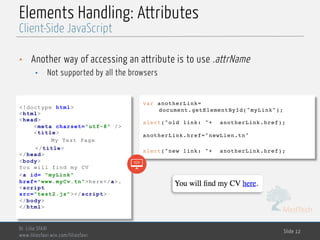
var anotherLink=
document.getElementById("myLink");
alert("old link: "+ anotherLink.href);
anotherLink.href="newLien.tn"
alert("new link: "+ anotherLink.href);
• Another way of accessing an attribute is to use .attrName
• Not supported by all the browsers
MedTech
Elements Handling: innerHTML
Dr. Lilia SFAXI
www.liliasfaxi.wix.com/liliasfaxi
Slide 13
Client-Side JavaScript
<html>
<head>
<meta charset="utf-8" />
<title> My Test Page</title>
</head>
<body>
<div id="div">
<p> I am in a div with id
div</p>
</div>
<div id="div1">
<p> I am in a div with id
div 1</p>
</div>
<script src="test3.js"></script>
</body>
</html>
var myDiv=document.getElementById("div");
var myDiv1=document.getElementById("div1");
function innerTest(){
myDiv1.textContent="I delete everything in my
road <b>i'm a monster 3:)</b> ";
myDiv.innerHTML="I delete everything in my road
<b>i'm a monster too 3:)</b> ";
}
• innerHTML
• Gets the child HTML code of a tag
• Adds directly HTML content
• textContent (or innerText, this latter not supported in all browsers)
• Gets only the text, without the HTML tags
MedTech
Elements Handling: querySelector
Dr. Lilia SFAXI
www.liliasfaxi.wix.com/liliasfaxi
Slide 14
Client-Side JavaScript
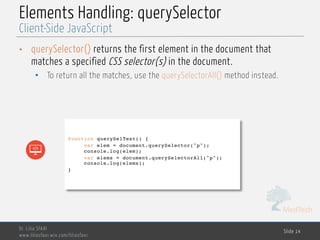
• querySelector() returns the first element in the document that
matches a specified CSS selector(s) in the document.
• To return all the matches, use the querySelectorAll() method instead.
function querySelTest() {
var elem = document.querySelector("p");
console.log(elem);
var elems = document.querySelectorAll("p");
console.log(elems);
}
MedTech
Elements Handling: Nodes
Dr. Lilia SFAXI
www.liliasfaxi.wix.com/liliasfaxi
Slide 15
Client-Side JavaScript
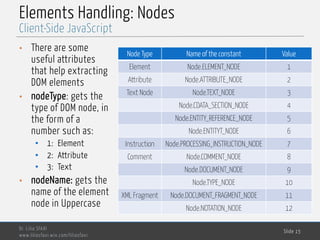
• There are some
useful attributes
that help extracting
DOM elements
• nodeType: gets the
type of DOM node, in
the form of a
number such as:
• 1: Element
• 2: Attribute
• 3: Text
• nodeName: gets the
name of the element
node in Uppercase
Node Type Name of the constant Value
Element Node.ELEMENT_NODE 1
Attribute Node.ATTRIBUTE_NODE 2
Text Node Node.TEXT_NODE 3
Node.CDATA_SECTION_NODE 4
Node.ENTITY_REFERENCE_NODE 5
Node.ENTITYT_NODE 6
Instruction Node.PROCESSING_INSTRUCTION_NODE 7
Comment Node.COMMENT_NODE 8
Node.DOCUMENT_NODE 9
Node.TYPE_NODE 10
XML Fragment Node.DOCUMENT_FRAGMENT_NODE 11
Node.NOTATION_NODE 12
MedTech
Elements Handling: Nodes
Dr. Lilia SFAXI
www.liliasfaxi.wix.com/liliasfaxi
Slide 16
Client-Side JavaScript
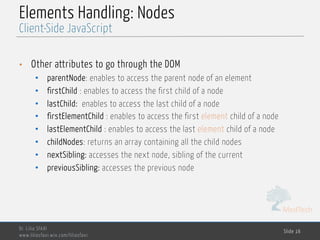
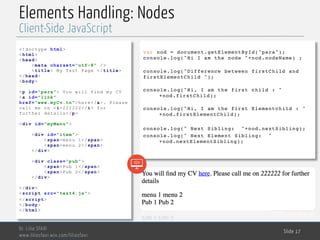
• Other attributes to go through the DOM
• parentNode: enables to access the parent node of an element
• firstChild : enables to access the first child of a node
• lastChild: enables to access the last child of a node
• firstElementChild : enables to access the first element child of a node
• lastElementChild : enables to access the last element child of a node
• childNodes: returns an array containing all the child nodes
• nextSibling: accesses the next node, sibling of the current
• previousSibling: accesses the previous node
MedTech
Elements Handling: Nodes
Dr. Lilia SFAXI
www.liliasfaxi.wix.com/liliasfaxi
Slide 17
Client-Side JavaScript
<!doctype html>
<html>
<head>
<meta charset="utf-8" />
<title> My Test Page </title>
</head>
<body>
<p id="para"> You will find my CV
<a id="link"
href="www.myCv.tn">here</a>. Please
call me on <i>222222</i> for
further details</p>
<div id="myMenu">
<div id="item">
<span>menu 1</span>
<span>menu 2</span>
</div>
<div class="pub">
<span>Pub 1</span>
<span>Pub 2</span>
</div>
</div>
<script src="test4.js">
</script>
</body>
</html>
var nod = document.getElementById("para");
console.log("Hi I am the node "+nod.nodeName) ;
console.log("Difference between firstChild and
firstElementChild ");
console.log("Hi, I am the first child : "
+nod.firstChild);
console.log("Hi, I am the first Elementchild : "
+nod.firstElementChild);
console.log(" Next Sibling: "+nod.nextSibling);
console.log(" Next Element Sibling: "
+nod.nextElementSibling);
MedTech
Elements Handling: Nodes
Dr. Lilia SFAXI
www.liliasfaxi.wix.com/liliasfaxi
Slide 18
Client-Side JavaScript
<!doctype html>
<html>
<head>
<meta charset="utf-8" />
<title> My Test Page </title>
</head>
<body>
<p id="para"> You will find my CV
<a id="link"
href="www.myCv.tn">here</a>. Please
call me on <i>222222</i> for
further details</p>
<div id="myMenu">
<div id="item">
<span>menu 1</span>
<span>menu 2</span>
</div>
<div class="pub">
<span>Pub 1</span>
<span>Pub 2</span>
</div>
</div>
<script src="test5.js">
</script>
</body>
</html>
var nod=document.getElementById("para");
console.log("Hi, I am the node: "+nod.nodeName) ;
console.log("These are my children : ");
var children=nod.childNodes;
for (var i=0;i<children.length;i++){
console.log("Hi, I am child number:"+ (i+1)+"
my name is: "
+children[i].nodeName+" and my content text
is:");
if(children[i].nodeType==Node.ELEMENT_NODE){
console.log(children[i].firstChild.data);
}else{
console.log(children[i].data);
}
}
MedTech
Elements Handling: Adding Nodes
Dr. Lilia SFAXI
www.liliasfaxi.wix.com/liliasfaxi
Slide 19
Client-Side JavaScript
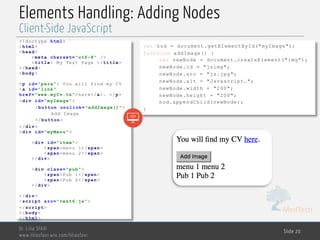
• In order to add a new node in the DOM, follow the next steps:
• Create the element to add, using the method createElement() that takes a
String as a parameter, representing the name of the element to create.
• Add the necessary attributes to the element using one of the following
methods:
• setAttribute(attr_name, value)
• <obj>.<attribute> = value
• Insert the element in the DOM using the method appendChild() that takes
as a parameter the element to insert, and adds this element as the last
child of the object calling the method.
• To add a text node, use the method createTextNode() with the
corresponding text as a parameter
• The method insertBefore(n , s) inserts the node n before the node s
MedTech
Elements Handling: Adding Nodes
Dr. Lilia SFAXI
www.liliasfaxi.wix.com/liliasfaxi
Slide 20
Client-Side JavaScript
<!doctype html>
<html>
<head>
<meta charset="utf-8" />
<title> My Test Page </title>
</head>
<body>
<p id="para"> You will find my CV
<a id="link"
href="www.myCv.tn">here</a>. </p>
<div id="myImage">
<button onclick="addImage()">
Add Image
</button>
</div>
<div id="myMenu">
<div id="item">
<span>menu 1</span>
<span>menu 2</span>
</div>
<div class="pub">
<span>Pub 1</span>
<span>Pub 2</span>
</div>
</div>
<script src="test6.js">
</script>
</body>
</html>
var nod = document.getElementById("myImage");
function addImage() {
var newNode = document.createElement("img");
newNode.id = "jsimg";
newNode.src = "js.jpg";
newNode.alt = "Javascript…";
newNode.width = "200";
newNode.height = "200";
nod.appendChild(newNode);
}
MedTech
Elements Handling: Cloning Nodes
Dr. Lilia SFAXI
www.liliasfaxi.wix.com/liliasfaxi
Slide 21
Client-Side JavaScript
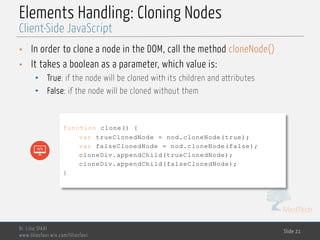
• In order to clone a node in the DOM, call the method cloneNode()
• It takes a boolean as a parameter, which value is:
• True: if the node will be cloned with its children and attributes
• False: if the node will be cloned without them
function clone() {
var trueClonedNode = nod.cloneNode(true);
var falseClonedNode = nod.cloneNode(false);
cloneDiv.appendChild(trueClonedNode);
cloneDiv.appendChild(falseClonedNode);
}
MedTech
Elements Handling: Deleting Nodes
Dr. Lilia SFAXI
www.liliasfaxi.wix.com/liliasfaxi
Slide 22
Client-Side JavaScript
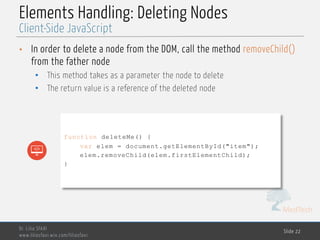
• In order to delete a node from the DOM, call the method removeChild()
from the father node
• This method takes as a parameter the node to delete
• The return value is a reference of the deleted node
function deleteMe() {
var elem = document.getElementById("item");
elem.removeChild(elem.firstElementChild);
}
MedTech
Elements Handling: Replacing Nodes
Dr. Lilia SFAXI
www.liliasfaxi.wix.com/liliasfaxi
Slide 23
Client-Side JavaScript
• In order to replace a node in the DOM, call replaceChild() from the
father node.
• This method takes as a parameter the new node, followed by the old node
function replaceMe() {
var nod = document.getElementById("item");
var newnod = document.
getElementsByClassName("pub")[0].
cloneNode(true);
nod.replaceChild(newnod, nod.lastElementChild);
}
MedTech
Events Handling
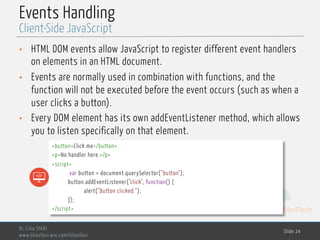
• HTML DOM events allow JavaScript to register different event handlers
on elements in an HTML document.
• Events are normally used in combination with functions, and the
function will not be executed before the event occurs (such as when a
user clicks a button).
• Every DOM element has its own addEventListener method, which allows
you to listen specifically on that element.
Dr. Lilia SFAXI
www.liliasfaxi.wix.com/liliasfaxi
Slide 24
Client-Side JavaScript
<button>Click me</button>
<p>No handler here.</p>
<script>
var button = document.querySelector("button");
button.addEventListener("click", function() {
alert("Button clicked.");
});
</script>
MedTech
Events Handling
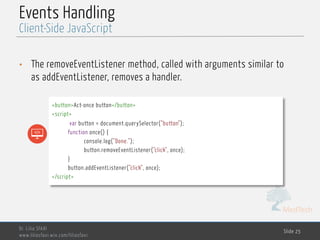
• The removeEventListener method, called with arguments similar to
as addEventListener, removes a handler.
Dr. Lilia SFAXI
www.liliasfaxi.wix.com/liliasfaxi
Slide 25
Client-Side JavaScript
<button>Act-once button</button>
<script>
var button = document.querySelector("button");
function once() {
console.log("Done.");
button.removeEventListener("click", once);
}
button.addEventListener("click", once);
</script>
MedTech
Events Handling: Event Objects
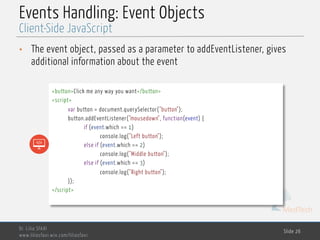
• The event object, passed as a parameter to addEventListener, gives
additional information about the event
Dr. Lilia SFAXI
www.liliasfaxi.wix.com/liliasfaxi
Slide 26
Client-Side JavaScript
<button>Click me any way you want</button>
<script>
var button = document.querySelector("button");
button.addEventListener("mousedown", function(event) {
if (event.which == 1)
console.log("Left button");
else if (event.which == 2)
console.log("Middle button");
else if (event.which == 3)
console.log("Right button");
});
</script>
MedTech
Events Handling: Event Propagation
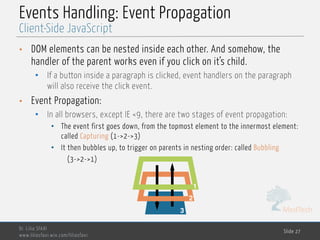
• DOM elements can be nested inside each other. And somehow, the
handler of the parent works even if you click on it’s child.
• If a button inside a paragraph is clicked, event handlers on the paragraph
will also receive the click event.
• Event Propagation:
• In all browsers, except IE <9, there are two stages of event propagation:
• The event first goes down, from the topmost element to the innermost element:
called Capturing (1->2->3)
• It then bubbles up, to trigger on parents in nesting order: called Bubbling
(3->2->1)
Dr. Lilia SFAXI
www.liliasfaxi.wix.com/liliasfaxi
Slide 27
Client-Side JavaScript
11
3
2
MedTech
Events Handling: Event Propagation
• All methods of event handling ignore the capturing phase.
• By default, only the bubbling takes place
• Using addEventListener with last argument true is only the way to catch the
event at capturing.
• The event object has a target property refering to the node where they
originated
Dr. Lilia SFAXI
www.liliasfaxi.wix.com/liliasfaxi
Slide 28
Client-Side JavaScript
<div class="d1"> 1
<div class="d1"> 2
<div class="d1"> 3 </div>
</div> </div>
<script>
var divs= document. getElementsByTagName("div");
for (var i = 0; i < divs.length; i++) {
divs[i].addEventListener('click', function(event) {
alert("target: " + event.target.className + " - this: " + this.className)
});
}
</script
MedTech
Events Handling: Event Propagation
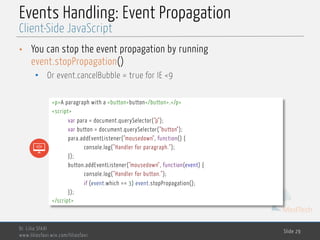
• You can stop the event propagation by running
event.stopPropagation()
• Or event.cancelBubble = true for IE <9
Dr. Lilia SFAXI
www.liliasfaxi.wix.com/liliasfaxi
Slide 29
Client-Side JavaScript
<p>A paragraph with a <button>button</button>.</p>
<script>
var para = document.querySelector("p");
var button = document.querySelector("button");
para.addEventListener("mousedown", function() {
console.log("Handler for paragraph.");
});
button.addEventListener("mousedown", function(event) {
console.log("Handler for button.");
if (event.which == 3) event.stopPropagation();
});
</script>
MedTech
Events Handling: Events
• Javascript defines various DOM events, such as:
• onmouseover: when the mouse hovers over the element
• onblur: when the element loses focus
• onfocus: when the element gains focus
• onselect: when the element is selected
• onchange: when the content of the element is changed
• onsubmit: when a form is submitted
• onload: when an element ends its loading phase
• …
Dr. Lilia SFAXI
www.liliasfaxi.wix.com/liliasfaxi
Slide 30
Client-Side JavaScript
MedTech
RUNNING EXAMPLE
JavaScript/ECMAScript
Dr. Lilia SFAXI
www.liliasfaxi.wix.com/liliasfaxi
Slide 31
MedTech
Todo App
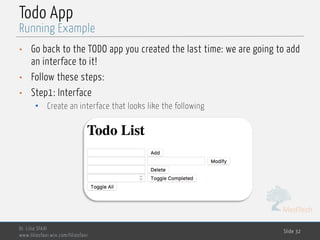
• Go back to the TODO app you created the last time: we are going to add
an interface to it!
• Follow these steps:
• Step1: Interface
• Create an interface that looks like the following
Dr. Lilia SFAXI
www.liliasfaxi.wix.com/liliasfaxi
Slide 32
Running Example
MedTech
Todo App
• For now, all the display will be on the console
• Step 2:
• Add a listener to the button add, that adds the written element to the
todolist
• Add a listener for the modify button, that modifies the element which id is
given in the first input with the task in the second
• Add a listener for the delete button, that deletes the task which id is given
in the input
• Add a listener to the toggle completed button, that does that to the task
which id is given in the input
• Add a listener to the ToggleAll button
• Step 3:
• Now, the tasks will be displayed in an unordered list under the form. Every
modification of the list is immediately impacted on the display
Dr. Lilia SFAXI
www.liliasfaxi.wix.com/liliasfaxi
Slide 33
Running Example
MedTech
References
Dr. Lilia SFAXI
www.liliasfaxi.wix.com/liliasfaxi
Slide 34
• M. Haverbeke, Eloquent JavaScript: A modern introduction to
programming, 2014
• Textbook
• D. Flanagan, JavaScript: The Definitive Guide, 6th edition, O’reilly, 2011

Client-side JavaScript

  • 1.
    MedTech Chp3- Client-Side JavaScript DOM,Forms and HTML Manipulation Dr. Lilia SFAXI www.liliasfaxi.wix.com/liliasfaxi Slide 1 MedTech – Mediterranean Institute of Technology CS-Web and Mobile Development MedTech
  • 2.
    MedTech Window object • Mainentry point to all client-side JS features and APIs • Represents a web browser window or frame • Referred to with the identifier window • It is the global object, and can be omitted • Defines properties like: • location (URL currently displayed) • Ex: window.location = ”http://medtech.tn/” navigates to the website of the institute • alert() : displays a message in a dialog box • setTimeout(): registers a function to be invoked after a specific amount of time • document: represents the content displayed in the window Dr. Lilia SFAXI www.liliasfaxi.wix.com/liliasfaxi Slide 2 Client-Side JavaScript
  • 3.
    MedTech DOM: Document ObjectModel • W3C Standard • Object-oriented model for representing HTML and XML documents • The HTML DOM is a standard object model and programming interface for HTML. It defines: • The HTML elements as objects • The properties of all HTML elements • The methods to access all HTML elements • The events for all HTML elements • The HTML DOM is a standard for how to get, change, add, or delete HTML elements. Dr. Lilia SFAXI www.liliasfaxi.wix.com/liliasfaxi Slide 3 Client-Side JavaScript
  • 4.
    DOM: Document ObjectModel Dr. Lilia SFAXI www.liliasfaxi.wix.com/liliasfaxi Slide 4 Client-Side JavaScript <html> <head> <title> My title</title> </head> <body> <h1> A heading </h1> <a href="link text"> and a link </a> </body> </html>
  • 5.
    MedTech GOING THROUGH THEDOM ELEMENTS Client-Side JavaScript Dr. Lilia SFAXI www.liliasfaxi.wix.com/liliasfaxi Slide 5
  • 6.
    MedTech DOM Programming Interface •The HTML DOM can be accessed with JavaScript (and with other programming languages). • In the DOM, all HTML elements are defined as objects. • The DOM Programming Interface is the set of properties and methods of each object • A property is a value that you can get or set (like changing the content of an HTML element). • A method is an action you can do (like add or deleting an HTML element). • The top of the DOM tree is the object window • The object document is a child element of window • It represents the web page and enables to access the HTML element Dr. Lilia SFAXI www.liliasfaxi.wix.com/liliasfaxi Slide 6 Client-Side JavaScript
  • 7.
    MedTech DOM Types • Node:The most generic type, all DOM elements are nodes • Element: HTML or XML Element • HTML Element: • An Element in an HTML DOM is an HTML Element • Represents the HTML elements of the document: the tags • All DOM elements are objects, thus having their own methods and attributes • Some methods and attributes are common to all DOM objects, as they are all of the same type : Node Dr. Lilia SFAXI www.liliasfaxi.wix.com/liliasfaxi Slide 7 Client-Side JavaScript Node Element HTMLElement HTMLDivElement
  • 8.
    MedTech Elements Handling • Toaccess HTML elements using the DOM, several methods are offered by the object document • getElementById(): accesses an element via its id • getElementByTagName(): gets all the elements of the given tag as an array of objects • getElementsByName(): returns an array of objects containing all the elements whose attribute name is equal to the given argument • querySelector() • This function takes as a parameter a string representing a CSS selector • Returns the first element that corresponds to this selector • querySelectorAll() • Returns an array of all the elements corresponding to the given selector Dr. Lilia SFAXI www.liliasfaxi.wix.com/liliasfaxi Slide 8 Client-Side JavaScript
  • 9.
    MedTech Elements Handling: getElementBy… Dr.Lilia SFAXI www.liliasfaxi.wix.com/liliasfaxi Slide 9 Client-Side JavaScript <!doctype html> <html> <head> <meta charset="utf-8" /> <title> My Test Page </title> </head> <body> <div id="myMenu"> <div class="item"> <span> Menu 1</span> <span> Menu 2</span> </div> <div class="Pub"> <span> Pub 1</span> <span> Pub 2</span> </div> </div> <div id="content"> <span> Here is my content </span> </div> A weird form to test getElementsByName() : <form name="myName"> <input type="password" name= "myName"> <input> <button name="myName"></button> </form> <script src="test.js"></script> </body> </html> var getByid= document.getElementById('myMenu'); var getElementByTagName = document.getElementsByTagName("div"); var getElementByName = document.getElementsByName("myName"); console.log("Result of getElementById : " + getByid.textContent); console.log("Result of getElementByTagName:"); for(var i=0;i<getElementByTagName.length;i++){ console.log(getElementByTagName[i]); } console.log("Result of getElementByName : "); for(var i=0;i<getElementByName.length;i++){ console.log(getElementByName[i]); }
  • 10.
    MedTech Elements Handling: querySelector Dr.Lilia SFAXI www.liliasfaxi.wix.com/liliasfaxi Slide 10 Client-Side JavaScript <!doctype html> <html> <head> <meta charset="utf-8" /> <title> My Test Page </title> </head> <body> <div id="myMenu"> <div class="item"> <span> Menu 1</span> <span> Menu 2</span> </div> <div class="Pub"> <span> Pub 1</span> <span> Pub 2</span> </div> </div> <div id="content"> <span> Here is my content </span> </div> A weird form to test getElementsByName() : <form name="myName"> <input type="password" name= "myName"> <input> <button name="myName"></button> </form> <script src="test.js"></script> </body> </html> var querySel= document.querySelector("head title"); var querySelAll= document.querySelectorAll("#myMenu .item span"); console.log("Result of querySelector : " + querySel.textContent); console.log("Result of querySelectorAll : "); for(var i=0;i<querySelAll.length;i++){ console.log(querySelAll[i].textContent); }
  • 11.
    MedTech Elements Handling: Attributes Dr.Lilia SFAXI www.liliasfaxi.wix.com/liliasfaxi Slide 11 Client-Side JavaScript <!doctype html> <html> <head> <meta charset="utf-8" /> <title> My Test Page </title> </head> <body> You will find my CV <a id= "link" href="www.myCv.tn">here</a>. <script src="test2.js"></script> </body> </html> var link=document.getElementById("myLink"); var dest=link.getAttribute("href"); console.log("URL of the link before modification : "+ dest); var newCVLink = prompt(); link.setAttribute("href", newCVLink); dest = link.getAttribute("href"); console.log("URL of the link after modification : "+dest); • To read, create or update an attribute of an element of the DOM, the object Element defines two methods: • getAttribute(): gets the value of an attribute • setAttribute(): updates the value of an attribute
  • 12.
    MedTech Elements Handling: Attributes Dr.Lilia SFAXI www.liliasfaxi.wix.com/liliasfaxi Slide 12 Client-Side JavaScript <!doctype html> <html> <head> <meta charset="utf-8" /> <title> My Test Page </title> </head> <body> You will find my CV <a id= "myLink" href="www.myCv.tn">here</a>. <script src="test2.js"></script> </body> </html> var anotherLink= document.getElementById("myLink"); alert("old link: "+ anotherLink.href); anotherLink.href="newLien.tn" alert("new link: "+ anotherLink.href); • Another way of accessing an attribute is to use .attrName • Not supported by all the browsers
  • 13.
    MedTech Elements Handling: innerHTML Dr.Lilia SFAXI www.liliasfaxi.wix.com/liliasfaxi Slide 13 Client-Side JavaScript <html> <head> <meta charset="utf-8" /> <title> My Test Page</title> </head> <body> <div id="div"> <p> I am in a div with id div</p> </div> <div id="div1"> <p> I am in a div with id div 1</p> </div> <script src="test3.js"></script> </body> </html> var myDiv=document.getElementById("div"); var myDiv1=document.getElementById("div1"); function innerTest(){ myDiv1.textContent="I delete everything in my road <b>i'm a monster 3:)</b> "; myDiv.innerHTML="I delete everything in my road <b>i'm a monster too 3:)</b> "; } • innerHTML • Gets the child HTML code of a tag • Adds directly HTML content • textContent (or innerText, this latter not supported in all browsers) • Gets only the text, without the HTML tags
  • 14.
    MedTech Elements Handling: querySelector Dr.Lilia SFAXI www.liliasfaxi.wix.com/liliasfaxi Slide 14 Client-Side JavaScript • querySelector() returns the first element in the document that matches a specified CSS selector(s) in the document. • To return all the matches, use the querySelectorAll() method instead. function querySelTest() { var elem = document.querySelector("p"); console.log(elem); var elems = document.querySelectorAll("p"); console.log(elems); }
  • 15.
    MedTech Elements Handling: Nodes Dr.Lilia SFAXI www.liliasfaxi.wix.com/liliasfaxi Slide 15 Client-Side JavaScript • There are some useful attributes that help extracting DOM elements • nodeType: gets the type of DOM node, in the form of a number such as: • 1: Element • 2: Attribute • 3: Text • nodeName: gets the name of the element node in Uppercase Node Type Name of the constant Value Element Node.ELEMENT_NODE 1 Attribute Node.ATTRIBUTE_NODE 2 Text Node Node.TEXT_NODE 3 Node.CDATA_SECTION_NODE 4 Node.ENTITY_REFERENCE_NODE 5 Node.ENTITYT_NODE 6 Instruction Node.PROCESSING_INSTRUCTION_NODE 7 Comment Node.COMMENT_NODE 8 Node.DOCUMENT_NODE 9 Node.TYPE_NODE 10 XML Fragment Node.DOCUMENT_FRAGMENT_NODE 11 Node.NOTATION_NODE 12
  • 16.
    MedTech Elements Handling: Nodes Dr.Lilia SFAXI www.liliasfaxi.wix.com/liliasfaxi Slide 16 Client-Side JavaScript • Other attributes to go through the DOM • parentNode: enables to access the parent node of an element • firstChild : enables to access the first child of a node • lastChild: enables to access the last child of a node • firstElementChild : enables to access the first element child of a node • lastElementChild : enables to access the last element child of a node • childNodes: returns an array containing all the child nodes • nextSibling: accesses the next node, sibling of the current • previousSibling: accesses the previous node
  • 17.
    MedTech Elements Handling: Nodes Dr.Lilia SFAXI www.liliasfaxi.wix.com/liliasfaxi Slide 17 Client-Side JavaScript <!doctype html> <html> <head> <meta charset="utf-8" /> <title> My Test Page </title> </head> <body> <p id="para"> You will find my CV <a id="link" href="www.myCv.tn">here</a>. Please call me on <i>222222</i> for further details</p> <div id="myMenu"> <div id="item"> <span>menu 1</span> <span>menu 2</span> </div> <div class="pub"> <span>Pub 1</span> <span>Pub 2</span> </div> </div> <script src="test4.js"> </script> </body> </html> var nod = document.getElementById("para"); console.log("Hi I am the node "+nod.nodeName) ; console.log("Difference between firstChild and firstElementChild "); console.log("Hi, I am the first child : " +nod.firstChild); console.log("Hi, I am the first Elementchild : " +nod.firstElementChild); console.log(" Next Sibling: "+nod.nextSibling); console.log(" Next Element Sibling: " +nod.nextElementSibling);
  • 18.
    MedTech Elements Handling: Nodes Dr.Lilia SFAXI www.liliasfaxi.wix.com/liliasfaxi Slide 18 Client-Side JavaScript <!doctype html> <html> <head> <meta charset="utf-8" /> <title> My Test Page </title> </head> <body> <p id="para"> You will find my CV <a id="link" href="www.myCv.tn">here</a>. Please call me on <i>222222</i> for further details</p> <div id="myMenu"> <div id="item"> <span>menu 1</span> <span>menu 2</span> </div> <div class="pub"> <span>Pub 1</span> <span>Pub 2</span> </div> </div> <script src="test5.js"> </script> </body> </html> var nod=document.getElementById("para"); console.log("Hi, I am the node: "+nod.nodeName) ; console.log("These are my children : "); var children=nod.childNodes; for (var i=0;i<children.length;i++){ console.log("Hi, I am child number:"+ (i+1)+" my name is: " +children[i].nodeName+" and my content text is:"); if(children[i].nodeType==Node.ELEMENT_NODE){ console.log(children[i].firstChild.data); }else{ console.log(children[i].data); } }
  • 19.
    MedTech Elements Handling: AddingNodes Dr. Lilia SFAXI www.liliasfaxi.wix.com/liliasfaxi Slide 19 Client-Side JavaScript • In order to add a new node in the DOM, follow the next steps: • Create the element to add, using the method createElement() that takes a String as a parameter, representing the name of the element to create. • Add the necessary attributes to the element using one of the following methods: • setAttribute(attr_name, value) • <obj>.<attribute> = value • Insert the element in the DOM using the method appendChild() that takes as a parameter the element to insert, and adds this element as the last child of the object calling the method. • To add a text node, use the method createTextNode() with the corresponding text as a parameter • The method insertBefore(n , s) inserts the node n before the node s
  • 20.
    MedTech Elements Handling: AddingNodes Dr. Lilia SFAXI www.liliasfaxi.wix.com/liliasfaxi Slide 20 Client-Side JavaScript <!doctype html> <html> <head> <meta charset="utf-8" /> <title> My Test Page </title> </head> <body> <p id="para"> You will find my CV <a id="link" href="www.myCv.tn">here</a>. </p> <div id="myImage"> <button onclick="addImage()"> Add Image </button> </div> <div id="myMenu"> <div id="item"> <span>menu 1</span> <span>menu 2</span> </div> <div class="pub"> <span>Pub 1</span> <span>Pub 2</span> </div> </div> <script src="test6.js"> </script> </body> </html> var nod = document.getElementById("myImage"); function addImage() { var newNode = document.createElement("img"); newNode.id = "jsimg"; newNode.src = "js.jpg"; newNode.alt = "Javascript…"; newNode.width = "200"; newNode.height = "200"; nod.appendChild(newNode); }
  • 21.
    MedTech Elements Handling: CloningNodes Dr. Lilia SFAXI www.liliasfaxi.wix.com/liliasfaxi Slide 21 Client-Side JavaScript • In order to clone a node in the DOM, call the method cloneNode() • It takes a boolean as a parameter, which value is: • True: if the node will be cloned with its children and attributes • False: if the node will be cloned without them function clone() { var trueClonedNode = nod.cloneNode(true); var falseClonedNode = nod.cloneNode(false); cloneDiv.appendChild(trueClonedNode); cloneDiv.appendChild(falseClonedNode); }
  • 22.
    MedTech Elements Handling: DeletingNodes Dr. Lilia SFAXI www.liliasfaxi.wix.com/liliasfaxi Slide 22 Client-Side JavaScript • In order to delete a node from the DOM, call the method removeChild() from the father node • This method takes as a parameter the node to delete • The return value is a reference of the deleted node function deleteMe() { var elem = document.getElementById("item"); elem.removeChild(elem.firstElementChild); }
  • 23.
    MedTech Elements Handling: ReplacingNodes Dr. Lilia SFAXI www.liliasfaxi.wix.com/liliasfaxi Slide 23 Client-Side JavaScript • In order to replace a node in the DOM, call replaceChild() from the father node. • This method takes as a parameter the new node, followed by the old node function replaceMe() { var nod = document.getElementById("item"); var newnod = document. getElementsByClassName("pub")[0]. cloneNode(true); nod.replaceChild(newnod, nod.lastElementChild); }
  • 24.
    MedTech Events Handling • HTMLDOM events allow JavaScript to register different event handlers on elements in an HTML document. • Events are normally used in combination with functions, and the function will not be executed before the event occurs (such as when a user clicks a button). • Every DOM element has its own addEventListener method, which allows you to listen specifically on that element. Dr. Lilia SFAXI www.liliasfaxi.wix.com/liliasfaxi Slide 24 Client-Side JavaScript <button>Click me</button> <p>No handler here.</p> <script> var button = document.querySelector("button"); button.addEventListener("click", function() { alert("Button clicked."); }); </script>
  • 25.
    MedTech Events Handling • TheremoveEventListener method, called with arguments similar to as addEventListener, removes a handler. Dr. Lilia SFAXI www.liliasfaxi.wix.com/liliasfaxi Slide 25 Client-Side JavaScript <button>Act-once button</button> <script> var button = document.querySelector("button"); function once() { console.log("Done."); button.removeEventListener("click", once); } button.addEventListener("click", once); </script>
  • 26.
    MedTech Events Handling: EventObjects • The event object, passed as a parameter to addEventListener, gives additional information about the event Dr. Lilia SFAXI www.liliasfaxi.wix.com/liliasfaxi Slide 26 Client-Side JavaScript <button>Click me any way you want</button> <script> var button = document.querySelector("button"); button.addEventListener("mousedown", function(event) { if (event.which == 1) console.log("Left button"); else if (event.which == 2) console.log("Middle button"); else if (event.which == 3) console.log("Right button"); }); </script>
  • 27.
    MedTech Events Handling: EventPropagation • DOM elements can be nested inside each other. And somehow, the handler of the parent works even if you click on it’s child. • If a button inside a paragraph is clicked, event handlers on the paragraph will also receive the click event. • Event Propagation: • In all browsers, except IE <9, there are two stages of event propagation: • The event first goes down, from the topmost element to the innermost element: called Capturing (1->2->3) • It then bubbles up, to trigger on parents in nesting order: called Bubbling (3->2->1) Dr. Lilia SFAXI www.liliasfaxi.wix.com/liliasfaxi Slide 27 Client-Side JavaScript 11 3 2
  • 28.
    MedTech Events Handling: EventPropagation • All methods of event handling ignore the capturing phase. • By default, only the bubbling takes place • Using addEventListener with last argument true is only the way to catch the event at capturing. • The event object has a target property refering to the node where they originated Dr. Lilia SFAXI www.liliasfaxi.wix.com/liliasfaxi Slide 28 Client-Side JavaScript <div class="d1"> 1 <div class="d1"> 2 <div class="d1"> 3 </div> </div> </div> <script> var divs= document. getElementsByTagName("div"); for (var i = 0; i < divs.length; i++) { divs[i].addEventListener('click', function(event) { alert("target: " + event.target.className + " - this: " + this.className) }); } </script
  • 29.
    MedTech Events Handling: EventPropagation • You can stop the event propagation by running event.stopPropagation() • Or event.cancelBubble = true for IE <9 Dr. Lilia SFAXI www.liliasfaxi.wix.com/liliasfaxi Slide 29 Client-Side JavaScript <p>A paragraph with a <button>button</button>.</p> <script> var para = document.querySelector("p"); var button = document.querySelector("button"); para.addEventListener("mousedown", function() { console.log("Handler for paragraph."); }); button.addEventListener("mousedown", function(event) { console.log("Handler for button."); if (event.which == 3) event.stopPropagation(); }); </script>
  • 30.
    MedTech Events Handling: Events •Javascript defines various DOM events, such as: • onmouseover: when the mouse hovers over the element • onblur: when the element loses focus • onfocus: when the element gains focus • onselect: when the element is selected • onchange: when the content of the element is changed • onsubmit: when a form is submitted • onload: when an element ends its loading phase • … Dr. Lilia SFAXI www.liliasfaxi.wix.com/liliasfaxi Slide 30 Client-Side JavaScript
  • 31.
    MedTech RUNNING EXAMPLE JavaScript/ECMAScript Dr. LiliaSFAXI www.liliasfaxi.wix.com/liliasfaxi Slide 31
  • 32.
    MedTech Todo App • Goback to the TODO app you created the last time: we are going to add an interface to it! • Follow these steps: • Step1: Interface • Create an interface that looks like the following Dr. Lilia SFAXI www.liliasfaxi.wix.com/liliasfaxi Slide 32 Running Example
  • 33.
    MedTech Todo App • Fornow, all the display will be on the console • Step 2: • Add a listener to the button add, that adds the written element to the todolist • Add a listener for the modify button, that modifies the element which id is given in the first input with the task in the second • Add a listener for the delete button, that deletes the task which id is given in the input • Add a listener to the toggle completed button, that does that to the task which id is given in the input • Add a listener to the ToggleAll button • Step 3: • Now, the tasks will be displayed in an unordered list under the form. Every modification of the list is immediately impacted on the display Dr. Lilia SFAXI www.liliasfaxi.wix.com/liliasfaxi Slide 33 Running Example
  • 34.
    MedTech References Dr. Lilia SFAXI www.liliasfaxi.wix.com/liliasfaxi Slide34 • M. Haverbeke, Eloquent JavaScript: A modern introduction to programming, 2014 • Textbook • D. Flanagan, JavaScript: The Definitive Guide, 6th edition, O’reilly, 2011