L
A
B
S
A
F
E
T
Y
M
E
A
S
U
R
E
S
It includes the safety measures and methods to overcome the accidents happen in Lab
Abu Ubaida Ahmed
BSc Hons 3rd Year
HOWT
OHANDLEACCIDENTSIN LAB
B
R
O
K
E
N
G
L
A
S
S
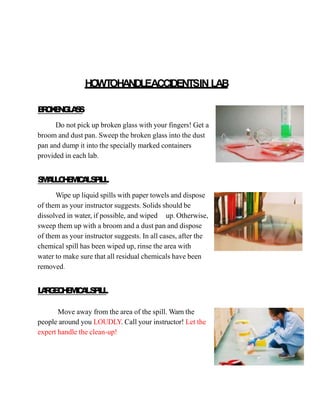
Do not pick up broken glass with your fingers! Get a
broom and dust pan. Sweep the broken glass into the dust
pan and dump it into the specially marked containers
provided in each lab.
S
M
A
L
L
C
H
E
M
I
C
A
LS
P
I
L
L
Wipe up liquid spills with paper towels and dispose
of them as your instructor suggests. Solids should be
dissolved in water, if possible, and wiped up. Otherwise,
sweep them up with a broom and a dust pan and dispose
of them as your instructor suggests. In all cases, after the
chemical spill has been wiped up, rinse the area with
water to make sure that all residual chemicals have been
removed.
L
A
R
G
E
C
H
E
M
I
C
A
LS
P
I
L
L
Move away from the area of the spill. Warn the
people around you LOUDLY. Call your instructor! Let the
expert handle the clean-up!
CHEMICALSPLASHES
C
H
E
M
I
C
A
LS
P
I
L
LO
N
Y
O
U
R
F
A
C
E
W
I
T
HG
O
O
L
G
E
S
O
N
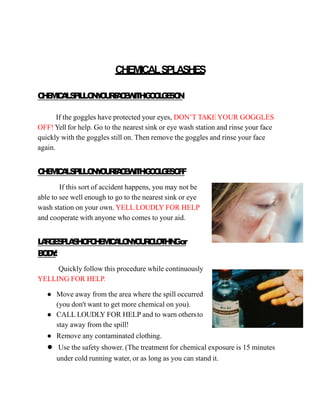
If the goggles have protected your eyes, DON’T TAKE YOUR GOGGLES
OFF! Yell for help. Go to the nearest sink or eye wash station and rinse your face
quickly with the goggles still on. Then remove the goggles and rinse your face
again.
C
H
E
M
I
C
A
LS
P
I
L
LO
N
Y
O
U
R
F
A
C
E
W
I
T
HG
O
O
L
G
E
S
O
F
F
If this sort of accident happens, you may not be
able to see well enough to go to the nearest sink or eye
wash station on your own. YELL LOUDLY FOR HELP
and cooperate with anyone who comes to your aid.
L
A
R
G
E
S
P
L
A
S
H
O
F
C
H
E
M
I
C
A
LO
N
Y
O
U
R
C
L
O
T
H
I
N
Gor
B
O
D
Y
:
Quickly follow this procedure while continuously
YELLING FOR HELP.
● Move away from the area where the spill occurred
(you don't want to get more chemical on you).
● CALL LOUDLY FOR HELP and to warn othersto
stay away from the spill!
● Remove any contaminated clothing.
● Use the safety shower. (The treatment for chemical exposure is 15 minutes
under cold running water, or as long as you can stand it.
INCASEOFFIRE
S
M
A
L
L
,C
O
N
F
I
N
E
DF
I
R
E
:
If you have a small fire in a container, (for
instance, a small beaker full of alcohol has caught
fire) find something you can use as a lid for the
container. When the container is covered, the fire will
quickly burn itself out. Call the instructor for help.
S
M
A
L
L
,O
P
E
N
F
I
R
E:
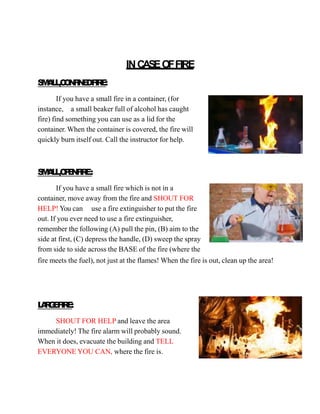
If you have a small fire which is not in a
container, move away from the fire and SHOUT FOR
HELP! You can use a fire extinguisher to put the fire
out. If you ever need to use a fire extinguisher,
remember the following (A) pull the pin, (B) aim to the
side at first, (C) depress the handle, (D) sweep the spray
from side to side across the BASE of the fire (where the
fire meets the fuel), not just at the flames! When the fire is out, clean up the area!
L
A
R
G
E
F
I
R
E
:
SHOUT FOR HELP and leave the area
immediately! The fire alarm will probably sound.
When it does, evacuate the building and TELL
EVERYONE YOU CAN, where the fire is.
Y
O
U
R
C
L
O
T
H
I
N
GO
N
F
I
R
E
:
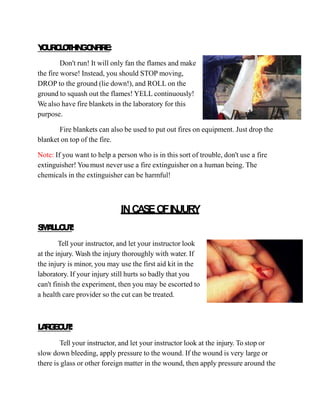
Don't run! It will only fan the flames and make
the fire worse! Instead, you should STOP moving,
DROP to the ground (lie down!), and ROLL on the
ground to squash out the flames! YELL continuously!
We also have fire blankets in the laboratory for this
purpose.
Fire blankets can also be used to put out fires on equipment. Just drop the
blanket on top of the fire.
Note: If you want to help a person who is in this sort of trouble, don't use a fire
extinguisher! You must never use a fire extinguisher on a human being. The
chemicals in the extinguisher can be harmful!
INCASEOFINJURY
S
M
A
L
LC
U
T
:
Tell your instructor, and let your instructor look
at the injury. Wash the injury thoroughly with water. If
the injury is minor, you may use the first aid kit in the
laboratory. If your injury still hurts so badly that you
can't finish the experiment, then you may be escorted to
a health care provider so the cut can be treated.
L
A
R
G
E
C
U
T
:
Tell your instructor, and let your instructor look at the injury. To stop or
slow down bleeding, apply pressure to the wound. If the wound is very large or
there is glass or other foreign matter in the wound, then apply pressure around the
arm or leg (between the body's torso and the injury) to slow the bleeding.
S
M
A
L
LB
U
R
N
:
Tell your instructor, and let your instructor look at the injury. Chemical burns
and heat burns should both be treated with lots of cold running water. Never put
anything but cold water on a burn! Doctors often have to remove ointments
because they retard healing! After this treatment, if the burn still hurts badly
enough that you cannot complete the experiment.
L
A
R
G
E
B
U
R
N
:
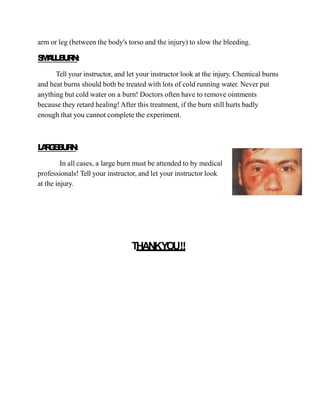
In all cases, a large burn must be attended to by medical
professionals! Tell your instructor, and let your instructor look
at the injury.
THANKYOU!!

Lab Safety Measures Presentation

  • 1.
    L A B S A F E T Y M E A S U R E S It includes thesafety measures and methods to overcome the accidents happen in Lab Abu Ubaida Ahmed BSc Hons 3rd Year
  • 2.
    HOWT OHANDLEACCIDENTSIN LAB B R O K E N G L A S S Do notpick up broken glass with your fingers! Get a broom and dust pan. Sweep the broken glass into the dust pan and dump it into the specially marked containers provided in each lab. S M A L L C H E M I C A LS P I L L Wipe up liquid spills with paper towels and dispose of them as your instructor suggests. Solids should be dissolved in water, if possible, and wiped up. Otherwise, sweep them up with a broom and a dust pan and dispose of them as your instructor suggests. In all cases, after the chemical spill has been wiped up, rinse the area with water to make sure that all residual chemicals have been removed. L A R G E C H E M I C A LS P I L L Move away from the area of the spill. Warn the people around you LOUDLY. Call your instructor! Let the expert handle the clean-up!
  • 3.
    CHEMICALSPLASHES C H E M I C A LS P I L LO N Y O U R F A C E W I T HG O O L G E S O N If the goggleshave protected your eyes, DON’T TAKE YOUR GOGGLES OFF! Yell for help. Go to the nearest sink or eye wash station and rinse your face quickly with the goggles still on. Then remove the goggles and rinse your face again. C H E M I C A LS P I L LO N Y O U R F A C E W I T HG O O L G E S O F F If this sort of accident happens, you may not be able to see well enough to go to the nearest sink or eye wash station on your own. YELL LOUDLY FOR HELP and cooperate with anyone who comes to your aid. L A R G E S P L A S H O F C H E M I C A LO N Y O U R C L O T H I N Gor B O D Y : Quickly follow this procedure while continuously YELLING FOR HELP. ● Move away from the area where the spill occurred (you don't want to get more chemical on you). ● CALL LOUDLY FOR HELP and to warn othersto stay away from the spill! ● Remove any contaminated clothing. ● Use the safety shower. (The treatment for chemical exposure is 15 minutes under cold running water, or as long as you can stand it.
  • 4.
    INCASEOFFIRE S M A L L ,C O N F I N E DF I R E : If you havea small fire in a container, (for instance, a small beaker full of alcohol has caught fire) find something you can use as a lid for the container. When the container is covered, the fire will quickly burn itself out. Call the instructor for help. S M A L L ,O P E N F I R E: If you have a small fire which is not in a container, move away from the fire and SHOUT FOR HELP! You can use a fire extinguisher to put the fire out. If you ever need to use a fire extinguisher, remember the following (A) pull the pin, (B) aim to the side at first, (C) depress the handle, (D) sweep the spray from side to side across the BASE of the fire (where the fire meets the fuel), not just at the flames! When the fire is out, clean up the area! L A R G E F I R E : SHOUT FOR HELP and leave the area immediately! The fire alarm will probably sound. When it does, evacuate the building and TELL EVERYONE YOU CAN, where the fire is.
  • 5.
    Y O U R C L O T H I N GO N F I R E : Don't run! Itwill only fan the flames and make the fire worse! Instead, you should STOP moving, DROP to the ground (lie down!), and ROLL on the ground to squash out the flames! YELL continuously! We also have fire blankets in the laboratory for this purpose. Fire blankets can also be used to put out fires on equipment. Just drop the blanket on top of the fire. Note: If you want to help a person who is in this sort of trouble, don't use a fire extinguisher! You must never use a fire extinguisher on a human being. The chemicals in the extinguisher can be harmful! INCASEOFINJURY S M A L LC U T : Tell your instructor, and let your instructor look at the injury. Wash the injury thoroughly with water. If the injury is minor, you may use the first aid kit in the laboratory. If your injury still hurts so badly that you can't finish the experiment, then you may be escorted to a health care provider so the cut can be treated. L A R G E C U T : Tell your instructor, and let your instructor look at the injury. To stop or slow down bleeding, apply pressure to the wound. If the wound is very large or there is glass or other foreign matter in the wound, then apply pressure around the
  • 6.
    arm or leg(between the body's torso and the injury) to slow the bleeding. S M A L LB U R N : Tell your instructor, and let your instructor look at the injury. Chemical burns and heat burns should both be treated with lots of cold running water. Never put anything but cold water on a burn! Doctors often have to remove ointments because they retard healing! After this treatment, if the burn still hurts badly enough that you cannot complete the experiment. L A R G E B U R N : In all cases, a large burn must be attended to by medical professionals! Tell your instructor, and let your instructor look at the injury. THANKYOU!!