LAB 2
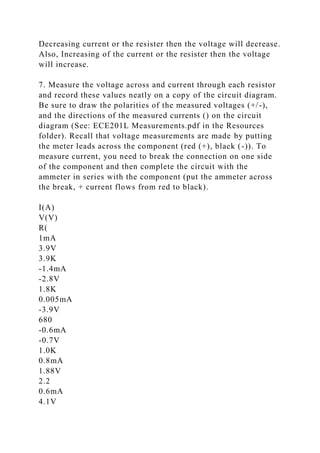
1. Create a plot of voltage vs. current using MATLAB (current
on horizontal axis). Be sure to label your axes and include
proper units.
V = [2,4,6,8,10,12,14,16,18,20];
I = [0.201,0.403,0.605,0.806,1.008,1.21,1.41,1.61,1.81,2.01];
figure;
plot(I,V,'ro-');
title('Voltage vs. power');
xlabel('Voltage (Volts)');
ylabel('Current (Ampere)');
2. What kind of voltage vs. current relationship did you find
(linear, quadratic, exponential, polynomial, etc.)?
Linear
3. Use these same data to make a power vs. voltage plot in
MATLAB. Recall, P = I V, or equivalently. Note that in
MATLAB, array operations can be achieved without a loop. You
can use. * ./ .^ for array multiply, array divide, and array
power, respectively. Label axes and show proper units.
Math Lab
R=10
V = [2,4,6,8,10,12,14,16,18,20];
I = [0.201,0.403,0.605,0.806,1.008,1.21,1.41,1.61,1.81,2.01];
P=I.*V;
figure;
plot(P,V,'ro-');
title('Voltage vs. Current Relationship');
xlabel('Voltage (Volts)');
ylabel('power (watts)');
4. What kind of power vs. voltage relationship did you
discover? Is this what you expected? Explain.
Quadratic, yes because P(W)=IV(V)
Now, change the resistance to 20 k. Observe and record the
current for at least 10 different voltages ranging from 2 to 20
volts as before.
5. Create a plot of voltage vs. current using MATLAB (current
on horizontal axis) for the 20 k resistor. If you want to get
fancy (not required), try plotting this curve along with that from
Question 1 on the same figure axis with distinct line colors, and
use the legend command to label the two curves. Use “help
plot” in MATLAB.
Math Lab
R=20
V = [2,4,6,8,10,12,14,16,18,20];
I =
[0.401,0.808,1.211,1.615,2.01,2.42,2.827,3.232,3.638,4.043];
figure;
plot(I,V,'ro-');
title('Voltage vs. Current Relationship');
xlabel('Voltage (Volts)');
ylabel('Current (Amps)');
6. Based on your observations and knowledge of Ohm’s law,
explain how voltage changes as a function of current for a
resistor. Explain how voltage changes with changing resistance
for a given fixed current. Also, for a given fixed voltage, what
happens to current as resistance changes?
According to the ohm’s low that V=IR
The voltage change when the current change. When we have a
big value of resister we will have a big value of the voltage.
Decreasing current or the resister then the voltage will decrease.
Also, Increasing of the current or the resister then the voltage
will increase.
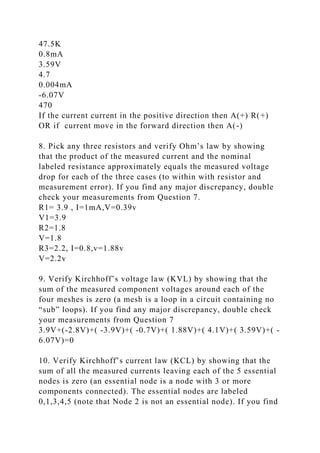
7. Measure the voltage across and current through each resistor
and record these values neatly on a copy of the circuit diagram.
Be sure to draw the polarities of the measured voltages (+/-),
and the directions of the measured currents () on the circuit
diagram (See: ECE201L Measurements.pdf in the Resources
folder). Recall that voltage measurements are made by putting
the meter leads across the component (red (+), black (-)). To
measure current, you need to break the connection on one side
of the component and then complete the circuit with the
ammeter in series with the component (put the ammeter across
the break, + current flows from red to black).
I(A)
V(V)
R(
1mA
3.9V
3.9K
-1.4mA
-2.8V
1.8K
0.005mA
-3.9V
680
-0.6mA
-0.7V
1.0K
0.8mA
1.88V
2.2
0.6mA
4.1V
47.5K
0.8mA
3.59V
4.7
0.004mA
-6.07V
470
If the current current in the positive direction then A(+) R(+)
OR if current move in the forward direction then A(-)
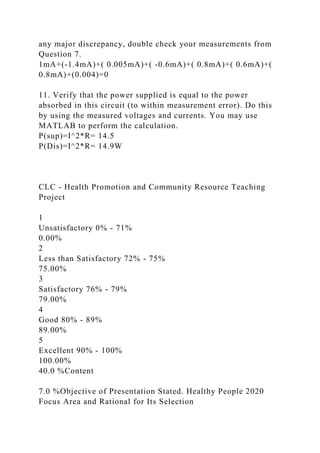
8. Pick any three resistors and verify Ohm’s law by showing
that the product of the measured current and the nominal
labeled resistance approximately equals the measured voltage
drop for each of the three cases (to within with resistor and
measurement error). If you find any major discrepancy, double
check your measurements from Question 7.
R1= 3.9 , I=1mA,V=0.39v
V1=3.9
R2=1.8
V=1.8
R3=2.2, I=0.8,v=1.88v
V=2.2v
9. Verify Kirchhoff’s voltage law (KVL) by showing that the
sum of the measured component voltages around each of the
four meshes is zero (a mesh is a loop in a circuit containing no
“sub” loops). If you find any major discrepancy, double check
your measurements from Question 7
3.9V+(-2.8V)+( -3.9V)+( -0.7V)+( 1.88V)+( 4.1V)+( 3.59V)+( -
6.07V)=0
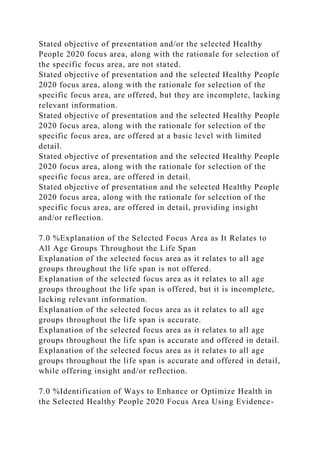
10. Verify Kirchhoff’s current law (KCL) by showing that the
sum of all the measured currents leaving each of the 5 essential
nodes is zero (an essential node is a node with 3 or more
components connected). The essential nodes are labeled
0,1,3,4,5 (note that Node 2 is not an essential node). If you find
any major discrepancy, double check your measurements from
Question 7.
1mA+(-1.4mA)+( 0.005mA)+( -0.6mA)+( 0.8mA)+( 0.6mA)+(
0.8mA)+(0.004)=0
11. Verify that the power supplied is equal to the power
absorbed in this circuit (to within measurement error). Do this
by using the measured voltages and currents. You may use
MATLAB to perform the calculation.
P(sup)=I^2*R= 14.5
P(Dis)=I^2*R= 14.9W
CLC - Health Promotion and Community Resource Teaching
Project
1
Unsatisfactory 0% - 71%
0.00%
2
Less than Satisfactory 72% - 75%
75.00%
3
Satisfactory 76% - 79%
79.00%
4
Good 80% - 89%
89.00%
5
Excellent 90% - 100%
100.00%
40.0 %Content
7.0 %Objective of Presentation Stated. Healthy People 2020
Focus Area and Rational for Its Selection
Stated objective of presentation and/or the selected Healthy
People 2020 focus area, along with the rationale for selection of
the specific focus area, are not stated.
Stated objective of presentation and the selected Healthy People
2020 focus area, along with the rationale for selection of the
specific focus area, are offered, but they are incomplete, lacking
relevant information.
Stated objective of presentation and the selected Healthy People
2020 focus area, along with the rationale for selection of the
specific focus area, are offered at a basic level with limited
detail.
Stated objective of presentation and the selected Healthy People
2020 focus area, along with the rationale for selection of the
specific focus area, are offered in detail.
Stated objective of presentation and the selected Healthy People
2020 focus area, along with the rationale for selection of the
specific focus area, are offered in detail, providing insight
and/or reflection.
7.0 %Explanation of the Selected Focus Area as It Relates to
All Age Groups Throughout the Life Span
Explanation of the selected focus area as it relates to all age
groups throughout the life span is not offered.
Explanation of the selected focus area as it relates to all age
groups throughout the life span is offered, but it is incomplete,
lacking relevant information.
Explanation of the selected focus area as it relates to all age
groups throughout the life span is accurate.
Explanation of the selected focus area as it relates to all age
groups throughout the life span is accurate and offered in detail.
Explanation of the selected focus area as it relates to all age
groups throughout the life span is accurate and offered in detail,
while offering insight and/or reflection.
7.0 %Identification of Ways to Enhance or Optimize Health in
the Selected Healthy People 2020 Focus Area Using Evidence-
Based Research With a Minimum of Three Peer-Reviewed
Articles
Identification of ways to enhance or optimize health in the
selected Healthy People 2020 focus area using evidence-based
research, using a minimum of three peer reviewed articles is not
offered.
Identification of ways to enhance or optimize health in the
selected Healthy People 2020 focus area using evidence-based
research, using a minimum of three peer reviewed articles is
offered, but it is incomplete, lacking relevant information.
Identification of ways to enhance or optimize health in the
selected Healthy People 2020 focus area using evidence-based
research, using a minimum of three peer reviewed articles is
offered at a basic level with limited detail.
Identification of ways to enhance or optimize health in the
selected Healthy People 2020 focus area using evidence-based
research, using a minimum of three peer reviewed articles are
offered in detail.
Identification of ways to enhance or optimize health in the
selected Healthy People 2020 focus area using evidence-based
research, using a minimum of three peer reviewed articles are
offered in detail, while offering insight and/or reflection.
6.0 %Health Disparity Among Different Segments of the
Population for the Selected Focus Area
The addressing of the health disparity among different segments
of the population for the selected focus area is not offered.
The addressing of the health disparity among different segments
of the population for the selected focus area is offered, but it is
incomplete, lacking relevant information.
The addressing of the health disparity among different segments
of the population for the selected focus area is accurate.
The addressing of the health disparity among different segments
of the population for the selected focus area is accurate and
offered in detail.
The addressing of the health disparity among different segments
of the population for the selected focus area is accurate and
offered in detail, while offering insight and/or reflection.
6.0 %Resources for Professionals and Clients
No community resources or website resources for professionals
and clients are offered.
The community resources and website resources for
professionals and clients are not appropriate for the selected
area of focus.
A brief description of two community resources and website
resources for professionals and clients is offered for the
selected area of focus.
A brief description of two community resources and website
resources for professionals and clients for the selected area of
focus is accurate and offered in detail.
A brief description of two community resources and website
resources for professionals and clients for the selected area of
focus is accurate and offered in detail. Selection of community
resources and websites reflect thoughtful consideration to users
of resources.
7.0 %Health-Related Organization for the Selected Focus Area
No health-related organization for the selected focus area is
offered.
A brief profile of at least one health-related organization for the
selected focus area is offered, but it is inappropriate for the
selected area of focus or is missing relevant information.
A brief profile of one health-related organization for the
selected focus area is offered.
A brief profile of one health-related organization for the
selected focus area is accurate and offered in detail.
A brief profile of one health-related organization for the
selected focus area is accurate and offered in detail. Selection
of community resources and websites reflects thoughtful
consideration to users of resources.
45.0 %Organization & Effectiveness
40.0 %Presentation of Content
The content lacks a clear point of view and logical sequence of
information. Includes little persuasive information. Sequencing
of ideas is unclear.
The content is vague in conveying a point of view and does not
create a strong sense of purpose. Includes some persuasive
information.
The presentation slides are generally competent, but ideas may
show some inconsistency in organization and/or in their
relationships to each other.
The content is written with a logical progression of ideas and
supporting information exhibiting a unity, coherence, and
cohesiveness. Includes persuasive information from reliable
sources.
The content is written clearly and concisely. Ideas universally
progress and relate to each other. The project includes
motivating questions and advanced organizers. The project
gives the audience a clear sense of the main idea.
5.0 %Language Use and Audience Awareness (includes sentence
construction, word choice, etc.)
Inappropriate word choice and lack of variety in language use
are evident. Writer appears to be unaware of audience. Use of
primer prose indicates writer either does not apply figures of
speech or uses them inappropriately.
Some distracting inconsistencies in language choice (register)
and/or word choice are present. The writer exhibits some lack of
control in using figures of speech appropriately.
Language is appropriate to the targeted audience for the most
part.
The writer is clearly aware of audience, uses a variety of
appropriate vocabulary for the targeted audience, and uses
figures of speech to communicate clearly.
The writer uses a variety of sentence constructions, figures of
speech, and word choice in distinctive and creative ways that
are appropriate to purpose, discipline, and scope.
15.0 %Format
5.0 %Evaluating and Documenting Sources (in-text citations for
paraphrasing and direct quotes, references page listing and
formatting, as appropriate to assignment and style)
Contains no title slide, no references section, and no correctly
cited references within the body of the presentation.
Title slide is incomplete or inaccurate. References section
includes sources, but many citation errors. Citations are
included within the body of the presentation but with many
errors.
Title slide has minor errors. References section includes
sources, but they are not consistently cited correctly. Citations
are included within the body of the presentation but with some
errors.
Title slide is complete. References section includes correctly
cited sources with minimal errors. Correct citations are included
within the body of the presentation.
Title slide is complete. References section includes correctly
cited sources. Correct citations are included within the body of
the presentation.
5.0 %Mechanics of Writing (includes spelling, punctuation,
grammar, language use)
Slide errors are pervasive enough that they impede
communication of meaning.
Frequent and repetitive mechanical errors distract the reader.
Some mechanical errors or typos are present, but are not overly
distracting to the reader.
Slides are largely free of mechanical errors, although a few may
be present.
Writer is clearly in control of standard, written academic
English.
5.0 %Layout
The layout is cluttered, confusing, and does not use spacing,
headings, and subheadings to enhance the readability. The text
is extremely difficult to read with long blocks of text, small
point size for fonts, and inappropriate contrasting colors. Poor
use of headings, subheadings, indentations, or bold formatting
is evident.
The layout shows some structure, but appears cluttered and busy
or distracting with large gaps of white space or a distracting
background. Overall readability is difficult due to lengthy
paragraphs, too many different fonts, dark or busy background,
overuse of bold, or lack of appropriate indentations of text.
The layout uses horizontal and vertical white space
appropriately. Sometimes the fonts are easy to read, but in a few
places the use of fonts, italics, bold, long paragraphs, color, or
busy background detracts and does not enhance readability.
The layout background and text complement each other and
enable the content to be easily read. The fonts are easy to read
and point size varies appropriately for headings and text.
The layout is visually pleasing and contributes to the overall
message with appropriate use of headings, subheadings, and
white space. Text is appropriate in length for the target
audience and to the point. The background and colors enhance
the readability of the text.
100 %Total Weightage
Respiratory Diseases
By Tania Gonzalez-diaz & Nelly Jacobo
Course: nrs-429vn
Objective
To provide educational knowledge about respiratory diseases,
which can be utilized to promote knowledge and prevent
diseases.
Good morning, today we would like to provide you guys with
the latest educational information regarding respiratory
diseases. We decided to talk about respiratory diseases for
various reasons. The first reason being that it affects many
individuals. The second reason being that it is something that
can be prevented and lastly because it is causing strains in our
communities.
2
Healthy People 2020
According to healthy people 2020 (2016) asthma and chronic
obstructive pulmonary diseases create significant healthcare
burden.
Annual health care cost of asthma is $20.7 billion (Healthy
people 2020, 2016).
Currently in United States 23 million people have asthma, 13.6
million people have been diagnosed with COPD and about the
same number of people have not yet been diagnosed (healthy
people 2020, 2016).
As you can see respiratory diseases affect a great number of
people. It has not only affected the person directly involved, but
it affects everyone else around them. It affects the persons
family members, school place, work place, and societies. The
cost of these diseases are creating a burden for health care
systems as well as individuals tax dollars. The cost of medical
insurances have increased due to the burdens it has caused
(healthy people 2020(2016).
3
Asthma
Is a condition in which your airway narrows, swell, and produce
mucus. This makes breathing become difficult (Mayo clinic
staff, 2016).
There is no cure, but treatment is available.
According to Mayo clinic staff (2016) asthma affects the
respiratory tract by causing swelling to the airways. It creates
constriction and mucus build up of the airways, making it
difficult to breathe. Causes include stress, airborne &
environmental substances, cold weather, physical activity, types
of food, and genetic makeup. There is no current cure, however
there is treatment available. Treatment consist of
bronchodilators, corticosteroids, avoiding triggers, and
maintaining regular doctor appointments. Keeping up to date
with immunizations such as influenza and pneumonia are
beneficial.
4
Asthma statistics
According to CDC in 2009, asthma caused: • 479,300
hospitalizations • 1.9 million emergency department visits • 8.9
million doctor visits
Black adults are hospitalized for asthma more often than white
adults.
Black and Hispanic children visit emergency departments for
asthma care more often than white children
More than 1 in 4 black adults can’t afford their asthma
medicines.
1 in 5 Hispanic adults can’t afford their asthma medicines.
According to Center for Disease control and Prevention (2016)
race and ethnicity affects the outcome of diseases. It appears
that Hispanics as well as Blacks have difficulties purchasing
medication due to financial resources. This indeed affects the
outcome of individuals health.
5
COPD
Is a chronic inflammatory lung disease that causes obstructed
airflow from the lungs.
It's caused by long-term exposure to irritating gases or
particulate matter, most often from cigarette smoke.
It can be prevented (Mayo Clinic staff, 2016).
According to Mayo clinic staff (2016) individual’s with COPD
are more prone in developing heart diseases and lung cancer.
You can see how this creates more health cost on society.
Emphysema and chronic bronchitis are the two most common
condition that contributes to COPD. COPD symptoms don’t
usually appears until lung damage is already present, this
includes chronic cough. COPD worsens with time, especially if
smoking continues. COPD is preventable in most cases, so why
not prevent it!
6
COPD statistics
COPD is the fourth leading cause of death in the United States
(Healthy people 2020, 2016).
In 2006, approximately 120,000 individuals died from COPD
(Healthy people 2020, 2016).
At baseline, 113.9 COPD deaths per 100,000 adults age 45
years and older occurred in 2007. The target is 102.6 (Healthy
people 2020, 2016).
According to Healthy people 2020 (2016) COPD is the fourth
leading cause of death in United States. It causes in great
amount of deaths of individuals. These disease is very costly
that not all people affected can afford.
7
Conclusion
Although not all respiratory diseases can be prevented, there are
treatments to stabilize the disease. The correct treatments and
educational information can help lessen the incidents, therefore
decreasing the health burden in our communities.
It is true that not all respiratory diseases have cures, but disease
such as COPD can be prevented. Specific methods of detection,
intervention, and treatment exist that may reduce this burden
and promote health. Proper treatments of medical problems can
help lessen the number of visits to emergency department as
well as medical cost. Making sure that individual’s receive
proper education can also help lessen diseases flare ups as well
as the use of individuals tax dollars.
14
References
Centers for Disease Control and Prevention. (2016). Data and
statistics. Retrieved from http://www.cdc.gov/dotw/index.html
Healthy people 2020. (2016). Respiratory diseases. Retrieved
from https://www.healthypeople.gov/2020/topics-
objectives/topic/respiratory- diseases
Mayo clinic staff. (2016). Diseases and Conditions. Retrieved
from http://www.mayoclinic.org/diseases-
conditions/copd/home/ovc-
20204482
LAB 5: Multisim
1. Objective
Students will be introduced to National Instrument Multisim
software for circuit design
and analysis. You will conduct a DC operating point analysis
simulation and you will
use this to verify Kirchhoff’s voltage and current laws, as well
as Ohm’s law. You will
need your computer for this lab. No physical circuit
construction is required!
2. Procedure
If you have not already done so, download National Instruments
Circuit Design Suite
from https://software.udayton.edu. For this class you only
need to install Multisim (the
other components are optional).
2.1 Basic DC operating point simulation
Use Multisim to simulation the circuit in Fig. 1. Make the
bottom node be the 0V
reference node by attaching a ground to it. You can use the
following YouTube video
link to help you through the process if necessary:
https://www.youtube.com/watch?v=2SOyJYQQflU.
1. Have Multisim perform a DC operating point analysis and
have it compute the
voltage at each node, and the current through each resistor.
Copy the Multisim
table and paste it into your report as a table.
2. Do a power-check using the Multisim provided parameters
for current, and the
known voltages for the sources. Include the power check
calculations in your
report
Figure 1: Circuit for Multisim DC operating point analysis.
https://software.udayton.edu/
https://www.youtube.com/watch?v=2SOyJYQQflU
2.2 KVL and KCL Verification
3. Enter the circuit from Lab 2 into Multisim. The circuit is
shown in Fig. 2. Have
Multisim perform a DC operating point analysis and have it
compute the voltage at
each node, the current through each resistor, and the current
through the voltage
source. Copy the Multisim table and paste it into your report
as a table.
V1
12 V
R1
3.9kΩ
R2
1.8kΩ R3
680Ω
R4
1.0kΩ
R5
2.2kΩ
R6
7.5kΩ
R7
4.7kΩ
R8
470Ω
1
2
4
5
0
3
Figure 2: Multisim circuit for KVL and KCL verification.
You are now going to repeat some of the steps from Lab 2, but
here using the Multisim
DC operating point computed values.
4. Pick any three resistors and verify Ohm’s law by showing
that the product of the
current and the nominal labeled resistance approximately equals
the voltage drop
across the resistor for each of the three cases. Note: resistor
voltage drops must be
determined as the difference between the Multisim node
voltages provided.
5. Verify Kirchhoff’s voltage law (KVL) by showing that the
sum of the measured
component voltages around each of the four meshes is zero (a
mesh is a loop in a
circuit containing no “sub” loops).
6. Verify Kirchhoff’s current law (KCL) by showing that the
sum of all the measured
currents leaving each of the 5 essential nodes is zero (an
essential node is a node with
3 or more components connected). The essential nodes are
labeled 0,1,3,4,5 (note
that Node 2 is not an essential node).
7. Verify that the power supplied is equal to the power absorbed
in this circuit.
(+1 Bonus) What is the unit of frequency? Who is it named
after?

LAB 21. Create a plot of voltage vs. current using MATLAB (cur.docx

  • 1.
    LAB 2 1. Createa plot of voltage vs. current using MATLAB (current on horizontal axis). Be sure to label your axes and include proper units. V = [2,4,6,8,10,12,14,16,18,20]; I = [0.201,0.403,0.605,0.806,1.008,1.21,1.41,1.61,1.81,2.01]; figure; plot(I,V,'ro-'); title('Voltage vs. power'); xlabel('Voltage (Volts)'); ylabel('Current (Ampere)'); 2. What kind of voltage vs. current relationship did you find (linear, quadratic, exponential, polynomial, etc.)? Linear 3. Use these same data to make a power vs. voltage plot in MATLAB. Recall, P = I V, or equivalently. Note that in MATLAB, array operations can be achieved without a loop. You can use. * ./ .^ for array multiply, array divide, and array power, respectively. Label axes and show proper units. Math Lab R=10 V = [2,4,6,8,10,12,14,16,18,20]; I = [0.201,0.403,0.605,0.806,1.008,1.21,1.41,1.61,1.81,2.01]; P=I.*V; figure; plot(P,V,'ro-'); title('Voltage vs. Current Relationship'); xlabel('Voltage (Volts)'); ylabel('power (watts)');
  • 2.
    4. What kindof power vs. voltage relationship did you discover? Is this what you expected? Explain. Quadratic, yes because P(W)=IV(V) Now, change the resistance to 20 k. Observe and record the current for at least 10 different voltages ranging from 2 to 20 volts as before. 5. Create a plot of voltage vs. current using MATLAB (current on horizontal axis) for the 20 k resistor. If you want to get fancy (not required), try plotting this curve along with that from Question 1 on the same figure axis with distinct line colors, and use the legend command to label the two curves. Use “help plot” in MATLAB. Math Lab R=20 V = [2,4,6,8,10,12,14,16,18,20]; I = [0.401,0.808,1.211,1.615,2.01,2.42,2.827,3.232,3.638,4.043]; figure; plot(I,V,'ro-'); title('Voltage vs. Current Relationship'); xlabel('Voltage (Volts)'); ylabel('Current (Amps)'); 6. Based on your observations and knowledge of Ohm’s law, explain how voltage changes as a function of current for a resistor. Explain how voltage changes with changing resistance for a given fixed current. Also, for a given fixed voltage, what happens to current as resistance changes? According to the ohm’s low that V=IR The voltage change when the current change. When we have a big value of resister we will have a big value of the voltage.
  • 3.
    Decreasing current orthe resister then the voltage will decrease. Also, Increasing of the current or the resister then the voltage will increase. 7. Measure the voltage across and current through each resistor and record these values neatly on a copy of the circuit diagram. Be sure to draw the polarities of the measured voltages (+/-), and the directions of the measured currents () on the circuit diagram (See: ECE201L Measurements.pdf in the Resources folder). Recall that voltage measurements are made by putting the meter leads across the component (red (+), black (-)). To measure current, you need to break the connection on one side of the component and then complete the circuit with the ammeter in series with the component (put the ammeter across the break, + current flows from red to black). I(A) V(V) R( 1mA 3.9V 3.9K -1.4mA -2.8V 1.8K 0.005mA -3.9V 680 -0.6mA -0.7V 1.0K 0.8mA 1.88V 2.2 0.6mA 4.1V
  • 4.
    47.5K 0.8mA 3.59V 4.7 0.004mA -6.07V 470 If the currentcurrent in the positive direction then A(+) R(+) OR if current move in the forward direction then A(-) 8. Pick any three resistors and verify Ohm’s law by showing that the product of the measured current and the nominal labeled resistance approximately equals the measured voltage drop for each of the three cases (to within with resistor and measurement error). If you find any major discrepancy, double check your measurements from Question 7. R1= 3.9 , I=1mA,V=0.39v V1=3.9 R2=1.8 V=1.8 R3=2.2, I=0.8,v=1.88v V=2.2v 9. Verify Kirchhoff’s voltage law (KVL) by showing that the sum of the measured component voltages around each of the four meshes is zero (a mesh is a loop in a circuit containing no “sub” loops). If you find any major discrepancy, double check your measurements from Question 7 3.9V+(-2.8V)+( -3.9V)+( -0.7V)+( 1.88V)+( 4.1V)+( 3.59V)+( - 6.07V)=0 10. Verify Kirchhoff’s current law (KCL) by showing that the sum of all the measured currents leaving each of the 5 essential nodes is zero (an essential node is a node with 3 or more components connected). The essential nodes are labeled 0,1,3,4,5 (note that Node 2 is not an essential node). If you find
  • 5.
    any major discrepancy,double check your measurements from Question 7. 1mA+(-1.4mA)+( 0.005mA)+( -0.6mA)+( 0.8mA)+( 0.6mA)+( 0.8mA)+(0.004)=0 11. Verify that the power supplied is equal to the power absorbed in this circuit (to within measurement error). Do this by using the measured voltages and currents. You may use MATLAB to perform the calculation. P(sup)=I^2*R= 14.5 P(Dis)=I^2*R= 14.9W CLC - Health Promotion and Community Resource Teaching Project 1 Unsatisfactory 0% - 71% 0.00% 2 Less than Satisfactory 72% - 75% 75.00% 3 Satisfactory 76% - 79% 79.00% 4 Good 80% - 89% 89.00% 5 Excellent 90% - 100% 100.00% 40.0 %Content 7.0 %Objective of Presentation Stated. Healthy People 2020 Focus Area and Rational for Its Selection
  • 6.
    Stated objective ofpresentation and/or the selected Healthy People 2020 focus area, along with the rationale for selection of the specific focus area, are not stated. Stated objective of presentation and the selected Healthy People 2020 focus area, along with the rationale for selection of the specific focus area, are offered, but they are incomplete, lacking relevant information. Stated objective of presentation and the selected Healthy People 2020 focus area, along with the rationale for selection of the specific focus area, are offered at a basic level with limited detail. Stated objective of presentation and the selected Healthy People 2020 focus area, along with the rationale for selection of the specific focus area, are offered in detail. Stated objective of presentation and the selected Healthy People 2020 focus area, along with the rationale for selection of the specific focus area, are offered in detail, providing insight and/or reflection. 7.0 %Explanation of the Selected Focus Area as It Relates to All Age Groups Throughout the Life Span Explanation of the selected focus area as it relates to all age groups throughout the life span is not offered. Explanation of the selected focus area as it relates to all age groups throughout the life span is offered, but it is incomplete, lacking relevant information. Explanation of the selected focus area as it relates to all age groups throughout the life span is accurate. Explanation of the selected focus area as it relates to all age groups throughout the life span is accurate and offered in detail. Explanation of the selected focus area as it relates to all age groups throughout the life span is accurate and offered in detail, while offering insight and/or reflection. 7.0 %Identification of Ways to Enhance or Optimize Health in the Selected Healthy People 2020 Focus Area Using Evidence-
  • 7.
    Based Research Witha Minimum of Three Peer-Reviewed Articles Identification of ways to enhance or optimize health in the selected Healthy People 2020 focus area using evidence-based research, using a minimum of three peer reviewed articles is not offered. Identification of ways to enhance or optimize health in the selected Healthy People 2020 focus area using evidence-based research, using a minimum of three peer reviewed articles is offered, but it is incomplete, lacking relevant information. Identification of ways to enhance or optimize health in the selected Healthy People 2020 focus area using evidence-based research, using a minimum of three peer reviewed articles is offered at a basic level with limited detail. Identification of ways to enhance or optimize health in the selected Healthy People 2020 focus area using evidence-based research, using a minimum of three peer reviewed articles are offered in detail. Identification of ways to enhance or optimize health in the selected Healthy People 2020 focus area using evidence-based research, using a minimum of three peer reviewed articles are offered in detail, while offering insight and/or reflection. 6.0 %Health Disparity Among Different Segments of the Population for the Selected Focus Area The addressing of the health disparity among different segments of the population for the selected focus area is not offered. The addressing of the health disparity among different segments of the population for the selected focus area is offered, but it is incomplete, lacking relevant information. The addressing of the health disparity among different segments of the population for the selected focus area is accurate. The addressing of the health disparity among different segments of the population for the selected focus area is accurate and offered in detail. The addressing of the health disparity among different segments
  • 8.
    of the populationfor the selected focus area is accurate and offered in detail, while offering insight and/or reflection. 6.0 %Resources for Professionals and Clients No community resources or website resources for professionals and clients are offered. The community resources and website resources for professionals and clients are not appropriate for the selected area of focus. A brief description of two community resources and website resources for professionals and clients is offered for the selected area of focus. A brief description of two community resources and website resources for professionals and clients for the selected area of focus is accurate and offered in detail. A brief description of two community resources and website resources for professionals and clients for the selected area of focus is accurate and offered in detail. Selection of community resources and websites reflect thoughtful consideration to users of resources. 7.0 %Health-Related Organization for the Selected Focus Area No health-related organization for the selected focus area is offered. A brief profile of at least one health-related organization for the selected focus area is offered, but it is inappropriate for the selected area of focus or is missing relevant information. A brief profile of one health-related organization for the selected focus area is offered. A brief profile of one health-related organization for the selected focus area is accurate and offered in detail. A brief profile of one health-related organization for the selected focus area is accurate and offered in detail. Selection of community resources and websites reflects thoughtful consideration to users of resources.
  • 9.
    45.0 %Organization &Effectiveness 40.0 %Presentation of Content The content lacks a clear point of view and logical sequence of information. Includes little persuasive information. Sequencing of ideas is unclear. The content is vague in conveying a point of view and does not create a strong sense of purpose. Includes some persuasive information. The presentation slides are generally competent, but ideas may show some inconsistency in organization and/or in their relationships to each other. The content is written with a logical progression of ideas and supporting information exhibiting a unity, coherence, and cohesiveness. Includes persuasive information from reliable sources. The content is written clearly and concisely. Ideas universally progress and relate to each other. The project includes motivating questions and advanced organizers. The project gives the audience a clear sense of the main idea. 5.0 %Language Use and Audience Awareness (includes sentence construction, word choice, etc.) Inappropriate word choice and lack of variety in language use are evident. Writer appears to be unaware of audience. Use of primer prose indicates writer either does not apply figures of speech or uses them inappropriately. Some distracting inconsistencies in language choice (register) and/or word choice are present. The writer exhibits some lack of control in using figures of speech appropriately. Language is appropriate to the targeted audience for the most part. The writer is clearly aware of audience, uses a variety of appropriate vocabulary for the targeted audience, and uses figures of speech to communicate clearly. The writer uses a variety of sentence constructions, figures of
  • 10.
    speech, and wordchoice in distinctive and creative ways that are appropriate to purpose, discipline, and scope. 15.0 %Format 5.0 %Evaluating and Documenting Sources (in-text citations for paraphrasing and direct quotes, references page listing and formatting, as appropriate to assignment and style) Contains no title slide, no references section, and no correctly cited references within the body of the presentation. Title slide is incomplete or inaccurate. References section includes sources, but many citation errors. Citations are included within the body of the presentation but with many errors. Title slide has minor errors. References section includes sources, but they are not consistently cited correctly. Citations are included within the body of the presentation but with some errors. Title slide is complete. References section includes correctly cited sources with minimal errors. Correct citations are included within the body of the presentation. Title slide is complete. References section includes correctly cited sources. Correct citations are included within the body of the presentation. 5.0 %Mechanics of Writing (includes spelling, punctuation, grammar, language use) Slide errors are pervasive enough that they impede communication of meaning. Frequent and repetitive mechanical errors distract the reader. Some mechanical errors or typos are present, but are not overly distracting to the reader. Slides are largely free of mechanical errors, although a few may be present. Writer is clearly in control of standard, written academic English.
  • 11.
    5.0 %Layout The layoutis cluttered, confusing, and does not use spacing, headings, and subheadings to enhance the readability. The text is extremely difficult to read with long blocks of text, small point size for fonts, and inappropriate contrasting colors. Poor use of headings, subheadings, indentations, or bold formatting is evident. The layout shows some structure, but appears cluttered and busy or distracting with large gaps of white space or a distracting background. Overall readability is difficult due to lengthy paragraphs, too many different fonts, dark or busy background, overuse of bold, or lack of appropriate indentations of text. The layout uses horizontal and vertical white space appropriately. Sometimes the fonts are easy to read, but in a few places the use of fonts, italics, bold, long paragraphs, color, or busy background detracts and does not enhance readability. The layout background and text complement each other and enable the content to be easily read. The fonts are easy to read and point size varies appropriately for headings and text. The layout is visually pleasing and contributes to the overall message with appropriate use of headings, subheadings, and white space. Text is appropriate in length for the target audience and to the point. The background and colors enhance the readability of the text. 100 %Total Weightage Respiratory Diseases By Tania Gonzalez-diaz & Nelly Jacobo Course: nrs-429vn
  • 12.
    Objective To provide educationalknowledge about respiratory diseases, which can be utilized to promote knowledge and prevent diseases. Good morning, today we would like to provide you guys with the latest educational information regarding respiratory diseases. We decided to talk about respiratory diseases for various reasons. The first reason being that it affects many individuals. The second reason being that it is something that can be prevented and lastly because it is causing strains in our communities. 2 Healthy People 2020 According to healthy people 2020 (2016) asthma and chronic obstructive pulmonary diseases create significant healthcare burden. Annual health care cost of asthma is $20.7 billion (Healthy people 2020, 2016). Currently in United States 23 million people have asthma, 13.6 million people have been diagnosed with COPD and about the same number of people have not yet been diagnosed (healthy people 2020, 2016). As you can see respiratory diseases affect a great number of people. It has not only affected the person directly involved, but it affects everyone else around them. It affects the persons
  • 13.
    family members, schoolplace, work place, and societies. The cost of these diseases are creating a burden for health care systems as well as individuals tax dollars. The cost of medical insurances have increased due to the burdens it has caused (healthy people 2020(2016). 3 Asthma Is a condition in which your airway narrows, swell, and produce mucus. This makes breathing become difficult (Mayo clinic staff, 2016). There is no cure, but treatment is available. According to Mayo clinic staff (2016) asthma affects the respiratory tract by causing swelling to the airways. It creates constriction and mucus build up of the airways, making it difficult to breathe. Causes include stress, airborne & environmental substances, cold weather, physical activity, types of food, and genetic makeup. There is no current cure, however there is treatment available. Treatment consist of bronchodilators, corticosteroids, avoiding triggers, and maintaining regular doctor appointments. Keeping up to date with immunizations such as influenza and pneumonia are beneficial. 4 Asthma statistics According to CDC in 2009, asthma caused: • 479,300 hospitalizations • 1.9 million emergency department visits • 8.9 million doctor visits
  • 14.
    Black adults arehospitalized for asthma more often than white adults. Black and Hispanic children visit emergency departments for asthma care more often than white children More than 1 in 4 black adults can’t afford their asthma medicines. 1 in 5 Hispanic adults can’t afford their asthma medicines. According to Center for Disease control and Prevention (2016) race and ethnicity affects the outcome of diseases. It appears that Hispanics as well as Blacks have difficulties purchasing medication due to financial resources. This indeed affects the outcome of individuals health. 5 COPD Is a chronic inflammatory lung disease that causes obstructed airflow from the lungs. It's caused by long-term exposure to irritating gases or particulate matter, most often from cigarette smoke. It can be prevented (Mayo Clinic staff, 2016). According to Mayo clinic staff (2016) individual’s with COPD are more prone in developing heart diseases and lung cancer. You can see how this creates more health cost on society. Emphysema and chronic bronchitis are the two most common condition that contributes to COPD. COPD symptoms don’t
  • 15.
    usually appears untillung damage is already present, this includes chronic cough. COPD worsens with time, especially if smoking continues. COPD is preventable in most cases, so why not prevent it! 6 COPD statistics COPD is the fourth leading cause of death in the United States (Healthy people 2020, 2016). In 2006, approximately 120,000 individuals died from COPD (Healthy people 2020, 2016). At baseline, 113.9 COPD deaths per 100,000 adults age 45 years and older occurred in 2007. The target is 102.6 (Healthy people 2020, 2016). According to Healthy people 2020 (2016) COPD is the fourth leading cause of death in United States. It causes in great amount of deaths of individuals. These disease is very costly that not all people affected can afford. 7
  • 16.
    Conclusion Although not allrespiratory diseases can be prevented, there are treatments to stabilize the disease. The correct treatments and educational information can help lessen the incidents, therefore decreasing the health burden in our communities. It is true that not all respiratory diseases have cures, but disease such as COPD can be prevented. Specific methods of detection, intervention, and treatment exist that may reduce this burden and promote health. Proper treatments of medical problems can help lessen the number of visits to emergency department as well as medical cost. Making sure that individual’s receive proper education can also help lessen diseases flare ups as well as the use of individuals tax dollars. 14 References Centers for Disease Control and Prevention. (2016). Data and statistics. Retrieved from http://www.cdc.gov/dotw/index.html Healthy people 2020. (2016). Respiratory diseases. Retrieved from https://www.healthypeople.gov/2020/topics- objectives/topic/respiratory- diseases Mayo clinic staff. (2016). Diseases and Conditions. Retrieved from http://www.mayoclinic.org/diseases-
  • 17.
    conditions/copd/home/ovc- 20204482 LAB 5: Multisim 1.Objective Students will be introduced to National Instrument Multisim software for circuit design and analysis. You will conduct a DC operating point analysis simulation and you will use this to verify Kirchhoff’s voltage and current laws, as well as Ohm’s law. You will need your computer for this lab. No physical circuit construction is required! 2. Procedure If you have not already done so, download National Instruments Circuit Design Suite from https://software.udayton.edu. For this class you only
  • 18.
    need to installMultisim (the other components are optional). 2.1 Basic DC operating point simulation Use Multisim to simulation the circuit in Fig. 1. Make the bottom node be the 0V reference node by attaching a ground to it. You can use the following YouTube video link to help you through the process if necessary: https://www.youtube.com/watch?v=2SOyJYQQflU. 1. Have Multisim perform a DC operating point analysis and have it compute the voltage at each node, and the current through each resistor. Copy the Multisim table and paste it into your report as a table. 2. Do a power-check using the Multisim provided parameters for current, and the known voltages for the sources. Include the power check calculations in your report
  • 19.
    Figure 1: Circuitfor Multisim DC operating point analysis. https://software.udayton.edu/ https://www.youtube.com/watch?v=2SOyJYQQflU 2.2 KVL and KCL Verification 3. Enter the circuit from Lab 2 into Multisim. The circuit is shown in Fig. 2. Have Multisim perform a DC operating point analysis and have it compute the voltage at each node, the current through each resistor, and the current through the voltage source. Copy the Multisim table and paste it into your report as a table. V1 12 V R1 3.9kΩ R2
  • 20.
  • 21.
    Figure 2: Multisimcircuit for KVL and KCL verification. You are now going to repeat some of the steps from Lab 2, but here using the Multisim DC operating point computed values. 4. Pick any three resistors and verify Ohm’s law by showing that the product of the current and the nominal labeled resistance approximately equals the voltage drop across the resistor for each of the three cases. Note: resistor voltage drops must be determined as the difference between the Multisim node voltages provided. 5. Verify Kirchhoff’s voltage law (KVL) by showing that the sum of the measured component voltages around each of the four meshes is zero (a mesh is a loop in a circuit containing no “sub” loops). 6. Verify Kirchhoff’s current law (KCL) by showing that the sum of all the measured currents leaving each of the 5 essential nodes is zero (an essential node is a node with 3 or more components connected). The essential nodes are
  • 22.
    labeled 0,1,3,4,5 (note thatNode 2 is not an essential node). 7. Verify that the power supplied is equal to the power absorbed in this circuit. (+1 Bonus) What is the unit of frequency? Who is it named after?