HR Planning, Recruitment & Selection
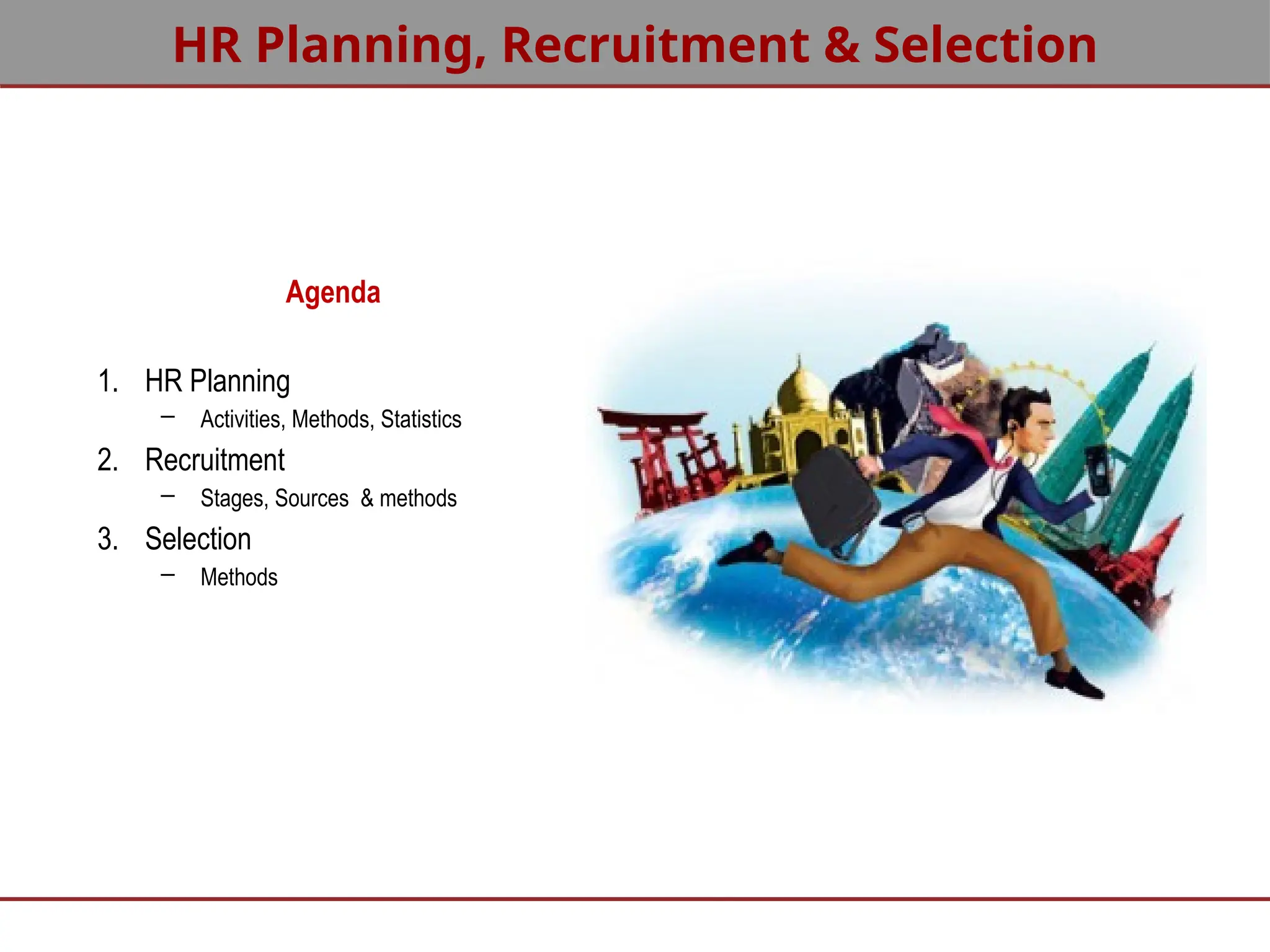
Agenda
1. HR Planning
– Activities, Methods, Statistics
2. Recruitment
– Stages, Sources & methods
3. Selection
– Methods
HR PLANNING
HR Planning
• HRP is concerned with the acquisition, use, improvement and
preservation of an organization's employees to match its business
plans.
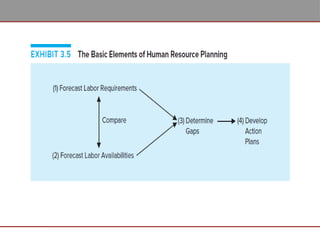
– attempts to reconcile HR ‘demand’ (forecast from extrapolating corporate
plans) and ‘supply’ (forecast by working out the availability of HR and
calculating likely shortfalls and surpluses)
– provides organizations with the possibility of reaching the ultimate goal of
employing the ‘correct’ number of people with the requisite skills
Activities in HR Planning
1. Forecasting Demand for HR – HR must plan with other departments
if they are to operate strategically. A demand model is then
constructed and data fed in to produce estimates. HR demand can
be determined by
• marketing plans, outlining which products will be offered and in what
quantities;
• operations plans, specifying methods of production, distribution and
development; and
• financial plans, detailing how activities will be funded.
2. Forecasting Supply of HR - HR supply (from both existing and new
sources) needs to be examined, calculated and forecast.
• includes the source of supply (ILMs or ELMs) and skills, profiles,
characteristics and behavior of the required HR
• In parts of Asia, the emphasis has been on the ‘right number’ and
‘right time’ and the ‘right skills’ has often been ignored.
• In some rapidly modernizing economies of Asia, HR are considered
to be so freely available that the potential contribution of HRM is
overlooked.
• This neglect of the application of systematic HRM techniques is
damaging to organizational success
Activities in HR Planning
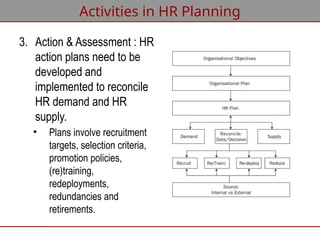
3. Action & Assessment : HR
action plans need to be
developed and
implemented to reconcile
HR demand and HR
supply.
• Plans involve recruitment
targets, selection criteria,
promotion policies,
(re)training,
redeployments,
redundancies and
retirements.
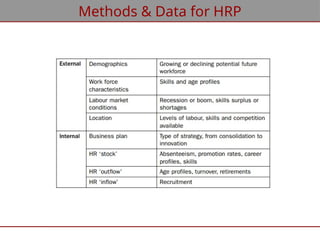
Methods & Data In HRP
• An initial starting point for HRP is to examine any corporate
databases.
– HRIS, main HRM records containing basic facts in a structured format, records
of performance appraisals and other reports
– production rates, salaries, financial files etc.
– Profiles: Length of service, skills, qualifications etc
– Parts of Asia the use of an HRIS is rare, personal files of staff are most likely to
be held in paper formats
• Work Study
– Even if ‘output’ (manufacturing and services) requirements and details of
existing HR are fairly certain, exactly how many, and what type of HR are
actually needed?
– work study can be used to compute standard times and standard work
methods for different jobs
– Sales and production forecasts can then be used as a basis for HR demand
forecasting
• In some organizations in Asia work study tends to be based on
historical data rather than the production of standard data.
Or political
• Modelling techniques - linear and other statistical models can be
used in forecasting and to investigate relationships between
variables.
– techniques can be used to project future demand based on previous HR levels
and sales or relate employment to a variety of factors, such as how technology
or market growth will affect employment
– Asian organizations can analyze daily and weekly data, as societies and
economies are changing so rapidly.
Methods & Data for HRP
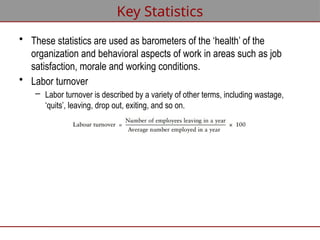
Key Statistics
• These statistics are used as barometers of the ‘health’ of the
organization and behavioral aspects of work in areas such as job
satisfaction, morale and working conditions.
• Labor turnover
– Labor turnover is described by a variety of other terms, including wastage,
‘quits’, leaving, drop out, exiting, and so on.
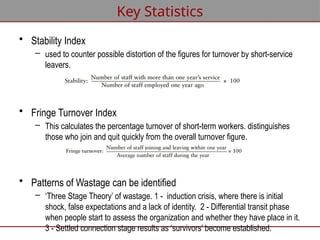
• Stability Index
– used to counter possible distortion of the figures for turnover by short-service
leavers.
• Fringe Turnover Index
– This calculates the percentage turnover of short-term workers. distinguishes
those who join and quit quickly from the overall turnover figure.
• Patterns of Wastage can be identified
– ‘Three Stage Theory’ of wastage. 1 - induction crisis, where there is initial
shock, false expectations and a lack of identity. 2 - Differential transit phase
when people start to assess the organization and whether they have place in it.
3 - Settled connection stage results as ‘survivors’ become established.
Key Statistics
• In parts of Asia, have little choice in their source of employment, and
employers and labour supply agents find a variety of means to
prevent employees from leaving.
• Absenteeism. This can be measured in several ways, which include
measuring (a) the percentage of lost working days, (b) days lost per
working year, and (c) average length of absence
• In Asia-Great pressure from employers
• Cultural and family pressures may leads to absenteeism.
Key Statistics
RECRUITMENT
Definition
• Recruitment is the process of contacting suitably qualified
applicants(internal and external) for a vacant position and
encouraging the suitable people to apply.
• Selection is the process of matching the attributes of candidates with
the requirements of the job and then choosing the most appropriate
applicants for the vacancies.
• Asian Patterns
– Asian countries will impose laws in recruitment, such as those that apply to the
scheduled castes (dalit or lower castes) in India or Bumiputras (Malays and
other ‘sons of the soil’) in Malaysia.
– In parts of Asia recruitment has depended more on ‘who you are’ and ‘who you
know’ rather than ‘what you know’. Some Asian employers will seek candidates
among relations or friends of existing staff or among other contacts.
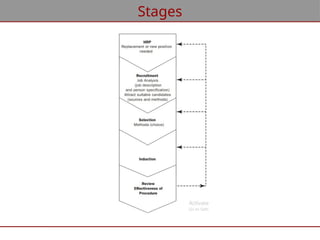
Stages
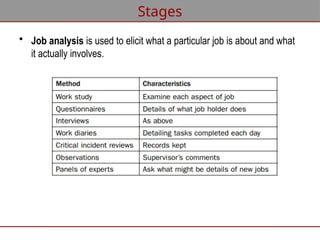
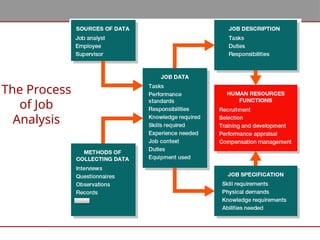
• Job analysis is used to elicit what a particular job is about and what
it actually involves.
Stages
The Process
of Job
Analysis
Stages
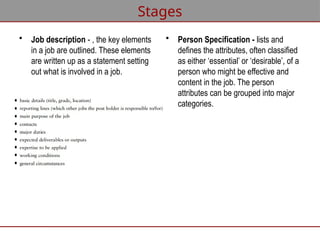
• Job description - , the key elements
in a job are outlined. These elements
are written up as a statement setting
out what is involved in a job.
• Person Specification - lists and
defines the attributes, often classified
as either ‘essential’ or ‘desirable’, of a
person who might be effective and
content in the job. The person
attributes can be grouped into major
categories.
• In some parts of Asia, specifications are very general, and would
probably be unacceptable in the West. For example, saying
‘attractive, female aged 18 to 21’ or ‘strong, healthy male aged 21 to
25’ would be considered discriminatory in the West.
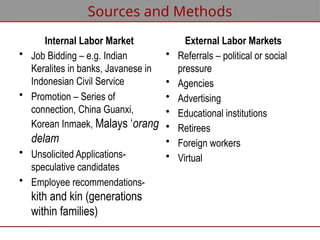
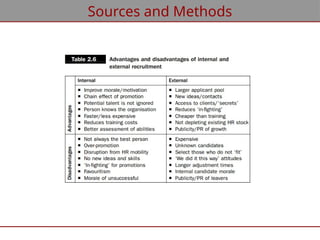
Sources and Methods
Internal Labor Market
• Job Bidding – e.g. Indian
Keralites in banks, Javanese in
Indonesian Civil Service
• Promotion – Series of
connection, China Guanxi,
Korean Inmaek, Malays ‘orang
delam
• Unsolicited Applications-
speculative candidates
• Employee recommendations-
kith and kin (generations
within families)
External Labor Markets
• Referrals – political or social
pressure
• Agencies
• Advertising
• Educational institutions
• Retirees
• Foreign workers
• Virtual
Foreign Workers
• Chinese laundry men,
Indian rubber tappers,
• Malaysian and Sikh
security guards in Hong
Kong.
Pakistanis moved to the UK
to work in industrial mills
Bangladeshis moved to
Europe to open ‘Indian’
restaurants.
Sources and Methods
SELECTION
Methods
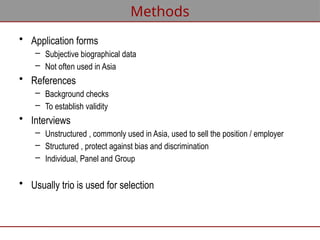
• Application forms
– Subjective biographical data
– Not often used in Asia
• References
– Background checks
– To establish validity
• Interviews
– Unstructured , commonly used in Asia, used to sell the position / employer
– Structured , protect against bias and discrimination
– Individual, Panel and Group
• Usually trio is used for selection
• Employment tests
– Better predictors than the trio
• Ability tests
• Psychometric tests
• Assessment centers
What might be some disadvantages with employment tests?
Methods
• Using tests developed outside Asia may have unforeseen cultural
expectations with them, may be biased against groups in Asia.
– For example, in some Asian educational systems students are taught to
remember the ‘right’ answer, whereas most Western ability tests ask those
being tested to find the ‘right’ answer.
Methods
Q&A

L7 - HR Planning, Recruitment & Selection.pptx

  • 1.
    HR Planning, Recruitment& Selection Agenda 1. HR Planning – Activities, Methods, Statistics 2. Recruitment – Stages, Sources & methods 3. Selection – Methods
  • 2.
  • 3.
    HR Planning • HRPis concerned with the acquisition, use, improvement and preservation of an organization's employees to match its business plans. – attempts to reconcile HR ‘demand’ (forecast from extrapolating corporate plans) and ‘supply’ (forecast by working out the availability of HR and calculating likely shortfalls and surpluses) – provides organizations with the possibility of reaching the ultimate goal of employing the ‘correct’ number of people with the requisite skills
  • 5.
    Activities in HRPlanning 1. Forecasting Demand for HR – HR must plan with other departments if they are to operate strategically. A demand model is then constructed and data fed in to produce estimates. HR demand can be determined by • marketing plans, outlining which products will be offered and in what quantities; • operations plans, specifying methods of production, distribution and development; and • financial plans, detailing how activities will be funded. 2. Forecasting Supply of HR - HR supply (from both existing and new sources) needs to be examined, calculated and forecast. • includes the source of supply (ILMs or ELMs) and skills, profiles, characteristics and behavior of the required HR
  • 6.
    • In partsof Asia, the emphasis has been on the ‘right number’ and ‘right time’ and the ‘right skills’ has often been ignored. • In some rapidly modernizing economies of Asia, HR are considered to be so freely available that the potential contribution of HRM is overlooked. • This neglect of the application of systematic HRM techniques is damaging to organizational success
  • 7.
    Activities in HRPlanning 3. Action & Assessment : HR action plans need to be developed and implemented to reconcile HR demand and HR supply. • Plans involve recruitment targets, selection criteria, promotion policies, (re)training, redeployments, redundancies and retirements.
  • 8.
    Methods & DataIn HRP • An initial starting point for HRP is to examine any corporate databases. – HRIS, main HRM records containing basic facts in a structured format, records of performance appraisals and other reports – production rates, salaries, financial files etc. – Profiles: Length of service, skills, qualifications etc – Parts of Asia the use of an HRIS is rare, personal files of staff are most likely to be held in paper formats • Work Study – Even if ‘output’ (manufacturing and services) requirements and details of existing HR are fairly certain, exactly how many, and what type of HR are actually needed? – work study can be used to compute standard times and standard work methods for different jobs – Sales and production forecasts can then be used as a basis for HR demand forecasting
  • 9.
    • In someorganizations in Asia work study tends to be based on historical data rather than the production of standard data. Or political
  • 10.
    • Modelling techniques- linear and other statistical models can be used in forecasting and to investigate relationships between variables. – techniques can be used to project future demand based on previous HR levels and sales or relate employment to a variety of factors, such as how technology or market growth will affect employment – Asian organizations can analyze daily and weekly data, as societies and economies are changing so rapidly. Methods & Data for HRP
  • 11.
  • 12.
    Key Statistics • Thesestatistics are used as barometers of the ‘health’ of the organization and behavioral aspects of work in areas such as job satisfaction, morale and working conditions. • Labor turnover – Labor turnover is described by a variety of other terms, including wastage, ‘quits’, leaving, drop out, exiting, and so on.
  • 13.
    • Stability Index –used to counter possible distortion of the figures for turnover by short-service leavers. • Fringe Turnover Index – This calculates the percentage turnover of short-term workers. distinguishes those who join and quit quickly from the overall turnover figure. • Patterns of Wastage can be identified – ‘Three Stage Theory’ of wastage. 1 - induction crisis, where there is initial shock, false expectations and a lack of identity. 2 - Differential transit phase when people start to assess the organization and whether they have place in it. 3 - Settled connection stage results as ‘survivors’ become established. Key Statistics
  • 14.
    • In partsof Asia, have little choice in their source of employment, and employers and labour supply agents find a variety of means to prevent employees from leaving.
  • 15.
    • Absenteeism. Thiscan be measured in several ways, which include measuring (a) the percentage of lost working days, (b) days lost per working year, and (c) average length of absence • In Asia-Great pressure from employers • Cultural and family pressures may leads to absenteeism. Key Statistics
  • 16.
  • 17.
    Definition • Recruitment isthe process of contacting suitably qualified applicants(internal and external) for a vacant position and encouraging the suitable people to apply. • Selection is the process of matching the attributes of candidates with the requirements of the job and then choosing the most appropriate applicants for the vacancies. • Asian Patterns – Asian countries will impose laws in recruitment, such as those that apply to the scheduled castes (dalit or lower castes) in India or Bumiputras (Malays and other ‘sons of the soil’) in Malaysia. – In parts of Asia recruitment has depended more on ‘who you are’ and ‘who you know’ rather than ‘what you know’. Some Asian employers will seek candidates among relations or friends of existing staff or among other contacts.
  • 18.
  • 19.
    • Job analysisis used to elicit what a particular job is about and what it actually involves. Stages
  • 20.
  • 21.
    Stages • Job description- , the key elements in a job are outlined. These elements are written up as a statement setting out what is involved in a job. • Person Specification - lists and defines the attributes, often classified as either ‘essential’ or ‘desirable’, of a person who might be effective and content in the job. The person attributes can be grouped into major categories.
  • 22.
    • In someparts of Asia, specifications are very general, and would probably be unacceptable in the West. For example, saying ‘attractive, female aged 18 to 21’ or ‘strong, healthy male aged 21 to 25’ would be considered discriminatory in the West.
  • 23.
    Sources and Methods InternalLabor Market • Job Bidding – e.g. Indian Keralites in banks, Javanese in Indonesian Civil Service • Promotion – Series of connection, China Guanxi, Korean Inmaek, Malays ‘orang delam • Unsolicited Applications- speculative candidates • Employee recommendations- kith and kin (generations within families) External Labor Markets • Referrals – political or social pressure • Agencies • Advertising • Educational institutions • Retirees • Foreign workers • Virtual
  • 24.
    Foreign Workers • Chineselaundry men, Indian rubber tappers, • Malaysian and Sikh security guards in Hong Kong. Pakistanis moved to the UK to work in industrial mills Bangladeshis moved to Europe to open ‘Indian’ restaurants.
  • 25.
  • 26.
  • 27.
    Methods • Application forms –Subjective biographical data – Not often used in Asia • References – Background checks – To establish validity • Interviews – Unstructured , commonly used in Asia, used to sell the position / employer – Structured , protect against bias and discrimination – Individual, Panel and Group • Usually trio is used for selection
  • 28.
    • Employment tests –Better predictors than the trio • Ability tests • Psychometric tests • Assessment centers What might be some disadvantages with employment tests? Methods
  • 29.
    • Using testsdeveloped outside Asia may have unforeseen cultural expectations with them, may be biased against groups in Asia. – For example, in some Asian educational systems students are taught to remember the ‘right’ answer, whereas most Western ability tests ask those being tested to find the ‘right’ answer. Methods
  • 30.