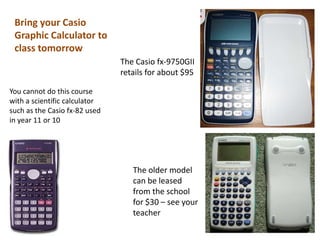
Bring your Casio
 Graphic Calculator to
 class tomorrow
                               The Casio fx-9750GII
                               retails for about $95

You cannot do this course
with a scientific calculator
such as the Casio fx-82 used
in year 11 or 10


                                  The older model
                                  can be leased
                                  from the school
                                  for $30 – see your
                                  teacher
Learning Intention


Understanding the different types of statistical questioning

(which is important to AS2.9)


                                      Please write this in your notes book


 We are going to analyse your questions – anonymously
Types of Data

Categorical: categories or groups which are non-numeric
        e.g. gender, favourite sport

Discrete: numeric data with integer or unit values
        e.g. number of students, cars

Continuous: numeric data which can have an infinite
            or large number of values, both integer and decimal
       e.g. sales revenue, height

                                        Please write this in your notes book

 Now consider what types of data is in the database
Types of questions

Summary information about something

e.g. what is the average score for the final test of Mr Honore’s maths class ?


Relationship how two things interact        (bivariate)

e.g. How does the length of a person’s arm affect the distance they can throw
       a softball ?

    How does the weather affect the number of New Zealanders sunbathing
      outdoors?

Comparison comparing one numeric thing across two non-numeric categories
           (multivariate)

e.g. How does the heights of boys at Rongotai compare to girls at WGC ?

    How does the cost of mobile phones from Vodafone compare with
     Telecom and 2D ?
                                          Don’t write this – notes are coming later
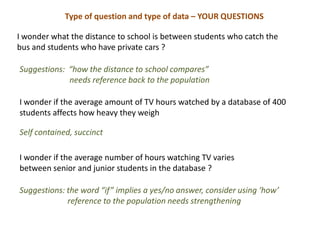
Type of question and type of data – YOUR QUESTIONS

I wonder what the distance to school is between students who catch the
bus and students who have private cars ?

Suggestions: “how the distance to school compares”
             needs reference back to the population

I wonder if the average amount of TV hours watched by a database of 400
students affects how heavy they weigh

Self contained, succinct

I wonder if the average number of hours watching TV varies
between senior and junior students in the database ?

Suggestions: the word “if” implies a yes/no answer, consider using ‘how’
             reference to the population needs strengthening
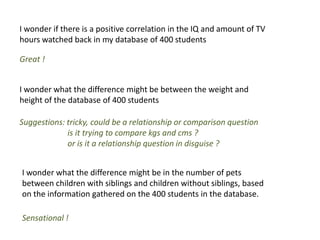
I wonder if there is a positive correlation in the IQ and amount of TV
hours watched back in my database of 400 students

Great !


I wonder what the difference might be between the weight and
height of the database of 400 students

Suggestions: tricky, could be a relationship or comparison question
             is it trying to compare kgs and cms ?
             or is it a relationship question in disguise ?


I wonder what the difference might be in the number of pets
between children with siblings and children without siblings, based
on the information gathered on the 400 students in the database.

Sensational !
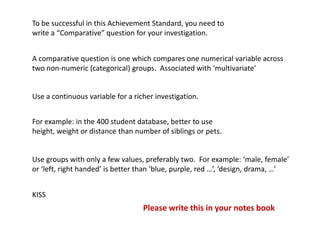
To be successful in this Achievement Standard, you need to
write a “Comparative” question for your investigation.


A comparative question is one which compares one numerical variable across
two non-numeric (categorical) groups. Associated with ‘multivariate’


Use a continuous variable for a richer investigation.


For example: in the 400 student database, better to use
height, weight or distance than number of siblings or pets.


Use groups with only a few values, preferably two. For example: ‘male, female’
or ‘left, right handed’ is better than ‘blue, purple, red …’, ‘design, drama, …’


KISS
                                   Please write this in your notes book
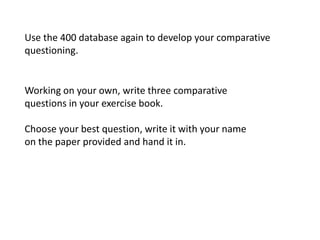
Use the 400 database again to develop your comparative
questioning.


Working on your own, write three comparative
questions in your exercise book.

Choose your best question, write it with your name
on the paper provided and hand it in.
L2 more on questions using their work 07feb12

L2 more on questions using their work 07feb12

  • 1.
    Bring your Casio Graphic Calculator to class tomorrow The Casio fx-9750GII retails for about $95 You cannot do this course with a scientific calculator such as the Casio fx-82 used in year 11 or 10 The older model can be leased from the school for $30 – see your teacher
  • 2.
    Learning Intention Understanding thedifferent types of statistical questioning (which is important to AS2.9) Please write this in your notes book We are going to analyse your questions – anonymously
  • 3.
    Types of Data Categorical:categories or groups which are non-numeric e.g. gender, favourite sport Discrete: numeric data with integer or unit values e.g. number of students, cars Continuous: numeric data which can have an infinite or large number of values, both integer and decimal e.g. sales revenue, height Please write this in your notes book Now consider what types of data is in the database
  • 4.
    Types of questions Summaryinformation about something e.g. what is the average score for the final test of Mr Honore’s maths class ? Relationship how two things interact (bivariate) e.g. How does the length of a person’s arm affect the distance they can throw a softball ? How does the weather affect the number of New Zealanders sunbathing outdoors? Comparison comparing one numeric thing across two non-numeric categories (multivariate) e.g. How does the heights of boys at Rongotai compare to girls at WGC ? How does the cost of mobile phones from Vodafone compare with Telecom and 2D ? Don’t write this – notes are coming later
  • 5.
    Type of questionand type of data – YOUR QUESTIONS I wonder what the distance to school is between students who catch the bus and students who have private cars ? Suggestions: “how the distance to school compares” needs reference back to the population I wonder if the average amount of TV hours watched by a database of 400 students affects how heavy they weigh Self contained, succinct I wonder if the average number of hours watching TV varies between senior and junior students in the database ? Suggestions: the word “if” implies a yes/no answer, consider using ‘how’ reference to the population needs strengthening
  • 6.
    I wonder ifthere is a positive correlation in the IQ and amount of TV hours watched back in my database of 400 students Great ! I wonder what the difference might be between the weight and height of the database of 400 students Suggestions: tricky, could be a relationship or comparison question is it trying to compare kgs and cms ? or is it a relationship question in disguise ? I wonder what the difference might be in the number of pets between children with siblings and children without siblings, based on the information gathered on the 400 students in the database. Sensational !
  • 7.
    To be successfulin this Achievement Standard, you need to write a “Comparative” question for your investigation. A comparative question is one which compares one numerical variable across two non-numeric (categorical) groups. Associated with ‘multivariate’ Use a continuous variable for a richer investigation. For example: in the 400 student database, better to use height, weight or distance than number of siblings or pets. Use groups with only a few values, preferably two. For example: ‘male, female’ or ‘left, right handed’ is better than ‘blue, purple, red …’, ‘design, drama, …’ KISS Please write this in your notes book
  • 8.
    Use the 400database again to develop your comparative questioning. Working on your own, write three comparative questions in your exercise book. Choose your best question, write it with your name on the paper provided and hand it in.