Scientific Writing;
Beginner’s guide
"Writing is an art. But when
it is writing to inform it
comes close to being a
science as well."
Robert Gunning
ABRAR HUSSAIN
RESEARCH SCHOLAR
1
Objectives
Understand
the concept
of scientific
writing
Elaborate
format and
process of
scientific
writing
Describe the
main
characteristics
of the
scientific
writing
Learn the
academic
integrity,
honesty, and
ethics of
scientific
writing
2
Scientific
Writing
3
Scientific Writing
► Scientific writing is a technical form of writing that
► communicates scientific information to others in a document, book
or presentation in written form.
► A precise way to explain what is done, what is found, and why it is
done.
► It is a clear, simple and well ordered communication of the
transmission of new scientific findings.
► The purpose of scientific writing is to communicate new
scientific findings.
4
History of Scientific Writing
► Knowledge is lost without written records
► Cave paintings and inscriptions were the first attempts to leave
records
► About 2000 BC, Papyrus paper was used as a medium of
communication
► In 190 BC, parchment made from animal skin came into use
► In 105 AD, the Chinese invented paper.
► Knowledge could not be widely circulated with no effective
duplication
► In 1100 AD, the Chinese invented movable type
► In 1455 AD, Gutenberg printed his 42-line Bible from movable type
on a printing press
► By the year 1500 thousands of copies of hundreds of books were
printed
► In 1665, the first scientific journals were published.
5
Publication
types
Research
paper
Review
Article
Reports
Letters
Notes
Commun
ication
Specific
issues
6
Characteristics
of scientific
writing
7
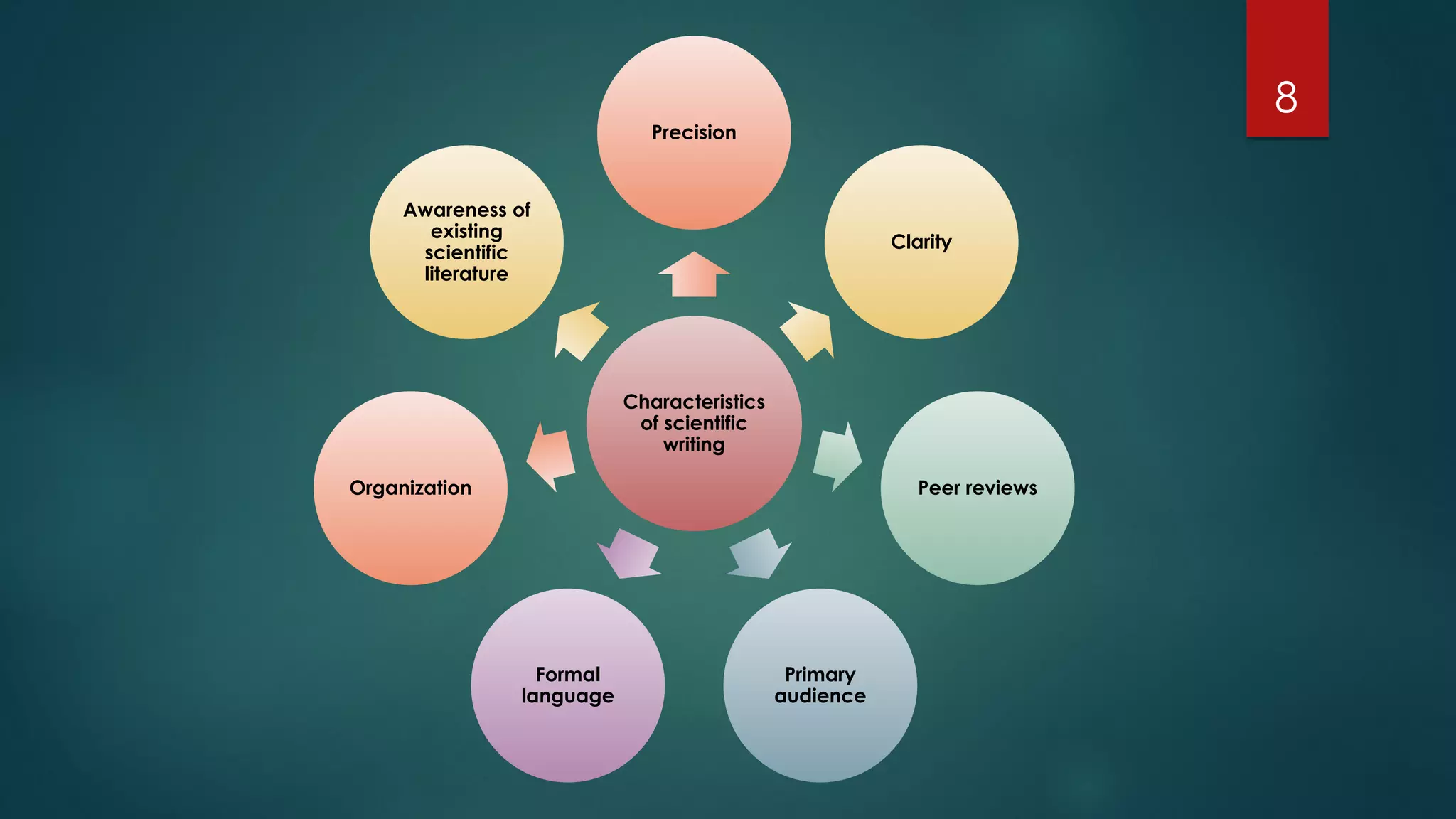
Characteristics
of scientific
writing
Precision
Clarity
Peer reviews
Primary
audience
Formal
language
Organization
Awareness of
existing
scientific
literature
8
9
Tips for
Scientific
writing
10
Tips for writing
Before you start writing, ask:
“What am I trying to say?”
► When you finish writing, ask:
“Have I said it?”
► Poor experimentation cannot be masked by brilliant writing; however,
poor writing can mask brilliant experimentation
► Avoid complex sentence structure
11
Write to
communicate,
not to impress.
Follow the
instructions.
Use good
models.
Gather plenty
of suitable
information.
Organize the
information
carefully.
Set aside blocks
of time for
writing.
Keep your
audience in
mind.
Credit sources
adequately.
Revise, revise,
revise.
12
Basic rules
for scientific
writing
Split the writing process
Mood
First draft
Revise
Finish
13
Process of scientific writing
14
IMRAD method
► I = Introduction, what question (problem) was studied
► M = Methods, how was the problem studied
► R = Results, what are the findings
► A = and
► D = Discussion, what do these findings mean
► If a number of methods were used to achieve directly
related results:
M + R = Experimental section
► The results are so complex that they need to be
immediately discussed:
R + D = Results and Discussion section.
15
48 point
36 point
24 point
18 point
14 point
12 point
10 point
8 point
posters
presentation slides
titles
text
footnotes
Formatting 16
Format is changing
Reports
Figure 1
Table 1
equation 1
Textbooks
Prentice-Hall
Fig. 1
Table 1
equation (1)
Journals
ASME
fig. 1
table 1
Eq. 1
17
Ethics in
Scientific Writing
18
Scientific writing ethics
► Following ethical guidelines will ensure that your research is authentic
and error-free, and will allow you to gain credibility and support from the
public.
► So ethical scientific writing involves several issues:
► 1) avoiding plagiarism – the copying of someone else’s expressions or ideas,
► 2) writing a report that is accurate and unbiased.
► 3) maintaining patient confidentiality.
► 4) not writing too many papers from a research study – so-called “salami
publication”
► 5) not failing to actually write-up and publish a peer-reviewed journal paper about a
completed study.
19
Submission
20
After writing
► i. Is topic of my paper within its scope and format?
► ii. Would it match my audience?
► iii. Ask mentor or other senior researchers
► iv. Impact Factor
► v. Consequences of wrong decision: time lost; failure to
publish
Suitable journal selection
21
Conclusion- Scientific writing
Ethical aspects of scientific writing include, avoiding plagiarism, confidentiality, accurate and unbiased.
IMRAD method are mostly used.
Write for communication, keeping audience in mind, organizations and use of formal language are
key feature of scientific writing.
Scientific writing have different forms, review article, the research proposal, and the lab report/research
paper.
Scientific writing is a clear, simple and precise way of writing that communicates scientific information
to others in a document, book or presentation in written form.
22
23

L1-Scientific Writing;Beginner guide

  • 1.
    Scientific Writing; Beginner’s guide "Writingis an art. But when it is writing to inform it comes close to being a science as well." Robert Gunning ABRAR HUSSAIN RESEARCH SCHOLAR 1
  • 2.
    Objectives Understand the concept of scientific writing Elaborate formatand process of scientific writing Describe the main characteristics of the scientific writing Learn the academic integrity, honesty, and ethics of scientific writing 2
  • 3.
  • 4.
    Scientific Writing ► Scientificwriting is a technical form of writing that ► communicates scientific information to others in a document, book or presentation in written form. ► A precise way to explain what is done, what is found, and why it is done. ► It is a clear, simple and well ordered communication of the transmission of new scientific findings. ► The purpose of scientific writing is to communicate new scientific findings. 4
  • 5.
    History of ScientificWriting ► Knowledge is lost without written records ► Cave paintings and inscriptions were the first attempts to leave records ► About 2000 BC, Papyrus paper was used as a medium of communication ► In 190 BC, parchment made from animal skin came into use ► In 105 AD, the Chinese invented paper. ► Knowledge could not be widely circulated with no effective duplication ► In 1100 AD, the Chinese invented movable type ► In 1455 AD, Gutenberg printed his 42-line Bible from movable type on a printing press ► By the year 1500 thousands of copies of hundreds of books were printed ► In 1665, the first scientific journals were published. 5
  • 6.
  • 7.
  • 8.
  • 9.
  • 10.
  • 11.
    Tips for writing Beforeyou start writing, ask: “What am I trying to say?” ► When you finish writing, ask: “Have I said it?” ► Poor experimentation cannot be masked by brilliant writing; however, poor writing can mask brilliant experimentation ► Avoid complex sentence structure 11
  • 12.
    Write to communicate, not toimpress. Follow the instructions. Use good models. Gather plenty of suitable information. Organize the information carefully. Set aside blocks of time for writing. Keep your audience in mind. Credit sources adequately. Revise, revise, revise. 12 Basic rules for scientific writing
  • 13.
    Split the writingprocess Mood First draft Revise Finish 13
  • 14.
  • 15.
    IMRAD method ► I= Introduction, what question (problem) was studied ► M = Methods, how was the problem studied ► R = Results, what are the findings ► A = and ► D = Discussion, what do these findings mean ► If a number of methods were used to achieve directly related results: M + R = Experimental section ► The results are so complex that they need to be immediately discussed: R + D = Results and Discussion section. 15
  • 16.
    48 point 36 point 24point 18 point 14 point 12 point 10 point 8 point posters presentation slides titles text footnotes Formatting 16
  • 17.
    Format is changing Reports Figure1 Table 1 equation 1 Textbooks Prentice-Hall Fig. 1 Table 1 equation (1) Journals ASME fig. 1 table 1 Eq. 1 17
  • 18.
  • 19.
    Scientific writing ethics ►Following ethical guidelines will ensure that your research is authentic and error-free, and will allow you to gain credibility and support from the public. ► So ethical scientific writing involves several issues: ► 1) avoiding plagiarism – the copying of someone else’s expressions or ideas, ► 2) writing a report that is accurate and unbiased. ► 3) maintaining patient confidentiality. ► 4) not writing too many papers from a research study – so-called “salami publication” ► 5) not failing to actually write-up and publish a peer-reviewed journal paper about a completed study. 19
  • 20.
  • 21.
    After writing ► i.Is topic of my paper within its scope and format? ► ii. Would it match my audience? ► iii. Ask mentor or other senior researchers ► iv. Impact Factor ► v. Consequences of wrong decision: time lost; failure to publish Suitable journal selection 21
  • 22.
    Conclusion- Scientific writing Ethicalaspects of scientific writing include, avoiding plagiarism, confidentiality, accurate and unbiased. IMRAD method are mostly used. Write for communication, keeping audience in mind, organizations and use of formal language are key feature of scientific writing. Scientific writing have different forms, review article, the research proposal, and the lab report/research paper. Scientific writing is a clear, simple and precise way of writing that communicates scientific information to others in a document, book or presentation in written form. 22
  • 23.