Replaced title type
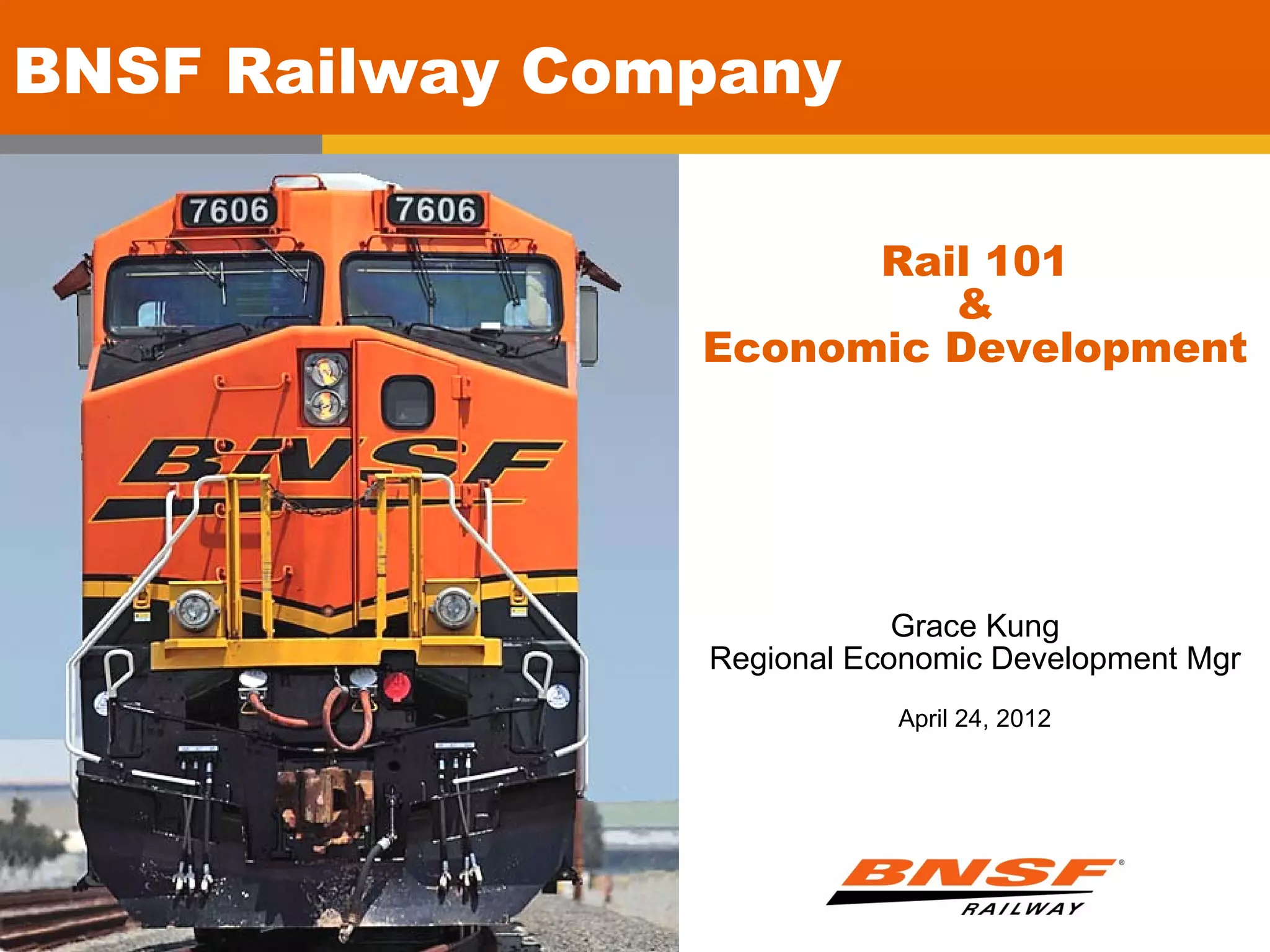
BNSF Railway Company              and photo


                      Rail 101
                         &
                Economic Development


                            Grace Kung
                Regional Economic Development Mgr
                           April 24, 2012
Agenda

   Industry Overview
   BNSF Overview
   Why Rail?
   Why Economic Development?


                                2
Rail Industry Overview


                         3
Industry Overview
America’s Railroad Industry
Railroads remain the backbone of America’s freight transportation network
     U.S. railroads operate over 140,000 miles of track and earn an
      aggregate freight revenue of nearly $57 billion
     In the United States, railroads account for more than 40%* of all
      freight (more than trucks, boats, barges or planes) *Measured in Ton Miles
     70% of all autos produced in America move by rail
     30% of all U.S. grain moves by rail
     65% of the coal is moved by rail which in turn produces half of
      America’s electricity
     U.S. Railroads move enough:
            Wheat to provide every person with a loaf of bread 6 days/week
            Concrete to build 45 miles of new highway every day


North American railroads form the world’s most efficient and lowest-cost freight network


 Source: American Association of Railroads (AAR)                                           4
Industry Overview
A key link in the U.S. Supply Chain
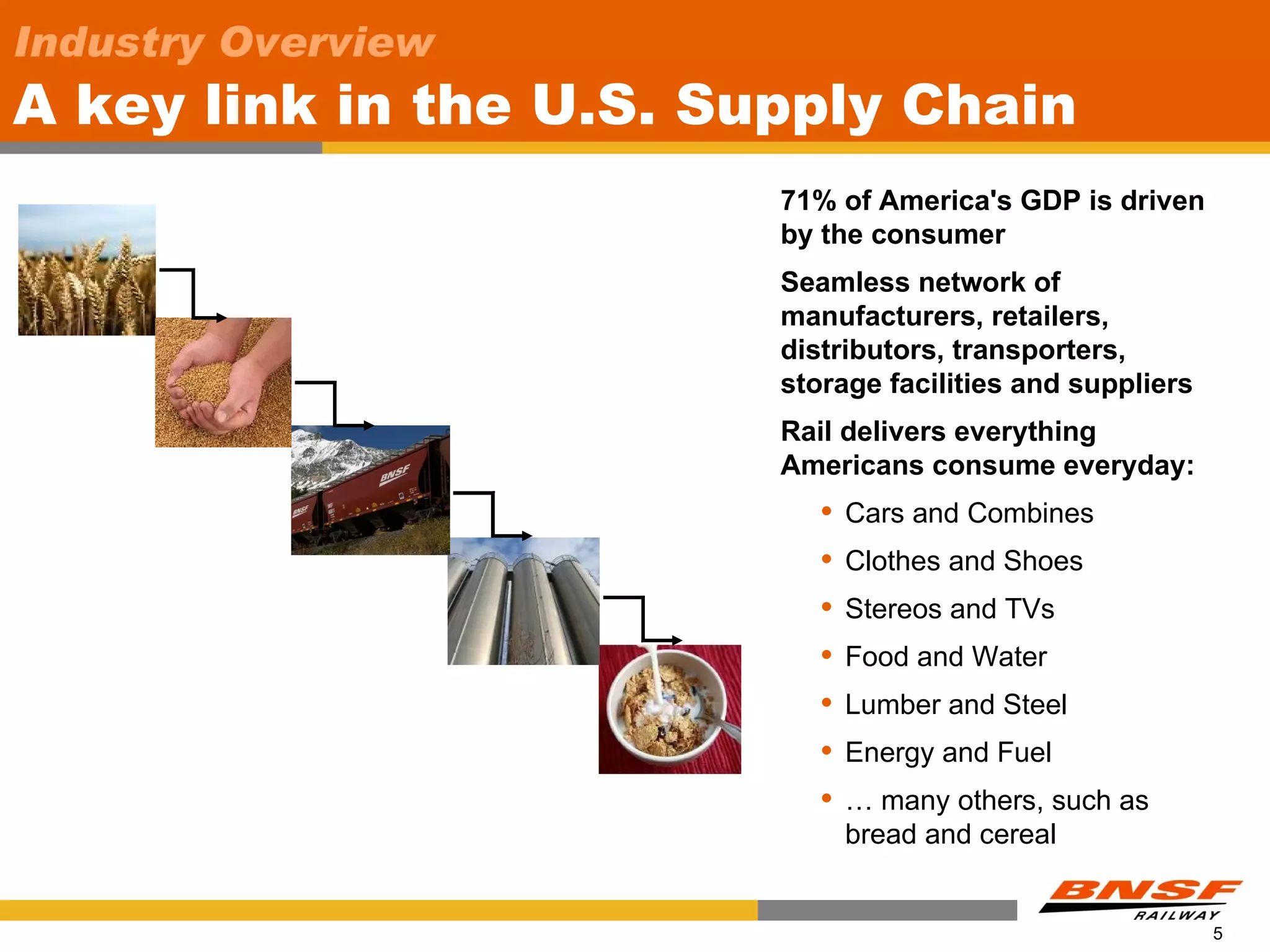
                         71% of America's GDP is driven
                         by the consumer
                         Seamless network of
                         manufacturers, retailers,
                         distributors, transporters,
                         storage facilities and suppliers
                         Rail delivers everything
                         Americans consume everyday:
                               Cars and Combines
                               Clothes and Shoes
                               Stereos and TVs
                               Food and Water
                               Lumber and Steel
                               Energy and Fuel
                               … many others, such as
                                bread and cereal


                                                            5
Industry Overview
Types of Railroads
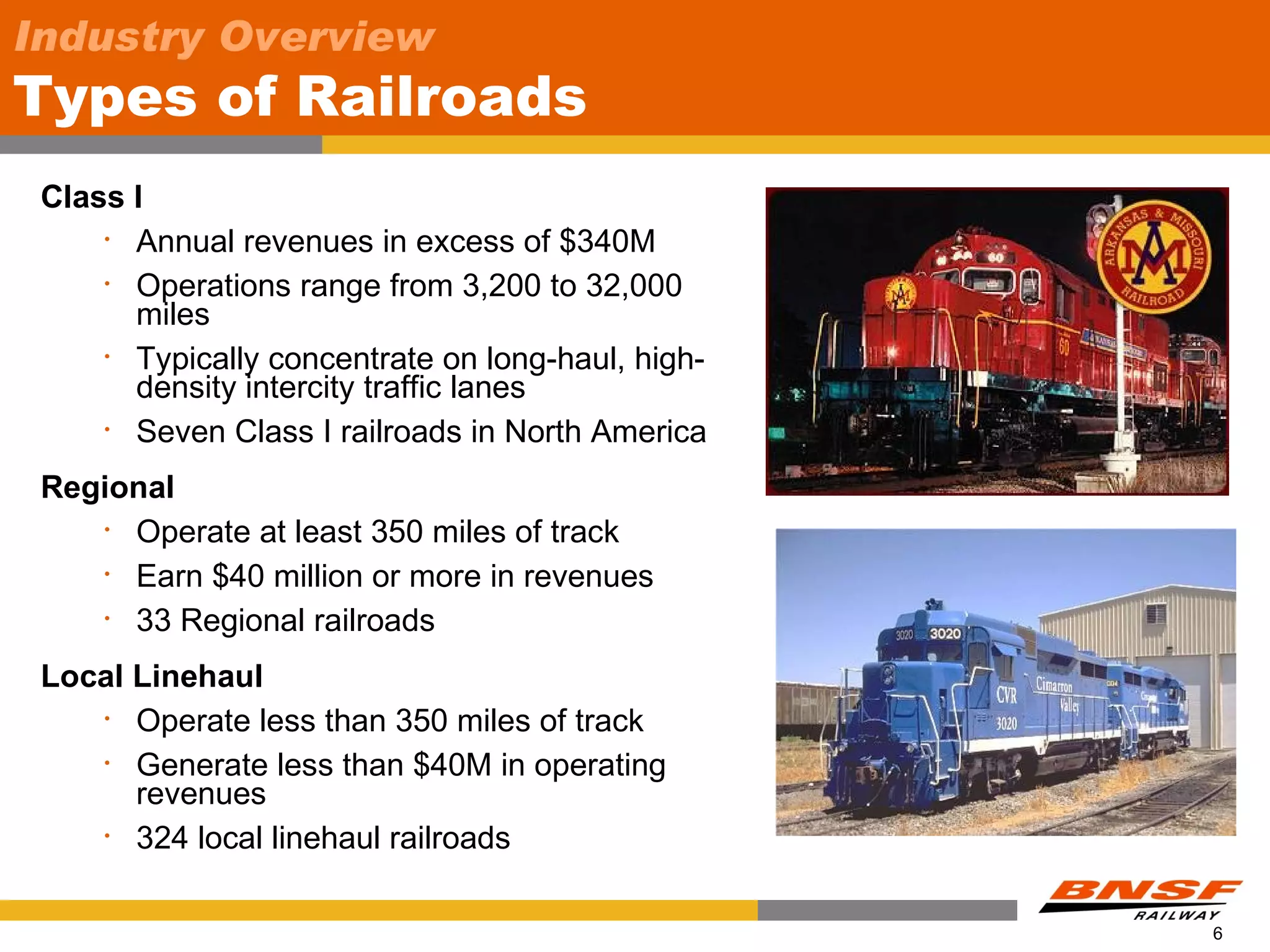
 Class I
     • Annual revenues in excess of $340M

     • Operations range from 3,200 to 32,000

       miles
     • Typically concentrate on long-haul, high-

       density intercity traffic lanes
     • Seven Class I railroads in North America


 Regional
    • Operate at least 350 miles of track

    • Earn $40 million or more in revenues

    • 33 Regional railroads


 Local Linehaul
    • Operate less than 350 miles of track

    • Generate less than $40M in operating

       revenues
    • 324 local linehaul railroads


                                                   6
Industry Overview
North America Rail Network
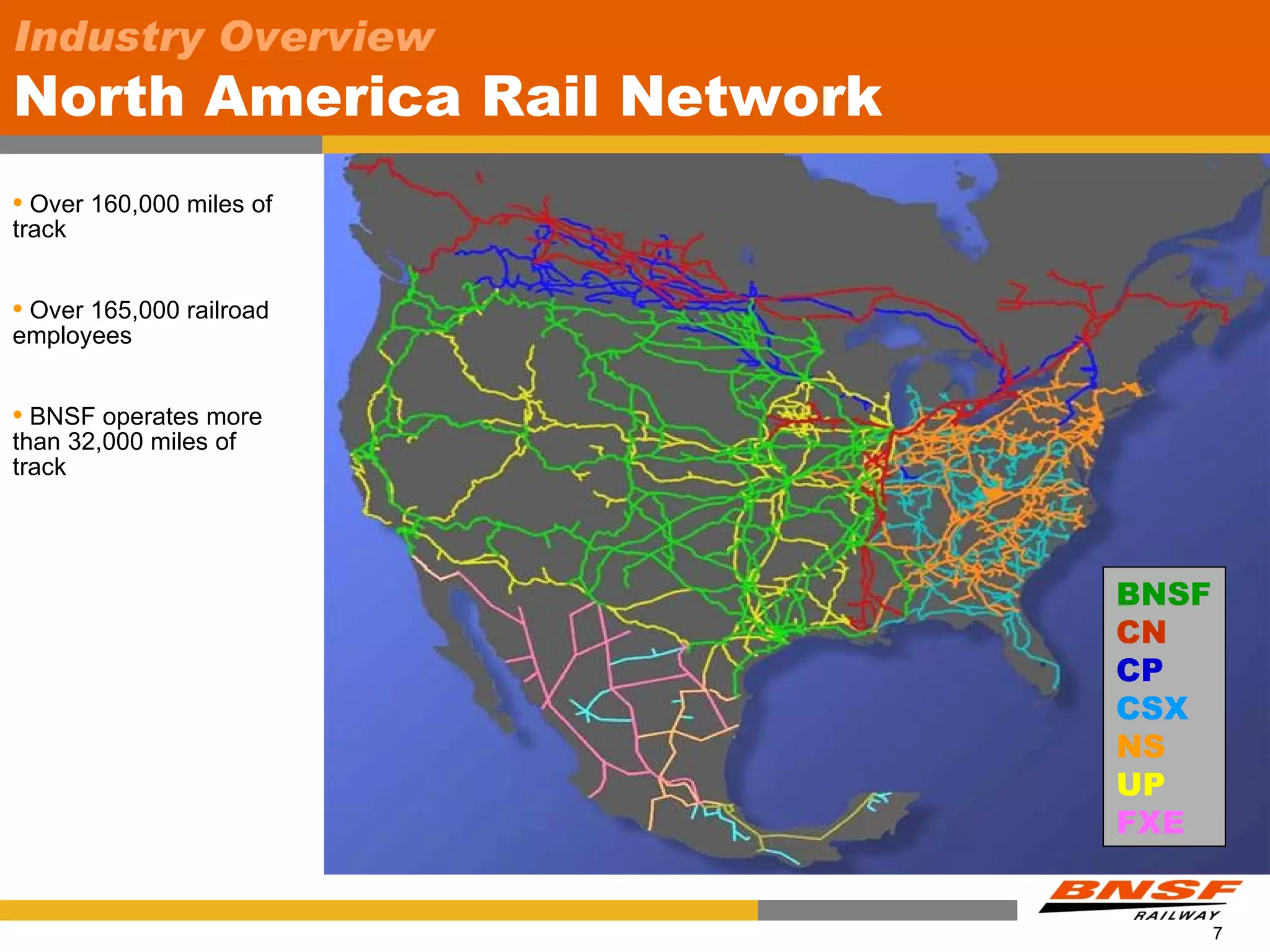
 Over 160,000 miles of
track


Over 165,000 railroad
employees


 BNSF operates more
than 32,000 miles of
track


                             BNSF
                             CN
                             CP
                             CSX
                             NS
                             UP
                             FXE


                                    7
Industry Overview
Transportation Industry Challenges


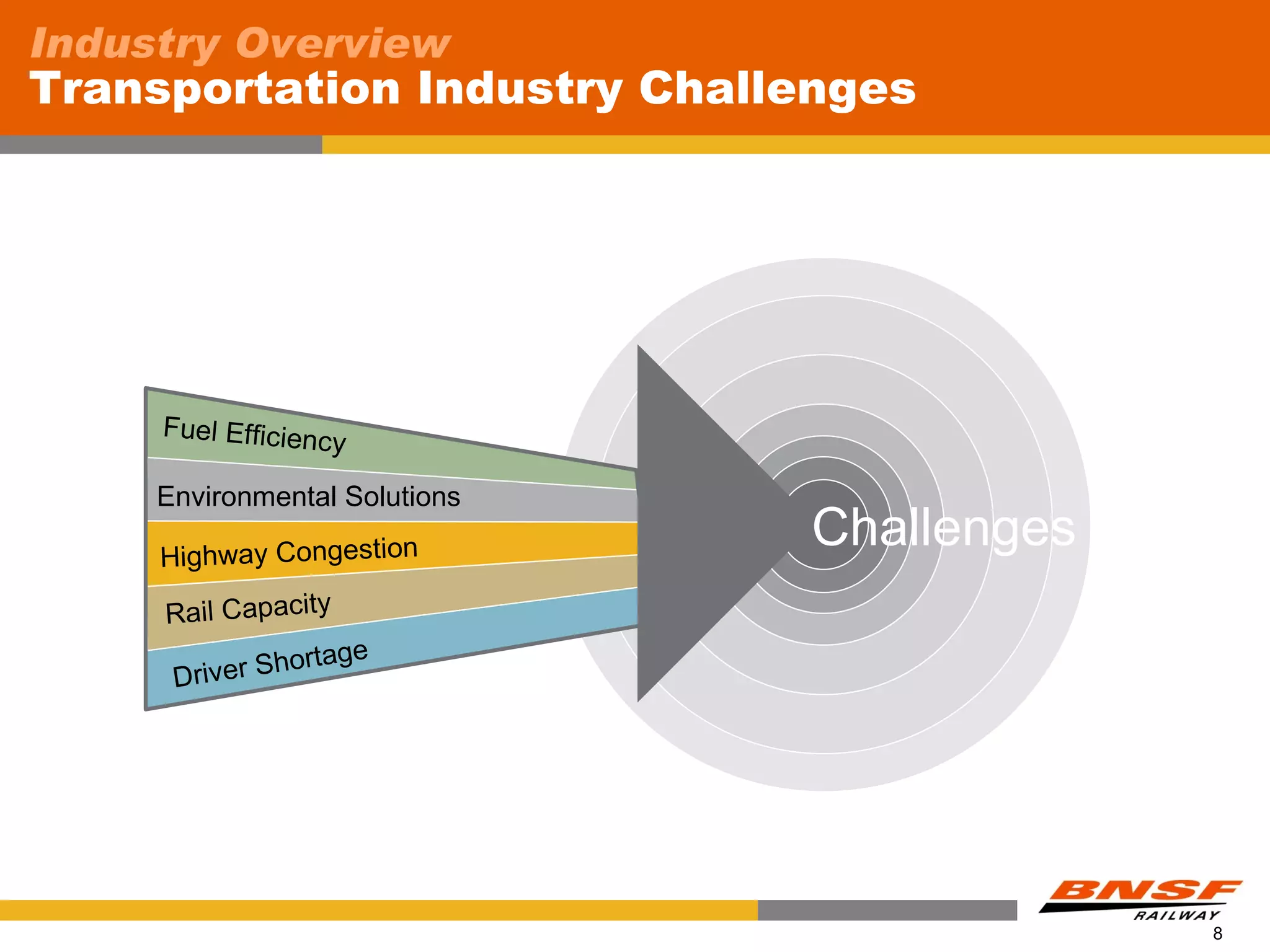
     Fuel Efficienc
                      y
     Environmental Solutions

     Highway Congestion
                               Challenges
     Rail Capacity
               rtage
     Driver Sho


                                            8
Industry Overview
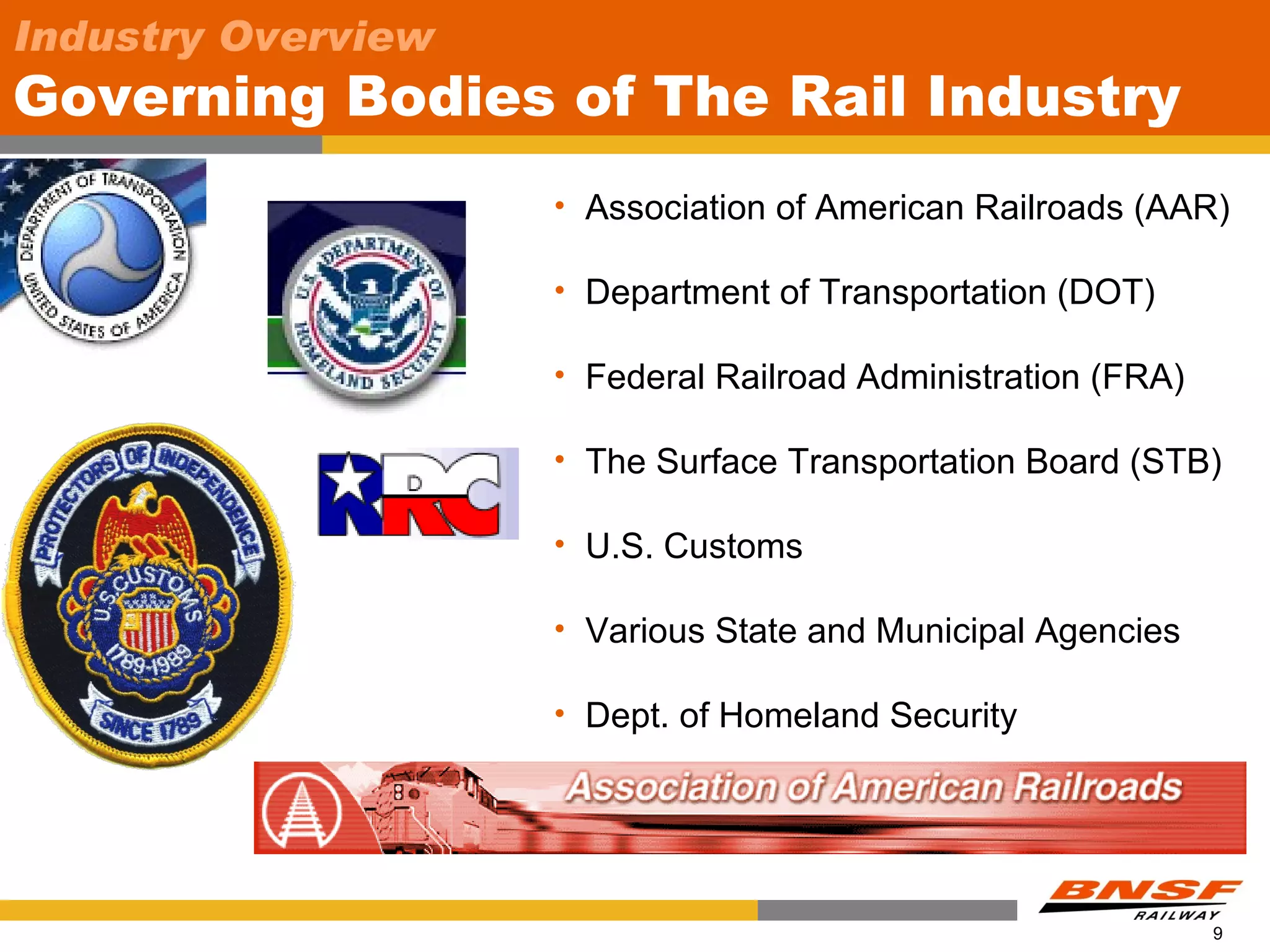
Governing Bodies of The Rail Industry
                    • Association of American Railroads (AAR)

                    • Department of Transportation (DOT)

                    • Federal Railroad Administration (FRA)

                    • The Surface Transportation Board (STB)

                    • U.S. Customs

                    • Various State and Municipal Agencies

                    • Dept. of Homeland Security


                                                              9
BNSF Overview


                10
BNSF Overview
“This is BNSF”


                Video: “This is BNSF”


                                        11
BNSF Overview
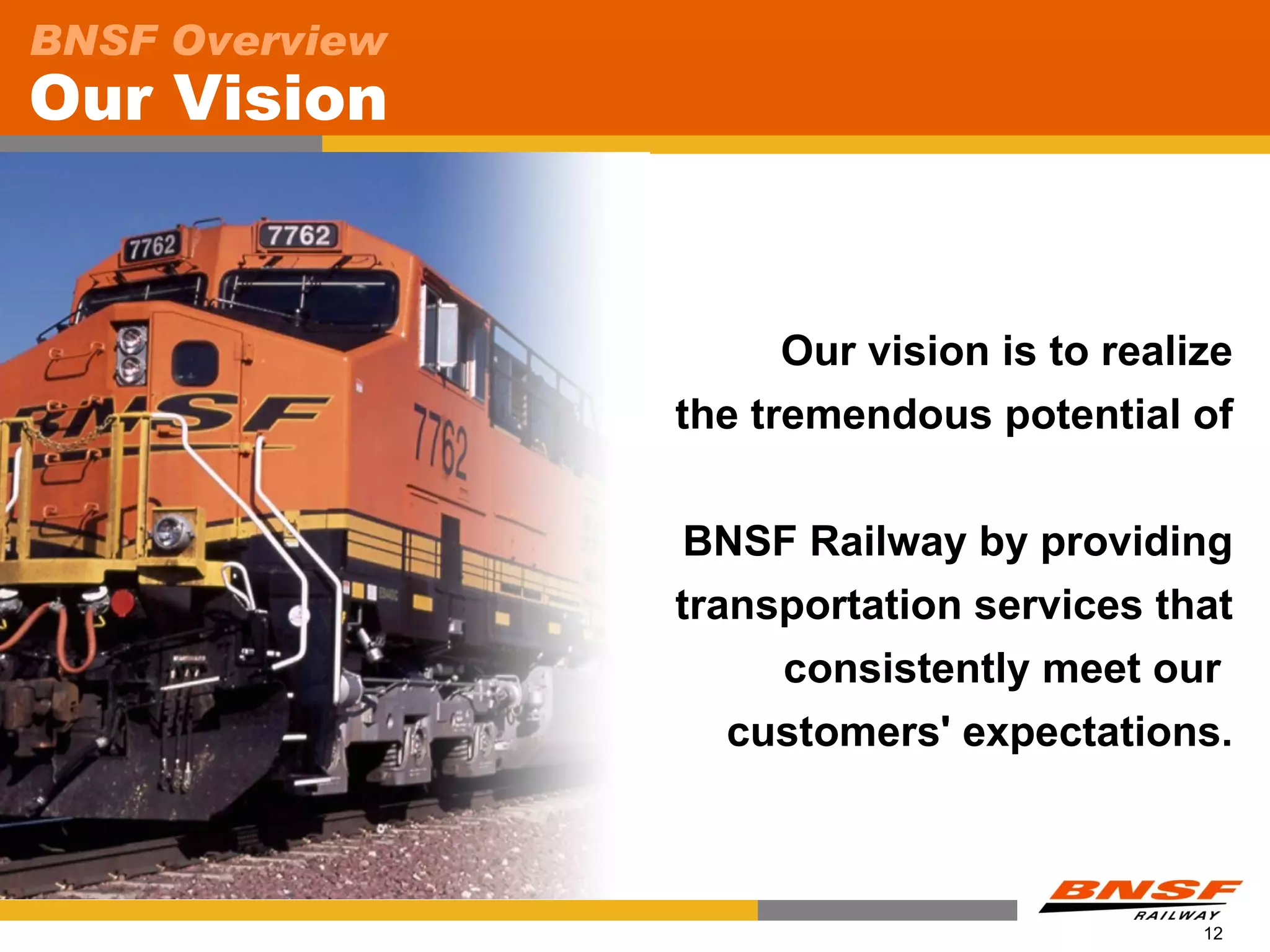
Our Vision


                      Our vision is to realize
                the tremendous potential of


                 BNSF Railway by providing
                transportation services that
                     consistently meet our
                   customers' expectations.


                                            12
BNSF Overview
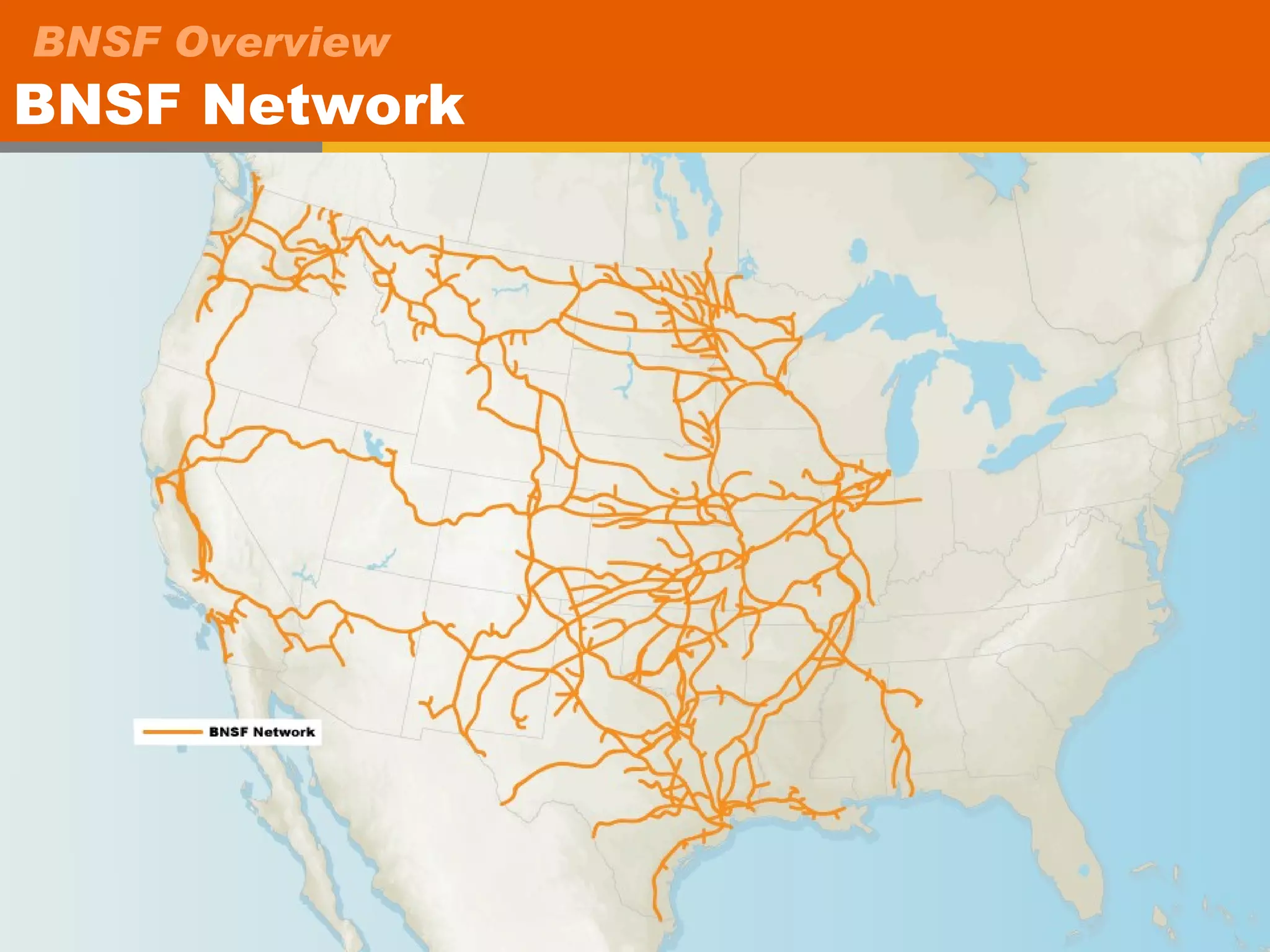
BNSF Network
BNSF Overview
BNSF: Size and Scope
    32,000 route miles in 28 states and two provinces
    Approximately 5,800 locomotives and 208,000 freight cars
    Employs approximately 38,000 people
    Operates an average of 1,400 freight trains per day
    Moves one fourth of the nation’s rail freight
    Serves all major ports on the West Coast and Gulf of Mexico
    If stacked end-to-end, all the intermodal loads shipped with BNSF
     in one year would reach from Los Angeles to Shanghai 6 times.
    Leads rail industry in technological innovation
    Has one of the largest computer systems in the world to manage
     our network operations 24 hours a day


                                                                         14
BNSF Overview
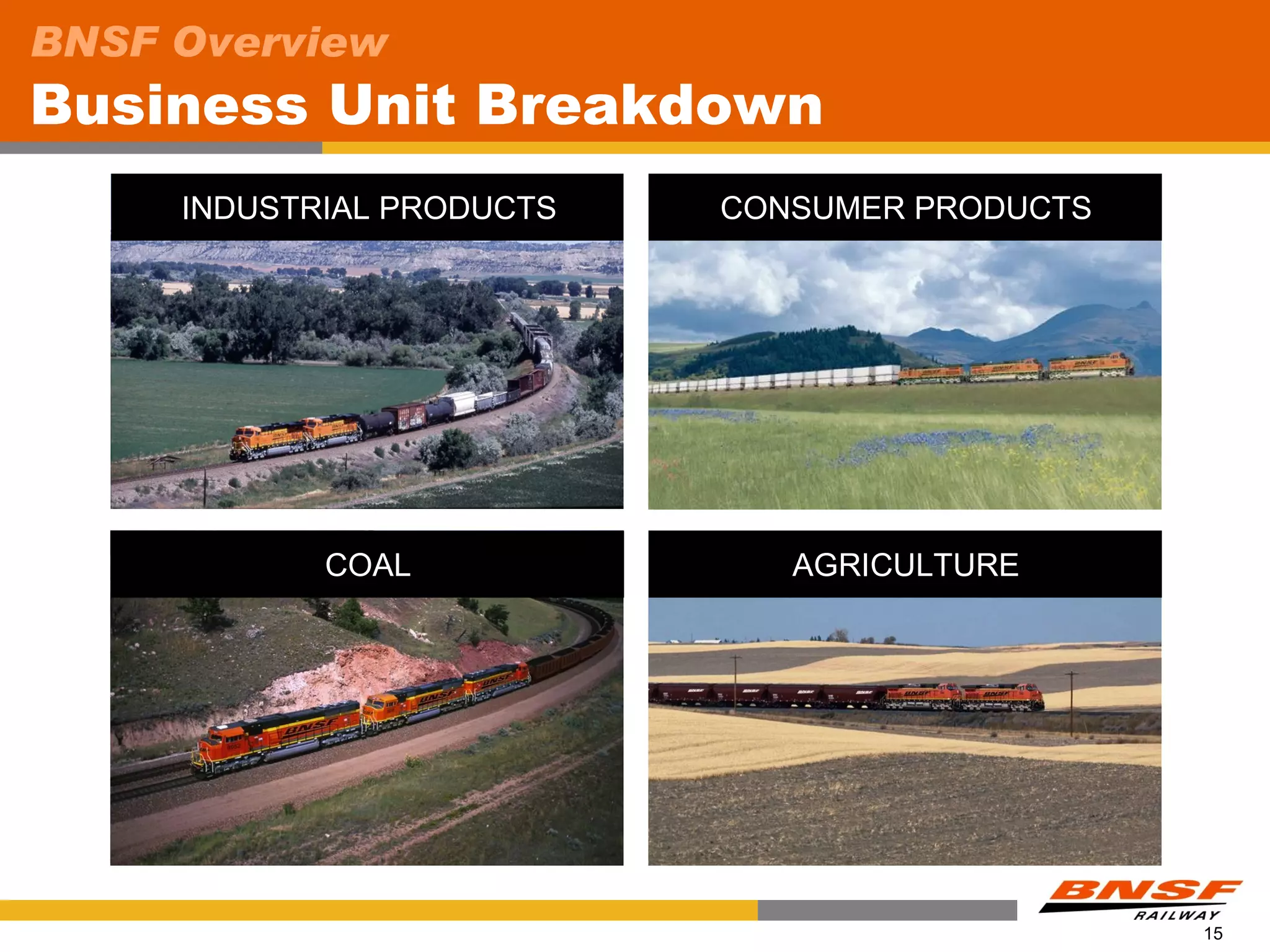
Business Unit Breakdown
     INDUSTRIAL PRODUCTS   CONSUMER PRODUCTS


            COAL              AGRICULTURE


                                               15
BNSF Overview
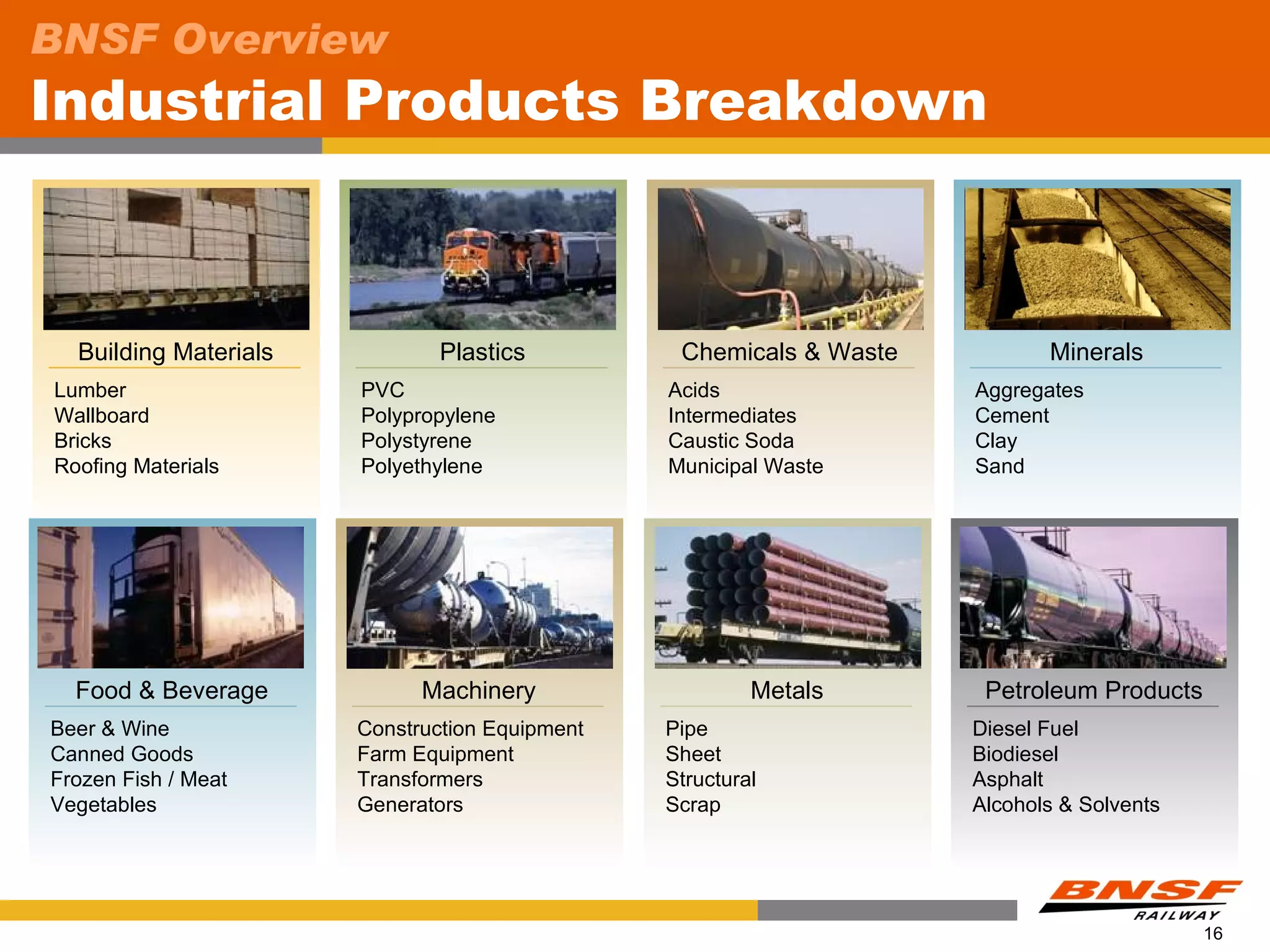
Industrial Products Breakdown


  Building Materials           Plastics          Chemicals & Waste          Minerals
Lumber                 PVC                      Acids                Aggregates
Wallboard              Polypropylene            Intermediates        Cement
Bricks                 Polystyrene              Caustic Soda         Clay
Roofing Materials      Polyethylene             Municipal Waste      Sand


  Food & Beverage            Machinery                   Metals       Petroleum Products
Beer & Wine            Construction Equipment   Pipe                 Diesel Fuel
Canned Goods           Farm Equipment           Sheet                Biodiesel
Frozen Fish / Meat     Transformers             Structural           Asphalt
Vegetables             Generators               Scrap                Alcohols & Solvents


                                                                                           16
BNSF Overview
Carload Solutions – Direct Rail
Direct Rail - Primary access to the BNSF Network directly to/from
a customer facility
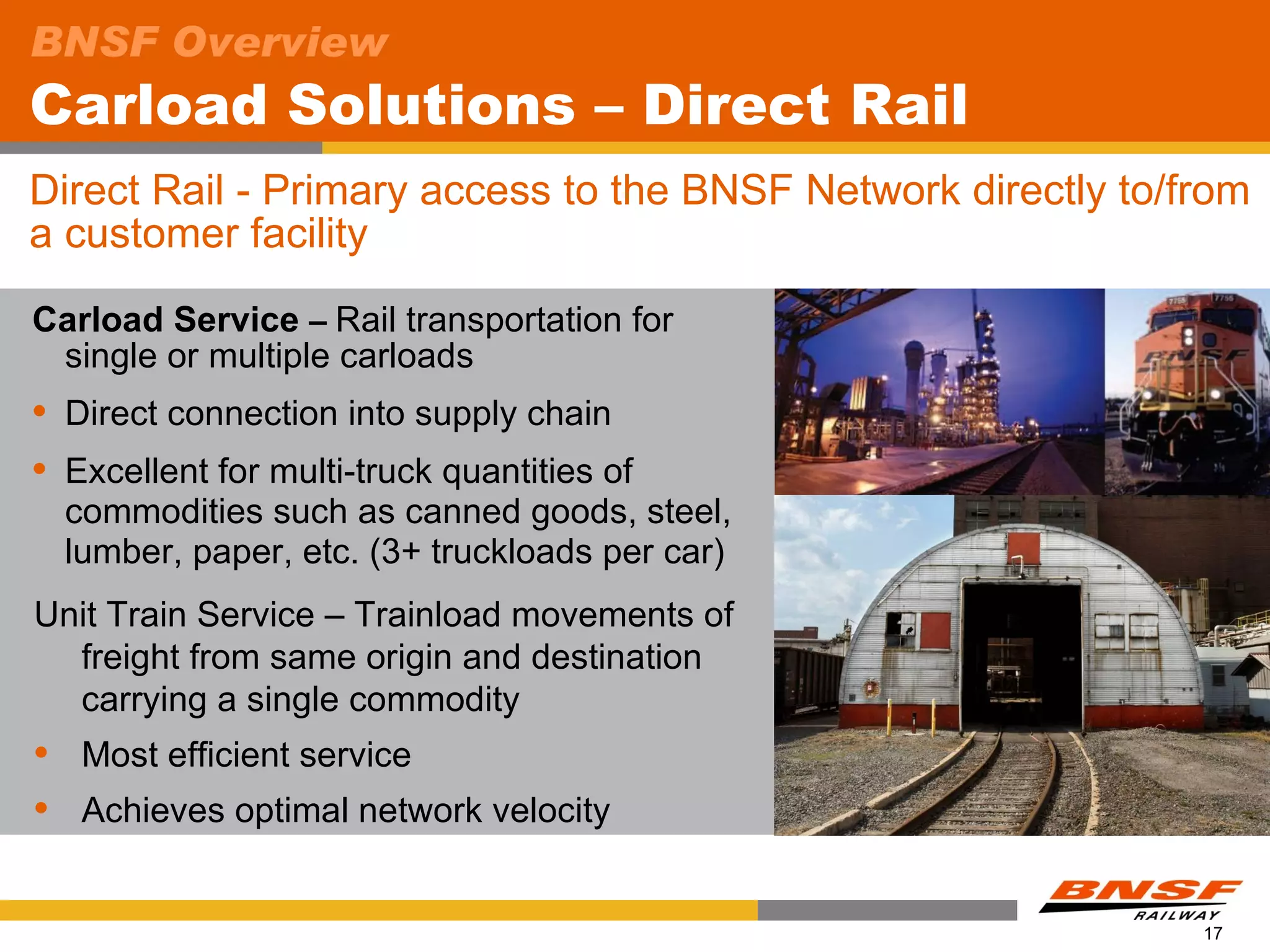
Carload Service – Rail transportation for
 single or multiple carloads
   Direct connection into supply chain
   Excellent for multi-truck quantities of
    commodities such as canned goods, steel,
    lumber, paper, etc. (3+ truckloads per car)
Unit Train Service – Trainload movements of
  freight from same origin and destination
  carrying a single commodity
    Most efficient service
    Achieves optimal network velocity


                                                              17
BNSF Overview
Carload Solutions - Transload
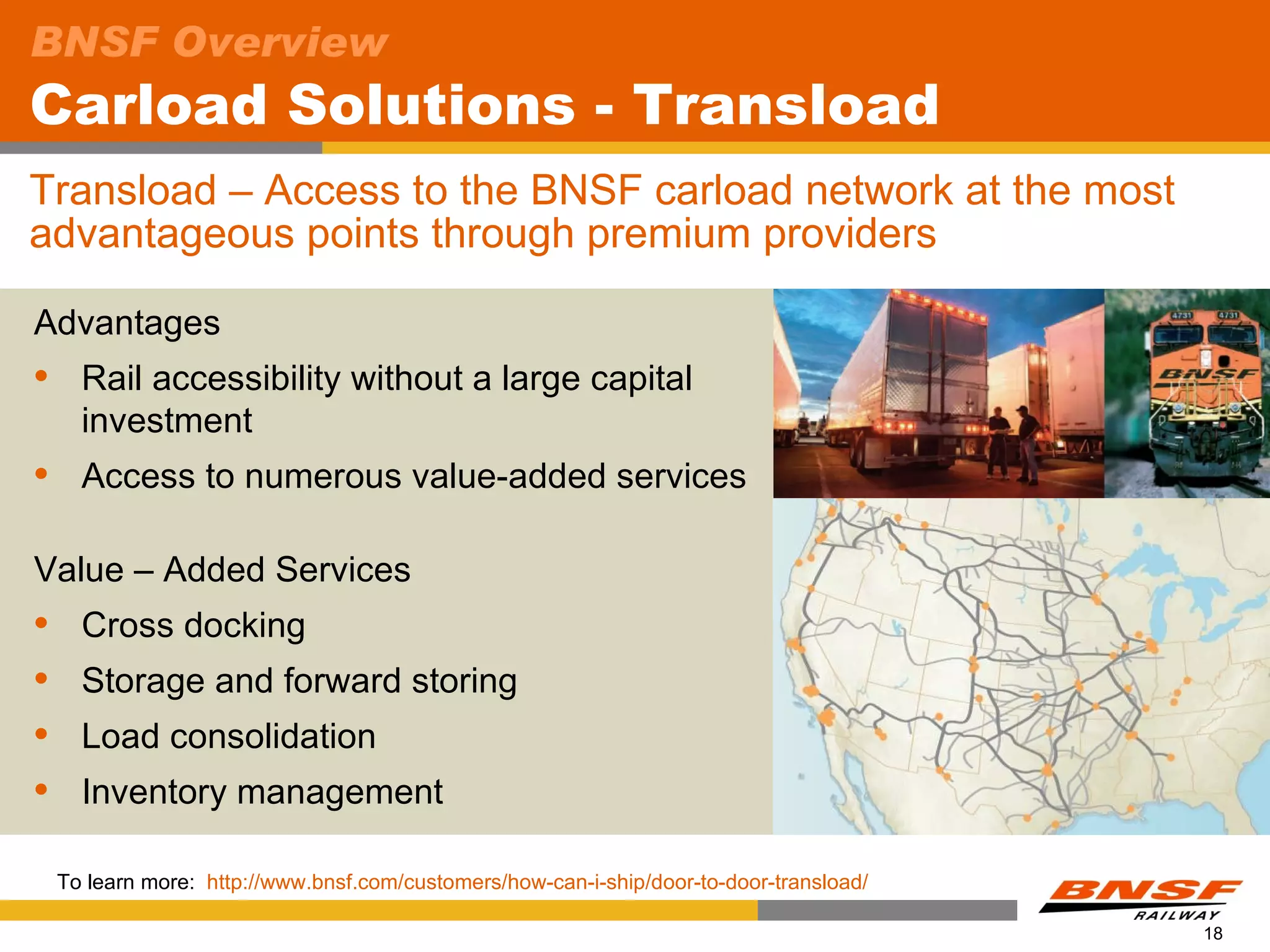
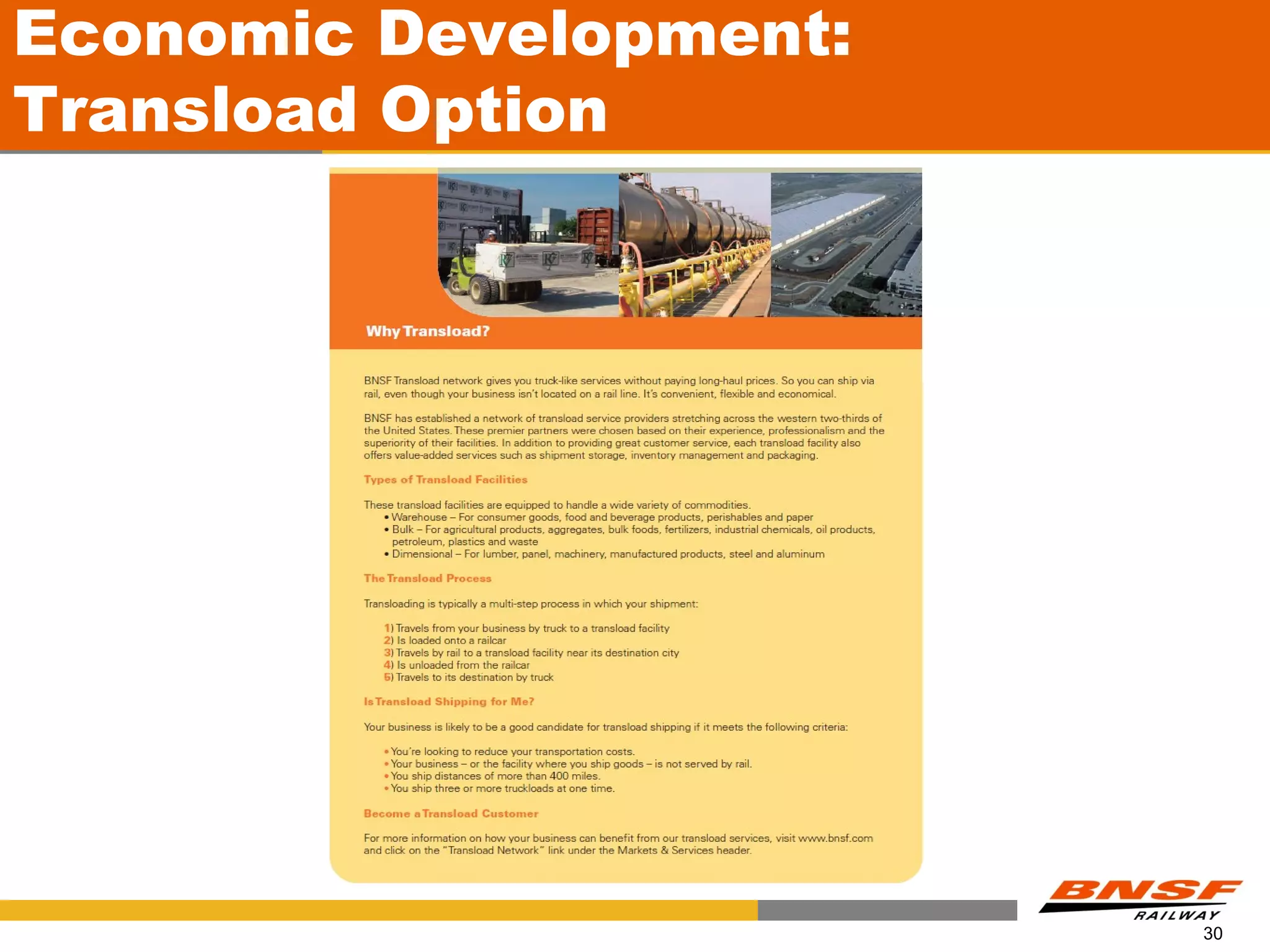
Transload – Access to the BNSF carload network at the most
advantageous points through premium providers

Advantages
     Rail accessibility without a large capital
      investment
     Access to numerous value-added services

Value – Added Services
     Cross docking
     Storage and forward storing
     Load consolidation
     Inventory management

    To learn more: http://www.bnsf.com/customers/how-can-i-ship/door-to-door-transload/

                                                                                          18
BNSF Overview
Consumer Products Breakdown


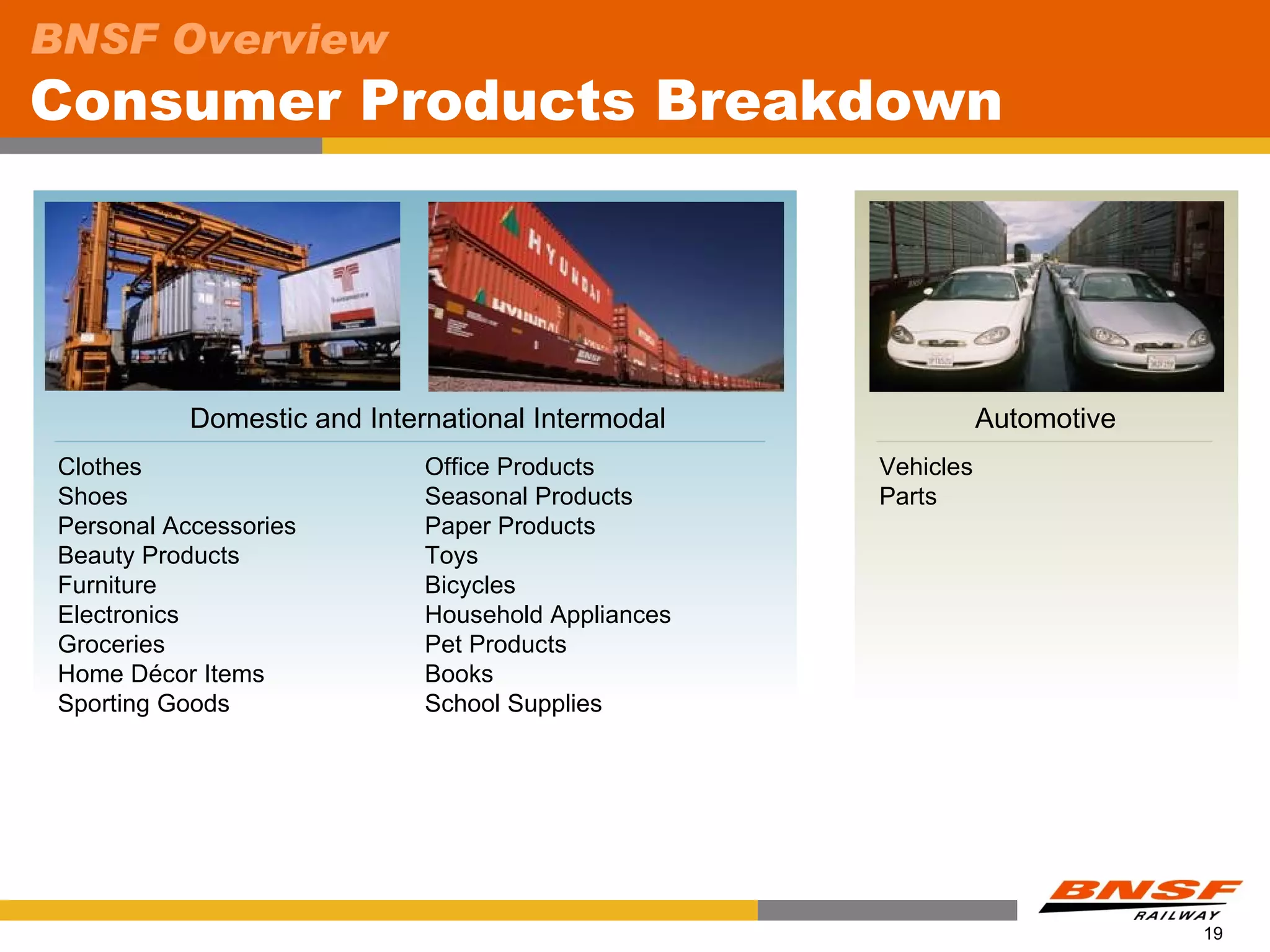
            Domestic and International Intermodal               Automotive
 Clothes                      Office Products        Vehicles
 Shoes                        Seasonal Products      Parts
 Personal Accessories         Paper Products
 Beauty Products              Toys
 Furniture                    Bicycles
 Electronics                  Household Appliances
 Groceries                    Pet Products
 Home Décor Items             Books
 Sporting Goods               School Supplies


                                                                             19
BNSF Overview
  Intermodal Services


                                                                        Expedited Trailer Service
                                                                        Domestic Only
                                                                           Fastest intermodal service in the industry
                                                                           Averages 700+ miles per day*
                                                                           Ideal for time-sensitive freight


                                                                      Premium Container Service
                                                                      International and Domestic
                                                                           Sustainable solution to price sensitive shippers
                                                                           Averages 400-500+ miles per day*
                                                                           Competitive daily schedules
   *Measurement derived from cutoff at origin to availability at destination


Service schedules can be found at http://www.bnsf.com/bnsf.was6/siisweb/cntrl                                                  20
BNSF Overview
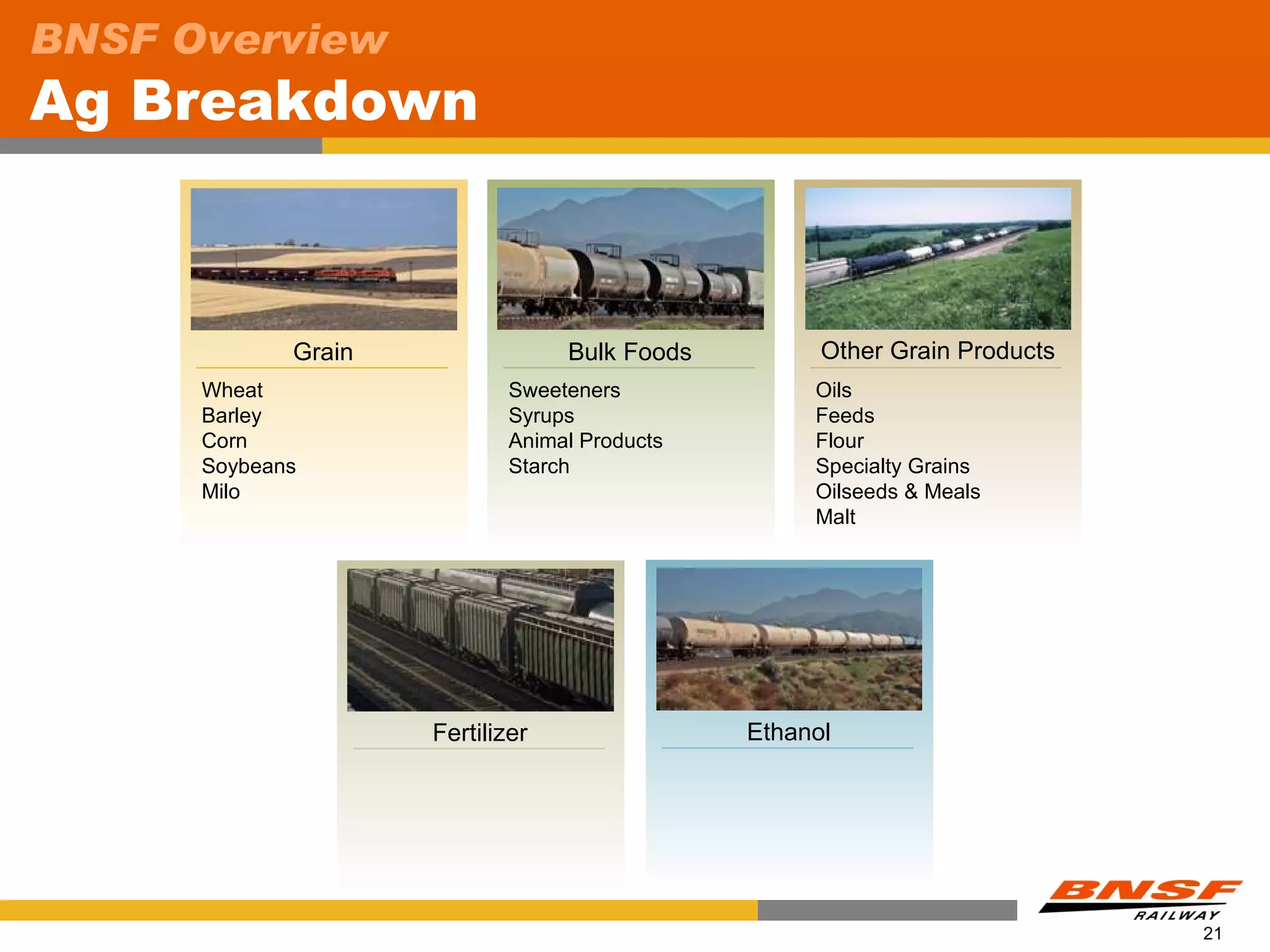
Ag Breakdown


             Grain                Bulk Foods         Other Grain Products
      Wheat                  Sweeteners             Oils
      Barley                 Syrups                 Feeds
      Corn                   Animal Products        Flour
      Soybeans               Starch                 Specialty Grains
      Milo                                          Oilseeds & Meals
                                                    Malt


                     Fertilizer                Ethanol


                                                                            21
BNSF Overview
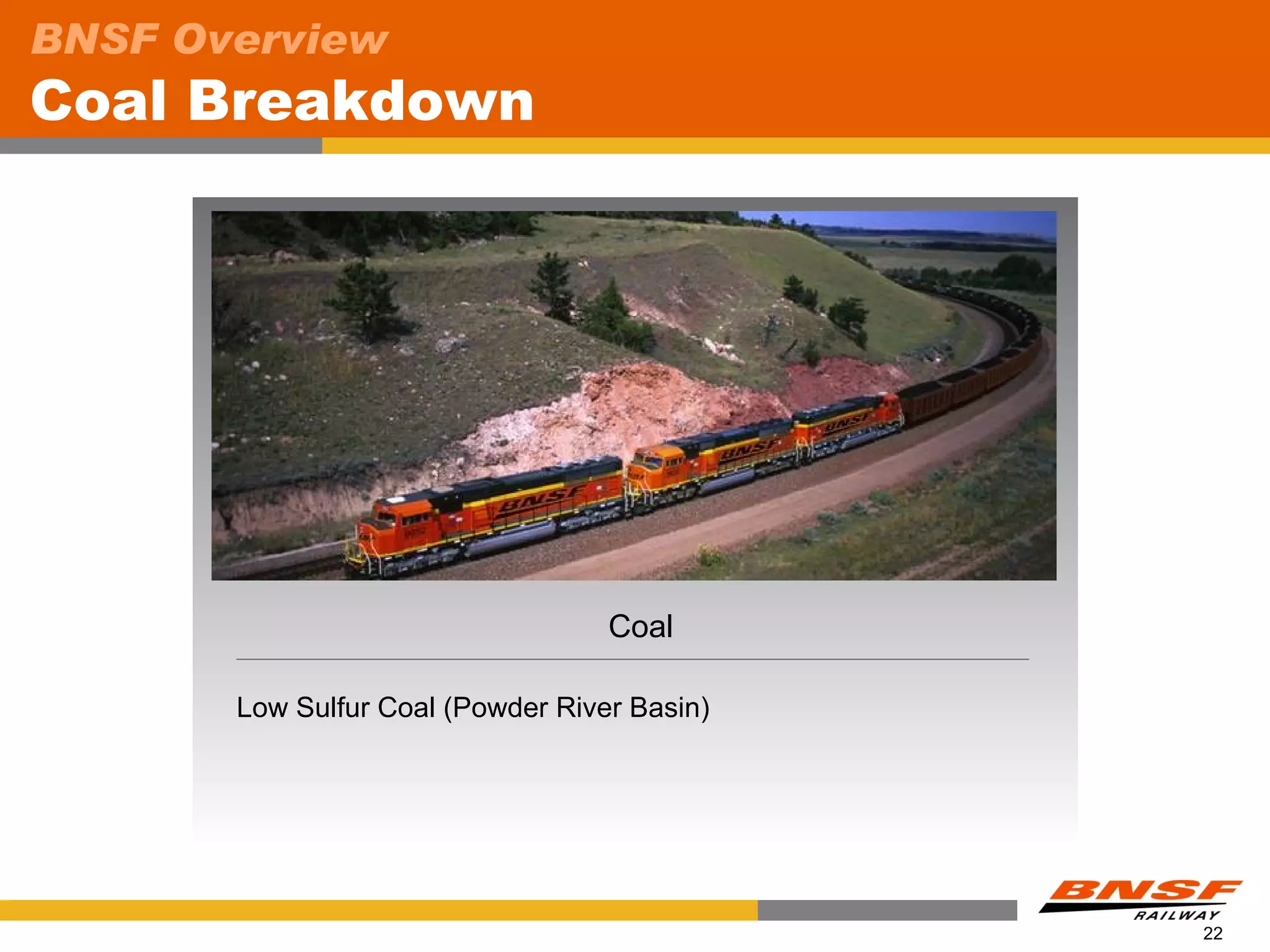
Coal Breakdown


                                   Coal

       Low Sulfur Coal (Powder River Basin)


                                              22
Why Rail?


            23
Why Rail?
 Key Benefits

             Fuel Efficiency – On average, railroads are three or
              more times more fuel efficient than trucks.
             Highway Gridlock Reduction – A typical train takes
              the freight equivalent of several hundred trucks off our
              highways.
             Cost Efficiency – In general, shippers pay less for
              shipping freight via rail, rather than other forms of land
              transportation.
             Environmental Friendliness – The EPA estimates that
              for every ton-mile, locomotives emit roughly one-third the
              amount of nitrogen oxides and particulates.


Source: AAR                                                                24
Why Rail?
Fuel Efficiency
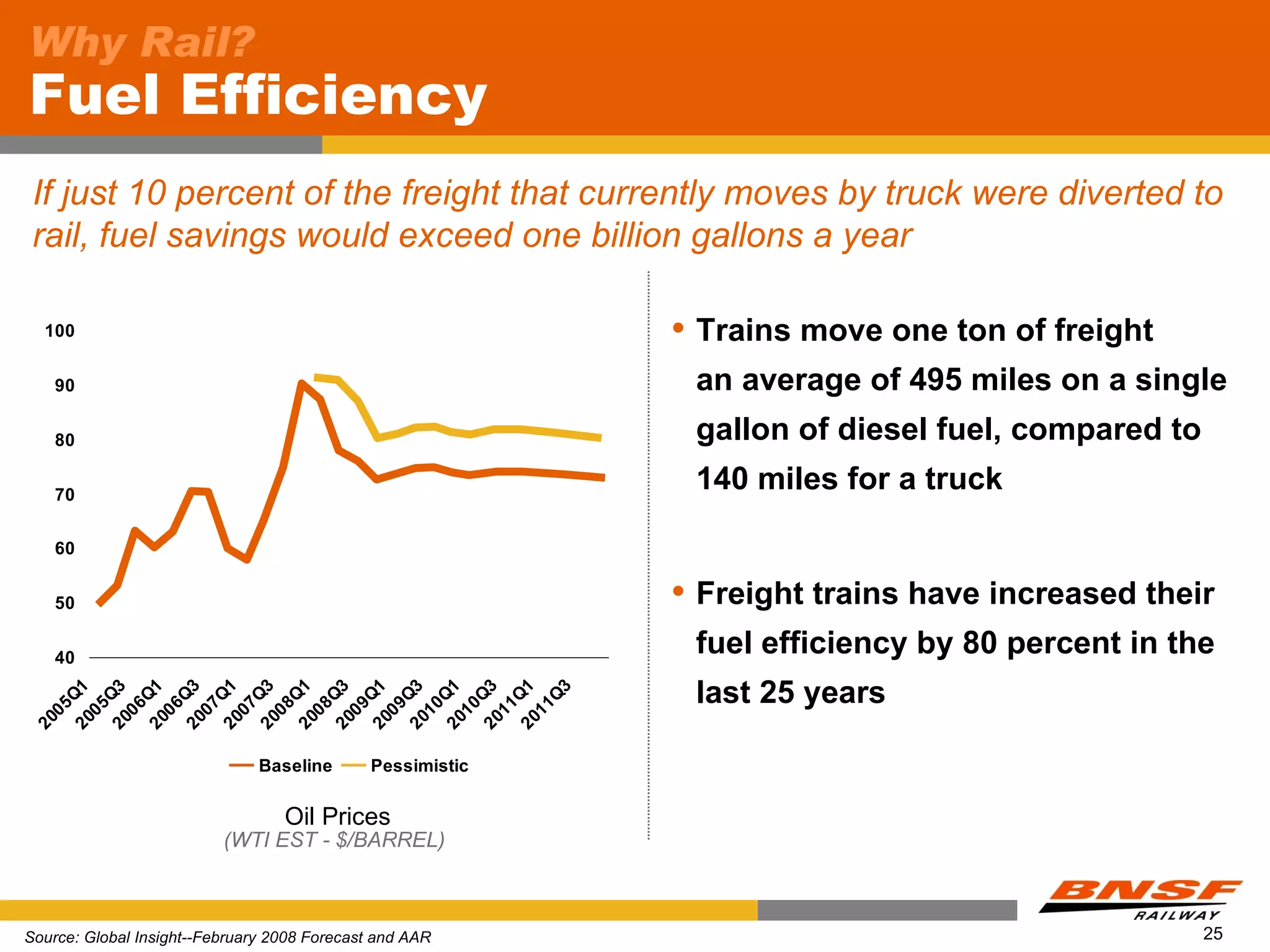
 If just 10 percent of the freight that currently moves by truck were diverted to
 rail, fuel savings would exceed one billion gallons a year

  100                                                          Trains move one ton of freight
    90                                                          an average of 495 miles on a single
    80                                                          gallon of diesel fuel, compared to
    70
                                                                140 miles for a truck

    60


    50
                                                               Freight trains have increased their
    40
                                                                fuel efficiency by 80 percent in the
                                                                last 25 years
20 3

20 1

20 3

20 1


20 3

20 1

      3
20 1

20 3

20 1


20 3

20 1

20 3

20 1
     Q

     Q

     Q

     Q

     Q

     Q

     Q

     Q

     Q

     Q

     Q

     Q

     Q

     Q
  08
  05

  05

  06

  06

  07

  07


  08

  09

  09

  10

  10

  11

  11
20


                               Baseline       Pessimistic


                                  Oil Prices
                          (WTI EST - $/BARREL)


Source: Global Insight--February 2008 Forecast and AAR                                               25
Why Rail?
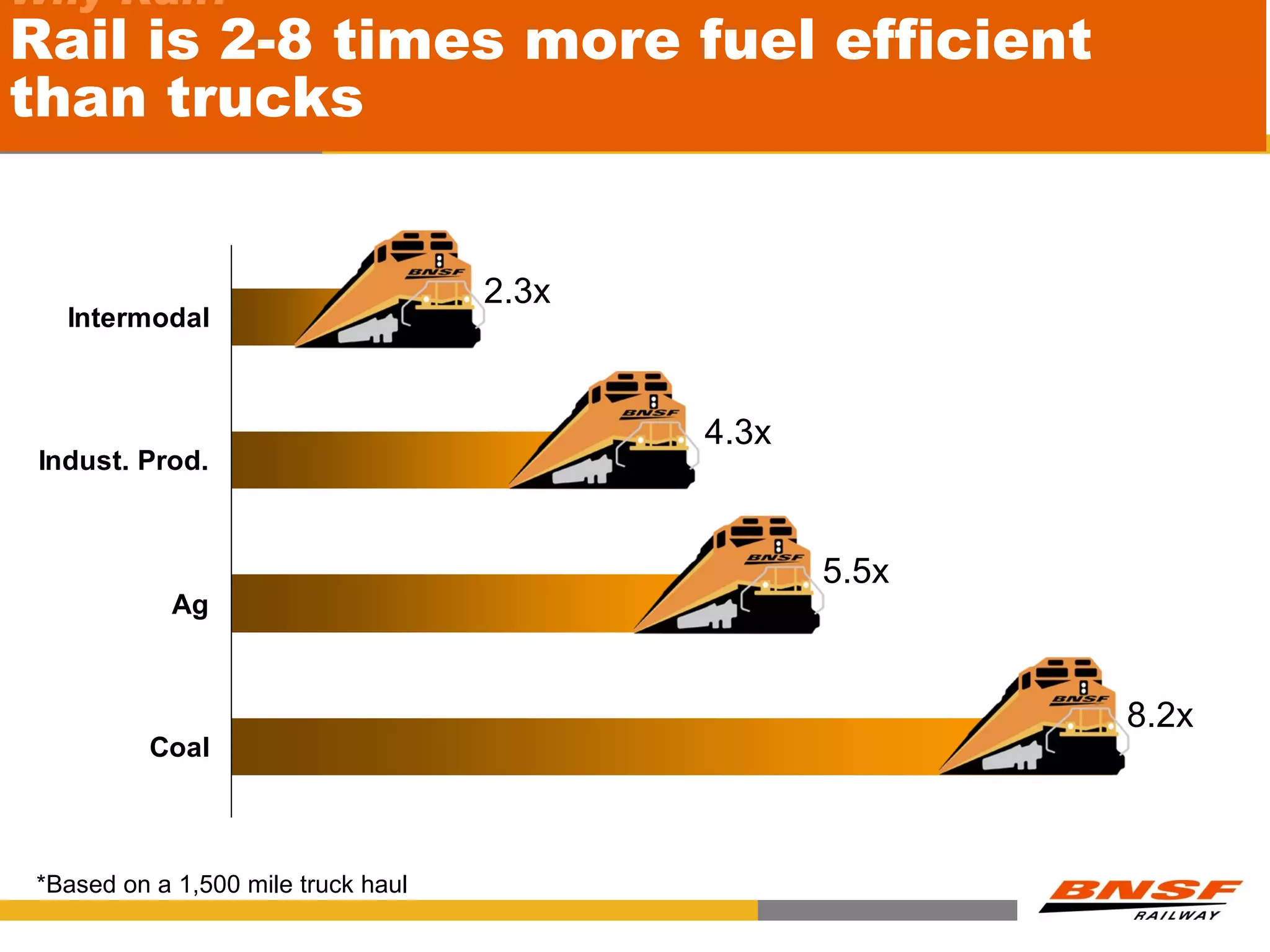
Rail is 2-8 times more fuel efficient
than trucks


                                     2.3x
   Intermodal


                                            4.3x
 Indust. Prod.


                                                   5.5x
             Ag


                                                          8.2x
           Coal


 *Based on a 1,500 mile truck haul
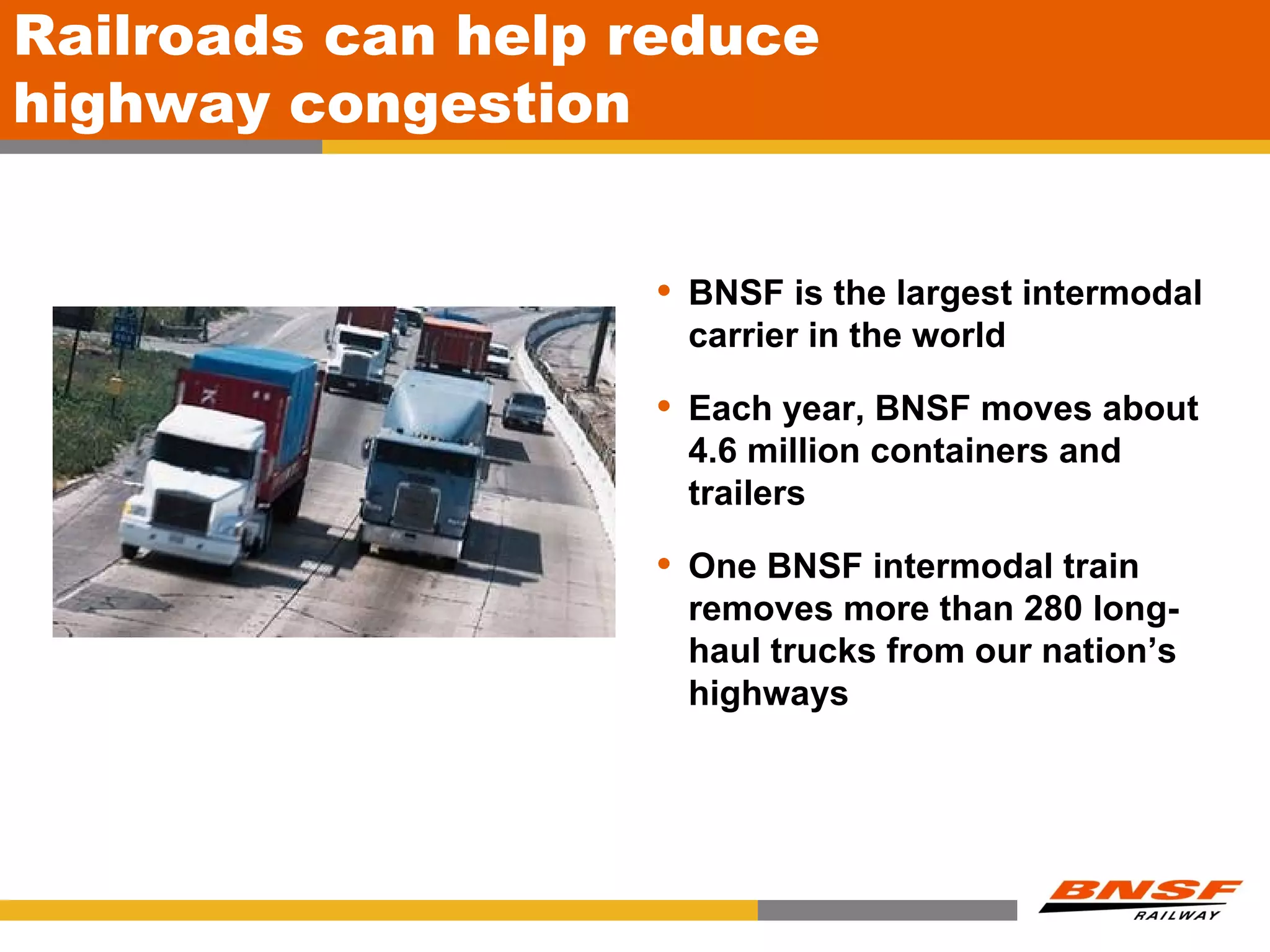
Railroads can help reduce
highway congestion


                      BNSF is the largest intermodal
                       carrier in the world
                      Each year, BNSF moves about
                       4.6 million containers and
                       trailers
                      One BNSF intermodal train
                       removes more than 280 long-
                       haul trucks from our nation’s
                       highways
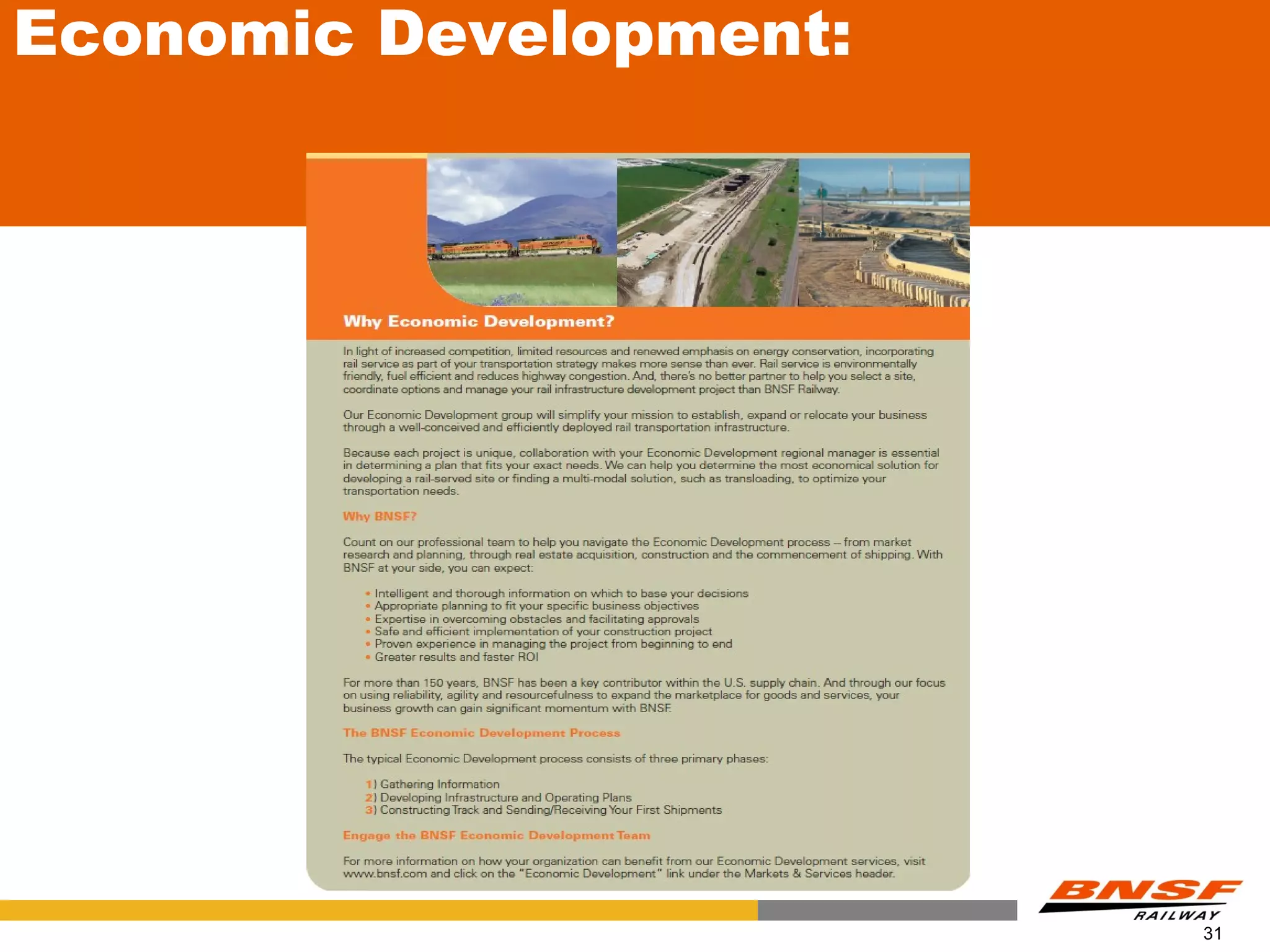
Why Economic Development?


                            28
Economic Development:

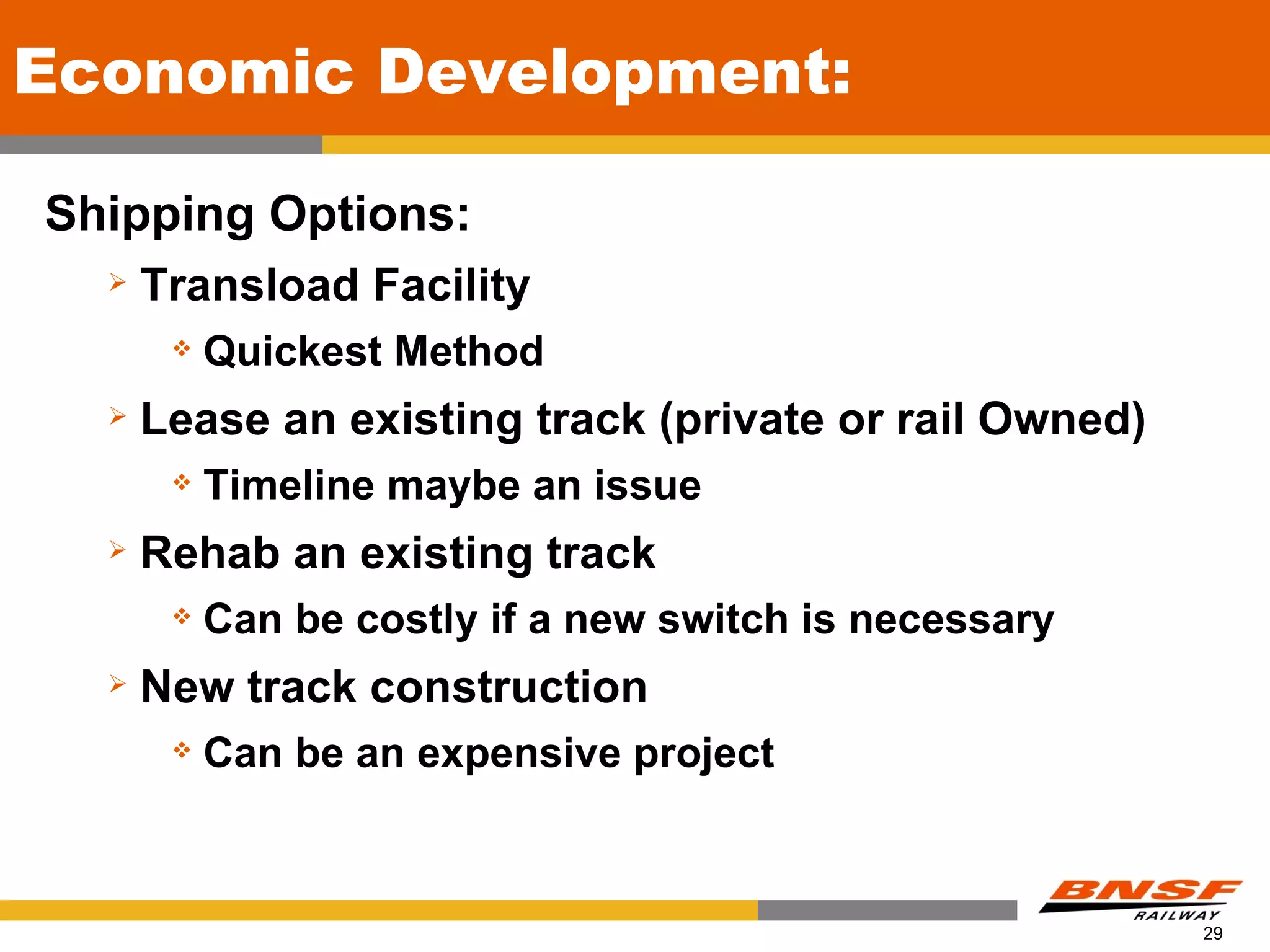
Shipping Options:
     Transload Facility
          Quickest Method
     Lease an existing track (private or rail Owned)
          Timeline maybe an issue
     Rehab an existing track
          Can be costly if a new switch is necessary
     New track construction
          Can be an expensive project


                                                        29
Economic Development:
Transload Option


                        30
Economic Development:


                        31
Economic Development:
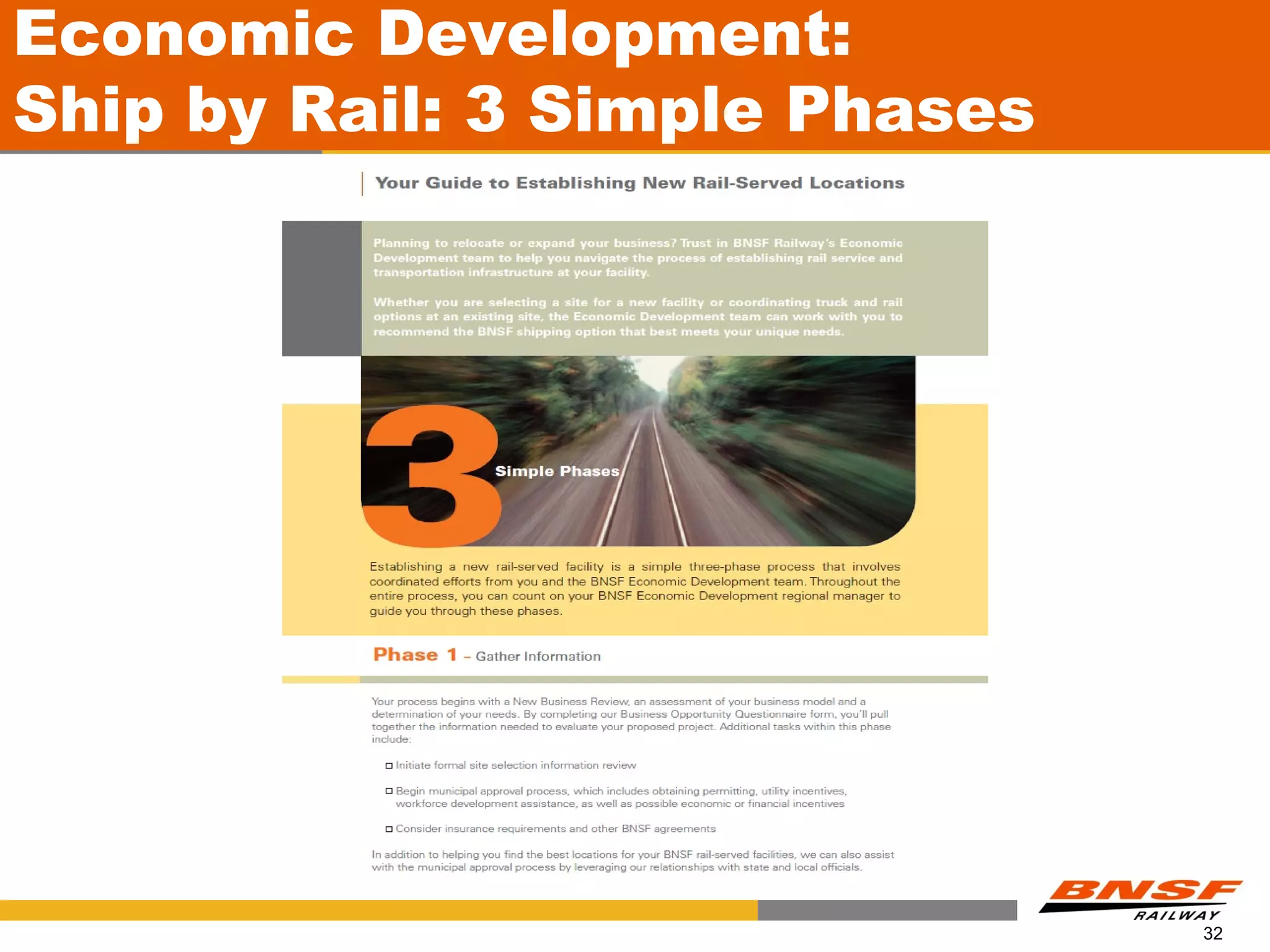
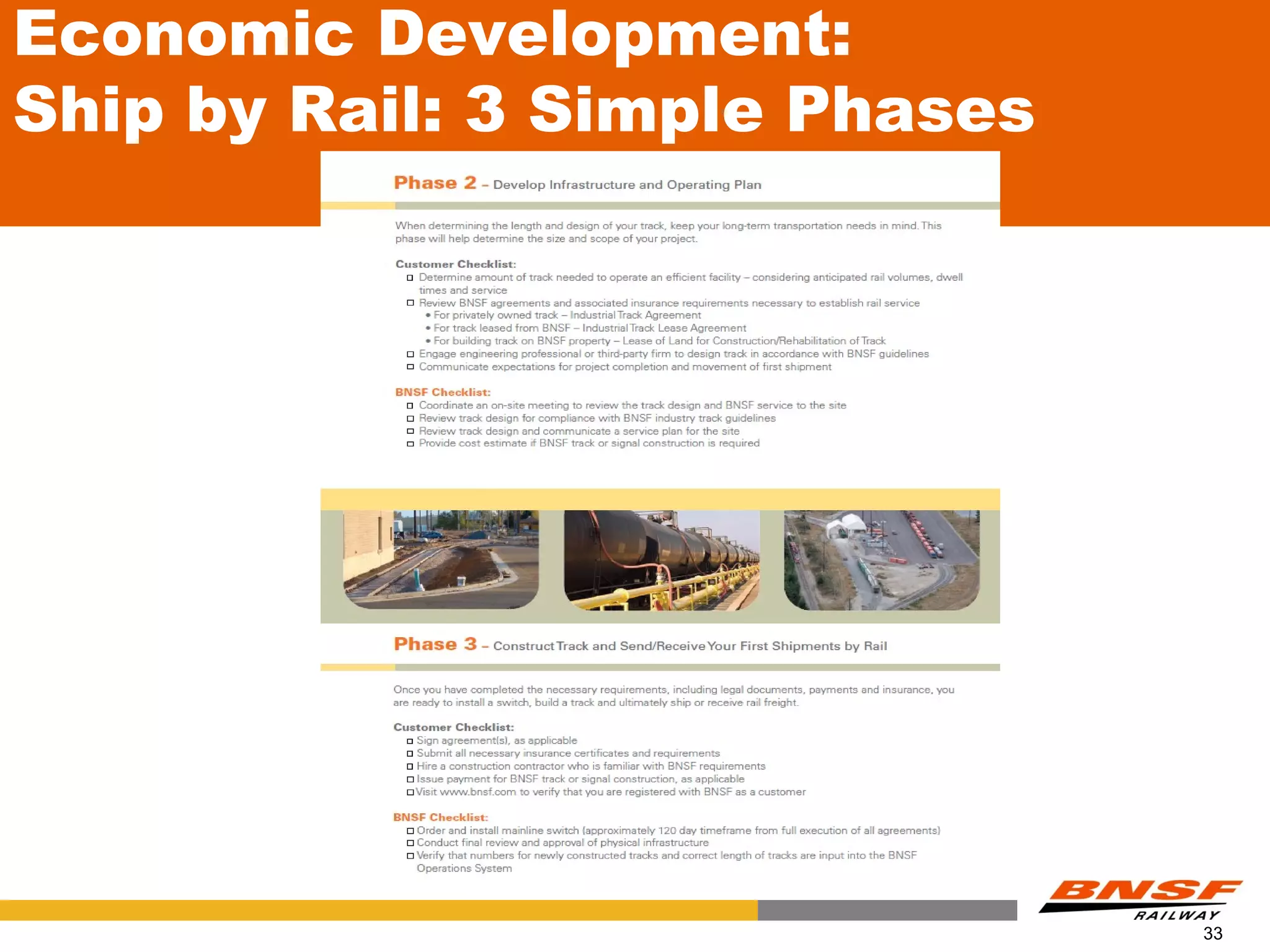
Ship by Rail: 3 Simple Phases


                                32
Economic Development:
Ship by Rail: 3 Simple Phases


                                33
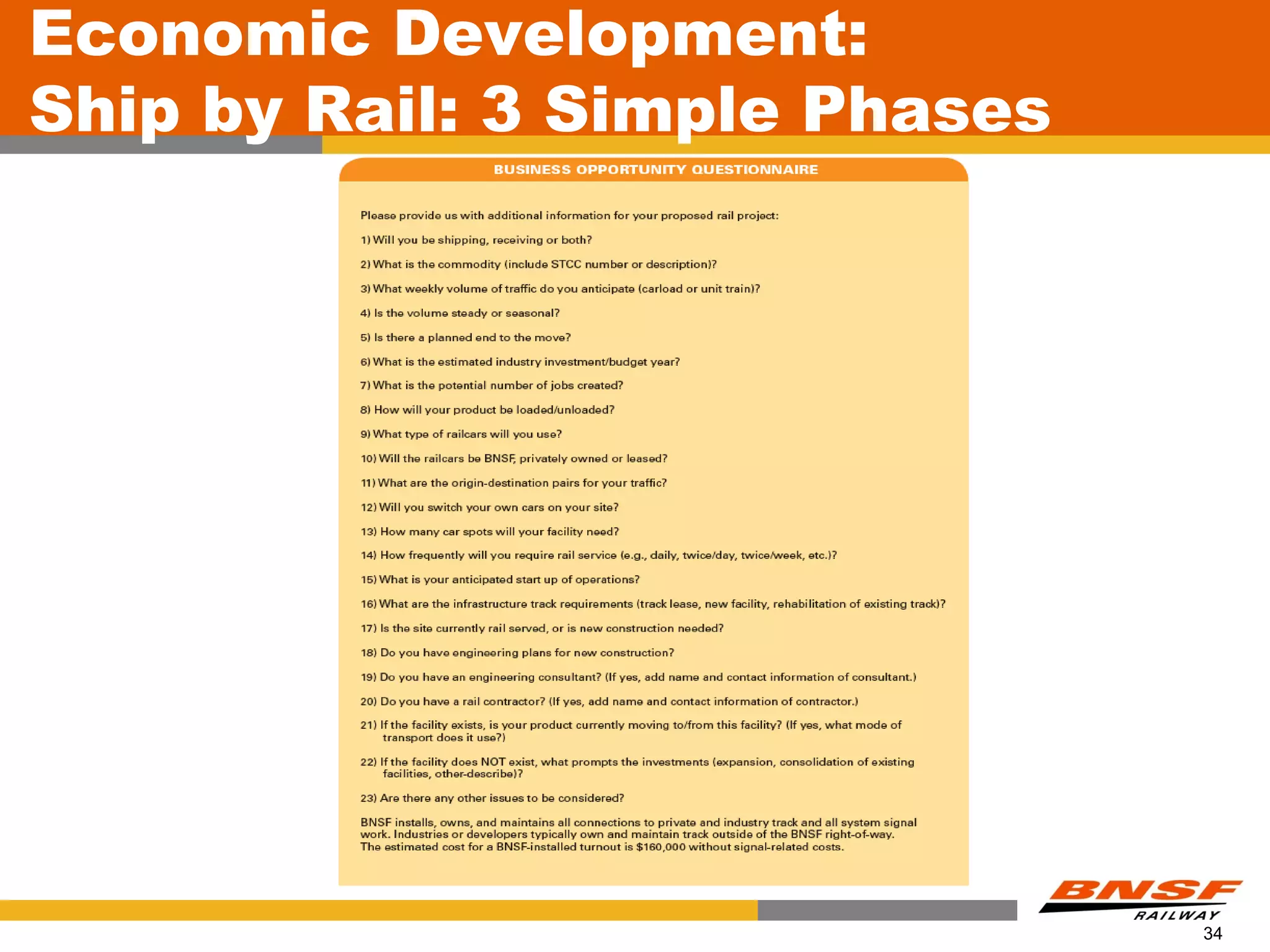
Economic Development:
Ship by Rail: 3 Simple Phases


                                34
So You Want to Ship by Rail?

So You Want to Ship by Rail?

  • 1.
    Replaced title type BNSFRailway Company and photo Rail 101 & Economic Development Grace Kung Regional Economic Development Mgr April 24, 2012
  • 2.
    Agenda  Industry Overview  BNSF Overview  Why Rail?  Why Economic Development? 2
  • 3.
  • 4.
    Industry Overview America’s RailroadIndustry Railroads remain the backbone of America’s freight transportation network  U.S. railroads operate over 140,000 miles of track and earn an aggregate freight revenue of nearly $57 billion  In the United States, railroads account for more than 40%* of all freight (more than trucks, boats, barges or planes) *Measured in Ton Miles  70% of all autos produced in America move by rail  30% of all U.S. grain moves by rail  65% of the coal is moved by rail which in turn produces half of America’s electricity  U.S. Railroads move enough:  Wheat to provide every person with a loaf of bread 6 days/week  Concrete to build 45 miles of new highway every day North American railroads form the world’s most efficient and lowest-cost freight network Source: American Association of Railroads (AAR) 4
  • 5.
    Industry Overview A keylink in the U.S. Supply Chain 71% of America's GDP is driven by the consumer Seamless network of manufacturers, retailers, distributors, transporters, storage facilities and suppliers Rail delivers everything Americans consume everyday:  Cars and Combines  Clothes and Shoes  Stereos and TVs  Food and Water  Lumber and Steel  Energy and Fuel  … many others, such as bread and cereal 5
  • 6.
    Industry Overview Types ofRailroads Class I • Annual revenues in excess of $340M • Operations range from 3,200 to 32,000 miles • Typically concentrate on long-haul, high- density intercity traffic lanes • Seven Class I railroads in North America Regional • Operate at least 350 miles of track • Earn $40 million or more in revenues • 33 Regional railroads Local Linehaul • Operate less than 350 miles of track • Generate less than $40M in operating revenues • 324 local linehaul railroads 6
  • 7.
    Industry Overview North AmericaRail Network  Over 160,000 miles of track Over 165,000 railroad employees  BNSF operates more than 32,000 miles of track BNSF CN CP CSX NS UP FXE 7
  • 8.
    Industry Overview Transportation IndustryChallenges Fuel Efficienc y Environmental Solutions Highway Congestion Challenges Rail Capacity rtage Driver Sho 8
  • 9.
    Industry Overview Governing Bodiesof The Rail Industry • Association of American Railroads (AAR) • Department of Transportation (DOT) • Federal Railroad Administration (FRA) • The Surface Transportation Board (STB) • U.S. Customs • Various State and Municipal Agencies • Dept. of Homeland Security 9
  • 10.
  • 11.
    BNSF Overview “This isBNSF” Video: “This is BNSF” 11
  • 12.
    BNSF Overview Our Vision Our vision is to realize the tremendous potential of BNSF Railway by providing transportation services that consistently meet our customers' expectations. 12
  • 13.
  • 14.
    BNSF Overview BNSF: Sizeand Scope  32,000 route miles in 28 states and two provinces  Approximately 5,800 locomotives and 208,000 freight cars  Employs approximately 38,000 people  Operates an average of 1,400 freight trains per day  Moves one fourth of the nation’s rail freight  Serves all major ports on the West Coast and Gulf of Mexico  If stacked end-to-end, all the intermodal loads shipped with BNSF in one year would reach from Los Angeles to Shanghai 6 times.  Leads rail industry in technological innovation  Has one of the largest computer systems in the world to manage our network operations 24 hours a day 14
  • 15.
    BNSF Overview Business UnitBreakdown INDUSTRIAL PRODUCTS CONSUMER PRODUCTS COAL AGRICULTURE 15
  • 16.
    BNSF Overview Industrial ProductsBreakdown Building Materials Plastics Chemicals & Waste Minerals Lumber PVC Acids Aggregates Wallboard Polypropylene Intermediates Cement Bricks Polystyrene Caustic Soda Clay Roofing Materials Polyethylene Municipal Waste Sand Food & Beverage Machinery Metals Petroleum Products Beer & Wine Construction Equipment Pipe Diesel Fuel Canned Goods Farm Equipment Sheet Biodiesel Frozen Fish / Meat Transformers Structural Asphalt Vegetables Generators Scrap Alcohols & Solvents 16
  • 17.
    BNSF Overview Carload Solutions– Direct Rail Direct Rail - Primary access to the BNSF Network directly to/from a customer facility Carload Service – Rail transportation for single or multiple carloads  Direct connection into supply chain  Excellent for multi-truck quantities of commodities such as canned goods, steel, lumber, paper, etc. (3+ truckloads per car) Unit Train Service – Trainload movements of freight from same origin and destination carrying a single commodity  Most efficient service  Achieves optimal network velocity 17
  • 18.
    BNSF Overview Carload Solutions- Transload Transload – Access to the BNSF carload network at the most advantageous points through premium providers Advantages  Rail accessibility without a large capital investment  Access to numerous value-added services Value – Added Services  Cross docking  Storage and forward storing  Load consolidation  Inventory management To learn more: http://www.bnsf.com/customers/how-can-i-ship/door-to-door-transload/ 18
  • 19.
    BNSF Overview Consumer ProductsBreakdown Domestic and International Intermodal Automotive Clothes Office Products Vehicles Shoes Seasonal Products Parts Personal Accessories Paper Products Beauty Products Toys Furniture Bicycles Electronics Household Appliances Groceries Pet Products Home Décor Items Books Sporting Goods School Supplies 19
  • 20.
    BNSF Overview Intermodal Services Expedited Trailer Service Domestic Only  Fastest intermodal service in the industry  Averages 700+ miles per day*  Ideal for time-sensitive freight Premium Container Service International and Domestic  Sustainable solution to price sensitive shippers  Averages 400-500+ miles per day*  Competitive daily schedules *Measurement derived from cutoff at origin to availability at destination Service schedules can be found at http://www.bnsf.com/bnsf.was6/siisweb/cntrl 20
  • 21.
    BNSF Overview Ag Breakdown Grain Bulk Foods Other Grain Products Wheat Sweeteners Oils Barley Syrups Feeds Corn Animal Products Flour Soybeans Starch Specialty Grains Milo Oilseeds & Meals Malt Fertilizer Ethanol 21
  • 22.
    BNSF Overview Coal Breakdown Coal Low Sulfur Coal (Powder River Basin) 22
  • 23.
  • 24.
    Why Rail? KeyBenefits  Fuel Efficiency – On average, railroads are three or more times more fuel efficient than trucks.  Highway Gridlock Reduction – A typical train takes the freight equivalent of several hundred trucks off our highways.  Cost Efficiency – In general, shippers pay less for shipping freight via rail, rather than other forms of land transportation.  Environmental Friendliness – The EPA estimates that for every ton-mile, locomotives emit roughly one-third the amount of nitrogen oxides and particulates. Source: AAR 24
  • 25.
    Why Rail? Fuel Efficiency If just 10 percent of the freight that currently moves by truck were diverted to rail, fuel savings would exceed one billion gallons a year 100  Trains move one ton of freight 90 an average of 495 miles on a single 80 gallon of diesel fuel, compared to 70 140 miles for a truck 60 50  Freight trains have increased their 40 fuel efficiency by 80 percent in the last 25 years 20 3 20 1 20 3 20 1 20 3 20 1 3 20 1 20 3 20 1 20 3 20 1 20 3 20 1 Q Q Q Q Q Q Q Q Q Q Q Q Q Q 08 05 05 06 06 07 07 08 09 09 10 10 11 11 20 Baseline Pessimistic Oil Prices (WTI EST - $/BARREL) Source: Global Insight--February 2008 Forecast and AAR 25
  • 26.
    Why Rail? Rail is2-8 times more fuel efficient than trucks 2.3x Intermodal 4.3x Indust. Prod. 5.5x Ag 8.2x Coal *Based on a 1,500 mile truck haul
  • 27.
    Railroads can helpreduce highway congestion  BNSF is the largest intermodal carrier in the world  Each year, BNSF moves about 4.6 million containers and trailers  One BNSF intermodal train removes more than 280 long- haul trucks from our nation’s highways
  • 28.
  • 29.
    Economic Development: Shipping Options:  Transload Facility  Quickest Method  Lease an existing track (private or rail Owned)  Timeline maybe an issue  Rehab an existing track  Can be costly if a new switch is necessary  New track construction  Can be an expensive project 29
  • 30.
  • 31.
  • 32.
    Economic Development: Ship byRail: 3 Simple Phases 32
  • 33.
    Economic Development: Ship byRail: 3 Simple Phases 33
  • 34.
    Economic Development: Ship byRail: 3 Simple Phases 34

Editor's Notes

  • #2 2007 Railway Template 05/11/12
  • #4 2007 Railway Template 05/11/12 Thank you for coming today and welcome. This is our seventh year of hosting these symposiums We are really glad to be here today. At BNSF we get a lot from these meetings and we hope you do as well While I am saying thank you, I would like to take a minute to say thank you for your business as well. We do not say that often enough and it is important that you know that we appreciate your business and when you choose us as your carrier, we do not take that responsibility lightly.
  • #7 2007 Railway Template 05/11/12
  • #8 2007 Railway Template 05/11/12 KCS Missing Route Miles 1833 – 380 miles 1860 – 30,000 miles 1916 – 254,000 miles (peak) In the east, rail connected cities, in the west many cities were built around the rail. Never be another Class I railroad “built” “ Porter’s model” – barriers to entry 2003 – First time ever that intermodal produced more rail revenue than coal BNSF Network – strong west coast franchise – good for globalization and China growth.
  • #9 2007 Railway Template 05/11/12 When will the growth return? No one knows for sure. However, the forces that have been stimulating growth in transportation over the years, still exist. The only thing that has changed is the slow down in the US economy, which is a temporary condition. The external forces that have been stimulating industry growth over the years, still continue, such as: driver shortages, highway congestion, fuel prices, and rail capacity, and developing environmental solutions – among others.
  • #10 2007 Railway Template 05/11/12 Association of American Railroads (AAR) Formed to bring unity to a large group of separately owned and managed rail companies across the United States. Its purpose is to "protect and advance the railroad industry under private ownership and management, to enable them better to handle their own affairs on a permanent basis." Prior to the AAR, there were over 100 local time zones around the country, and over 20 different rail gauges (the distance between rails) ranging from two to six feet. There was also no fixed standard for the various types of freight cars owned by the many railroads. Department of Transportation (DOT) Created by an Act of Congress in 1966; formally activated early in 1967. Responsible for developing a national transportation system adequate for economic growth and stability, the welfare of the people, and national security. The Office of the Secretary of Transportation formulates overall policy, allocates resources, and proposes and coordinates legislation concerning private transportation. Participates in negotiations with foreign governments relating to aviation and maritime matters. Nine operating administrations report to the DOT. One is the Federal Railroad Administration (FRA). Federal Railroad Administration (FRA) Monitoring and enforcing arm of the DOT, as it relates to the rail industry. Enforces all Federal rail safety regulations including, Hours of Service, mandatory FRA inspection of freight cars and locomotives, and the safe transportation of Hazardous Materials. The Surface Transportation Board (STB) Established January 1, 1996, the STB picked up several functions previously handled by the Interstate Commerce Commission (ICC), which was terminated on December 31, 1995. General responsibilities include railroad rate and service issues, mergers, line sales, line construction, line abandonments and labor matters related thereto. Also regulates trucking, ocean shipping, intercity passenger bus and certain pipeline matters. Unlike the ICC, the STB is also more of a watchdog organization, intervening when shippers and carriers cannot resolve an issue. US. Customs Oldest Law Enforcement Agency in the country. Established in 1789 as the Revenue Cutter Service and serving the only mode of transportation at the time, it was the sole collector of revenue for the new government until the inception of the Internal Revenue Service in the early 1900's. Collect tariffs and customs duties on goods imported into the United States from overseas, as well as to enforce control over what products are allowed in the country.
  • #11 2007 Railway Template 05/11/12 Thank you for coming today and welcome. This is our seventh year of hosting these symposiums We are really glad to be here today. At BNSF we get a lot from these meetings and we hope you do as well While I am saying thank you, I would like to take a minute to say thank you for your business as well. We do not say that often enough and it is important that you know that we appreciate your business and when you choose us as your carrier, we do not take that responsibility lightly.
  • #13 2007 Railway Template 05/11/12 When it comes to shipping, BNSF Railway moves you forward. No matter what you’re transporting or where you’re transporting it, you can rely on our best-in-class services to deliver your goods in the most effective, cost-efficient and environmentally friendly manner. Our vision is to realize the tremendous potential of BNSF Railway by providing transportation services that consistently meet our customers' expectations. So no matter your product, trust in BNSF to help you exceed your shipping goals.
  • #15 2007 Railway Template 05/11/12
  • #16 2007 Railway Template 05/11/12
  • #17 2007 Railway Template 05/11/12
  • #18 2007 Railway Template 05/11/12
  • #19 2007 Railway Template 05/11/12 Companies that do not have a rail line into their facilities but can handle/store large quantities at their facilities. A transload facility allows the customer to obtain the cost convenience of using carload. The carload unit goes into a transload facility (direct rail service), where it is moved from the carload into a truck (3+ per carload) and delivered to the customer.
  • #20 2007 Railway Template 05/11/12
  • #21 2007 Railway Template 05/11/12
  • #22 2007 Railway Template 05/11/12
  • #23 2007 Railway Template 05/11/12
  • #24 2007 Railway Template 05/11/12 Thank you for coming today and welcome. This is our seventh year of hosting these symposiums We are really glad to be here today. At BNSF we get a lot from these meetings and we hope you do as well While I am saying thank you, I would like to take a minute to say thank you for your business as well. We do not say that often enough and it is important that you know that we appreciate your business and when you choose us as your carrier, we do not take that responsibility lightly.
  • #25 2007 Railway Template 05/11/12 I often get asked the question, why should we support projects that benefit rail, either passenger or freight? And why do we, as a society need more rail? Because putting more traffic on rail is an important part in bridging the funding gap I mentioned earlier. Railroads can provide even more significant value to our society in the future. Here’s why: First, rail is the most environmentally friendly way to move a ton of freight, thus reducing greenhouse gasses. Second, rail is the most fuel-efficient mode, reducing our dependence on foreign oil. Third, rail is the most effective way to reduce congestion on our nation’s highways, thus reducing both greenhouse gasses and lowering our dependence on foreign oil. And fourth – rail is perhaps the most cost-efficient form of land transportation available.
  • #26 2007 Railway Template 05/11/12 In 2003 BNSF paid $1B for 1.4B gallons of fuel This year, we paid $1B for fuel in just the first quarter (Matt Rose – Trains, Sept 2008) We’re able to recover much, but not all of it in fuel surcharges All total, the rail industry spent about $5B in fuel in 2003 This year, that figure will go to $18B By comparison, the airlines have gone from spending $18B on fuel to $60B Trucking is spending $130B, three times what it was five years ago
  • #29 2007 Railway Template 05/11/12 Thank you for coming today and welcome. This is our seventh year of hosting these symposiums We are really glad to be here today. At BNSF we get a lot from these meetings and we hope you do as well While I am saying thank you, I would like to take a minute to say thank you for your business as well. We do not say that often enough and it is important that you know that we appreciate your business and when you choose us as your carrier, we do not take that responsibility lightly.
  • #35 2007 Railway Template 05/11/12 Thank you for coming today and welcome. This is our seventh year of hosting these symposiums We are really glad to be here today. At BNSF we get a lot from these meetings and we hope you do as well While I am saying thank you, I would like to take a minute to say thank you for your business as well. We do not say that often enough and it is important that you know that we appreciate your business and when you choose us as your carrier, we do not take that responsibility lightly.
  • #36 2007 Railway Template 05/11/12