REPUBLIC OF ZAMBIA
MINISTRY OF TRANSPORT, WORKS, SUPPLY AND COMMUNICATIONS
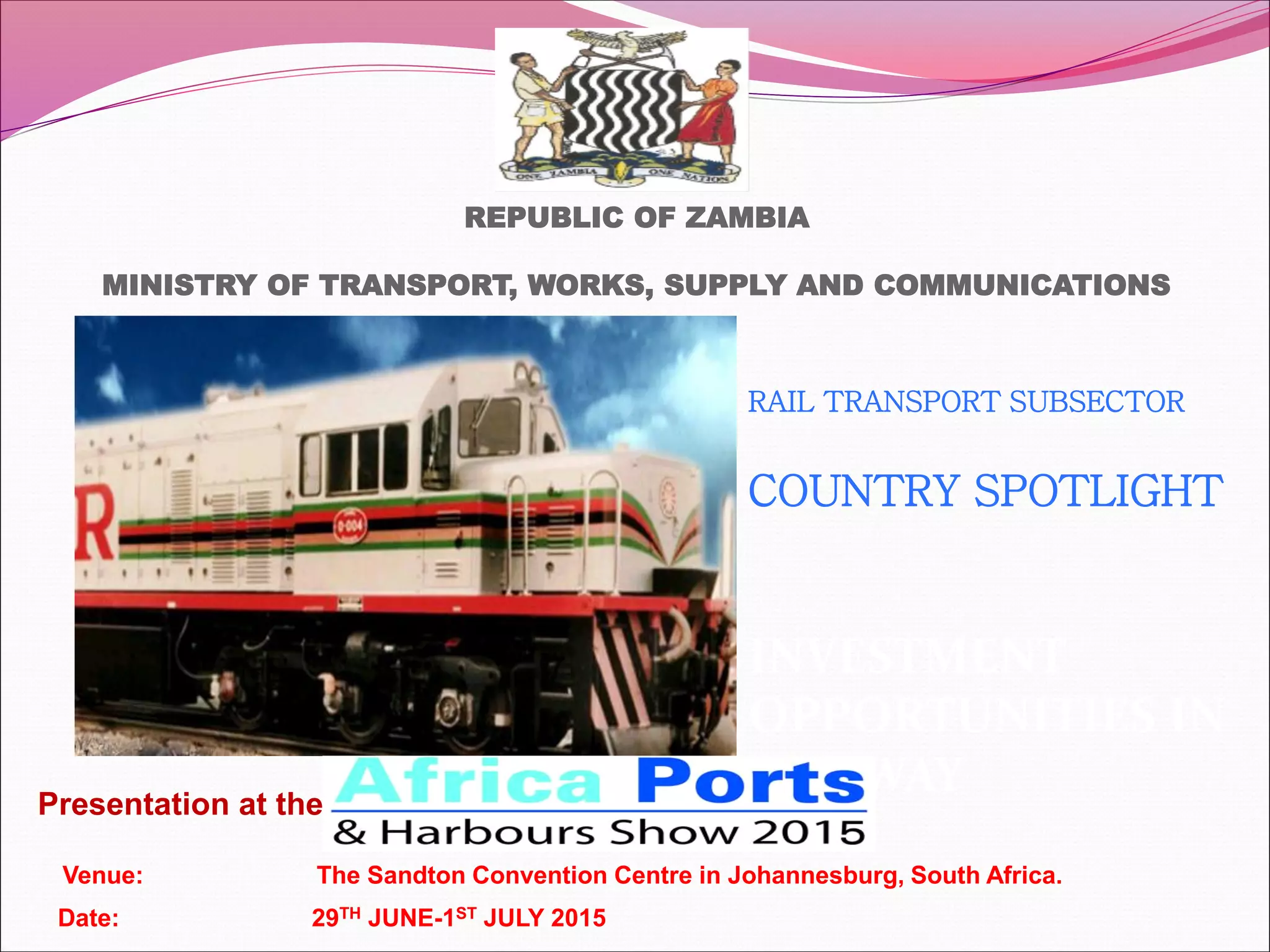
RAIL TRANSPORT SUBSECTOR
COUNTRY SPOTLIGHT
INVESTMENT
OPPORTUNITIES IN
RAILWAYPresentation at the
Venue: The Sandton Convention Centre in Johannesburg, South Africa.
Date: 29TH JUNE-1ST JULY 2015
TABLE OF CONTENTS
1.0 ZAMBIA RAILWAY SYSTEM – Background
1.1 ZAMBIA RAILWAYS LIMITED
1.2 TAZARA RAILWAY LINE
1.3 ROUTE MAPS
1.4 RAIL SUPPLY CHAIN
2.0 ZAMBIA RAILWAY SYSTEM CHALLENGES
2.1 ZAMBIA RAILWAYS LIMITED CHALLENGES
2.2 TAZARA CHALLENGES
3.0 EEFORTS TO REVITALISE ZAMBIA RAILWAY SYSTEM
4.0 COUNTRY SPOTLIGHT OR FOCUS
5.0 CONCLUSION
ZAMBIA RAILWAY SYSTEM
1.0 BACKGROUND
The Railway System of Zambia (RSZ) consists of two major railroad networks, namely:
i) Zambia Railways Limited (ZRL) network; and
ii) Tanzania Zambia Railways Authority (TAZARA) network.
1.1 ZAMBIA RAILWAYS LIMITED (ZRL)
 Zambia Railways Limited (ZRL) is the National Railway of Zambia, with gauge (Cape
gauge) of 1,067 mm (3 ft 6 in)
 ZRL network was built during British colonial rule as part of the vision of the Cape-
Cairo railway but the economic spur was to access the mines of Central Africa.
 The Railway started as part of Rhodesian Railways, the company which ran the
railways of Northern Rhodesia(now Zambia) and Southern Rhodesia(now Zimbabwe)
as an integrated operation.
 The Railway arrived in the future Zambia early in 1905 when the 150 km Livingstone-
Kalomo line was built.
1.1 ZAMBIA RAILWAYS LIMITED CONTINUED.
 The line reached Broken Hill (Kabwe) in 1906 and Ndola
in the Copper belt in 1909 (connecting to Sakania in the
Congo DR).
 In the mid-1960s spurred by the Rhodesian UDI crisis,
the newly independent Zambia split its Railways off from
Rhodesia Railways, and Zambia Railways came into
being.
 Now, ZRL is Mandated under the Railways Act to operate
Freight and Passenger Trains.
 Therefore, ZRL was set up to be the main carrier of
heavy cargo, particularly for the Mining Sector.
1.1 ZAMBIA RAILWAYS LIMITED CONTINUED
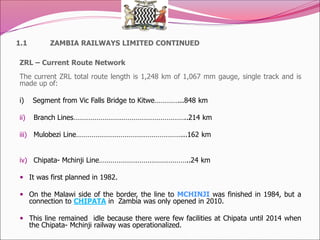
ZRL – Current Route Network
The current ZRL total route length is 1,248 km of 1,067 mm gauge, single track and is
made up of:
i) Segment from Vic Falls Bridge to Kitwe…………...848 km
ii) Branch Lines…………………………………………………..214 km
iii) Mulobezi Line………………………………………………...162 km
iv) Chipata- Mchinji Line………………………………………..24 km
 It was first planned in 1982.
 On the Malawi side of the border, the line to MCHINJI was finished in 1984, but a
connection to CHIPATA in Zambia was only opened in 2010.
 This line remained idle because there were few facilities at Chipata until 2014 when
the Chipata- Mchinji railway was operationalized.
1.2 TAZARA RAILWAY LINE (ALSO CALLED THE TANZAM RAILWAY)
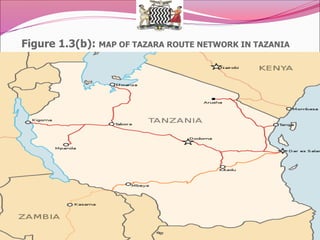
 The other railway system is the bi-national TAZARA Railway (TAZARA) that interconnects
with the ZR at Kapiri Mposhi in Zambia's Central Province, and provides a link to the
Tanzanian port of Dar es Salaam.
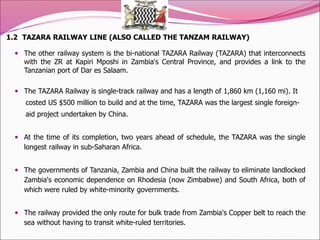
 The TAZARA Railway is single-track railway and has a length of 1,860 km (1,160 mi). It
costed US $500 million to build and at the time, TAZARA was the largest single foreign-
aid project undertaken by China.
 At the time of its completion, two years ahead of schedule, the TAZARA was the single
longest railway in sub-Saharan Africa.
 The governments of Tanzania, Zambia and China built the railway to eliminate landlocked
Zambia's economic dependence on Rhodesia (now Zimbabwe) and South Africa, both of
which were ruled by white-minority governments.
 The railway provided the only route for bulk trade from Zambia's Copper belt to reach the
sea without having to transit white-ruled territories.
1.2 TAZARA RAILWAY LINE (ALSO CALLED THE TANZAM RAILWAY)CONTINUED
 The Government of the People’s Republic of China has also over the years continued to
support TAZARA through the Technical Cooperation Agreements (Protocols) by providing
further loans in form of materials, spare parts, training and equipment to support the
smooth operations of the Authority.
TAZARA Governing Legislation
 TAZARA is governed under the provisions of the Tanzania Zambia Railway Authority ACT
number 10 of 1995.
 This Act gave effect to the Agreement relating to the Tanzania-Zambia Railway made
between the Government of the United Republic of Tanzania and the Government of the
Republic of Zambia, dated 28th September, 1993.
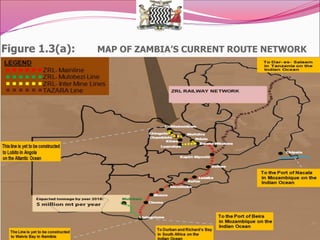
Figure 1.3(a): MAP OF ZAMBIA’S CURRENT ROUTE NETWORK
Figure 1.3(b): MAP OF TAZARA ROUTE NETWORK IN TAZANIA
ZAMBIA RAILWAY SYSTEM
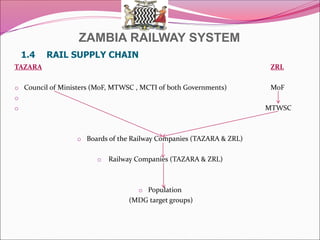
1.4 RAIL SUPPLY CHAIN
TAZARA ZRL
o Council of Ministers (MoF, MTWSC , MCTI of both Governments) MoF
o
o MTWSC
o Boards of the Railway Companies (TAZARA & ZRL)
o Railway Companies (TAZARA & ZRL)
o Population
(MDG target groups)
2.0 Zambia Railway System Challenges
 Although substantial investments were injected in the sector soon after independence,
subsequent investments over the years have not been able to sustain the existing
infrastructure resulting in its deterioration.
 Lack of a comprehensive policy framework to provide the necessary guidance in
investment programs for the sector also contributed to its poor performance in the
economy.
2.1 ZAMBIA RAILWAYS LIMITED (ZRL) CHALLENGES;
2.1.1 Period from 1960-1990
 Up until about 1990, the railway was the main carrier of heavy cargo but due to
numerous problems in the Land Transport system (Rail and Road) in Zambia, the
railway’s traffic tremendously reduced.
2.1 ZAMBIA RAILWAYS LIMITED (ZRL) CHALLENGES CONTINUED;
2.1.1 Period from 1960-1990
The problems included:
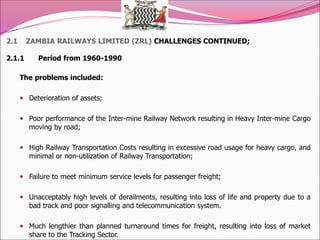
 Deterioration of assets;
 Poor performance of the Inter-mine Railway Network resulting in Heavy Inter-mine Cargo
moving by road;
 High Railway Transportation Costs resulting in excessive road usage for heavy cargo, and
minimal or non-utilization of Railway Transportation;
 Failure to meet minimum service levels for passenger freight;
 Unacceptably high levels of derailments, resulting into loss of life and property due to a
bad track and poor signalling and telecommunication system.
 Much lengthier than planned turnaround times for freight, resulting into loss of market
share to the Tracking Sector.
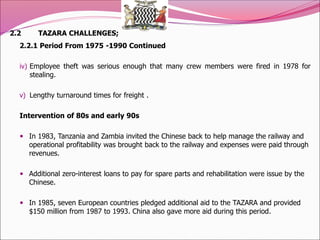
2.2 TANZANIA ZAMBIA RAILWAYS AUTHORITY (TAZARA) CHALLENGES
2.2.1 Period from 1975-1990
 The TAZARA has been a major economic conduit in the region but it faced operating
difficulties from the start and, owing to various subsequent developments, never reached
the expected delivery tonnage of two million tons per day.
 Within the first years of operation, serious problems arose with maintenance and
employees:
i) In their haste to complete the railway ahead of schedule, the Chinese did not train
sufficient African Technicians to take over management of the railway. Service was
frequently disrupted, especially during the rainy season due Landslides and washouts
(e.g. rain season of 1979).
ii) The initial diesel hydraulic locomotives sent by the Chinese were insufficiently powerful to
haul heavy loads up the steep escarpment between Mlimba and Makambako.
iii) When the Chinese rolling stock broke down, there was limited local capacity to repair.
Therefore, by 1978, 19 to 27 of the locomotives were out of operation for repair and so
were half of the rail cars.
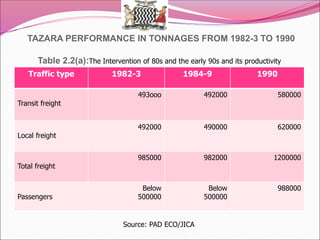
2.2 TAZARA CHALLENGES;
2.2.1 Period From 1975 -1990 Continued
iv) Employee theft was serious enough that many crew members were fired in 1978 for
stealing.
v) Lengthy turnaround times for freight .
Intervention of 80s and early 90s
 In 1983, Tanzania and Zambia invited the Chinese back to help manage the railway and
operational profitability was brought back to the railway and expenses were paid through
revenues.
 Additional zero-interest loans to pay for spare parts and rehabilitation were issue by the
Chinese.
 In 1985, seven European countries pledged additional aid to the TAZARA and provided
$150 million from 1987 to 1993. China also gave more aid during this period.
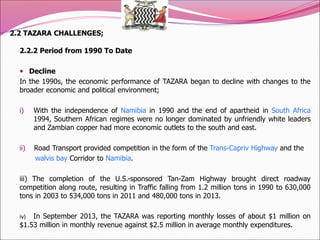
TAZARA PERFORMANCE IN TONNAGES FROM 1982-3 TO 1990
Table 2.2(a):The Intervention of 80s and the early 90s and its productivity
Traffic type 1982-3 1984-9 1990
Transit freight
493ooo 492000 580000
Local freight
492000 490000 620000
Total freight
985000 982000 1200000
Passengers
Below
500000
Below
500000
988000
Source: PAD ECO/JICA
2.2 TAZARA CHALLENGES;
2.2.2 Period from 1990 To Date
 Decline
In the 1990s, the economic performance of TAZARA began to decline with changes to the
broader economic and political environment;
i) With the independence of Namibia in 1990 and the end of apartheid in South Africa
1994, Southern African regimes were no longer dominated by unfriendly white leaders
and Zambian copper had more economic outlets to the south and east.
ii) Road Transport provided competition in the form of the Trans-Capriv Highway and the
walvis bay Corridor to Namibia.
iii) The completion of the U.S.-sponsored Tan-Zam Highway brought direct roadway
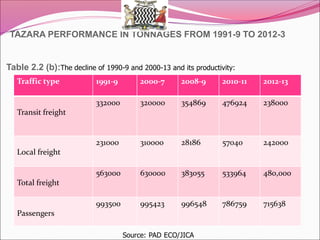
competition along route, resulting in Traffic falling from 1.2 million tons in 1990 to 630,000
tons in 2003 to 534,000 tons in 2011 and 480,000 tons in 2013.
iv) In September 2013, the TAZARA was reporting monthly losses of about $1 million on
$1.53 million in monthly revenue against $2.5 million in average monthly expenditures.
TAZARA PERFORMANCE IN TONNAGES FROM 1991-9 TO 2012-3
Table 2.2 (b):The decline of 1990-9 and 2000-13 and its productivity:
Traffic type 1991-9 2000-7 2008-9 2010-11 2012-13
Transit freight
332000 320000 354869 476924 238000
Local freight
231000 310ooo 28186 57040 242000
Total freight
563000 630000 383055 533964 480,000
Passengers
993500 995423 996548 786759 715638
3.0 EFFORTS TO REVITALIZE ZAMBIA RAILWAY SYSTEM
 In the early 90s, Government of Zambia showed commitment to ensuring that the
Transport Sector performed its role as a catalyst in the social and economic development
process of the country by Providing Policy guidelines for the Transport Sector designed to
effectively contribute to the growth of the Zambian economy.
 Therefore, in 2002, the Transport Policy was formulated (Transport Policy of 2002,
currently under review).
 The policy guidelines were in line with the economic measures being pursued by
Government to resuscitate the economy.
 The measures included, the liberalization of the sector and privatization or
commercialization of state owned enterprises.
 Nevertheless, the Transport policies and strategies then only helped the Road Sub-sector
in achieving appreciable milestones (Adequate Institutional Framework; Adequate Legal
Framework; Road Sector Investment Programme; RoadSIP I and II etc.)
3.0 EFFORTS TO REVITALIZE ZAMBIA RAILWAY SYSTEM CONTINUED
 Whilst, the Rail, Air and Water Transport Subsectors recorded less milestones.
Zambia Railways Limited
 Consequently, Zambia Railways was Concessioned to Railway Systems of Zambia (RSZ)
Limited after signing of the Freight Concession Agreement on 14th February 2003.
 The Concession was to operate for a period of 20 years with a possible extension for a
further 10 years.
 However, in September 2012, the government revoked the concession and Zambia
Railways resumed control.
 The acquisition was necessitated by a number of issues, some being:
i) Mismanagement of Zambia Railways infrastructure and rolling stock.
ii) Abandonment of the inter-mine railway network resulting in loss of Intermine freight
modal share (heavy inter-mine cargo moving by road);
3.0 EFFORTS TO REVITALIZE ZAMBIA RAILWAY SYSTEM CONTINUED
iii) High railway transportation costs accounting for 60% - 70% of the cost of production
and resulting in excessive road usage for heavy cargo, and minimal or non-utilization of
railway transportation;
iv) Failure to meet minimum service levels for passenger freight despite being a beneficiary
of a substantial Government subsidy;
v) Unacceptably high levels of derailments, leading to loss of life and property and
resulting into enormous cost to Government; and
vi) Blatant disregard of the provisions of the concession agreement and unsatisfactory
performance, resulting in great risks to the sustainability of Railway Transport in
Zambia.
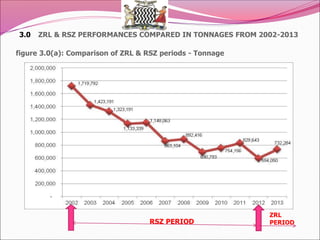
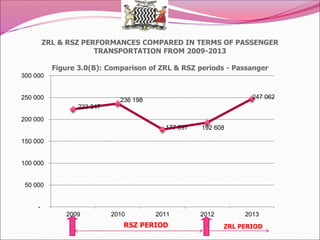
Upon Zambia Railways resuming control after the revocation of the concession in September
2012, the company immediately showed positive trends as indicated in figures 1 and 2:
3.0 ZRL & RSZ PERFORMANCES COMPARED IN TONNAGES FROM 2002-2013
figure 3.0(a): Comparison of ZRL & RSZ periods - Tonnage
ZRL & RSZ PERFORMANCES COMPARED IN TERMS OF PASSENGER
TRANSPORTATION FROM 2009-2013
Figure 3.0(B): Comparison of ZRL & RSZ periods - Passanger
223 347
236 198
177 097 192 608
247 062
-
50 000
100 000
150 000
200 000
250 000
300 000
2009 2010 2011 2012 2013
ZRL PERIOD
3.0 EFFORTS TO REVITALIZE ZAMBIA RAILWAY SYSTEM CONTINUED
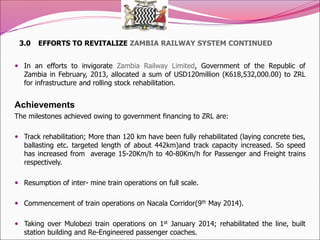
 In an efforts to invigorate Zambia Railway Limited, Government of the Republic of
Zambia in February, 2013, allocated a sum of USD120million (K618,532,000.00) to ZRL
for infrastructure and rolling stock rehabilitation.
Achievements
The milestones achieved owing to government financing to ZRL are:
 Track rehabilitation; More than 120 km have been fully rehabilitated (laying concrete ties,
ballasting etc. targeted length of about 442km)and track capacity increased. So speed
has increased from average 15-20Km/h to 40-80Km/h for Passenger and Freight trains
respectively.
 Resumption of inter- mine train operations on full scale.
 Commencement of train operations on Nacala Corridor(9th May 2014).
 Taking over Mulobezi train operations on 1st January 2014; rehabilitated the line, built
station building and Re-Engineered passenger coaches.
3.0 EFFORTS TO REVITALIZE ZAMBIA RAILWAY SYSTEM CONTINUED
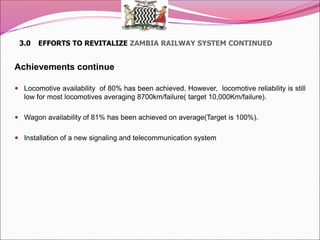
Achievements continue
 Locomotive availability of 80% has been achieved. However, locomotive reliability is still
low for most locomotives averaging 8700km/failure( target 10,000Km/failure).
 Wagon availability of 81% has been achieved on average(Target is 100%).
 Installation of a new signaling and telecommunication system
3.0 EFFORTS TO REVITALIZE ZAMBIA RAILWAY SYSTEM CONTINUED
TAZARA
 At the beginning of 2010, the Chinese government gave TAZARA a US$39 million
interest-free loan to revive its operations.
 However, TAZARA management estimated that it would require US$770 million to
become commercially viable.
 In 2011, China wrote off about half of the debts it was owed by TAZARA; and
 In October 2012, gave $42 million for four new main locomotives, two shunting
locomotives, other equipment, spare parts and staff training.
 In April 2013, With Government involvement, Zambia’s second largest Copper Mine,
Konkola Copper Mines, agreed to re-commence shipping copper on the TAZARA after a
five-year stoppage and by November 2013, the line was reported shipping 15,000 tons of
copper weekly, but still prone to breakdowns and delays.
3.0 EFFORTS TO REVITALIZE ZAMBIA RAILWAY SYSTEM CONTINUED
TAZARA
 In August 2014, the Zambian government gave TAZARA Zmk 18, 353, 109 towards the
company’s liabilities.
 Again in January 2015, the Zambian government gave TAZARA Zmk 19, 500, 000
towards the company’s liabilities.
 In March 2014, Tanzanian, Zambian and Chinese officials held talks to recapitalize the
TARZARA and to decentralise operations of TAZARA to the two regions, Zambian region
and Tanzanian region.
All these efforts and much more have not yielded required results. TAZARA require
sustainability.
4.0 ZAMBIA RAILWAY SYSTEM-COUNTRY SPOTLIGHT/FOCUS
To improve Rail Freight and Passenger Transport performance, the Government’s focus is:
 Strengthening the management of the Railway Companies including ‘Down size and upskill’ (i.e. less
labour intensive and more core competences), especially for TAZARA;
 Improving the existing Railway Net Work to maintainable standard and extending the net work along
development corridors and to link sea ports both on the East and West coasts;
 Facilitating corridor development by intermodal transport;
 Review and Formulation of national railway policy and strategy;
 Linking trains into supply chains (inter-modalism and multi-modalism ); increasing market reach
without increasing network length;
 Improving and up grading Rolling Stock;
4.0 ZAMBIA RAILWAY SYSTEM-COUNTRY SPOTLIGHT/FOCUS
PROJECTS/PROGRAMS BEING UNDERTAKEN
i) STRENGTHEN THE MANAGEMENT
 Government is facilitating restructuring programs in the railway companies with the view
to Down size and up skill (i.e. less labour intensive and more core competences) the
institutions especially the TAZARA.
ii) EXISTING RAILWAY NET WORK (TRACKAGE PROJECTS)
Government is facilitating improvement of the existing Railway Net Work through financing:
 Replacement of steel rails and timber ties (sleepers) with concrete ties to maintain a
consistent distance apart, or gauge.
 Welding rails together to form lengths of continuous welded rail to counteract additional
wear and tear on rolling stock caused by the small surface gap at the joints between rails
and also make for a quieter ride (passenger trains).
ii) IMPROVING EXISTING RAILWAY NET WORK-TRACKAGE PROJECTS CONT.
 Stabilizing the foundation made of compressed earth and ballasting to distribute the
load from the ties and to prevent the track from bucking as the ground settles over
time under the weight of the vehicles passing above and to serve as a means of
drainage.
 Replacing of cracked or split Concrete ties or sleepers.
 lifting of rails settled due to soil subsidence.
 Removing ballast and replacing with clean ballast to ensure adequate drainage.
 Constructing and cleaning Culverts and other passages for water to prevent impounding
of water by the track bed, causing landslips.
iii) NETWORK EXTENSION PROJECTS
 Construction of branch lines to Link trains into supply chains and to increase market
reach e.g. ZRL in the inter-mine region instituted works aimed at revamping the rail
infrastructure in order to service KCM’s Konkola and Nchanga mines.
The works included:
 Rehabilitation of a 1,048 m stretch and opening up of drainages in Konkola Plant;
 Construction of a 700 m rail track in Nchanga Plant;
 Track rehabilitation works on the Luano-Chililabombwe.
 Construction of rail lines to facilitate Intermodal Land Transport Corridor Development:
As a landlocked and a transit country, Trade Corridors and a well managed transport system
are vital. In Zambia's case, these are road and/or rail routes which cross international
borders to Sea ports and which are the subject of international agreements on planning, use
and management.
They are not separate from the road and rail networks in the country, but are entities
superimposed on those networks for strategic economic and trade development.
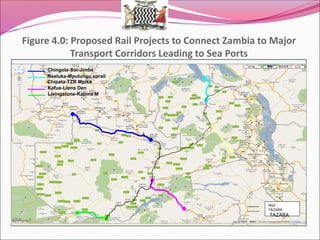
Figure 4.0: Proposed Rail Projects to Connect Zambia to Major
Transport Corridors Leading to Sea Ports
Chingola-Sol-Jimbe
Nseluka-Mpulungu sprail
Chipata-TZR Mpika
Kafue-Lions Den
Livingstone-Katima M
RSZ
TAZARA
TAZARA
iii) NETWORK EXTENSION PROJECTS CONTINUED
Corridors of importance to Zambia are as follows:
 Southern Corridor: to Durban Port via Johannesburg, South Africa via Zimbabwe (road
or rail) or Botswana (road).
 Maputo Corridor: As for (1) but rail or road from Johannesburg to Maputo Port,
Mozambique.
 Walvis Bay Corridor: Road via Livingstone/Sesheke/Katima Mulilo to Walvis Bay Port,
Namibia.
 Beira Corridor: Road to Harare or rail to Bulawayo, then rail via Mutare to Beira,
Mozambique.
 Nacala Corridor: road to Lilongwe then rail to Nacala, Mozambique or road to Chipata
then rail to Nacala, Mozambique, .
iii) NETWORK EXTENSION PROJECTS CONTINUED
 Tazara Corridor: Road or Rail via kapiri mposhi to Dar es Salaam, Tanzania.
 Lobito Corridor: Northern Route and Southern Route
(a) Northern Route :
Rail via DR Congo to lobito bay, Angola (not currently operational, depends on Katanga-
Benguela line, which is incomplete).
(b) Southern Route:
Currently, Rail to Road in Chingola via Solwezi, Zambia to Jimbe on the Angolan border.
Construction of the Rail Line from Chingola to Jimbe is being considered on either PPP basis
or joint venture.
iii) REVIEW AND FORMULATION OF NATIONAL TRANSPORT POLICY AND
RAILWAY STRATEGY
Objective;
 Government strategies and policies to help both rail freight and road freight industry
succeed for modal balance.
 Promote Un-constrained commercial instinct and freedoms of Rail Freight Companies.
 Promote Effective Private Sector participation in the Rail Sector.
 Promote the development of International Rail Corridors.
Trains and their passengers must be able to cross borders freely within an integrated area
by improving the interoperability of networks by stimulating investment in infrastructures
and implementing policy to harmonise passengers’ rights and working conditions, within the
region.
 Promote integration of Rail Transport with other modes.
 Promote freight carriage via track access rights.
iv) IMPROVING AND UP GRADING ROLLING STOCK;
.
Investment and Maintenance policy shift for Railways.
i) Investment in High speed trains with high design speed.
ii) Investment in Sustainable Rail Passenger Transport.
iii) Investment in railway upgrades.
iv) Apt Investment in maintenance:
Maintenance Facilities with good access, Cleaning and Stabling facilities, wheel
profiling facility( wheel lathe), Inspection Sheds, Excellent Rolling stock
maintenance programs (by mileage, by time or by conditioning monitoring),
performance based maintenance contracts.
v) Installation of High-Tech Signalling and Telecommunication System.
vi) Investment in Mass Rapid Transit, or MRT,
5.0 CONCLUSION
RAILWAYS HAVE A PARTICULAR ROLE TO PERFORM:
1. THEY CAN CONVEY A MUCH WINDER RANGE OF FREIGHT TYPES THAN PIPELINES.
2. THEY ARE FASTER AND MORE UNIVERSALLY AVAILABLE THAN INLAND WATER WAYS ROUTES.
3. THEY HAVE INFINITELY GREATER CARRYING CAPACITY AND CARRY AT A FRACTION OF THE COSTS
OF AIR TRANSPORT.
4. IF WELL DESIGNED AND MANAGED, THEY CAN, FOR A WIDE RANGE OF COMMODITIES DELIVER
BOTH HIGHER CAPACITY AND LOWER COSTS OF OPERATIONS THAN ROAD HAULAGE AT LOWER
EXTERNAL COST TO THE COMMUNITY.
5. ABOVE ALL, RAILWAYS ARE MORE ECO TRANSPORT THAN ROAD.

Zambia rail industry

  • 1.
    REPUBLIC OF ZAMBIA MINISTRYOF TRANSPORT, WORKS, SUPPLY AND COMMUNICATIONS RAIL TRANSPORT SUBSECTOR COUNTRY SPOTLIGHT INVESTMENT OPPORTUNITIES IN RAILWAYPresentation at the Venue: The Sandton Convention Centre in Johannesburg, South Africa. Date: 29TH JUNE-1ST JULY 2015
  • 2.
    TABLE OF CONTENTS 1.0ZAMBIA RAILWAY SYSTEM – Background 1.1 ZAMBIA RAILWAYS LIMITED 1.2 TAZARA RAILWAY LINE 1.3 ROUTE MAPS 1.4 RAIL SUPPLY CHAIN 2.0 ZAMBIA RAILWAY SYSTEM CHALLENGES 2.1 ZAMBIA RAILWAYS LIMITED CHALLENGES 2.2 TAZARA CHALLENGES 3.0 EEFORTS TO REVITALISE ZAMBIA RAILWAY SYSTEM 4.0 COUNTRY SPOTLIGHT OR FOCUS 5.0 CONCLUSION
  • 3.
    ZAMBIA RAILWAY SYSTEM 1.0BACKGROUND The Railway System of Zambia (RSZ) consists of two major railroad networks, namely: i) Zambia Railways Limited (ZRL) network; and ii) Tanzania Zambia Railways Authority (TAZARA) network. 1.1 ZAMBIA RAILWAYS LIMITED (ZRL)  Zambia Railways Limited (ZRL) is the National Railway of Zambia, with gauge (Cape gauge) of 1,067 mm (3 ft 6 in)  ZRL network was built during British colonial rule as part of the vision of the Cape- Cairo railway but the economic spur was to access the mines of Central Africa.  The Railway started as part of Rhodesian Railways, the company which ran the railways of Northern Rhodesia(now Zambia) and Southern Rhodesia(now Zimbabwe) as an integrated operation.  The Railway arrived in the future Zambia early in 1905 when the 150 km Livingstone- Kalomo line was built.
  • 4.
    1.1 ZAMBIA RAILWAYSLIMITED CONTINUED.  The line reached Broken Hill (Kabwe) in 1906 and Ndola in the Copper belt in 1909 (connecting to Sakania in the Congo DR).  In the mid-1960s spurred by the Rhodesian UDI crisis, the newly independent Zambia split its Railways off from Rhodesia Railways, and Zambia Railways came into being.  Now, ZRL is Mandated under the Railways Act to operate Freight and Passenger Trains.  Therefore, ZRL was set up to be the main carrier of heavy cargo, particularly for the Mining Sector.
  • 5.
    1.1 ZAMBIA RAILWAYSLIMITED CONTINUED ZRL – Current Route Network The current ZRL total route length is 1,248 km of 1,067 mm gauge, single track and is made up of: i) Segment from Vic Falls Bridge to Kitwe…………...848 km ii) Branch Lines…………………………………………………..214 km iii) Mulobezi Line………………………………………………...162 km iv) Chipata- Mchinji Line………………………………………..24 km  It was first planned in 1982.  On the Malawi side of the border, the line to MCHINJI was finished in 1984, but a connection to CHIPATA in Zambia was only opened in 2010.  This line remained idle because there were few facilities at Chipata until 2014 when the Chipata- Mchinji railway was operationalized.
  • 6.
    1.2 TAZARA RAILWAYLINE (ALSO CALLED THE TANZAM RAILWAY)  The other railway system is the bi-national TAZARA Railway (TAZARA) that interconnects with the ZR at Kapiri Mposhi in Zambia's Central Province, and provides a link to the Tanzanian port of Dar es Salaam.  The TAZARA Railway is single-track railway and has a length of 1,860 km (1,160 mi). It costed US $500 million to build and at the time, TAZARA was the largest single foreign- aid project undertaken by China.  At the time of its completion, two years ahead of schedule, the TAZARA was the single longest railway in sub-Saharan Africa.  The governments of Tanzania, Zambia and China built the railway to eliminate landlocked Zambia's economic dependence on Rhodesia (now Zimbabwe) and South Africa, both of which were ruled by white-minority governments.  The railway provided the only route for bulk trade from Zambia's Copper belt to reach the sea without having to transit white-ruled territories.
  • 7.
    1.2 TAZARA RAILWAYLINE (ALSO CALLED THE TANZAM RAILWAY)CONTINUED  The Government of the People’s Republic of China has also over the years continued to support TAZARA through the Technical Cooperation Agreements (Protocols) by providing further loans in form of materials, spare parts, training and equipment to support the smooth operations of the Authority. TAZARA Governing Legislation  TAZARA is governed under the provisions of the Tanzania Zambia Railway Authority ACT number 10 of 1995.  This Act gave effect to the Agreement relating to the Tanzania-Zambia Railway made between the Government of the United Republic of Tanzania and the Government of the Republic of Zambia, dated 28th September, 1993.
  • 8.
    Figure 1.3(a): MAPOF ZAMBIA’S CURRENT ROUTE NETWORK
  • 9.
    Figure 1.3(b): MAPOF TAZARA ROUTE NETWORK IN TAZANIA
  • 10.
    ZAMBIA RAILWAY SYSTEM 1.4RAIL SUPPLY CHAIN TAZARA ZRL o Council of Ministers (MoF, MTWSC , MCTI of both Governments) MoF o o MTWSC o Boards of the Railway Companies (TAZARA & ZRL) o Railway Companies (TAZARA & ZRL) o Population (MDG target groups)
  • 11.
    2.0 Zambia RailwaySystem Challenges  Although substantial investments were injected in the sector soon after independence, subsequent investments over the years have not been able to sustain the existing infrastructure resulting in its deterioration.  Lack of a comprehensive policy framework to provide the necessary guidance in investment programs for the sector also contributed to its poor performance in the economy. 2.1 ZAMBIA RAILWAYS LIMITED (ZRL) CHALLENGES; 2.1.1 Period from 1960-1990  Up until about 1990, the railway was the main carrier of heavy cargo but due to numerous problems in the Land Transport system (Rail and Road) in Zambia, the railway’s traffic tremendously reduced.
  • 12.
    2.1 ZAMBIA RAILWAYSLIMITED (ZRL) CHALLENGES CONTINUED; 2.1.1 Period from 1960-1990 The problems included:  Deterioration of assets;  Poor performance of the Inter-mine Railway Network resulting in Heavy Inter-mine Cargo moving by road;  High Railway Transportation Costs resulting in excessive road usage for heavy cargo, and minimal or non-utilization of Railway Transportation;  Failure to meet minimum service levels for passenger freight;  Unacceptably high levels of derailments, resulting into loss of life and property due to a bad track and poor signalling and telecommunication system.  Much lengthier than planned turnaround times for freight, resulting into loss of market share to the Tracking Sector.
  • 13.
    2.2 TANZANIA ZAMBIARAILWAYS AUTHORITY (TAZARA) CHALLENGES 2.2.1 Period from 1975-1990  The TAZARA has been a major economic conduit in the region but it faced operating difficulties from the start and, owing to various subsequent developments, never reached the expected delivery tonnage of two million tons per day.  Within the first years of operation, serious problems arose with maintenance and employees: i) In their haste to complete the railway ahead of schedule, the Chinese did not train sufficient African Technicians to take over management of the railway. Service was frequently disrupted, especially during the rainy season due Landslides and washouts (e.g. rain season of 1979). ii) The initial diesel hydraulic locomotives sent by the Chinese were insufficiently powerful to haul heavy loads up the steep escarpment between Mlimba and Makambako. iii) When the Chinese rolling stock broke down, there was limited local capacity to repair. Therefore, by 1978, 19 to 27 of the locomotives were out of operation for repair and so were half of the rail cars.
  • 14.
    2.2 TAZARA CHALLENGES; 2.2.1Period From 1975 -1990 Continued iv) Employee theft was serious enough that many crew members were fired in 1978 for stealing. v) Lengthy turnaround times for freight . Intervention of 80s and early 90s  In 1983, Tanzania and Zambia invited the Chinese back to help manage the railway and operational profitability was brought back to the railway and expenses were paid through revenues.  Additional zero-interest loans to pay for spare parts and rehabilitation were issue by the Chinese.  In 1985, seven European countries pledged additional aid to the TAZARA and provided $150 million from 1987 to 1993. China also gave more aid during this period.
  • 15.
    TAZARA PERFORMANCE INTONNAGES FROM 1982-3 TO 1990 Table 2.2(a):The Intervention of 80s and the early 90s and its productivity Traffic type 1982-3 1984-9 1990 Transit freight 493ooo 492000 580000 Local freight 492000 490000 620000 Total freight 985000 982000 1200000 Passengers Below 500000 Below 500000 988000 Source: PAD ECO/JICA
  • 16.
    2.2 TAZARA CHALLENGES; 2.2.2Period from 1990 To Date  Decline In the 1990s, the economic performance of TAZARA began to decline with changes to the broader economic and political environment; i) With the independence of Namibia in 1990 and the end of apartheid in South Africa 1994, Southern African regimes were no longer dominated by unfriendly white leaders and Zambian copper had more economic outlets to the south and east. ii) Road Transport provided competition in the form of the Trans-Capriv Highway and the walvis bay Corridor to Namibia. iii) The completion of the U.S.-sponsored Tan-Zam Highway brought direct roadway competition along route, resulting in Traffic falling from 1.2 million tons in 1990 to 630,000 tons in 2003 to 534,000 tons in 2011 and 480,000 tons in 2013. iv) In September 2013, the TAZARA was reporting monthly losses of about $1 million on $1.53 million in monthly revenue against $2.5 million in average monthly expenditures.
  • 17.
    TAZARA PERFORMANCE INTONNAGES FROM 1991-9 TO 2012-3 Table 2.2 (b):The decline of 1990-9 and 2000-13 and its productivity: Traffic type 1991-9 2000-7 2008-9 2010-11 2012-13 Transit freight 332000 320000 354869 476924 238000 Local freight 231000 310ooo 28186 57040 242000 Total freight 563000 630000 383055 533964 480,000 Passengers 993500 995423 996548 786759 715638
  • 18.
    3.0 EFFORTS TOREVITALIZE ZAMBIA RAILWAY SYSTEM  In the early 90s, Government of Zambia showed commitment to ensuring that the Transport Sector performed its role as a catalyst in the social and economic development process of the country by Providing Policy guidelines for the Transport Sector designed to effectively contribute to the growth of the Zambian economy.  Therefore, in 2002, the Transport Policy was formulated (Transport Policy of 2002, currently under review).  The policy guidelines were in line with the economic measures being pursued by Government to resuscitate the economy.  The measures included, the liberalization of the sector and privatization or commercialization of state owned enterprises.  Nevertheless, the Transport policies and strategies then only helped the Road Sub-sector in achieving appreciable milestones (Adequate Institutional Framework; Adequate Legal Framework; Road Sector Investment Programme; RoadSIP I and II etc.)
  • 19.
    3.0 EFFORTS TOREVITALIZE ZAMBIA RAILWAY SYSTEM CONTINUED  Whilst, the Rail, Air and Water Transport Subsectors recorded less milestones. Zambia Railways Limited  Consequently, Zambia Railways was Concessioned to Railway Systems of Zambia (RSZ) Limited after signing of the Freight Concession Agreement on 14th February 2003.  The Concession was to operate for a period of 20 years with a possible extension for a further 10 years.  However, in September 2012, the government revoked the concession and Zambia Railways resumed control.  The acquisition was necessitated by a number of issues, some being: i) Mismanagement of Zambia Railways infrastructure and rolling stock. ii) Abandonment of the inter-mine railway network resulting in loss of Intermine freight modal share (heavy inter-mine cargo moving by road);
  • 20.
    3.0 EFFORTS TOREVITALIZE ZAMBIA RAILWAY SYSTEM CONTINUED iii) High railway transportation costs accounting for 60% - 70% of the cost of production and resulting in excessive road usage for heavy cargo, and minimal or non-utilization of railway transportation; iv) Failure to meet minimum service levels for passenger freight despite being a beneficiary of a substantial Government subsidy; v) Unacceptably high levels of derailments, leading to loss of life and property and resulting into enormous cost to Government; and vi) Blatant disregard of the provisions of the concession agreement and unsatisfactory performance, resulting in great risks to the sustainability of Railway Transport in Zambia. Upon Zambia Railways resuming control after the revocation of the concession in September 2012, the company immediately showed positive trends as indicated in figures 1 and 2:
  • 21.
    3.0 ZRL &RSZ PERFORMANCES COMPARED IN TONNAGES FROM 2002-2013 figure 3.0(a): Comparison of ZRL & RSZ periods - Tonnage
  • 22.
    ZRL & RSZPERFORMANCES COMPARED IN TERMS OF PASSENGER TRANSPORTATION FROM 2009-2013 Figure 3.0(B): Comparison of ZRL & RSZ periods - Passanger 223 347 236 198 177 097 192 608 247 062 - 50 000 100 000 150 000 200 000 250 000 300 000 2009 2010 2011 2012 2013 ZRL PERIOD
  • 23.
    3.0 EFFORTS TOREVITALIZE ZAMBIA RAILWAY SYSTEM CONTINUED  In an efforts to invigorate Zambia Railway Limited, Government of the Republic of Zambia in February, 2013, allocated a sum of USD120million (K618,532,000.00) to ZRL for infrastructure and rolling stock rehabilitation. Achievements The milestones achieved owing to government financing to ZRL are:  Track rehabilitation; More than 120 km have been fully rehabilitated (laying concrete ties, ballasting etc. targeted length of about 442km)and track capacity increased. So speed has increased from average 15-20Km/h to 40-80Km/h for Passenger and Freight trains respectively.  Resumption of inter- mine train operations on full scale.  Commencement of train operations on Nacala Corridor(9th May 2014).  Taking over Mulobezi train operations on 1st January 2014; rehabilitated the line, built station building and Re-Engineered passenger coaches.
  • 24.
    3.0 EFFORTS TOREVITALIZE ZAMBIA RAILWAY SYSTEM CONTINUED Achievements continue  Locomotive availability of 80% has been achieved. However, locomotive reliability is still low for most locomotives averaging 8700km/failure( target 10,000Km/failure).  Wagon availability of 81% has been achieved on average(Target is 100%).  Installation of a new signaling and telecommunication system
  • 25.
    3.0 EFFORTS TOREVITALIZE ZAMBIA RAILWAY SYSTEM CONTINUED TAZARA  At the beginning of 2010, the Chinese government gave TAZARA a US$39 million interest-free loan to revive its operations.  However, TAZARA management estimated that it would require US$770 million to become commercially viable.  In 2011, China wrote off about half of the debts it was owed by TAZARA; and  In October 2012, gave $42 million for four new main locomotives, two shunting locomotives, other equipment, spare parts and staff training.  In April 2013, With Government involvement, Zambia’s second largest Copper Mine, Konkola Copper Mines, agreed to re-commence shipping copper on the TAZARA after a five-year stoppage and by November 2013, the line was reported shipping 15,000 tons of copper weekly, but still prone to breakdowns and delays.
  • 26.
    3.0 EFFORTS TOREVITALIZE ZAMBIA RAILWAY SYSTEM CONTINUED TAZARA  In August 2014, the Zambian government gave TAZARA Zmk 18, 353, 109 towards the company’s liabilities.  Again in January 2015, the Zambian government gave TAZARA Zmk 19, 500, 000 towards the company’s liabilities.  In March 2014, Tanzanian, Zambian and Chinese officials held talks to recapitalize the TARZARA and to decentralise operations of TAZARA to the two regions, Zambian region and Tanzanian region. All these efforts and much more have not yielded required results. TAZARA require sustainability.
  • 27.
    4.0 ZAMBIA RAILWAYSYSTEM-COUNTRY SPOTLIGHT/FOCUS To improve Rail Freight and Passenger Transport performance, the Government’s focus is:  Strengthening the management of the Railway Companies including ‘Down size and upskill’ (i.e. less labour intensive and more core competences), especially for TAZARA;  Improving the existing Railway Net Work to maintainable standard and extending the net work along development corridors and to link sea ports both on the East and West coasts;  Facilitating corridor development by intermodal transport;  Review and Formulation of national railway policy and strategy;  Linking trains into supply chains (inter-modalism and multi-modalism ); increasing market reach without increasing network length;  Improving and up grading Rolling Stock;
  • 28.
    4.0 ZAMBIA RAILWAYSYSTEM-COUNTRY SPOTLIGHT/FOCUS PROJECTS/PROGRAMS BEING UNDERTAKEN i) STRENGTHEN THE MANAGEMENT  Government is facilitating restructuring programs in the railway companies with the view to Down size and up skill (i.e. less labour intensive and more core competences) the institutions especially the TAZARA. ii) EXISTING RAILWAY NET WORK (TRACKAGE PROJECTS) Government is facilitating improvement of the existing Railway Net Work through financing:  Replacement of steel rails and timber ties (sleepers) with concrete ties to maintain a consistent distance apart, or gauge.  Welding rails together to form lengths of continuous welded rail to counteract additional wear and tear on rolling stock caused by the small surface gap at the joints between rails and also make for a quieter ride (passenger trains).
  • 29.
    ii) IMPROVING EXISTINGRAILWAY NET WORK-TRACKAGE PROJECTS CONT.  Stabilizing the foundation made of compressed earth and ballasting to distribute the load from the ties and to prevent the track from bucking as the ground settles over time under the weight of the vehicles passing above and to serve as a means of drainage.  Replacing of cracked or split Concrete ties or sleepers.  lifting of rails settled due to soil subsidence.  Removing ballast and replacing with clean ballast to ensure adequate drainage.  Constructing and cleaning Culverts and other passages for water to prevent impounding of water by the track bed, causing landslips.
  • 30.
    iii) NETWORK EXTENSIONPROJECTS  Construction of branch lines to Link trains into supply chains and to increase market reach e.g. ZRL in the inter-mine region instituted works aimed at revamping the rail infrastructure in order to service KCM’s Konkola and Nchanga mines. The works included:  Rehabilitation of a 1,048 m stretch and opening up of drainages in Konkola Plant;  Construction of a 700 m rail track in Nchanga Plant;  Track rehabilitation works on the Luano-Chililabombwe.  Construction of rail lines to facilitate Intermodal Land Transport Corridor Development: As a landlocked and a transit country, Trade Corridors and a well managed transport system are vital. In Zambia's case, these are road and/or rail routes which cross international borders to Sea ports and which are the subject of international agreements on planning, use and management. They are not separate from the road and rail networks in the country, but are entities superimposed on those networks for strategic economic and trade development.
  • 31.
    Figure 4.0: ProposedRail Projects to Connect Zambia to Major Transport Corridors Leading to Sea Ports Chingola-Sol-Jimbe Nseluka-Mpulungu sprail Chipata-TZR Mpika Kafue-Lions Den Livingstone-Katima M RSZ TAZARA TAZARA
  • 32.
    iii) NETWORK EXTENSIONPROJECTS CONTINUED Corridors of importance to Zambia are as follows:  Southern Corridor: to Durban Port via Johannesburg, South Africa via Zimbabwe (road or rail) or Botswana (road).  Maputo Corridor: As for (1) but rail or road from Johannesburg to Maputo Port, Mozambique.  Walvis Bay Corridor: Road via Livingstone/Sesheke/Katima Mulilo to Walvis Bay Port, Namibia.  Beira Corridor: Road to Harare or rail to Bulawayo, then rail via Mutare to Beira, Mozambique.  Nacala Corridor: road to Lilongwe then rail to Nacala, Mozambique or road to Chipata then rail to Nacala, Mozambique, .
  • 33.
    iii) NETWORK EXTENSIONPROJECTS CONTINUED  Tazara Corridor: Road or Rail via kapiri mposhi to Dar es Salaam, Tanzania.  Lobito Corridor: Northern Route and Southern Route (a) Northern Route : Rail via DR Congo to lobito bay, Angola (not currently operational, depends on Katanga- Benguela line, which is incomplete). (b) Southern Route: Currently, Rail to Road in Chingola via Solwezi, Zambia to Jimbe on the Angolan border. Construction of the Rail Line from Chingola to Jimbe is being considered on either PPP basis or joint venture.
  • 34.
    iii) REVIEW ANDFORMULATION OF NATIONAL TRANSPORT POLICY AND RAILWAY STRATEGY Objective;  Government strategies and policies to help both rail freight and road freight industry succeed for modal balance.  Promote Un-constrained commercial instinct and freedoms of Rail Freight Companies.  Promote Effective Private Sector participation in the Rail Sector.  Promote the development of International Rail Corridors. Trains and their passengers must be able to cross borders freely within an integrated area by improving the interoperability of networks by stimulating investment in infrastructures and implementing policy to harmonise passengers’ rights and working conditions, within the region.  Promote integration of Rail Transport with other modes.  Promote freight carriage via track access rights.
  • 35.
    iv) IMPROVING ANDUP GRADING ROLLING STOCK; . Investment and Maintenance policy shift for Railways. i) Investment in High speed trains with high design speed. ii) Investment in Sustainable Rail Passenger Transport. iii) Investment in railway upgrades. iv) Apt Investment in maintenance: Maintenance Facilities with good access, Cleaning and Stabling facilities, wheel profiling facility( wheel lathe), Inspection Sheds, Excellent Rolling stock maintenance programs (by mileage, by time or by conditioning monitoring), performance based maintenance contracts. v) Installation of High-Tech Signalling and Telecommunication System. vi) Investment in Mass Rapid Transit, or MRT,
  • 36.
    5.0 CONCLUSION RAILWAYS HAVEA PARTICULAR ROLE TO PERFORM: 1. THEY CAN CONVEY A MUCH WINDER RANGE OF FREIGHT TYPES THAN PIPELINES. 2. THEY ARE FASTER AND MORE UNIVERSALLY AVAILABLE THAN INLAND WATER WAYS ROUTES. 3. THEY HAVE INFINITELY GREATER CARRYING CAPACITY AND CARRY AT A FRACTION OF THE COSTS OF AIR TRANSPORT. 4. IF WELL DESIGNED AND MANAGED, THEY CAN, FOR A WIDE RANGE OF COMMODITIES DELIVER BOTH HIGHER CAPACITY AND LOWER COSTS OF OPERATIONS THAN ROAD HAULAGE AT LOWER EXTERNAL COST TO THE COMMUNITY. 5. ABOVE ALL, RAILWAYS ARE MORE ECO TRANSPORT THAN ROAD.