11
© Fraser Health Authority, 2007
The Fraser Health Authority (“FH”) authorizes the use, reproduction and/or
modification of this publication for purposes other than commercial redistribution. In
consideration for this authorization, the user agrees that any unmodified
reproduction of this publication shall retain all copyright and proprietary notices. If
the user modifies the content of this publication, all FH copyright notices shall be
removed, however FH shall be acknowledged as the author of the source
publication.
Reproduction or storage of this publication in any form by any means for the purpose
of commercial redistribution is strictly prohibited.
This publication is intended to provide general information only, and should not be
relied on as providing specific healthcare, legal or other professional advice. The
Fraser Health Authority, and every person involved in the creation of this publication,
disclaims any warranty, express or implied, as to its accuracy, completeness or
currency, and disclaims all liability in respect of any actions, including the results of
any actions, taken or not taken in reliance on the information contained herein.
Knowledge Transfer and Exchange (KTE)
Terminology and Steps in Planning Dissemination
2222
Beware!
Be aware of the fact that the science of KTE has a
deluge of terminology which is often used
interchangeably (and often incorrectly !)
terms actually all have a specific meaning and action(s)
associated
In this presentation, you will be introduced to the same
terminology from two (or more) perspectives:
1) the academic research perspective –CIHR / CHSRF
2) the continuing health education perspective-CACHE
The key is to remember the source and its objective
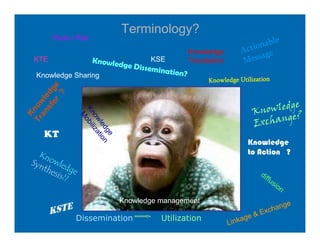
Know
ledge
Transfer
?
Knowledge
Synthesis??
Knowledge
Exchange?
Knowledge
to Action ?
Knowledge Dissemination?
KT
KSTE
Knowledge Utilization
Terminology?
Dissemination Utilization
Actionable
Message
KTE KSE
Knowledge Sharing
diffusion
Push / Pull
Linkage & Exchange
Knowledge
Translation
Knowledge
M
obilization
Knowledge management
4444
What is most important?
To understand:
That KTE is an iterative process that takes time
How the KTE process works
That a range of stakeholders need to be involved
Effective strategies for KTE
Useful frameworks for facilitating the use of best
evidence in practice or decision making
555555
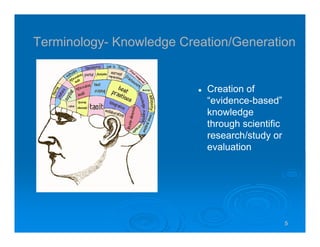
Terminology- Knowledge Creation/Generation
Creation of
“evidence-based”
knowledge
through scientific
research/study or
evaluation
666666
Terminology- Knowledge Translation
“The exchange, synthesis & ethically-sound application of
knowledge---within a complex system of interactions among
researchers & users----to accelerate the capture of benefits of
research for Canadians through improved health, more
effective services & products, and a strengthened health care
system”
• Canadian Institutes of Health Research (CIHR-2000)
“The purpose is to bridge the gap between what we know
(evidence) with what we actually do; any KT strategy takes
into account that translation and learning occurs in a complex
social system, thus, it requires a learner-centered approach”
• Canadian Association of Continuing Health Education (CACHE)
7777
Terminology- Knowledge Synthesis
The importance of understanding how the results
from a single research study mesh with the larger
body of knowledge / research on the topic
Conducted by completing a synthesis of the global
literature on the topic
Allows determination of the effectiveness of
interventions or practices
Canadian Institutes of Health Research (CIHR-2000)
8888
Terminology- Knowledge
Exchange
The interactions between the research user and
the research producer that result in mutual
learning
• Canadian Institutes of Health Research (CIHR-2000)
Emphasizes a collaborative approach that spans
knowledge creation to its implementation.
• Canadian Association of Continuing Health Education
(CACHE-)
Lavis, Lomas et al (2006). BulletinLavis, Lomas et al (2006). Bulletin
of the WHO.of the WHO. 99
The Push Model
Push
the researcher is the catalyst for change
• packages tools (syntheses, policy briefs, videos) in
order to make research more accessible for
decision-makers & other research users
Decision-maker is the target of information in
the push model, but may be involved in the
research also
Lavis, Lomas et al (2006). BulletinLavis, Lomas et al (2006). Bulletin
of the WHO.of the WHO. 1010
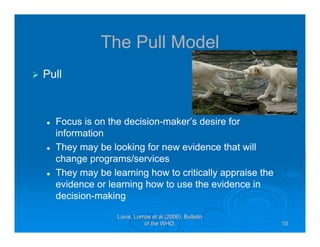
The Pull Model
Pull
Focus is on the decision-maker’s desire for
information
They may be looking for new evidence that will
change programs/services
They may be learning how to critically appraise the
evidence or learning how to use the evidence in
decision-making
Lavis, Lomas et al (2006). BulletinLavis, Lomas et al (2006). Bulletin
of the WHO.of the WHO. 1111
Linkage and Exchange Model
Researchers and research-users
collaborate for mutual benefit
May be a short or long-term
collaboration and may occur at
any point in the research / policy
process
May include priority setting
exercises, collaborative research
projects, or projects with a
developmental product at the end
eg. database
12121212
Terminology- Knowledge Transfer
“A systematic approach to capturing, collecting & sharing tacit knowledge
in order for it to become explicit knowledge”
Government of Alberta
KT is about transferring good ideas, research results & skills between
universities, other research organizations, business & the wider
community to enable innovative new products and services to be
developed
UK Office of Science and Technology
“Successful knowledge transfer involves much more than a one way, linear
diffusion of knowledge & skills from a university to industry; it depends on
access to people, information and infrastructure”
UK Particle Physics & Astronomy Research Council
Refers to the process of having all forms of knowledge used by
stakeholders; has been criticized for implying a unidirectional
process.
Canadian Association of Continuing Health Education (CACHE)
131313131313
Terminology-
Diffusion and Dissemination
Diffusion: The process by which an innovation is communicated through
certain channels over time among members of a social system
• Rogers (1995 -5th ed.)
Dissemination: targets a specific audience and (inter) actively uses
specific styles and levels / types of communication (small group
discussion, one-one meetings, didactic pres) of information to improve
knowledge or skills or elicit change
The spreading of knowledge or research eg in journals or at conferences
Concerns the transmitting of knowledge, but does not emphasize the
development of knowledge, nor the context of the receiver of
knowledge.
• Canadian Association of Continuing Health Education (CACHE)
14141414
Terminology
Research Utilization
The process by which specific research-
based knowledge is implemented in practice
• Estabrooks et al, 2003
Implementation
The execution of the adoption decision where
the research or decision is put into practice
151515151515
Terminology
Adoption and Uptake:
To implement and sustain the innovation or
program over time as a regular ingredient of
practice/policy
Evaluation:
Measure how successful knowledge
exchange activities are based on a pre-
determined set of outcomes or indicators
16161616
Knowledge Transfer and Exchange
(KTE)
WHAT IS THE GOAL OF KTE?:
To produce and disseminate information that
is useful for intended end-users (managers,
decision makers, policymakers)
The style, format, content, and process of
reporting information influences the ability
for the information to be used
17171717
Dissemination ActivitiesDissemination Activities--
when and who?when and who?
What is the preferred order of these disseminationWhat is the preferred order of these dissemination
activities and why?activities and why?
Who will take the lead on each of these?Who will take the lead on each of these?
Suggest: Each committee member responsible for atSuggest: Each committee member responsible for at
least one dissemination activity with reportleast one dissemination activity with report--back atback at
next meeting to groupnext meeting to group
Steps in Planning Dissemination
19191919
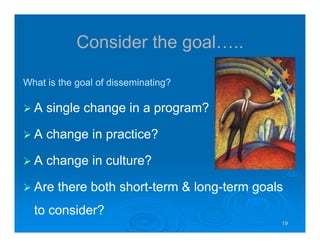
Consider the goal…..
What is the goal of disseminating?
A single change in a program?
A change in practice?
A change in culture?
Are there both short-term & long-term goals
to consider?
20202020
Consider the context….
In creating a plan, we will need
to consider the context or the
environment that it is being
completed within
• political, organizational, social,
cultural context?
• utility?
• relevance?
Grol and Grimshaw (2003)Grol and Grimshaw (2003) 21212121
Consider the Barriers…..
Potential barriers exist- examples :
The practice environment / organizational context
• Financial disincentives (lack of re-imbursement)
• Lack of time
• Risk of formal complaint
The social context
• Usual Routines
• Opinion leaders do not agree with the evidence
• Obsolete knowledge
Professional Context aka knowledge and attitudes
• Clinical uncertainty
• Self confidence in skills
• Need to do something
• Inability to appraise the evidence
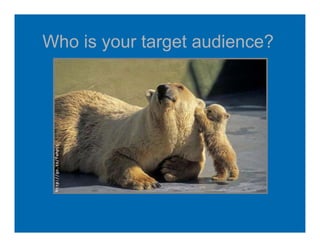
Who is your target audience?
23232323
Who is your Target Audience?
Who are the people who can
use these findings/results?
• Primary Audience?
• Secondary Audience?
Target audiences should be identified
and engaged early in the process to
build their interest and give them a
sense of ownership in the program
24242424
Developing key messages……
252525252525
Develop Key Messages ….
identify the most important, and locally relevant
findings, results, information
What does it mean? why it is important? How does it fit
into the local context?
Consider: How is this information potentially useful to
your target audience?
develop clear, simple, action-oriented messages
the tone, content, and language of a key message needs
to be appropriate for its intended audience
26262626
Tips on tailoring the messages
Messages should be tailored to each audience
based on what is relevant and of interest to them
Consider your specific target audience- how would
you tailor your message so that it becomes what
the audience wants to hear?
27272727
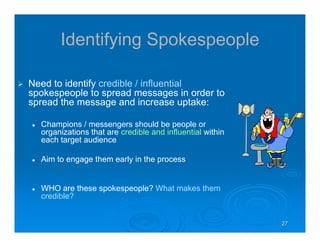
Identifying Spokespeople
Need to identify credible / influential
spokespeople to spread messages in order to
spread the message and increase uptake:
Champions / messengers should be people or
organizations that are credible and influential within
each target audience
Aim to engage them early in the process
WHO are these spokespeople? What makes them
credible?
28282828
Dissemination Activities-what?
What activities will be
undertaken for
dissemination of the key
messages to each of the
target audiences?
What is appropriate and
effective?
Grol and Grimshaw (2003)Grol and Grimshaw (2003) 2929
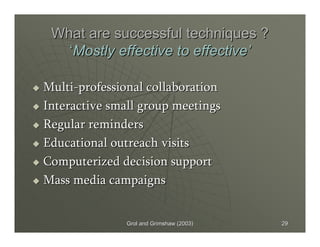
What are successful techniques ?What are successful techniques ?
‘‘Mostly effective to effectiveMostly effective to effective’’
MultiMulti--professional collaborationprofessional collaboration
Interactive small group meetingsInteractive small group meetings
Regular remindersRegular reminders
Educational outreach visitsEducational outreach visits
Computerized decision supportComputerized decision support
Mass media campaignsMass media campaigns
Grol and Grimshaw (2003)Grol and Grimshaw (2003) 3030
What are successful techniques ?What are successful techniques ?
‘‘Mixed effectsMixed effects’’
Educational MaterialsEducational Materials
ConferencesConferences
Use of opinion leadersUse of opinion leaders
Education with different educationalEducation with different educational
strategiesstrategies
Feedback on performanceFeedback on performance
Continuous quality improvementContinuous quality improvement
31313131
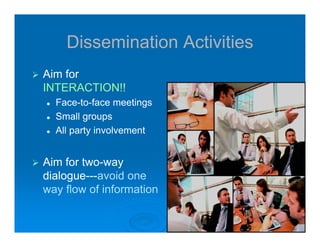
Dissemination Activities
Aim for
INTERACTION!!
Face-to-face meetings
Small groups
All party involvement
Aim for two-way
dialogue---avoid one
way flow of information
32323232
Other considerations for
dissemination..
While planning, don’t forget: COSTS
print or web-based support materials: cost of design,
layout, translation if required
travel costs: whose budget? how much is required?
venue, equipment, technicians, catering costs
resources for future activities (meetings) and actions
that pertain to messages (eg new initiatives)
33333333
Note to self:
What is the timeline for dissemination?
Remember:
Dissemination is an iterative process of several
months / meetings, not a one-off task
Meetings will provide an opportunity to assess
progress, adjust and fine-tune activities as required
34343434
Time to spread the message……..
Who else needs to know?
Raise awareness internally- who else needs to know?
What will they do with the information?
Managers, Directors, Executive, Front Line staff
Others?
Externally-Raising public awareness
Develop and distribute public reports
Media releases, interviews
Government
Organise public forums
Other ideas?
36363636
External Communication
Strategy
Is one required?
Who needs to know? What do they need to know and
why?
For media releases to the public, use plain language and
tell a story that will generate human interest
Consider informing other groups e.g. rotary clubs, chamber
of commerce
Enlist outsiders (public, media and externals) to assist in
spreading the messages
37373737
Useful KTE
Resources-practical examples
From CIHR, the KT Casebook titled
Moving Population and Public Health Knowledge Into Action
–A casebook of Knowledge Translation stories
From CIHR, the KT Casebook titled
Evidence in Action. Acting on Evidence. A casebook of
health services and policy research knowledge translation
stories
http://www.cihr-irsc.gc.ca/e/30739.html
38383838
Useful KTE Resources
Canadian Association of Continuing Health Education
http://www.cachecanada.org
Institute of Health Economics Report (2008). Effective Dissemination
of Findings from Research. www.ihe.ca
Canadian Health Services Research Foundation: www.chsrf.ca
Molapo, D (2007). Knowledge dissemination: Determining impact.
IFLA Conference, Knowledge Management Workshop, Howard
College Campus, University of KwaZulu-Natal, Durban.
http://researchspace.csir.co.za/dspace/bitstream/10204/1255/1/Molapo_2007.pdf
Developing an Effective Dissemination Plan (2001).
http://www.researchutilization.org/matrix/resources/dedp/#ten
39393939
Useful KTE Resources:
Canadian Health Services Research Foundation http:// www.chsrf.ca
The Foundation's Communication Notes:
Developing a Dissemination Plan
Reader-Friendly Writing - 1:3:25
How to Give a Research Presentation to Decision
Makers
Dealing With the Media
Self-Editing: Putting Your Readers First
Designing a Great Poster
Communications Primer

Kte terminology-and-steps-in-planning-dissemination

  • 1.
    11 © Fraser HealthAuthority, 2007 The Fraser Health Authority (“FH”) authorizes the use, reproduction and/or modification of this publication for purposes other than commercial redistribution. In consideration for this authorization, the user agrees that any unmodified reproduction of this publication shall retain all copyright and proprietary notices. If the user modifies the content of this publication, all FH copyright notices shall be removed, however FH shall be acknowledged as the author of the source publication. Reproduction or storage of this publication in any form by any means for the purpose of commercial redistribution is strictly prohibited. This publication is intended to provide general information only, and should not be relied on as providing specific healthcare, legal or other professional advice. The Fraser Health Authority, and every person involved in the creation of this publication, disclaims any warranty, express or implied, as to its accuracy, completeness or currency, and disclaims all liability in respect of any actions, including the results of any actions, taken or not taken in reliance on the information contained herein. Knowledge Transfer and Exchange (KTE) Terminology and Steps in Planning Dissemination
  • 2.
    2222 Beware! Be aware ofthe fact that the science of KTE has a deluge of terminology which is often used interchangeably (and often incorrectly !) terms actually all have a specific meaning and action(s) associated In this presentation, you will be introduced to the same terminology from two (or more) perspectives: 1) the academic research perspective –CIHR / CHSRF 2) the continuing health education perspective-CACHE The key is to remember the source and its objective
  • 3.
    Know ledge Transfer ? Knowledge Synthesis?? Knowledge Exchange? Knowledge to Action ? KnowledgeDissemination? KT KSTE Knowledge Utilization Terminology? Dissemination Utilization Actionable Message KTE KSE Knowledge Sharing diffusion Push / Pull Linkage & Exchange Knowledge Translation Knowledge M obilization Knowledge management
  • 4.
    4444 What is mostimportant? To understand: That KTE is an iterative process that takes time How the KTE process works That a range of stakeholders need to be involved Effective strategies for KTE Useful frameworks for facilitating the use of best evidence in practice or decision making
  • 5.
    555555 Terminology- Knowledge Creation/Generation Creationof “evidence-based” knowledge through scientific research/study or evaluation
  • 6.
    666666 Terminology- Knowledge Translation “Theexchange, synthesis & ethically-sound application of knowledge---within a complex system of interactions among researchers & users----to accelerate the capture of benefits of research for Canadians through improved health, more effective services & products, and a strengthened health care system” • Canadian Institutes of Health Research (CIHR-2000) “The purpose is to bridge the gap between what we know (evidence) with what we actually do; any KT strategy takes into account that translation and learning occurs in a complex social system, thus, it requires a learner-centered approach” • Canadian Association of Continuing Health Education (CACHE)
  • 7.
    7777 Terminology- Knowledge Synthesis Theimportance of understanding how the results from a single research study mesh with the larger body of knowledge / research on the topic Conducted by completing a synthesis of the global literature on the topic Allows determination of the effectiveness of interventions or practices Canadian Institutes of Health Research (CIHR-2000)
  • 8.
    8888 Terminology- Knowledge Exchange The interactionsbetween the research user and the research producer that result in mutual learning • Canadian Institutes of Health Research (CIHR-2000) Emphasizes a collaborative approach that spans knowledge creation to its implementation. • Canadian Association of Continuing Health Education (CACHE-)
  • 9.
    Lavis, Lomas etal (2006). BulletinLavis, Lomas et al (2006). Bulletin of the WHO.of the WHO. 99 The Push Model Push the researcher is the catalyst for change • packages tools (syntheses, policy briefs, videos) in order to make research more accessible for decision-makers & other research users Decision-maker is the target of information in the push model, but may be involved in the research also
  • 10.
    Lavis, Lomas etal (2006). BulletinLavis, Lomas et al (2006). Bulletin of the WHO.of the WHO. 1010 The Pull Model Pull Focus is on the decision-maker’s desire for information They may be looking for new evidence that will change programs/services They may be learning how to critically appraise the evidence or learning how to use the evidence in decision-making
  • 11.
    Lavis, Lomas etal (2006). BulletinLavis, Lomas et al (2006). Bulletin of the WHO.of the WHO. 1111 Linkage and Exchange Model Researchers and research-users collaborate for mutual benefit May be a short or long-term collaboration and may occur at any point in the research / policy process May include priority setting exercises, collaborative research projects, or projects with a developmental product at the end eg. database
  • 12.
    12121212 Terminology- Knowledge Transfer “Asystematic approach to capturing, collecting & sharing tacit knowledge in order for it to become explicit knowledge” Government of Alberta KT is about transferring good ideas, research results & skills between universities, other research organizations, business & the wider community to enable innovative new products and services to be developed UK Office of Science and Technology “Successful knowledge transfer involves much more than a one way, linear diffusion of knowledge & skills from a university to industry; it depends on access to people, information and infrastructure” UK Particle Physics & Astronomy Research Council Refers to the process of having all forms of knowledge used by stakeholders; has been criticized for implying a unidirectional process. Canadian Association of Continuing Health Education (CACHE)
  • 13.
    131313131313 Terminology- Diffusion and Dissemination Diffusion:The process by which an innovation is communicated through certain channels over time among members of a social system • Rogers (1995 -5th ed.) Dissemination: targets a specific audience and (inter) actively uses specific styles and levels / types of communication (small group discussion, one-one meetings, didactic pres) of information to improve knowledge or skills or elicit change The spreading of knowledge or research eg in journals or at conferences Concerns the transmitting of knowledge, but does not emphasize the development of knowledge, nor the context of the receiver of knowledge. • Canadian Association of Continuing Health Education (CACHE)
  • 14.
    14141414 Terminology Research Utilization The processby which specific research- based knowledge is implemented in practice • Estabrooks et al, 2003 Implementation The execution of the adoption decision where the research or decision is put into practice
  • 15.
    151515151515 Terminology Adoption and Uptake: Toimplement and sustain the innovation or program over time as a regular ingredient of practice/policy Evaluation: Measure how successful knowledge exchange activities are based on a pre- determined set of outcomes or indicators
  • 16.
    16161616 Knowledge Transfer andExchange (KTE) WHAT IS THE GOAL OF KTE?: To produce and disseminate information that is useful for intended end-users (managers, decision makers, policymakers) The style, format, content, and process of reporting information influences the ability for the information to be used
  • 17.
    17171717 Dissemination ActivitiesDissemination Activities-- whenand who?when and who? What is the preferred order of these disseminationWhat is the preferred order of these dissemination activities and why?activities and why? Who will take the lead on each of these?Who will take the lead on each of these? Suggest: Each committee member responsible for atSuggest: Each committee member responsible for at least one dissemination activity with reportleast one dissemination activity with report--back atback at next meeting to groupnext meeting to group
  • 18.
    Steps in PlanningDissemination
  • 19.
    19191919 Consider the goal….. Whatis the goal of disseminating? A single change in a program? A change in practice? A change in culture? Are there both short-term & long-term goals to consider?
  • 20.
    20202020 Consider the context…. Increating a plan, we will need to consider the context or the environment that it is being completed within • political, organizational, social, cultural context? • utility? • relevance?
  • 21.
    Grol and Grimshaw(2003)Grol and Grimshaw (2003) 21212121 Consider the Barriers….. Potential barriers exist- examples : The practice environment / organizational context • Financial disincentives (lack of re-imbursement) • Lack of time • Risk of formal complaint The social context • Usual Routines • Opinion leaders do not agree with the evidence • Obsolete knowledge Professional Context aka knowledge and attitudes • Clinical uncertainty • Self confidence in skills • Need to do something • Inability to appraise the evidence
  • 22.
    Who is yourtarget audience?
  • 23.
    23232323 Who is yourTarget Audience? Who are the people who can use these findings/results? • Primary Audience? • Secondary Audience? Target audiences should be identified and engaged early in the process to build their interest and give them a sense of ownership in the program
  • 24.
  • 25.
    252525252525 Develop Key Messages…. identify the most important, and locally relevant findings, results, information What does it mean? why it is important? How does it fit into the local context? Consider: How is this information potentially useful to your target audience? develop clear, simple, action-oriented messages the tone, content, and language of a key message needs to be appropriate for its intended audience
  • 26.
    26262626 Tips on tailoringthe messages Messages should be tailored to each audience based on what is relevant and of interest to them Consider your specific target audience- how would you tailor your message so that it becomes what the audience wants to hear?
  • 27.
    27272727 Identifying Spokespeople Need toidentify credible / influential spokespeople to spread messages in order to spread the message and increase uptake: Champions / messengers should be people or organizations that are credible and influential within each target audience Aim to engage them early in the process WHO are these spokespeople? What makes them credible?
  • 28.
    28282828 Dissemination Activities-what? What activitieswill be undertaken for dissemination of the key messages to each of the target audiences? What is appropriate and effective?
  • 29.
    Grol and Grimshaw(2003)Grol and Grimshaw (2003) 2929 What are successful techniques ?What are successful techniques ? ‘‘Mostly effective to effectiveMostly effective to effective’’ MultiMulti--professional collaborationprofessional collaboration Interactive small group meetingsInteractive small group meetings Regular remindersRegular reminders Educational outreach visitsEducational outreach visits Computerized decision supportComputerized decision support Mass media campaignsMass media campaigns
  • 30.
    Grol and Grimshaw(2003)Grol and Grimshaw (2003) 3030 What are successful techniques ?What are successful techniques ? ‘‘Mixed effectsMixed effects’’ Educational MaterialsEducational Materials ConferencesConferences Use of opinion leadersUse of opinion leaders Education with different educationalEducation with different educational strategiesstrategies Feedback on performanceFeedback on performance Continuous quality improvementContinuous quality improvement
  • 31.
    31313131 Dissemination Activities Aim for INTERACTION!! Face-to-facemeetings Small groups All party involvement Aim for two-way dialogue---avoid one way flow of information
  • 32.
    32323232 Other considerations for dissemination.. Whileplanning, don’t forget: COSTS print or web-based support materials: cost of design, layout, translation if required travel costs: whose budget? how much is required? venue, equipment, technicians, catering costs resources for future activities (meetings) and actions that pertain to messages (eg new initiatives)
  • 33.
    33333333 Note to self: Whatis the timeline for dissemination? Remember: Dissemination is an iterative process of several months / meetings, not a one-off task Meetings will provide an opportunity to assess progress, adjust and fine-tune activities as required
  • 34.
    34343434 Time to spreadthe message……..
  • 35.
    Who else needsto know? Raise awareness internally- who else needs to know? What will they do with the information? Managers, Directors, Executive, Front Line staff Others? Externally-Raising public awareness Develop and distribute public reports Media releases, interviews Government Organise public forums Other ideas?
  • 36.
    36363636 External Communication Strategy Is onerequired? Who needs to know? What do they need to know and why? For media releases to the public, use plain language and tell a story that will generate human interest Consider informing other groups e.g. rotary clubs, chamber of commerce Enlist outsiders (public, media and externals) to assist in spreading the messages
  • 37.
    37373737 Useful KTE Resources-practical examples FromCIHR, the KT Casebook titled Moving Population and Public Health Knowledge Into Action –A casebook of Knowledge Translation stories From CIHR, the KT Casebook titled Evidence in Action. Acting on Evidence. A casebook of health services and policy research knowledge translation stories http://www.cihr-irsc.gc.ca/e/30739.html
  • 38.
    38383838 Useful KTE Resources CanadianAssociation of Continuing Health Education http://www.cachecanada.org Institute of Health Economics Report (2008). Effective Dissemination of Findings from Research. www.ihe.ca Canadian Health Services Research Foundation: www.chsrf.ca Molapo, D (2007). Knowledge dissemination: Determining impact. IFLA Conference, Knowledge Management Workshop, Howard College Campus, University of KwaZulu-Natal, Durban. http://researchspace.csir.co.za/dspace/bitstream/10204/1255/1/Molapo_2007.pdf Developing an Effective Dissemination Plan (2001). http://www.researchutilization.org/matrix/resources/dedp/#ten
  • 39.
    39393939 Useful KTE Resources: CanadianHealth Services Research Foundation http:// www.chsrf.ca The Foundation's Communication Notes: Developing a Dissemination Plan Reader-Friendly Writing - 1:3:25 How to Give a Research Presentation to Decision Makers Dealing With the Media Self-Editing: Putting Your Readers First Designing a Great Poster Communications Primer