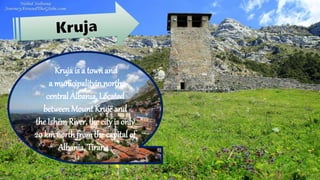
Kruja is a town and
a municipalityin north
central Albania. Located
between Mount Krujë and
the IshëmRiver, the city is only
20 km northfromthe capital of
Albania, Tirana .
Krujë was inhabited by the ancient Illyriantribe of the Albani. In 1190
Krujë became the capital of the first autonomous Albanianstate in
the middle ages, the Principality of Arbër Laterit was the capital of
theKingdomof Albania, while in theearly 15th centuryKrujëwas
conqueredby the Ottoman Empire, but thenrecaptured in 1443 by
Skanderbeg, leader of the League of Lezhë, who successfully defended
it against three Ottomansieges until his deathin 1468.TheOttomans
took control of the townafterthefourth siege in 1478, and
incorporated it in their territories.
Ottoman Empire was followed by the 1912 Declaration of
Independence of Albania. In the mid-1910s Krujë was one of the
battlefields of the conflict between the short-lived Republic of
Central Albania, founded by Essad Toptani, and the Principality
of Albania. In 1914 Toptani managed to seize the town but during
the same year it was reincorporated by Prênk Bibë Doda in the
Principality of Albania. During World War II it was the center of
the activities of resistance leader Abaz Kupi.
HISTORY
The Krujëcastle is a castle in the city
of Krujë, Albania and the center
of Skanderbeg's rebellion against
the Ottoman Empire. Inside the castle is
the Teqe of Dollme of the Bektashi, the
National Skanderbeg Museum, the
remains of the Fatih Sultan Mehmed
mosque and its minaret, an ethnographic
museum and a Turkish bath.
THE MUSEUM
҉In antiquity Krujë was a site used for pagan rituals,
while after the spread of Christianity a church
dedicated to Saint Alexander was built near Mount
Krujë. In the late 9th century David of Krujë is
mentioned as one of the bishops, who participated in
the Fourth Council of Constantinople. In the early
10th century Krujë had an Eastern
Orthodox suffragan bishop, subject to the
metropolitan bishop of Durrës. The Roman Catholic
bishopric of Krujë was established in 1167, when its
bishop was consecrated by Pope Alexander III. In
1284 the Byzantine Empire expelled the Catholic
bishop of Krujë, while after Stefan Uroš II
Milutin captured the town, he also expelled the
Catholic bishop Andreas Croensis in 1317
Kruja

Kruja

  • 2.
    Kruja is atown and a municipalityin north central Albania. Located between Mount Krujë and the IshëmRiver, the city is only 20 km northfromthe capital of Albania, Tirana .
  • 4.
    Krujë was inhabitedby the ancient Illyriantribe of the Albani. In 1190 Krujë became the capital of the first autonomous Albanianstate in the middle ages, the Principality of Arbër Laterit was the capital of theKingdomof Albania, while in theearly 15th centuryKrujëwas conqueredby the Ottoman Empire, but thenrecaptured in 1443 by Skanderbeg, leader of the League of Lezhë, who successfully defended it against three Ottomansieges until his deathin 1468.TheOttomans took control of the townafterthefourth siege in 1478, and incorporated it in their territories.
  • 5.
    Ottoman Empire wasfollowed by the 1912 Declaration of Independence of Albania. In the mid-1910s Krujë was one of the battlefields of the conflict between the short-lived Republic of Central Albania, founded by Essad Toptani, and the Principality of Albania. In 1914 Toptani managed to seize the town but during the same year it was reincorporated by Prênk Bibë Doda in the Principality of Albania. During World War II it was the center of the activities of resistance leader Abaz Kupi. HISTORY
  • 6.
    The Krujëcastle isa castle in the city of Krujë, Albania and the center of Skanderbeg's rebellion against the Ottoman Empire. Inside the castle is the Teqe of Dollme of the Bektashi, the National Skanderbeg Museum, the remains of the Fatih Sultan Mehmed mosque and its minaret, an ethnographic museum and a Turkish bath. THE MUSEUM
  • 7.
    ҉In antiquity Krujëwas a site used for pagan rituals, while after the spread of Christianity a church dedicated to Saint Alexander was built near Mount Krujë. In the late 9th century David of Krujë is mentioned as one of the bishops, who participated in the Fourth Council of Constantinople. In the early 10th century Krujë had an Eastern Orthodox suffragan bishop, subject to the metropolitan bishop of Durrës. The Roman Catholic bishopric of Krujë was established in 1167, when its bishop was consecrated by Pope Alexander III. In 1284 the Byzantine Empire expelled the Catholic bishop of Krujë, while after Stefan Uroš II Milutin captured the town, he also expelled the Catholic bishop Andreas Croensis in 1317