Chapter 11Chapter 11 Copyright (c) 2007 John Wiley & Sons, Inc.Copyright (c) 2007 John Wiley & Sons, Inc. 11
Global Marketing Management, 4eGlobal Marketing Management, 4e
Chapter 11
Global Product PolicyGlobal Product Policy
Decisions I: DevelopingDecisions I: Developing
New Products forNew Products for
Global MarketsGlobal Markets
Chapter 11Chapter 11 Copyright (c) 2007 John Wiley & Sons, Inc.Copyright (c) 2007 John Wiley & Sons, Inc. 22
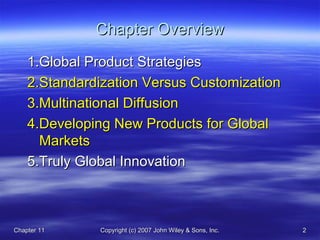
Chapter OverviewChapter Overview
1.Global Product Strategies1.Global Product Strategies
2.Standardization Versus Customization2.Standardization Versus Customization
3.Multinational Diffusion3.Multinational Diffusion
4.Developing New Products for Global4.Developing New Products for Global
MarketsMarkets
5.Truly Global Innovation5.Truly Global Innovation
Chapter 11Chapter 11 Copyright (c) 2007 John Wiley & Sons, Inc.Copyright (c) 2007 John Wiley & Sons, Inc. 33
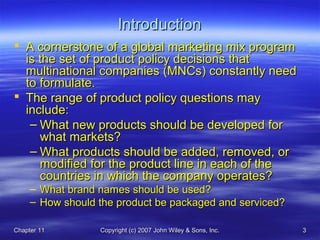
IntroductionIntroduction
 A cornerstone of a global marketing mix programA cornerstone of a global marketing mix program
is the set of product policy decisions thatis the set of product policy decisions that
multinational companies (MNCs) constantly needmultinational companies (MNCs) constantly need
to formulate.to formulate.
 The range of product policy questions mayThe range of product policy questions may
include:include:
– What new products should be developed forWhat new products should be developed for
what markets?what markets?
– What products should be added, removed, orWhat products should be added, removed, or
modified for the product line in each of themodified for the product line in each of the
countries in which the company operates?countries in which the company operates?
– What brand names should be used?What brand names should be used?
– How should the product be packaged and serviced?How should the product be packaged and serviced?
Chapter 11Chapter 11 Copyright (c) 2007 John Wiley & Sons, Inc.Copyright (c) 2007 John Wiley & Sons, Inc. 44
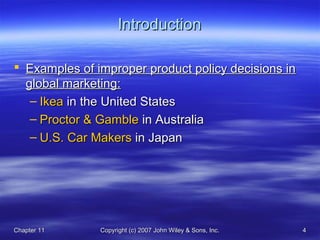
IntroductionIntroduction
 Examples of improper product policy decisions inExamples of improper product policy decisions in
global marketing:global marketing:
– IkeaIkea in the United Statesin the United States
– Proctor & GambleProctor & Gamble in Australiain Australia
– U.S. Car MakersU.S. Car Makers in Japanin Japan
Chapter 11Chapter 11 Copyright (c) 2007 John Wiley & Sons, Inc.Copyright (c) 2007 John Wiley & Sons, Inc. 55
1.1. Global Product StrategiesGlobal Product Strategies
 Three global strategies to penetrate foreignThree global strategies to penetrate foreign
markets:markets:
– Extension strategyExtension strategy
– Adaptation strategyAdaptation strategy
– Invention strategyInvention strategy
Chapter 11Chapter 11 Copyright (c) 2007 John Wiley & Sons, Inc.Copyright (c) 2007 John Wiley & Sons, Inc. 66
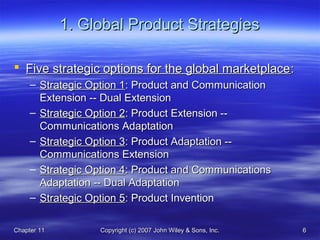
1. Global Product Strategies1. Global Product Strategies
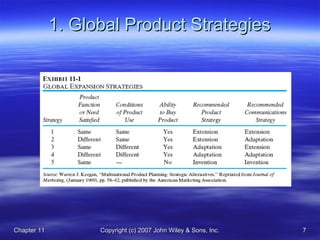
 Five strategic options for the global marketplaceFive strategic options for the global marketplace::
– Strategic Option 1Strategic Option 1: Product and Communication: Product and Communication
Extension -- Dual ExtensionExtension -- Dual Extension
– Strategic Option 2Strategic Option 2: Product Extension --: Product Extension --
Communications AdaptationCommunications Adaptation
– Strategic Option 3Strategic Option 3: Product Adaptation --: Product Adaptation --
Communications ExtensionCommunications Extension
– Strategic Option 4Strategic Option 4: Product and Communications: Product and Communications
Adaptation -- Dual AdaptationAdaptation -- Dual Adaptation
– Strategic Option 5Strategic Option 5: Product Invention: Product Invention
Chapter 11Chapter 11 Copyright (c) 2007 John Wiley & Sons, Inc.Copyright (c) 2007 John Wiley & Sons, Inc. 77
1. Global Product Strategies1. Global Product Strategies
Chapter 11Chapter 11 Copyright (c) 2007 John Wiley & Sons, Inc.Copyright (c) 2007 John Wiley & Sons, Inc. 88
2. Standardization versus Customization2. Standardization versus Customization
 Five forces favoring a globalized product strategy:Five forces favoring a globalized product strategy:
1. Common customer needs1. Common customer needs
2. Global customers2. Global customers
3. Scale economies3. Scale economies
4. Time to market4. Time to market
5. Regional market agreements5. Regional market agreements
Chapter 11Chapter 11 Copyright (c) 2007 John Wiley & Sons, Inc.Copyright (c) 2007 John Wiley & Sons, Inc. 99
2. Standardization versus Customization2. Standardization versus Customization
 Degree of StandardizationDegree of Standardization
– Modular ApproachModular Approach
– Core-Product (Common Platform) ApproachCore-Product (Common Platform) Approach
 Balancing act between standardization andBalancing act between standardization and
adaptationadaptation
 Overstandardization vs. overcustomizationOverstandardization vs. overcustomization
Chapter 11Chapter 11 Copyright (c) 2007 John Wiley & Sons, Inc.Copyright (c) 2007 John Wiley & Sons, Inc. 1010
3. Multinational Diffusion3. Multinational Diffusion
 ExamplesExamples::
– Microsoft’s Xbox videogameMicrosoft’s Xbox videogame
– NTT DoCoMo’s iModeNTT DoCoMo’s iMode
 The Adoption of new products is driven by three types ofThe Adoption of new products is driven by three types of
factors:factors:
– Individual DifferencesIndividual Differences
– Personal InfluencesPersonal Influences
– Product CharacteristicsProduct Characteristics
1. Relative advantage1. Relative advantage
2. Compatibility2. Compatibility
3. Complexity3. Complexity
4. Trialability4. Trialability
5. Observability5. Observability
Chapter 11Chapter 11 Copyright (c) 2007 John Wiley & Sons, Inc.Copyright (c) 2007 John Wiley & Sons, Inc. 1111
3. Multinational Diffusion3. Multinational Diffusion
 Other country characteristics used to predictOther country characteristics used to predict
new product penetration patterns include:new product penetration patterns include:
– Homogeneous populationHomogeneous population
– Lead countriesLead countries
– Lag countriesLag countries
– CosmopolitanismCosmopolitanism
– MobilityMobility
– Labor force profile, Developing vs.Labor force profile, Developing vs.
Developed countriesDeveloped countries
Chapter 11Chapter 11 Copyright (c) 2007 John Wiley & Sons, Inc.Copyright (c) 2007 John Wiley & Sons, Inc. 1212
3. Multinational Diffusion3. Multinational Diffusion
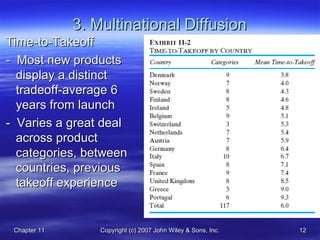
Time-to-TakeoffTime-to-Takeoff
- Most new products- Most new products
display a distinctdisplay a distinct
tradeoff-average 6tradeoff-average 6
years from launchyears from launch
- Varies a great deal- Varies a great deal
across productacross product
categories, betweencategories, between
countries, previouscountries, previous
takeoff experiencetakeoff experience
Chapter 11Chapter 11 Copyright (c) 2007 John Wiley & Sons, Inc.Copyright (c) 2007 John Wiley & Sons, Inc. 1313
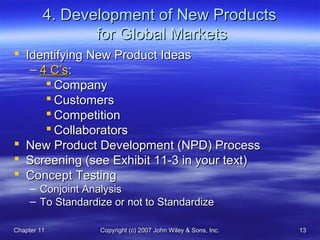
4. Development of New Products4. Development of New Products
for Global Marketsfor Global Markets
 Identifying New Product IdeasIdentifying New Product Ideas
– 4 C’s4 C’s::
 CompanyCompany
 CustomersCustomers
 CompetitionCompetition
 CollaboratorsCollaborators
 New Product Development (NPD) ProcessNew Product Development (NPD) Process
 Screening (see Exhibit 11-3 in your text)Screening (see Exhibit 11-3 in your text)
 Concept TestingConcept Testing
– Conjoint AnalysisConjoint Analysis
– To Standardize or not to StandardizeTo Standardize or not to Standardize
Chapter 11Chapter 11 Copyright (c) 2007 John Wiley & Sons, Inc.Copyright (c) 2007 John Wiley & Sons, Inc. 1414
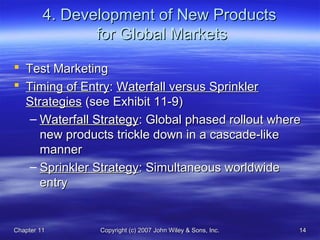
4. Development of New Products4. Development of New Products
for Global Marketsfor Global Markets
 Test MarketingTest Marketing
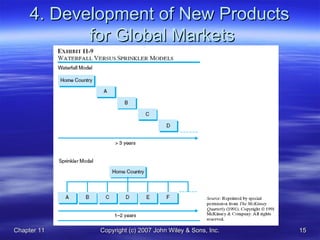
 Timing of EntryTiming of Entry:: Waterfall versus SprinklerWaterfall versus Sprinkler
StrategiesStrategies (see Exhibit 11-9)(see Exhibit 11-9)
– Waterfall StrategyWaterfall Strategy: Global phased rollout where: Global phased rollout where
new products trickle down in a cascade-likenew products trickle down in a cascade-like
mannermanner
– Sprinkler StrategySprinkler Strategy: Simultaneous worldwide: Simultaneous worldwide
entryentry
Chapter 11Chapter 11 Copyright (c) 2007 John Wiley & Sons, Inc.Copyright (c) 2007 John Wiley & Sons, Inc. 1515
4. Development of New Products4. Development of New Products
for Global Marketsfor Global Markets
Chapter 11Chapter 11 Copyright (c) 2007 John Wiley & Sons, Inc.Copyright (c) 2007 John Wiley & Sons, Inc. 1616
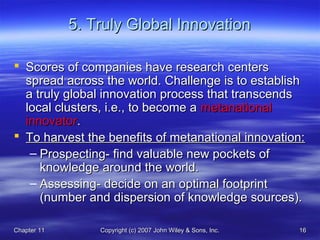
5. Truly Global Innovation5. Truly Global Innovation
 Scores of companies have research centersScores of companies have research centers
spread across the world. Challenge is to establishspread across the world. Challenge is to establish
a truly global innovation process that transcendsa truly global innovation process that transcends
local clusters, i.e., to become alocal clusters, i.e., to become a metanationalmetanational
innovatorinnovator..
 To harvest the benefits of metanational innovation:To harvest the benefits of metanational innovation:
– Prospecting- find valuable new pockets ofProspecting- find valuable new pockets of
knowledge around the world.knowledge around the world.
– Assessing- decide on an optimal footprintAssessing- decide on an optimal footprint
(number and dispersion of knowledge sources).(number and dispersion of knowledge sources).
Chapter 11Chapter 11 Copyright (c) 2007 John Wiley & Sons, Inc.Copyright (c) 2007 John Wiley & Sons, Inc. 1717
5. Truly Global Innovation5. Truly Global Innovation
– Mobilizing- to harness the benefits of globalMobilizing- to harness the benefits of global
innovation, companies must find ways toinnovation, companies must find ways to
mobilize pockets of knowledge (e.g., technicalmobilize pockets of knowledge (e.g., technical
blueprints, patents, equipment, marketblueprints, patents, equipment, market
knowledge).knowledge).
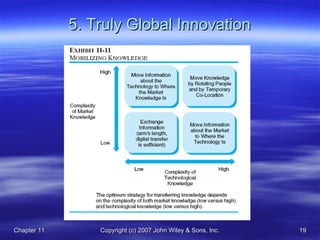
– The optimal strategy for mobilizing knowledgeThe optimal strategy for mobilizing knowledge
depends on the type (simple vs. complex) anddepends on the type (simple vs. complex) and
nature (technical vs. market) of the knowledgenature (technical vs. market) of the knowledge
involved.involved.
Chapter 11Chapter 11 Copyright (c) 2007 John Wiley & Sons, Inc.Copyright (c) 2007 John Wiley & Sons, Inc. 1818
5. Truly Global Innovation5. Truly Global Innovation
 4 possible strategic scenarios for mobilizing4 possible strategic scenarios for mobilizing
knowledge:knowledge:
– Exchange information (arm’s length, digitalExchange information (arm’s length, digital
transfer is sufficient).transfer is sufficient).
– Move information about the market where theMove information about the market where the
technology is.technology is.
– Move information about the technology to whereMove information about the technology to where
the market knowledge isthe market knowledge is
– Move knowledge by rotating people and byMove knowledge by rotating people and by
temporary co-locationtemporary co-location
Chapter 11Chapter 11 Copyright (c) 2007 John Wiley & Sons, Inc.Copyright (c) 2007 John Wiley & Sons, Inc. 1919
5. Truly Global Innovation5. Truly Global Innovation

Kotabe gmm4 p_pt_ch11

  • 1.
    Chapter 11Chapter 11Copyright (c) 2007 John Wiley & Sons, Inc.Copyright (c) 2007 John Wiley & Sons, Inc. 11 Global Marketing Management, 4eGlobal Marketing Management, 4e Chapter 11 Global Product PolicyGlobal Product Policy Decisions I: DevelopingDecisions I: Developing New Products forNew Products for Global MarketsGlobal Markets
  • 2.
    Chapter 11Chapter 11Copyright (c) 2007 John Wiley & Sons, Inc.Copyright (c) 2007 John Wiley & Sons, Inc. 22 Chapter OverviewChapter Overview 1.Global Product Strategies1.Global Product Strategies 2.Standardization Versus Customization2.Standardization Versus Customization 3.Multinational Diffusion3.Multinational Diffusion 4.Developing New Products for Global4.Developing New Products for Global MarketsMarkets 5.Truly Global Innovation5.Truly Global Innovation
  • 3.
    Chapter 11Chapter 11Copyright (c) 2007 John Wiley & Sons, Inc.Copyright (c) 2007 John Wiley & Sons, Inc. 33 IntroductionIntroduction  A cornerstone of a global marketing mix programA cornerstone of a global marketing mix program is the set of product policy decisions thatis the set of product policy decisions that multinational companies (MNCs) constantly needmultinational companies (MNCs) constantly need to formulate.to formulate.  The range of product policy questions mayThe range of product policy questions may include:include: – What new products should be developed forWhat new products should be developed for what markets?what markets? – What products should be added, removed, orWhat products should be added, removed, or modified for the product line in each of themodified for the product line in each of the countries in which the company operates?countries in which the company operates? – What brand names should be used?What brand names should be used? – How should the product be packaged and serviced?How should the product be packaged and serviced?
  • 4.
    Chapter 11Chapter 11Copyright (c) 2007 John Wiley & Sons, Inc.Copyright (c) 2007 John Wiley & Sons, Inc. 44 IntroductionIntroduction  Examples of improper product policy decisions inExamples of improper product policy decisions in global marketing:global marketing: – IkeaIkea in the United Statesin the United States – Proctor & GambleProctor & Gamble in Australiain Australia – U.S. Car MakersU.S. Car Makers in Japanin Japan
  • 5.
    Chapter 11Chapter 11Copyright (c) 2007 John Wiley & Sons, Inc.Copyright (c) 2007 John Wiley & Sons, Inc. 55 1.1. Global Product StrategiesGlobal Product Strategies  Three global strategies to penetrate foreignThree global strategies to penetrate foreign markets:markets: – Extension strategyExtension strategy – Adaptation strategyAdaptation strategy – Invention strategyInvention strategy
  • 6.
    Chapter 11Chapter 11Copyright (c) 2007 John Wiley & Sons, Inc.Copyright (c) 2007 John Wiley & Sons, Inc. 66 1. Global Product Strategies1. Global Product Strategies  Five strategic options for the global marketplaceFive strategic options for the global marketplace:: – Strategic Option 1Strategic Option 1: Product and Communication: Product and Communication Extension -- Dual ExtensionExtension -- Dual Extension – Strategic Option 2Strategic Option 2: Product Extension --: Product Extension -- Communications AdaptationCommunications Adaptation – Strategic Option 3Strategic Option 3: Product Adaptation --: Product Adaptation -- Communications ExtensionCommunications Extension – Strategic Option 4Strategic Option 4: Product and Communications: Product and Communications Adaptation -- Dual AdaptationAdaptation -- Dual Adaptation – Strategic Option 5Strategic Option 5: Product Invention: Product Invention
  • 7.
    Chapter 11Chapter 11Copyright (c) 2007 John Wiley & Sons, Inc.Copyright (c) 2007 John Wiley & Sons, Inc. 77 1. Global Product Strategies1. Global Product Strategies
  • 8.
    Chapter 11Chapter 11Copyright (c) 2007 John Wiley & Sons, Inc.Copyright (c) 2007 John Wiley & Sons, Inc. 88 2. Standardization versus Customization2. Standardization versus Customization  Five forces favoring a globalized product strategy:Five forces favoring a globalized product strategy: 1. Common customer needs1. Common customer needs 2. Global customers2. Global customers 3. Scale economies3. Scale economies 4. Time to market4. Time to market 5. Regional market agreements5. Regional market agreements
  • 9.
    Chapter 11Chapter 11Copyright (c) 2007 John Wiley & Sons, Inc.Copyright (c) 2007 John Wiley & Sons, Inc. 99 2. Standardization versus Customization2. Standardization versus Customization  Degree of StandardizationDegree of Standardization – Modular ApproachModular Approach – Core-Product (Common Platform) ApproachCore-Product (Common Platform) Approach  Balancing act between standardization andBalancing act between standardization and adaptationadaptation  Overstandardization vs. overcustomizationOverstandardization vs. overcustomization
  • 10.
    Chapter 11Chapter 11Copyright (c) 2007 John Wiley & Sons, Inc.Copyright (c) 2007 John Wiley & Sons, Inc. 1010 3. Multinational Diffusion3. Multinational Diffusion  ExamplesExamples:: – Microsoft’s Xbox videogameMicrosoft’s Xbox videogame – NTT DoCoMo’s iModeNTT DoCoMo’s iMode  The Adoption of new products is driven by three types ofThe Adoption of new products is driven by three types of factors:factors: – Individual DifferencesIndividual Differences – Personal InfluencesPersonal Influences – Product CharacteristicsProduct Characteristics 1. Relative advantage1. Relative advantage 2. Compatibility2. Compatibility 3. Complexity3. Complexity 4. Trialability4. Trialability 5. Observability5. Observability
  • 11.
    Chapter 11Chapter 11Copyright (c) 2007 John Wiley & Sons, Inc.Copyright (c) 2007 John Wiley & Sons, Inc. 1111 3. Multinational Diffusion3. Multinational Diffusion  Other country characteristics used to predictOther country characteristics used to predict new product penetration patterns include:new product penetration patterns include: – Homogeneous populationHomogeneous population – Lead countriesLead countries – Lag countriesLag countries – CosmopolitanismCosmopolitanism – MobilityMobility – Labor force profile, Developing vs.Labor force profile, Developing vs. Developed countriesDeveloped countries
  • 12.
    Chapter 11Chapter 11Copyright (c) 2007 John Wiley & Sons, Inc.Copyright (c) 2007 John Wiley & Sons, Inc. 1212 3. Multinational Diffusion3. Multinational Diffusion Time-to-TakeoffTime-to-Takeoff - Most new products- Most new products display a distinctdisplay a distinct tradeoff-average 6tradeoff-average 6 years from launchyears from launch - Varies a great deal- Varies a great deal across productacross product categories, betweencategories, between countries, previouscountries, previous takeoff experiencetakeoff experience
  • 13.
    Chapter 11Chapter 11Copyright (c) 2007 John Wiley & Sons, Inc.Copyright (c) 2007 John Wiley & Sons, Inc. 1313 4. Development of New Products4. Development of New Products for Global Marketsfor Global Markets  Identifying New Product IdeasIdentifying New Product Ideas – 4 C’s4 C’s::  CompanyCompany  CustomersCustomers  CompetitionCompetition  CollaboratorsCollaborators  New Product Development (NPD) ProcessNew Product Development (NPD) Process  Screening (see Exhibit 11-3 in your text)Screening (see Exhibit 11-3 in your text)  Concept TestingConcept Testing – Conjoint AnalysisConjoint Analysis – To Standardize or not to StandardizeTo Standardize or not to Standardize
  • 14.
    Chapter 11Chapter 11Copyright (c) 2007 John Wiley & Sons, Inc.Copyright (c) 2007 John Wiley & Sons, Inc. 1414 4. Development of New Products4. Development of New Products for Global Marketsfor Global Markets  Test MarketingTest Marketing  Timing of EntryTiming of Entry:: Waterfall versus SprinklerWaterfall versus Sprinkler StrategiesStrategies (see Exhibit 11-9)(see Exhibit 11-9) – Waterfall StrategyWaterfall Strategy: Global phased rollout where: Global phased rollout where new products trickle down in a cascade-likenew products trickle down in a cascade-like mannermanner – Sprinkler StrategySprinkler Strategy: Simultaneous worldwide: Simultaneous worldwide entryentry
  • 15.
    Chapter 11Chapter 11Copyright (c) 2007 John Wiley & Sons, Inc.Copyright (c) 2007 John Wiley & Sons, Inc. 1515 4. Development of New Products4. Development of New Products for Global Marketsfor Global Markets
  • 16.
    Chapter 11Chapter 11Copyright (c) 2007 John Wiley & Sons, Inc.Copyright (c) 2007 John Wiley & Sons, Inc. 1616 5. Truly Global Innovation5. Truly Global Innovation  Scores of companies have research centersScores of companies have research centers spread across the world. Challenge is to establishspread across the world. Challenge is to establish a truly global innovation process that transcendsa truly global innovation process that transcends local clusters, i.e., to become alocal clusters, i.e., to become a metanationalmetanational innovatorinnovator..  To harvest the benefits of metanational innovation:To harvest the benefits of metanational innovation: – Prospecting- find valuable new pockets ofProspecting- find valuable new pockets of knowledge around the world.knowledge around the world. – Assessing- decide on an optimal footprintAssessing- decide on an optimal footprint (number and dispersion of knowledge sources).(number and dispersion of knowledge sources).
  • 17.
    Chapter 11Chapter 11Copyright (c) 2007 John Wiley & Sons, Inc.Copyright (c) 2007 John Wiley & Sons, Inc. 1717 5. Truly Global Innovation5. Truly Global Innovation – Mobilizing- to harness the benefits of globalMobilizing- to harness the benefits of global innovation, companies must find ways toinnovation, companies must find ways to mobilize pockets of knowledge (e.g., technicalmobilize pockets of knowledge (e.g., technical blueprints, patents, equipment, marketblueprints, patents, equipment, market knowledge).knowledge). – The optimal strategy for mobilizing knowledgeThe optimal strategy for mobilizing knowledge depends on the type (simple vs. complex) anddepends on the type (simple vs. complex) and nature (technical vs. market) of the knowledgenature (technical vs. market) of the knowledge involved.involved.
  • 18.
    Chapter 11Chapter 11Copyright (c) 2007 John Wiley & Sons, Inc.Copyright (c) 2007 John Wiley & Sons, Inc. 1818 5. Truly Global Innovation5. Truly Global Innovation  4 possible strategic scenarios for mobilizing4 possible strategic scenarios for mobilizing knowledge:knowledge: – Exchange information (arm’s length, digitalExchange information (arm’s length, digital transfer is sufficient).transfer is sufficient). – Move information about the market where theMove information about the market where the technology is.technology is. – Move information about the technology to whereMove information about the technology to where the market knowledge isthe market knowledge is – Move knowledge by rotating people and byMove knowledge by rotating people and by temporary co-locationtemporary co-location
  • 19.
    Chapter 11Chapter 11Copyright (c) 2007 John Wiley & Sons, Inc.Copyright (c) 2007 John Wiley & Sons, Inc. 1919 5. Truly Global Innovation5. Truly Global Innovation