Crohn’s Disease
By: Kaitlyn Kostyo
What is Crohn’s Disease?
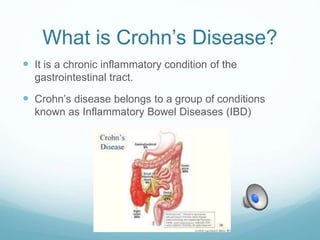
 It is a chronic inflammatory condition of the
gastrointestinal tract.
 Crohn’s disease belongs to a group of conditions
known as Inflammatory Bowel Diseases (IBD)
What part of the body does it
affect?
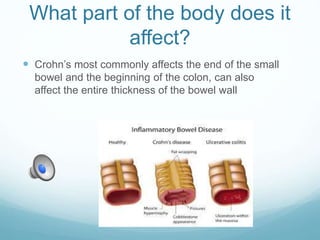
 Crohn’s most commonly affects the end of the small
bowel and the beginning of the colon, can also
affect the entire thickness of the bowel wall
Who is affected?
 Crohn’s disease may affect as many as 700,000
Americans.
 Men and Women are equally likely to be affected.
 The disease can occur at any age, but is most
frequently seen among adolescents and young adults
between the ages of 15 and 35.
Signs/Sympotms
 Persistent Diarrhea
 Rectal bleeding
 Urgent need to move bowels
 Abdominal cramps and pain
 Sensation of incomplete evacuation
 Constipation
Causes of Crohn’s
 Diet and stress may aggravate Crohn’s Disease, but
they do not cause Crohn’s.
 research suggests hereditary, genetics, or
environmental factors such as developed countries
rather than undeveloped countries, urban rather than
rural areas, and in northern rather than southern
climates may contribute to the development of Crohn’s.
 The GI tract normally contains harmless bacteria, many of
which aid in digestion.
 The immune system usually attacks and kills foreign
invaders, such as “bad” bacteria.
 Under normal circumstances, the harmless bacteria in the
intestines are protected from such an attack.
 In people with IBD, these bacteria are mistaken for harmful
invaders, leading to chronic inflammation, ulceration,
thickening of the intestinal wall, and eventually causing
symptoms of Crohn’s disease.
Early tests
 laboratory tests of blood and stool matter, as well as X-
rays of the upper and lower GI tract
Endoscopy and Biopsy
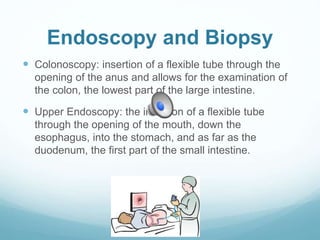
 Colonoscopy: insertion of a flexible tube through the
opening of the anus and allows for the examination of
the colon, the lowest part of the large intestine.
 Upper Endoscopy: the insertion of a flexible tube
through the opening of the mouth, down the
esophagus, into the stomach, and as far as the
duodenum, the first part of the small intestine.
Treatment options
 Medication
 Diet & Nutrition
 Surgery- involves removal of the diseased segment of
bowel, then joining together the two ends of healthy
bowel

Kostyo,kaitlyn crohnsdisease

  • 1.
  • 2.
    What is Crohn’sDisease?  It is a chronic inflammatory condition of the gastrointestinal tract.  Crohn’s disease belongs to a group of conditions known as Inflammatory Bowel Diseases (IBD)
  • 3.
    What part ofthe body does it affect?  Crohn’s most commonly affects the end of the small bowel and the beginning of the colon, can also affect the entire thickness of the bowel wall
  • 4.
    Who is affected? Crohn’s disease may affect as many as 700,000 Americans.  Men and Women are equally likely to be affected.  The disease can occur at any age, but is most frequently seen among adolescents and young adults between the ages of 15 and 35.
  • 5.
    Signs/Sympotms  Persistent Diarrhea Rectal bleeding  Urgent need to move bowels  Abdominal cramps and pain  Sensation of incomplete evacuation  Constipation
  • 6.
    Causes of Crohn’s Diet and stress may aggravate Crohn’s Disease, but they do not cause Crohn’s.  research suggests hereditary, genetics, or environmental factors such as developed countries rather than undeveloped countries, urban rather than rural areas, and in northern rather than southern climates may contribute to the development of Crohn’s.
  • 7.
     The GItract normally contains harmless bacteria, many of which aid in digestion.  The immune system usually attacks and kills foreign invaders, such as “bad” bacteria.  Under normal circumstances, the harmless bacteria in the intestines are protected from such an attack.  In people with IBD, these bacteria are mistaken for harmful invaders, leading to chronic inflammation, ulceration, thickening of the intestinal wall, and eventually causing symptoms of Crohn’s disease.
  • 8.
    Early tests  laboratorytests of blood and stool matter, as well as X- rays of the upper and lower GI tract
  • 9.
    Endoscopy and Biopsy Colonoscopy: insertion of a flexible tube through the opening of the anus and allows for the examination of the colon, the lowest part of the large intestine.  Upper Endoscopy: the insertion of a flexible tube through the opening of the mouth, down the esophagus, into the stomach, and as far as the duodenum, the first part of the small intestine.
  • 10.
    Treatment options  Medication Diet & Nutrition  Surgery- involves removal of the diseased segment of bowel, then joining together the two ends of healthy bowel