z
Knowledge sharing on P2P
& Best Procurement
Practices.
z
Procurement To Pay Cycle :-
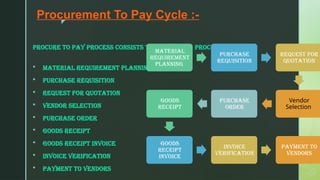
Procure to pay Process consists the following processes.
 Material requirement planning
 Purchase Requisition
 Request for Quotation
 Vendor Selection
 Purchase Order
 Goods Receipt
 Goods Receipt Invoice
 Invoice Verification
 Payment to Vendors
Material
requirement
planning
Purchase
Requisition
Request for
Quotation
Vendor
Selection
Purchase
Order
Goods
Receipt
Goods
Receipt
Invoice
Invoice
Verification
Payment to
Vendors
z
1. Material requirement planning (MRP) :-
Materials requirements planning (MRP) refers to the technique of using a projected manufacturing
material, spares requirements schedule to figure out what supplied materials you will need, and when you
will need them. Materials requirements planning (MRP) type controls the MRP procedure, pricing, material
valuation. Material requirement planning carried out by MRP controller /User function department.
2. Purchase Requisition :-
A purchase requisition is an internal request to purchasing. It gives estimated details regarding certain
quantity of a material or service on a certain date. A purchase requisition can be created in SAP by user
while material/service requirement. PR converts to RFQ and circulated to supplied for enquiry. PR can be
raised in SAP by using T-code ME51N which should be approved by concern authority as per DOA. Purchase
Requisition includes the following information.
 Material Qty, description of goods & service and total value.
 Department details.
 Signature by an Authorized Department.
 Delivery period.
 Attach Quote from the suggested vendor if any specific cases.
z
3. Request for Quotation :-
Requesting potential vendors to submit a quotation for a material or services. A request for quote (RFQ), also known as an invitation for
bid (IFB), is a process in which a company solicits select suppliers and contractors to submit price quotes and bids for the chance to fulfill
requirements in terms supply or service. The RFQ process is especially important to businesses that need a consistent supply of a specific
number of standard products. Quotation should be contained below information.
 Date of enquiry.
 Details description of material/service with basic rate and taxes.
 Other condition like freight, P&F or other charges.
 Terms of delivery and payment.
4. Vendor selection :-
Vendor selection is one of the important step in procurement process. With the help of obtained quotations from sources
and by comparing them comparative statement to be prepare and negotiation carry out. Overall analysis of comparative
parameter likes basic price, transportation charges, Quality of material, terms of delivery, supplier performance etc. In last,
vendors get finalized by considering all the parameter ok like lowest in market price, Technical competency and best in
quality of supply within time limit.
5. Purchase Order :-
Purchase Order (PO) is a formal request to a vendor to supply certain materials or services under the certain conditions.
A Purchase Order (PO) can be created against purchase requisition with reference to request for quotation, or another
purchase order.
z
POs usually specify terms of payment, incoterms, delivery date, specifications, material qty, price and reference or part numbers.
Below are types of purchase orders in procurement process and can be raise by using T-Code ME21N.
 PO against Specified Items (e.g., Min/Max)
 PO against non specified Items (e.g., Spares, consumable etc.)
 PO against Capital Assets/Non-stock (e.g., Specific Capex/project Item or against Cost center)
 PO against CPC Contract . (PO against Outline agreements by CPC.)
6. Goods Receipt :-
Goods Receipts (GR) is created to reflect the Goods Receipts for the specified material ordered from a vendor using Purchase
Order process. After receiving the goods, the company can record the following information, this information can be used for
accounting, stock check and rotation, to return any goods if there is a problem found while inspection.
 What goods were delivered.
 Which vendor delivered the goods.
 Who, how, when goods were delivered and received the goods.
7. Goods Receipt Invoice (GRIN) :-
Goods receipt Invoice process is one of the important process in procurement process cycle. It is matching the goods that a
company receives with the company PO (purchase order). It involves checking the goods are not damaged and fit for use,
verifying the price, quantity, payment terms. Goods movement are entered into the system with reference to Purchase order and
goods receipt material documents are posted, automatically appropriate general ledgers are posts and stock accounts are
updated. GRN created by store dept. by using T-code MIGO in SAP.
z
8. Invoice Verification :-
After GRIN process, next process of procurement to pay is invoice verification. It plays an important
role in procurement process and Materials Management Module which performs the following tasks
A Vendor Invoice can be created with reference to a Purchase Order, a Goods Receipt, a Delivery Note..
 Invoice is verified in-terms of prices, quantity,
 Necessary approvals by project managers
After verifying all the data, the invoice is being posted and the data is saved in the system. The system
updates the invoice data in Materials Management and Financial Accounting.
9. Payment to Vendors:-
The last step in procurement process cycle is payment to vendors and it is also known procure to pay
process. Vendors are get paid as per payment terms. In this fast technology world, companies can pay
through many methods to vendors. For example – through Net banking, Check payment etc.
z
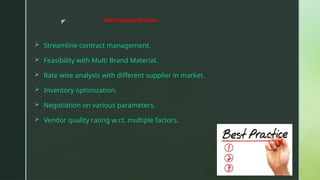
 Streamline contract management.
 Feasibility with Multi Brand Material.
 Rate wise analysis with different supplier in market.
 Inventory optimization.
 Negotiation on various parameters.
 Vendor quality rating w.r.t. multiple factors.
Best Practices We Done:-
z
Support for Improvements:-
 SLA needs to be defined on different stages.
 Requirement should be clear on first communication.
 Avoid material/Service rejection.
 Necessary approval & document should be attached with PR (Hardcopy).
 Feasible make should be mentioned on PR if any.
z
Thank you

Knowledge sharing on P2P & Best Procurement Practices.pptx

  • 1.
    z Knowledge sharing onP2P & Best Procurement Practices.
  • 2.
    z Procurement To PayCycle :- Procure to pay Process consists the following processes.  Material requirement planning  Purchase Requisition  Request for Quotation  Vendor Selection  Purchase Order  Goods Receipt  Goods Receipt Invoice  Invoice Verification  Payment to Vendors Material requirement planning Purchase Requisition Request for Quotation Vendor Selection Purchase Order Goods Receipt Goods Receipt Invoice Invoice Verification Payment to Vendors
  • 3.
    z 1. Material requirementplanning (MRP) :- Materials requirements planning (MRP) refers to the technique of using a projected manufacturing material, spares requirements schedule to figure out what supplied materials you will need, and when you will need them. Materials requirements planning (MRP) type controls the MRP procedure, pricing, material valuation. Material requirement planning carried out by MRP controller /User function department. 2. Purchase Requisition :- A purchase requisition is an internal request to purchasing. It gives estimated details regarding certain quantity of a material or service on a certain date. A purchase requisition can be created in SAP by user while material/service requirement. PR converts to RFQ and circulated to supplied for enquiry. PR can be raised in SAP by using T-code ME51N which should be approved by concern authority as per DOA. Purchase Requisition includes the following information.  Material Qty, description of goods & service and total value.  Department details.  Signature by an Authorized Department.  Delivery period.  Attach Quote from the suggested vendor if any specific cases.
  • 4.
    z 3. Request forQuotation :- Requesting potential vendors to submit a quotation for a material or services. A request for quote (RFQ), also known as an invitation for bid (IFB), is a process in which a company solicits select suppliers and contractors to submit price quotes and bids for the chance to fulfill requirements in terms supply or service. The RFQ process is especially important to businesses that need a consistent supply of a specific number of standard products. Quotation should be contained below information.  Date of enquiry.  Details description of material/service with basic rate and taxes.  Other condition like freight, P&F or other charges.  Terms of delivery and payment. 4. Vendor selection :- Vendor selection is one of the important step in procurement process. With the help of obtained quotations from sources and by comparing them comparative statement to be prepare and negotiation carry out. Overall analysis of comparative parameter likes basic price, transportation charges, Quality of material, terms of delivery, supplier performance etc. In last, vendors get finalized by considering all the parameter ok like lowest in market price, Technical competency and best in quality of supply within time limit. 5. Purchase Order :- Purchase Order (PO) is a formal request to a vendor to supply certain materials or services under the certain conditions. A Purchase Order (PO) can be created against purchase requisition with reference to request for quotation, or another purchase order.
  • 5.
    z POs usually specifyterms of payment, incoterms, delivery date, specifications, material qty, price and reference or part numbers. Below are types of purchase orders in procurement process and can be raise by using T-Code ME21N.  PO against Specified Items (e.g., Min/Max)  PO against non specified Items (e.g., Spares, consumable etc.)  PO against Capital Assets/Non-stock (e.g., Specific Capex/project Item or against Cost center)  PO against CPC Contract . (PO against Outline agreements by CPC.) 6. Goods Receipt :- Goods Receipts (GR) is created to reflect the Goods Receipts for the specified material ordered from a vendor using Purchase Order process. After receiving the goods, the company can record the following information, this information can be used for accounting, stock check and rotation, to return any goods if there is a problem found while inspection.  What goods were delivered.  Which vendor delivered the goods.  Who, how, when goods were delivered and received the goods. 7. Goods Receipt Invoice (GRIN) :- Goods receipt Invoice process is one of the important process in procurement process cycle. It is matching the goods that a company receives with the company PO (purchase order). It involves checking the goods are not damaged and fit for use, verifying the price, quantity, payment terms. Goods movement are entered into the system with reference to Purchase order and goods receipt material documents are posted, automatically appropriate general ledgers are posts and stock accounts are updated. GRN created by store dept. by using T-code MIGO in SAP.
  • 6.
    z 8. Invoice Verification:- After GRIN process, next process of procurement to pay is invoice verification. It plays an important role in procurement process and Materials Management Module which performs the following tasks A Vendor Invoice can be created with reference to a Purchase Order, a Goods Receipt, a Delivery Note..  Invoice is verified in-terms of prices, quantity,  Necessary approvals by project managers After verifying all the data, the invoice is being posted and the data is saved in the system. The system updates the invoice data in Materials Management and Financial Accounting. 9. Payment to Vendors:- The last step in procurement process cycle is payment to vendors and it is also known procure to pay process. Vendors are get paid as per payment terms. In this fast technology world, companies can pay through many methods to vendors. For example – through Net banking, Check payment etc.
  • 7.
    z  Streamline contractmanagement.  Feasibility with Multi Brand Material.  Rate wise analysis with different supplier in market.  Inventory optimization.  Negotiation on various parameters.  Vendor quality rating w.r.t. multiple factors. Best Practices We Done:-
  • 8.
    z Support for Improvements:- SLA needs to be defined on different stages.  Requirement should be clear on first communication.  Avoid material/Service rejection.  Necessary approval & document should be attached with PR (Hardcopy).  Feasible make should be mentioned on PR if any.
  • 9.