Knowledge regimes: order from
chaos?
The camera is never neutral
John Tagg
Knowledge and Policy
Brussels – 21-23 September 2011
Filipa M. Ribeiro
PhD candidate at University of Porto
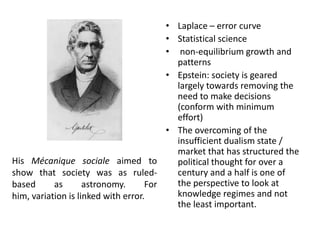
His Mécanique sociale aimed to
show that society was as ruled-
based as astronomy. For
him, variation is linked with error.
• Laplace – error curve
• Statistical science
• non-equilibrium growth and
patterns
• Epstein: society is geared
largely towards removing the
need to make decisions
(conform with minimum
effort)
• The overcoming of the
insufficient dualism state /
market that has structured the
political thought for over a
century and a half is one of
the perspective to look at
knowledge regimes and not
the least important.
Otto Neurath: antireductionist and the unity of science
• “orchestration” of sciences that
was partly to be realized in the form
of the Encyclopedia.
•Viena Circle Manifest: “We witness
the spirit of the scientific world-
conception penetrating in growing
measure the forms of personal and
public life, in
education, upbringing, architecture,
and the shaping of economic and
social life according to rational
principles. The scientific world-
conception serves life and life
receives it” (Neurath et al, 1929).
Regimes and contexts
• historical
• socio-cultural
• individual
• situational
• structural
Schema theory : Is there room for
sprucing up new knowledge?
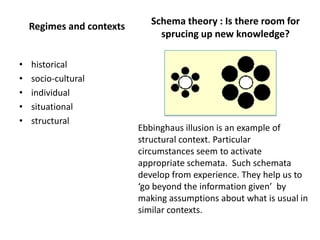
Ebbinghaus illusion is an example of
structural context. Particular
circumstances seem to activate
appropriate schemata. Such schemata
develop from experience. They help us to
‘go beyond the information given’ by
making assumptions about what is usual in
similar contexts.
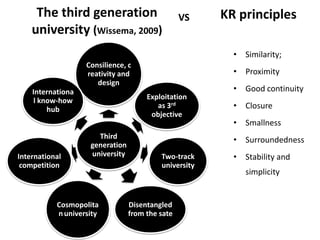
The third generation
university (Wissema, 2009)
Third
generation
university
Consilience, c
reativity and
design
Exploitation
as 3rd
objective
Two-track
university
Disentangled
from the sate
Cosmopolita
nuniversity
International
competition
Internationa
l know-how
hub
KR principles
• Similarity;
• Proximity
• Good continuity
• Closure
• Smallness
• Surroundedness
• Stability and
simplicity
VS
The way we see things is affected by what we
know or what we believe - John Berger
• What determines the
diversity of Knowledges?
• Why do some minority
knowledges survive while
others vanish?
• Why do any two
knowledges not generally
converge completely when
they interact (like the
scientific and the spiritual
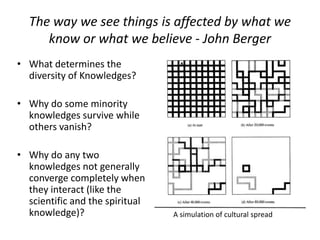
knowledge)? A simulation of cultural spread
Seeing like a State?*
• The pragmatism of each knowledge regime.
• A knowledge regime approach doesn’t mean a global narrative
anymore, rather it aims at meeting specific needs, at creating free
logics that result into governance experiences that are not anymore
an ideology or policies in abstracto.
• This process of agglutination is one of the major issues concerning
the knowledge regimes approach: how can different knowledges be
fruitful beyond mutual recognition?
*James Scott
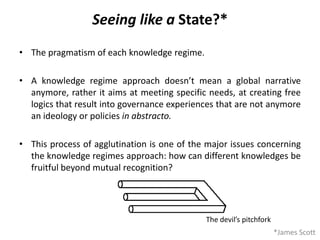
The devil’s pitchfork
Standards, dominations and absences
• Historical development of
dominant and excluded
knowledge concepts/ regimes;
• Identification of morphic fields
that gave rise to dominant
knowledges and
contemporary issues ;
• What factors are challenging
knowledge regimes?
• What relation is there today
between wisdom and
knowledge and how that
affects the knowledge regime
approach?
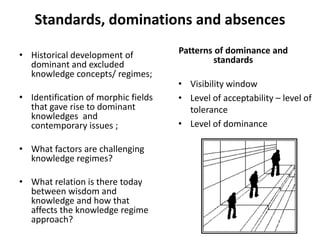
Patterns of dominance and
standards
• Visibility window
• Level of acceptability – level of
tolerance
• Level of dominance
Emergent issues (1)
1. Knowledge networks
• The network approach offers a new set of tools for illuminating
the on the ground work of the organization and it is in that
ongoing process that change is legitimized, ideas given
meaning, relations built and practice sustained or transformed.
• Network structures emerge as key mechanisms in the complicated
interplay of broad (macro-level) institutional and social
developments and the situated (micro-level) practice of change;
• How to conceptualize knowledge and power in networks?
• Systemic power – power structures
2. Knowledge networks and Knowledge regimes
• Knowledge regimes or knowledge networks?
• Development led to universities facing a multitude of new demands
from a host of stakeholders.
• Knowledge regimes and academic freedom?
• Is there inter-knowledge in the universities?
• How to distinguish between various scientific and
nonscientific, Western and non-Western knowledges? What are
hierarchies of knowledge?
• What kinds of relationships are possible between different
knowledge in universities?
• How can these relationships be lead to research and teaching?
• Universities may or may not provide conditions for epistemological
diversity in society?
Emergent issues (2)
Enduring problems of change
• How do KN bear on scaling up mixing knowledges within and across
HEI?
• How does the understanding and mapping of network ties and
flows deepen our understanding of organizational
capacity, including the nature of available knowledge?
• What happens to the quality and reach of networks as
organizational attention and knowledge types shift over time?
In what ways do social networks support or constrain efforts at
change at multiple levels within knowledge regimes?
Methodology and challenges (1)
Data collection focus
• Historical evolution of
universities and the
identification of distinctive
features in the process of
stabilization of methods of
knowledge production and
teaching;
• Criteria used by researchers /
teachers to select the content
they teach, on a number of
disciplines;
• Perceptions of teachers /
researchers on the knowledge
they produce and teach;
• Knowledge policy documents
about teaching and learning in
universities.
Data gathering and analysis
• Historical analysis (analysis of
texts and text network
analysis);
• Accounts and autobiographical
narratives;
• Interviews
• Social network analysis (to
track changes and
dominant/excluded types of
knowledge).
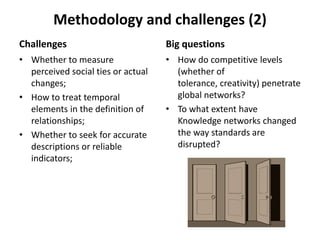
Methodology and challenges (2)
Challenges
• Whether to measure
perceived social ties or actual
changes;
• How to treat temporal
elements in the definition of
relationships;
• Whether to seek for accurate
descriptions or reliable
indicators;
Big questions
• How do competitive levels
(whether of
tolerance, creativity) penetrate
global networks?
• To what extent have
Knowledge networks changed
the way standards are
disrupted?
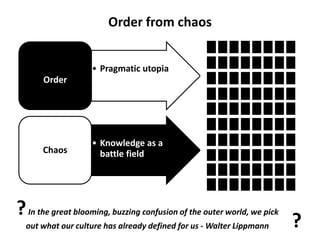
Order from chaos
• Pragmatic utopia
Order
• Knowledge as a
battle fieldChaos
?In the great blooming, buzzing confusion of the outer world, we pick
out what our culture has already defined for us - Walter Lippmann ?
Yes, there are loads of questions, but…
let’s talk about it! Thank you!
Filipa M. Ribeiro
filipa.ribeiro@gmail.com

Knowledge regimes

  • 1.
    Knowledge regimes: orderfrom chaos? The camera is never neutral John Tagg Knowledge and Policy Brussels – 21-23 September 2011 Filipa M. Ribeiro PhD candidate at University of Porto
  • 2.
    His Mécanique socialeaimed to show that society was as ruled- based as astronomy. For him, variation is linked with error. • Laplace – error curve • Statistical science • non-equilibrium growth and patterns • Epstein: society is geared largely towards removing the need to make decisions (conform with minimum effort) • The overcoming of the insufficient dualism state / market that has structured the political thought for over a century and a half is one of the perspective to look at knowledge regimes and not the least important.
  • 3.
    Otto Neurath: antireductionistand the unity of science • “orchestration” of sciences that was partly to be realized in the form of the Encyclopedia. •Viena Circle Manifest: “We witness the spirit of the scientific world- conception penetrating in growing measure the forms of personal and public life, in education, upbringing, architecture, and the shaping of economic and social life according to rational principles. The scientific world- conception serves life and life receives it” (Neurath et al, 1929).
  • 4.
    Regimes and contexts •historical • socio-cultural • individual • situational • structural Schema theory : Is there room for sprucing up new knowledge? Ebbinghaus illusion is an example of structural context. Particular circumstances seem to activate appropriate schemata. Such schemata develop from experience. They help us to ‘go beyond the information given’ by making assumptions about what is usual in similar contexts.
  • 5.
    The third generation university(Wissema, 2009) Third generation university Consilience, c reativity and design Exploitation as 3rd objective Two-track university Disentangled from the sate Cosmopolita nuniversity International competition Internationa l know-how hub KR principles • Similarity; • Proximity • Good continuity • Closure • Smallness • Surroundedness • Stability and simplicity VS
  • 6.
    The way wesee things is affected by what we know or what we believe - John Berger • What determines the diversity of Knowledges? • Why do some minority knowledges survive while others vanish? • Why do any two knowledges not generally converge completely when they interact (like the scientific and the spiritual knowledge)? A simulation of cultural spread
  • 7.
    Seeing like aState?* • The pragmatism of each knowledge regime. • A knowledge regime approach doesn’t mean a global narrative anymore, rather it aims at meeting specific needs, at creating free logics that result into governance experiences that are not anymore an ideology or policies in abstracto. • This process of agglutination is one of the major issues concerning the knowledge regimes approach: how can different knowledges be fruitful beyond mutual recognition? *James Scott The devil’s pitchfork
  • 8.
    Standards, dominations andabsences • Historical development of dominant and excluded knowledge concepts/ regimes; • Identification of morphic fields that gave rise to dominant knowledges and contemporary issues ; • What factors are challenging knowledge regimes? • What relation is there today between wisdom and knowledge and how that affects the knowledge regime approach? Patterns of dominance and standards • Visibility window • Level of acceptability – level of tolerance • Level of dominance
  • 9.
    Emergent issues (1) 1.Knowledge networks • The network approach offers a new set of tools for illuminating the on the ground work of the organization and it is in that ongoing process that change is legitimized, ideas given meaning, relations built and practice sustained or transformed. • Network structures emerge as key mechanisms in the complicated interplay of broad (macro-level) institutional and social developments and the situated (micro-level) practice of change; • How to conceptualize knowledge and power in networks? • Systemic power – power structures
  • 10.
    2. Knowledge networksand Knowledge regimes • Knowledge regimes or knowledge networks? • Development led to universities facing a multitude of new demands from a host of stakeholders. • Knowledge regimes and academic freedom? • Is there inter-knowledge in the universities? • How to distinguish between various scientific and nonscientific, Western and non-Western knowledges? What are hierarchies of knowledge? • What kinds of relationships are possible between different knowledge in universities? • How can these relationships be lead to research and teaching? • Universities may or may not provide conditions for epistemological diversity in society? Emergent issues (2)
  • 11.
    Enduring problems ofchange • How do KN bear on scaling up mixing knowledges within and across HEI? • How does the understanding and mapping of network ties and flows deepen our understanding of organizational capacity, including the nature of available knowledge? • What happens to the quality and reach of networks as organizational attention and knowledge types shift over time? In what ways do social networks support or constrain efforts at change at multiple levels within knowledge regimes?
  • 12.
    Methodology and challenges(1) Data collection focus • Historical evolution of universities and the identification of distinctive features in the process of stabilization of methods of knowledge production and teaching; • Criteria used by researchers / teachers to select the content they teach, on a number of disciplines; • Perceptions of teachers / researchers on the knowledge they produce and teach; • Knowledge policy documents about teaching and learning in universities. Data gathering and analysis • Historical analysis (analysis of texts and text network analysis); • Accounts and autobiographical narratives; • Interviews • Social network analysis (to track changes and dominant/excluded types of knowledge).
  • 13.
    Methodology and challenges(2) Challenges • Whether to measure perceived social ties or actual changes; • How to treat temporal elements in the definition of relationships; • Whether to seek for accurate descriptions or reliable indicators; Big questions • How do competitive levels (whether of tolerance, creativity) penetrate global networks? • To what extent have Knowledge networks changed the way standards are disrupted?
  • 14.
    Order from chaos •Pragmatic utopia Order • Knowledge as a battle fieldChaos ?In the great blooming, buzzing confusion of the outer world, we pick out what our culture has already defined for us - Walter Lippmann ?
  • 15.
    Yes, there areloads of questions, but… let’s talk about it! Thank you! Filipa M. Ribeiro filipa.ribeiro@gmail.com