India plans to set up a 'meta-university', a countrywide network for higher education that will
allow students the flexibility to design their own curriculum and combine subjects of their
choice, Prime Minister Manmohan Singh has announced.
Others have floated the idea of a meta-university. Notably Charles Vest, president-emeritus at
America's Massachusetts Institute of Technology, first talked of the emergence of the meta-
university in a speech more than five years ago.
However, if fully implemented India could be host to the world's first national meta-university.
According to the government, the proposed interconnected web-based platform will enable
students and teachers to access and share teaching material, scholarly publications, research,
scientific work and virtual experiments. The internet will provide the communication
infrastructure, while a network of universities will offer courses in various disciplines,
facilitating more collaborative and multidisciplinary learning.
Students enrolled in a college or a university will be able to pursue courses in other universities
and colleges. At present, students registered at one university cannot attend classes or courses
offered at another, unless an exchange programme exists between them.
"The meta-university would enable a student of astrophysics at the Indian Institute of Science,
Bangalore, for example, to take up a course in comparative literature at Jadavpur University [in
Kolkata]. Such creative reconfigurations are expected to create 'new minds' conducive to
innovation," said Singh in a speech to the National Innovation Council (NIC) on 15 November.
Singh pointed out that "demographically we are also a very youthful nation. The young people
are restless, they are impatient for change, and they are innovative. We need to fully exploit
these enormous advantages that we have as a nation."
The government describes 'new minds' as combining "right brain and left brain - attributes that
foster innovation".
NIC chair Sam Pitroda said the aim was to use the meta-university as a tool to rethink education.
Students "would be tested for their competencies before enrolling in a particular programme in
another university, and will be awarded degrees," he said.
The meta-university concept is similar to the Academy of Scientific and Innovative Research, a
recent virtual university championed by the publicly-funded Council of Scientific and Industrial
Research (CSIR). It allows the CSIR to offer courses, degrees and diplomas to graduates without
requiring them to register at bricks-and-mortar universities.
"The aim is to enable information technology connectivity," said CSIR director-general Samir
Brahmachari, who is also a member of the NIC. "It is not possible for every student to physically
take every course at the university of his choice. But all students will be able to access course
material of their choice."
The meta-university will use the National Knowledge Network, which connects a large number
of central and state universities and other higher education institutions via a high-speed fibre-
based broadband network.
The knowledge network will ultimately link all universities, research institutions, libraries,
laboratories, hospitals and agricultural institutions across the country.
However, practical problems that have prevented the implementation of previous similar
proposals will still have to be addressed. In 2009, the government approved connecting 18,000
colleges and 419 universities. So far, however, only 11,600 colleges now have internet
connectivity.
Just over two years ago India's three science academies jointly proposed changes to allow
students to pick courses across disciplines within the same university. That proposal has yet to be
implemented.
Implementation of the meta-university would also require all participating institutions to have
a similar credit and grading system, which is not currently the case.
"The idea of a meta-university is very good but the question is: Are our universities ready to take
this up? I think a combination of incentives and force will be necessary to do this," said Subhash
Lakhotia, a senior zoologist at Banaras Hindu University in Varanasi.
Some experts say that with little progress on several other higher education reforms, this
announcement appears to be another 'grand idea' from the government that lacks a coherent
roadmap for implementation.
The Foreign Universities Bill, the National Council for Higher Education and Research Bill, the
Educational Tribunal Bill, the Prohibition of Unfair Practices Bill, and the National Academic
Depository Bill are among the many higher education reform bills awaiting the approval of
parliament.
"Much of the detail is still being worked out," said R Gopalakrishnan, additional secretary in the
Prime Minister's Office and a member of the NIC. "But initially we are trying to get leading
Delhi-based institutions on board. The Human Resource Development Ministry is closely
working with us on this."
Relatedlinks
INDIA: Central universities agree to credit transfer
INDIA: Hazare unrest delays higher education bills
INDIA: University chiefs back semester plan
Comment
A great leap forward at the right time. But the governmental role shouldl be kept at a minimum,
giving the due infrastructure to participatory institutions and full publicity for this new deal. This
move may inspire middle and primary level participation. A meta-university shouldl not be either
left to bureaucracy or to educator-administrators and bureaucratic functionaries, who resist
change.The campus is a free space in society to generate and exchange ideas. This paradigm can
be ventured upon now by the mass of teachers and students. 'Think dangerously', 'Research
translationally' to take the society, economy, polity, science and technology on a more advanced
and risky level by its praxis of education and training in future course of history.
Paradigms:
Across disciplines (and within) there are varying views of what research is and how this relates
to the kind of knowledge being developed. Paradigms guide how we make decisions and carry
out research. Lawyers, for example, will use an adversarial paradigm while selection committees
will use a judgemental paradigm (Guba 1990). Your own discipline will also be guided by a
paradigm and through the research papers you read in your subject, you will begin to identify,
through the methodology the kind of paradigm that is used. As a researcher, it is important to
know where your discipline belongs, that there are different ways of viewing the world and that
your approach to knowledge is one of many. The following concepts, in boxes, illustrate some of
the different approaches to research.
A paradigm is simply a belief system (or theory) that guides the way we do things, or more
formally establishes a set of practices. This can range from thought patterns to action.
Disciplines tend to be governed by particular paradigms, such as:
 positivism (e.g. experimental testing),
 post positivism (i.e. a view that we need context and that context free experimental
design is insufficient)
 critical theory (e.g. ideas in relation to an ideology - knowledge is not value free and
bias should be articulated) and
 constructivism (i.e. each individual constructs his/her own reality so there are multiple
interpretations. This is sometimes referred to as interpretivism).
According to Guba (1990), paradigms can be characterised through their: ontology (What is
reality?), epistemology (How do you know something?) and methodology (How do go about
finding out?). These characteristics create a holistic view of how we view knowledge: how we
see ourselves in relation to this knowledge and the methodological strategies we use to
un/discover it.
In order to get to grips with this, we need to clarify what these terms mean.
Ontology is what exists and is a view on the nature of reality.
Are you a realist ? You see reality as something 'out there', as a law of nature just waiting to be
found ?
Are you a critical realist? You know things exist 'out there' but as human beings our own
presence as researchers influences what we are trying to measure.
Or, are you a relativist ? You believe that knowledge is a social reality, value-laden and it only
comes to light through individual interpretation?
Epistemology is our perceived relationship with the knowledge we are un/dis/covering. Are we
part of that knowledge or are we external to it?
Your view will frame your interaction with what you are researching and will depend on your
ontological view. Your approach, for example, will be objective if you see knowledge governed
by the laws of nature or subjective if you see knowledge as something interpreted by individuals.
This in turn affects your methodology.
Methodology refers to how you go about finding out knowledge and carrying out your research.
It is your strategic approach, rather than your techniques and data analysis (Wainright, 1997).
Some examples of such methods are:
 the scientific method (quantitative method),
 ethnographic approach, case study approach, (both using qualitative methods),
ideological framework (e.g. an interpretation from Marxist, Feminist viewpoint), dialectic
approach (e.g. compare and contrast different points of view or constructs, including your
own).
Now you may find it useful to read the Wikipedia articles and their related links on the following
key words: epistemology, methodology, ontology, paradigm, positivism, post-positivism, critical
theory and constructivism before you try to answer the questions.
ACTIVITY 5: How our view of what knowledge is affects the way we research.
Having read about the concepts paradigm, epistemology, ontology and methodology you will
begin to see how our view of the knowledge and the world affects how we plan and carry out
research. You may have noticed that different disciplines have a different view of how research
should be conducted. It is important to know how your discipline carries out research, and you
may even want to challenge this.
In this exercise, match the following concepts to the following paradigms: positivism, post-
positivism, critical theory or constructivism by typing in the appropriate code to the appropriate
box here and in your log book. Each paradigm can be used more than once. Below are a few
examples:
 PO: POsitivism -e.g. hypothesis testing;
 PP: Post -Positivism - e.g. prefers use of natural settings;
 CT: Critical Theory - e.g. research is a political act;;
 CO: COnstructivism - e.g. relativist;
 CC: Critical theory AND Constructivism - e.g. realist
Percepective:
Theory:
Theories are a set of logical propositions that are presented in a systematic way which describe
and explain any behavior. These are logically constructed statement that includes some
information in any particular area. Theories are such a statements always open for testing,
reviewing, reformulating, modifying, adding.
Paradigm:
Paradigm is a set of propositions that explain how the world is perceived it contains a world view
a way of breaking down the complexity of the real world.
Paradigms are broad theoretical formulations. They provide us a sets of assumptions that
help us to find out the description of the reality so that we derive some hypothesis.
Based on hypothesis we can have help on research on specific process and effects.
Paradigm is a whole system of thinking. It is different insight to viewing and perceiving world to
observe things and any social reality based on the basic assumptions
Types of paradigms:
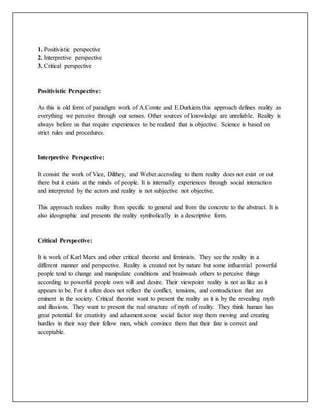
1. Positivistic perspective
2. Interpretive perspective
3. Critical perspective
Positivistic Perspective:
As this is old form of paradigm work of A.Comte and E.Durkiem.this approach defines reality as
everything we perceive through our senses. Other sources of knowledge are unreliable. Reality is
always before us that require experiences to be realized that is objective. Science is based on
strict rules and procedures.
Interpretive Perspective:
It consist the work of Vice, Dilthey, and Weber.accroding to them reality does not exist or out
there but it exists at the minds of people. It is internally experiences through social interaction
and interpreted by the actors and reality is not subjective not objective.
This approach realizes reality from specific to general and from the concrete to the abstract. It is
also ideographic and presents the reality symbolically in a descriptive form.
Critical Perspective:
It is work of Karl Marx and other critical theorist and feminists. They see the reality in a
different manner and perspective. Reality is created not by nature but some influential powerful
people tend to change and manipulate conditions and brainwash others to perceive things
according to powerful people own will and desire. Their viewpoint reality is not as like as it
appears to be. For it often does not reflect the conflict, tensions, and contradiction that are
eminent in the society. Critical theorist want to present the reality as it is by the revealing myth
and illusions. They want to present the real structure of myth of reality. They think human has
great potential for creativity and adusment.some social factor stop them moving and creating
hurdles in their way their fellow men, which convince them that their fate is correct and
acceptable.
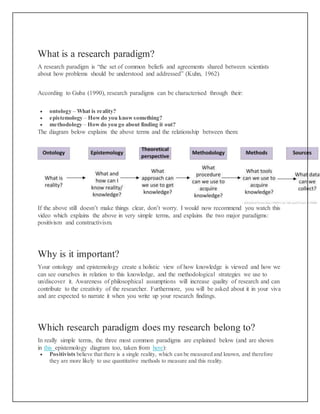
What is a research paradigm?
A research paradigm is “the set of common beliefs and agreements shared between scientists
about how problems should be understood and addressed” (Kuhn, 1962)
According to Guba (1990), research paradigms can be characterised through their:
 ontology – What is reality?
 epistemology – Howdo you know something?
 methodology – Howdo you go about finding it out?
The diagram below explains the above terms and the relationship between them:
If the above still doesn’t make things clear, don’t worry. I would now recommend you watch this
video which explains the above in very simple terms, and explains the two major paradigms:
positivism and constructivism.
Why is it important?
Your ontology and epistemology create a holistic view of how knowledge is viewed and how we
can see ourselves in relation to this knowledge, and the methodological strategies we use to
un/discover it. Awareness of philosophical assumptions will increase quality of research and can
contribute to the creativity of the researcher. Furthermore, you will be asked about it in your viva
and are expected to narrate it when you write up your research findings.
Which research paradigm does my research belong to?
In really simple terms, the three most common paradigms are explained below (and are shown
in this epistemology diagram too, taken from here):
 Positivists believe that there is a single reality, which can be measured and known, and therefore
they are more likely to use quantitative methods to measure and this reality.
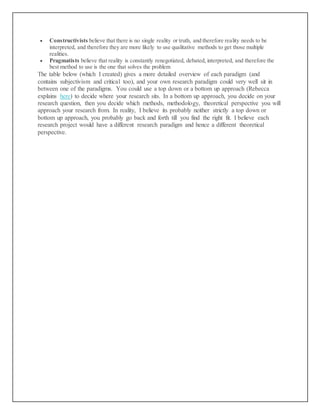
 Constructivists believe that there is no single reality or truth, and therefore reality needs to be
interpreted, and therefore they are more likely to use qualitative methods to get those multiple
realities.
 Pragmatists believe that reality is constantly renegotiated, debated, interpreted, and therefore the
best method to use is the one that solves the problem
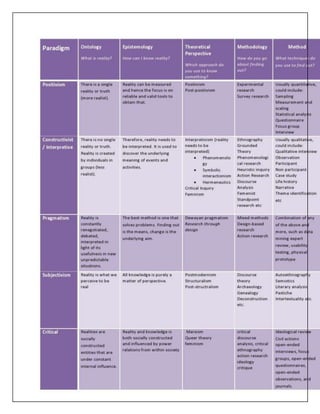
The table below (which I created) gives a more detailed overview of each paradigm (and
contains subjectivism and critical too), and your own research paradigm could very well sit in
between one of the paradigms. You could use a top down or a bottom up approach (Rebecca
explains here) to decide where your research sits. In a bottom up approach, you decide on your
research question, then you decide which methods, methodology, theoretical perspective you will
approach your research from. In reality, I believe its probably neither strictly a top down or
bottom up approach, you probably go back and forth till you find the right fit. I believe each
research project would have a different research paradigm and hence a different theoretical
perspective.
Table adapted from various sources, including Crotty (1998). Crotty left ontology out of his
framework, and also didn’t include Pragmatism and Critical. But the assumptions underlying
every piece of research are both ontological and epistemological.
Where does most social science research sit?
According to Eddie, and quoting directly, most social science sits into the following:
“1. Experimental (Positivist), with a more realist ontology (i.e. reality is out there), with an
empiricist epistemology (i.e. and I’ll gather sense data to find it);
2. Postmodernist constructivism, with a less realist ontology (i.e. reality is just a load of
competing claims), and a constructivist epistemology (i.e. and I’ll analyse those competing
accounts to explore it)
Applied, then to social psychology, it is important to understand the tension, throughout its
history, between:
1. A more traditional experimental (quantitative) approach, which sees social reality as a set of
facts to be known for all time by measuring people in the laboratory;
2. A more critical, discursive (qualitative) approach, which sees social reality as mutually
constructed between people in the real world.”
However, I must add that pragmatism (and hence mixed methods research) is also being
increasingly used in social sciences.
What impact will my chosen paradigm have on my research?
It will have a huge impact. Let me give you an example of an interview based research that is
constructivist:
“So as GP trainers, constructivism means that to understand our trainees and their learning,
beliefs or behaviours we have to be aware of their experience and culture (the historical and
cultural contexts) and recognise that they don’t just potentially see the world differently to us,
but experience it differently too.” Source.
Useful reading and references
Texts I found useful:
Crotty, M., 1998. Foundations of social research: Meaning and Perspective in the Research
Process. p.256.
Easterby-Smith, M., Thorpe, R. and Jackson, P.R., 2012. Management Research. [online] SAGE
Publications. Available at:
<https://books.google.co.uk/books/about/Management_Research.html?id=ahbhMb-
R7MQC&pgis=1> [Accessed 14 Jul. 2015].
Scotland, J., 2012. Exploring the philosophical underpinnings of research: Relating ontology and
epistemology to the methodology and methods of the scientific, interpretive, and critical research
paradigms. English Language Teaching, 5(9), pp.9–16.
Blog posts that were useful:
http://doctoralstudy.blogspot.co.uk/2009/05/being-clear-about-methodology-ontology.html?m=1
http://eddiechauncy.blogspot.co.uk/2012/01/what-are-ontology-and-epistemology_12.html
https://www.academia.edu/12235888/Developing_an_Appreciative_Understanding_of_Epistemo
logies_in_Educational_Research_One_Bloggers_Journey
Useful video:
Assumptions of researchers: https://www.youtube.com/watch?v=gONyWHpSSWc

June2014ans

  • 1.
    India plans toset up a 'meta-university', a countrywide network for higher education that will allow students the flexibility to design their own curriculum and combine subjects of their choice, Prime Minister Manmohan Singh has announced. Others have floated the idea of a meta-university. Notably Charles Vest, president-emeritus at America's Massachusetts Institute of Technology, first talked of the emergence of the meta- university in a speech more than five years ago. However, if fully implemented India could be host to the world's first national meta-university. According to the government, the proposed interconnected web-based platform will enable students and teachers to access and share teaching material, scholarly publications, research, scientific work and virtual experiments. The internet will provide the communication infrastructure, while a network of universities will offer courses in various disciplines, facilitating more collaborative and multidisciplinary learning. Students enrolled in a college or a university will be able to pursue courses in other universities and colleges. At present, students registered at one university cannot attend classes or courses offered at another, unless an exchange programme exists between them. "The meta-university would enable a student of astrophysics at the Indian Institute of Science, Bangalore, for example, to take up a course in comparative literature at Jadavpur University [in Kolkata]. Such creative reconfigurations are expected to create 'new minds' conducive to innovation," said Singh in a speech to the National Innovation Council (NIC) on 15 November. Singh pointed out that "demographically we are also a very youthful nation. The young people are restless, they are impatient for change, and they are innovative. We need to fully exploit these enormous advantages that we have as a nation." The government describes 'new minds' as combining "right brain and left brain - attributes that foster innovation". NIC chair Sam Pitroda said the aim was to use the meta-university as a tool to rethink education. Students "would be tested for their competencies before enrolling in a particular programme in another university, and will be awarded degrees," he said. The meta-university concept is similar to the Academy of Scientific and Innovative Research, a recent virtual university championed by the publicly-funded Council of Scientific and Industrial Research (CSIR). It allows the CSIR to offer courses, degrees and diplomas to graduates without requiring them to register at bricks-and-mortar universities. "The aim is to enable information technology connectivity," said CSIR director-general Samir Brahmachari, who is also a member of the NIC. "It is not possible for every student to physically take every course at the university of his choice. But all students will be able to access course material of their choice."
  • 2.
    The meta-university willuse the National Knowledge Network, which connects a large number of central and state universities and other higher education institutions via a high-speed fibre- based broadband network. The knowledge network will ultimately link all universities, research institutions, libraries, laboratories, hospitals and agricultural institutions across the country. However, practical problems that have prevented the implementation of previous similar proposals will still have to be addressed. In 2009, the government approved connecting 18,000 colleges and 419 universities. So far, however, only 11,600 colleges now have internet connectivity. Just over two years ago India's three science academies jointly proposed changes to allow students to pick courses across disciplines within the same university. That proposal has yet to be implemented. Implementation of the meta-university would also require all participating institutions to have a similar credit and grading system, which is not currently the case. "The idea of a meta-university is very good but the question is: Are our universities ready to take this up? I think a combination of incentives and force will be necessary to do this," said Subhash Lakhotia, a senior zoologist at Banaras Hindu University in Varanasi. Some experts say that with little progress on several other higher education reforms, this announcement appears to be another 'grand idea' from the government that lacks a coherent roadmap for implementation. The Foreign Universities Bill, the National Council for Higher Education and Research Bill, the Educational Tribunal Bill, the Prohibition of Unfair Practices Bill, and the National Academic Depository Bill are among the many higher education reform bills awaiting the approval of parliament. "Much of the detail is still being worked out," said R Gopalakrishnan, additional secretary in the Prime Minister's Office and a member of the NIC. "But initially we are trying to get leading Delhi-based institutions on board. The Human Resource Development Ministry is closely working with us on this." Relatedlinks INDIA: Central universities agree to credit transfer INDIA: Hazare unrest delays higher education bills INDIA: University chiefs back semester plan
  • 3.
    Comment A great leapforward at the right time. But the governmental role shouldl be kept at a minimum, giving the due infrastructure to participatory institutions and full publicity for this new deal. This move may inspire middle and primary level participation. A meta-university shouldl not be either left to bureaucracy or to educator-administrators and bureaucratic functionaries, who resist change.The campus is a free space in society to generate and exchange ideas. This paradigm can be ventured upon now by the mass of teachers and students. 'Think dangerously', 'Research translationally' to take the society, economy, polity, science and technology on a more advanced and risky level by its praxis of education and training in future course of history. Paradigms: Across disciplines (and within) there are varying views of what research is and how this relates to the kind of knowledge being developed. Paradigms guide how we make decisions and carry out research. Lawyers, for example, will use an adversarial paradigm while selection committees will use a judgemental paradigm (Guba 1990). Your own discipline will also be guided by a paradigm and through the research papers you read in your subject, you will begin to identify, through the methodology the kind of paradigm that is used. As a researcher, it is important to know where your discipline belongs, that there are different ways of viewing the world and that your approach to knowledge is one of many. The following concepts, in boxes, illustrate some of the different approaches to research. A paradigm is simply a belief system (or theory) that guides the way we do things, or more formally establishes a set of practices. This can range from thought patterns to action. Disciplines tend to be governed by particular paradigms, such as:  positivism (e.g. experimental testing),  post positivism (i.e. a view that we need context and that context free experimental design is insufficient)  critical theory (e.g. ideas in relation to an ideology - knowledge is not value free and bias should be articulated) and  constructivism (i.e. each individual constructs his/her own reality so there are multiple interpretations. This is sometimes referred to as interpretivism).
  • 4.
    According to Guba(1990), paradigms can be characterised through their: ontology (What is reality?), epistemology (How do you know something?) and methodology (How do go about finding out?). These characteristics create a holistic view of how we view knowledge: how we see ourselves in relation to this knowledge and the methodological strategies we use to un/discover it. In order to get to grips with this, we need to clarify what these terms mean. Ontology is what exists and is a view on the nature of reality. Are you a realist ? You see reality as something 'out there', as a law of nature just waiting to be found ? Are you a critical realist? You know things exist 'out there' but as human beings our own presence as researchers influences what we are trying to measure. Or, are you a relativist ? You believe that knowledge is a social reality, value-laden and it only comes to light through individual interpretation? Epistemology is our perceived relationship with the knowledge we are un/dis/covering. Are we part of that knowledge or are we external to it? Your view will frame your interaction with what you are researching and will depend on your ontological view. Your approach, for example, will be objective if you see knowledge governed by the laws of nature or subjective if you see knowledge as something interpreted by individuals. This in turn affects your methodology. Methodology refers to how you go about finding out knowledge and carrying out your research. It is your strategic approach, rather than your techniques and data analysis (Wainright, 1997). Some examples of such methods are:  the scientific method (quantitative method),  ethnographic approach, case study approach, (both using qualitative methods), ideological framework (e.g. an interpretation from Marxist, Feminist viewpoint), dialectic approach (e.g. compare and contrast different points of view or constructs, including your own). Now you may find it useful to read the Wikipedia articles and their related links on the following key words: epistemology, methodology, ontology, paradigm, positivism, post-positivism, critical theory and constructivism before you try to answer the questions. ACTIVITY 5: How our view of what knowledge is affects the way we research.
  • 5.
    Having read aboutthe concepts paradigm, epistemology, ontology and methodology you will begin to see how our view of the knowledge and the world affects how we plan and carry out research. You may have noticed that different disciplines have a different view of how research should be conducted. It is important to know how your discipline carries out research, and you may even want to challenge this. In this exercise, match the following concepts to the following paradigms: positivism, post- positivism, critical theory or constructivism by typing in the appropriate code to the appropriate box here and in your log book. Each paradigm can be used more than once. Below are a few examples:  PO: POsitivism -e.g. hypothesis testing;  PP: Post -Positivism - e.g. prefers use of natural settings;  CT: Critical Theory - e.g. research is a political act;;  CO: COnstructivism - e.g. relativist;  CC: Critical theory AND Constructivism - e.g. realist Percepective: Theory: Theories are a set of logical propositions that are presented in a systematic way which describe and explain any behavior. These are logically constructed statement that includes some information in any particular area. Theories are such a statements always open for testing, reviewing, reformulating, modifying, adding. Paradigm: Paradigm is a set of propositions that explain how the world is perceived it contains a world view a way of breaking down the complexity of the real world. Paradigms are broad theoretical formulations. They provide us a sets of assumptions that help us to find out the description of the reality so that we derive some hypothesis. Based on hypothesis we can have help on research on specific process and effects. Paradigm is a whole system of thinking. It is different insight to viewing and perceiving world to observe things and any social reality based on the basic assumptions Types of paradigms:
  • 6.
    1. Positivistic perspective 2.Interpretive perspective 3. Critical perspective Positivistic Perspective: As this is old form of paradigm work of A.Comte and E.Durkiem.this approach defines reality as everything we perceive through our senses. Other sources of knowledge are unreliable. Reality is always before us that require experiences to be realized that is objective. Science is based on strict rules and procedures. Interpretive Perspective: It consist the work of Vice, Dilthey, and Weber.accroding to them reality does not exist or out there but it exists at the minds of people. It is internally experiences through social interaction and interpreted by the actors and reality is not subjective not objective. This approach realizes reality from specific to general and from the concrete to the abstract. It is also ideographic and presents the reality symbolically in a descriptive form. Critical Perspective: It is work of Karl Marx and other critical theorist and feminists. They see the reality in a different manner and perspective. Reality is created not by nature but some influential powerful people tend to change and manipulate conditions and brainwash others to perceive things according to powerful people own will and desire. Their viewpoint reality is not as like as it appears to be. For it often does not reflect the conflict, tensions, and contradiction that are eminent in the society. Critical theorist want to present the reality as it is by the revealing myth and illusions. They want to present the real structure of myth of reality. They think human has great potential for creativity and adusment.some social factor stop them moving and creating hurdles in their way their fellow men, which convince them that their fate is correct and acceptable.
  • 7.
    What is aresearch paradigm? A research paradigm is “the set of common beliefs and agreements shared between scientists about how problems should be understood and addressed” (Kuhn, 1962) According to Guba (1990), research paradigms can be characterised through their:  ontology – What is reality?  epistemology – Howdo you know something?  methodology – Howdo you go about finding it out? The diagram below explains the above terms and the relationship between them: If the above still doesn’t make things clear, don’t worry. I would now recommend you watch this video which explains the above in very simple terms, and explains the two major paradigms: positivism and constructivism. Why is it important? Your ontology and epistemology create a holistic view of how knowledge is viewed and how we can see ourselves in relation to this knowledge, and the methodological strategies we use to un/discover it. Awareness of philosophical assumptions will increase quality of research and can contribute to the creativity of the researcher. Furthermore, you will be asked about it in your viva and are expected to narrate it when you write up your research findings. Which research paradigm does my research belong to? In really simple terms, the three most common paradigms are explained below (and are shown in this epistemology diagram too, taken from here):  Positivists believe that there is a single reality, which can be measured and known, and therefore they are more likely to use quantitative methods to measure and this reality.
  • 8.
     Constructivists believethat there is no single reality or truth, and therefore reality needs to be interpreted, and therefore they are more likely to use qualitative methods to get those multiple realities.  Pragmatists believe that reality is constantly renegotiated, debated, interpreted, and therefore the best method to use is the one that solves the problem The table below (which I created) gives a more detailed overview of each paradigm (and contains subjectivism and critical too), and your own research paradigm could very well sit in between one of the paradigms. You could use a top down or a bottom up approach (Rebecca explains here) to decide where your research sits. In a bottom up approach, you decide on your research question, then you decide which methods, methodology, theoretical perspective you will approach your research from. In reality, I believe its probably neither strictly a top down or bottom up approach, you probably go back and forth till you find the right fit. I believe each research project would have a different research paradigm and hence a different theoretical perspective.
  • 10.
    Table adapted fromvarious sources, including Crotty (1998). Crotty left ontology out of his framework, and also didn’t include Pragmatism and Critical. But the assumptions underlying every piece of research are both ontological and epistemological. Where does most social science research sit? According to Eddie, and quoting directly, most social science sits into the following: “1. Experimental (Positivist), with a more realist ontology (i.e. reality is out there), with an empiricist epistemology (i.e. and I’ll gather sense data to find it); 2. Postmodernist constructivism, with a less realist ontology (i.e. reality is just a load of competing claims), and a constructivist epistemology (i.e. and I’ll analyse those competing accounts to explore it) Applied, then to social psychology, it is important to understand the tension, throughout its history, between: 1. A more traditional experimental (quantitative) approach, which sees social reality as a set of facts to be known for all time by measuring people in the laboratory; 2. A more critical, discursive (qualitative) approach, which sees social reality as mutually constructed between people in the real world.” However, I must add that pragmatism (and hence mixed methods research) is also being increasingly used in social sciences. What impact will my chosen paradigm have on my research? It will have a huge impact. Let me give you an example of an interview based research that is constructivist: “So as GP trainers, constructivism means that to understand our trainees and their learning, beliefs or behaviours we have to be aware of their experience and culture (the historical and cultural contexts) and recognise that they don’t just potentially see the world differently to us, but experience it differently too.” Source. Useful reading and references Texts I found useful: Crotty, M., 1998. Foundations of social research: Meaning and Perspective in the Research Process. p.256. Easterby-Smith, M., Thorpe, R. and Jackson, P.R., 2012. Management Research. [online] SAGE Publications. Available at: <https://books.google.co.uk/books/about/Management_Research.html?id=ahbhMb- R7MQC&pgis=1> [Accessed 14 Jul. 2015].
  • 11.
    Scotland, J., 2012.Exploring the philosophical underpinnings of research: Relating ontology and epistemology to the methodology and methods of the scientific, interpretive, and critical research paradigms. English Language Teaching, 5(9), pp.9–16. Blog posts that were useful: http://doctoralstudy.blogspot.co.uk/2009/05/being-clear-about-methodology-ontology.html?m=1 http://eddiechauncy.blogspot.co.uk/2012/01/what-are-ontology-and-epistemology_12.html https://www.academia.edu/12235888/Developing_an_Appreciative_Understanding_of_Epistemo logies_in_Educational_Research_One_Bloggers_Journey Useful video: Assumptions of researchers: https://www.youtube.com/watch?v=gONyWHpSSWc