Knowledge and Information Jennifer, Pasin, Vasu, Sai, Yui
Definition    Knowledge:   K=JTB (Justified true belief) Without the truth and justification,        it is only a belief   Can be justified through          - language         - perception         - emotion         - reason  contain "How" question   Example:  You see a car accident in front of you, therefore you have knowledge that there was a car accident through perception. 
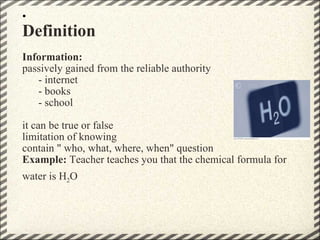
Definition Information: passively gained from the reliable authority       - internet       - books        - school          it can be true or false  limitation of knowing contain " who, what, where, when" question Example:  Teacher teaches you that the chemical formula for water is H 2 O
Compare and Contrast   Difference In order to know something, you must believe in it  You do not HAVE TO believe in information Information is not always true but in order to know something, it must be true Information is usually from others but knowledge can be obtained by yourself Information can change over time but knowledge cannot Information sometimes get distorted by censorship, society, religion    Similarity Both come from external sources  
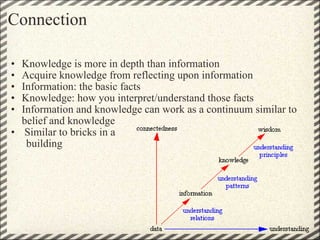
Connection Knowledge is more in depth than information Acquire knowledge from reflecting upon information Information: the basic facts Knowledge: how you interpret/understand those facts Information and knowledge can work as a continuum similar to belief and knowledge   Similar to bricks in a          building
Example  Math class You are given information that if a>b, b>c then a>c This is only information but when you test it out, through reasoning you are able to justify and it becomes Knowledge. a= 6, b=3, c=1 a>b 6>3, b>c 3>1 then a>c 6>1    Racism Sometimes there information given in the media that makes generalization in a race and those statements usually made without justification, so that false information is invalid to form knowledge.
Bibliography  Lagemaat, Richard Van De.  Theory of Knowledge for the IB Diploma . Cambridge: Cambridge UP, 2005. Print.

Knowledge and Information

  • 1.
    Knowledge and InformationJennifer, Pasin, Vasu, Sai, Yui
  • 2.
    Definition  Knowledge:   K=JTB (Justified true belief) Without the truth and justification,        it is only a belief   Can be justified through         - language        - perception        - emotion        - reason  contain "How" question   Example: You see a car accident in front of you, therefore you have knowledge that there was a car accident through perception. 
  • 3.
    Definition Information: passivelygained from the reliable authority       - internet       - books        - school         it can be true or false  limitation of knowing contain " who, what, where, when" question Example: Teacher teaches you that the chemical formula for water is H 2 O
  • 4.
    Compare and Contrast  Difference In order to know something, you must believe in it  You do not HAVE TO believe in information Information is not always true but in order to know something, it must be true Information is usually from others but knowledge can be obtained by yourself Information can change over time but knowledge cannot Information sometimes get distorted by censorship, society, religion   Similarity Both come from external sources  
  • 5.
    Connection Knowledge ismore in depth than information Acquire knowledge from reflecting upon information Information: the basic facts Knowledge: how you interpret/understand those facts Information and knowledge can work as a continuum similar to belief and knowledge   Similar to bricks in a          building
  • 6.
    Example  Math classYou are given information that if a>b, b>c then a>c This is only information but when you test it out, through reasoning you are able to justify and it becomes Knowledge. a= 6, b=3, c=1 a>b 6>3, b>c 3>1 then a>c 6>1    Racism Sometimes there information given in the media that makes generalization in a race and those statements usually made without justification, so that false information is invalid to form knowledge.
  • 7.
    Bibliography Lagemaat,Richard Van De. Theory of Knowledge for the IB Diploma . Cambridge: Cambridge UP, 2005. Print.