“Your logo could be here instead!”
CREDIT UNION
YOUR
BROUGHT TO YOU BY
Know Your
CHECKING ACCOUNT
Understanding
OVERDRAFT
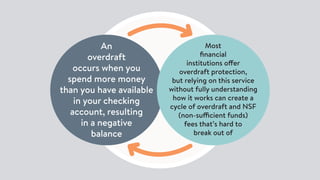
An
overdraft
occurs when you
spend more money
than you have available
in your checking
account, resulting
in a negative
balance
Most
financial
institutions offer
overdraft protection,
but relying on this service
without fully understanding
how it works can create a
cycle of overdraft and NSF
(non-sufficient funds)
fees that’s hard to
break out of
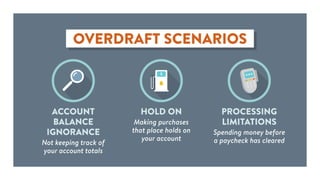
OVERDRAFT SCENARIOS
ACCOUNT
BALANCE
IGNORANCE
Not keeping track of
your account totals
HOLD ON
Making purchases
that place holds on
your account
PROCESSING
LIMITATIONS
Spending money before
a paycheck has cleared
OVERDRAFT PROTECTION
OPTING OUT
VS.
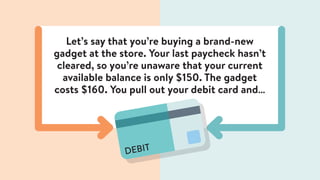
Let’s say that you’re buying a brand-new
gadget at the store. Your last paycheck hasn’t
cleared, so you’re unaware that your current
available balance is only $150. The gadget
costs $160. You pull out your debit card and…
DEBIT
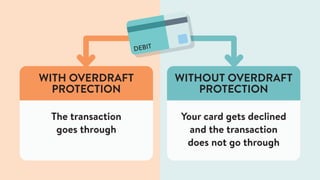
The transaction
goes through
Your card gets declined
and the transaction
does not go through
WITH OVERDRAFT
PROTECTION
DEBIT
WITHOUT OVERDRAFT
PROTECTION
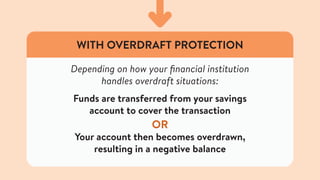
Depending on how your financial institution
handles overdraft situations:
Funds are transferred from your savings
account to cover the transaction
OR
Your account then becomes overdrawn,
resulting in a negative balance
WITH OVERDRAFT PROTECTION
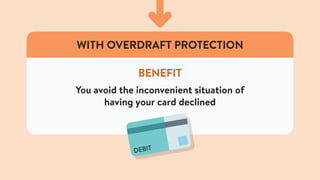
BENEFIT
You avoid the inconvenient situation of
having your card declined
WITH OVERDRAFT PROTECTION
DEBIT
DEBIT
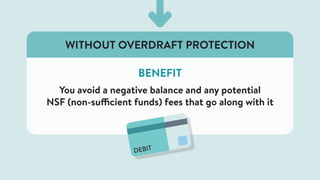
BENEFIT
You avoid a negative balance and any potential
NSF (non-sufficient funds) fees that go along with it
WITHOUT OVERDRAFT PROTECTION
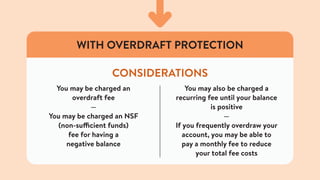
CONSIDERATIONS
WITH OVERDRAFT PROTECTION
You may be charged an
overdraft fee
—
You may be charged an NSF
(non-sufficient funds)
fee for having a
negative balance
You may also be charged a
recurring fee until your balance
is positive
—
If you frequently overdraw your
account, you may be able to
pay a monthly fee to reduce
your total fee costs
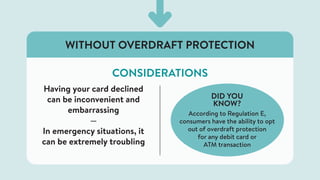
CONSIDERATIONS
WITHOUT OVERDRAFT PROTECTION
Having your card declined
can be inconvenient and
embarrassing
—
In emergency situations, it
can be extremely troubling
DID YOU
KNOW?
According to Regulation E,
consumers have the ability to opt
out of overdraft protection
for any debit card or
ATM transaction
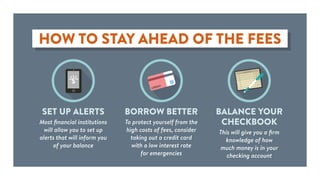
HOW TO STAY AHEAD OF THE FEES
CREDIT
SET UP ALERTS
Most financial institutions
will allow you to set up
alerts that will inform you
of your balance
BORROW BETTER
To protect yourself from the
high costs of fees, consider
taking out a credit card
with a low interest rate
for emergencies
BALANCE YOUR
CHECKBOOK
This will give you a firm
knowledge of how
much money is in your
checking account
Balance Your
CHECKBOOK
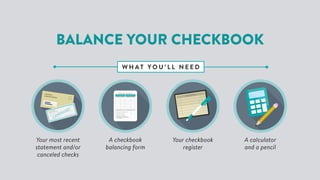
Your most recent
statement and/or
canceled checks
A checkbook
balancing form
Your checkbook
register
A calculator
and a pencil
W H A T Y O U ’ L L N E E D
BALANCE YOUR CHECKBOOK
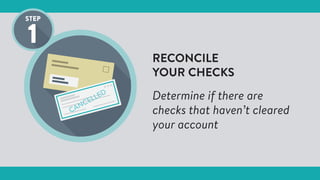
RECONCILE
YOUR CHECKS
Determine if there are
checks that haven’t cleared
your account
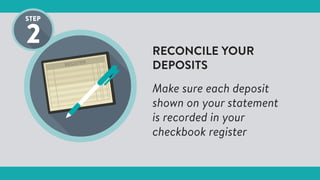
RECONCILE YOUR
DEPOSITS
Make sure each deposit
shown on your statement
is recorded in your
checkbook register
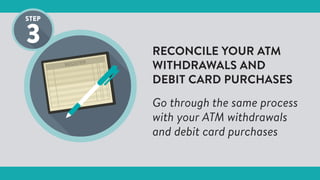
RECONCILE YOUR ATM
WITHDRAWALS AND
DEBIT CARD PURCHASES
Go through the same process
with your ATM withdrawals
and debit card purchases
RECORD INTEREST
EARNED AND FEES
Check your statement
for any other fees and
record them in your
checkbook register
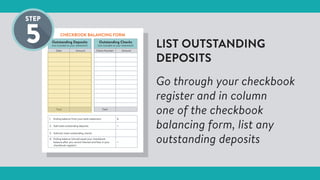
LIST OUTSTANDING
DEPOSITS
Go through your checkbook
register and in column
one of the checkbook
balancing form, list any
outstanding deposits
CHECKBOOK BALANCING FORM
Outstanding Deposits
(not included on your statement)
Outstanding Checks
(not included on your statement)
Date Amount Check Number Amount
Total Total
1. Ending balance from your bank statement $
2. Add total outstanding deposits +
3. Subtract total outstanding checks -
4. Ending balance (should equal your checkbook
balance after you record interest and fees in your
checkbook register)
=
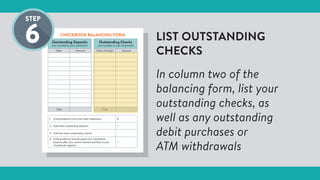
LIST OUTSTANDING
CHECKS
In column two of the
balancing form, list your
outstanding checks, as
well as any outstanding
debit purchases or
ATM withdrawals
CHECKBOOK BALANCING FORM
Outstanding Deposits
(not included on your statement)
Outstanding Checks
(not included on your statement)
Date Amount Check Number Amount
Total Total
1. Ending balance from your bank statement $
2. Add total outstanding deposits +
3. Subtract total outstanding checks -
4. Ending balance (should equal your checkbook
balance after you record interest and fees in your
checkbook register)
=
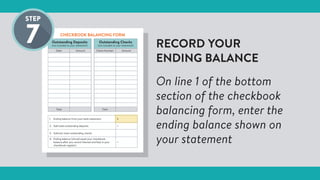
RECORD YOUR
ENDING BALANCE
On line 1 of the bottom
section of the checkbook
balancing form, enter the
ending balance shown on
your statement
CHECKBOOK BALANCING FORM
Outstanding Deposits
(not included on your statement)
Outstanding Checks
(not included on your statement)
Date Amount Check Number Amount
Total Total
1. Ending balance from your bank statement $
2. Add total outstanding deposits +
3. Subtract total outstanding checks -
4. Ending balance (should equal your checkbook
balance after you record interest and fees in your
checkbook register)
=
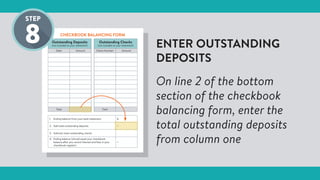
ENTER OUTSTANDING
DEPOSITS
On line 2 of the bottom
section of the checkbook
balancing form, enter the
total outstanding deposits
from column one
CHECKBOOK BALANCING FORM
Outstanding Deposits
(not included on your statement)
Outstanding Checks
(not included on your statement)
Date Amount Check Number Amount
Total Total
1. Ending balance from your bank statement $
2. Add total outstanding deposits +
3. Subtract total outstanding checks -
4. Ending balance (should equal your checkbook
balance after you record interest and fees in your
checkbook register)
=
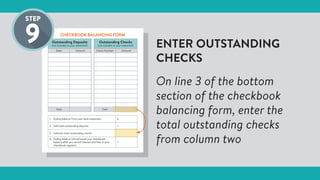
ENTER OUTSTANDING
CHECKS
On line 3 of the bottom
section of the checkbook
balancing form, enter the
total outstanding checks
from column two
CHECKBOOK BALANCING FORM
Outstanding Deposits
(not included on your statement)
Outstanding Checks
(not included on your statement)
Date Amount Check Number Amount
Total Total
1. Ending balance from your bank statement $
2. Add total outstanding deposits +
3. Subtract total outstanding checks -
4. Ending balance (should equal your checkbook
balance after you record interest and fees in your
checkbook register)
=
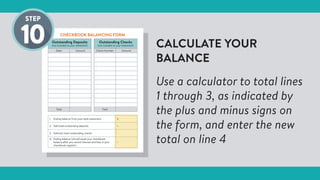
CALCULATE YOUR
BALANCE
Use a calculator to total lines
1 through 3, as indicated by
the plus and minus signs on
the form, and enter the new
total on line 4
CHECKBOOK BALANCING FORM
Outstanding Deposits
(not included on your statement)
Outstanding Checks
(not included on your statement)
Date Amount Check Number Amount
Total Total
1. Ending balance from your bank statement $
2. Add total outstanding deposits +
3. Subtract total outstanding checks -
4. Ending balance (should equal your checkbook
balance after you record interest and fees in your
checkbook register)
=
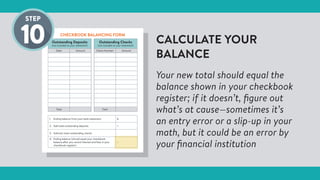
CALCULATE YOUR
BALANCE
Your new total should equal the
balance shown in your checkbook
register; if it doesn’t, figure out
what’s at cause—sometimes it’s
an entry error or a slip-up in your
math, but it could be an error by
your financial institution
CHECKBOOK BALANCING FORM
Outstanding Deposits
(not included on your statement)
Outstanding Checks
(not included on your statement)
Date Amount Check Number Amount
Total Total
1. Ending balance from your bank statement $
2. Add total outstanding deposits +
3. Subtract total outstanding checks -
4. Ending balance (should equal your checkbook
balance after you record interest and fees in your
checkbook register)
=
Sources: CreditCards.com, Forbes
It’s a Money Thing is a registered trademark of Currency Marketing
“Your logo could be here instead!”
CREDIT UNION
YOUR
BROUGHT TO YOU BY

Knowing Your Checking Account - It's a Money Thing

  • 1.
    “Your logo couldbe here instead!” CREDIT UNION YOUR BROUGHT TO YOU BY Know Your CHECKING ACCOUNT
  • 2.
  • 3.
    An overdraft occurs when you spendmore money than you have available in your checking account, resulting in a negative balance Most financial institutions offer overdraft protection, but relying on this service without fully understanding how it works can create a cycle of overdraft and NSF (non-sufficient funds) fees that’s hard to break out of
  • 4.
    OVERDRAFT SCENARIOS ACCOUNT BALANCE IGNORANCE Not keepingtrack of your account totals HOLD ON Making purchases that place holds on your account PROCESSING LIMITATIONS Spending money before a paycheck has cleared
  • 5.
  • 6.
    Let’s say thatyou’re buying a brand-new gadget at the store. Your last paycheck hasn’t cleared, so you’re unaware that your current available balance is only $150. The gadget costs $160. You pull out your debit card and… DEBIT
  • 7.
    The transaction goes through Yourcard gets declined and the transaction does not go through WITH OVERDRAFT PROTECTION DEBIT WITHOUT OVERDRAFT PROTECTION
  • 8.
    Depending on howyour financial institution handles overdraft situations: Funds are transferred from your savings account to cover the transaction OR Your account then becomes overdrawn, resulting in a negative balance WITH OVERDRAFT PROTECTION
  • 9.
    BENEFIT You avoid theinconvenient situation of having your card declined WITH OVERDRAFT PROTECTION DEBIT
  • 10.
    DEBIT BENEFIT You avoid anegative balance and any potential NSF (non-sufficient funds) fees that go along with it WITHOUT OVERDRAFT PROTECTION
  • 11.
    CONSIDERATIONS WITH OVERDRAFT PROTECTION Youmay be charged an overdraft fee — You may be charged an NSF (non-sufficient funds) fee for having a negative balance You may also be charged a recurring fee until your balance is positive — If you frequently overdraw your account, you may be able to pay a monthly fee to reduce your total fee costs
  • 12.
    CONSIDERATIONS WITHOUT OVERDRAFT PROTECTION Havingyour card declined can be inconvenient and embarrassing — In emergency situations, it can be extremely troubling DID YOU KNOW? According to Regulation E, consumers have the ability to opt out of overdraft protection for any debit card or ATM transaction
  • 13.
    HOW TO STAYAHEAD OF THE FEES CREDIT SET UP ALERTS Most financial institutions will allow you to set up alerts that will inform you of your balance BORROW BETTER To protect yourself from the high costs of fees, consider taking out a credit card with a low interest rate for emergencies BALANCE YOUR CHECKBOOK This will give you a firm knowledge of how much money is in your checking account
  • 14.
  • 15.
    Your most recent statementand/or canceled checks A checkbook balancing form Your checkbook register A calculator and a pencil W H A T Y O U ’ L L N E E D BALANCE YOUR CHECKBOOK
  • 16.
    RECONCILE YOUR CHECKS Determine ifthere are checks that haven’t cleared your account
  • 17.
    RECONCILE YOUR DEPOSITS Make sureeach deposit shown on your statement is recorded in your checkbook register
  • 18.
    RECONCILE YOUR ATM WITHDRAWALSAND DEBIT CARD PURCHASES Go through the same process with your ATM withdrawals and debit card purchases
  • 19.
    RECORD INTEREST EARNED ANDFEES Check your statement for any other fees and record them in your checkbook register
  • 20.
    LIST OUTSTANDING DEPOSITS Go throughyour checkbook register and in column one of the checkbook balancing form, list any outstanding deposits CHECKBOOK BALANCING FORM Outstanding Deposits (not included on your statement) Outstanding Checks (not included on your statement) Date Amount Check Number Amount Total Total 1. Ending balance from your bank statement $ 2. Add total outstanding deposits + 3. Subtract total outstanding checks - 4. Ending balance (should equal your checkbook balance after you record interest and fees in your checkbook register) =
  • 21.
    LIST OUTSTANDING CHECKS In columntwo of the balancing form, list your outstanding checks, as well as any outstanding debit purchases or ATM withdrawals CHECKBOOK BALANCING FORM Outstanding Deposits (not included on your statement) Outstanding Checks (not included on your statement) Date Amount Check Number Amount Total Total 1. Ending balance from your bank statement $ 2. Add total outstanding deposits + 3. Subtract total outstanding checks - 4. Ending balance (should equal your checkbook balance after you record interest and fees in your checkbook register) =
  • 22.
    RECORD YOUR ENDING BALANCE Online 1 of the bottom section of the checkbook balancing form, enter the ending balance shown on your statement CHECKBOOK BALANCING FORM Outstanding Deposits (not included on your statement) Outstanding Checks (not included on your statement) Date Amount Check Number Amount Total Total 1. Ending balance from your bank statement $ 2. Add total outstanding deposits + 3. Subtract total outstanding checks - 4. Ending balance (should equal your checkbook balance after you record interest and fees in your checkbook register) =
  • 23.
    ENTER OUTSTANDING DEPOSITS On line2 of the bottom section of the checkbook balancing form, enter the total outstanding deposits from column one CHECKBOOK BALANCING FORM Outstanding Deposits (not included on your statement) Outstanding Checks (not included on your statement) Date Amount Check Number Amount Total Total 1. Ending balance from your bank statement $ 2. Add total outstanding deposits + 3. Subtract total outstanding checks - 4. Ending balance (should equal your checkbook balance after you record interest and fees in your checkbook register) =
  • 24.
    ENTER OUTSTANDING CHECKS On line3 of the bottom section of the checkbook balancing form, enter the total outstanding checks from column two CHECKBOOK BALANCING FORM Outstanding Deposits (not included on your statement) Outstanding Checks (not included on your statement) Date Amount Check Number Amount Total Total 1. Ending balance from your bank statement $ 2. Add total outstanding deposits + 3. Subtract total outstanding checks - 4. Ending balance (should equal your checkbook balance after you record interest and fees in your checkbook register) =
  • 25.
    CALCULATE YOUR BALANCE Use acalculator to total lines 1 through 3, as indicated by the plus and minus signs on the form, and enter the new total on line 4 CHECKBOOK BALANCING FORM Outstanding Deposits (not included on your statement) Outstanding Checks (not included on your statement) Date Amount Check Number Amount Total Total 1. Ending balance from your bank statement $ 2. Add total outstanding deposits + 3. Subtract total outstanding checks - 4. Ending balance (should equal your checkbook balance after you record interest and fees in your checkbook register) =
  • 26.
    CALCULATE YOUR BALANCE Your newtotal should equal the balance shown in your checkbook register; if it doesn’t, figure out what’s at cause—sometimes it’s an entry error or a slip-up in your math, but it could be an error by your financial institution CHECKBOOK BALANCING FORM Outstanding Deposits (not included on your statement) Outstanding Checks (not included on your statement) Date Amount Check Number Amount Total Total 1. Ending balance from your bank statement $ 2. Add total outstanding deposits + 3. Subtract total outstanding checks - 4. Ending balance (should equal your checkbook balance after you record interest and fees in your checkbook register) =
  • 27.
    Sources: CreditCards.com, Forbes It’sa Money Thing is a registered trademark of Currency Marketing “Your logo could be here instead!” CREDIT UNION YOUR BROUGHT TO YOU BY