How Tagging Today
Increases Access
Tomorrow
July 10, 2013
Elizabeth F. McLean MSLS CKM
Knowledge Management Reference Group
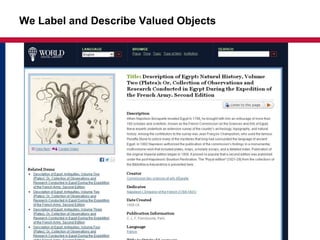
We Label and Describe Valued Objects
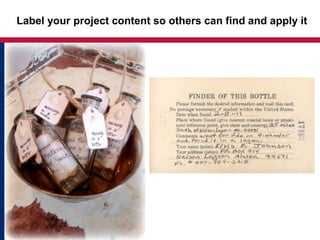
Label your project content so others can find and apply it
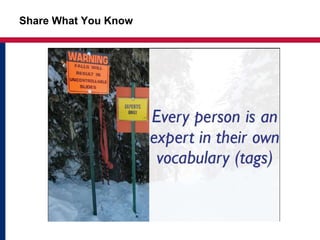
Share What You Know
Tags and Categories added by users
• Connect knowledge assets to
provide a more complete picture
• Connect people to knowledge in
context
• Connect people to experts in context
(problem solving, new insights)
• Empowers Contributors
• Personalizes Access
At the point of content creation
Tags, Categories, Keywords or labels
• Least effort, least expensive
• Organic to project
• Flexible
• Work in all kinds of collaboration tools
• Can contribute to updated controlled
vocabularies
• KM: Can inform where gaps are or depict
other patterns
• Private, Group, Social, Automatic
• Apply in organization collaboration
where users engage with content
• Personalized
• Group created finding aids at the
point of project, evaluation or ah-hah
moment
Types of Tags Today
Why We Tag
• Label applied to knowledge assets
by experts
• User generated content explosion in
social and enterprise content
• Interactivity and sharing
• Culture of engagement and influence
• Access and discoverability on trust
network
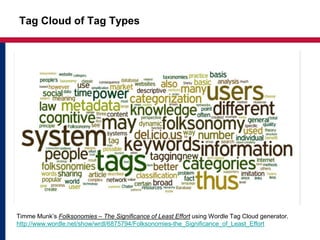
Tag Cloud of Tag Types
Timme Munk’s Folksonomies – The Significance of Least Effort using Wordle Tag Cloud generator.
http://www.wordle.net/show/wrdl/6875794/Folksonomies-the_Significance_of_Least_Effort
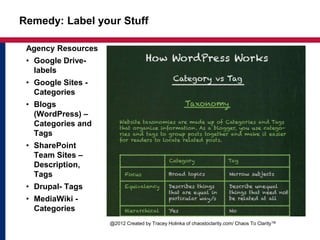
Remedy: Label your Stuff
Agency Resources
• Google Drive-
labels
• Google Sites -
Categories
• Blogs
(WordPress) –
Categories and
Tags
• SharePoint
Team Sites –
Description,
Tags
• Drupal- Tags
• MediaWiki -
Categories
@2012 Created by Tracey Holinka of chaostoclarity.com/ Chaos To Clarity™
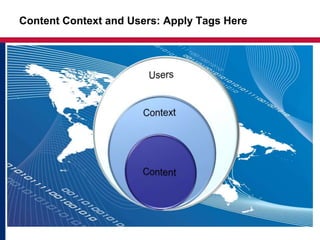
Content Context and Users: Apply Tags Here
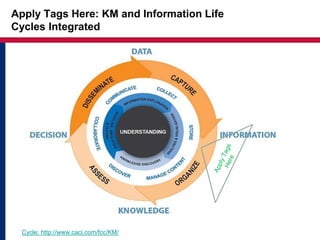
Apply Tags Here: KM and Information Life
Cycles Integrated
Cycle: http://www.caci.com/fcc/KM/
• Keys to access, analysis, and
discovery to strategic project assets
• Applicable to each activity in KM
cycle
• Shows how Users apply Context to
Content owned within program
framework
• Visual “Search” guide for quick
scanning of info
KM Tool/Concept: We know. What’s in it for us?
Looking at Tags and Categories with KM Lens
• Provides snapshot of content within
the context of the experts and project
• What do we see here? What should
we see here? Where are our gaps?
• Why are we doing it like this? What
could be better?
• Do these visual labels match our
strategies and objectives?
CHALLENGES FOR ADOPTION,
MAINTAINING OR SUSTAINING
Conversations and Applications:
SUMMARY, DISCUSSION AND
QUESTIONS
Resources
• Modular Unified Tagging Ontology
(MUTO) http://purl.org./muto
• Timme Munk’s Folksonomies – The
Significance of Least Effort using
Wordle Tag Cloud generator.
http://www.wordle.net/show/wrdl/687
5794/Folksonomies-
the_Significance_of_Least_Effort

KM Reference Group Meeting - July 10- PowerPoint Slides

  • 1.
    How Tagging Today IncreasesAccess Tomorrow July 10, 2013 Elizabeth F. McLean MSLS CKM Knowledge Management Reference Group
  • 2.
    We Label andDescribe Valued Objects
  • 4.
    Label your projectcontent so others can find and apply it
  • 5.
  • 6.
    Tags and Categoriesadded by users • Connect knowledge assets to provide a more complete picture • Connect people to knowledge in context • Connect people to experts in context (problem solving, new insights) • Empowers Contributors • Personalizes Access
  • 7.
    At the pointof content creation Tags, Categories, Keywords or labels • Least effort, least expensive • Organic to project • Flexible • Work in all kinds of collaboration tools • Can contribute to updated controlled vocabularies • KM: Can inform where gaps are or depict other patterns
  • 8.
    • Private, Group,Social, Automatic • Apply in organization collaboration where users engage with content • Personalized • Group created finding aids at the point of project, evaluation or ah-hah moment Types of Tags Today
  • 9.
    Why We Tag •Label applied to knowledge assets by experts • User generated content explosion in social and enterprise content • Interactivity and sharing • Culture of engagement and influence • Access and discoverability on trust network
  • 10.
    Tag Cloud ofTag Types Timme Munk’s Folksonomies – The Significance of Least Effort using Wordle Tag Cloud generator. http://www.wordle.net/show/wrdl/6875794/Folksonomies-the_Significance_of_Least_Effort
  • 11.
    Remedy: Label yourStuff Agency Resources • Google Drive- labels • Google Sites - Categories • Blogs (WordPress) – Categories and Tags • SharePoint Team Sites – Description, Tags • Drupal- Tags • MediaWiki - Categories @2012 Created by Tracey Holinka of chaostoclarity.com/ Chaos To Clarity™
  • 12.
    Content Context andUsers: Apply Tags Here
  • 13.
    Apply Tags Here:KM and Information Life Cycles Integrated Cycle: http://www.caci.com/fcc/KM/
  • 14.
    • Keys toaccess, analysis, and discovery to strategic project assets • Applicable to each activity in KM cycle • Shows how Users apply Context to Content owned within program framework • Visual “Search” guide for quick scanning of info KM Tool/Concept: We know. What’s in it for us?
  • 15.
    Looking at Tagsand Categories with KM Lens • Provides snapshot of content within the context of the experts and project • What do we see here? What should we see here? Where are our gaps? • Why are we doing it like this? What could be better? • Do these visual labels match our strategies and objectives?
  • 16.
    CHALLENGES FOR ADOPTION, MAINTAININGOR SUSTAINING Conversations and Applications:
  • 17.
  • 18.
    Resources • Modular UnifiedTagging Ontology (MUTO) http://purl.org./muto • Timme Munk’s Folksonomies – The Significance of Least Effort using Wordle Tag Cloud generator. http://www.wordle.net/show/wrdl/687 5794/Folksonomies- the_Significance_of_Least_Effort