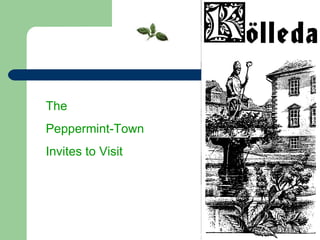
The Peppermint-Town I nvites to  V isit
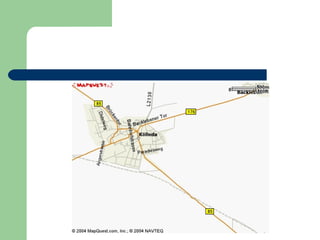
Map of Kölleda
A place to live
General Facts Kölleda, with a population of ca. 6.000, covers   a total area of 3,023 hectares (including outlying parts). (6,530 people in 1994) .  Its first documentary record was in the real estate book of Hersfeld monastery dated back to the year 786.
Local functions   Kölleda is one of the smaller centres in the district from where the villages of Großneuhausen, Kleineuhausen, Großmonra, Burgwenden, Beichlingen, Altenbeichlingen, Dermsdorf, Schillingstedt, Ostramondra, Backleben and Kiebitzhöhe are administered.
About 270 firms are based there (including 63 craft enterprises). Kölleda has the following social infrastructure facilities: primary school, secondary school, grammar school, hospital, nursing home, nurseries, youth club, sport facilities, bowling alley, community centre, airfield for sporting craft and an outdoor swimming pool.
Traffic links   An airfield offers charter flights to all German airports for craft with a maximum take – off weight of 5.7 tonnes.
Kölleda is located at the federal highways B85 and B176. The town has a passenger and a freight station on the Straußfurt – Großheringen branch line.   The construction of the motorway A71, 8 km away from Kölleda, provides for a fast and convenient transport of people and goods.
 
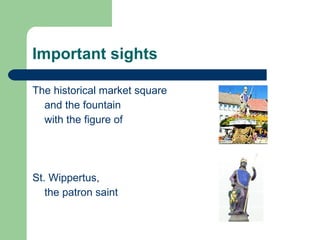
Important sights The historical market square  and the fountain  with the figure of St. Wippertus, the patron saint
The two churches, the Johannes Church and the Wippertus Church The Backleben Gate The town hall
Special features Medicinal and herbal plants have traditionally been grown in and around Kölleda. Kölleda is known as the “Peppermint Town” with the railway as the “Peppermint Line”. It is a venue for old markets and every year in May-June there are different fairs, i.e. the St Wippertus fair.
Economy The industrial park “Kiebitzhöhe”, two kilometres to the west, covers a total area of 62 hectares.   In Kölleda there are 2,600 workplaces. Since 1995 there has been a development of commercial and industrial areas. In the industrial park there are investors from home and foreign countries. In 2001 the Mitsubishi- Daimler-Chrysler Corporation started to build a large engine producing plant, which was opened in 2003.
History
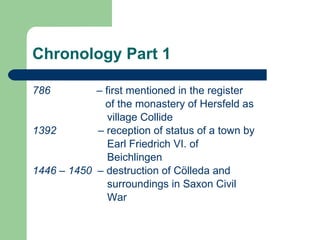
Chronology Part 1 786   –  first   mentioned in the register     of the monastery of Hersfeld as  village Collide 1392  – reception of status of a town by  Earl Friedrich VI. of  Beichlingen 1446  –  1450  – destruction of Cölleda and  surroundings in Saxon Civil War
Chronology Part 2 1641  – hardest year for town Cölleda during 30-Year-War (1618-1648) 1649   – (19 th  April) drawing up of  border after 30-Year-War 1728   – (18 th  June) last execution on the gallows hill 1756 – 1763  –  experience of horrors of the  7-Year-War
Chronology Part 3 1795  -  ( 14 th  August ) destruction of  the biggest part by a huge fire   1815  -  Vienna Congress;    Kölleda became part of Prussia (30 th  April) formation of  district of Eckartsberga 1824   - (October) district town of  Eckartsberga
Chronology Part 4 1857  -  construction of the bank  Sparkasse  1900   - building of gasworks 1908  -  construction of the hospital  1911  -  handing over the children’s home ( today kindergarten )  1944   - hardest air raid on the airfield - no bombs on town
Chronology Part 5 1952  -  (1 st  September) administrative  reform of the GDR  - disintegration of district    Kölleda – town became part of   new district Sömmerda  1958  -  construction of new part in the  east of Kölleda 1986  -  celebration of 1.200 th   anniversary of town
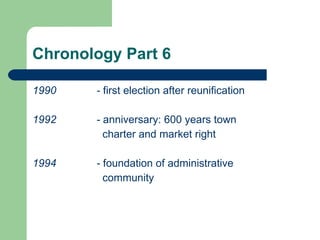
Chronology Part 6 1990  -  first election after reunification 1992  -  anniversary: 600 years town   charter and market right 1994  -  foundation of administrative   community
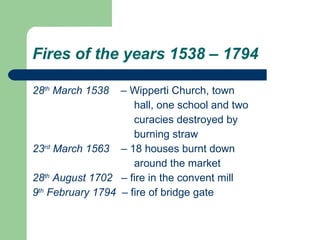
Fires of the years 1538 – 1794   28 th  March 1538  – Wipperti Church, town  hall, one school and two  curacies destroyed by  burning straw 23 rd  March 1563  –  18 houses burnt down around the market 28 th  August 1702  –  fire in the convent mill 9 th  February 1794  –  fire of bridge gate
Famous people in Kölleda   Prof. Dr. Fritz Hofmann (1866-1956) is the inventor of synthetic rubber. The grammar school is named after him.   Eugen Richter (1838-1906) lived as a civil democrat parliamentary representative.
Albert Träger, a poet and parliamentary representative lived and worked as a notary in Kölleda   from 1862 to 1875.   Friedrich Ludwig Jahn   (1778-1852) is the founder of German gymnastics and fighter   for German unity. A street and   one school is named after him.
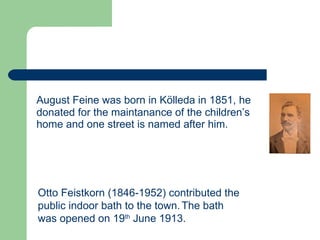
August Feine was born in Kölleda in 1851, he donated for the maintanance of the children’s home and one street is named after him.   Otto Feistkorn (1846-1952) contributed the public indoor bath to the town.   The bath was opened on 19 th  June 1913.
The brothers Karl and Fritz Feistkorn founded the children’s home and donated heating of the church to the Wipperti Church.   Karl Feistkorn (1850-1923) donated a church clock to the Johannis Church.
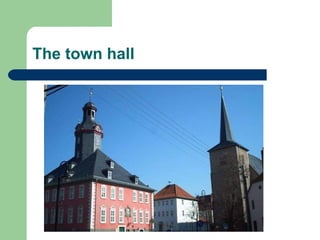
Historical Buildings   Das Rathaus (the Town Hall) The town hall was built in 1701 and is the 3rd building. The first and second one burned down.  In 1770 the town hall was used as a dwelling.  It was not destroyed in the big fire in Kölleda in 1795. In the next years the building was  restored several times.  In 2002 the town hall had its 300th jubilee.
The town hall
Das “Backlebener Tor”(The Gate of Backleben) The “Backleben Gate” was built in 1538 as one of the five town gates. But it is the only one that was restored. The other town gates, called “Johannestor”, “Brückentor”, “Weimarsches Tor” and “Klostertor”, were destroyed. There is a permanent exhibition open to visitors every Saturday  from 1 o’ clock to 5 o’clock. In the exhibition called “Gegen das Vergessen” relics of the two world wars, i.e. war equipment, guns, findings of bombs and aircrafts, are displayed.
The Gate of Backleben
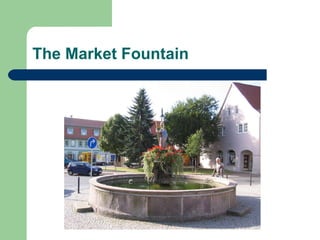
Der Marktbrunnen (The Market Fountain) Its building is dated back to the year 1584 and holds the only “Wigbert” monument in Germany. The water comes from the “Backleben” spring, the oldest water pipeline in Kölleda. Earlier, the water was necessary for brewery. Today the spring is a distinctive sign of the town.
The Market Fountain
Das Schützenhaus (The House of the Shooters) In the year 1800, the shooting club laid the foundation for the first ”Schützenhaus”. One year later the simple half-timbered house was finished. It was closed by the police in 1830, because it was dilapidated. In 1837, due to damage, the house was reconstructed.
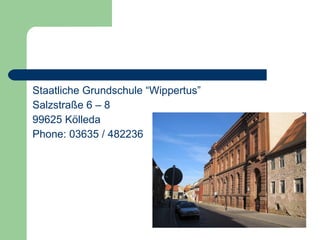
Das Kreishaus (The House of the District) The “Kreishaus” was constructed in 1879. Later it was used as a bank and a school. Today it is the primary school- “Wippertus Schule”.
Das Kinderheim (Children’s Home) The foundation of the brothers Karl and Fritz Feistkorn was established in 1911. They were born in Kölleda and spent their childhood there. It used to be a nursery- school and now it is a kindergarten.
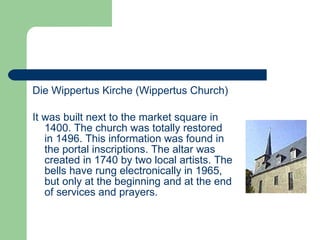
Die Wippertus Kirche (Wippertus Church) It was built next to the market square in 1400. The church was totally restored in 1496. This information was found in the portal inscriptions. The altar was created in 1740 by two local artists.  The bells have rung electronically in 1965, but only at the beginning and at the end of services and prayers.
Die Johannes Kirche (Johannes Church) The middle part of the church, once a monastery, was built at the same time as the monastery. The side parts were added in 1266 and destroyed during the Reformation. The tower was erected in 1462. But the church has never gained the same importance as the Wippertus Church. The Johannes Church has belonged to the Catholic Church since 1964.
Das Heimatmuseum  (Museum of Native Country) There you can find information about the traditional agriculture, manual work, plants and animals from the Stone Age until the present. In this great building once lived famous people of German history. The building had different functions – the poet Albert Träger lived there, later it was used as the printers of the family Böhme. Theodor Böhme contributed the house as a present to the town of Kölleda. Later it was used as the town’s archive, then as a museum. Today plenty of information about the town and its surroundings are displayed.  Since 1991 there has been a historical garden with herbal beds, different fruit trees, historical roses and peppermint.
Museum of Native Country
Die Bibliothek (The library) In 1913 the ”Stadtbad”(public bath) was founded by the “Otto Feistkorn foundation”. It was used as a bath and laundry, later as a living room and in 1992 as the town’s archive and library.  The library contains more than 22,500 media (books, magazines, DVDs, CDs, videos) and it is used for puppet shows, cabaret and authors read out their stories there. In the town archive you can find documents that go back to 1404.
The library
Das Funkwerkmuseum (Museum of the “Funkwerk”-factory) In 1735 there was a fire in this building and eight years later it was rebuilt. Until 1947 it was used as a vocational school and in the 80s it was restored. Since 2000 it has been the “Funkwerk Museum”. The museum shows the development of typewriters and telegraphic technology displaying gadgets from the beginning of the production of the “Funkwerk” until today. After the visit of the museum you can go into the “Internet – cafe”, which is part of it.
Museum of the “Funkwerk”-factory
Events Throughout the year several cultural events take place, i.e. the Pigeons’ Market and the Carnival Session with the Parade every year in February. At the “Pigeons’Market” breeders offer and sell all sorts of small animals, i.e. pigeons, rabbits, guinea pigs and ducks.  The by far greatest event of the year is the “Wippertus Fest”, lasting four days, starting on Ascension Day. A historical market, bustles, shows, concerts and dances invite visitors as well as locals to enjoy the cultural life of the town. One of the highlights is the coronation of the Peppermint Princess.
There are also some reading evenings for all age groups.  Moreover one can listen to the many choir and church concerts, among these national, international but also local artists.  A great opportunity to get out and spend time with the family and the community is the May shooting.
Peppermint-Town
Peppermint Princess The coronation of the peppermint Princess has been a tradition since 1999. She is elected for one year at the opening of the Wippertusfest (festival of the town) in May every year. It must be a maid of the town, who is to represent her hometown at public events in and outside Kölleda. Taking up this position is a big honour. Anita  I .  in the museum of local history in Kölleda  Source: TA, 6 th  Sep 2004
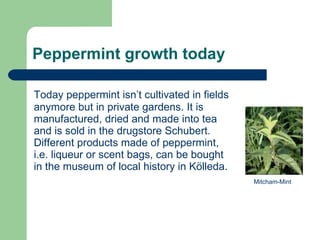
Peppermint growth today   Today peppermint isn’t cultivated in fields anymore but in private gardens. It is manufactured, dried and made into tea and is sold in the drugstore Schubert. Different products made of peppermint, i.e. liqueur or scent bags, can be bought in the museum of local history in Kölleda. Mitcham-Mint
History of the peppermint Perhaps the peppermint has already spread it’s scent in the garden of the monastery near the little stream called Frauenbach, when the nuns in the Benedict Abbey used it as a remedy to heal illnesses in the 13 th  century.
History of the peppermint   1750 1815 1817 1827 1828 1838 / 39 1874 1904 1914 1917
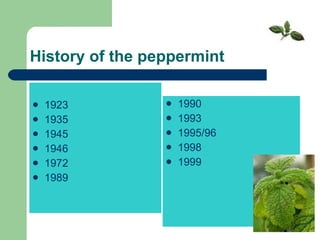
History of the peppermint 1923 1935 1945 1946 1972 1989 1990 1993 1995 / 96 1998 1999
1750 1         tries of cultivation of peppermint in  Großneuhausen, a village near  Kölleda for the first time
1815 - cultivation in the fields
1817      - beginning of cultivation in   Kölleda - peppermint is coloured bright green  with mild aroma
1827 - making the land fertile - growth of peppermint by poor people  and  families with many children   
1828        - cultivation with herbs on an area of 17,5ha
1838/39 - production of peppermint oil in 10 to 12 different distilleries
1874         - opening of the railroad Peppermint Train
1904 - cultivation of Mitcham-Mint (black mint) until today
1914 - trade with peppermint oil decreases because of bad quality - beginning of First World War  -  seizure of copper kettle from the  distilleries -  Production stop  
1917    -  bad harvest  - demandincrease because of the War   
1923         -  20 ha of peppermint
family Müller processes peppermint in the 30s
1935        -  reception of national acknowledgement because of best quality Peppermint
1945         -  Cultivation of medical herbs declines after Second World War
1946 -promotion of cultivation of medical herbs by supporting it financially by Sovjets
1972 -different sorts of peppermint with more oil content, more resistant and  better in growth  (green ukrain mint &   multi menta)
1989 -30 ha peppermint
1990 -after reunification the growth  reduces because to much storage   price reduction
1993 -decreasing to 18 ha between Kölleda  and Großneuhausen
1995/96 -  cultivation area amount to 63 ha
1998 - 30 ha peppermint - most harvest goes to Spain for oil  extraction
1999 - appearance in the “Guinness book of  the records” with the biggest  tea- bag of the world Culture
Education
Education On the following pages you find an introduction of important buildings and institutions in Kölleda. At first you get information about the two kindergartens named “ Feistkorn Kindergarten ” and “ Frieden Kindergarten ”. The next part is about the elementary school of Kölleda which is called “ Wippertus elementary school”. After that the grammar school “ Prof. Fritz Hofmann” and in German the so called “ Regelschule Friedrich Ludwig Jahn “ are introduced.
The kindergarten "Frieden" Education is for respect and the dignity of the human and for the probation of the nature. The aim of the old-fair promotion is to develop imagination and creativity. They want to stimulate the mental and physical development and this is for free unfold  of the personality of the children. Social learning is for themselves and for being in a community. The children receive an education of fair-behaviour which is independent of sex, nationality and origin.
The kindergarten is placed in the populated area of Wilhelm-Pieck-Ring which was established in the time from 1955 to 1985. The distance to the city centre is only 500 meters. In 1991 the kindergarten “Frieden” appeared out of the kindergarten for little ones and the enterprise kindergarten of the “VEB  Funkwerk Kölleda“. The kindergarten consists of two buildings.
Building I : In this house there are five groups with the following names and compositions.  There are the dwarfs’ group, flower children’s group, sun children’s group, butterfly’s group and beetle’s group. In this house there are a group space, a sleeping room, two bathrooms, a office, a children library, a kitchen, wardrobes, a creative space and some basement rooms.
The garden space is surrounded by some little trees. Gigantic slides, several game combinations and various possibilities for active movement offer a  sand box and showers in the summer are for the children’s outside. The meals can be taken on a terrace. The kitchen tract serves the preparations of parties, lunch issue and the supply of the beverages. Lunch is provided daily by the catering service Rastenberg.
Building II : In this house there are four mixed groups. The open garden is connected with the house I by a garden gate. The children have enough game devices to climb, to play football and to drive with the scooter.
Organisation: The parents can choose a half day care or a whole day care for their children. The daily routine is organized by playing games and the children have the chance to learn simple things. 15 qualified assistants take care of the children. The assistants want to make every day a special day and so they arrange celebrations like the “ spring celebration ” and the “ Easter celebration ”.
Kindertagesstätte "Frieden" Wilhelm-Pieck-Ring 32 99625 Kölleda Phone: 03635/483339
Kindergarten "Feistkorn" The kindergarten was built in 1910. One year  later the kindergarten was handed over to the town of Kölleda. It was built by the brothers Feistkorn. Now there are 80 children in 4 groups. They are educated by 8 nursery school teachers, who are well-trained. The groups are mixed of age and gender and the kids are two and a half till six years old. In the Feistkorn kindergarten they have an educational conception: From the first day on the children are prepared for elementary school.
The town of Kölleda is the provider of this institution. The teachers work together with parents in the parents council. Every month there is one highlight, e.g. Halloween, Christmas week, Advents time, farm party, final trip to Beichlingen for the kids who start school, Mother day programme, looking for Easter eggs, visiting the fire brigade and the library (with lecture), children’s day week, "sugar cone festival" and spring festival.
Kindertagesstätte  "Feistkornstiftung" Feistkornstraße 1 99625 Kölleda Phone: 03635/483247
Elementary School "Wippertus" Since the 14th August 1996 the school is called "Wippertus Elementary School". 19 teachers and about 250 pupils work and  learn there. The pupils are at the age of 6 till 10. An after-school care centre provides  leisure activities like sport, choir, handicraft or  working in the school’s garden. From year 3  on pupils are taught in English.
Staatliche Grundschule “Wippertus” Salzstraße 6 – 8 99625 Kölleda Phone: 03635 / 482236
Secondary School  "Friedrich Ludwig Jahn" In 1952 the school was founded. Since 1991 the school is called “Regelschule Friedrich Ludwig Jahn” .In the school there are students from the 5th to the 10th grade. They can choose in  the 7th grade  if they want to attend nine or ten years of school. Due to their decision they will be separated. If they go nine years to school they will get the so called “Hauptschulabschluss” and if they go ten years to school they receive the so called “Realschulabschluss”. The school consists of one big main building and a gym. Around these buildings there is a yard. In the afternoon the students get the chance to do activities, for example to play basketball, handball, dancing etc.
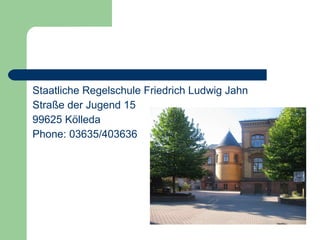
Staatliche Regelschule Friedrich Ludwig Jahn Straße der Jugend 15  99625 Kölleda Phone: 03635/403636
Grammar School  "Prof. Fritz Hofmann"   The school was founded in August 1991 and is called “Prof. Fritz Hofmann“. Fritz Hofmann was a chemist and the inventor of the synthetic rubber and lived in Kölleda. Today 476 pupils attend this school. At the moment there are 15 classes and 7 courses. More than 46 teachers work at this school. All in all the pupils come from over 40 places. The grammar school begins at the 5th form and ends at the 12th form. In grade 10 there is an examination for all pupils. At school there are a lot of after school activities, for example: choir, theatre, computer, plant spiral, pond, soccer, volleyball, table tennis, ballet, museum, sewing and handicraft, first aid and creative writing.
The director of this school is Mrs. Herma Placzko.  Pupils can change to this school after the 4th grade, the 5th grade, the 6th grade and after the 10th grade. In the brakes the students can play basketball or tabletennis or sit down and talk. In the 1st brake, which is for breakfast, the pupils can buy their food in the canteen. They can drink coffee or tea and eat their  sandwiches.  One day in the year there is a so called “Tag der offenen Tür“ in the grammar school, interested parents and pupils can visit the school. They can look at the different rooms, talk to the teachers and can get information about the school.
Staatl. Gymnasium „Prof. Fritz Hofmann“ Kölleda  Langer Weg 165 99625 Kölleda Phone: 03635/479043
Economy
Economy Agriculture Electronical   Industry   Enterprises  on different  industrial sectors  General facts about economy in Kölleda
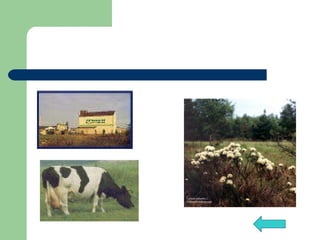
Agriculture For more than 600 years Kölleda is known as the “Peppermint Town“. Today also flavour-, fragrance-, and medical plants are planted. Likewise wheat ,original Thuringia marjoram, barley, flower seed ,rape and flax are grown here. For all these plants Kölleda has got an agricultural productive land of over 2,100 ha. Kölleda is well-known for its Thuringian meat and sausage specialities all over the world. The reason for this is the traditional breeding of pigs and cattle.   pictures
 
Electronical Industry   The firm “Logatec ”: “ Logatec” corporation is a famous enterprise in Kölleda, which works in the sectors of IT-Technology , CNC-Technology, and Building-Technology. The corporation was founded in 1993 in the industrial park of Kölleda. Since the founding, the enterprise has been expanding more and more. In 1997 they started constructing computers for “MEDION”. “Logatec” is known for high quality products, too, all over the world, because of their well educated workers   pictures www . logatec . com
 
Enterprises on different industrial sectors   Mitsubishi Daimler Chrysler (MDC) Power: The most important metal-processing industry in Kölleda is the” MDC Power” . The engine plant was built from January 2002 to December 2003. MDC has chosen Kölleda out of 49 possible locations .The Owners of the engine plant are Mitsubishi Motors and Daimler Chrysler Corporation. There have been created 500 new jobs in Kölleda by MDC. These workers produce 3- and 4-Cylinder fuel-engines for the cars “smart forfour” and “Mitsubishi Colt”. pictures contact
 
Contact: MDC Power GmbH Rudolf-Caracciola-Straße 1 99625 Kölleda  Phone : +49-(0) 3635-601-0 E-Mail:  info @ mdc -power. com
You can also find a lot of firms in other industrial sectors of Kölleda. To mention just a few: Craft   Building   trade
Craft        - baker’s shop “Triebel” - master painter “Schöps” - master smith “Pohlmann”
Building trade   - building-and-excavator-firm “Lars Smolarski” -“Wippertusbau” Corporation
General facts about economy in Kölleda   Electronical industry and metal-processing industry were expanding in the last years. In this industrial sector many jobs have been created since 1995 in the industrial park of Kölleda. Also companies of the the food industry were successfully settled here.  There are 2,600 jobs in Kölleda and about 1,600 employees from the region near Kölleda daily work in these jobs. In the last years Kölleda became an international and important industrial place in Thuringia. The companies in Kölleda have already trade relations with more than 70 countries all over the world.     pictures
Industrial park
Infrastructure   Position of Kölleda Kölleda lies in the county of Sömmerda in the Free State of Thuringia. The town is situated geographically in the middle of Germany.   Road system  In the town Kölleda there are two federal highways (B85, B176). The motorway A71 near Sömmerda has existed since 2003.  
Railway Tourists can reach Kölleda from Erfurt via Sömmerda by a regional railway line. It takes about an hour.  There is a special train from Straußfurt via Kölleda to Großheringen, which is called “Peppermint Train”.
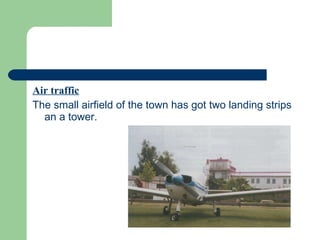
Air traffic The small airfield of the town has got two landing strips an a tower.
Distances to important cities Erfurt: via A71 circa 30km (20 min.) Weimar:  via B85 circa 30km (20 min.) Sömmerda: via B176 circa 10 km (15 min.)
Logatec The Logatec Company is situated in the heart of Thuringia and has its offices in the industrial area on the western periphery of the city of Kölleda.  Kölleda lies at the intersection of the federal highways, B 85 and B 176,  and is located just 10 km from the county town, Sömmerda. Logatec is ca. 30 km away from the state capital Erfurt and from Weimar. There is a direct highway connection from Erfurt. And there will be a connection from Nuremberg via Erfurt to Magdeburg when the highway A71 is finished.
In the company “Logatec” you can do a theoretical and a practical professional training. The IT-area is divided into different jobs: - system electronics engineer - specialized information scientist - tools mechanic
There are some re-educations to: - office administrator - lathe operator - milling cutter - brick-layer
production facility 1.200 m², construction period 72 days
production facility 9.200 m², construction period 102 days
Company Principles Logatec declares that its top priority is being an expert, competent and  efficient partner to its customers who fulfills its contracts by meeting all quality demands on time. Our product quality is ensured by the work of all employees and defined by their success-oriented motivation.  We promote creative cooperation by providing an excellent working  environment.
We secure the adjustment to market demands with our company's traditionally  favourable business location. Environmentally sound processes and the widespread return of materials are our contribution to environmental protection.  The company management takes on a role model function; they promote and develop quality awareness equally along with cost awareness. This quality policy is upheld by all company workers and put into practice  in their daily work.
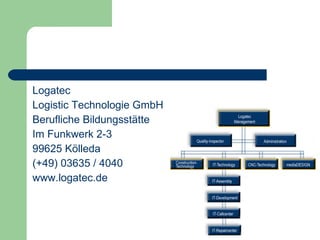
Logatec Logistic Technologie GmbH Berufliche Bildungsstätte Im Funkwerk 2-3 99625 Kölleda (+49) 03635 / 4040 www.logatec.de

Kölleda

  • 1.
    The Peppermint-Town Invites to V isit
  • 2.
  • 3.
  • 4.
    General Facts Kölleda,with a population of ca. 6.000, covers a total area of 3,023 hectares (including outlying parts). (6,530 people in 1994) . Its first documentary record was in the real estate book of Hersfeld monastery dated back to the year 786.
  • 5.
    Local functions Kölleda is one of the smaller centres in the district from where the villages of Großneuhausen, Kleineuhausen, Großmonra, Burgwenden, Beichlingen, Altenbeichlingen, Dermsdorf, Schillingstedt, Ostramondra, Backleben and Kiebitzhöhe are administered.
  • 6.
    About 270 firmsare based there (including 63 craft enterprises). Kölleda has the following social infrastructure facilities: primary school, secondary school, grammar school, hospital, nursing home, nurseries, youth club, sport facilities, bowling alley, community centre, airfield for sporting craft and an outdoor swimming pool.
  • 7.
    Traffic links An airfield offers charter flights to all German airports for craft with a maximum take – off weight of 5.7 tonnes.
  • 8.
    Kölleda is locatedat the federal highways B85 and B176. The town has a passenger and a freight station on the Straußfurt – Großheringen branch line. The construction of the motorway A71, 8 km away from Kölleda, provides for a fast and convenient transport of people and goods.
  • 9.
  • 10.
    Important sights Thehistorical market square and the fountain with the figure of St. Wippertus, the patron saint
  • 11.
    The two churches,the Johannes Church and the Wippertus Church The Backleben Gate The town hall
  • 12.
    Special features Medicinaland herbal plants have traditionally been grown in and around Kölleda. Kölleda is known as the “Peppermint Town” with the railway as the “Peppermint Line”. It is a venue for old markets and every year in May-June there are different fairs, i.e. the St Wippertus fair.
  • 13.
    Economy The industrialpark “Kiebitzhöhe”, two kilometres to the west, covers a total area of 62 hectares. In Kölleda there are 2,600 workplaces. Since 1995 there has been a development of commercial and industrial areas. In the industrial park there are investors from home and foreign countries. In 2001 the Mitsubishi- Daimler-Chrysler Corporation started to build a large engine producing plant, which was opened in 2003.
  • 14.
  • 15.
    Chronology Part 1786 – first mentioned in the register of the monastery of Hersfeld as village Collide 1392 – reception of status of a town by Earl Friedrich VI. of Beichlingen 1446 – 1450 – destruction of Cölleda and surroundings in Saxon Civil War
  • 16.
    Chronology Part 21641 – hardest year for town Cölleda during 30-Year-War (1618-1648) 1649 – (19 th April) drawing up of border after 30-Year-War 1728 – (18 th June) last execution on the gallows hill 1756 – 1763 – experience of horrors of the 7-Year-War
  • 17.
    Chronology Part 31795 - ( 14 th August ) destruction of the biggest part by a huge fire   1815 - Vienna Congress; Kölleda became part of Prussia (30 th April) formation of district of Eckartsberga 1824 - (October) district town of Eckartsberga
  • 18.
    Chronology Part 41857 - construction of the bank Sparkasse 1900 - building of gasworks 1908 - construction of the hospital 1911 - handing over the children’s home ( today kindergarten ) 1944 - hardest air raid on the airfield - no bombs on town
  • 19.
    Chronology Part 51952 - (1 st September) administrative reform of the GDR - disintegration of district Kölleda – town became part of new district Sömmerda 1958 - construction of new part in the east of Kölleda 1986 - celebration of 1.200 th anniversary of town
  • 20.
    Chronology Part 61990 - first election after reunification 1992 - anniversary: 600 years town charter and market right 1994 - foundation of administrative community
  • 21.
    Fires of theyears 1538 – 1794 28 th March 1538 – Wipperti Church, town hall, one school and two curacies destroyed by burning straw 23 rd March 1563 – 18 houses burnt down around the market 28 th August 1702 – fire in the convent mill 9 th February 1794 – fire of bridge gate
  • 22.
    Famous people inKölleda Prof. Dr. Fritz Hofmann (1866-1956) is the inventor of synthetic rubber. The grammar school is named after him. Eugen Richter (1838-1906) lived as a civil democrat parliamentary representative.
  • 23.
    Albert Träger, apoet and parliamentary representative lived and worked as a notary in Kölleda from 1862 to 1875. Friedrich Ludwig Jahn (1778-1852) is the founder of German gymnastics and fighter for German unity. A street and one school is named after him.
  • 24.
    August Feine wasborn in Kölleda in 1851, he donated for the maintanance of the children’s home and one street is named after him. Otto Feistkorn (1846-1952) contributed the public indoor bath to the town. The bath was opened on 19 th June 1913.
  • 25.
    The brothers Karland Fritz Feistkorn founded the children’s home and donated heating of the church to the Wipperti Church. Karl Feistkorn (1850-1923) donated a church clock to the Johannis Church.
  • 26.
    Historical Buildings Das Rathaus (the Town Hall) The town hall was built in 1701 and is the 3rd building. The first and second one burned down. In 1770 the town hall was used as a dwelling. It was not destroyed in the big fire in Kölleda in 1795. In the next years the building was restored several times. In 2002 the town hall had its 300th jubilee.
  • 27.
  • 28.
    Das “Backlebener Tor”(TheGate of Backleben) The “Backleben Gate” was built in 1538 as one of the five town gates. But it is the only one that was restored. The other town gates, called “Johannestor”, “Brückentor”, “Weimarsches Tor” and “Klostertor”, were destroyed. There is a permanent exhibition open to visitors every Saturday from 1 o’ clock to 5 o’clock. In the exhibition called “Gegen das Vergessen” relics of the two world wars, i.e. war equipment, guns, findings of bombs and aircrafts, are displayed.
  • 29.
    The Gate ofBackleben
  • 30.
    Der Marktbrunnen (TheMarket Fountain) Its building is dated back to the year 1584 and holds the only “Wigbert” monument in Germany. The water comes from the “Backleben” spring, the oldest water pipeline in Kölleda. Earlier, the water was necessary for brewery. Today the spring is a distinctive sign of the town.
  • 31.
  • 32.
    Das Schützenhaus (TheHouse of the Shooters) In the year 1800, the shooting club laid the foundation for the first ”Schützenhaus”. One year later the simple half-timbered house was finished. It was closed by the police in 1830, because it was dilapidated. In 1837, due to damage, the house was reconstructed.
  • 33.
    Das Kreishaus (TheHouse of the District) The “Kreishaus” was constructed in 1879. Later it was used as a bank and a school. Today it is the primary school- “Wippertus Schule”.
  • 34.
    Das Kinderheim (Children’sHome) The foundation of the brothers Karl and Fritz Feistkorn was established in 1911. They were born in Kölleda and spent their childhood there. It used to be a nursery- school and now it is a kindergarten.
  • 35.
    Die Wippertus Kirche(Wippertus Church) It was built next to the market square in 1400. The church was totally restored in 1496. This information was found in the portal inscriptions. The altar was created in 1740 by two local artists. The bells have rung electronically in 1965, but only at the beginning and at the end of services and prayers.
  • 36.
    Die Johannes Kirche(Johannes Church) The middle part of the church, once a monastery, was built at the same time as the monastery. The side parts were added in 1266 and destroyed during the Reformation. The tower was erected in 1462. But the church has never gained the same importance as the Wippertus Church. The Johannes Church has belonged to the Catholic Church since 1964.
  • 37.
    Das Heimatmuseum (Museum of Native Country) There you can find information about the traditional agriculture, manual work, plants and animals from the Stone Age until the present. In this great building once lived famous people of German history. The building had different functions – the poet Albert Träger lived there, later it was used as the printers of the family Böhme. Theodor Böhme contributed the house as a present to the town of Kölleda. Later it was used as the town’s archive, then as a museum. Today plenty of information about the town and its surroundings are displayed. Since 1991 there has been a historical garden with herbal beds, different fruit trees, historical roses and peppermint.
  • 38.
  • 39.
    Die Bibliothek (Thelibrary) In 1913 the ”Stadtbad”(public bath) was founded by the “Otto Feistkorn foundation”. It was used as a bath and laundry, later as a living room and in 1992 as the town’s archive and library. The library contains more than 22,500 media (books, magazines, DVDs, CDs, videos) and it is used for puppet shows, cabaret and authors read out their stories there. In the town archive you can find documents that go back to 1404.
  • 40.
  • 41.
    Das Funkwerkmuseum (Museumof the “Funkwerk”-factory) In 1735 there was a fire in this building and eight years later it was rebuilt. Until 1947 it was used as a vocational school and in the 80s it was restored. Since 2000 it has been the “Funkwerk Museum”. The museum shows the development of typewriters and telegraphic technology displaying gadgets from the beginning of the production of the “Funkwerk” until today. After the visit of the museum you can go into the “Internet – cafe”, which is part of it.
  • 42.
    Museum of the“Funkwerk”-factory
  • 43.
    Events Throughout theyear several cultural events take place, i.e. the Pigeons’ Market and the Carnival Session with the Parade every year in February. At the “Pigeons’Market” breeders offer and sell all sorts of small animals, i.e. pigeons, rabbits, guinea pigs and ducks. The by far greatest event of the year is the “Wippertus Fest”, lasting four days, starting on Ascension Day. A historical market, bustles, shows, concerts and dances invite visitors as well as locals to enjoy the cultural life of the town. One of the highlights is the coronation of the Peppermint Princess.
  • 44.
    There are alsosome reading evenings for all age groups. Moreover one can listen to the many choir and church concerts, among these national, international but also local artists. A great opportunity to get out and spend time with the family and the community is the May shooting.
  • 45.
  • 46.
    Peppermint Princess Thecoronation of the peppermint Princess has been a tradition since 1999. She is elected for one year at the opening of the Wippertusfest (festival of the town) in May every year. It must be a maid of the town, who is to represent her hometown at public events in and outside Kölleda. Taking up this position is a big honour. Anita I . in the museum of local history in Kölleda Source: TA, 6 th Sep 2004
  • 47.
    Peppermint growth today Today peppermint isn’t cultivated in fields anymore but in private gardens. It is manufactured, dried and made into tea and is sold in the drugstore Schubert. Different products made of peppermint, i.e. liqueur or scent bags, can be bought in the museum of local history in Kölleda. Mitcham-Mint
  • 48.
    History of thepeppermint Perhaps the peppermint has already spread it’s scent in the garden of the monastery near the little stream called Frauenbach, when the nuns in the Benedict Abbey used it as a remedy to heal illnesses in the 13 th century.
  • 49.
    History of thepeppermint 1750 1815 1817 1827 1828 1838 / 39 1874 1904 1914 1917
  • 50.
    History of thepeppermint 1923 1935 1945 1946 1972 1989 1990 1993 1995 / 96 1998 1999
  • 51.
    1750 1        tries of cultivation of peppermint in Großneuhausen, a village near Kölleda for the first time
  • 52.
    1815 - cultivationin the fields
  • 53.
    1817     - beginning of cultivation in Kölleda - peppermint is coloured bright green with mild aroma
  • 54.
    1827 - makingthe land fertile - growth of peppermint by poor people and families with many children  
  • 55.
    1828        -cultivation with herbs on an area of 17,5ha
  • 56.
    1838/39 - productionof peppermint oil in 10 to 12 different distilleries
  • 57.
    1874        - opening of the railroad Peppermint Train
  • 58.
    1904 - cultivationof Mitcham-Mint (black mint) until today
  • 59.
    1914 - tradewith peppermint oil decreases because of bad quality - beginning of First World War - seizure of copper kettle from the distilleries - Production stop  
  • 60.
    1917    - bad harvest - demandincrease because of the War  
  • 61.
    1923        - 20 ha of peppermint
  • 62.
    family Müller processespeppermint in the 30s
  • 63.
    1935       - reception of national acknowledgement because of best quality Peppermint
  • 64.
    1945        - Cultivation of medical herbs declines after Second World War
  • 65.
    1946 -promotion ofcultivation of medical herbs by supporting it financially by Sovjets
  • 66.
    1972 -different sortsof peppermint with more oil content, more resistant and better in growth (green ukrain mint & multi menta)
  • 67.
    1989 -30 hapeppermint
  • 68.
    1990 -after reunificationthe growth reduces because to much storage price reduction
  • 69.
    1993 -decreasing to18 ha between Kölleda and Großneuhausen
  • 70.
    1995/96 - cultivation area amount to 63 ha
  • 71.
    1998 - 30ha peppermint - most harvest goes to Spain for oil extraction
  • 72.
    1999 - appearancein the “Guinness book of the records” with the biggest tea- bag of the world Culture
  • 73.
  • 74.
    Education On thefollowing pages you find an introduction of important buildings and institutions in Kölleda. At first you get information about the two kindergartens named “ Feistkorn Kindergarten ” and “ Frieden Kindergarten ”. The next part is about the elementary school of Kölleda which is called “ Wippertus elementary school”. After that the grammar school “ Prof. Fritz Hofmann” and in German the so called “ Regelschule Friedrich Ludwig Jahn “ are introduced.
  • 75.
    The kindergarten "Frieden"Education is for respect and the dignity of the human and for the probation of the nature. The aim of the old-fair promotion is to develop imagination and creativity. They want to stimulate the mental and physical development and this is for free unfold of the personality of the children. Social learning is for themselves and for being in a community. The children receive an education of fair-behaviour which is independent of sex, nationality and origin.
  • 76.
    The kindergarten isplaced in the populated area of Wilhelm-Pieck-Ring which was established in the time from 1955 to 1985. The distance to the city centre is only 500 meters. In 1991 the kindergarten “Frieden” appeared out of the kindergarten for little ones and the enterprise kindergarten of the “VEB Funkwerk Kölleda“. The kindergarten consists of two buildings.
  • 77.
    Building I :In this house there are five groups with the following names and compositions. There are the dwarfs’ group, flower children’s group, sun children’s group, butterfly’s group and beetle’s group. In this house there are a group space, a sleeping room, two bathrooms, a office, a children library, a kitchen, wardrobes, a creative space and some basement rooms.
  • 78.
    The garden spaceis surrounded by some little trees. Gigantic slides, several game combinations and various possibilities for active movement offer a sand box and showers in the summer are for the children’s outside. The meals can be taken on a terrace. The kitchen tract serves the preparations of parties, lunch issue and the supply of the beverages. Lunch is provided daily by the catering service Rastenberg.
  • 79.
    Building II :In this house there are four mixed groups. The open garden is connected with the house I by a garden gate. The children have enough game devices to climb, to play football and to drive with the scooter.
  • 80.
    Organisation: The parentscan choose a half day care or a whole day care for their children. The daily routine is organized by playing games and the children have the chance to learn simple things. 15 qualified assistants take care of the children. The assistants want to make every day a special day and so they arrange celebrations like the “ spring celebration ” and the “ Easter celebration ”.
  • 81.
    Kindertagesstätte "Frieden" Wilhelm-Pieck-Ring32 99625 Kölleda Phone: 03635/483339
  • 82.
    Kindergarten "Feistkorn" Thekindergarten was built in 1910. One year later the kindergarten was handed over to the town of Kölleda. It was built by the brothers Feistkorn. Now there are 80 children in 4 groups. They are educated by 8 nursery school teachers, who are well-trained. The groups are mixed of age and gender and the kids are two and a half till six years old. In the Feistkorn kindergarten they have an educational conception: From the first day on the children are prepared for elementary school.
  • 83.
    The town ofKölleda is the provider of this institution. The teachers work together with parents in the parents council. Every month there is one highlight, e.g. Halloween, Christmas week, Advents time, farm party, final trip to Beichlingen for the kids who start school, Mother day programme, looking for Easter eggs, visiting the fire brigade and the library (with lecture), children’s day week, "sugar cone festival" and spring festival.
  • 84.
    Kindertagesstätte "Feistkornstiftung"Feistkornstraße 1 99625 Kölleda Phone: 03635/483247
  • 85.
    Elementary School "Wippertus"Since the 14th August 1996 the school is called "Wippertus Elementary School". 19 teachers and about 250 pupils work and learn there. The pupils are at the age of 6 till 10. An after-school care centre provides leisure activities like sport, choir, handicraft or working in the school’s garden. From year 3 on pupils are taught in English.
  • 86.
    Staatliche Grundschule “Wippertus”Salzstraße 6 – 8 99625 Kölleda Phone: 03635 / 482236
  • 87.
    Secondary School "Friedrich Ludwig Jahn" In 1952 the school was founded. Since 1991 the school is called “Regelschule Friedrich Ludwig Jahn” .In the school there are students from the 5th to the 10th grade. They can choose in the 7th grade if they want to attend nine or ten years of school. Due to their decision they will be separated. If they go nine years to school they will get the so called “Hauptschulabschluss” and if they go ten years to school they receive the so called “Realschulabschluss”. The school consists of one big main building and a gym. Around these buildings there is a yard. In the afternoon the students get the chance to do activities, for example to play basketball, handball, dancing etc.
  • 88.
    Staatliche Regelschule FriedrichLudwig Jahn Straße der Jugend 15 99625 Kölleda Phone: 03635/403636
  • 89.
    Grammar School "Prof. Fritz Hofmann" The school was founded in August 1991 and is called “Prof. Fritz Hofmann“. Fritz Hofmann was a chemist and the inventor of the synthetic rubber and lived in Kölleda. Today 476 pupils attend this school. At the moment there are 15 classes and 7 courses. More than 46 teachers work at this school. All in all the pupils come from over 40 places. The grammar school begins at the 5th form and ends at the 12th form. In grade 10 there is an examination for all pupils. At school there are a lot of after school activities, for example: choir, theatre, computer, plant spiral, pond, soccer, volleyball, table tennis, ballet, museum, sewing and handicraft, first aid and creative writing.
  • 90.
    The director ofthis school is Mrs. Herma Placzko. Pupils can change to this school after the 4th grade, the 5th grade, the 6th grade and after the 10th grade. In the brakes the students can play basketball or tabletennis or sit down and talk. In the 1st brake, which is for breakfast, the pupils can buy their food in the canteen. They can drink coffee or tea and eat their sandwiches. One day in the year there is a so called “Tag der offenen Tür“ in the grammar school, interested parents and pupils can visit the school. They can look at the different rooms, talk to the teachers and can get information about the school.
  • 91.
    Staatl. Gymnasium „Prof.Fritz Hofmann“ Kölleda Langer Weg 165 99625 Kölleda Phone: 03635/479043
  • 92.
  • 93.
    Economy Agriculture Electronical Industry Enterprises on different industrial sectors General facts about economy in Kölleda
  • 94.
    Agriculture For morethan 600 years Kölleda is known as the “Peppermint Town“. Today also flavour-, fragrance-, and medical plants are planted. Likewise wheat ,original Thuringia marjoram, barley, flower seed ,rape and flax are grown here. For all these plants Kölleda has got an agricultural productive land of over 2,100 ha. Kölleda is well-known for its Thuringian meat and sausage specialities all over the world. The reason for this is the traditional breeding of pigs and cattle. pictures
  • 95.
  • 96.
    Electronical Industry The firm “Logatec ”: “ Logatec” corporation is a famous enterprise in Kölleda, which works in the sectors of IT-Technology , CNC-Technology, and Building-Technology. The corporation was founded in 1993 in the industrial park of Kölleda. Since the founding, the enterprise has been expanding more and more. In 1997 they started constructing computers for “MEDION”. “Logatec” is known for high quality products, too, all over the world, because of their well educated workers pictures www . logatec . com
  • 97.
  • 98.
    Enterprises on differentindustrial sectors Mitsubishi Daimler Chrysler (MDC) Power: The most important metal-processing industry in Kölleda is the” MDC Power” . The engine plant was built from January 2002 to December 2003. MDC has chosen Kölleda out of 49 possible locations .The Owners of the engine plant are Mitsubishi Motors and Daimler Chrysler Corporation. There have been created 500 new jobs in Kölleda by MDC. These workers produce 3- and 4-Cylinder fuel-engines for the cars “smart forfour” and “Mitsubishi Colt”. pictures contact
  • 99.
  • 100.
    Contact: MDC PowerGmbH Rudolf-Caracciola-Straße 1 99625 Kölleda Phone : +49-(0) 3635-601-0 E-Mail: info @ mdc -power. com
  • 101.
    You can alsofind a lot of firms in other industrial sectors of Kölleda. To mention just a few: Craft Building trade
  • 102.
    Craft       - baker’s shop “Triebel” - master painter “Schöps” - master smith “Pohlmann”
  • 103.
    Building trade - building-and-excavator-firm “Lars Smolarski” -“Wippertusbau” Corporation
  • 104.
    General facts abouteconomy in Kölleda Electronical industry and metal-processing industry were expanding in the last years. In this industrial sector many jobs have been created since 1995 in the industrial park of Kölleda. Also companies of the the food industry were successfully settled here. There are 2,600 jobs in Kölleda and about 1,600 employees from the region near Kölleda daily work in these jobs. In the last years Kölleda became an international and important industrial place in Thuringia. The companies in Kölleda have already trade relations with more than 70 countries all over the world.     pictures
  • 105.
  • 106.
    Infrastructure Position of Kölleda Kölleda lies in the county of Sömmerda in the Free State of Thuringia. The town is situated geographically in the middle of Germany.   Road system In the town Kölleda there are two federal highways (B85, B176). The motorway A71 near Sömmerda has existed since 2003.  
  • 107.
    Railway Tourists canreach Kölleda from Erfurt via Sömmerda by a regional railway line. It takes about an hour. There is a special train from Straußfurt via Kölleda to Großheringen, which is called “Peppermint Train”.
  • 108.
    Air traffic Thesmall airfield of the town has got two landing strips an a tower.
  • 109.
    Distances to importantcities Erfurt: via A71 circa 30km (20 min.) Weimar: via B85 circa 30km (20 min.) Sömmerda: via B176 circa 10 km (15 min.)
  • 110.
    Logatec The LogatecCompany is situated in the heart of Thuringia and has its offices in the industrial area on the western periphery of the city of Kölleda. Kölleda lies at the intersection of the federal highways, B 85 and B 176,  and is located just 10 km from the county town, Sömmerda. Logatec is ca. 30 km away from the state capital Erfurt and from Weimar. There is a direct highway connection from Erfurt. And there will be a connection from Nuremberg via Erfurt to Magdeburg when the highway A71 is finished.
  • 111.
    In the company“Logatec” you can do a theoretical and a practical professional training. The IT-area is divided into different jobs: - system electronics engineer - specialized information scientist - tools mechanic
  • 112.
    There are somere-educations to: - office administrator - lathe operator - milling cutter - brick-layer
  • 113.
    production facility 1.200m², construction period 72 days
  • 114.
    production facility 9.200m², construction period 102 days
  • 115.
    Company Principles Logatecdeclares that its top priority is being an expert, competent and  efficient partner to its customers who fulfills its contracts by meeting all quality demands on time. Our product quality is ensured by the work of all employees and defined by their success-oriented motivation. We promote creative cooperation by providing an excellent working  environment.
  • 116.
    We secure theadjustment to market demands with our company's traditionally  favourable business location. Environmentally sound processes and the widespread return of materials are our contribution to environmental protection. The company management takes on a role model function; they promote and develop quality awareness equally along with cost awareness. This quality policy is upheld by all company workers and put into practice  in their daily work.
  • 117.
    Logatec Logistic TechnologieGmbH Berufliche Bildungsstätte Im Funkwerk 2-3 99625 Kölleda (+49) 03635 / 4040 www.logatec.de