Kleenoil Onboard Oil Recycling Systems
Go GREEN! - Keep it KLEEN!
Kleenoil Bypass Filtration System
We are committed to
helping you reduce
your OTR truck oil
usage up to 80%
Resource Responsibility
Fewer oil changes
and reducing wear in
engines yields
revenue in areas
often overlooked
Economic Profitability
Less consumable oil
used equals a
smaller carbon
footprint and a
cleaner environment
Social Accountability
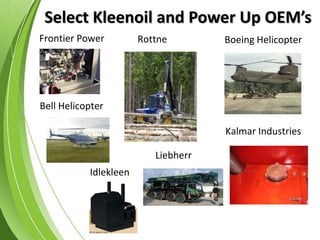
Select Customers
Select Drilling Customers
Bell Helicopter
Boeing Helicopter
Kalmar Industries
Rottne
Frontier Power
Select Kleenoil and Power Up OEM’s
Idlekleen
Liebherr
Kleenoil Bypass Filtration History
Is the Kleenoil Bypass Filter an
established and tested
technology?
How do Kleenoil Bypass Filters differ
from the standard main flow, OEM
Filters?
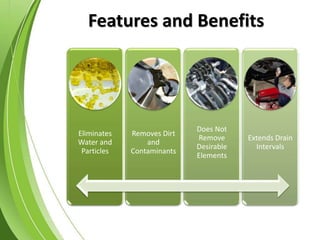
Features and Benefits
Eliminates
Water and
Particles
Removes Dirt
and
Contaminants
Does Not
Remove
Desirable
Elements
Extends Drain
Intervals
Reduces
Time
Needed for
Service
Continuous
Protection
Provided
Good for the
Environment
Features and Benefits
Oil Does Not Wear Out
The U.S. Air Force says; “Despite the
popular notion that oil ‘breaks down’ or
‘wears out’ and is unfit for further use,
it’s permanent value has been well
known to the U.S.A.F. since World War 1"
Standard Oil of New York; “Many times
the question has been asked ‘Does
lubricating oil wear out ?’ The question
should be answered in the negative”.
Mobil Oil Technical Bulletin #863; “Oil does not wear
out, breakdown or otherwise deteriorate to such an
extent that it needs to be changed. It becomes
contaminated with water, acids, carbon particles and
sludge. The engine’s oil filter(s) can only remove solid
particles above a certain size. It (they) cannot remove
water, acids, carbon particles or sludge all of which
pass through the filter(s) just as readily as the oil.
U.S. Standards Bulletin #86; “Oil does
not wear out, but only gets dirty”.
Theory and Practice of Lubrication for Engineers, 2nd
edition, P590 - P591; “Oil is like any mineral and
cannot wear out. Oil can become dirty and
contaminated but, like copper, iron or silver, when
they are reprocessed, they are as good as new.
Studies have shown that oil actually improves
significantly in it’s lubricating qualities as it is exposed
to heat during use in the engine”.
Tribology International, 1991, P329; “New oil
right out of the can is not as pure as one might
think but contains metallic and non metallic
particles in various amounts”.
Fact no. 1; When engine oil is replaced, the new
oil becomes dirty the moment the engine is
started. This is because approximately 18% of
the old oil remains in the engine. The 18% old
oil instantly mixes with the new oil and the
contaminants from the old oil are pumped
through the engine.
Fact no. 2; Test results from engines equipped
with full flow filter elements have shown that
4% of the oil drained from the engines was solid
particles consisting of carbon, dirt and metal
particles.
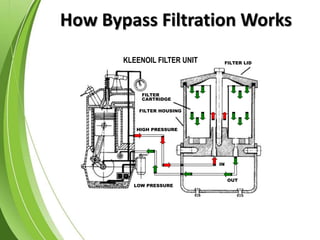
How Bypass Filtration Works
LOW PRESSURE
OUT
IN
HIGH PRESSURE
FILTER HOUSING
FILTER
CARTRIDGE
FILTER LID
KLEENOIL FILTER UNIT
Rethinking Old Practices
• Change Your Thinking, Not Your Oil
• Onboard Oil Recycling Systems
• Kleenoil Invented in the United States
but Marketed in Europe
Will heat cause degradation or “oil breakdown”?
What does the term “Oil breakdown” mean?
Does oil wear out?
How long can oil drain intervals be extended?
Will extending oil drain intervals void engine manufacturers’
warranties?
Extended Drain Intervals
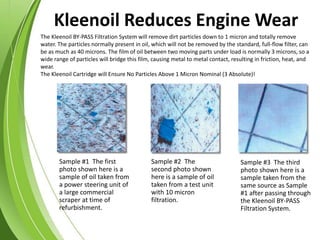
Sample #1 The first
photo shown here is a
sample of oil taken from
a power steering unit of
a large commercial
scraper at time of
refurbishment.
Sample #2 The
second photo shown
here is a sample of oil
taken from a test unit
with 10 micron
filtration.
Sample #3 The third
photo shown here is a
sample taken from the
same source as Sample
#1 after passing through
the Kleenoil BY-PASS
Filtration System.
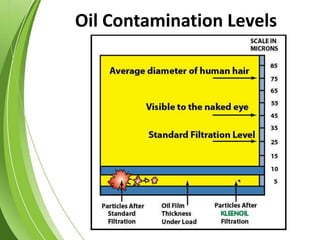
The Kleenoil BY-PASS Filtration System will remove dirt particles down to 1 micron and totally remove
water. The particles normally present in oil, which will not be removed by the standard, full-flow filter, can
be as much as 40 microns. The film of oil between two moving parts under load is normally 3 microns, so a
wide range of particles will bridge this film, causing metal to metal contact, resulting in friction, heat, and
wear.
The Kleenoil Cartridge will Ensure No Particles Above 1 Micron Nominal (3 Absolute)!
Kleenoil Reduces Engine Wear
Oil Contamination Levels
Exactly How Big is 1-Micron?
ISO
CODE
MORE
THAN
UP TO AND
INCLUDING
( Particles per ml of oil )
24 80,000 160,000
23 40,000 80,000
22 20,000 40,000
21 10,000 20,000
20 5,000 10,000
19 2,500 5,000
18 1,300 2,500
17 640 1,300
16 320 640
15 160 320
14 80 160
13 40 80
12 20 40
11 10 20
10 5 10
9 2.5 5
8 1.3 2.5
ISO 4406:1999 Contamination Chart
Table 1
PARTICLES/
ML
ISO
CODE
> 4 microns 9721 20
> 6 microns 1554 18
> 10 microns 558
> 14 microns 189 15
> 21 microns 12
> 35 microns 5
> 70 microns 0
> 100 microns 0
In this example, you can see how the
particles measured at the given micron levels
are assigned the specific code based on
where that value falls in the table. For this
example, the ISO code would be 20/18/15.
This is the cleanliness of brand new oil which
is not very clean!
20 / 18 / 15
4µ 6µ 14µ
Suggested Acceptable
Contamination Codes
ISO CODE > 4 microns > 6 microns > 14 microns Type of System Typical Components
Importance of Oil
Cleanliness for
the Application
23/21/17 40,000 - 80,000 10,000 - 20,000 640 - 1,300
Low pressure systems with
large clearances
Ram pumps Low
20/18/15 5,000 - 10,000 1,300 - 2,500 160 - 320
Typical cleanliness of new oil
(hydraulic or engine) straight
from the manufacturer.
Low pressure heavy industrial
systems or applications where
long-life is not critical
Flow control valves,
Cylinders
Average
19/17/14 2,500 - 5,000 640 - 1,300 80 - 160
General machinery and mobile
systems. Medium pressure,
medium capacity
Gear pumps/motors Important
18/16/13 1,300 - 2,500 320 - 640 40 - 80
World Wide Fuel Charter
cleanliness standard for diesel
fuel delivered from the filling
station nozzle. High quality
reliable systems. General
machine requirements
Injector valve
and high pressure
pumps/motors;
Directional and
pressure control valves
Critical
17/15/12 640 - 1,300 160 - 320 20 - 40
Highly sophisticated systems
and hydrostatic transmissions
Proportional valves Critical
16/14/11 320 - 640 80 - 160 10 - 20
Performance servo and high
Pressure long-life systems e.g.
Aircraft machine tools, etc.
Industrial servovalves Critical
15/13/09 160 - 320 40 - 80 2.5 - 5
Silt sensitive control system
with very high reliability
Laboratory or aerospace
High performance
servovalves
Super critical
NOTE: The three figures of the ISO code numbers represent ISO level contamination grades for particles of >4μm(c), >6μm(c) and
>14μm(c) respectively.
Life Extension of Equipment Components
Component Life Extension AFTER Kleenoil - New Cleanliness Level (ISO CODE)
22/20/17 21/19/16 20/18/15 19/17/14 18/16/13 17/15/12 16/14/11 15/13/10 14/12/9 13/11/8 12/10/7
Component
Life
Extension
BEFORE
Kleenoil
-
Old
Cleanliness
Level
(ISO
CODE)
28/26/23
5 3 7 3.5 9 4 >10 5 >10 6 >10 7.5 >10 9 >10 >10 >10 >10 >10 >10 >10 >10
4 2.5 4.5 3 6 3.5 6.5 4 7.5 5 8.5 6.5 10 7 >10 9 >10 10 >10 >10 >10 >10
27/25/22
4 2.5 5 3 7 3.5 9 4 >10 5 >10 6 >10 7 >10 9 >10 >10 >10 >10 >10 >10
3 2 3.5 2.5 4.5 3 5 3.5 6.5 4 8 5 9 6 10 7.5 >10 9 >10 >10 >10 >10
26/24/21
3 2 4 2.5 6 3 7 4 9 5 >10 6 >10 7 >10 9 >10 10 >10 >10 >10 >10
2.5 1.5 3 2 4 2.5 5 3 6.5 4 7.5 5 9 6 10 7.5 >10 8 >10 10 >10 >10
25/23/20
2 1.5 3 2 4 2.5 5 3 7 3.5 9 4 >10 5 >10 6 >10 8 >10 9 >10 >10
1.7 1.3 2.3 1.5 3 2 3.7 2.5 5 3 6 3.5 7 4 8 5 10 6.5 >10 8.5 >10 10
24/22/19
1.6 1.3 2 1.6 3 2 4 2.5 5 3 7 3.5 8 4 >10 5 >10 6 >10 7 >10 >10
1.4 1.1 1.8 1.3 2.3 1.7 3 2 3.5 2.5 4.5 3 5.5 3.5 7 4 8 5 10 5.5 >10 8.5
23/21/18
1.3 1.2 1.5 1.5 2 1.7 3 2 4 2.5 5 3 7 3.5 9 4 >10 5 >10 7 >10 >10
1.2 1.1 1.5 1.3 1.8 1.4 2.2 1.6 3 2 3.5 2.5 4.5 3 5 3.5 7 4 9 5.5 10 8
22/20/17
1.3 1.2 1.6 1.5 2 1.7 3 2 4 2.5 5 3 7 4 9 4 >10 7 >10 9
1.2 1.05 1.5 1.3 1.8 1.4 2.3 1.7 3 2 3.5 2.5 5 3 5 3.5 8 5.5 10 7
21/19/16
1.3 1.2 1.6 1.5 2 1.7 3 2 4 2.5 5 3 7 4 9 6 >10 8
1.2 1.1 1.5 1.3 1.8 1.5 2.2 1.7 3 2 3.5 2.5 5 3 7 4.5 9 6
20/18/15
1.3 1.2 1.6 1.5 2 1.7 3 2 4 2.5 5 3 7 4.5 >10 6
1.2 1.1 1.5 1.3 1.8 1.5 2.3 1.7 3 2 3.5 2.5 5.5 3.7 8 5
19/17/14
1.3 1.2 1.6 1.5 2 1.7 3 2 4 2.5 6 3 8 5
1.2 1.1 1.5 1.3 1.8 1.5 2.3 1.7 3 2 4 2.5 6 3.5
18/16/13
Hydraulics and
Diesel Engines
Rolling Element
Bearings
1.3 1.2 1.6 1.5 2 1.7 3 2 4 3.5 6 4
1.2 1.1 1.5 1.3 1.8 1.5 2.3 1.7 3.7 3 4.5 3.5
17/15/12
1.3 1.2 1.6 1.5 2 1.7 3 2 4 2.5
1.2 1.1 1.5 1.3 1.8 1.5 2.3 1.8 3 2.2
16/14/11 Journal Bearings
and Turbo
Machinery
Gear Boxes and
Other
1.3 1.3 1.6 1.5 2 1.8 3 2
1.3 1.2 1.5 1.4 1.9 1.5 2.3 1.8
15/13/10
1.4 1.2 1.8 1.5 2.5 1.8
1.2 1.1 1.6 1.3 2 1.6
ISO 4406:1999 Particle Counts
ISO CODE > 4 microns > 6 microns > 14 microns
23 / 21 / 18 40000 - 80000 10000 - 20000 1300 - 2500
23 / 21 / 17 40000 - 80000 10000 - 20000 640 - 1300
23 / 21 / 16 40000 - 80000 10000 - 20000 320 - 640
23 / 21 / 15 40000 - 80000 10000 - 20000 160 - 320
22 / 20 / 17 20000 - 40000 5000 - 10000 640 - 1300
22 / 20 / 16 20000 - 40000 5000 - 10000 320 - 640
22 / 20 / 15 20000 - 40000 5000 - 10000 160 - 320
22 / 20 / 14 20000 - 40000 5000 - 10000 80 - 160
21 / 19 / 16 10000 - 20000 2500 - 5000 320 - 640
21 / 19 / 15 10000 - 20000 2500 - 5000 160 - 320
21 / 19 / 14 10000 - 20000 2500 - 5000 80 - 160
21 / 19 / 13 10000 - 20000 2500 - 5000 40 - 80
20 / 18 / 15 5000 - 10000 1300 - 2500 160 - 320
20 / 18 / 14 5000 - 10000 1300 - 2500 80 - 160
20 / 18 / 13 5000 - 10000 1300 - 2500 40 - 80
20 / 18 / 12 5000 - 10000 1300 - 2500 20 - 40
19 / 17 / 14 2500 - 5000 640 - 1300 80 - 160
19 / 17 / 13 2500 - 5000 640 - 1300 40 - 80
19 / 17 / 12 2500 - 5000 640 - 1300 20 - 40
19 / 17 / 11 2500 - 5000 640 - 1300 10 - 20
18 / 16 / 13 1300 - 2500 320 - 640 40 - 80
18 / 16 / 12 1300 - 2500 320 - 640 20 - 40
18 / 16 / 11 1300 - 2500 320 - 640 10 - 20
18 / 16 / 10 1300 - 2500 320 - 640 5 - 10
17 / 15 / 12 640 - 1300 160 - 320 20 - 40
17 / 15 / 11 640 - 1300 160 - 320 10 - 20
17 / 15 / 10 640 - 1300 160 - 320 5 - 10
16 / 14 / 11 320 - 640 80 - 160 10 - 20
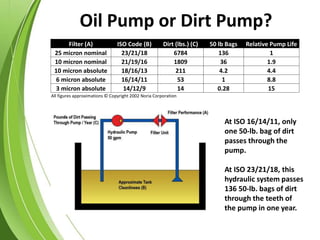
At ISO 16/14/11, only
one 50-lb. bag of dirt
passes through the
pump.
At ISO 23/21/18, this
hydraulic system passes
136 50-lb. bags of dirt
through the teeth of
the pump in one year.
Oil Pump or Dirt Pump?
Filter (A) ISO Code (B) Dirt (lbs.) (C) 50 lb Bags Relative Pump Life
25 micron nominal 23/21/18 6784 136 1
10 micron nominal 21/19/16 1809 36 1.9
10 micron absolute 18/16/13 211 4.2 4.4
6 micron absolute 16/14/11 53 1 8.8
3 micron absolute 14/12/9 14 0.28 15
All figures approximations © Copyright 2002 Noria Corporation
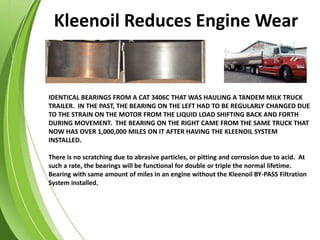
IDENTICAL BEARINGS FROM A CAT 3406C THAT WAS HAULING A TANDEM MILK TRUCK
TRAILER. IN THE PAST, THE BEARING ON THE LEFT HAD TO BE REGULARLY CHANGED DUE
TO THE STRAIN ON THE MOTOR FROM THE LIQUID LOAD SHIFTING BACK AND FORTH
DURING MOVEMENT. THE BEARING ON THE RIGHT CAME FROM THE SAME TRUCK THAT
NOW HAS OVER 1,000,000 MILES ON IT AFTER HAVING THE KLEENOIL SYSTEM
INSTALLED.
There is no scratching due to abrasive particles, or pitting and corrosion due to acid. At
such a rate, the bearings will be functional for double or triple the normal lifetime.
Bearing with same amount of miles in an engine without the Kleenoil BY-PASS Filtration
System installed.
Kleenoil Reduces Engine Wear
For trucks with pan capacities of up to 11 gallons the cost of a Kleenoil
bypass filter is $695.
With immediate savings of around $1,000 per year the cost of the unit
is written off in about six or seven months. Bypass filter cartridge
replacements, changed at the old oil change frequency, will cost around
$33 each. Other units are available for heavy equipment and also for
small trucks.
Kleenoil Provides Immediate
Cost Savings
The Kleenoil bypass filtration system is a major
friend of the environment. It naturally
encourages the conservation of our earth’s
resources. With the current and impending laws
on the use and disposal of oil, Kleenoil offers a
way to protect not only the environment, but
also the user. This is particularly true for
unnecessary consumption and disposal costs.
Is the decision to extend oil drain
intervals a maintenance issue only?
The cost of used oil disposal with less
than 5% water may be 5 -10 cents per
gallon. If it contains more than 5% water,
then the cost can rise to 10 - 25 cents
per gallon. This is 25% of its original
value when new. Projected estimates
suggest that the disposal cost of non
contaminated used oil, could equate to
the value of new oil within the next 2 to
5 years.
What is the cost of disposing of used
oil?
No. Extended oil drain intervals are not
strictly a maintenance concern.
Environmental issues and costs are also
pertinent.
Environmental Concerns
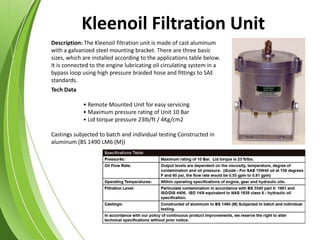
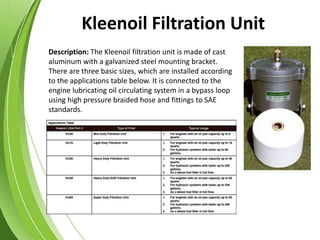
Description: The Kleenoil filtration unit is made of cast aluminum
with a galvanized steel mounting bracket. There are three basic
sizes, which are installed according to the applications table below.
It is connected to the engine lubricating oil circulating system in a
bypass loop using high pressure braided hose and fittings to SAE
standards.
Tech Data
• Remote Mounted Unit for easy servicing
• Maximum pressure rating of Unit 10 Bar
• Lid torque pressure 23lb/ft / 4Kg/cm2
Castings subjected to batch and individual testing Constructed in
aluminum (BS 1490 LM6 (M))
Kleenoil Filtration Unit
Description: The Kleenoil filtration unit is made of cast
aluminum with a galvanized steel mounting bracket.
There are three basic sizes, which are installed according
to the applications table below. It is connected to the
engine lubricating oil circulating system in a bypass loop
using high pressure braided hose and fittings to SAE
standards.
Kleenoil Filtration Unit
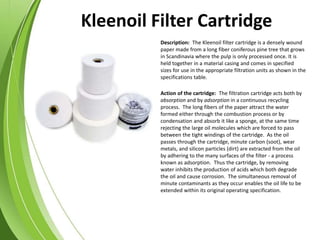
Description: The Kleenoil filter cartridge is a densely wound
paper made from a long fiber coniferous pine tree that grows
in Scandinavia where the pulp is only processed once. It is
held together in a material casing and comes in specified
sizes for use in the appropriate filtration units as shown in the
specifications table.
Action of the cartridge: The filtration cartridge acts both by
absorption and by adsorption in a continuous recycling
process. The long fibers of the paper attract the water
formed either through the combustion process or by
condensation and absorb it like a sponge, at the same time
rejecting the large oil molecules which are forced to pass
between the tight windings of the cartridge. As the oil
passes through the cartridge, minute carbon (soot), wear
metals, and silicon particles (dirt) are extracted from the oil
by adhering to the many surfaces of the filter - a process
known as adsorption. Thus the cartridge, by removing
water inhibits the production of acids which both degrade
the oil and cause corrosion. The simultaneous removal of
minute contaminants as they occur enables the oil life to be
extended within its original operating specification.
Kleenoil Filter Cartridge
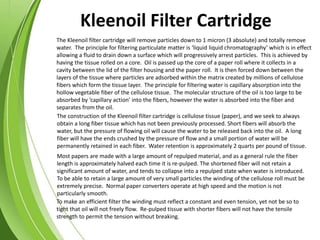
The Kleenoil filter cartridge will remove particles down to 1 micron (3 absolute) and totally remove
water. The principle for filtering particulate matter is ‘liquid liquid chromatography’ which is in effect
allowing a fluid to drain down a surface which will progressively arrest particles. This is achieved by
having the tissue rolled on a core. Oil is passed up the core of a paper roll where it collects in a
cavity between the lid of the filter housing and the paper roll. It is then forced down between the
layers of the tissue where particles are adsorbed within the matrix created by millions of cellulose
fibers which form the tissue layer. The principle for filtering water is capillary absorption into the
hollow vegetable fiber of the cellulose tissue. The molecular structure of the oil is too large to be
absorbed by ‘capillary action’ into the fibers, however the water is absorbed into the fiber and
separates from the oil.
To make an efficient filter the winding must reflect a constant and even tension, yet not be so to
tight that oil will not freely flow. Re-pulped tissue with shorter fibers will not have the tensile
strength to permit the tension without breaking.
Most papers are made with a large amount of repulped material, and as a general rule the fiber
length is approximately halved each time it is re-pulped. The shortened fiber will not retain a
significant amount of water, and tends to collapse into a repulped state when water is introduced.
To be able to retain a large amount of very small particles the winding of the cellulose roll must be
extremely precise. Normal paper converters operate at high speed and the motion is not
particularly smooth.
The construction of the Kleenoil filter cartridge is cellulose tissue (paper), and we seek to always
obtain a long fiber tissue which has not been previously processed. Short fibers will absorb the
water, but the pressure of flowing oil will cause the water to be released back into the oil. A long
fiber will have the ends crushed by the pressure of flow and a small portion of water will be
permanently retained in each fiber. Water retention is approximately 2 quarts per pound of tissue.
Kleenoil Filter Cartridge
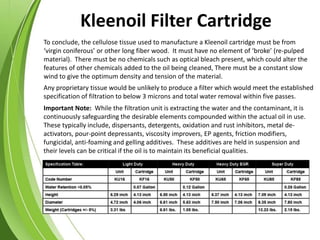
To conclude, the cellulose tissue used to manufacture a Kleenoil cartridge must be from
‘virgin coniferous’ or other long fiber wood. It must have no element of ‘broke’ (re-pulped
material). There must be no chemicals such as optical bleach present, which could alter the
features of other chemicals added to the oil being cleaned, There must be a constant slow
wind to give the optimum density and tension of the material.
Important Note: While the filtration unit is extracting the water and the contaminant, it is
continuously safeguarding the desirable elements compounded within the actual oil in use.
These typically include, dispersants, detergents, oxidation and rust inhibitors, metal de-
activators, pour-point depressants, viscosity improvers, EP agents, friction modifiers,
fungicidal, anti-foaming and gelling additives. These additives are held in suspension and
their levels can be critical if the oil is to maintain its beneficial qualities.
Any proprietary tissue would be unlikely to produce a filter which would meet the established
specification of filtration to below 3 microns and total water removal within five passes.
Kleenoil Filter Cartridge
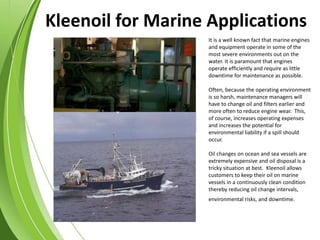
It is a well known fact that marine engines
and equipment operate in some of the
most severe environments out on the
water. It is paramount that engines
operate efficiently and require as little
downtime for maintenance as possible.
Often, because the operating environment
is so harsh, maintenance managers will
have to change oil and filters earlier and
more often to reduce engine wear. This,
of course, increases operating expenses
and increases the potential for
environmental liability if a spill should
occur.
Oil changes on ocean and sea vessels are
extremely expensive and oil disposal is a
tricky situation at best. Kleenoil allows
customers to keep their oil on marine
vessels in a continuously clean condition
thereby reducing oil change intervals,
environmental risks, and downtime.
Kleenoil for Marine Applications
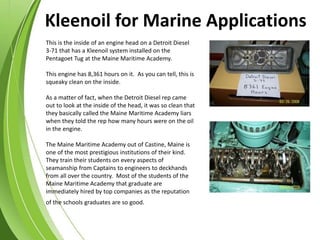
This is the inside of an engine head on a Detroit Diesel
3-71 that has a Kleenoil system installed on the
Pentagoet Tug at the Maine Maritime Academy.
This engine has 8,361 hours on it. As you can tell, this is
squeaky clean on the inside.
As a matter of fact, when the Detroit Diesel rep came
out to look at the inside of the head, it was so clean that
they basically called the Maine Maritime Academy liars
when they told the rep how many hours were on the oil
in the engine.
The Maine Maritime Academy out of Castine, Maine is
one of the most prestigious institutions of their kind.
They train their students on every aspects of
seamanship from Captains to engineers to deckhands
from all over the country. Most of the students of the
Maine Maritime Academy that graduate are
immediately hired by top companies as the reputation
of the schools graduates are so good.
Kleenoil for Marine Applications
Dipstick of an oil sample taken from a Detroit Diesel on the Pentagoet Tug with 8163 engine hours on it
looking crystal clear! They were using Mobil Delvac 50 that they monitored every 200 engine hours and
changed once a year! The particulate was lower on this sample than it was on brand new oil and this has
8163 hours on it.
Before installing Kleenoil on the Pentagoet Tug, they were
doing 5 oil changes a year at $1700 per oil change at the
old prices before the most recent price hike on oil. Now,
they are only changing their oil 1 time per year and keeping
it in cleaner than brand new condition all the time.
Kleenoil for Marine Applications
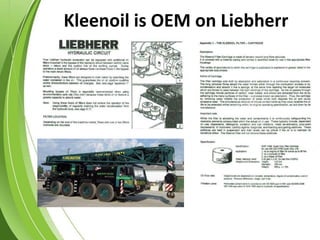
Kleenoil is OEM on Liebherr
Kleenoil is OEM on IdleKleen
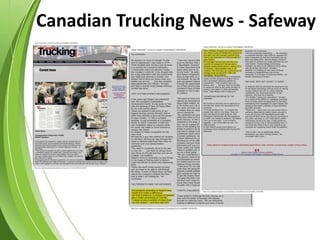
Canadian Trucking News - Safeway
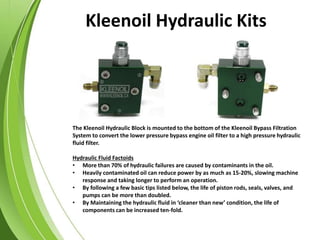
The Kleenoil Hydraulic Block is mounted to the bottom of the Kleenoil Bypass Filtration
System to convert the lower pressure bypass engine oil filter to a high pressure hydraulic
fluid filter.
Hydraulic Fluid Factoids
• More than 70% of hydraulic failures are caused by contaminants in the oil.
• Heavily contaminated oil can reduce power by as much as 15-20%, slowing machine
response and taking longer to perform an operation.
• By following a few basic tips listed below, the life of piston rods, seals, valves, and
pumps can be more than doubled.
• By Maintaining the hydraulic fluid in ‘cleaner than new’ condition, the life of
components can be increased ten-fold.
Kleenoil Hydraulic Kits
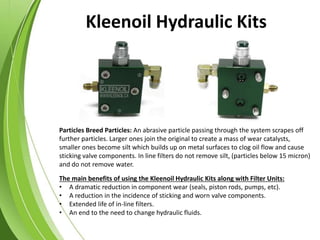
Particles Breed Particles: An abrasive particle passing through the system scrapes off
further particles. Larger ones join the original to create a mass of wear catalysts,
smaller ones become silt which builds up on metal surfaces to clog oil flow and cause
sticking valve components. In line filters do not remove silt, (particles below 15 micron)
and do not remove water.
The main benefits of using the Kleenoil Hydraulic Kits along with Filter Units:
• A dramatic reduction in component wear (seals, piston rods, pumps, etc).
• A reduction in the incidence of sticking and worn valve components.
• Extended life of in-line filters.
• An end to the need to change hydraulic fluids.
Kleenoil Hydraulic Kits
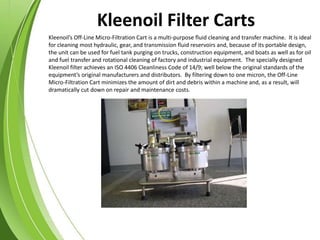
Kleenoil’s Off-Line Micro-Filtration Cart is a multi-purpose fluid cleaning and transfer machine. It is ideal
for cleaning most hydraulic, gear, and transmission fluid reservoirs and, because of its portable design,
the unit can be used for fuel tank purging on trucks, construction equipment, and boats as well as for oil
and fuel transfer and rotational cleaning of factory and industrial equipment. The specially designed
Kleenoil filter achieves an ISO 4406 Cleanliness Code of 14/9; well below the original standards of the
equipment’s original manufacturers and distributors. By filtering down to one micron, the Off-Line
Micro-Filtration Cart minimizes the amount of dirt and debris within a machine and, as a result, will
dramatically cut down on repair and maintenance costs.
Kleenoil Filter Carts
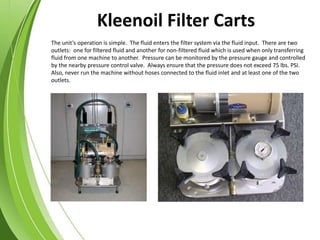
The unit’s operation is simple. The fluid enters the filter system via the fluid input. There are two
outlets: one for filtered fluid and another for non-filtered fluid which is used when only transferring
fluid from one machine to another. Pressure can be monitored by the pressure gauge and controlled
by the nearby pressure control valve. Always ensure that the pressure does not exceed 75 lbs. PSI.
Also, never run the machine without hoses connected to the fluid inlet and at least one of the two
outlets.
Kleenoil Filter Carts
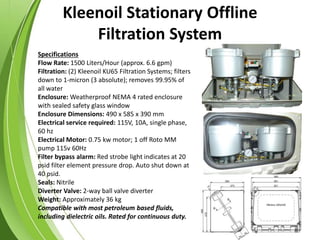
Kleenoil Stationary Offline

Filtration System
Specifications
Flow Rate: 1500 Liters/Hour (approx. 6.6 gpm)
Filtration: (2) Kleenoil KU65 Filtration Systems; filters
down to 1-micron (3 absolute); removes 99.95% of
all water
Enclosure: Weatherproof NEMA 4 rated enclosure
with sealed safety glass window
Enclosure Dimensions: 490 x 585 x 390 mm
Electrical service required: 115V, 10A, single phase,
60 hz
Electrical Motor: 0.75 kw motor; 1 off Roto MM
pump 115v 60Hz
Filter bypass alarm: Red strobe light indicates at 20
psid filter element pressure drop. Auto shut down at
40 psid.
Seals: Nitrile
Diverter Valve: 2-way ball valve diverter
Weight: Approximately 36 kg
Compatible with most petroleum based fluids,
including dielectric oils. Rated for continuous duty.
Oil Analysis 101
The following information is provided to assist you in the interpretation of the analysis.
Spectrochemical Data
Spectrographic Analysis of Wear Metal Results in ppm (parts per million). The acceptable or normal levels of wear
metal and/or airborne (dirt) contamination vary considerably form component to component; as well as, from unit to
unit. Operating conditions, various component wear characteristics, drain intervals, and maintenance practices will
affect wear levels. Historical wear levels are established by sampling and service as a reasonable guide for normal
wear levels for a given unit. Any sudden changes in the historical wear levels could indicate abnormal wear and
reflect mechanical problems outside a normal acceptable range have been marked on the latest sample line. Possible
sources of wear are referenced in this guide and can also be found on the back of the report form.
Viscosity
A lubricant can thicken or thin with use. Changes in the lubricant viscosity are generally due to contamination by fuel,
water and soot. Chemical changes to the lubricant such as oxidation and/or nitration can also have an affect on the
viscosity.
Water
Water is a by-product of fuel-combustion. If the operating conditions do not allow the engine to operate at peak
efficiency, the moisture will not evaporate resulting in an accumulation in the crankcase. Water contamination can
also occur as the result of a coolant leak. Water reported in components, other than engines, indicates external
contamination and should be corrected.
Antifreeze/Coolant
Antifreeze contamination indicates an internal coolant leak through head gaskets or a possible cracked block and
should be corrected as soon as possible.
Oxidation
Lubricating oil in engines and other components can react with available oxygen under certain operating conditions to
form harmful by-products. Heat, pressure and catalyst materials (wear metals) can accelerate the oxidation process.
It can result in lubricant viscosity thickening. Sample reports are in Percent Allowable.
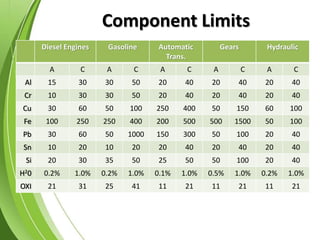
Component Limits
Diesel Engines Gasoline Automatic
Trans.
Gears Hydraulic
A C A C A C A C A C
Al 15 30 30 50 20 40 20 40 20 40
Cr 10 30 30 50 20 40 20 40 20 40
Cu 30 60 50 100 250 400 50 150 60 100
Fe 100 250 250 400 200 500 500 1500 50 100
Pb 30 60 50 1000 150 300 50 100 20 40
Sn 10 20 10 20 20 40 20 40 20 40
Si 20 30 35 50 25 50 50 100 20 40
H20 0.2% 1.0% 0.2% 1.0% 0.1% 1.0% 0.5% 1.0% 0.2% 1.0%
OXI 21 31 25 41 11 21 11 21 11 21
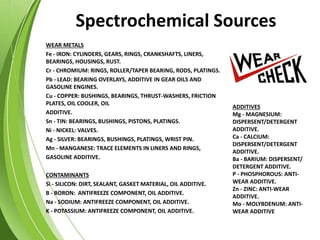
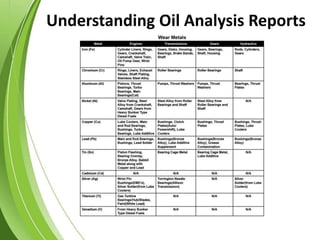
Spectrochemical Sources
WEAR METALS
Fe - IRON: CYLINDERS, GEARS, RINGS, CRANKSHAFTS, LINERS,
BEARINGS, HOUSINGS, RUST.
Cr - CHROMIUM: RINGS, ROLLER/TAPER BEARING, RODS, PLATINGS.
Pb - LEAD: BEARING OVERLAYS, ADDITIVE IN GEAR OILS AND
GASOLINE ENGINES.
Cu - COPPER: BUSHINGS, BEARINGS, THRUST-WASHERS, FRICTION
PLATES, OIL COOLER, OIL
ADDITIVE.
Sn - TIN: BEARINGS, BUSHINGS, PISTONS, PLATINGS.
Ni - NICKEL: VALVES.
Ag - SILVER: BEARINGS, BUSHINGS, PLATINGS, WRIST PIN.
Mn - MANGANESE: TRACE ELEMENTS IN LINERS AND RINGS,
GASOLINE ADDITIVE.
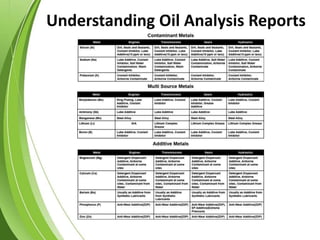
CONTAMINANTS
Si - SILICON: DIRT, SEALANT, GASKET MATERIAL, OIL ADDITIVE.
B - BORON: ANTIFREEZE COMPONENT, OIL ADDITIVE.
Na - SODIUM: ANTIFREEZE COMPONENT, OIL ADDITIVE.
K - POTASSIUM: ANTIFREEZE COMPONENT, OIL ADDITIVE.
ADDITIVES
Mg - MAGNESIUM:
DISPERSENT/DETERGENT
ADDITIVE.
Ca - CALCIUM:
DISPERSENT/DETERGENT
ADDITIVE.
Ba - BARIUM: DISPERSENT/
DETERGENT ADDITIVE.
P - PHOSPHOROUS: ANTI-
WEAR ADDITIVE.
Zn - ZINC: ANTI-WEAR
ADDITIVE.
Mo - MOLYBDENUM: ANTI-
WEAR ADDITIVE
Viscosity Limits @ 100 C cSt
SAE Viscosity Grade MIN MAX
5W20 5.6 9.2
5W30 9.3 12.4
5W40 12.5 16.2
5W50 16.3 21.8
10W20 5.6 9.2
10W30 9.3 12.4
10W40 12.4 16.2
15W40 12.5 16.3
10W50 16.3 21.8
15W20 5.6 9.2
15W30 9.3 12.4
15W40 12.4 16.2
15W50 16.3 21.8
20W20 5.6 9.2
20W30 9.3 12.4
20W40 12.4 16.2
20W50 16.3 21.8
10W 4.9 7.6
20W 5.6 9.2
30W 9.3 12.4
40W 12.4 16.2
Understanding Oil Analysis Reports
Total Base Number (TBN)
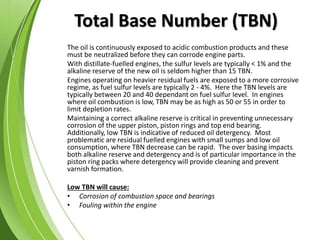
The oil is continuously exposed to acidic combustion products and these
must be neutralized before they can corrode engine parts.
With distillate-fuelled engines, the sulfur levels are typically < 1% and the
alkaline reserve of the new oil is seldom higher than 15 TBN.
Engines operating on heavier residual fuels are exposed to a more corrosive
regime, as fuel sulfur levels are typically 2 - 4%. Here the TBN levels are
typically between 20 and 40 dependant on fuel sulfur level. In engines
where oil combustion is low, TBN may be as high as 50 or 55 in order to
limit depletion rates.
Maintaining a correct alkaline reserve is critical in preventing unnecessary
corrosion of the upper piston, piston rings and top end bearing.
Additionally, low TBN is indicative of reduced oil detergency. Most
problematic are residual fuelled engines with small sumps and low oil
consumption, where TBN decrease can be rapid. The over basing impacts
both alkaline reserve and detergency and is of particular importance in the
piston ring packs where detergency will provide cleaning and prevent
varnish formation.
Low TBN will cause:
• Corrosion of combustion space and bearings
• Fouling within the engine
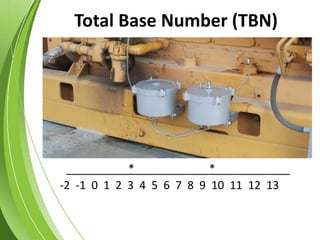
__________*____________*____________
-2 -1 0 1 2 3 4 5 6 7 8 9 10 11 12 13
Total Base Number (TBN)
Total Acid Number (TAN)
Total Acid Number, or TAN, is the measure of both
the weak organic and strong inorganic acids present
in oil. It is applicable to gearbox, gas engine, gas
turbine, synthetic and hydraulic lubes. TAN is not
generally associated with engine crankcase
lubricants, unless they are severely contaminated.
The singular exception to this may be crankcase
lubricants for gas engines. In this instance, TBN can
deplete very rapidly and elevated operating
temperatures can generate high levels of weak
organic acids. A rise in TAN is generally associated
with oil oxidation due to time and /or operating
temperature. Trend as well as absolute values
should be used to monitor TAN.
Total Acid Number (TAN)
High combustion temperatures in gas engines (especially
ones using a stoichiomettic (1:1) air/fuel ratio) will lead to
rapid TBN depletion. This is further exaggerated when
using landfill gas where typical oil life is less than 500
hours. Under these circumstances, high TAN and viscosity
usually become the limiting parameters for oil life.
High TAN will cause:
• The formation of gums and lacquers on metal surfaces.
• (Associated with) increased viscosity of pumping
losses.
• A gradual speed up in the rate of TAN increase.
• System corrosion, particularly if water is present.
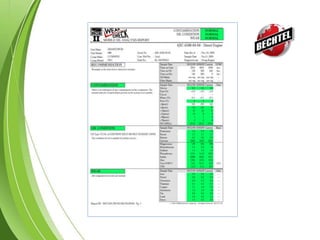
This section should be kept for your records so you have a means to follow up if
necessary.
This code designates that the results will show up on the Kleenoil account on their
website.
This section needs to be filled in COMPLETELY with the customers company
information.
Serial No. = Not necessary
Component Make = i.e. Power Stroke
Component Model = 7.3L Diesel
Unit ID = i.e. Toms Truck
Unit Make = i.e. Ford
Unit Model = F-250
System Oil Capacity = i.e. 15 quarts
Brand & Type of Oil = i.e. Valvoline 15W40
Additive Type = i.e. Power Up
Filter Type = i.e. most of the time would be Element
Filter Micron Rating = Usually just put 25-40 micron full flow and 1 micron Kleenoil
Filter
This section is the MOST IMPORTANT one of all. ALL FIELDS NEED TO BE FILLED IN
COMPLETELY!
Sample Date = i.e. 1/25/2005
Time Units = i.e. how the company measures usage on the vehicle / component either in
miles, hours, etc.
Total Time on Unit = i.e. since the unit was put into service by the company. Might be
235,000 miles, etc.
Time on Oil = the amount of miles/hours on the oil since the last oil change
Time on Filter = the amount of miles/hours on the Kleenoil Filter Unit.
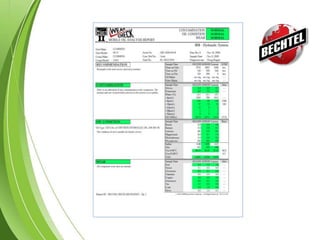
Wearcheck USA Form
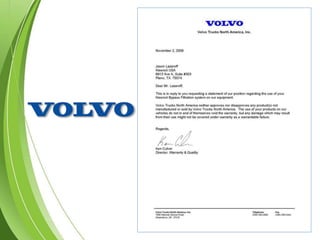
Volvo Letter
Gentlemen,
The filtration method I would recommend for machine L180E, serial # 9009, is more commonly called by-pass filtration. This system is
fitted into a lower flow portion of the hydraulic circuit i.e. servo or cooler return, and filters the oil over a longer time frame but to a finer
level.
During this filtration period the machine can be operated as normal and, in fact, the more functions that are operated the cleaner the
system hydraulic oil becomes. This method has no effect on machine operation and requires no external power or pumps.
Here are some links to sites that sell/service bypass systems.
http://www.kleenoilusa.com/
As we discussed, anyone who owns, rents or uses Volvo equipment can use the contact information below. I would prefer any other
equipment owners/users to use: jhemmings11@comcast.net
Best regards,
Jim Hemmings
Technical Support Specialist
Volvo Construction Equipment North America
One Volvo Drive
Asheville, North Carolina 28803
E mail james.hemmings@volvo.com
Tel 828-650-2083
Mob 828-230-4838
Fax 425-675-5968
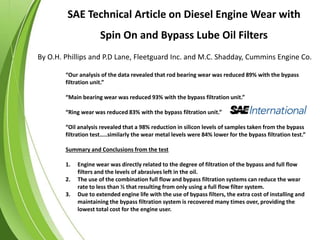
“Our analysis of the data revealed that rod bearing wear was reduced 89% with the bypass
filtration unit.”
“Main bearing wear was reduced 93% with the bypass filtration unit.”
“Ring wear was reduced 83% with the bypass filtration unit.”
“Oil analysis revealed that a 98% reduction in silicon levels of samples taken from the bypass
filtration test…..similarly the wear metal levels were 84% lower for the bypass filtration test.”
Summary and Conclusions from the test
1. Engine wear was directly related to the degree of filtration of the bypass and full flow
filters and the levels of abrasives left in the oil.
2. The use of the combination full flow and bypass filtration systems can reduce the wear
rate to less than ½ that resulting from only using a full flow filter system.
3. Due to extended engine life with the use of bypass filters, the extra cost of installing and
maintaining the bypass filtration system is recovered many times over, providing the
lowest total cost for the engine user.
SAE Technical Article on Diesel Engine Wear with
Spin On and Bypass Lube Oil Filters
By O.H. Phillips and P.D Lane, Fleetguard Inc. and M.C. Shadday, Cummins Engine Co.
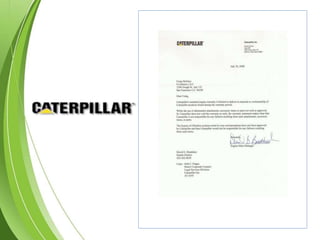
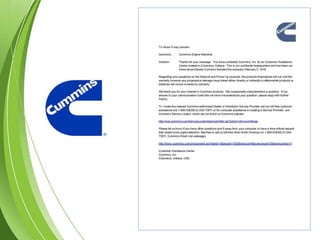
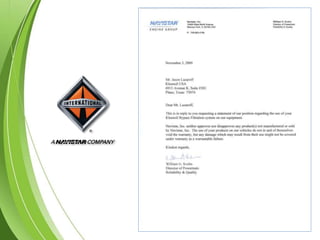
Manufacturer Warranty Concerns
One of the number one questions received at Kleenoil USA is regarding
installation of a Kleenoil Onboard Oil Recycling System on your truck or
equipment and whether the installation could void the warranty?
Rest assured that due to the Magnuson-Moss Warranty Act, this is not a
concern at all.
We also have a comprehensive list of the major manufacturers below and their
statements on use of Kleenoil Onboard Oil Recycling System on their equipment.
Kleenoil Lifetime Warranty
Original equipment warranties are unaffected by the
installation of a Kleenoil Onboard Oil Recycling System.
Kleenoil USA Inc. Onboard Oil Recycling Systems -
bypass filtration systems (excluding hoses and fittings)
carry a lifetime warranty.
Kleenoil USA Inc. warranties the Kleenoil filter housing and brackets to
the original purchaser for life.
Adaptors, hose ends, and hosing will all carry the normal warranty of the
original supplier of those parts.
The Kleenoil Lifetime Warranty does not cover any damages caused by
you or due to external causes, including any act of God, natural disaster,
accident, flood, war, sabotage, terrorism, military actions, or problems
with the engine, e.g., failure to maintain the engine in accordance with
its documentation (other than manufactures recommended oil
changes).
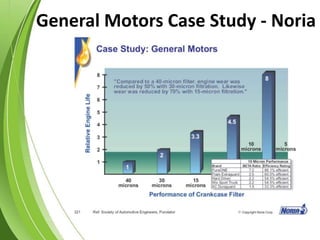
General Motors Case Study - Noria
Kleenoil Competition
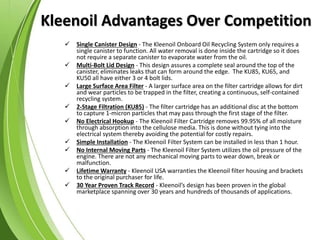
Kleenoil Advantages Over Competition
 Single Canister Design - The Kleenoil Onboard Oil Recycling System only requires a
single canister to function. All water removal is done inside the cartridge so it does
not require a separate canister to evaporate water from the oil.
 Multi-Bolt Lid Design - This design assures a complete seal around the top of the
canister, eliminates leaks that can form around the edge. The KU85, KU65, and
KU50 all have either 3 or 4 bolt lids.
 Large Surface Area Filter - A larger surface area on the filter cartridge allows for dirt
and wear particles to be trapped in the filter, creating a continuous, self-contained
recycling system.
 2-Stage Filtration (KU85) - The filter cartridge has an additional disc at the bottom
to capture 1-micron particles that may pass through the first stage of the filter.
 No Electrical Hookup - The Kleenoil Filter Cartridge removes 99.95% of all moisture
through absorption into the cellulose media. This is done without tying into the
electrical system thereby avoiding the potential for costly repairs.
 Simple Installation - The Kleenoil Filter System can be installed in less than 1 hour.
 No Internal Moving Parts - The Kleenoil Filter System utilizes the oil pressure of the
engine. There are not any mechanical moving parts to wear down, break or
malfunction.
 Lifetime Warranty - Kleenoil USA warranties the Kleenoil filter housing and brackets
to the original purchaser for life.
 30 Year Proven Track Record - Kleenoil’s design has been proven in the global
marketplace spanning over 30 years and hundreds of thousands of applications.
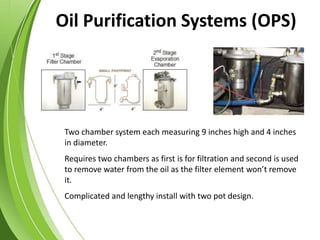
Two chamber system each measuring 9 inches high and 4 inches
in diameter.
Requires two chambers as first is for filtration and second is used
to remove water from the oil as the filter element won’t remove
it.
Complicated and lengthy install with two pot design.
Oil Purification Systems (OPS)
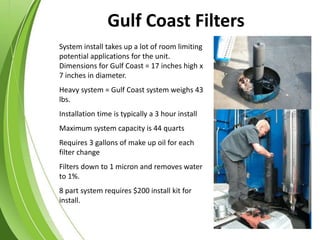
System install takes up a lot of room limiting
potential applications for the unit.
Dimensions for Gulf Coast = 17 inches high x
7 inches in diameter.
Heavy system = Gulf Coast system weighs 43
lbs.
Installation time is typically a 3 hour install
Maximum system capacity is 44 quarts
Requires 3 gallons of make up oil for each
filter change
Filters down to 1 micron and removes water
to 1%.
8 part system requires $200 install kit for
install.
Gulf Coast Filters
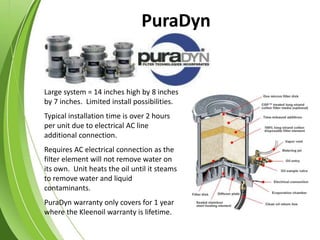
Large system = 14 inches high by 8 inches
by 7 inches. Limited install possibilities.
Typical installation time is over 2 hours
per unit due to electrical AC line
additional connection.
Requires AC electrical connection as the
filter element will not remove water on
its own. Unit heats the oil until it steams
to remove water and liquid
contaminants.
PuraDyn warranty only covers for 1 year
where the Kleenoil warranty is lifetime.
PuraDyn
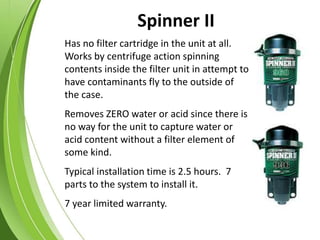
Has no filter cartridge in the unit at all.
Works by centrifuge action spinning
contents inside the filter unit in attempt to
have contaminants fly to the outside of
the case.
Removes ZERO water or acid since there is
no way for the unit to capture water or
acid content without a filter element of
some kind.
Typical installation time is 2.5 hours. 7
parts to the system to install it.
7 year limited warranty.
Spinner II
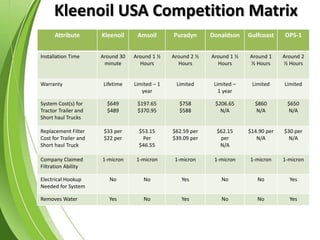
Kleenoil USA Competition Matrix
Attribute Kleenoil Amsoil Puradyn Donaldson Gulfcoast OPS-1
Installation Time Around 30
minute
Around 1 ½
Hours
Around 2 ½
Hours
Around 1 ½
Hours
Around 1
½ Hours
Around 2
½ Hours
Warranty Lifetime Limited – 1
year
Limited Limited –
1 year
Limited Limited
System Cost(s) for
Tractor Trailer and
Short haul Trucks
$649
$489
$197.65
$370.95
$758
$588
$206.65
N/A
$860
N/A
$650
N/A
Replacement Filter
Cost for Trailer and
Short haul Truck
$33 per
$22 per
$53.15
Per
$46.55
$62.59 per
$39.09 per
$62.15
per
N/A
$14.90 per
N/A
$30 per
N/A
Company Claimed
Filtration Ability
1-micron 1-micron 1-micron 1-micron 1-micron 1-micron
Electrical Hookup
Needed for System
No No Yes No No Yes
Removes Water Yes No Yes No No Yes
“Make Green the new color of your bottom line!”

Kleenoil Bypass Filtration System Presentation

  • 1.
    Kleenoil Onboard OilRecycling Systems Go GREEN! - Keep it KLEEN!
  • 2.
  • 3.
    We are committedto helping you reduce your OTR truck oil usage up to 80% Resource Responsibility
  • 4.
    Fewer oil changes andreducing wear in engines yields revenue in areas often overlooked Economic Profitability
  • 5.
    Less consumable oil usedequals a smaller carbon footprint and a cleaner environment Social Accountability
  • 6.
  • 7.
  • 8.
    Bell Helicopter Boeing Helicopter KalmarIndustries Rottne Frontier Power Select Kleenoil and Power Up OEM’s Idlekleen Liebherr
  • 9.
    Kleenoil Bypass FiltrationHistory Is the Kleenoil Bypass Filter an established and tested technology? How do Kleenoil Bypass Filters differ from the standard main flow, OEM Filters?
  • 10.
    Features and Benefits Eliminates Waterand Particles Removes Dirt and Contaminants Does Not Remove Desirable Elements Extends Drain Intervals
  • 11.
  • 12.
    Oil Does NotWear Out The U.S. Air Force says; “Despite the popular notion that oil ‘breaks down’ or ‘wears out’ and is unfit for further use, it’s permanent value has been well known to the U.S.A.F. since World War 1" Standard Oil of New York; “Many times the question has been asked ‘Does lubricating oil wear out ?’ The question should be answered in the negative”. Mobil Oil Technical Bulletin #863; “Oil does not wear out, breakdown or otherwise deteriorate to such an extent that it needs to be changed. It becomes contaminated with water, acids, carbon particles and sludge. The engine’s oil filter(s) can only remove solid particles above a certain size. It (they) cannot remove water, acids, carbon particles or sludge all of which pass through the filter(s) just as readily as the oil. U.S. Standards Bulletin #86; “Oil does not wear out, but only gets dirty”. Theory and Practice of Lubrication for Engineers, 2nd edition, P590 - P591; “Oil is like any mineral and cannot wear out. Oil can become dirty and contaminated but, like copper, iron or silver, when they are reprocessed, they are as good as new. Studies have shown that oil actually improves significantly in it’s lubricating qualities as it is exposed to heat during use in the engine”. Tribology International, 1991, P329; “New oil right out of the can is not as pure as one might think but contains metallic and non metallic particles in various amounts”. Fact no. 1; When engine oil is replaced, the new oil becomes dirty the moment the engine is started. This is because approximately 18% of the old oil remains in the engine. The 18% old oil instantly mixes with the new oil and the contaminants from the old oil are pumped through the engine. Fact no. 2; Test results from engines equipped with full flow filter elements have shown that 4% of the oil drained from the engines was solid particles consisting of carbon, dirt and metal particles.
  • 13.
    How Bypass FiltrationWorks LOW PRESSURE OUT IN HIGH PRESSURE FILTER HOUSING FILTER CARTRIDGE FILTER LID KLEENOIL FILTER UNIT
  • 14.
    Rethinking Old Practices •Change Your Thinking, Not Your Oil • Onboard Oil Recycling Systems • Kleenoil Invented in the United States but Marketed in Europe
  • 15.
    Will heat causedegradation or “oil breakdown”? What does the term “Oil breakdown” mean? Does oil wear out? How long can oil drain intervals be extended? Will extending oil drain intervals void engine manufacturers’ warranties? Extended Drain Intervals
  • 16.
    Sample #1 Thefirst photo shown here is a sample of oil taken from a power steering unit of a large commercial scraper at time of refurbishment. Sample #2 The second photo shown here is a sample of oil taken from a test unit with 10 micron filtration. Sample #3 The third photo shown here is a sample taken from the same source as Sample #1 after passing through the Kleenoil BY-PASS Filtration System. The Kleenoil BY-PASS Filtration System will remove dirt particles down to 1 micron and totally remove water. The particles normally present in oil, which will not be removed by the standard, full-flow filter, can be as much as 40 microns. The film of oil between two moving parts under load is normally 3 microns, so a wide range of particles will bridge this film, causing metal to metal contact, resulting in friction, heat, and wear. The Kleenoil Cartridge will Ensure No Particles Above 1 Micron Nominal (3 Absolute)! Kleenoil Reduces Engine Wear
  • 17.
  • 18.
    Exactly How Bigis 1-Micron?
  • 19.
    ISO CODE MORE THAN UP TO AND INCLUDING (Particles per ml of oil ) 24 80,000 160,000 23 40,000 80,000 22 20,000 40,000 21 10,000 20,000 20 5,000 10,000 19 2,500 5,000 18 1,300 2,500 17 640 1,300 16 320 640 15 160 320 14 80 160 13 40 80 12 20 40 11 10 20 10 5 10 9 2.5 5 8 1.3 2.5 ISO 4406:1999 Contamination Chart Table 1 PARTICLES/ ML ISO CODE > 4 microns 9721 20 > 6 microns 1554 18 > 10 microns 558 > 14 microns 189 15 > 21 microns 12 > 35 microns 5 > 70 microns 0 > 100 microns 0 In this example, you can see how the particles measured at the given micron levels are assigned the specific code based on where that value falls in the table. For this example, the ISO code would be 20/18/15. This is the cleanliness of brand new oil which is not very clean! 20 / 18 / 15 4µ 6µ 14µ
  • 20.
    Suggested Acceptable Contamination Codes ISOCODE > 4 microns > 6 microns > 14 microns Type of System Typical Components Importance of Oil Cleanliness for the Application 23/21/17 40,000 - 80,000 10,000 - 20,000 640 - 1,300 Low pressure systems with large clearances Ram pumps Low 20/18/15 5,000 - 10,000 1,300 - 2,500 160 - 320 Typical cleanliness of new oil (hydraulic or engine) straight from the manufacturer. Low pressure heavy industrial systems or applications where long-life is not critical Flow control valves, Cylinders Average 19/17/14 2,500 - 5,000 640 - 1,300 80 - 160 General machinery and mobile systems. Medium pressure, medium capacity Gear pumps/motors Important 18/16/13 1,300 - 2,500 320 - 640 40 - 80 World Wide Fuel Charter cleanliness standard for diesel fuel delivered from the filling station nozzle. High quality reliable systems. General machine requirements Injector valve and high pressure pumps/motors; Directional and pressure control valves Critical 17/15/12 640 - 1,300 160 - 320 20 - 40 Highly sophisticated systems and hydrostatic transmissions Proportional valves Critical 16/14/11 320 - 640 80 - 160 10 - 20 Performance servo and high Pressure long-life systems e.g. Aircraft machine tools, etc. Industrial servovalves Critical 15/13/09 160 - 320 40 - 80 2.5 - 5 Silt sensitive control system with very high reliability Laboratory or aerospace High performance servovalves Super critical NOTE: The three figures of the ISO code numbers represent ISO level contamination grades for particles of >4μm(c), >6μm(c) and >14μm(c) respectively.
  • 21.
    Life Extension ofEquipment Components Component Life Extension AFTER Kleenoil - New Cleanliness Level (ISO CODE) 22/20/17 21/19/16 20/18/15 19/17/14 18/16/13 17/15/12 16/14/11 15/13/10 14/12/9 13/11/8 12/10/7 Component Life Extension BEFORE Kleenoil - Old Cleanliness Level (ISO CODE) 28/26/23 5 3 7 3.5 9 4 >10 5 >10 6 >10 7.5 >10 9 >10 >10 >10 >10 >10 >10 >10 >10 4 2.5 4.5 3 6 3.5 6.5 4 7.5 5 8.5 6.5 10 7 >10 9 >10 10 >10 >10 >10 >10 27/25/22 4 2.5 5 3 7 3.5 9 4 >10 5 >10 6 >10 7 >10 9 >10 >10 >10 >10 >10 >10 3 2 3.5 2.5 4.5 3 5 3.5 6.5 4 8 5 9 6 10 7.5 >10 9 >10 >10 >10 >10 26/24/21 3 2 4 2.5 6 3 7 4 9 5 >10 6 >10 7 >10 9 >10 10 >10 >10 >10 >10 2.5 1.5 3 2 4 2.5 5 3 6.5 4 7.5 5 9 6 10 7.5 >10 8 >10 10 >10 >10 25/23/20 2 1.5 3 2 4 2.5 5 3 7 3.5 9 4 >10 5 >10 6 >10 8 >10 9 >10 >10 1.7 1.3 2.3 1.5 3 2 3.7 2.5 5 3 6 3.5 7 4 8 5 10 6.5 >10 8.5 >10 10 24/22/19 1.6 1.3 2 1.6 3 2 4 2.5 5 3 7 3.5 8 4 >10 5 >10 6 >10 7 >10 >10 1.4 1.1 1.8 1.3 2.3 1.7 3 2 3.5 2.5 4.5 3 5.5 3.5 7 4 8 5 10 5.5 >10 8.5 23/21/18 1.3 1.2 1.5 1.5 2 1.7 3 2 4 2.5 5 3 7 3.5 9 4 >10 5 >10 7 >10 >10 1.2 1.1 1.5 1.3 1.8 1.4 2.2 1.6 3 2 3.5 2.5 4.5 3 5 3.5 7 4 9 5.5 10 8 22/20/17 1.3 1.2 1.6 1.5 2 1.7 3 2 4 2.5 5 3 7 4 9 4 >10 7 >10 9 1.2 1.05 1.5 1.3 1.8 1.4 2.3 1.7 3 2 3.5 2.5 5 3 5 3.5 8 5.5 10 7 21/19/16 1.3 1.2 1.6 1.5 2 1.7 3 2 4 2.5 5 3 7 4 9 6 >10 8 1.2 1.1 1.5 1.3 1.8 1.5 2.2 1.7 3 2 3.5 2.5 5 3 7 4.5 9 6 20/18/15 1.3 1.2 1.6 1.5 2 1.7 3 2 4 2.5 5 3 7 4.5 >10 6 1.2 1.1 1.5 1.3 1.8 1.5 2.3 1.7 3 2 3.5 2.5 5.5 3.7 8 5 19/17/14 1.3 1.2 1.6 1.5 2 1.7 3 2 4 2.5 6 3 8 5 1.2 1.1 1.5 1.3 1.8 1.5 2.3 1.7 3 2 4 2.5 6 3.5 18/16/13 Hydraulics and Diesel Engines Rolling Element Bearings 1.3 1.2 1.6 1.5 2 1.7 3 2 4 3.5 6 4 1.2 1.1 1.5 1.3 1.8 1.5 2.3 1.7 3.7 3 4.5 3.5 17/15/12 1.3 1.2 1.6 1.5 2 1.7 3 2 4 2.5 1.2 1.1 1.5 1.3 1.8 1.5 2.3 1.8 3 2.2 16/14/11 Journal Bearings and Turbo Machinery Gear Boxes and Other 1.3 1.3 1.6 1.5 2 1.8 3 2 1.3 1.2 1.5 1.4 1.9 1.5 2.3 1.8 15/13/10 1.4 1.2 1.8 1.5 2.5 1.8 1.2 1.1 1.6 1.3 2 1.6 ISO 4406:1999 Particle Counts ISO CODE > 4 microns > 6 microns > 14 microns 23 / 21 / 18 40000 - 80000 10000 - 20000 1300 - 2500 23 / 21 / 17 40000 - 80000 10000 - 20000 640 - 1300 23 / 21 / 16 40000 - 80000 10000 - 20000 320 - 640 23 / 21 / 15 40000 - 80000 10000 - 20000 160 - 320 22 / 20 / 17 20000 - 40000 5000 - 10000 640 - 1300 22 / 20 / 16 20000 - 40000 5000 - 10000 320 - 640 22 / 20 / 15 20000 - 40000 5000 - 10000 160 - 320 22 / 20 / 14 20000 - 40000 5000 - 10000 80 - 160 21 / 19 / 16 10000 - 20000 2500 - 5000 320 - 640 21 / 19 / 15 10000 - 20000 2500 - 5000 160 - 320 21 / 19 / 14 10000 - 20000 2500 - 5000 80 - 160 21 / 19 / 13 10000 - 20000 2500 - 5000 40 - 80 20 / 18 / 15 5000 - 10000 1300 - 2500 160 - 320 20 / 18 / 14 5000 - 10000 1300 - 2500 80 - 160 20 / 18 / 13 5000 - 10000 1300 - 2500 40 - 80 20 / 18 / 12 5000 - 10000 1300 - 2500 20 - 40 19 / 17 / 14 2500 - 5000 640 - 1300 80 - 160 19 / 17 / 13 2500 - 5000 640 - 1300 40 - 80 19 / 17 / 12 2500 - 5000 640 - 1300 20 - 40 19 / 17 / 11 2500 - 5000 640 - 1300 10 - 20 18 / 16 / 13 1300 - 2500 320 - 640 40 - 80 18 / 16 / 12 1300 - 2500 320 - 640 20 - 40 18 / 16 / 11 1300 - 2500 320 - 640 10 - 20 18 / 16 / 10 1300 - 2500 320 - 640 5 - 10 17 / 15 / 12 640 - 1300 160 - 320 20 - 40 17 / 15 / 11 640 - 1300 160 - 320 10 - 20 17 / 15 / 10 640 - 1300 160 - 320 5 - 10 16 / 14 / 11 320 - 640 80 - 160 10 - 20
  • 22.
    At ISO 16/14/11,only one 50-lb. bag of dirt passes through the pump. At ISO 23/21/18, this hydraulic system passes 136 50-lb. bags of dirt through the teeth of the pump in one year. Oil Pump or Dirt Pump? Filter (A) ISO Code (B) Dirt (lbs.) (C) 50 lb Bags Relative Pump Life 25 micron nominal 23/21/18 6784 136 1 10 micron nominal 21/19/16 1809 36 1.9 10 micron absolute 18/16/13 211 4.2 4.4 6 micron absolute 16/14/11 53 1 8.8 3 micron absolute 14/12/9 14 0.28 15 All figures approximations © Copyright 2002 Noria Corporation
  • 23.
    IDENTICAL BEARINGS FROMA CAT 3406C THAT WAS HAULING A TANDEM MILK TRUCK TRAILER. IN THE PAST, THE BEARING ON THE LEFT HAD TO BE REGULARLY CHANGED DUE TO THE STRAIN ON THE MOTOR FROM THE LIQUID LOAD SHIFTING BACK AND FORTH DURING MOVEMENT. THE BEARING ON THE RIGHT CAME FROM THE SAME TRUCK THAT NOW HAS OVER 1,000,000 MILES ON IT AFTER HAVING THE KLEENOIL SYSTEM INSTALLED. There is no scratching due to abrasive particles, or pitting and corrosion due to acid. At such a rate, the bearings will be functional for double or triple the normal lifetime. Bearing with same amount of miles in an engine without the Kleenoil BY-PASS Filtration System installed. Kleenoil Reduces Engine Wear
  • 24.
    For trucks withpan capacities of up to 11 gallons the cost of a Kleenoil bypass filter is $695. With immediate savings of around $1,000 per year the cost of the unit is written off in about six or seven months. Bypass filter cartridge replacements, changed at the old oil change frequency, will cost around $33 each. Other units are available for heavy equipment and also for small trucks. Kleenoil Provides Immediate Cost Savings
  • 25.
    The Kleenoil bypassfiltration system is a major friend of the environment. It naturally encourages the conservation of our earth’s resources. With the current and impending laws on the use and disposal of oil, Kleenoil offers a way to protect not only the environment, but also the user. This is particularly true for unnecessary consumption and disposal costs. Is the decision to extend oil drain intervals a maintenance issue only? The cost of used oil disposal with less than 5% water may be 5 -10 cents per gallon. If it contains more than 5% water, then the cost can rise to 10 - 25 cents per gallon. This is 25% of its original value when new. Projected estimates suggest that the disposal cost of non contaminated used oil, could equate to the value of new oil within the next 2 to 5 years. What is the cost of disposing of used oil? No. Extended oil drain intervals are not strictly a maintenance concern. Environmental issues and costs are also pertinent. Environmental Concerns
  • 26.
    Description: The Kleenoilfiltration unit is made of cast aluminum with a galvanized steel mounting bracket. There are three basic sizes, which are installed according to the applications table below. It is connected to the engine lubricating oil circulating system in a bypass loop using high pressure braided hose and fittings to SAE standards. Tech Data • Remote Mounted Unit for easy servicing • Maximum pressure rating of Unit 10 Bar • Lid torque pressure 23lb/ft / 4Kg/cm2 Castings subjected to batch and individual testing Constructed in aluminum (BS 1490 LM6 (M)) Kleenoil Filtration Unit
  • 27.
    Description: The Kleenoilfiltration unit is made of cast aluminum with a galvanized steel mounting bracket. There are three basic sizes, which are installed according to the applications table below. It is connected to the engine lubricating oil circulating system in a bypass loop using high pressure braided hose and fittings to SAE standards. Kleenoil Filtration Unit
  • 28.
    Description: The Kleenoilfilter cartridge is a densely wound paper made from a long fiber coniferous pine tree that grows in Scandinavia where the pulp is only processed once. It is held together in a material casing and comes in specified sizes for use in the appropriate filtration units as shown in the specifications table. Action of the cartridge: The filtration cartridge acts both by absorption and by adsorption in a continuous recycling process. The long fibers of the paper attract the water formed either through the combustion process or by condensation and absorb it like a sponge, at the same time rejecting the large oil molecules which are forced to pass between the tight windings of the cartridge. As the oil passes through the cartridge, minute carbon (soot), wear metals, and silicon particles (dirt) are extracted from the oil by adhering to the many surfaces of the filter - a process known as adsorption. Thus the cartridge, by removing water inhibits the production of acids which both degrade the oil and cause corrosion. The simultaneous removal of minute contaminants as they occur enables the oil life to be extended within its original operating specification. Kleenoil Filter Cartridge
  • 29.
    The Kleenoil filtercartridge will remove particles down to 1 micron (3 absolute) and totally remove water. The principle for filtering particulate matter is ‘liquid liquid chromatography’ which is in effect allowing a fluid to drain down a surface which will progressively arrest particles. This is achieved by having the tissue rolled on a core. Oil is passed up the core of a paper roll where it collects in a cavity between the lid of the filter housing and the paper roll. It is then forced down between the layers of the tissue where particles are adsorbed within the matrix created by millions of cellulose fibers which form the tissue layer. The principle for filtering water is capillary absorption into the hollow vegetable fiber of the cellulose tissue. The molecular structure of the oil is too large to be absorbed by ‘capillary action’ into the fibers, however the water is absorbed into the fiber and separates from the oil. To make an efficient filter the winding must reflect a constant and even tension, yet not be so to tight that oil will not freely flow. Re-pulped tissue with shorter fibers will not have the tensile strength to permit the tension without breaking. Most papers are made with a large amount of repulped material, and as a general rule the fiber length is approximately halved each time it is re-pulped. The shortened fiber will not retain a significant amount of water, and tends to collapse into a repulped state when water is introduced. To be able to retain a large amount of very small particles the winding of the cellulose roll must be extremely precise. Normal paper converters operate at high speed and the motion is not particularly smooth. The construction of the Kleenoil filter cartridge is cellulose tissue (paper), and we seek to always obtain a long fiber tissue which has not been previously processed. Short fibers will absorb the water, but the pressure of flowing oil will cause the water to be released back into the oil. A long fiber will have the ends crushed by the pressure of flow and a small portion of water will be permanently retained in each fiber. Water retention is approximately 2 quarts per pound of tissue. Kleenoil Filter Cartridge
  • 30.
    To conclude, thecellulose tissue used to manufacture a Kleenoil cartridge must be from ‘virgin coniferous’ or other long fiber wood. It must have no element of ‘broke’ (re-pulped material). There must be no chemicals such as optical bleach present, which could alter the features of other chemicals added to the oil being cleaned, There must be a constant slow wind to give the optimum density and tension of the material. Important Note: While the filtration unit is extracting the water and the contaminant, it is continuously safeguarding the desirable elements compounded within the actual oil in use. These typically include, dispersants, detergents, oxidation and rust inhibitors, metal de- activators, pour-point depressants, viscosity improvers, EP agents, friction modifiers, fungicidal, anti-foaming and gelling additives. These additives are held in suspension and their levels can be critical if the oil is to maintain its beneficial qualities. Any proprietary tissue would be unlikely to produce a filter which would meet the established specification of filtration to below 3 microns and total water removal within five passes. Kleenoil Filter Cartridge
  • 31.
    It is awell known fact that marine engines and equipment operate in some of the most severe environments out on the water. It is paramount that engines operate efficiently and require as little downtime for maintenance as possible. Often, because the operating environment is so harsh, maintenance managers will have to change oil and filters earlier and more often to reduce engine wear. This, of course, increases operating expenses and increases the potential for environmental liability if a spill should occur. Oil changes on ocean and sea vessels are extremely expensive and oil disposal is a tricky situation at best. Kleenoil allows customers to keep their oil on marine vessels in a continuously clean condition thereby reducing oil change intervals, environmental risks, and downtime. Kleenoil for Marine Applications
  • 32.
    This is theinside of an engine head on a Detroit Diesel 3-71 that has a Kleenoil system installed on the Pentagoet Tug at the Maine Maritime Academy. This engine has 8,361 hours on it. As you can tell, this is squeaky clean on the inside. As a matter of fact, when the Detroit Diesel rep came out to look at the inside of the head, it was so clean that they basically called the Maine Maritime Academy liars when they told the rep how many hours were on the oil in the engine. The Maine Maritime Academy out of Castine, Maine is one of the most prestigious institutions of their kind. They train their students on every aspects of seamanship from Captains to engineers to deckhands from all over the country. Most of the students of the Maine Maritime Academy that graduate are immediately hired by top companies as the reputation of the schools graduates are so good. Kleenoil for Marine Applications
  • 33.
    Dipstick of anoil sample taken from a Detroit Diesel on the Pentagoet Tug with 8163 engine hours on it looking crystal clear! They were using Mobil Delvac 50 that they monitored every 200 engine hours and changed once a year! The particulate was lower on this sample than it was on brand new oil and this has 8163 hours on it. Before installing Kleenoil on the Pentagoet Tug, they were doing 5 oil changes a year at $1700 per oil change at the old prices before the most recent price hike on oil. Now, they are only changing their oil 1 time per year and keeping it in cleaner than brand new condition all the time. Kleenoil for Marine Applications
  • 34.
    Kleenoil is OEMon Liebherr
  • 35.
    Kleenoil is OEMon IdleKleen
  • 36.
  • 37.
    The Kleenoil HydraulicBlock is mounted to the bottom of the Kleenoil Bypass Filtration System to convert the lower pressure bypass engine oil filter to a high pressure hydraulic fluid filter. Hydraulic Fluid Factoids • More than 70% of hydraulic failures are caused by contaminants in the oil. • Heavily contaminated oil can reduce power by as much as 15-20%, slowing machine response and taking longer to perform an operation. • By following a few basic tips listed below, the life of piston rods, seals, valves, and pumps can be more than doubled. • By Maintaining the hydraulic fluid in ‘cleaner than new’ condition, the life of components can be increased ten-fold. Kleenoil Hydraulic Kits
  • 38.
    Particles Breed Particles:An abrasive particle passing through the system scrapes off further particles. Larger ones join the original to create a mass of wear catalysts, smaller ones become silt which builds up on metal surfaces to clog oil flow and cause sticking valve components. In line filters do not remove silt, (particles below 15 micron) and do not remove water. The main benefits of using the Kleenoil Hydraulic Kits along with Filter Units: • A dramatic reduction in component wear (seals, piston rods, pumps, etc). • A reduction in the incidence of sticking and worn valve components. • Extended life of in-line filters. • An end to the need to change hydraulic fluids. Kleenoil Hydraulic Kits
  • 39.
    Kleenoil’s Off-Line Micro-FiltrationCart is a multi-purpose fluid cleaning and transfer machine. It is ideal for cleaning most hydraulic, gear, and transmission fluid reservoirs and, because of its portable design, the unit can be used for fuel tank purging on trucks, construction equipment, and boats as well as for oil and fuel transfer and rotational cleaning of factory and industrial equipment. The specially designed Kleenoil filter achieves an ISO 4406 Cleanliness Code of 14/9; well below the original standards of the equipment’s original manufacturers and distributors. By filtering down to one micron, the Off-Line Micro-Filtration Cart minimizes the amount of dirt and debris within a machine and, as a result, will dramatically cut down on repair and maintenance costs. Kleenoil Filter Carts
  • 40.
    The unit’s operationis simple. The fluid enters the filter system via the fluid input. There are two outlets: one for filtered fluid and another for non-filtered fluid which is used when only transferring fluid from one machine to another. Pressure can be monitored by the pressure gauge and controlled by the nearby pressure control valve. Always ensure that the pressure does not exceed 75 lbs. PSI. Also, never run the machine without hoses connected to the fluid inlet and at least one of the two outlets. Kleenoil Filter Carts
  • 41.
    Kleenoil Stationary Offline FiltrationSystem Specifications Flow Rate: 1500 Liters/Hour (approx. 6.6 gpm) Filtration: (2) Kleenoil KU65 Filtration Systems; filters down to 1-micron (3 absolute); removes 99.95% of all water Enclosure: Weatherproof NEMA 4 rated enclosure with sealed safety glass window Enclosure Dimensions: 490 x 585 x 390 mm Electrical service required: 115V, 10A, single phase, 60 hz Electrical Motor: 0.75 kw motor; 1 off Roto MM pump 115v 60Hz Filter bypass alarm: Red strobe light indicates at 20 psid filter element pressure drop. Auto shut down at 40 psid. Seals: Nitrile Diverter Valve: 2-way ball valve diverter Weight: Approximately 36 kg Compatible with most petroleum based fluids, including dielectric oils. Rated for continuous duty.
  • 42.
    Oil Analysis 101 Thefollowing information is provided to assist you in the interpretation of the analysis. Spectrochemical Data Spectrographic Analysis of Wear Metal Results in ppm (parts per million). The acceptable or normal levels of wear metal and/or airborne (dirt) contamination vary considerably form component to component; as well as, from unit to unit. Operating conditions, various component wear characteristics, drain intervals, and maintenance practices will affect wear levels. Historical wear levels are established by sampling and service as a reasonable guide for normal wear levels for a given unit. Any sudden changes in the historical wear levels could indicate abnormal wear and reflect mechanical problems outside a normal acceptable range have been marked on the latest sample line. Possible sources of wear are referenced in this guide and can also be found on the back of the report form. Viscosity A lubricant can thicken or thin with use. Changes in the lubricant viscosity are generally due to contamination by fuel, water and soot. Chemical changes to the lubricant such as oxidation and/or nitration can also have an affect on the viscosity. Water Water is a by-product of fuel-combustion. If the operating conditions do not allow the engine to operate at peak efficiency, the moisture will not evaporate resulting in an accumulation in the crankcase. Water contamination can also occur as the result of a coolant leak. Water reported in components, other than engines, indicates external contamination and should be corrected. Antifreeze/Coolant Antifreeze contamination indicates an internal coolant leak through head gaskets or a possible cracked block and should be corrected as soon as possible. Oxidation Lubricating oil in engines and other components can react with available oxygen under certain operating conditions to form harmful by-products. Heat, pressure and catalyst materials (wear metals) can accelerate the oxidation process. It can result in lubricant viscosity thickening. Sample reports are in Percent Allowable.
  • 43.
    Component Limits Diesel EnginesGasoline Automatic Trans. Gears Hydraulic A C A C A C A C A C Al 15 30 30 50 20 40 20 40 20 40 Cr 10 30 30 50 20 40 20 40 20 40 Cu 30 60 50 100 250 400 50 150 60 100 Fe 100 250 250 400 200 500 500 1500 50 100 Pb 30 60 50 1000 150 300 50 100 20 40 Sn 10 20 10 20 20 40 20 40 20 40 Si 20 30 35 50 25 50 50 100 20 40 H20 0.2% 1.0% 0.2% 1.0% 0.1% 1.0% 0.5% 1.0% 0.2% 1.0% OXI 21 31 25 41 11 21 11 21 11 21

  • 44.
    Spectrochemical Sources WEAR METALS Fe- IRON: CYLINDERS, GEARS, RINGS, CRANKSHAFTS, LINERS, BEARINGS, HOUSINGS, RUST. Cr - CHROMIUM: RINGS, ROLLER/TAPER BEARING, RODS, PLATINGS. Pb - LEAD: BEARING OVERLAYS, ADDITIVE IN GEAR OILS AND GASOLINE ENGINES. Cu - COPPER: BUSHINGS, BEARINGS, THRUST-WASHERS, FRICTION PLATES, OIL COOLER, OIL ADDITIVE. Sn - TIN: BEARINGS, BUSHINGS, PISTONS, PLATINGS. Ni - NICKEL: VALVES. Ag - SILVER: BEARINGS, BUSHINGS, PLATINGS, WRIST PIN. Mn - MANGANESE: TRACE ELEMENTS IN LINERS AND RINGS, GASOLINE ADDITIVE. CONTAMINANTS Si - SILICON: DIRT, SEALANT, GASKET MATERIAL, OIL ADDITIVE. B - BORON: ANTIFREEZE COMPONENT, OIL ADDITIVE. Na - SODIUM: ANTIFREEZE COMPONENT, OIL ADDITIVE. K - POTASSIUM: ANTIFREEZE COMPONENT, OIL ADDITIVE. ADDITIVES Mg - MAGNESIUM: DISPERSENT/DETERGENT ADDITIVE. Ca - CALCIUM: DISPERSENT/DETERGENT ADDITIVE. Ba - BARIUM: DISPERSENT/ DETERGENT ADDITIVE. P - PHOSPHOROUS: ANTI- WEAR ADDITIVE. Zn - ZINC: ANTI-WEAR ADDITIVE. Mo - MOLYBDENUM: ANTI- WEAR ADDITIVE
  • 45.
    Viscosity Limits @100 C cSt SAE Viscosity Grade MIN MAX 5W20 5.6 9.2 5W30 9.3 12.4 5W40 12.5 16.2 5W50 16.3 21.8 10W20 5.6 9.2 10W30 9.3 12.4 10W40 12.4 16.2 15W40 12.5 16.3 10W50 16.3 21.8 15W20 5.6 9.2 15W30 9.3 12.4 15W40 12.4 16.2 15W50 16.3 21.8 20W20 5.6 9.2 20W30 9.3 12.4 20W40 12.4 16.2 20W50 16.3 21.8 10W 4.9 7.6 20W 5.6 9.2 30W 9.3 12.4 40W 12.4 16.2
  • 46.
  • 47.
  • 48.
    Total Base Number(TBN) The oil is continuously exposed to acidic combustion products and these must be neutralized before they can corrode engine parts. With distillate-fuelled engines, the sulfur levels are typically < 1% and the alkaline reserve of the new oil is seldom higher than 15 TBN. Engines operating on heavier residual fuels are exposed to a more corrosive regime, as fuel sulfur levels are typically 2 - 4%. Here the TBN levels are typically between 20 and 40 dependant on fuel sulfur level. In engines where oil combustion is low, TBN may be as high as 50 or 55 in order to limit depletion rates. Maintaining a correct alkaline reserve is critical in preventing unnecessary corrosion of the upper piston, piston rings and top end bearing. Additionally, low TBN is indicative of reduced oil detergency. Most problematic are residual fuelled engines with small sumps and low oil consumption, where TBN decrease can be rapid. The over basing impacts both alkaline reserve and detergency and is of particular importance in the piston ring packs where detergency will provide cleaning and prevent varnish formation. Low TBN will cause: • Corrosion of combustion space and bearings • Fouling within the engine
  • 49.
    __________*____________*____________ -2 -1 01 2 3 4 5 6 7 8 9 10 11 12 13 Total Base Number (TBN)
  • 50.
    Total Acid Number(TAN) Total Acid Number, or TAN, is the measure of both the weak organic and strong inorganic acids present in oil. It is applicable to gearbox, gas engine, gas turbine, synthetic and hydraulic lubes. TAN is not generally associated with engine crankcase lubricants, unless they are severely contaminated. The singular exception to this may be crankcase lubricants for gas engines. In this instance, TBN can deplete very rapidly and elevated operating temperatures can generate high levels of weak organic acids. A rise in TAN is generally associated with oil oxidation due to time and /or operating temperature. Trend as well as absolute values should be used to monitor TAN.
  • 51.
    Total Acid Number(TAN) High combustion temperatures in gas engines (especially ones using a stoichiomettic (1:1) air/fuel ratio) will lead to rapid TBN depletion. This is further exaggerated when using landfill gas where typical oil life is less than 500 hours. Under these circumstances, high TAN and viscosity usually become the limiting parameters for oil life. High TAN will cause: • The formation of gums and lacquers on metal surfaces. • (Associated with) increased viscosity of pumping losses. • A gradual speed up in the rate of TAN increase. • System corrosion, particularly if water is present.
  • 52.
    This section shouldbe kept for your records so you have a means to follow up if necessary. This code designates that the results will show up on the Kleenoil account on their website. This section needs to be filled in COMPLETELY with the customers company information. Serial No. = Not necessary Component Make = i.e. Power Stroke Component Model = 7.3L Diesel Unit ID = i.e. Toms Truck Unit Make = i.e. Ford Unit Model = F-250 System Oil Capacity = i.e. 15 quarts Brand & Type of Oil = i.e. Valvoline 15W40 Additive Type = i.e. Power Up Filter Type = i.e. most of the time would be Element Filter Micron Rating = Usually just put 25-40 micron full flow and 1 micron Kleenoil Filter This section is the MOST IMPORTANT one of all. ALL FIELDS NEED TO BE FILLED IN COMPLETELY! Sample Date = i.e. 1/25/2005 Time Units = i.e. how the company measures usage on the vehicle / component either in miles, hours, etc. Total Time on Unit = i.e. since the unit was put into service by the company. Might be 235,000 miles, etc. Time on Oil = the amount of miles/hours on the oil since the last oil change Time on Filter = the amount of miles/hours on the Kleenoil Filter Unit. Wearcheck USA Form
  • 55.
    Volvo Letter Gentlemen, The filtrationmethod I would recommend for machine L180E, serial # 9009, is more commonly called by-pass filtration. This system is fitted into a lower flow portion of the hydraulic circuit i.e. servo or cooler return, and filters the oil over a longer time frame but to a finer level. During this filtration period the machine can be operated as normal and, in fact, the more functions that are operated the cleaner the system hydraulic oil becomes. This method has no effect on machine operation and requires no external power or pumps. Here are some links to sites that sell/service bypass systems. http://www.kleenoilusa.com/ As we discussed, anyone who owns, rents or uses Volvo equipment can use the contact information below. I would prefer any other equipment owners/users to use: jhemmings11@comcast.net Best regards, Jim Hemmings Technical Support Specialist Volvo Construction Equipment North America One Volvo Drive Asheville, North Carolina 28803 E mail james.hemmings@volvo.com Tel 828-650-2083 Mob 828-230-4838 Fax 425-675-5968
  • 56.
    “Our analysis ofthe data revealed that rod bearing wear was reduced 89% with the bypass filtration unit.” “Main bearing wear was reduced 93% with the bypass filtration unit.” “Ring wear was reduced 83% with the bypass filtration unit.” “Oil analysis revealed that a 98% reduction in silicon levels of samples taken from the bypass filtration test…..similarly the wear metal levels were 84% lower for the bypass filtration test.” Summary and Conclusions from the test 1. Engine wear was directly related to the degree of filtration of the bypass and full flow filters and the levels of abrasives left in the oil. 2. The use of the combination full flow and bypass filtration systems can reduce the wear rate to less than ½ that resulting from only using a full flow filter system. 3. Due to extended engine life with the use of bypass filters, the extra cost of installing and maintaining the bypass filtration system is recovered many times over, providing the lowest total cost for the engine user. SAE Technical Article on Diesel Engine Wear with Spin On and Bypass Lube Oil Filters By O.H. Phillips and P.D Lane, Fleetguard Inc. and M.C. Shadday, Cummins Engine Co.
  • 57.
    Manufacturer Warranty Concerns Oneof the number one questions received at Kleenoil USA is regarding installation of a Kleenoil Onboard Oil Recycling System on your truck or equipment and whether the installation could void the warranty? Rest assured that due to the Magnuson-Moss Warranty Act, this is not a concern at all. We also have a comprehensive list of the major manufacturers below and their statements on use of Kleenoil Onboard Oil Recycling System on their equipment.
  • 62.
    Kleenoil Lifetime Warranty Originalequipment warranties are unaffected by the installation of a Kleenoil Onboard Oil Recycling System. Kleenoil USA Inc. Onboard Oil Recycling Systems - bypass filtration systems (excluding hoses and fittings) carry a lifetime warranty. Kleenoil USA Inc. warranties the Kleenoil filter housing and brackets to the original purchaser for life. Adaptors, hose ends, and hosing will all carry the normal warranty of the original supplier of those parts. The Kleenoil Lifetime Warranty does not cover any damages caused by you or due to external causes, including any act of God, natural disaster, accident, flood, war, sabotage, terrorism, military actions, or problems with the engine, e.g., failure to maintain the engine in accordance with its documentation (other than manufactures recommended oil changes).
  • 63.
    General Motors CaseStudy - Noria
  • 64.
  • 65.
    Kleenoil Advantages OverCompetition  Single Canister Design - The Kleenoil Onboard Oil Recycling System only requires a single canister to function. All water removal is done inside the cartridge so it does not require a separate canister to evaporate water from the oil.  Multi-Bolt Lid Design - This design assures a complete seal around the top of the canister, eliminates leaks that can form around the edge. The KU85, KU65, and KU50 all have either 3 or 4 bolt lids.  Large Surface Area Filter - A larger surface area on the filter cartridge allows for dirt and wear particles to be trapped in the filter, creating a continuous, self-contained recycling system.  2-Stage Filtration (KU85) - The filter cartridge has an additional disc at the bottom to capture 1-micron particles that may pass through the first stage of the filter.  No Electrical Hookup - The Kleenoil Filter Cartridge removes 99.95% of all moisture through absorption into the cellulose media. This is done without tying into the electrical system thereby avoiding the potential for costly repairs.  Simple Installation - The Kleenoil Filter System can be installed in less than 1 hour.  No Internal Moving Parts - The Kleenoil Filter System utilizes the oil pressure of the engine. There are not any mechanical moving parts to wear down, break or malfunction.  Lifetime Warranty - Kleenoil USA warranties the Kleenoil filter housing and brackets to the original purchaser for life.  30 Year Proven Track Record - Kleenoil’s design has been proven in the global marketplace spanning over 30 years and hundreds of thousands of applications.
  • 66.
    Two chamber systemeach measuring 9 inches high and 4 inches in diameter. Requires two chambers as first is for filtration and second is used to remove water from the oil as the filter element won’t remove it. Complicated and lengthy install with two pot design. Oil Purification Systems (OPS)
  • 67.
    System install takesup a lot of room limiting potential applications for the unit. Dimensions for Gulf Coast = 17 inches high x 7 inches in diameter. Heavy system = Gulf Coast system weighs 43 lbs. Installation time is typically a 3 hour install Maximum system capacity is 44 quarts Requires 3 gallons of make up oil for each filter change Filters down to 1 micron and removes water to 1%. 8 part system requires $200 install kit for install. Gulf Coast Filters
  • 68.
    Large system =14 inches high by 8 inches by 7 inches. Limited install possibilities. Typical installation time is over 2 hours per unit due to electrical AC line additional connection. Requires AC electrical connection as the filter element will not remove water on its own. Unit heats the oil until it steams to remove water and liquid contaminants. PuraDyn warranty only covers for 1 year where the Kleenoil warranty is lifetime. PuraDyn
  • 69.
    Has no filtercartridge in the unit at all. Works by centrifuge action spinning contents inside the filter unit in attempt to have contaminants fly to the outside of the case. Removes ZERO water or acid since there is no way for the unit to capture water or acid content without a filter element of some kind. Typical installation time is 2.5 hours. 7 parts to the system to install it. 7 year limited warranty. Spinner II
  • 70.
    Kleenoil USA CompetitionMatrix Attribute Kleenoil Amsoil Puradyn Donaldson Gulfcoast OPS-1 Installation Time Around 30 minute Around 1 ½ Hours Around 2 ½ Hours Around 1 ½ Hours Around 1 ½ Hours Around 2 ½ Hours Warranty Lifetime Limited – 1 year Limited Limited – 1 year Limited Limited System Cost(s) for Tractor Trailer and Short haul Trucks $649 $489 $197.65 $370.95 $758 $588 $206.65 N/A $860 N/A $650 N/A Replacement Filter Cost for Trailer and Short haul Truck $33 per $22 per $53.15 Per $46.55 $62.59 per $39.09 per $62.15 per N/A $14.90 per N/A $30 per N/A Company Claimed Filtration Ability 1-micron 1-micron 1-micron 1-micron 1-micron 1-micron Electrical Hookup Needed for System No No Yes No No Yes Removes Water Yes No Yes No No Yes
  • 71.
    “Make Green thenew color of your bottom line!”